Target Account Selling Methodology: The Practitioner's Guide for 2026
Only 5% of your addressable accounts are in-market at any given time. Five percent. The target account selling methodology exists to find them - and to make sure you're spending your best hours on the accounts that'll actually close. TAS means focusing your entire sales org on 50-100 high-fit accounts instead of spraying thousands, and well-run programs boost win rates by 20-40% compared to spray-and-pray prospecting.
Below: the scoring model, tiering framework, and execution steps that most guides skip.
What Is Target Account Selling?
Target account selling is a methodology where sales teams concentrate resources on a curated list of high-value accounts matching your ideal customer profile. Instead of working 2,000 loosely qualified leads, reps go deep on 50-200 accounts with personalized research, multi-threaded engagement, and cross-functional coordination.
That lift comes from better account selection and deeper buyer intelligence - not from working more hours. Organizations that invest in structured TAS training see faster ramp times and more consistent execution across the team, because the methodology forces a repeatable process onto what's usually chaos.
TAS vs. ABM vs. ABS
These terms get used interchangeably, and that's a problem.
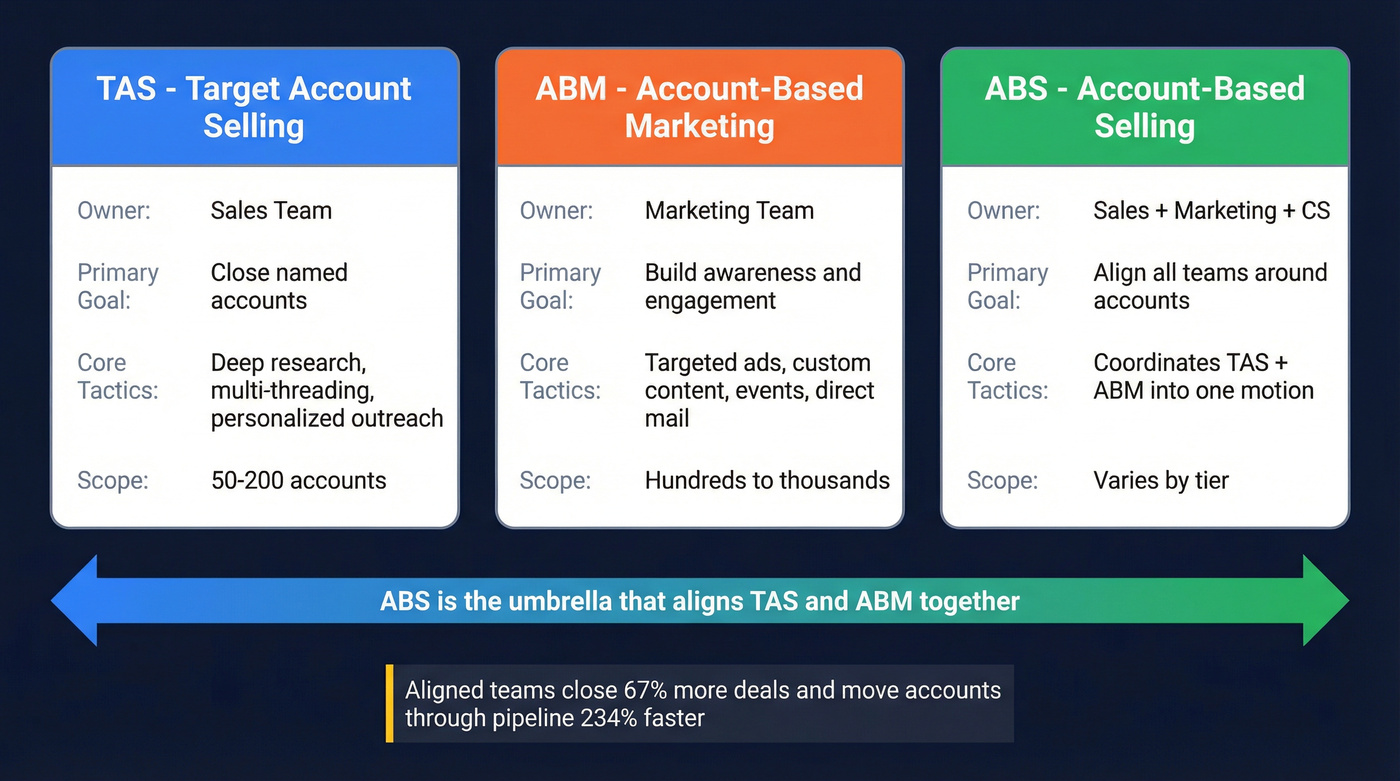
| TAS | ABM | ABS | |
|---|---|---|---|
| Owner | Sales | Marketing | Sales (with marketing + CS aligned) |
| Focus | Close named accounts | Create awareness + engagement | Umbrella strategy |
| Tactics | Research, multi-thread, close | Ads, content, events, direct mail | Aligns TAS + ABM |
TAS is sales execution. ABM is marketing air cover. An account-based selling system is the umbrella aligning both.
The gap between "we do ABM" and "we're actually aligned" is where most programs stall. 71% of companies claim an ABM strategy, but only 36% have tight sales-marketing alignment. When teams do align, accounts move through pipeline 234% faster per Forrester benchmarks, and aligned teams close 67% more deals on average.
Score and Tier Your Accounts
This is the centerpiece. Most TAS guides hand-wave at "pick your best accounts." Here's the actual math.
Gut-feel account selection is the #1 reason targeted account selling fails. We've seen teams waste entire quarters on accounts that were never going to buy because someone "had a feeling." Let's kill that instinct with a scoring model.
Weighted ICP Scorecard
| Criteria | Weight | What to Measure |
|---|---|---|
| Revenue / company size | 20% | Fits your sweet spot (e.g., $10M-$500M ARR) |
| Industry fit | 15% | Vertical alignment with your strongest case studies |
| Tech stack | 15% | Uses complementary tools you integrate with |
| Buying signals | 20% | Intent data, job posts, funding rounds |
| Relationship depth | 15% | Existing contacts, past conversations, warm intros |
| Competitive landscape | 15% | Incumbent vulnerability, contract renewal timing |
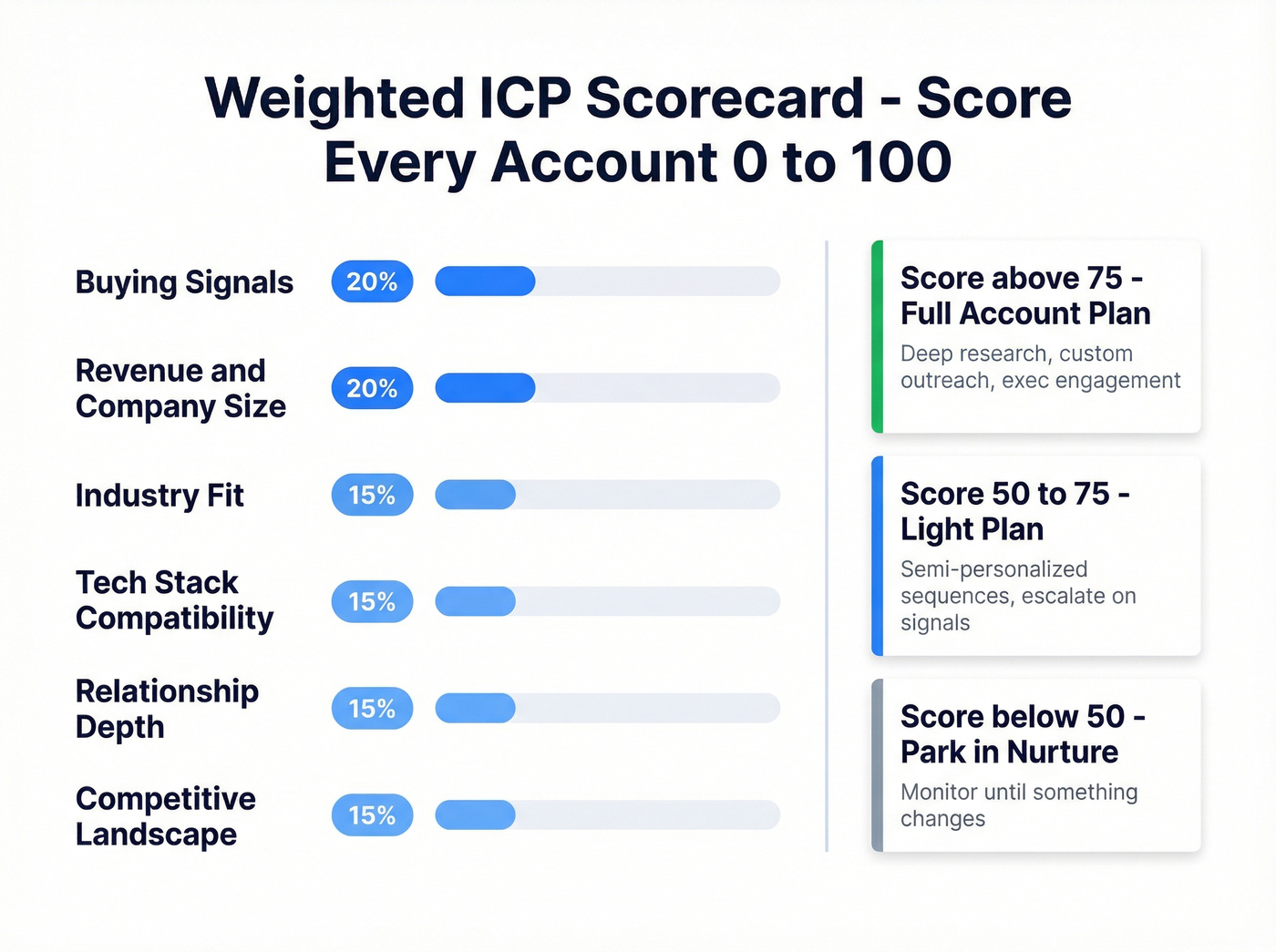
Score each account 0-100, then apply cutoffs:
- >75: Full account plan - deep research, custom outreach, executive engagement
- 50-75: Light plan - semi-personalized sequences, escalate when signals fire
- <50: Park in nurture until something changes
Tiering and Share-of-Wallet
- Tier 1 (5-10 accounts per rep, quarterly): Full plans with stakeholder maps, custom content, executive sponsorship
- Tier 2 (15-25 accounts, semi-annually): Abbreviated plans with signal-triggered escalation
- Tier 3 (signal-triggered only): Monitor intent data and job changes - engage only when buying signals fire
For existing customers, layer in a share-of-wallet model. Rank accounts by potential spending minus current revenue. In our experience, your best expansion targets are hiding in your existing book - not in net-new prospecting lists. A customer spending $40K against a $200K potential is a better Tier 1 candidate than most cold accounts.
Research Accounts Deeply
Here's where most TAS programs fall apart. Reps pick great accounts, then send the same generic sequence they'd send to anyone.
Deep research covers four areas:
Company intelligence - financials, strategy, org changes. Market context - industry trends, regulatory shifts affecting the buyer's world. Competitive positioning - incumbent tools, contract timing, known pain points with current vendors. Primary research - actual conversations with people inside or adjacent to the account, not just desk research.
B2B deals involve 5-11 stakeholders per Gartner. You need to identify and research each one. By 2027, 95% of seller research workflows will start with AI - up from 20% in 2024.
But TAS lives or dies on data quality. Roughly 30-40% of B2B contact data decays annually - people change jobs, get promoted, switch emails. If a third of your buying committee contacts bounce, your personalized outreach is dead on arrival. Prospeo's 7-day refresh cycle and 98% email accuracy mean when you map 8 stakeholders, you can actually reach them. Teams like Snyk cut bounce rates from 35-40% to under 5% after switching - the kind of data hygiene that makes or breaks a named-account program.


TAS programs fail when a third of your buying committee contacts bounce. Prospeo refreshes 300M+ profiles every 7 days - not every 6 weeks - so your stakeholder maps stay accurate. Layer 30+ filters including buyer intent, technographics, and headcount growth to score and tier accounts with real signals, not gut feel.
Map 8 stakeholders and actually reach all 8. At $0.01 per email.
Map the Buying Committee
Winning deals have at least three buyer participants in meetings per Gong's research. You need more than three mapped. You need all of them.
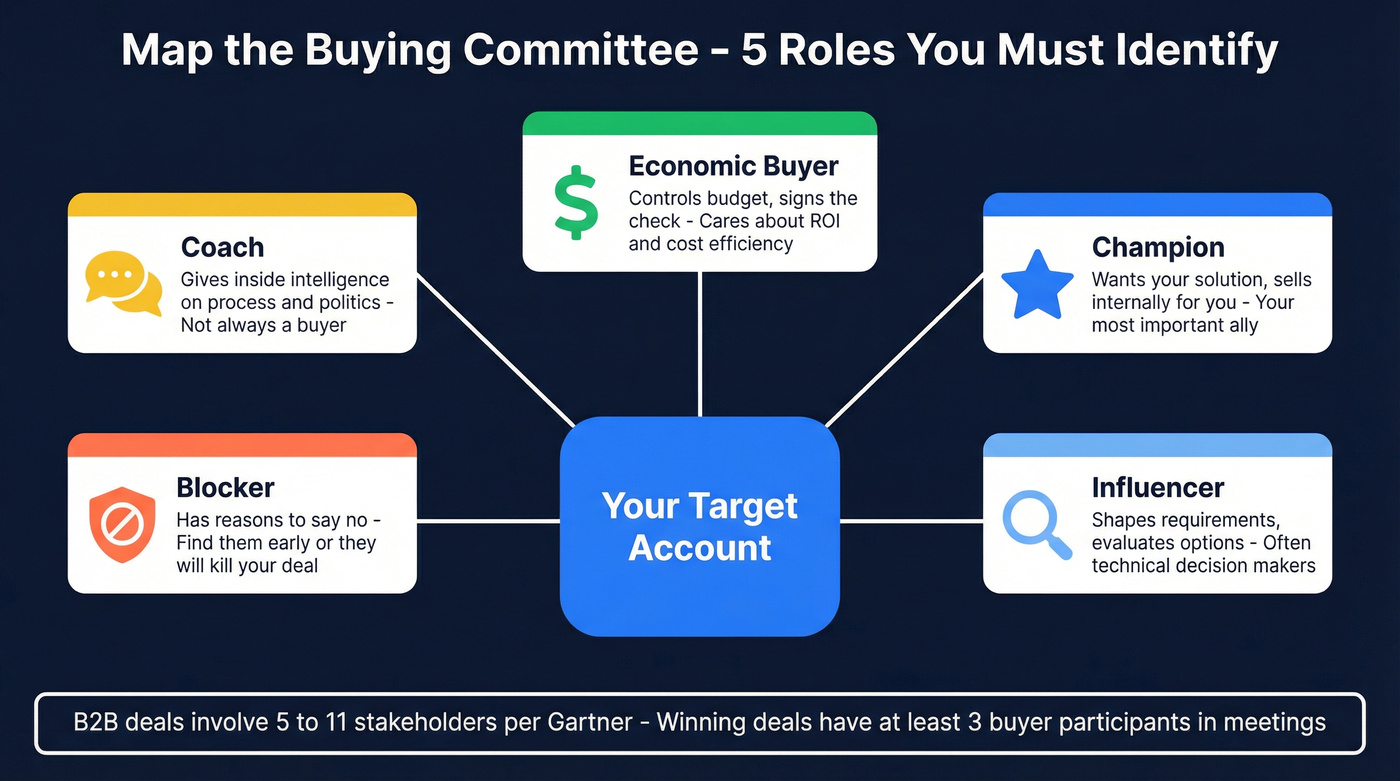
For every Tier 1 account, identify these roles:
- Economic buyer - controls budget, signs the check
- Champion - wants your solution, sells internally for you
- Influencer - shapes requirements, evaluates options
- Blocker - has reasons to say no (find them early)
- Coach - gives inside intelligence on process and politics
Here's the thing: the CFO cares about cost efficiency and ROI timelines. The CTO cares about scalability and integration complexity. Sending the same deck to both is a waste of everyone's time. Each stakeholder needs messaging that speaks to their specific anxieties and goals, which is why the research phase can't be shortcut.
Execute Personalized Outreach
Personalization matters: 74% of B2B buyers expect personalized insights, and 78% buy from vendors who deliver them. Generic outreach doesn't just underperform - it actively damages your credibility with accounts you've spent weeks researching.
Gong's data makes this tactical: stating the reason for your call increases cold-call success by 2.1x. The optimal talk-to-listen ratio on a first call is 55:45. Aim for 11-14 questions per discovery call. Go multi-channel - email alone won't cut it. Layer in calls, social touches, and direct mail for Tier 1 accounts. One of our team's favorite plays: send a short Loom video referencing something specific from the account's latest earnings call or product launch, then follow up with a phone call the next morning.
Stacking TAS With Deal Frameworks
TAS picks the accounts. MEDDIC qualifies the deals. SPIN runs the discovery calls. Challenger frames the narrative. They're complementary layers, not competitors.
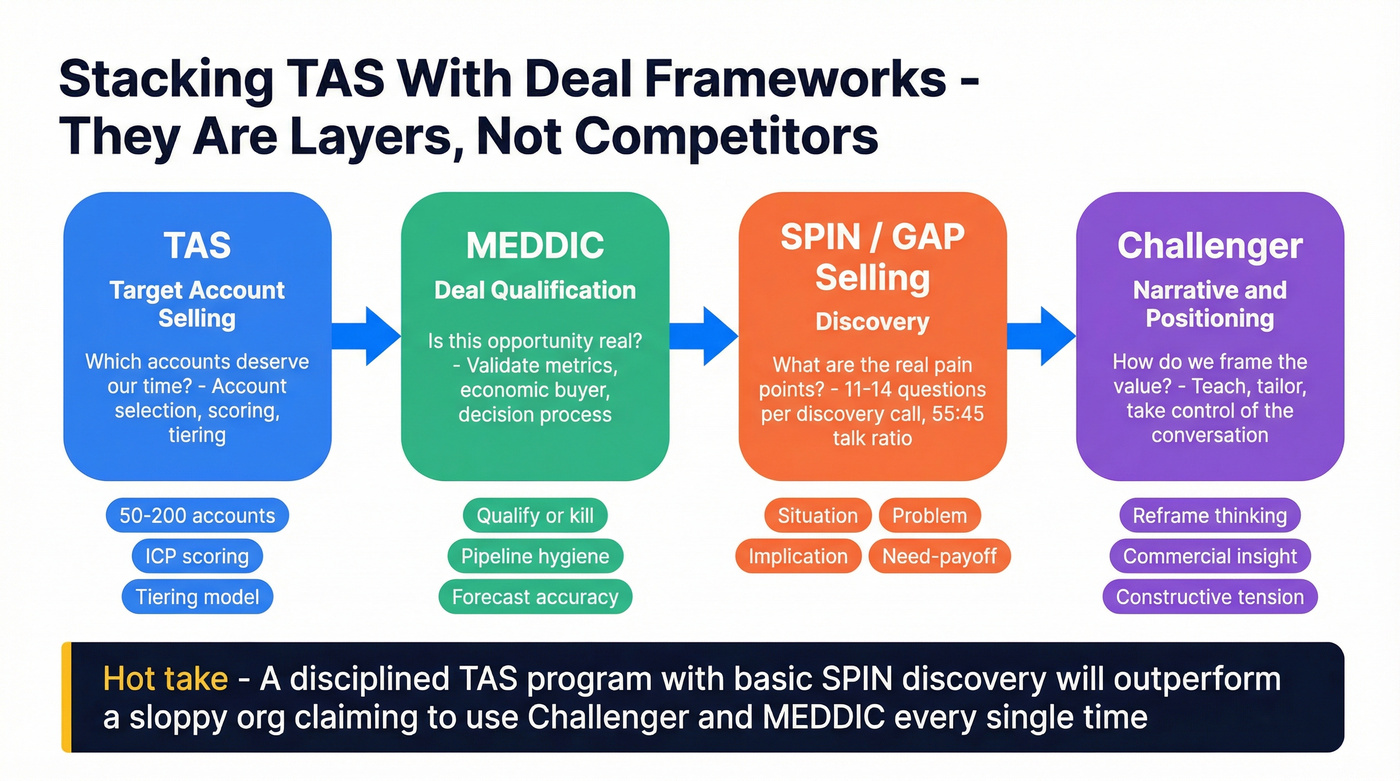
TAS answers "which accounts deserve our time?" Once inside an account, you need deal execution frameworks like MEDDIC to validate the opportunity, SPIN or GAP Selling for discovery, and Challenger to position value. Trying to use TAS for everything is like using a telescope as a microscope - wrong tool, wrong job.
Hot take: Most teams don't need a more sophisticated methodology. They need to actually do the scoring and research work on fewer accounts. A disciplined TAS program with basic SPIN discovery will outperform a sloppy "we use Challenger and MEDDIC" org every single time.
Where Targeted Account Selling Fails
The failure modes are consistent, and fewer than 20% of companies have fully embedded account planning into operations. The other 80% are doing TAS theater - naming accounts without doing the work.
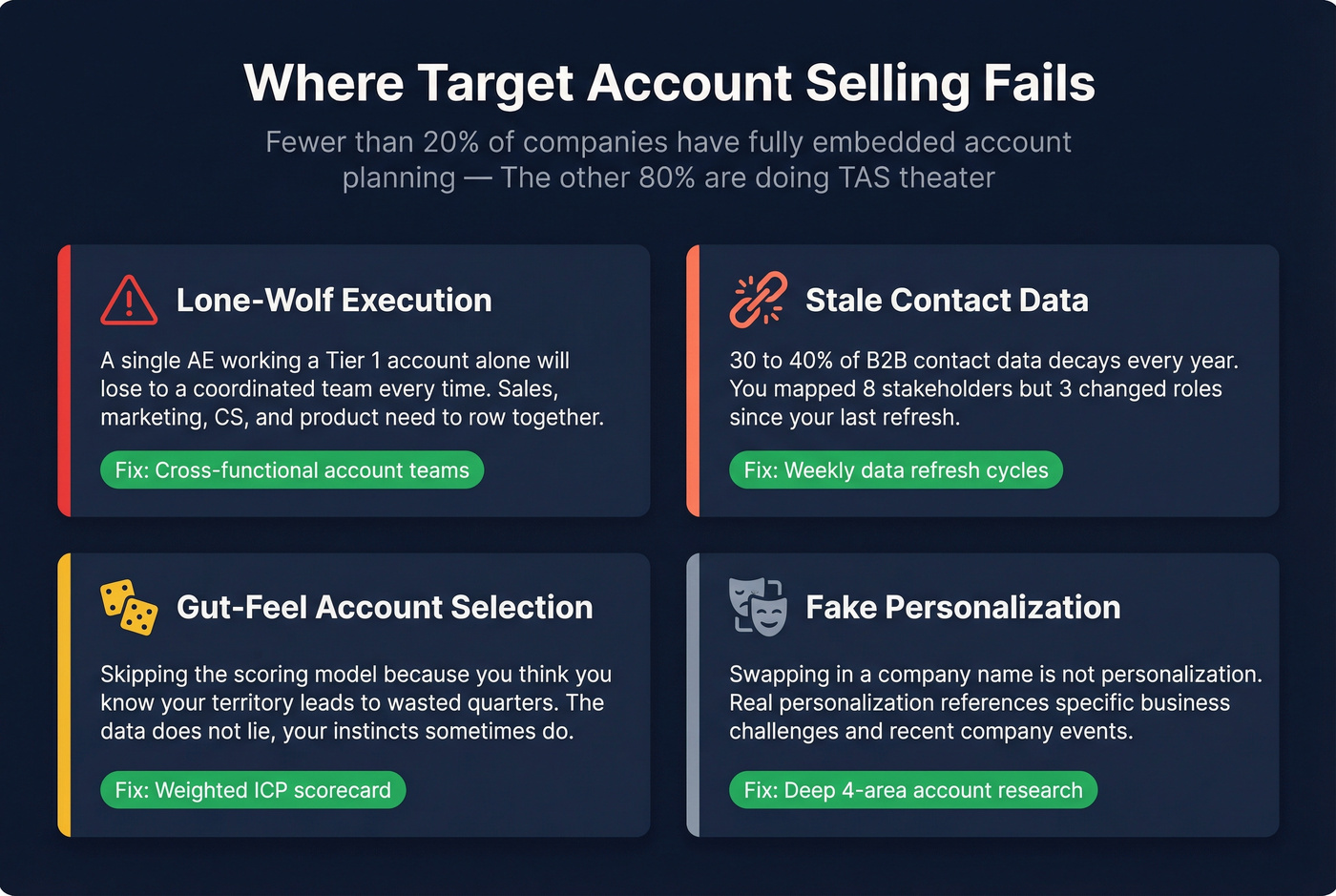
Lone-wolf execution. A proper account-based selling system requires cross-functional alignment. A single AE working a Tier 1 account alone will lose to a coordinated team every time. Sales, marketing, CS, and sometimes product need to be rowing in the same direction.
Stale contact data. You mapped 8 stakeholders, but 3 changed roles since your last refresh. Your "personalized" email goes to someone who left four months ago. This is why a data platform with weekly refresh cycles matters more than one with a bigger database that's six weeks stale.
Gut-feel account selection. Skipping the scoring model because "I know my territory" leads to wasted quarters. We've watched it happen dozens of times. The data doesn't lie; your instincts sometimes do.
Fake personalization. Swapping in a company name isn't personalization. Real personalization references specific business challenges, recent company events, and stakeholder priorities that you couldn't know without doing the homework.
Let's be honest: the target account selling methodology isn't complicated in theory. The hard part is discipline - doing the research, maintaining the data, and resisting the urge to chase every inbound lead that doesn't fit your target list. Skip this methodology entirely if your average deal size is under $10K; the research investment won't pay off at that price point, and you're better served by a high-velocity model.
Snyk's 50 AEs cut bounce rates from 35-40% to under 5% and generated 200+ new opportunities per month. When your named-account outreach lands in inboxes instead of bouncing, personalized multi-threading actually works. Prospeo's 98% verified emails and 125M+ direct dials give your Tier 1 accounts the data quality they demand.
Stop researching accounts you can't reach. Get verified contact data now.
FAQ
How many accounts should a TAS program target?
Start with 50-100 Tier 1 accounts for a team of 5-10 AEs. Deep research doesn't scale to 500 accounts simultaneously - 10-20 per rep is the realistic ceiling for full-plan execution. Expand your list only after proving consistent win rates on the initial set.
Is TAS the same as ABM?
No. TAS is sales execution - reps research, multi-thread, and close named accounts. ABM is marketing strategy - targeted ads, content, and events aimed at the same accounts. Combining both accelerates deal velocity by up to 234% per Forrester benchmarks.
How long before TAS produces pipeline impact?
Expect 1-2 quarters for measurable results. Enterprise deal cycles run 6-18 months, so this is a long game. Early wins show up in better win rates and larger deal sizes before total pipeline volume catches up.
What tools support a TAS workflow?
You need a data platform for account scoring and contact discovery, a CRM for account plans, and intent data for signal monitoring. Layer in your CRM and an outreach tool for execution, and make sure whatever data source you pick refreshes frequently enough that your stakeholder maps don't go stale mid-cycle.