How to Choose a Sales Engagement Platform (Without Wasting $2,340/Rep/Year)
84% of sales reps missed quota last year. The instinct is to buy more software - another sequencer, another dialer, another dashboard nobody opens after week two. The average B2B sales team already runs 8.3 tools costing $187/rep/month, and 73% of those teams report overlap waste adding another $2,340/rep/year on top. Knowing how to choose a sales engagement platform means ignoring the feature matrix and focusing on three things: your data quality, your actual sales motion, and whether your reps will use the thing 30 days from now.
The Quick Version
Your SDR manager pulls up last month's sequence report - 18% bounce rate, half the team back in Gmail, and finance asking why you're paying six figures for a platform nobody uses. Sound familiar?
The fix isn't comparing 15 platforms and picking the one with the longest feature list. It's three steps: fix your data quality first, match the platform to your sales motion and team size, then run a structured 30-day pilot. Everything below walks through each step with real pricing, benchmarks, and a decision framework you can use as a sales engagement evaluation checklist.
What a Sales Engagement Platform Actually Does
A sales engagement platform (SEP) automates and sequences your outbound touchpoints - emails, calls, social touches, and follow-ups that turn prospects into pipeline. It's not a CRM. Your CRM stores deal data and tracks revenue. An SEP sits on top of it, giving reps a structured workflow for actually reaching buyers.
The category is evolving fast. Forrester's newer framing is "revenue orchestration platforms," where engagement gets bundled with conversation intelligence, deal workflows, and forecasting. For most teams under 100 reps, the core engagement functionality is still what matters:
- Sequencing - automated multi-step cadences across email, phone, and social
- Multichannel coordination - managing touches across channels in a single workflow
- Analytics - reply rates, open rates, meeting conversion, sequence performance
- CRM sync - logging activities back to Salesforce, HubSpot, or whatever you're running
Here's what SEPs don't solve: bad data, bad messaging, and no ICP definition. You can build the most sophisticated 14-step sequence in the world, and it won't matter if your emails bounce or you're targeting the wrong personas. That's the part most buying guides skip - and it's the part that actually determines whether your SEP investment pays off.
With 80% of B2B sales interactions now happening through digital channels, your SEP is the primary interface between your reps and your buyers. Getting this choice wrong doesn't just waste budget. It stalls pipeline for a quarter.
Fix Your Data Before You Buy Anything
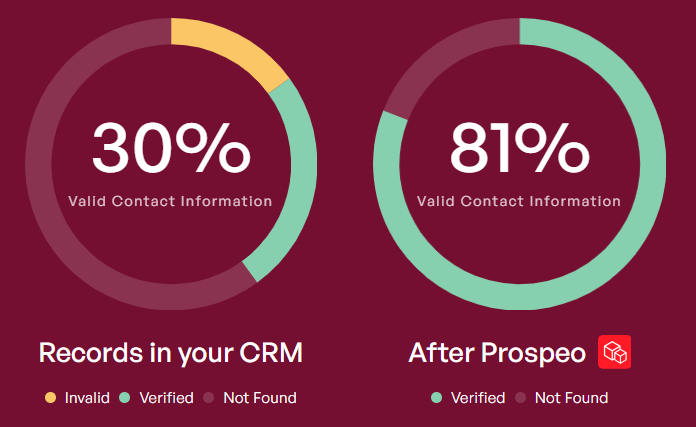
Contact data loses roughly 30% of its accuracy within a year. People change jobs, companies get acquired, email domains rotate. If you're feeding stale data into a shiny new engagement platform, you're automating failure at scale.
The smartest framework we've seen is "intelligence before engagement." Teams that build a strong data foundation first see 3-5x better ROI on their engagement spend, plus 43% higher win rates and 37% faster sales cycles. That's not marginal - it's the difference between a platform that pays for itself in Q1 and one that gets shelved by Q3.
This is the Step 0 most teams skip. A dedicated verification layer with 98% email accuracy on a 7-day refresh cycle - compared to the 6-week industry average - keeps deliverability healthy and prevents your sequences from burning your domain reputation. Meritt saw their bounce rate drop from 35% to under 4% after fixing their data layer, and pipeline tripled from $100K to $300K per week.


You just read that 30% of contact data goes stale every year. Prospeo refreshes every 7 days - not the 6-week industry average. With 98% email accuracy and 5-step verification, your sequences hit real inboxes instead of burning your domain.
Fix Step 0 before you spend six figures on a sequencer.
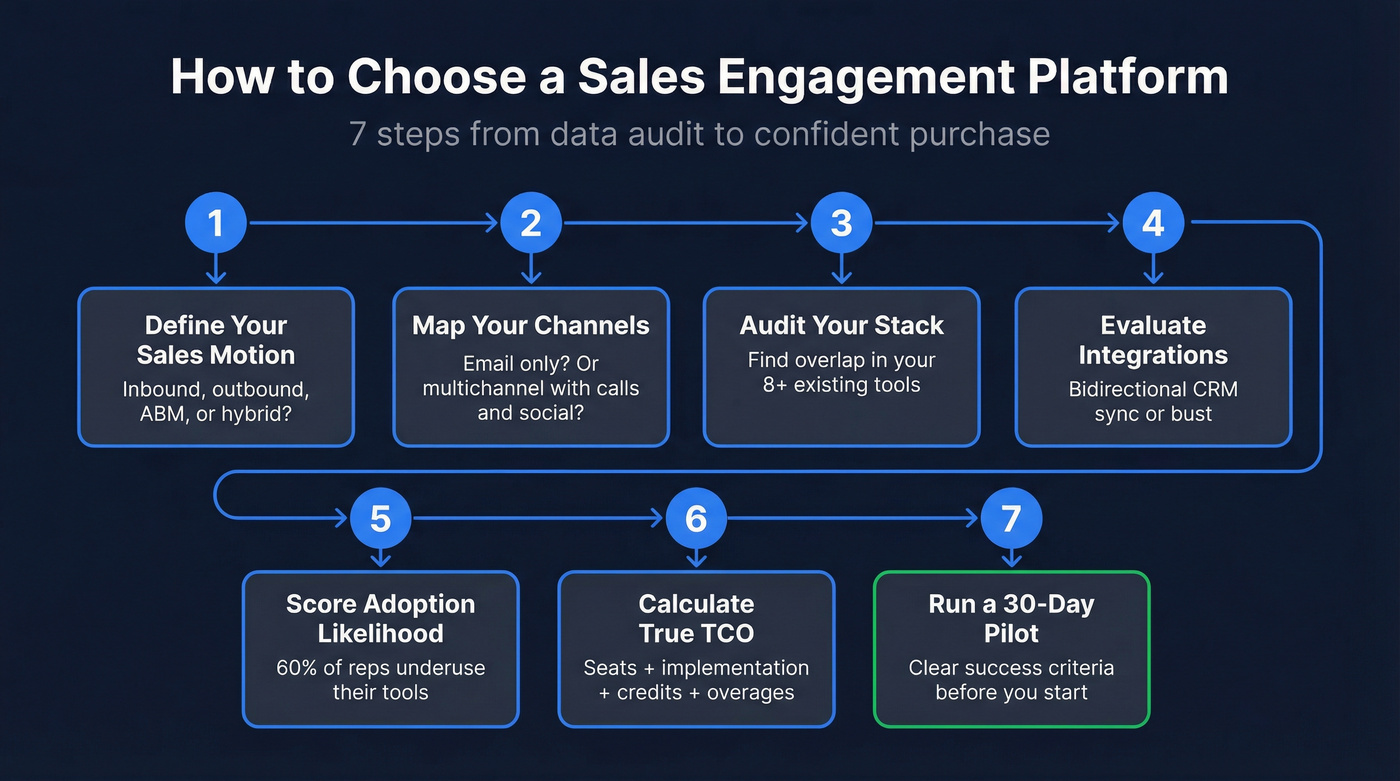
7-Step Framework for Selecting the Right SEP
1. Define Your Sales Motion
An inbound-heavy team processing MQLs needs a different tool than an outbound squad cold-calling 200 accounts a week. ABM teams running coordinated plays across multiple stakeholders per account need yet another thing entirely. Before you open a single vendor's pricing page, write down your primary motion: inbound, outbound, ABM, or hybrid. This single decision eliminates half the market immediately.
2. Map Your Channel Requirements
Multichannel sequences - email plus social touches, for instance - can drive 3.5x higher response rates compared to email-only cadences. That tracks with how buyers actually behave: the average B2B buyer now uses roughly 10 interaction channels during their purchasing journey, up from 5 in 2016.
If your reps only need email sequences, Mailshake or Instantly works fine. If they need integrated dialing, social steps, and SMS, you're looking at Salesloft, Outreach, or Apollo.
3. Audit Your Current Stack
The average team is already running 8.3 tools, and 68% of sales leaders struggle with overlap and data silos. Before adding another platform, map what you already have. Do you have a dialer? A separate email tool? A data provider? An SEP should consolidate, not add to the sprawl. If you're spending $187/rep/month across your stack, figure out which tools the new SEP replaces - and actually cancel them.
If you want a baseline for what “lean” looks like, compare your stack against a modern B2B sales stack blueprint.
4. Evaluate Integration Depth
Not all CRM integrations are equal. You need to ask whether the sync is bidirectional or one-way, whether activity logging happens in real time or in batches, and whether field mapping is automatic or requires manual configuration. A "Salesforce integration" that dumps activities into a generic notes field is worthless compared to one that maps each touchpoint to the right object with custom fields intact.
Teams with a strong data foundation report 64% fewer integration issues. The CRM sync you're evaluating is only as good as the data governance underneath it - especially basic CRM hygiene.
5. Score on Adoption Likelihood
Here's the uncomfortable truth: roughly 60% of B2B professionals don't use their automation tools to full potential. We've watched teams where finance asks why 8 of 12 reps went back to Gmail three months after a six-figure platform purchase. The industry average time-to-value for an SEP is 28 days. Top performers hit it in 15. Tools with time-to-value under 14 days see 92% one-year retention versus 67% for slower ones.
Pick the tool your reps will actually use, not the one with the longest feature list.
6. Calculate True TCO
Seats x monthly price is the starting point, not the total. Add implementation fees ($1,000-$8,000 depending on the vendor and your CRM complexity), overage charges on credits or sends, and the admin overhead of someone managing the platform.
Apollo charges 1 credit per business email and 8 credits per mobile number, with extras at $0.20 each - credits that expire monthly. Outreach and Salesloft require custom quotes, which usually means annual contracts. Get the full number before you sign.
If you want to sanity-check your assumptions, run the numbers against typical cost of sales tech stack benchmarks.
7. Run a Structured Pilot
Thirty days minimum. Measure adoption rate (what percentage of reps are actually using it daily), reply rate, meetings booked, and deliverability. Don't evaluate in week one - reps need time to build sequences, warm up sending domains, and develop muscle memory.
The teams that kill pilots early because "the numbers don't look good yet" are the same teams that churn through three platforms in two years. Give it the full 30 days with clear success criteria defined upfront.
If your pilot is email-heavy, make sure you’re also tracking email deliverability so you don’t confuse “tool performance” with inboxing issues.
Real SEP Pricing for 2026
The fact that Outreach and Salesloft still won't publish pricing is frustrating - so here's the ballpark based on what teams actually pay:
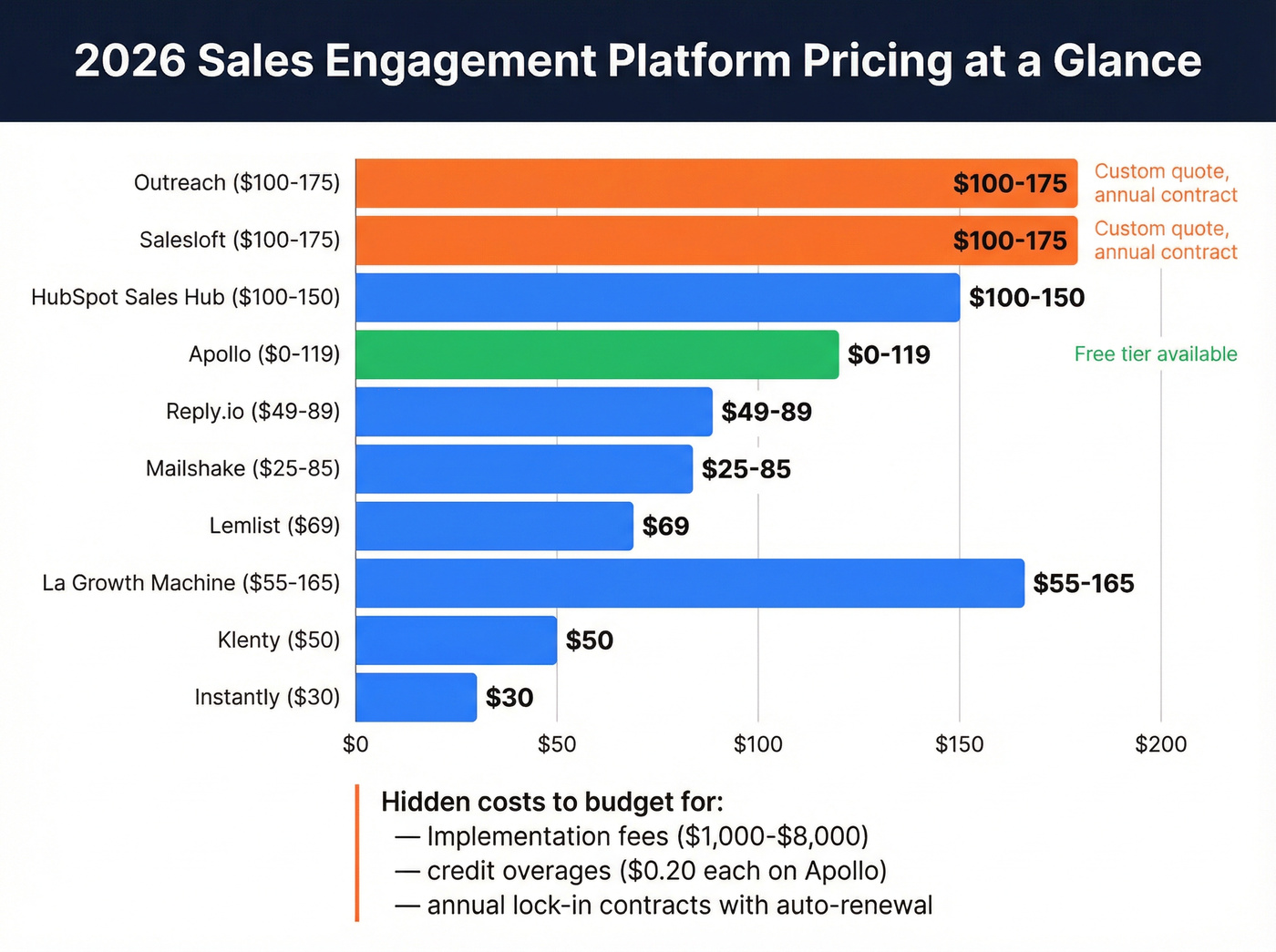
| Platform | Starting Price | Top Tier | Notes |
|---|---|---|---|
| Outreach | ~$100-$175/user/mo | ~$100-$175/user/mo | Custom quote, annual |
| Salesloft | ~$100-$175/user/mo | ~$100-$175/user/mo | Custom quote, annual |
| Apollo | Free | $119/user/mo | Plans at Free/$49/$79/$119 |
| HubSpot Sales Hub | $100/user/mo (Pro) | $150/user/mo | Best if already on HubSpot CRM |
| Reply.io | $49/user/mo | $89/user/mo | AI SDR from $800/mo |
| Mailshake | $25/user/mo | $85/user/mo | Annual billing |
| Lemlist | $69/user/mo | Not public | Per-user pricing |
| Instantly | ~$30/1K contacts | Not public | Volume-based |
| La Growth Machine | ~$55/mo | ~$165/mo | Per identity |
| Klenty | ~$50/user/mo | Not public | Scales with features |
| Salesforce Sales Engagement | $50/user/mo | Not public | Needs Sales Cloud |
Beyond the sticker price, budget $1,000-$8,000 for implementation on enterprise platforms. Credit overages on tools like Apollo add up fast if you're pulling mobile numbers at scale. Annual contracts with Outreach or Salesloft lock you in for 12 months with auto-renewal clauses - read the fine print. "Call for a quote" really means "prepare to negotiate."
5 Mistakes That Kill Your SEP Investment
Buying engagement before intelligence. The most common mistake is automating outreach before your data is clean. If your contact list is 30% decayed, you're paying to send sequences into the void. Verify your list before it hits a sequence - even a free verification tier catches the worst offenders.
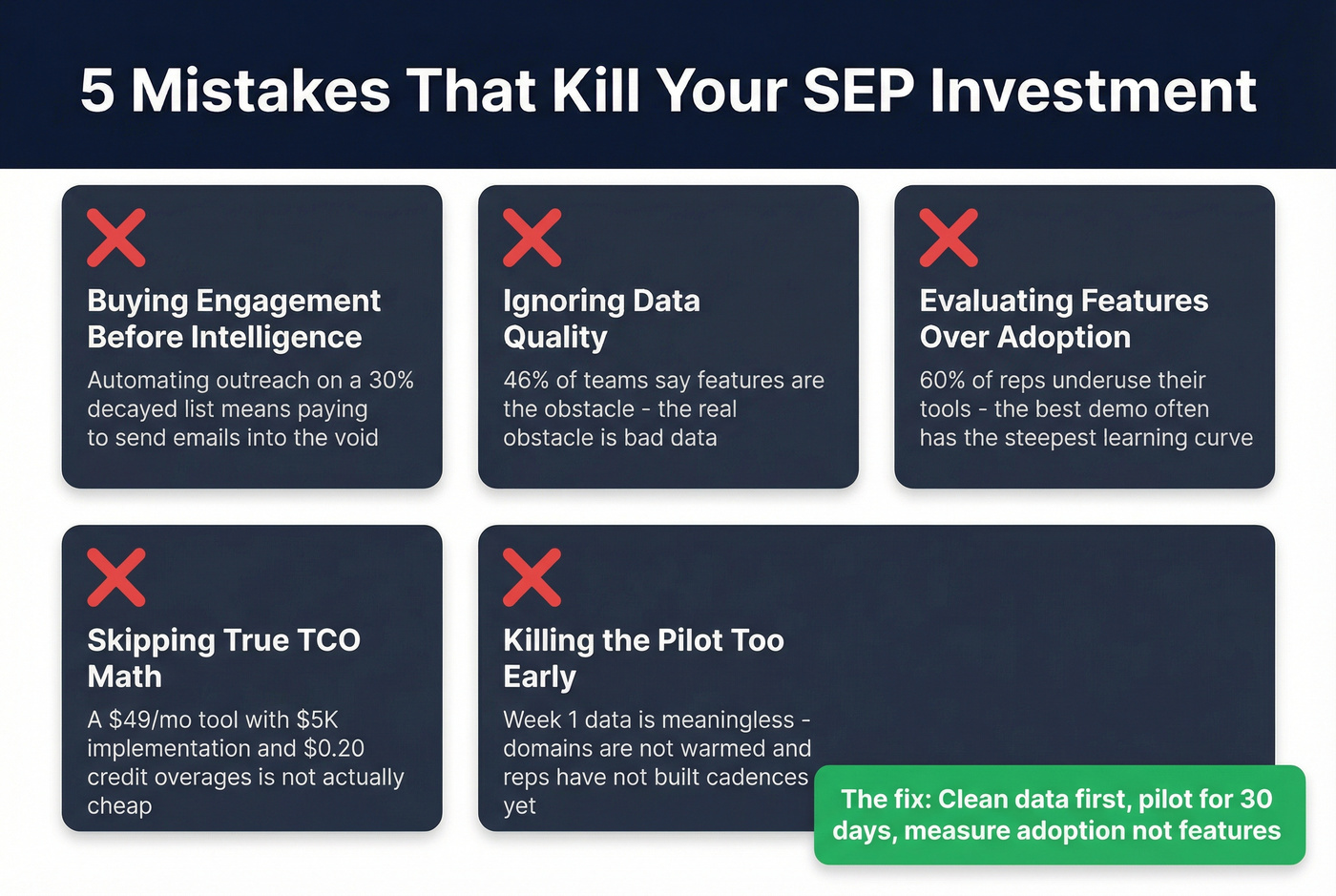
Ignoring data quality entirely. Surveys show 45.9% of companies cite "finding the right features" as their biggest obstacle when evaluating SEPs. The real obstacle is data. A platform with every feature imaginable still fails when bounce rates run high.
If you’re seeing bounces, start by diagnosing whether they’re hard bounce issues or list quality issues.
Evaluating on features instead of adoption. That 60% underutilization stat isn't a fluke. The platform with the best demo often has the steepest learning curve. Ask vendors for their average time-to-value and first-month adoption rates. If they can't answer, that tells you something.
Not calculating total cost of ownership. A $49/user/month tool that charges $0.20 per extra credit and requires a $5,000 implementation isn't actually cheap. Run the full math for your team size and expected usage before signing anything.
Skipping the pilot - or evaluating it too early. Sequence performance in week one is meaningless. Domains aren't warmed, reps haven't built cadences, and your A/B tests have no statistical significance. Give it 30 days with clear success criteria defined upfront. The teams that follow a disciplined process consistently end up with higher adoption and faster time-to-value.
Which SEP Fits Your Team?
Under 20 reps, outbound-heavy: Apollo, Instantly, or Mailshake. You need speed, simplicity, and a price point that doesn't require board approval. Apollo's free tier lets you test before committing. Instantly is the cheapest path to high-volume email. Mailshake sits in between with solid email plus basic phone.
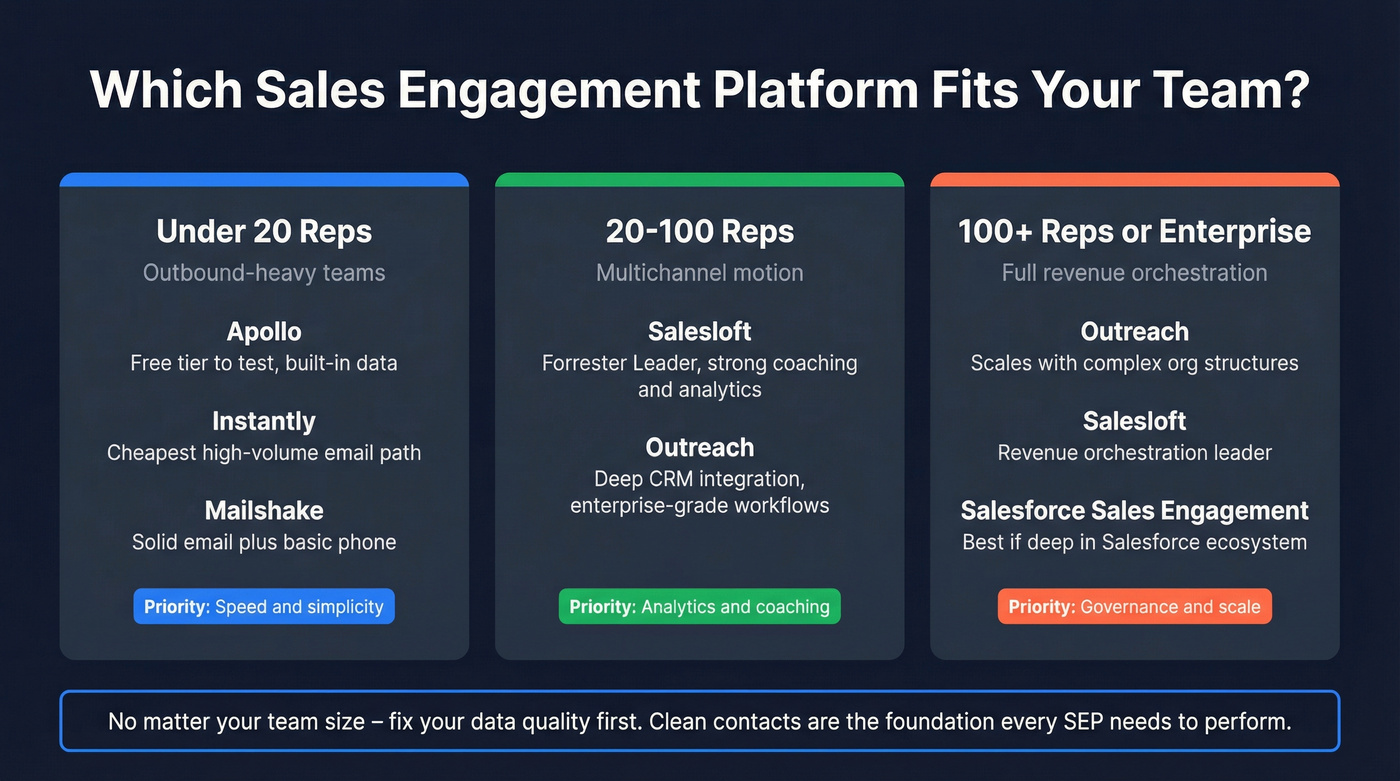
20-100 reps, multichannel: Salesloft or Outreach. At this scale, you need strong analytics, coaching features, and deep CRM integration. Salesloft was named a Leader in Forrester's inaugural Revenue Orchestration Platforms Wave - that matters for enterprise buyers who need analyst validation. Outreach is a common choice for Salesforce-heavy teams.
Any size, already on HubSpot: HubSpot Sales Hub. The native CRM integration is unbeatable if you're already running HubSpot for marketing and deals. Adding a third-party SEP on top of HubSpot creates the exact data silo problem you're trying to avoid.
Let's be honest about something the consensus on r/sales keeps reinforcing: 72% of enterprise sales orgs prefer platform approaches over point solutions, but most teams under 50 reps don't need an all-in-one platform. They need clean data, a simple sequencer, and reps who actually follow up. If your average deal size is under $15K, a $100+/user/month enterprise SEP is overkill - start with Apollo or Instantly and invest the savings in better contact data through a provider like Prospeo. At this stage, prioritize simplicity and deliverability over feature depth.
If you’re building the outbound motion from scratch, use a repeatable prospecting workflow so the SEP supports the process (not the other way around).
Skip the enterprise platforms entirely if you don't have dedicated RevOps support. The most common complaint about Outreach and Salesloft is that you need a full-time admin just to keep sequences running. If that sounds like your situation, start simpler and scale up when your team and deal sizes justify the complexity.
Meritt tripled pipeline from $100K to $300K/week and cut bounce rates from 35% to under 4% - before changing their engagement platform. The difference was a data layer with 98% accuracy at $0.01/email, no annual contract required.
Stop automating failure. Start with data your SEP deserves.
FAQ
What's the difference between a sales engagement platform and a CRM?
A CRM stores customer data and tracks deals through the pipeline. An SEP automates the outreach that creates those deals - sequences, multichannel touchpoints, and follow-up cadences. Most teams need both working together via bidirectional sync.
How long does it take to see ROI from an SEP?
Industry average time-to-value is 28 days; top performers hit it in 15. Tools with time-to-value under 14 days see 92% one-year retention versus 67% for slower ones. Plan your pilot around the 30-day mark for a realistic read.
Do I need a separate data provider alongside my SEP?
Most SEPs include some contact data, but accuracy varies wildly - often below 80%. A dedicated verification layer keeps deliverability healthy and prevents your sequences from burning your domain reputation. We've seen teams cut bounce rates from 35%+ to under 5% just by adding a verification step before sequences fire.
How much should I budget for a sales engagement platform?
SMB tools run $25-$85/user/month. Mid-market platforms cost $49-$119/user/month. Enterprise SEPs start at $100+/user/month plus $1,000-$8,000 in implementation fees. Factor in credit overages and admin time for the true total cost of ownership.
What's the best way to evaluate sales engagement tools?
Start by defining your sales motion and channel needs, then audit your existing stack for overlap. Run a structured 30-day pilot measuring adoption rate, reply rate, and meetings booked. In our experience, teams that follow a disciplined process instead of buying off a demo consistently end up with higher adoption and faster time-to-value.