

B2B Cold Email Reply Rates: What the Data Actually Says in 2026
You sent 200 cold emails last week. Three replies came back - two were "please remove me." That's not a broken campaign. That's normal.
And here's what makes it worth continuing: 61% of decision-makers still prefer cold email over LinkedIn messages or cold calls. The channel works. But the gap between vendor promises and real data is wide, and most benchmarks mix warm and cold audiences until the numbers look flattering. We pulled four major datasets to show where B2B cold email reply rates actually sit in 2026 - and the five levers that move them.
The Quick Answer
The average B2B cold email reply rate sits between 3.43% and 5.8% depending on the dataset. Top 10% of campaigns clear 10%+. The biggest lever most teams ignore isn't copywriting - it's data quality and deliverability. If 17% of your emails never reach an inbox, no subject line will save you.
2026 Reply Rate Benchmarks
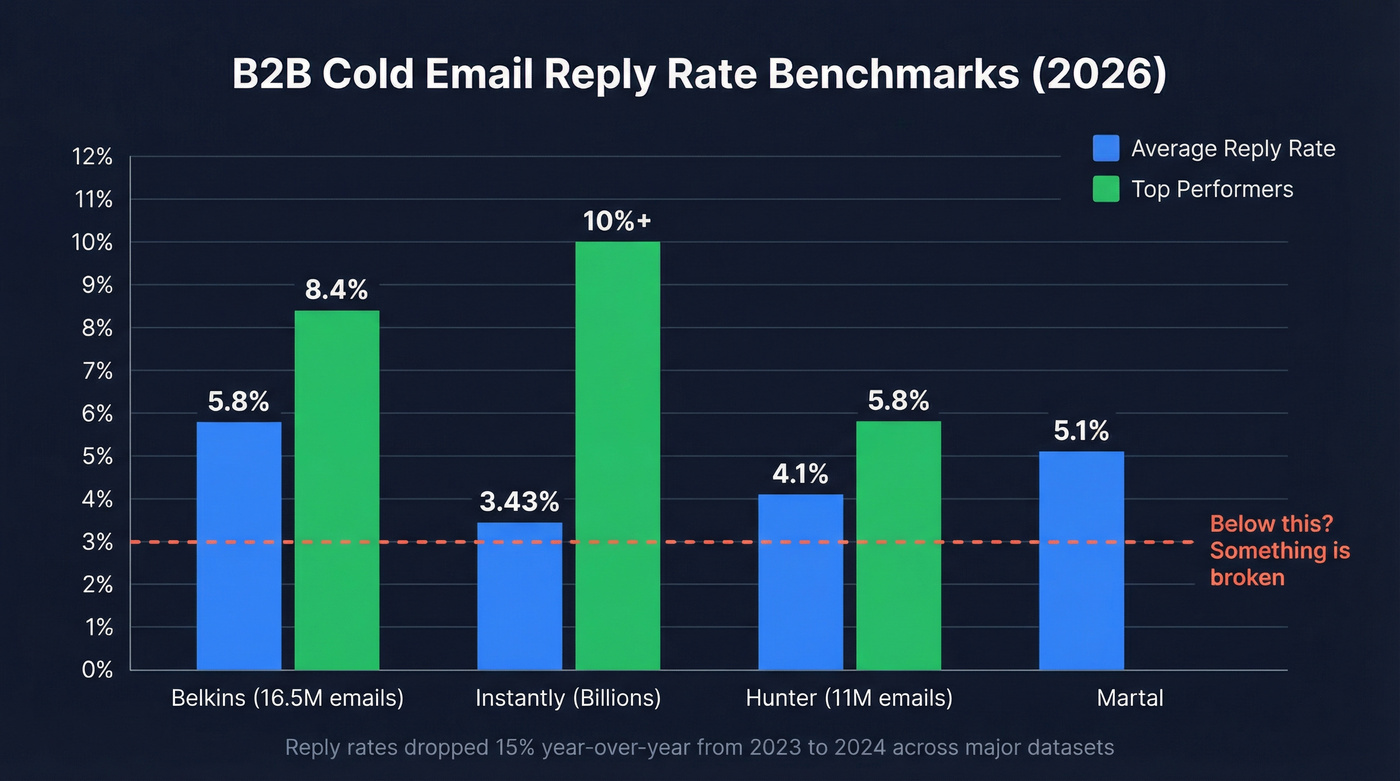
Four major datasets give us solid triangulation. They don't agree perfectly, which is a good sign - they're measuring different slices of reality.
| Source | Dataset | Avg Reply Rate | Top Performers | Year |
|---|---|---|---|---|
| Belkins | 16.5M emails | 5.8% | 8.4% (one-touch) | 2024 |
| Instantly | Billions | 3.43% | 10%+ (top 10%) | 2026 |
| Hunter | 11M emails | 4.1% | 5.8% (under 50 recipients) | 2024 |
| Martal | - | 5.1% | - | 2025 |
Below 3% means something's broken. Between 3-5% is realistic for a competent team at scale. Hitting 5-8% is good. And 10%+ is elite - tight ICPs, small hyper-personalized lists.
The trendline matters too. Reply rates dropped from 6.8% in 2023 to 5.8% in 2024 across the 16.5M-email dataset, a 15% year-over-year decline. Inboxes are more crowded, spam filters are smarter, and decision-makers are more skeptical than they were even 18 months ago.
Peak reply days cluster mid-week. Some datasets show Tuesday-Wednesday as the strongest window, while others show Thursday leading at 6.87%. Net: Tuesday through Thursday is where you want your best sends.
Why Decision-Makers Don't Reply
A survey of 217 decision-makers reveals the hierarchy: 71% cite lack of relevance, 43% say the email feels impersonal, 36% don't trust the sender.
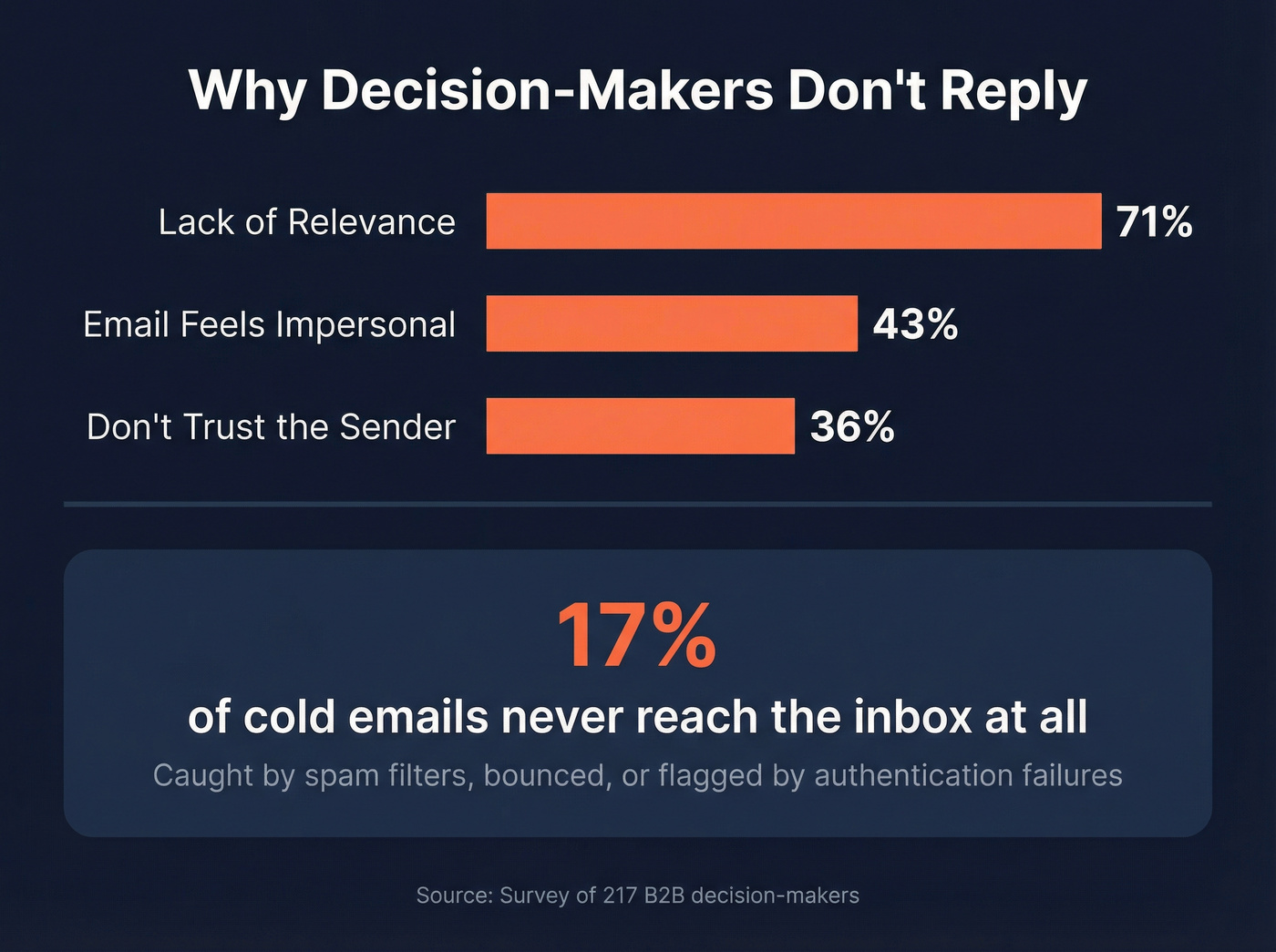
Notice "bad copy" isn't on the list. The problem is almost always upstream of the writing. Meanwhile, about 17% of cold emails never reach the inbox at all - caught by spam filters, bounced by invalid addresses, or flagged by authentication failures. You can't get a reply from someone who never saw your message.

71% of decision-makers ignore cold emails for lack of relevance. But 17% never see your email at all - bounced, spam-filtered, or sent to dead addresses. Prospeo's 98% email accuracy and 7-day data refresh eliminate the biggest silent killer of your reply rates at ~$0.01 per verified contact.
Stop optimizing subject lines for emails that land in spam.
Response Rates by Industry and List Size
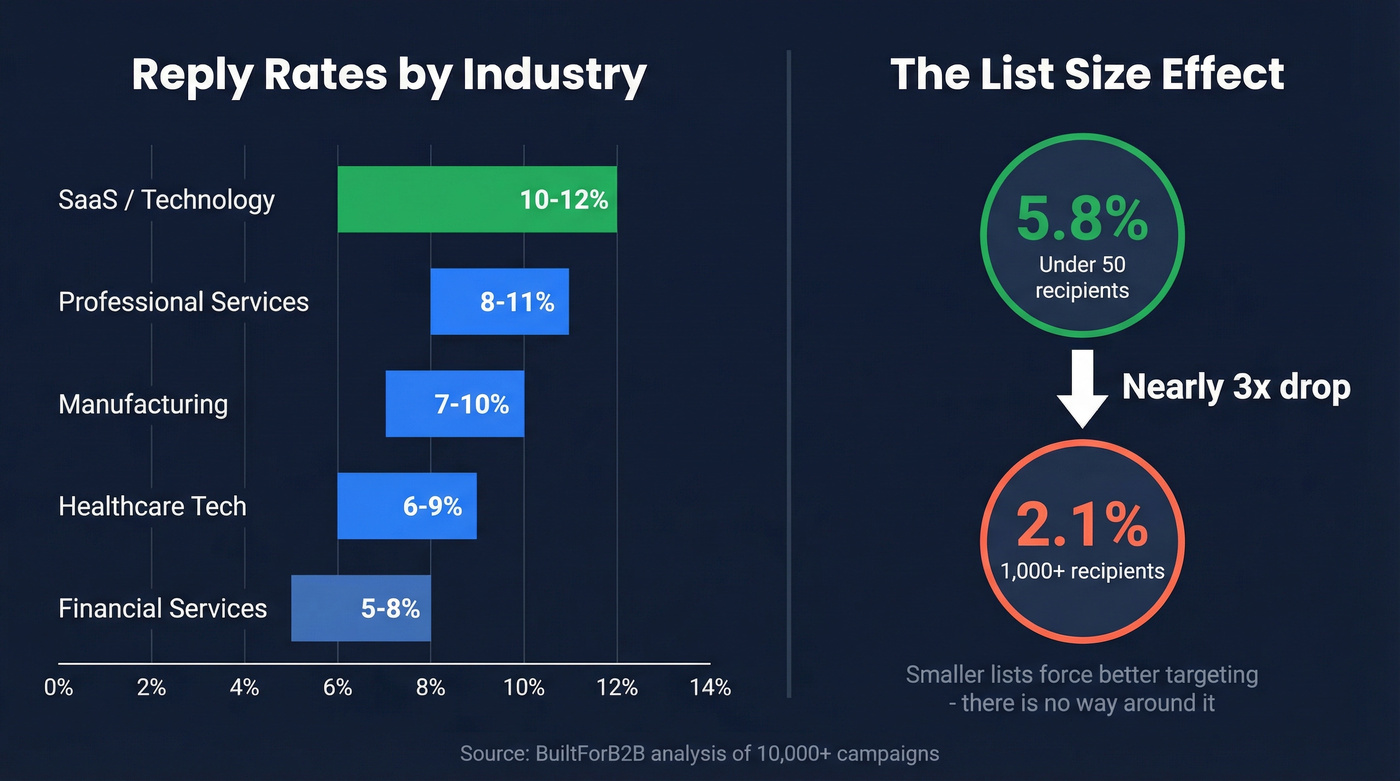
BuiltForB2B analyzed 10,000+ campaigns and found meaningful variation. These are top-performer ranges, not averages:
| Industry | Top-Performer Reply Rate |
|---|---|
| SaaS/Technology | 10-12% |
| Professional Services | 8-11% |
| Manufacturing | 7-10% |
| Healthcare Tech | 6-9% |
| Financial Services | 5-8% |
List size is the more powerful variable. Campaigns targeting 50 or fewer recipients average 5.8%. Scale to 1,000+ and it drops to 2.1%. Smaller lists force better targeting - there's no way around it. If you're trying to improve your cold email response rate, shrinking your list is often more effective than rewriting your copy for the fourth time.
Five Levers That Move Reply Rates
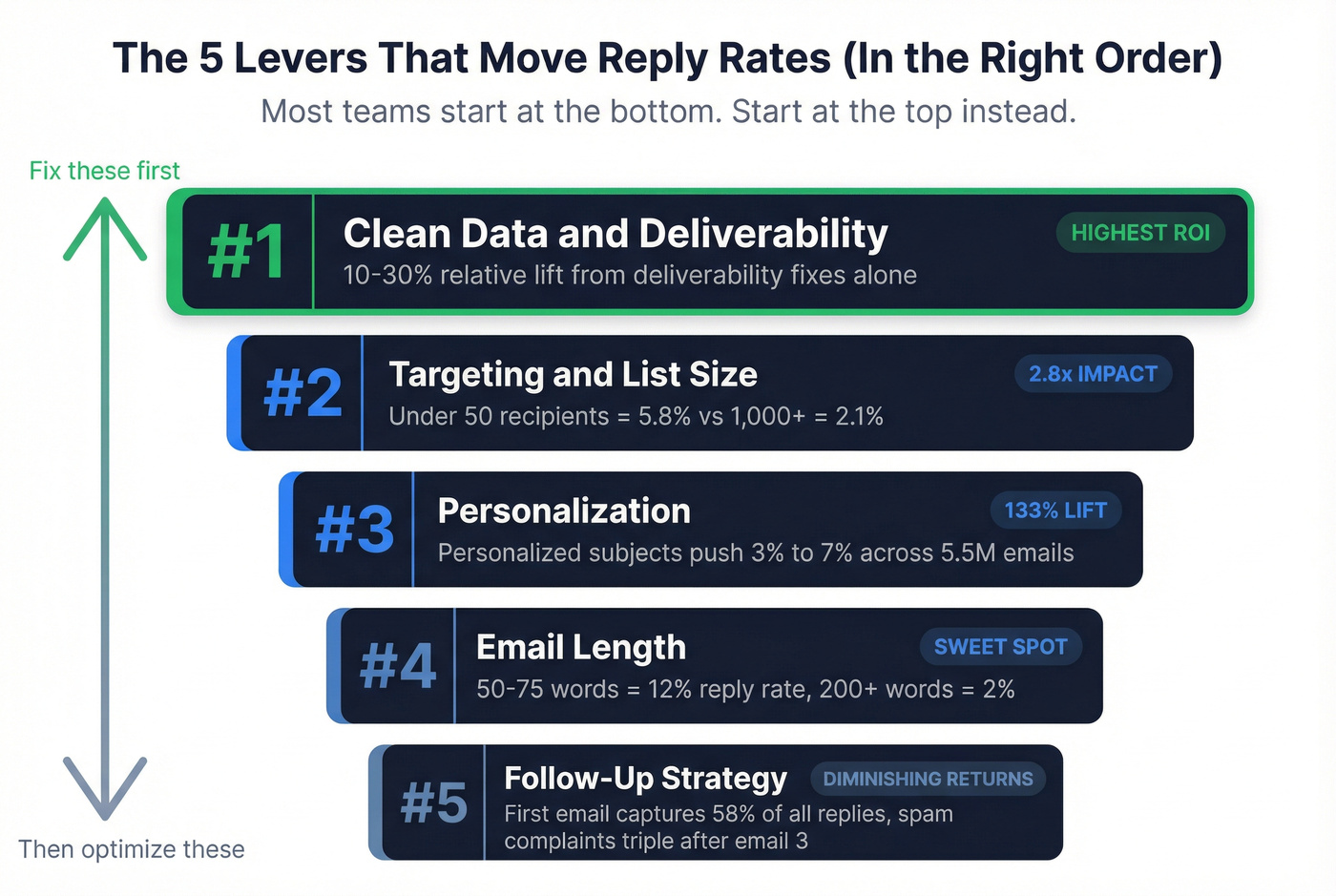
Most guides rank these wrong, starting with subject lines and ending with deliverability. In our experience, the opposite order produces better results.
1. Clean Data and Deliverability
This has the highest ROI and gets skipped most often. Here's the thing: bounced emails trigger ISP penalties, pushing future sends to spam and tanking response rates on emails that were otherwise fine. Set up SPF, DKIM, and DMARC before sending anything. Verify every address. Kill open-tracking pixels - one large-scale test showed they cost roughly 3% in replies. Deliverability fixes alone commonly raise reply rates 10-30% relative.

Prospeo's 98% email accuracy and 7-day refresh cycle handle this at roughly $0.01 per verified email. Meritt cut their bounce rate from 35% to under 4% after switching, and their pipeline tripled from $100K to $300K/week. That's not a copywriting win - that's a data quality win.
2. Targeting and List Size
5.8% reply rate for campaigns under 50 recipients versus 2.1% for 1,000+. Nearly 3x, driven entirely by how well you know who you're emailing. Tight ICPs with intent signals consistently crush broad lists. The consensus on r/sales backs this up - the reps posting 10%+ reply rates are almost always working micro-segments, not blasting thousands.
3. Personalization
Personalized subject lines jumped reply rates from 3% to 7% across 5.5M emails - a 133% lift. Subject lines of 2-4 words hit a 46% open rate. Advanced personalization using company-specific pain points can push replies to 18%, but it doesn't scale without tight lists from lever two. Skip this lever if your list isn't clean and targeted first; you'd be polishing a message that lands in spam.
4. Email Length
Best performance lands under roughly 80 words. The 50-75 word range delivers 12% reply rates among top performers; 200+ words drops to 2%. Say one thing, make one ask, stop writing.
5. Follow-Up Strategy
48% of reps never send a second message, and they're leaving money on the table - but not as much as you'd think. Your first email captures 58% of all replies. The sweet spot for sequence length is 4-7 touchpoints, but spam complaints rise fast as you stack follow-ups: 0.5% on the first email jumps to 1.6% by the fourth in one large dataset. Front-load value in emails one through three, then taper. Don't send seven follow-ups that all say "just bumping this up."
Let's be honest about multi-channel, too. Email-only campaigns average 4-6% replies, while adding a second channel like phone or social pushes that to 8-10%. If you're only emailing, you're capping your ceiling.
The Reply Rate Math
Send 1,000 verified emails. At 5%, that's 50 replies. Half are positive - 25. Maybe 8 book a meeting. Two become deals.
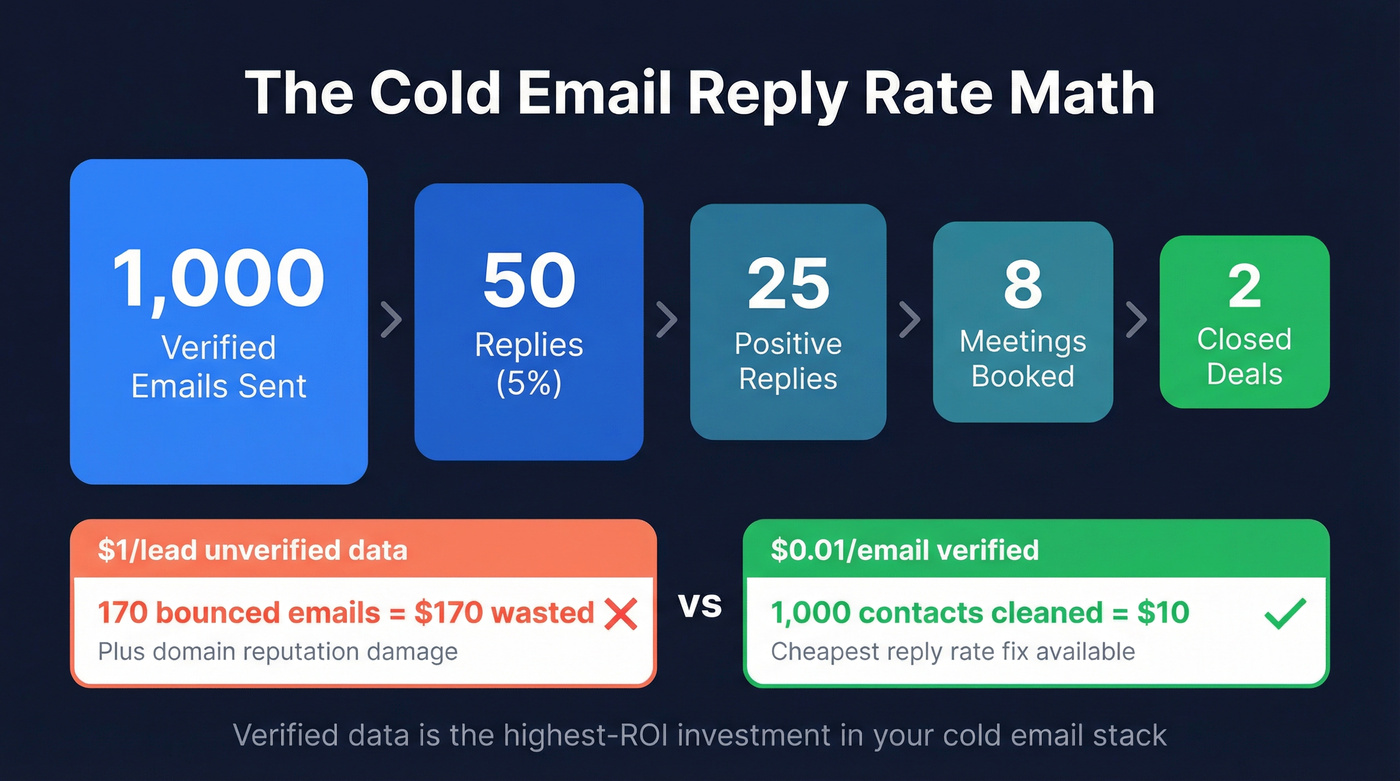
Your cost-per-reply matters enormously. Paying $1/lead for unverified data with 17% bounce means you're burning $170 on contacts that never reach an inbox - and damaging your domain reputation in the process. Cleaning 1,000 contacts with an email checker tool costs $10. That's the cheapest reply-rate fix available, and we've seen it produce the fastest lift across every team we've worked with.
Campaigns under 50 recipients hit 5.8% reply rates - nearly 3x larger blasts. Prospeo's 30+ filters (intent data, technographics, job changes, headcount growth) let you build micro-segments that convert. Meritt tripled their pipeline to $300K/week by pairing tight targeting with verified data.
Build the tight list that turns 3% reply rates into 10%+.
FAQ
What's a good B2B cold email reply rate in 2026?
3-5% is average across 2026 datasets; 5-8% is good; top 10% of campaigns exceed 10%. Below 3% consistently signals a deliverability or targeting problem, not a copywriting one. Check bounce rates and spam placement first.
How many follow-ups should I send?
Four to seven touchpoints is the sweet spot for cumulative replies, but front-load value in emails one through three. Spam complaints triple after the third email, and the first message captures 58% of all replies. Taper aggressively after touch four.
Does email verification actually improve reply rates?
Yes. Bounced emails damage domain reputation, pushing future sends to spam. Teams using verified data routinely cut bounce rates from 30%+ to under 4% and see pipeline double or triple. At roughly $0.01 per verified email, it's the highest-ROI fix available.
What's the cheapest way to improve cold email response rates?
Verify your list before sending. Cleaning 1,000 emails costs about $10 - versus $170+ wasted on bounced sends from unverified data. Pair that with proper SPF/DKIM/DMARC setup and removing open-tracking pixels for the fastest lift.