The Outreach Sales Engagement Platform Guide: What It Costs and Which One to Pick in 2026
You just signed a $40K annual contract for a sales engagement platform. Your reps built sequences, loaded contacts, hit send - and 30% of those emails bounced. The domain takes a hit, deliverability craters, and now the entire team's outreach is landing in spam. That's not a platform problem. That's a data problem wearing a platform disguise.
Choosing the right outreach sales engagement platform is the backbone of modern outbound. But the platform itself matters less than what you feed it. Here's what these tools actually do, what they cost, and how to avoid the expensive mistake of picking the right tool with the wrong data underneath it.
What You Need (Quick Version)
Enterprise teams with budget: Outreach or Salesloft. They're the incumbents for a reason - deep workflow customization, conversation intelligence, and forecasting baked in.
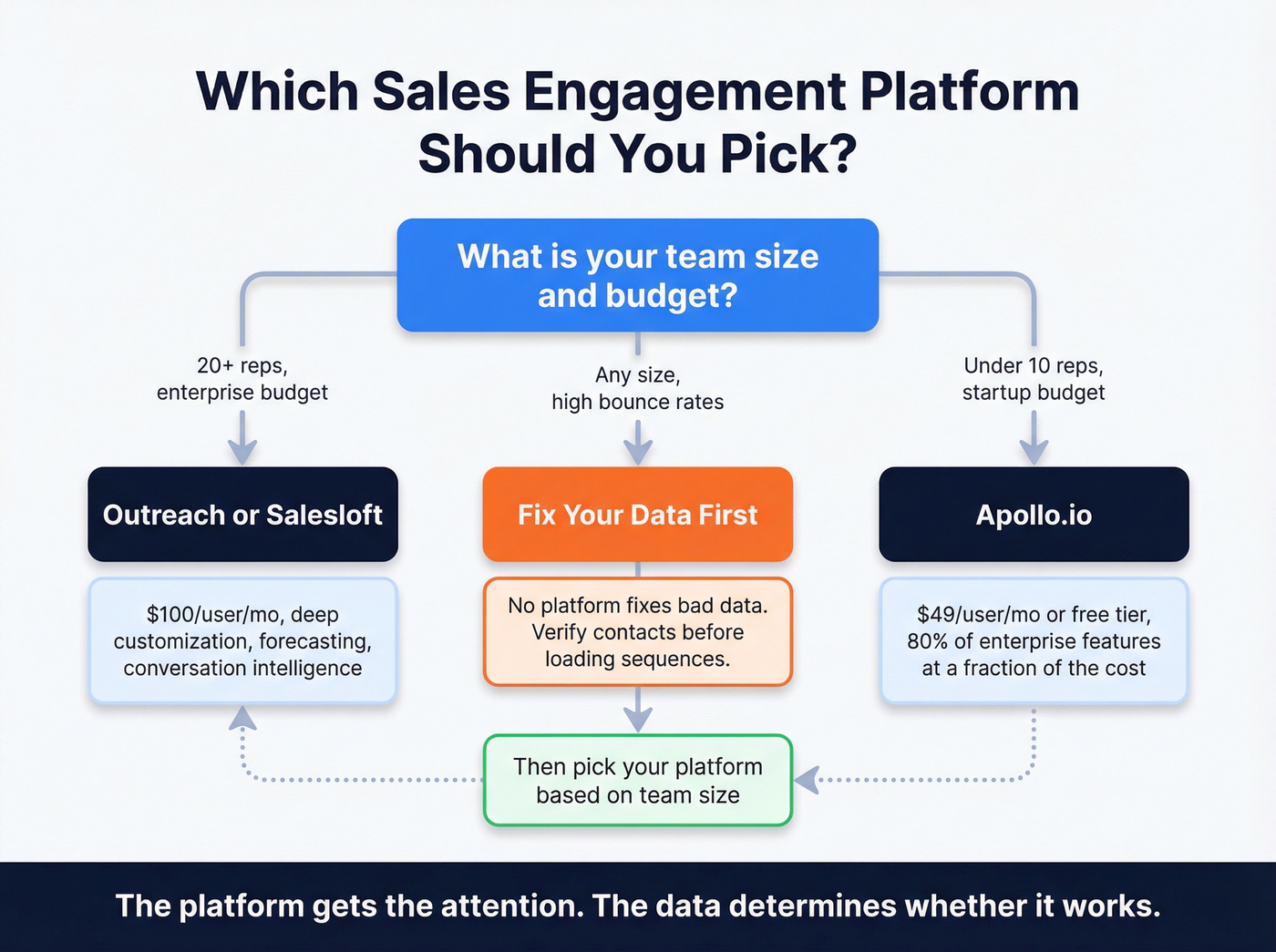
SMBs and startups: Apollo handles roughly 80% of what Outreach does at a fraction of the cost. Apollo at $49/user/month plus a credit-based data verification layer gets you an enterprise-grade stack without the enterprise price tag.
Any team with bounce rate problems: Stop buying more platform. Fix your data layer first.
Here's the thing most SEP articles won't tell you: a $100/user/month tool running on stale contacts performs worse than a $49/month tool running on verified ones. The platform choice gets all the attention. The data choice determines whether any of it works.
What Is a Sales Engagement Platform?
A sales engagement platform is the action layer between your CRM and your prospects. Gartner defines the category as tools that streamline how sellers execute sales activities and deal workflows at scale - combining multichannel engagement, outbound workflow execution, and AI-driven automation in a single interface.
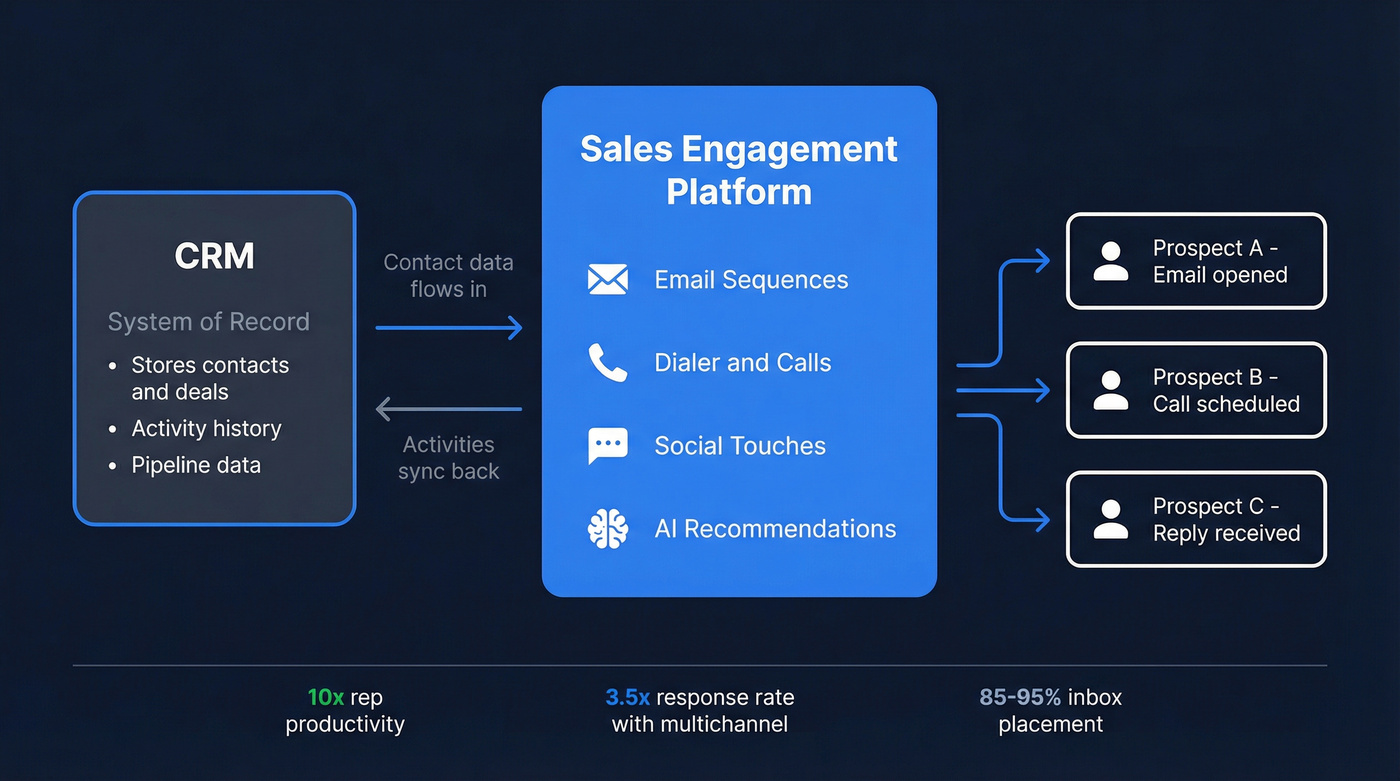
Your CRM is the system of record. It stores contacts, deals, and activity history. Your SEP is where reps actually do things: build multi-step sequences across email, phone, and social; get AI-powered suggestions on who to contact next; and log every touchpoint back to the CRM automatically. That distinction matters because it shapes what you should expect from each tool in your stack.
This is different from sales enablement, which covers training, content, and process. Enablement teaches reps how to sell. Engagement tools execute the selling motions at scale.
Gartner has been transitioning the category toward what they call "Revenue Action Orchestration" - a broader framing that includes deal management, forecasting, and conversation intelligence alongside traditional sequencing. That evolution explains why platforms like Outreach and Salesloft keep bolting on features. They're not just email sequencers anymore. They're trying to be the operating system for your entire revenue team, which means you're no longer buying a cadence tool - you're buying into a workflow philosophy. That makes the choice harder, and the cost of switching higher.
Why SEPs Matter for Revenue Teams
The sales engagement market [hit $7.4B in 2022](https://finance.yahoo.com/news/global-sales-engagement-software-market-180000664.html) and is projected to [reach roughly $30B by 2032](https://www.factmr.com/report/sales-engagement-software-market) and is projected to reach roughly $30B by 2032. That growth isn't hype.
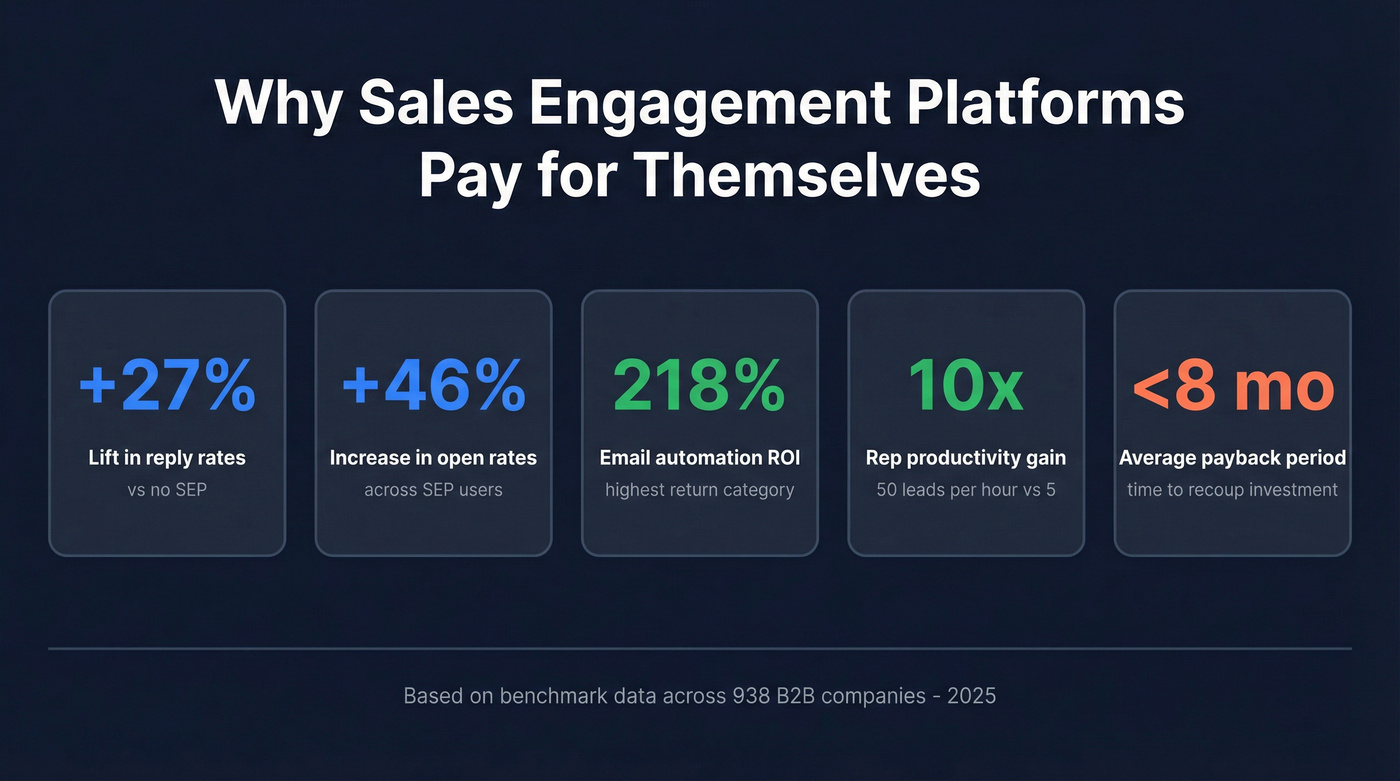
Teams using SEPs see an average +27% lift in reply rates, +46% in open rates, and +15% in meetings booked. Benchmark data across 938 B2B companies puts email automation ROI at 218% and conversation intelligence at 189% - making them two of the highest-return investments in a modern sales stack.
A rep running sequences through a platform can process 50 leads per hour versus 5 manually. That's a 10x productivity multiplier that compounds across a team of 20 or 50 reps. Most teams recoup their SEP investment in under 8 months, and 87% of sales development teams now run on some form of engagement platform. Nine out of ten sales organizations consider their SEP critical infrastructure.
The question isn't whether you need one. It's which one, at what price, and what data you're piping into it.
Core Features to Look For
Not every SEP needs every bell and whistle. But these are non-negotiable:
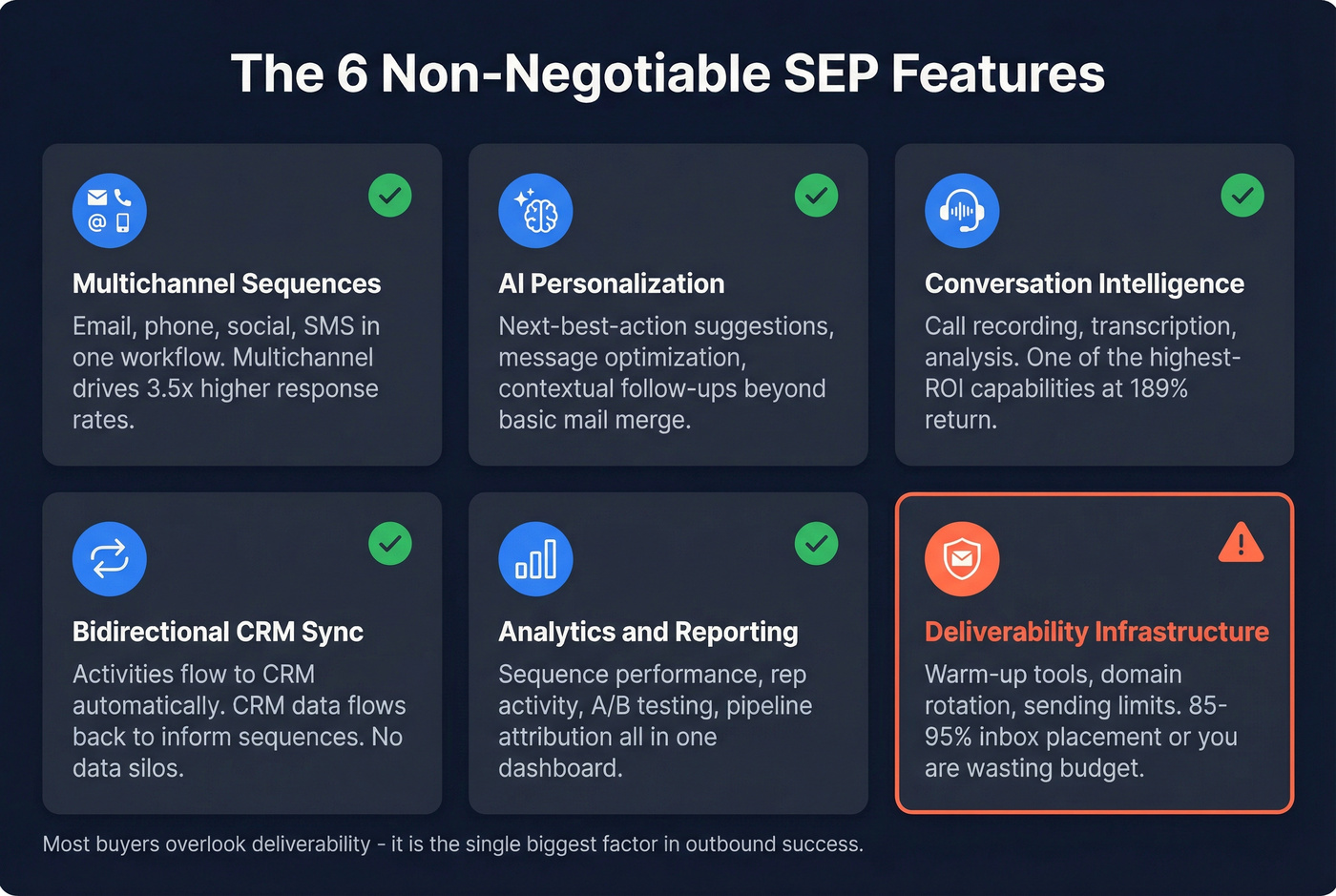
Multichannel sequences across email, phone, social, and SMS in a single workflow. Email-only cadences leave money on the table - a multichannel approach drives 3.5x higher response rates versus email alone.
AI-powered personalization that goes beyond mail merge tokens. You want next-best-action recommendations and message optimization based on engagement signals, not just "Hi {first_name}." Many platforms now include an AI assistant that drafts contextual follow-ups and suggests optimal send times based on prospect behavior.
Conversation intelligence for call recording, transcription, and analysis. This is where coaching happens at scale, and it's one of the highest-ROI capabilities in the stack.
Bidirectional CRM sync where activities flow into your CRM automatically and CRM data flows back to inform sequences. One-way sync creates data silos that erode trust in your pipeline numbers.
Analytics and reporting covering sequence performance, rep activity, A/B testing results, and pipeline attribution.
Deliverability infrastructure is the one most buyers overlook. Industry-leading platforms maintain 85-95% inbox placement. Poor infrastructure can land 40% of your emails in spam. Ask vendors specifically about warm-up tools, domain rotation, and sending limits. If you're troubleshooting inboxing, use an email deliverability checklist before you blame the SEP.
Contract flexibility matters more than you think. Annual lock-ins are the norm at the enterprise tier, but month-to-month options exist for smaller teams. Know what you're signing before you've validated time-to-value.

You read it above: 30% bounce rates kill domains and crater deliverability. Prospeo's 5-step email verification delivers 98% accuracy with a 7-day refresh cycle - so every contact you load into Outreach, Salesloft, or Apollo actually reaches a real inbox. At $0.01 per email, fixing your data costs less than one bounced sequence.
Stop feeding stale data into expensive platforms.
Best Sales Engagement Platforms in 2026
Outreach
Use this if: You're running 20+ reps, need deep customization, and want forecasting, conversation intelligence, and deal management in one platform.
Skip this if: You're a small team, you want transparent pricing, or you need to be live in under a week. Outreach's learning curve is steep, and the consensus on G2 reviews is that implementation complexity is one of the biggest surprises for new buyers.

Pricing starts around $100/user/month on annual contracts, with typical mid-market spend running $20K-$50K+ per year plus $1K-$8K in implementation fees. Two license tiers - Accelerate and Optimized - determine what you get. There's no public pricing page, which is frustrating but standard at this tier.
Outreach earns a 4.3/5 on G2 across 3,488 reviews and 4.5/5 on Gartner across 184 ratings. Time-to-value benchmarks put best-in-class email automation at 12 days with Outreach - faster than most competitors and well ahead of the 28-day industry average. Outreach's modular packaging lets you add voice/calling, forecasting, and AI capabilities as separate modules, which gives large orgs flexibility but also means the final invoice can look very different from the initial quote.
SalesLoft
Salesloft is the platform reps actually adopt without months of training. Where Outreach wins on depth and customization, Salesloft wins on UX polish and speed to productivity. For mid-market teams that need enterprise-grade sequencing without the enterprise-grade implementation headache, it's the better fit.
Two tiers - Advanced and Premier - with a 3-seat minimum. Typical cost runs around $1,000/user/year. The dialer is a separate add-on at approximately $200/user/year plus $1/number/month for LocalDial, which is worth factoring into your budget. Gartner rates Salesloft 4.4/5 across 284 ratings, and time-to-value benchmarks put it at 15 days - still well ahead of the 28-day industry average.
The honest tradeoff: you get faster adoption and a cleaner interface, but you sacrifice some of the deep workflow customization that complex sales orgs need. For teams under 50 reps, that tradeoff almost always favors Salesloft.
Apollo.io
Apollo is the Swiss Army knife for teams that can't justify $100/user/month. It bundles prospecting, sequencing, and a basic dialer into one tool - and the free tier is genuinely useful for solo founders and early-stage teams testing outbound for the first time.
Free tier available, paid plans from $49/user/month. The UX is lightweight and reps can be productive on day one. The built-in contact database is large but accuracy varies, so pairing Apollo with a dedicated verification layer is the move if you're sending at any real volume. We've seen teams cut their bounce rate in half just by running Apollo contacts through a verification step before loading them into sequences.
Where Apollo falls short: the dialer is functional but not built for high-volume call campaigns, and conversation intelligence is minimal compared to Outreach or Salesloft. If your average deal size is under $10K and your team is under 10 reps, none of that matters. Apollo paired with verified data is the highest-ROI stack available right now for early-stage outbound.
Reply.io
Use this if: Cold email is your primary channel and you want best-in-class deliverability tooling. Reply.io packs 30+ deliverability features - warm-up, domain rotation, sending optimization - into a platform that takes email seriously.
Skip this if: You need a full-featured dialer or deep CRM workflow automation. Reply.io is email-first, everything else second.
Sales Outreach plan starts at $49/user/month, Multichannel at $89/user/month. Their AI SDR agent Jason runs from $500/month and handles autonomous prospecting - worth testing if you're short on headcount but not on budget.
HubSpot Sales Hub
Built-in sequencing for teams already running HubSpot CRM. Starter at $15/seat/month. Professional and Enterprise typically run $100-$150/seat/month plus onboarding fees that commonly hit $1,500-$3,500. Don't buy it for the SEP - buy it because your CRM is already there and you want one fewer integration to manage.
Salesforce Sales Engagement
Native engagement layer for Salesforce shops at $50/user/month on annual contracts, requires Sales Cloud. It includes buying-signal scoring and automated call insights inside the Salesforce workflow. If your org lives in Salesforce and won't adopt another tool, this is the path of least resistance. For more flexibility within the ecosystem, Groove - now part of Clari - is worth evaluating.
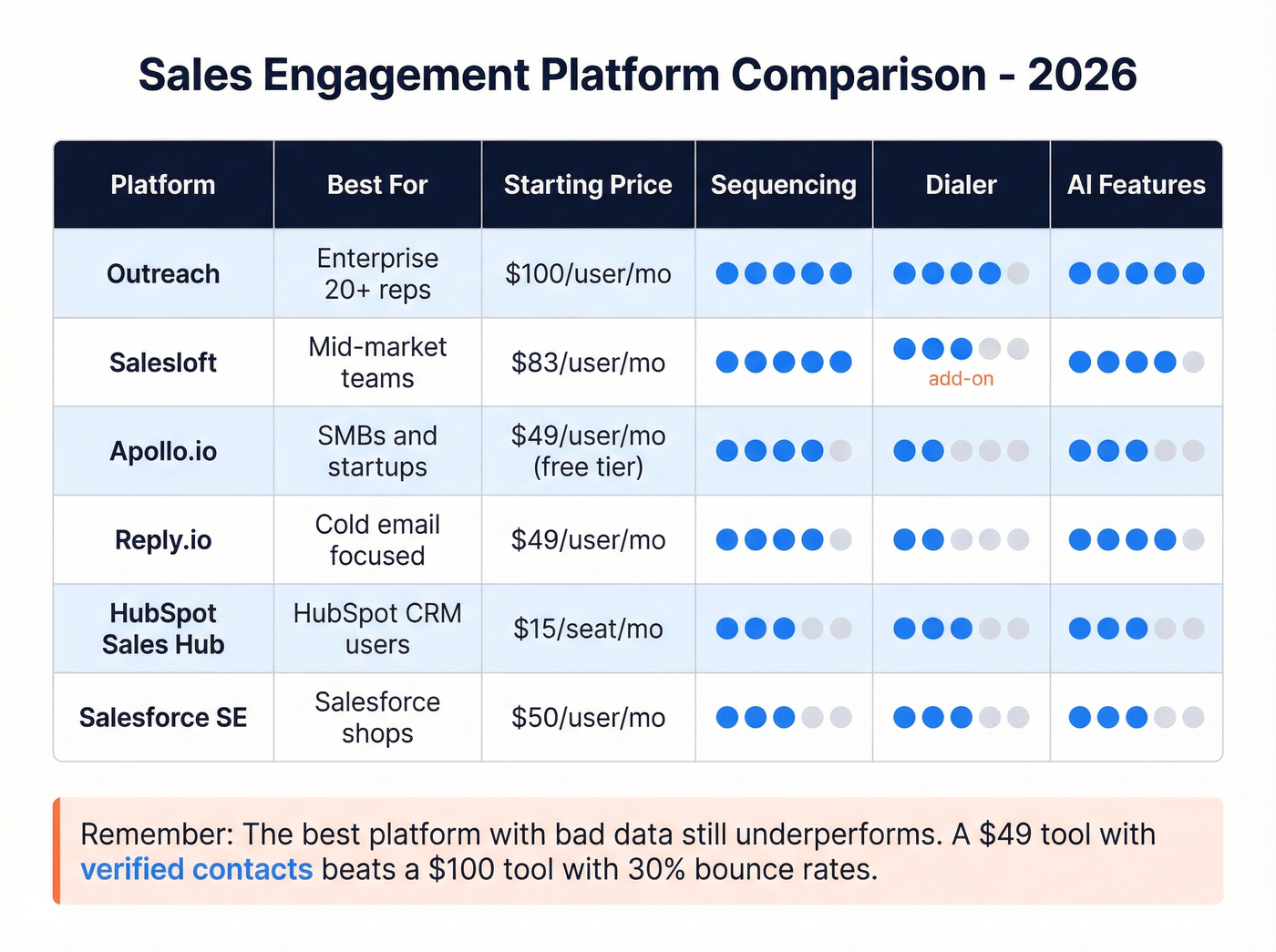
Platform Comparison
| Tool | Best For | Starting Price | Key Strength | Key Limitation |
|---|---|---|---|---|
| Outreach | Enterprise, 20+ reps | ~$100/user/mo | Deepest customization | Steep learning curve |
| Salesloft | Mid-market teams | ~$1,000/user/yr | Fastest rep adoption | Dialer costs extra |
| Apollo.io | SMBs and startups | Free / $49/user/mo | All-in-one value | Basic dialer |
| Reply.io | Cold email focus | $49/user/mo | Deliverability tools | Email-first design |
| HubSpot Sales Hub | HubSpot CRM users | $15/seat/mo | Native CRM sync | Onboarding fees |
| SF Sales Engagement | Salesforce orgs | $50/user/mo | Zero adoption friction | Requires Sales Cloud |
Which Platform Fits Your Team?
Teams under 10 reps with less than $500/month to spend should start with Apollo for sequencing and layer in verified contact data separately. You'll get 80% of the enterprise experience at maybe 15% of the cost. Don't overcomplicate this - a lightweight stack that reps actually use beats a sophisticated one they abandon after two weeks.
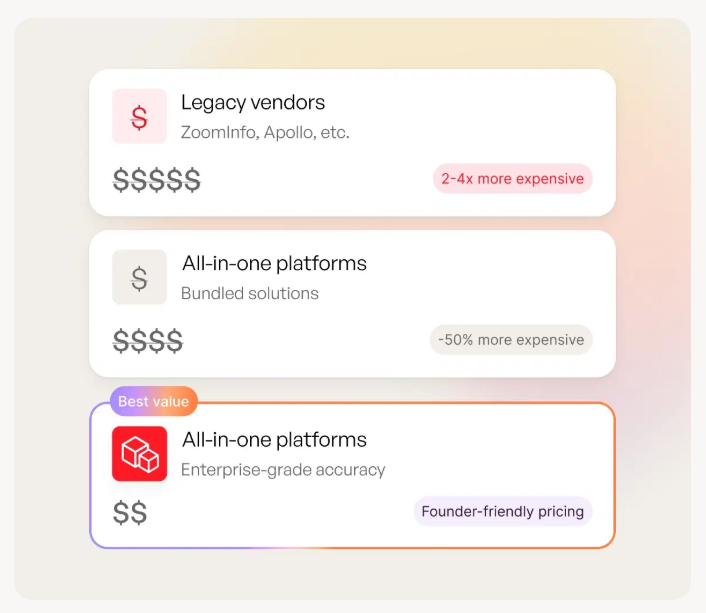
Mid-market teams of 10-50 reps are the sweet spot for Salesloft or Reply.io. Salesloft if you need multichannel engagement with a polished UX, Reply.io if cold email is your bread and butter. At this scale, a 5% bounce rate difference across thousands of weekly sends compounds fast - investing in a data verification layer alongside your SEP pays for itself within the first month. If you're scaling outbound, follow a sales cadence example that matches your channels and volume.
Enterprise teams with 50+ reps typically land on Outreach or Salesforce Sales Engagement, depending on their CRM. The real risk at this tier isn't picking the wrong platform - it's paying $100/user/month for a tool half the team logs into once a week. Right-size your licenses, and make sure your contact data refreshes frequently enough to keep pace with your sending volume.
Let's be honest: the "which platform" question gets all the attention. But we've seen teams agonize over Outreach vs. Salesloft for months, then lose more pipeline to bad data in the first quarter than the price difference between the two tools.
The Data Problem Nobody Talks About
The average B2B sales team runs 8.3 tools costing $187/rep/month, with 73% reporting overlap that wastes $2,340/rep/year. But the most expensive waste isn't tool overlap - it's feeding bad data into good tools.

When your bounce rate climbs above 5%, email service providers start throttling your domain. That doesn't just affect the bad addresses - it tanks deliverability for your entire team, across every sequence, for weeks. One rep uploading an unverified list can poison the well for 50 others. We watched this happen to a client running Outreach with a 200-person sales org, and it took six weeks to recover their sender reputation. If you want the benchmarks behind this, see B2B contact data decay and how it impacts deliverability.
Snyk's 50-person AE team learned this the hard way. Bad data was costing them 35-40% bounce rates. After fixing the data layer with Prospeo, bounces dropped under 5%, and the team generated 200+ new opportunities per month - a 180% jump in AE-sourced pipeline. The 5-step verification process, including catch-all handling, spam-trap removal, and honeypot filtering on a 7-day refresh cycle, is what keeps bounce rates below the threshold where deliverability starts degrading.
Before you spend $30K on a sales engagement platform, make sure the data going into it is actually good. A $39/month data verification plan protecting a $40K platform contract isn't an expense - it's insurance. If you're cleaning lists at the source, use a CRM hygiene process so bad records don't keep re-entering your SEP.
The best SEP in the world can't fix bad phone numbers. Prospeo gives you 125M+ verified mobile numbers with a 30% pickup rate - nearly 3x the industry average. Pair that with 300M+ profiles and 30+ filters like buyer intent, technographics, and headcount growth to build sequences that actually connect.
Build sequences on data that connects reps to real buyers.
How to Evaluate an SEP
Before you sign anything, run through this checklist:
- Deliverability infrastructure - ask specifically about warm-up tools, domain rotation, and inbox placement rates. If they can't answer, that's your answer.
- CRM integration depth - bidirectional sync is table stakes. Test whether custom fields, activities, and deal stages actually flow both ways.
- Pricing transparency - if you can't find pricing on the website, budget 30-40% more than whatever the first quote says. Modules, add-ons, and implementation fees add up fast.
- Time-to-value - best-in-class SEPs get teams productive in 12-15 days. The industry average is 28 days. Ask for references from companies your size.
- Data quality of contacts - does the platform include a contact database? If so, what's the verification rate? If not, what's your plan for feeding it clean data? (If you're building this layer, start with email verification for Outreach.)
- AI capabilities - ask what the AI actually does versus what the marketing page says. "AI-powered" can mean anything from GPT-generated email drafts to basic A/B test optimization. If you're comparing tools, see AI in sales cadences.
- Contract flexibility - annual lock-ins are standard for enterprise, but month-to-month options exist. Don't sign a 12-month contract before you've validated time-to-value.
FAQ
What's the best outreach sales engagement platform in 2026?
Outreach leads for enterprise customization and workflow depth, Salesloft wins on mid-market UX, and Apollo is the best value for budget-conscious SMBs. The right choice depends on team size, budget, and whether you need a built-in dialer or AI agents. Pair any of them with a verified data source to maximize deliverability and reply rates.
How much does Outreach cost?
Outreach starts around $100/user/month on annual contracts. Typical mid-market spend runs $20K-$50K+ per year, plus $1K-$8K in one-time implementation fees. There's no public pricing page - you'll need to request a quote and should expect negotiation on modules and seat counts.
What's the difference between a sales engagement platform and a CRM?
A CRM is your system of record - the central database where contacts, deals, and activity history live. A sales engagement platform is the action layer that uses CRM data to execute outreach across email, phone, and social, then logs every touchpoint back to the CRM automatically.
Do I need a separate data provider with my SEP?
Yes, unless your SEP includes a verified contact database with 95%+ accuracy - and most don't. Feeding unverified data into sequences tanks deliverability and damages your domain. A verification layer with 98% email accuracy and weekly data refreshes keeps data clean so your SEP actually performs.
Is Outreach worth it for small teams?
Usually not. Annual contracts, no public pricing, a steep learning curve, and implementation fees make Outreach purpose-built for 20+ rep teams. Small teams get better ROI from Apollo or Reply.io paired with verified contact data - similar outcomes at a fraction of the cost.