Best Email Marketing Tools for Startups on a Budget (2026)
Your startup's email list is the one marketing asset that doesn't vanish when an algorithm changes. Email returns $36 for every $1 spent, and 42% of marketers rank it as their most effective channel - beating social media and paid search. The catch? Most email platforms get expensive fast, and the wrong pick locks you into a migration nightmare six months from now.
We've tested the major budget options and tracked how their pricing scales. Here's what actually holds up.
Why Email Still Wins for Bootstrapped Startups
Paid ads stop the second your budget runs out. Social reach depends on platforms you don't control. Email is the only channel where you own the relationship and the distribution.
The global email marketing market hit $8.3B in 2023 and is projected to reach $18.9B by 2028. Average open rates sit around 42% in 2026, with CTR hovering near 2% - some industries push past 4%. Those numbers crush every other owned channel. The question isn't whether to invest in email. It's which tool won't bleed you dry as your list grows.
Our Top Picks (TL;DR)
| Pick | Best For | Free Plan |
|---|---|---|
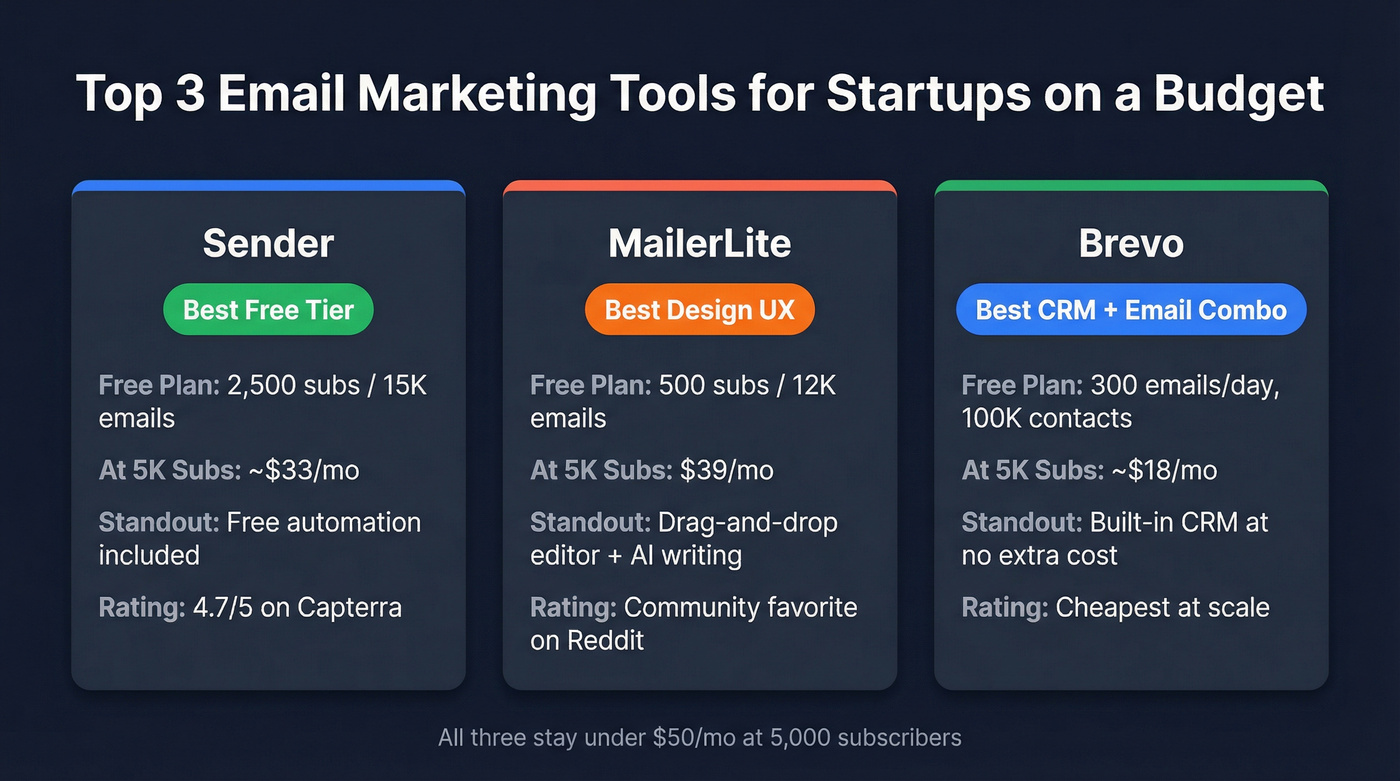
| Sender | Most generous free tier | 2,500 subs / 15K emails |
| MailerLite | Design and editor UX | 500 subs / 12K emails |
| Brevo | CRM + email in one | 300 emails/day, 100K contacts |
Here's the thing: if your average deal size is under five figures, you probably don't need a $75/month ESP. The tools on this list will outperform Mailchimp at a fraction of the cost until you're well past 10,000 subscribers.
Before You Pick a Tool
Your co-founder just exported 2,000 "leads" from a conference badge scanner. Half are personal Gmail addresses, a quarter bounced six months ago, and at least a few are spam traps and honeypots. Sound familiar?

Blasting scraped or purchased lists. Spam traps and honeypots live in those lists. One bad send can get your domain blacklisted - recovering takes weeks, not hours. Bad data wastes more budget than the wrong tool ever will. Verify before you send (or run an email validity check first).
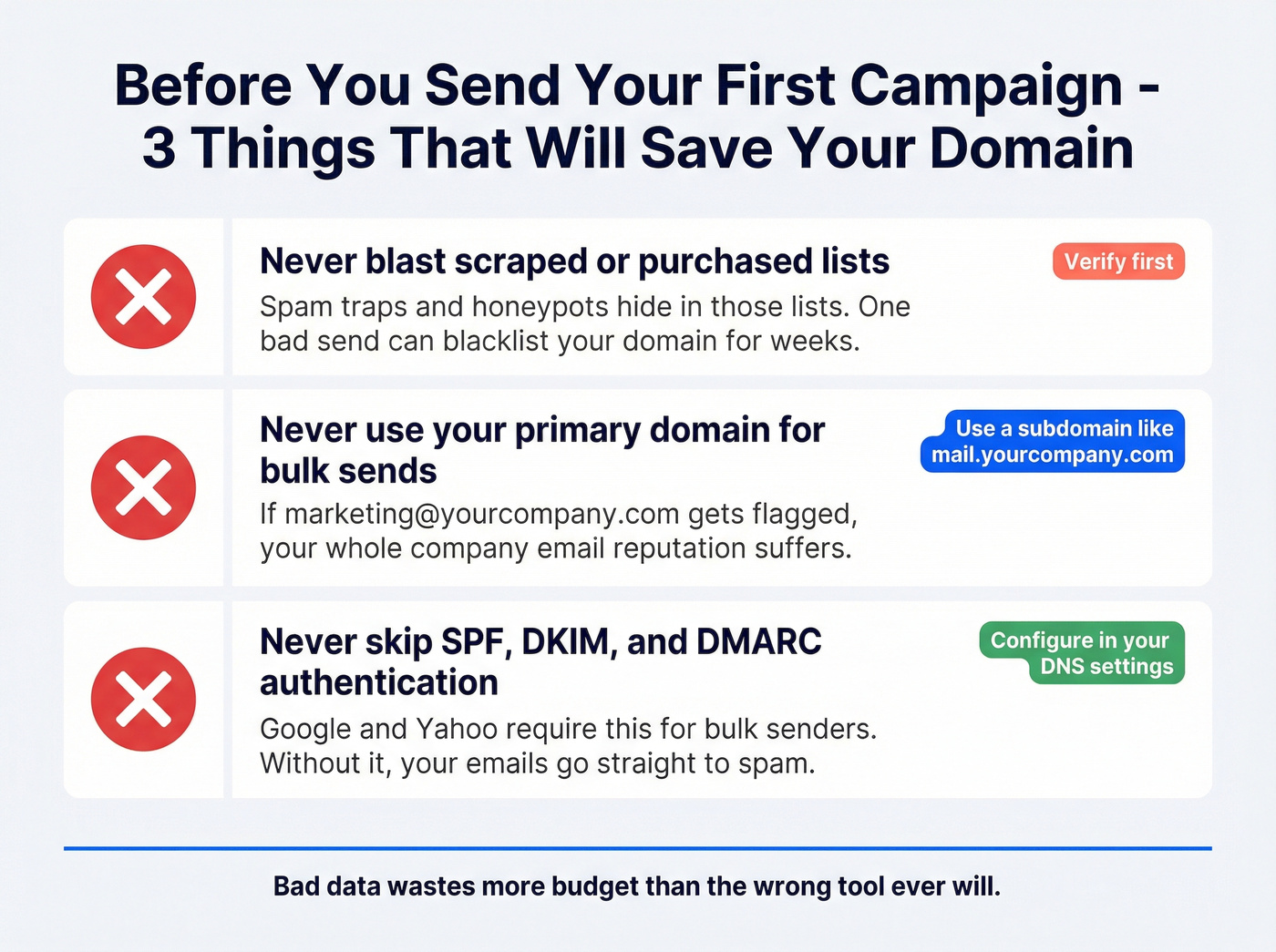
Using your primary domain for bulk sends. If marketing@yourcompany.com gets flagged, your entire company's email reputation suffers. Set up a subdomain like mail.yourcompany.com for marketing sends from day one.
Skipping SPF, DKIM, and DMARC authentication. Google and Yahoo's bulk sender requirements make this mandatory. Without proper authentication, your emails go straight to spam regardless of content quality. All reputable ESPs support these protocols, but you still need to configure them in your DNS (use this SPF, DKIM, DMARC guide if you want the full setup steps).
Best Budget Email Platforms Compared
Here's how the field stacks up on the metrics that actually matter when you're stretching every dollar:
| Tool | Free Plan | Paid Start | ~Price at 5K Subs | Best For |
|---|---|---|---|---|
| Sender | 2,500 / 15K emails | ~$10-$15/mo | ~$33/mo | Free automation |
| MailerLite | 500 / 12K emails | $10/mo | $39/mo | Design + UX |
| Brevo | 300/day, 100K contacts | $9-$15/mo | ~$18/mo | CRM + email |
| Kit | 10K / unlimited | ~$29-$39/mo | $49/mo | Creators |
| EmailOctopus | 2,500 / 10K emails | ~$36-$40/mo (10K subs) | ~$36-$40/mo | Simple newsletters |
| Loops | 1K / 4K sends | ~$49/mo | ~$49/mo | SaaS lifecycle |
| Mailchimp | 500 contacts | $13/mo | ~$75/mo | Legacy brand |
| GetResponse | 500 / 2,500 emails | $19/mo | ~$54/mo | Mid-range |
| Moosend | 30-day trial only | $5.60/mo | ~$32/mo | Cheapest paid |
Sender
Use this if you want the most generous free plan in the market and need automation from day one. Sender gives you 2,500 subscribers and 15,000 emails per month on the free tier - with automation and segmentation included. Most tools gate automation behind paid plans. Capterra reviewers give it a 4.7/5 across 210 reviews, with consistent praise for deliverability and support. Sender and MailerLite are the two names that come up most in Reddit threads about affordable ESP options.
Skip this if you need advanced A/B testing or CRM-level contact management. Paid plans start around $10-$15/mo and run $39.90/mo at 10K subscribers - still competitive. For a pre-revenue startup that needs to launch drip campaigns this week without paying anything, Sender is the obvious starting point.
MailerLite
Use this if design quality matters to your brand and you want the best drag-and-drop editor in the budget tier. MailerLite's editor is genuinely enjoyable - closer to Squarespace than a typical ESP builder. The AI writing assistant helps draft subject lines and body copy, which is a lifesaver when you're a two-person team without a copywriter (see more on AI in Email Marketing). Free plan covers 500 subscribers and 12,000 emails per month. Paid plans start at $10/mo and hit $39/mo at 5,000 subscribers.
Skip this if you need templates on the free plan - they're locked behind paid tiers. MailerLite has a rigorous account approval process that requires a real website URL and an explanation of your use case. Sounds annoying, but it's actually a deliverability advantage: fewer spammers on the platform means better shared-IP reputation for everyone.
Brevo
Brevo is the pick when you want CRM and email marketing in one platform without paying for two tools. The free plan is structured differently - 300 emails per day with up to 100,000 contacts stored. That contact-generous model works perfectly if you're building a list now but sending sparingly.
The trade-off: 300 emails per day caps you at roughly 9,000/month, which limits frequent campaign sends. Paid plans start around $9-$15/mo depending on volume, and the Business plan at $18/mo unlocks more advanced segmentation and automation. At 5,000 subscribers, you're looking at roughly $18/mo - making Brevo one of the cheapest options at scale among the top three. If your startup has a sales pipeline alongside marketing, Brevo is the one.
Kit (ConvertKit)
Use this if you're a creator selling courses, paid newsletters, or digital products. Kit's free plan sounds incredible - 10,000 subscribers with unlimited sends. But automation is gated behind a paid plan, and at 3,000 subscribers you're paying $49/mo. Steep for a B2B startup.
Skip this if you're building a SaaS or ecommerce company. Kit is purpose-built for the creator economy - paid subscriptions, digital downloads, audience monetization. If that's not your model, you're paying a premium for features you won't touch.
EmailOctopus
A cheap path to scale for straightforward broadcast newsletters. Free plan covers 2,500 subscribers and 10,000 emails per month. Paid plans scale to about $40/mo at 10K subscribers. The automation builder feels a generation behind Sender or MailerLite, so don't pick this for conditional workflows or advanced segmentation. But if your entire email strategy is "write a weekly newsletter and hit send," EmailOctopus does that well for less money.
Loops
Your SaaS just hit 500 signups and half haven't activated. That's the exact problem Loops was built to solve.
It handles onboarding sequences, feature announcements, and lifecycle campaigns natively - no duct-taping a general-purpose ESP into product-led workflows. Free plan covers 1,000 contacts and 4,000 sends. Paid plans start around $49/mo, which is expensive for a general newsletter but reasonable if lifecycle email is your growth lever. Don't pick Loops for ecommerce or traditional newsletters - you'll feel the gaps immediately.
Mailchimp
Mailchimp's free tier caps at 500 contacts with limited monthly sends. At 5,000 subscribers, you're paying roughly $75/mo. The consensus on r/sales and r/startups matches our experience: Mailchimp is the tool people start with and migrate away from. MailerLite and Sender both offer more for less at every tier.
GetResponse
Free plan covers 500 contacts and 2,500 emails. Starter runs $19/mo. Solid mid-range option with decent automation and landing page builders, but nothing stands out enough to recommend over Sender or MailerLite for a budget-constrained startup.
Moosend
No permanent free plan - just a 30-day trial. Pro starts at $5.60/mo for 500 contacts, making it the cheapest paid entry point. Worth a look if you know you'll pay from day one and want to minimize that first invoice.
Honorable mentions: Benchmark Email offers 500 contacts free, AWeber gives you 500 subscribers free, and Mailjet covers 1,000 subscribers with 6,000 emails per month - none stand out enough to crack the main list.

Spam traps and bounced emails destroy startup domains faster than picking the wrong ESP. Prospeo's 5-step verification catches invalid addresses, spam traps, and honeypots before they tank your sender reputation - at just $0.01 per email.
Clean your list before your first campaign. Your domain depends on it.
The Budget Scaling Trap
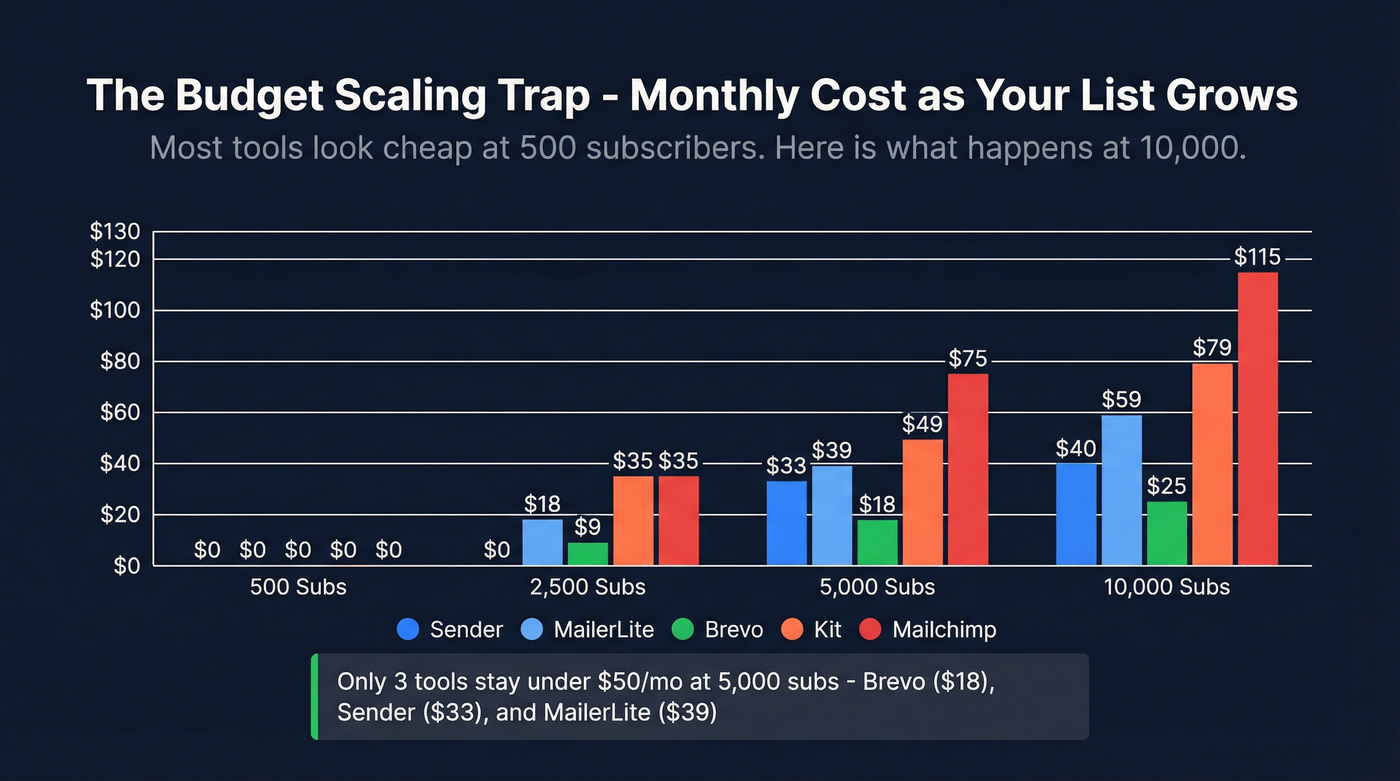
Every tool looks affordable at 500 subscribers. Here's what happens when your list actually grows:
| Tool | 500 Subs | 2,500 Subs | 5,000 Subs | 10,000 Subs |
|---|---|---|---|---|
| Sender | Free | Free | ~$33/mo | $39.90/mo |
| MailerLite | Free | ~$18/mo | $39/mo | ~$59/mo |
| Brevo | Free | ~$9/mo | ~$18/mo | ~$25/mo |
| Kit | Free | ~$29-$39/mo | $49/mo | ~$79/mo |
| Mailchimp | Free | ~$35/mo | ~$75/mo | ~$115/mo |
| ActiveCampaign | $29/mo | ~$49/mo | ~$79/mo | ~$129/mo |
ActiveCampaign is included for reference - it has no free plan and starts at $29/mo, so it's not a budget starter, but many startups consider it once they outgrow simpler tools.
Three tools stay under $50/mo at 5,000 subscribers: Brevo at roughly $18, Sender at $33, and MailerLite at $39. Mailchimp and ActiveCampaign blow past that threshold fast. In our experience, most startups outgrow free plans between three and six months of consistent sending. The upgrade triggers are straightforward: your bounce rate climbs above 5% (see what a hard bounce actually means), you hit your subscriber cap, or you need conditional automation workflows the free tier doesn't support.
One more thing: don't pay for a dedicated IP until you're past 50,000 subscribers. Shared IPs work fine at startup scale, and the cost isn't justified earlier. Proper authentication and list hygiene matter far more than IP type at your stage.
The Hidden Budget Killer
You picked a tool. Now who do you email?
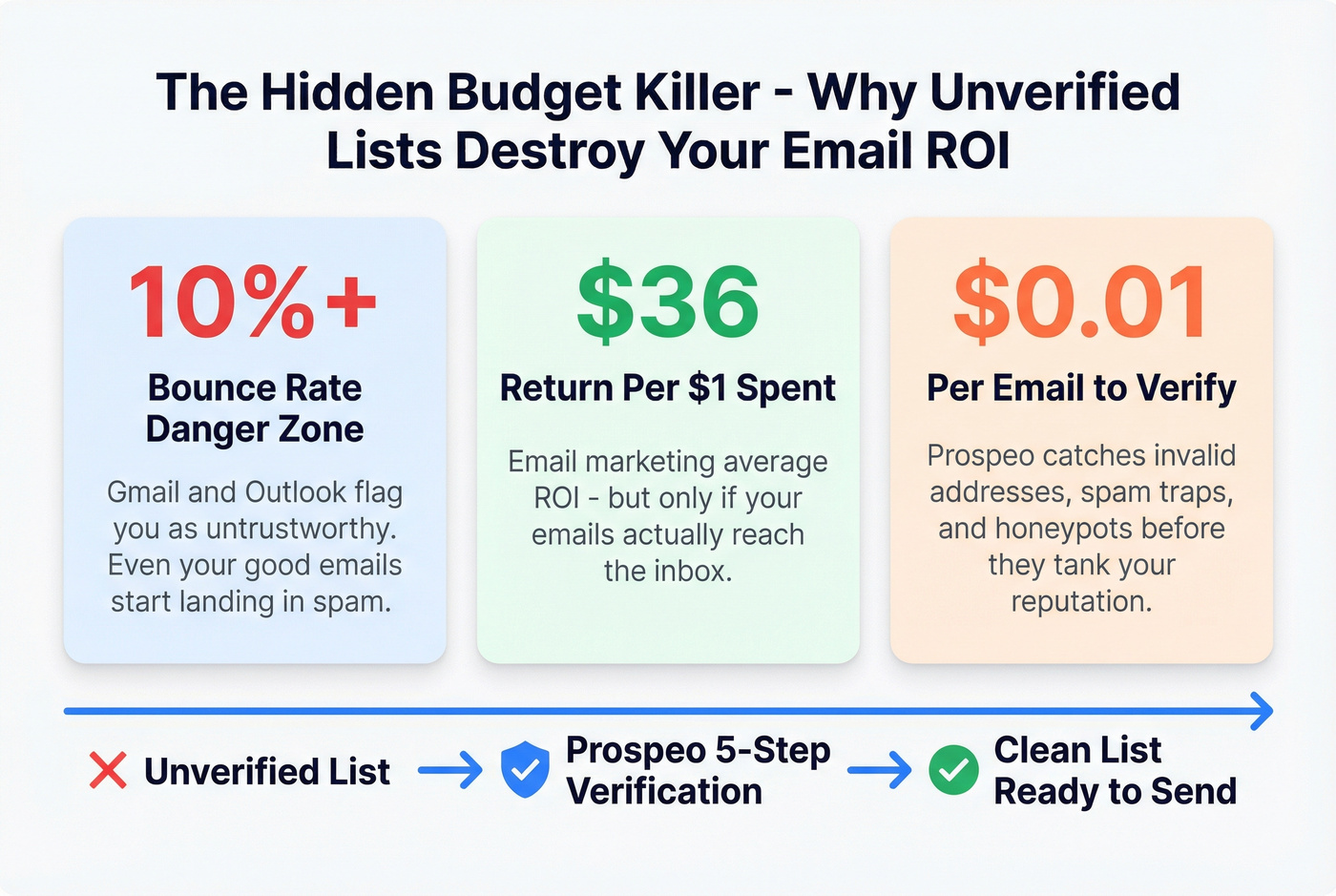
This is where most startups silently waste their budget. Sending to unverified lists doesn't just bounce - it actively damages your sender reputation. A 10%+ bounce rate tells Gmail and Outlook you're not a trustworthy sender, and even your good emails start landing in spam (use an email checker tool before you scale volume).
Prospeo's 5-step email verification catches invalid addresses, spam traps, and honeypots before they ever hit your ESP. Stack Optimize used Prospeo-verified data to build from $0 to $1M ARR while maintaining 94%+ deliverability and under 3% bounce rates across all clients - zero domain flags. The free tier gives you 75 verified emails per month with no credit card required, and native integrations with HubSpot, Instantly, Smartlead, Lemlist, Clay, Zapier, and Make mean verification slots into your workflow without extra steps.
The cheapest email tool means nothing if half your list bounces. Prospeo verifies 143M+ emails at 98% accuracy with catch-all handling and spam-trap removal - so every dollar you spend on your ESP actually reaches a real inbox.
Stop wasting sends on dead addresses. Verify first, send second.
Your First 30 Days
Don't overthink your first campaigns. Three sequences, four weeks, done.
Week 1-2: Welcome sequence. Three to five emails over 7-10 days. First email fires immediately on signup - deliver whatever you promised, whether that's a lead magnet, product access, or confirmation. Follow up at 24-48 hours with your story or a quick win, then layer in social proof and a soft CTA. Automated onboarding emails produce 50% higher activation rates for SaaS products. Include images in every email - emails with visuals see 4.84% CTR vs 1.6% for text-only. Don't skip this sequence.
Week 2-3: Launch or announcement sequence. Teaser email 3 days before. Main announcement on launch day. Social proof follow-up 2 days after. Last-chance reminder 5-7 days after. This four-email arc works for product launches, feature releases, or even a pricing change.
Week 3-4: Retention or cart recovery. For ecommerce, set up abandoned cart emails at 1 hour, 24 hours, and 72 hours. For SaaS, build an engagement sequence for users who signed up but haven't activated. Win-back workflows recover 10-15% of dormant users, and automated retention workflows can cut churn by nearly 15%. Retaining customers costs 5x less than acquiring new ones - these sequences aren't nice-to-haves, they're revenue you're leaving on the table.
Which Tool for Your Startup Type
The "best" tool depends entirely on what you're building.
SaaS startup: Loops if you're product-led and need lifecycle emails baked in. MailerLite if you want a more traditional ESP with strong automation, opt-in forms, and design.
Ecommerce: Brevo or Sender. You need transactional emails like order confirmations and shipping updates alongside marketing campaigns, and both handle that well. Brevo's CRM edge makes it slightly better if you're also managing a sales pipeline.
Creator or digital products: Kit. It's built for your model. The free plan's 10K subscriber cap gives you serious runway.
Agency: Brevo. The built-in CRM and multi-client management make it the cleanest option without bolting on three separate tools.
Let's be honest - the biggest risk isn't picking the "wrong" tool. It's spending three weeks comparing tools instead of sending your first campaign. Pick one, verify your list, and ship something this week. Everything else is optimization (and if you're also doing outbound, keep your stack separate with cold email marketing tools).
FAQ
Budget Email Marketing: Common Questions
What's the most generous free email plan in 2026?
Sender offers 2,500 subscribers and 15,000 emails per month with automation included - no paid upgrade required for workflows. Kit allows 10,000 subscribers with unlimited sends, but automation requires a paid plan, which is a significant limitation for startups that need drip sequences immediately.
When should a startup upgrade from a free plan?
Upgrade when your bounce rate exceeds 5%, you hit your subscriber cap, or you need conditional automation like A/B split workflows. Most startups outgrow free tiers between three and six months of consistent sending - budget $15-$40/mo for the next tier.
Is Mailchimp still worth it for startups?
Not if you're watching costs. The free tier caps at 500 contacts with limited sends, and at 5,000 subscribers you're paying roughly $75/month. MailerLite ($39/mo) and Sender ($33/mo) both offer more features for half the price at that same list size.
How do I keep startup emails out of spam?
Configure SPF, DKIM, and DMARC authentication in your DNS - mandatory under Google and Yahoo's bulk sender rules. Use a subdomain for marketing sends, and verify your list before sending to catch invalid addresses and spam traps that tank your sender reputation.
Do I need separate tools for cold outreach and marketing email?
Yes - always. ESPs like MailerLite and Brevo are built for opt-in subscribers. Cold outreach requires a dedicated platform like Instantly or Smartlead with proper domain warmup. Sending unsolicited emails from your marketing ESP will get your account banned and your domain blacklisted.