

AI in Email Marketing: The Practitioner's Guide for 2026
A marketing team we know rolled out AI across their entire email program last quarter. Subject lines, body copy, send-time optimization, segmentation - the works. Output went up 4x. Open rates stayed flat. Unsubscribes climbed. Their domain reputation started sliding.
The problem wasn't AI. The problem was what AI was working with: a list that hadn't been verified in six months, fed into tools that happily blasted 50,000 emails a day to addresses that no longer existed.
Most guides on this topic are written by vendors selling you AI features. This one's different. We're going to talk about what actually works, what's overhyped, and the prerequisite nobody discusses: data quality.
The Short Version
AI is table stakes. 63% of email marketers already use it. The competitive edge isn't adoption - it's execution quality.
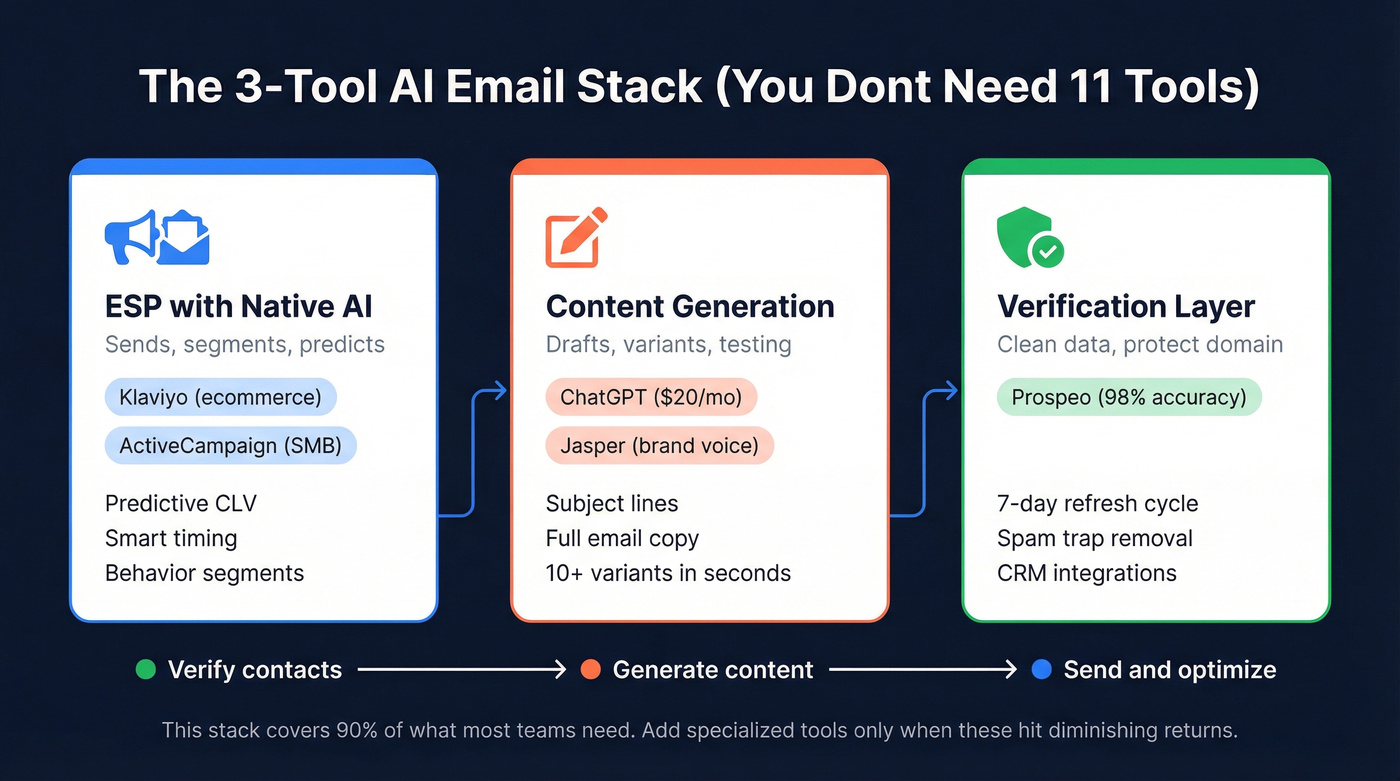
You need 2-3 tools, not 11. One ESP with native AI (Klaviyo for ecommerce, ActiveCampaign for SMB), one content tool like ChatGPT, and one verification layer. That's the stack.
Verify before you scale. AI on dirty data damages your domain faster than manual campaigns ever could. Pair any AI-powered email program with a verification layer that refreshes weekly, not every six weeks.
Where AI-Powered Email Stands in 2026
The shift happened fast. 70% of email marketers say up to half of their operations will be AI-driven by the end of 2026, and the share of marketers using generative AI for email tasks jumped 340% between 2024 and 2025. The production timeline collapsed: teams needing two or more weeks to produce a single email dropped from 62% to just 6%.
That speed is real. So is the downstream pressure it creates.
More emails, faster, to more people - and ISPs are watching. Email ROI still holds at $36-$42 per $1 spent, making it the highest-return channel in digital marketing. But that number assumes your emails actually land.
| Metric | 2026 Range |
|---|---|
| Open rate | 26.9%-42.35% |
| Click-through rate | 2.0%-3.2% |
| Bounce rate | 2.48% avg |
| Unsubscribe rate | 0.1% global |
| Inbox placement | ~83% |
That inbox placement number should worry you. Roughly 16.9% of emails never reach the inbox - they're bouncing, landing in spam, or vanishing entirely. AI is accelerating send volume while deliverability gets tighter. That's a collision course.
What AI Actually Does in Email
AI does two distinct jobs in email programs, and the mistake most teams make is treating them as the same thing.
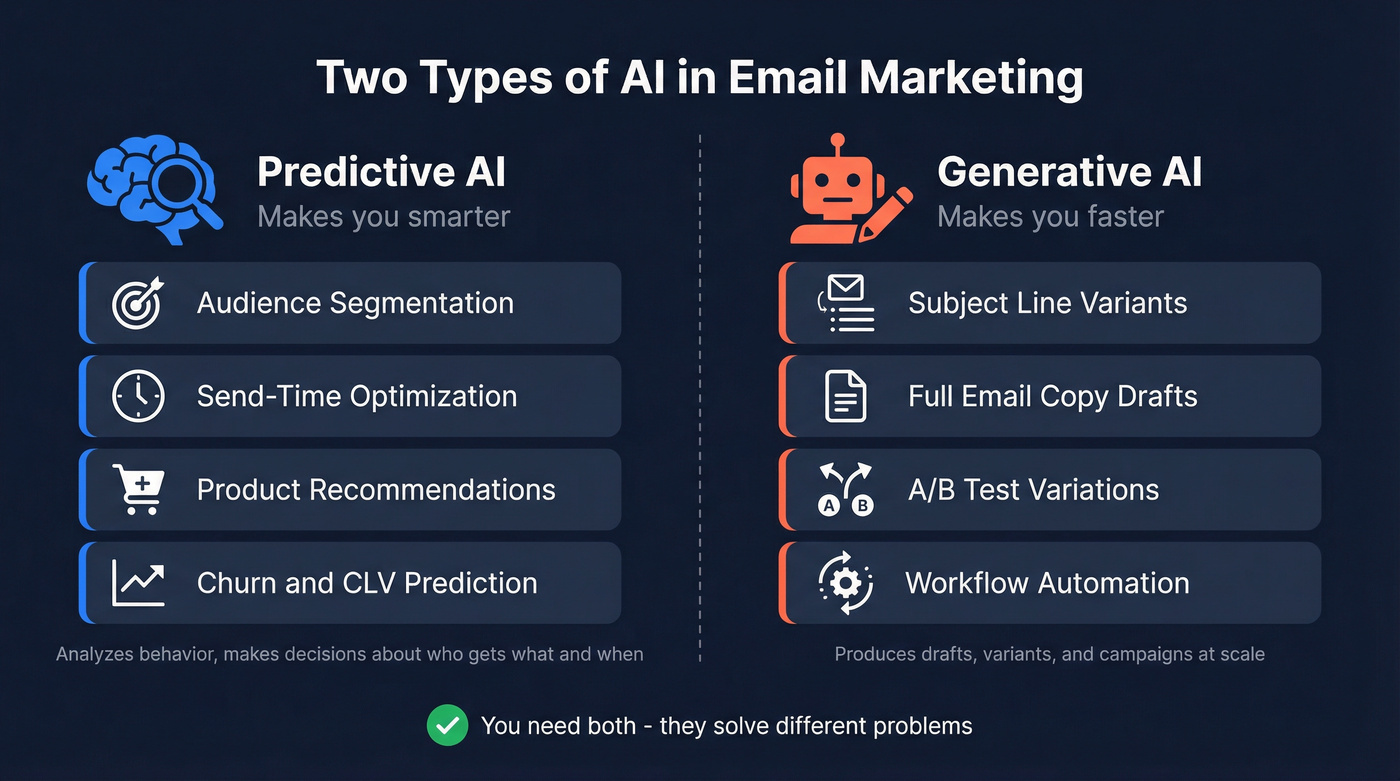
Predictive AI makes you smarter. Personalization, timing, segmentation, product recommendations - it analyzes behavioral data and makes decisions about who gets what, when. Klaviyo's predictive CLV and churn scoring are good examples. One underexplored benefit: AI-driven personalization surfaces a wider range of customer preferences and product combinations than manual segmentation, which tends to default to the most obvious demographic buckets.
Generative AI makes you faster. Content generation, variant testing, workflow automation - it produces drafts, subject lines, and campaign structures at a pace no human team can match. ChatGPT dominates at 51% usage, followed by Copy.ai at 22% and Jasper at 14%.
You need both. But they solve different problems.
Use Cases That Deliver Real Results
Subject Line Optimization
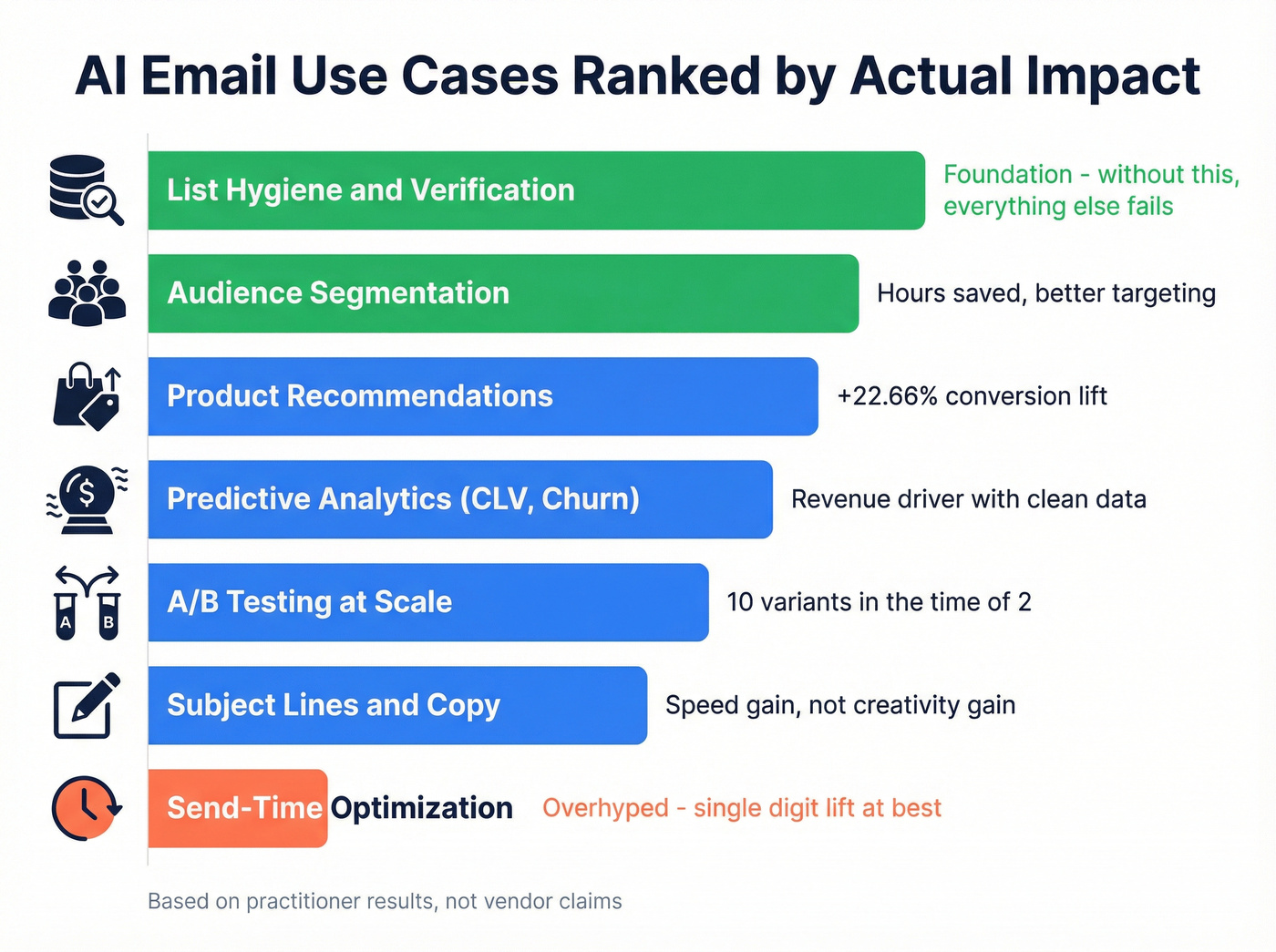
47% of people open emails based on the subject line alone. AI's strength here isn't writing one perfect subject line - it's generating 20 variants in seconds so you can test more aggressively. Try this prompt: "Write 10 subject lines for a SaaS renewal reminder. Tone: urgent but not pushy. Max 50 characters." You'll have a testing pool in under a minute. The real win is testing velocity, not AI creativity. (If you need examples, borrow patterns from re-engagement subject lines and adapt them to your offer.)
Content and Copy Generation
ChatGPT and Jasper can draft full email sequences in minutes. The guardrail that matters: brand voice. AI-generated copy defaults to a generic, slightly enthusiastic tone that reads like every other email in your prospect's inbox. Feed it your style guide, past high-performing emails, and specific customer language. Without that context, you're generating polished mediocrity.
AI can also handle accessibility tasks - generating alt text for images, checking contrast ratios, formatting for screen readers - which most teams still do manually or skip entirely.
Send-Time Optimization
Here's the thing: send-time optimization is the most overhyped feature in the space. Every ESP pitches it. The actual lift? Single digits in most cases. If your open rates are 25%, optimized timing might push them to 26-27%. Focus your energy on behavioral segmentation and content first. Come back to send-time once those are producing diminishing returns.
Audience Segmentation
This is where predictive AI earns its keep. Instead of building segments manually based on demographics, AI clusters audiences by behavior - purchase patterns, engagement frequency, content preferences, browsing history. Klaviyo's natural-language segmentation lets you type something like "customers who bought skincare products but never purchased moisturizer" and get a ready-to-target segment. That's genuinely powerful and saves hours of filter-building.
A/B Testing at Scale
The traditional A/B test - two subject lines, split your list, wait 48 hours - is painfully slow. AI multivariate testing changes the math entirely. You run tests across subject lines, preview text, CTAs, and send times simultaneously, testing 10 variants in the time it used to take to test 2. More tests, faster cycles, better compounding results over time. (If you want a tool shortlist, see email A/B testing tools.)
Personalized Product Recommendations
AI-driven product recommendations in email can increase conversion rates by 22.66%. This works especially well for ecommerce - post-purchase flows, abandoned cart sequences, and re-engagement campaigns. The key is feeding the recommendation engine enough behavioral data. Thin data produces generic suggestions that feel like spam.
Predictive Analytics
Predicting which customers are about to churn, which leads are most likely to convert, and what each customer's lifetime value looks like - that's where AI moves from "nice to have" to "revenue driver." Klaviyo and Salesforce both offer predictive CLV and churn risk scoring natively. The teams getting the most from this are the ones feeding clean, enriched data into these models. Garbage in, garbage out. The model is only as good as what you feed it.
List Hygiene and Verification
This is the use case nobody writes about, and it's the most important one.
When AI scales your email output from 5,000 sends a week to 50,000, every bad address in your list does 10x more damage. Bounces spike. Spam traps trigger. Your domain reputation degrades. Behavior-triggered campaigns can drive over 50% open rates - but only if those emails actually reach inboxes. (If you’re comparing vendors, start with an email ID validator or a broader email checker tool.)


You just read it: AI on dirty data wrecks your domain faster than manual campaigns ever could. Prospeo's 5-step email verification - with catch-all handling, spam-trap removal, and a 7-day refresh cycle - gives your AI email stack the clean foundation it needs. 98% accuracy at $0.01/email.
Stop letting AI amplify bad data. Fix the foundation first.
The Data Quality Prerequisite
AI doesn't fix bad data. It amplifies it.
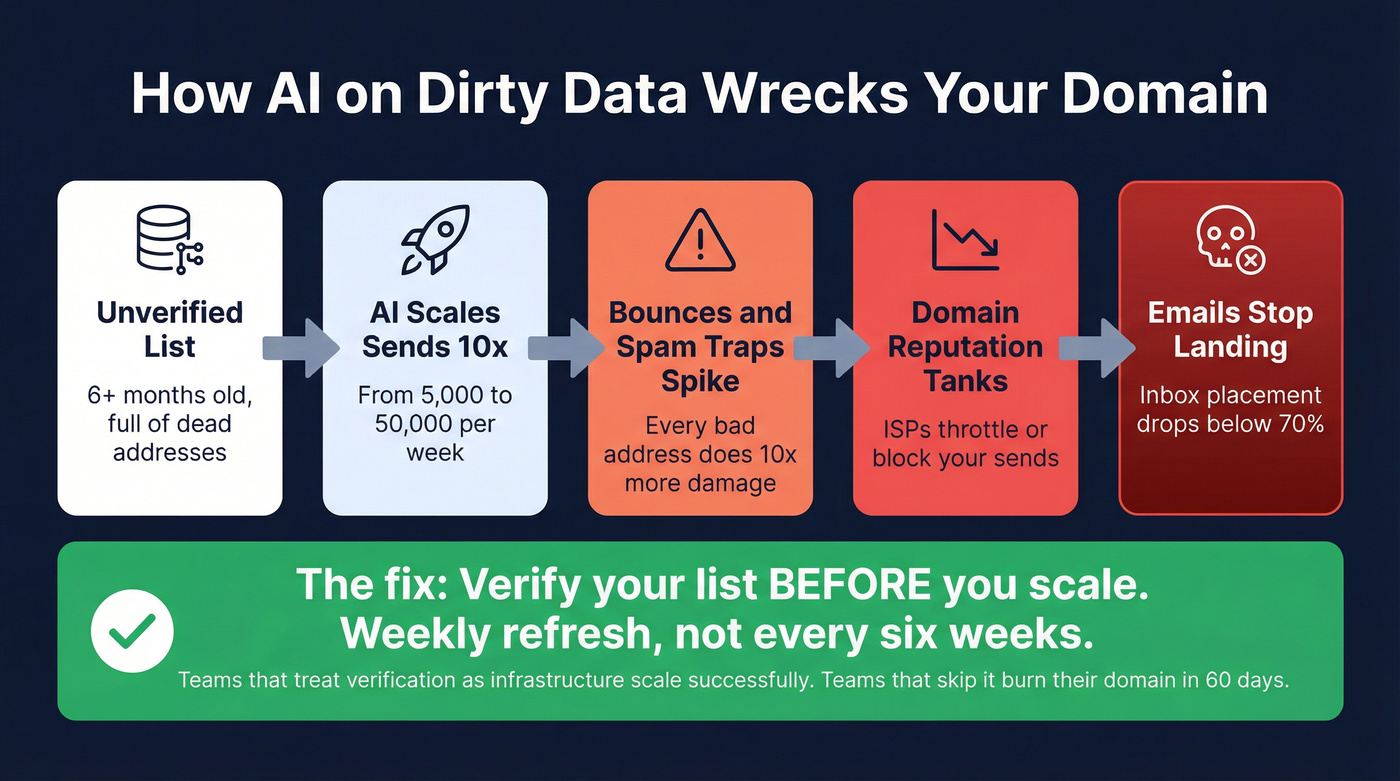
Average inbox placement sits at roughly 83%. That means nearly 16.9% of your emails never reach a human being. The industry average bounce rate is 2.48%, and Gmail and Yahoo now enforce a hard spam complaint threshold of 0.3%. When AI tools 10x your sending volume, you're 10x-ing your exposure to these thresholds.
We've seen this pattern repeatedly: a team adopts AI email tools, output skyrockets, and within 60 days their domain score is in the gutter because nobody cleaned the list first. The AI didn't cause the problem. It accelerated it.
The most common complaint from practitioners isn't that AI writes bad emails. It's that AI writes too many emails to too many bad addresses. The teams that scale successfully treat verification as infrastructure, not an afterthought.
Before you scale AI-powered sends, run your list through verification that catches invalid addresses, spam traps, and honeypots. Prospeo's 5-step verification process delivers 98% email accuracy across 143M+ verified addresses on a 7-day refresh cycle - the average B2B data provider refreshes every six weeks. Upload a CSV, get results in minutes, and push clean contacts directly into your CRM through native integrations with HubSpot, Salesforce, Instantly, and Lemlist. The free tier gives you 75 verified emails per month to test the workflow, and credits run roughly $0.01 per email after that. (If you want the deeper workflow, see email verification for outreach.)
Compare that to the cost of a burned domain.
Tools Worth Using in 2026
You need 2-3 tools, not 11. Here's the landscape, organized by what each tool actually does.
| Tool | Category | Starting Price | AI Highlight |
|---|---|---|---|
| Klaviyo | Lifecycle (ecommerce) | Free / paid plans | Predictive CLV, smart timing |
| ActiveCampaign | Lifecycle (SMB) | ~$15/mo | Predictive sending, workflows |
| MailerLite | Lifecycle (budget) | Free / ~$10/mo | AI subject lines, smart sending |
| ChatGPT | Content generation | Free / $20/mo | Most versatile for email copy |
| Jasper | Content generation | Paid plans | Brand voice templates |
| Copy.ai | Content generation | ~$29/mo | Workflow automation, bulk copy |
| Instantly | Outbound | ~$30/mo | AI sequences, send scheduling |
| Prospeo | Data quality | Free / ~$0.01/email | 98% accuracy, 7-day refresh |
| Phrasee | Subject lines (enterprise) | ~$500+/mo | NLP-optimized at scale |
| SendGrid | Deliverability / infra | Free tier available | Neural protection, ISP pacing |
Lifecycle and Marketing Automation. Klaviyo is a top choice for ecommerce email when you want native AI features like Smart Send Time, natural-language segmentation, and predictive CLV scoring. ActiveCampaign fills the SMB gap nicely with predictive sending, automated workflows, and a built-in CRM starting at ~$15/mo. MailerLite covers the basics well for early-stage teams.
Content Generation. ChatGPT at $20/mo is the most versatile content tool for email marketers - subject lines, body copy, campaign briefs, prompt-based variant generation. Jasper adds brand voice templates for teams producing at scale. For most teams, ChatGPT alone covers 80% of content needs.
Outbound and Sales. Instantly handles AI sequence writing and send scheduling for cold outbound. Pair it with a verification layer before any campaign goes live - Instantly's strength is delivery infrastructure, not data quality. (If you’re building a full outbound stack, start with cold email marketing tools.)
Specialized and Infrastructure. Phrasee is enterprise-only NLP subject line optimization - skip it unless you're sending millions of emails monthly. SendGrid offers deliverability tooling with AI-driven ISP pacing and retry logic that adapts sending patterns in real time.
Deliverability Guardrails for AI Sends
The 340% increase in marketers using genAI is creating a deliverability crunch. More emails, faster production, bigger lists - and ISPs are responding with tighter filtering.
Since February 2024, Gmail and Yahoo require bulk senders (5,000+ daily emails) to authenticate with SPF, DKIM, and DMARC, provide one-click unsubscribe, honor opt-outs within two days, and maintain a spam complaint rate under 0.3%.
Here's your pre-flight checklist before scaling AI sends:
- Authenticate everything. SPF, DKIM, DMARC - non-negotiable. If you haven't set these up, stop reading and go do it now. (If you need the exact steps, use this SPF, DKIM, DMARC guide.)
- Verify your list. Every address, every time. A 2.48% bounce rate is the average - you want to be well below it. (Related: hard bounce.)
- Monitor complaint rates weekly. Not monthly. One bad campaign can push you past 0.3% and trigger throttling.
- Warm new domains gradually. AI makes it tempting to blast 10,000 emails on day one. Don't. Ramp over 2-4 weeks. (More detail: automated email warmup.)
- Segment aggressively. Send to engaged contacts first. Let your domain build reputation before expanding to cold or dormant segments.
The AI email revolution is making deliverability worse for lazy operators and better for disciplined ones. Be disciplined.
Right Way vs. Wrong Way to Integrate AI
AI should be your co-pilot, not the pilot. Let's break down what that looks like in practice.
Do this:
- Generate 10-20 subject line variants, then pick the 4 best for testing. Human curation on AI output.
- Use predictive segmentation to identify high-intent audiences, then write targeted campaigns for each segment.
- Automate behavior-triggered flows and let AI optimize timing and content within those flows.
- Audit one campaign's personalization depth before scaling AI across your program. Are you personalizing on behavior, or just first name?
Don't do this:
- Ship AI-generated copy without editing. Two in five consumers are less likely to trust marketing emails they suspect were written by AI. The "AI slop" problem is real - technically correct but emotionally empty.
- Use clickbait subject lines because AI suggested them. Short-term open rate gains, long-term trust erosion.
- Over-send because production is easier. AI removing the content bottleneck doesn't mean you should email people daily.
- Skip the human authenticity layer. A real customer review, a handwritten-style PS, a genuine story - these elements can't be automated and they're what builds connection.
The most common practitioner complaint we hear echoes across Reddit threads and Slack communities: AI-generated emails all sound the same. Every inbox gets the same slightly enthusiastic, slightly urgent tone. The teams winning are the ones feeding AI their actual customer language, not relying on defaults.
Hot take: If your deals close under $15k, you probably don't need Klaviyo-level predictive analytics. ChatGPT plus a clean list will outperform a sophisticated AI stack built on dirty data every single time.
One pattern we've seen in ecommerce: teams producing "gorgeous" AI-optimized emails with unsubscribe rates climbing and revenue stagnating. The emails looked great. They just weren't relevant. AI optimized the wrong thing.
The rollout that works: audit one campaign's personalization depth - behavior vs. demographics. Add a human-only authenticity element like a real review or a handwritten-style PS. Measure clicks through to repeat purchases, then scale what works.
Predictive models, personalization engines, AI segmentation - they all produce garbage output when fed stale contacts. Prospeo refreshes 300M+ profiles every 7 days (industry average: 6 weeks) and returns 50+ enriched data points per contact. That's the data layer your AI email program is missing.
Feed your AI engine data it can actually work with.
FAQ
Does AI replace email marketers?
No. AI accelerates production - teams needing two-plus weeks to produce an email dropped from 62% to 6% - but strategy, brand voice, and human oversight remain irreplaceable. The human layer is a competitive advantage, not a luxury.
What's the ROI of AI-powered email campaigns?
Email ROI sits at $36-$42 per $1 spent. AI amplifies this through faster testing, a 22.66% conversion lift from personalized recommendations, and automated workflows. The compounding effect of more tests, faster iteration, and smarter segmentation is where the real return lives.
Which use cases move the needle most?
List hygiene, predictive segmentation, and subject line optimization deliver the highest measurable returns. Send-time optimization and content generation get more attention, but those first three matter most when your data foundation is solid.
How do I start using AI in my email program?
Clean your data first. AI personalization and send-time optimization are meaningless if 16.9% of your emails never reach an inbox. Prospeo's free tier lets you test the workflow with 75 verifications per month, then layer in AI content and automation tools once your list is healthy and your domain reputation is solid.
Clean data first. AI second. That's the order that works.