Creatio vs Salesforce: Which CRM Is Actually Worth Your Money in 2026?
You just got the renewal quote. $165 per user per month - up 6% from last year - and that's before Agentforce, Premier support, or the storage overages your admin keeps flagging. The CFO wants to know why you're spending six figures on a CRM that reps still complain about. So you start comparing Creatio vs Salesforce to figure out if there's a better path forward.
One platform bets that business users should build and customize their own workflows without writing code. The other bets that a massive ecosystem of consultants, apps, and deep enterprise tooling justifies the premium. The right choice depends entirely on where your team sits today and where it's headed.
30-Second Verdict
Under 200 employees, no legacy CRM investment: Go with Creatio. Lower TCO, faster deployment, AI baked into the base license. You'll be live in weeks, not months.
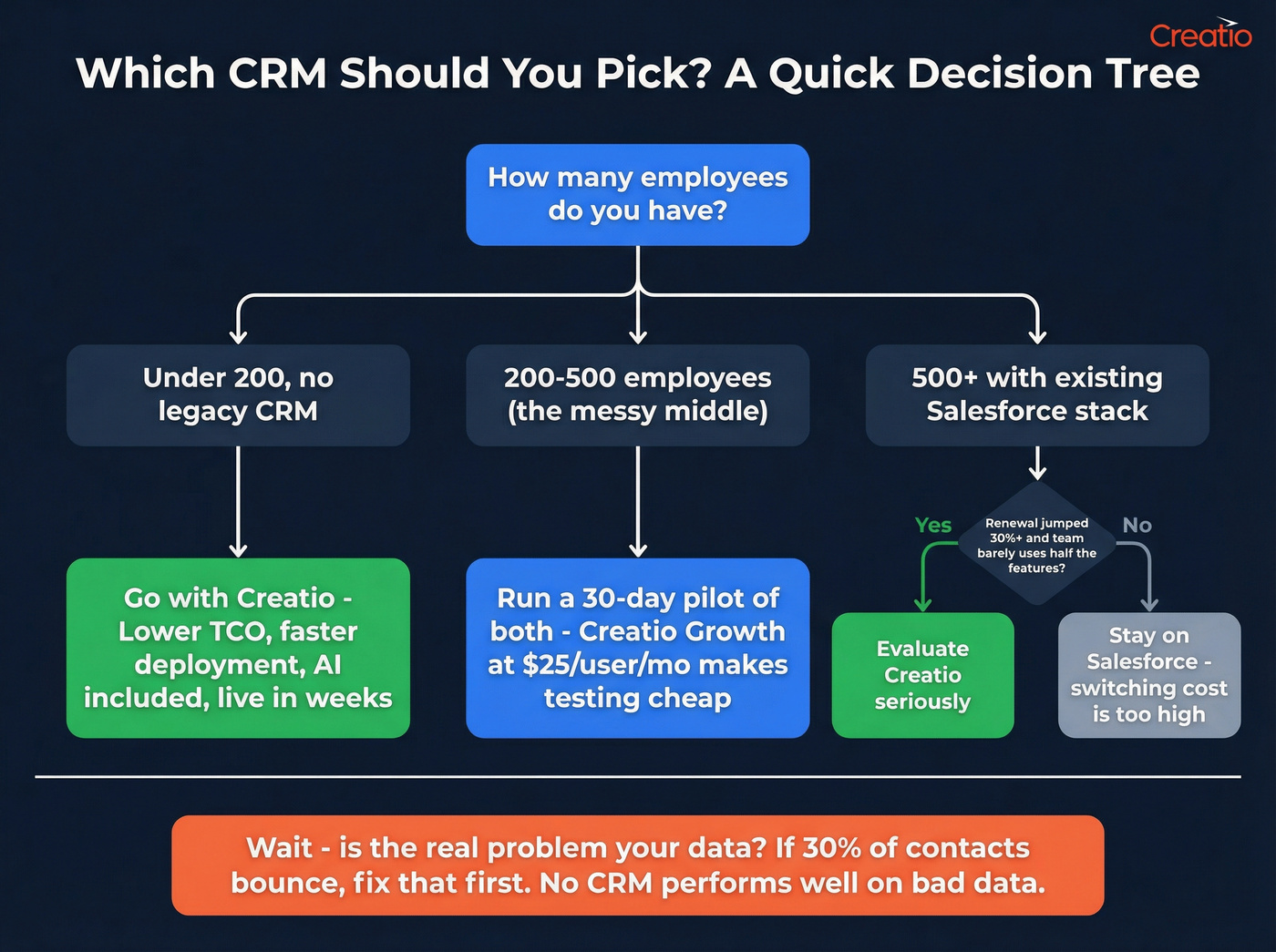
Enterprise 500+ with an existing Salesforce stack: Stay on Salesforce. The switching cost - data migration, retraining, integration rewiring - isn't worth it unless your renewal just jumped 30% and your team barely uses half the features.
200-500 employees (the messy middle): Run a 30-day pilot of both. Creatio's Growth plan at $25/user/month makes this cheap to test. Salesforce Starter matches that price, but you'll outgrow it fast.
Skip both if: Your real problem isn't the CRM - it's the data inside it. Dead emails, wrong phone numbers, contacts who left the company two years ago. Fix that first. No CRM performs well when 30% of your contacts bounce.
Creatio vs Salesforce at a Glance
| Dimension | Creatio | Salesforce |
|---|---|---|
| G2 Rating | 4.7/5 (311 reviews) | 4.4/5 (25,418 reviews) |
| Entry Price | $25/user/mo | $25/user/mo |
| Mid-Tier Price | $55/user/mo | ~$165/user/mo |
| AI Included? | Yes, in base license | Add-on ($125-$550/mo) |
| Customization | No-code / drag-and-drop | Apex, Visualforce, code |
| Dashboards & Reporting | Good (80% benchmark) | Stronger (90% benchmark) |
| Implementation | Weeks | Months |
| Best For | Mid-market, fast movers | Enterprise 500+, complex orgs |
| Marketplace | 700+ add-ons | 5,000+ AppExchange apps |
| Company Size | ~850 employees | 75,000+ employees |
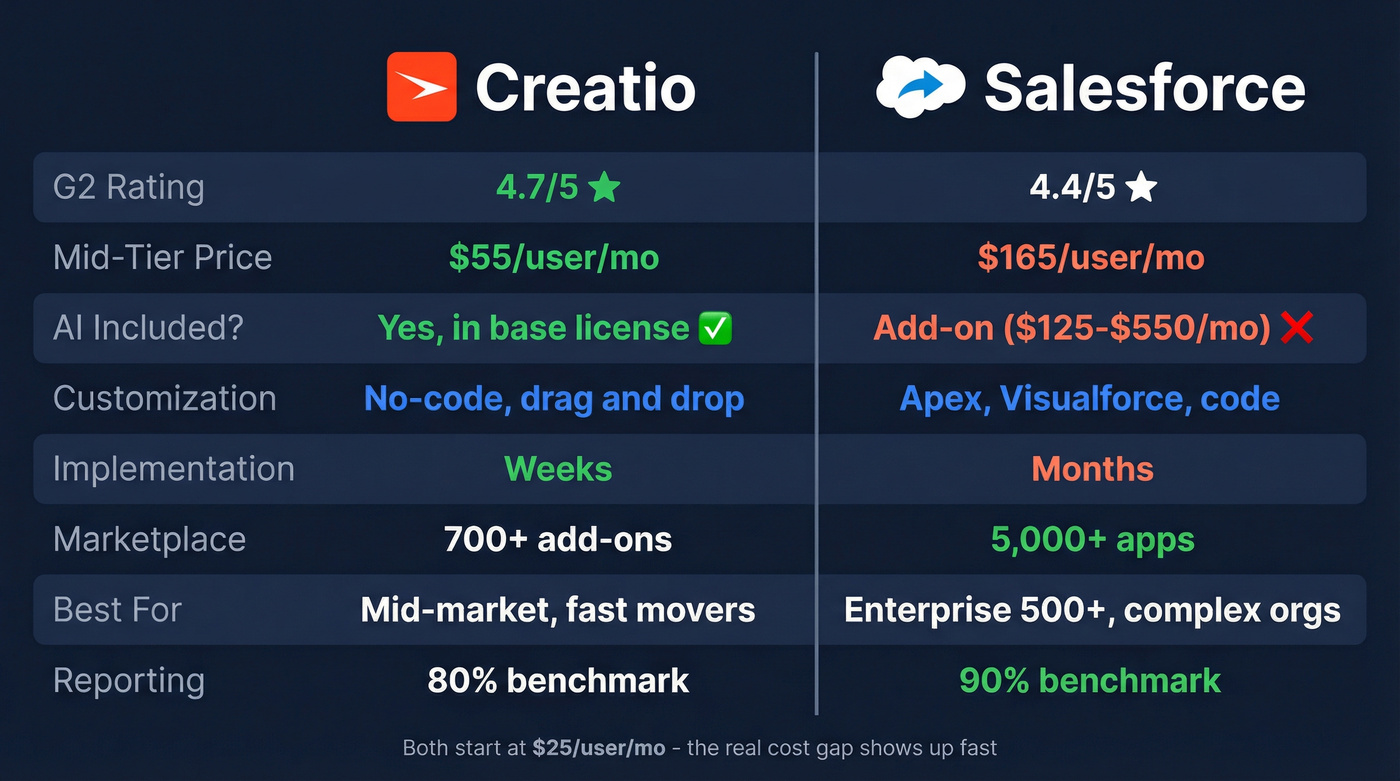
Both platforms start at $25/user/month on paper. That's where the similarity ends. The real cost divergence hits the moment you need AI, support, customization, or anything beyond basic contact management.
Pricing Breakdown - What You'll Actually Pay
Creatio Pricing
Creatio uses a composable model: pick your platform tier, then bolt on product modules. It's modular, which gives you flexibility - but also means you need to stack components to see your real cost.
| Component | Price |
|---|---|
| Growth (platform) | $25/user/mo |
| Enterprise (platform) | $55/user/mo |
| Unlimited (platform) | $85/user/mo |
| Sales module | +$15/user/mo |
| Marketing module | +$15/user/mo |
| Service module | +$15/user/mo |
| AI token pack | $150/10M tokens |
| Basic support | Free |
| Business support | 10% of subscription |
| Premium support | 20% of subscription |
A sales team on Enterprise with the Sales module pays $70/user/month. Add Premium support and you're at $84/user/month. There's a $10,000/year minimum commitment, which means you need at least ~21 users on Growth+Sales to clear the floor.
Limited-use licenses (mobile-only, internal, B2B portal) run $12/user/month - useful for field teams or partner access.
Salesforce Pricing (After the August 2025 Increase)
Salesforce bumped Enterprise and Unlimited edition prices by ~6% in August 2025. Starter and Pro stayed flat.
| Edition | Price |
|---|---|
| Starter | $25/user/mo |
| Professional | ~$80/user/mo |
| Enterprise | ~$165/user/mo |
| Unlimited | ~$330/user/mo |
| Agentforce add-on | +$125/user/mo |
| Agentforce 1 Edition | +$550/user/mo |
| Premier Support | +15% of license |
| Extra storage | $125/mo per 500 MB |
The Agentforce Tax - What Salesforce AI Actually Costs
Here's where the gap gets painful.
Creatio includes AI - predictive, generative, and agentic capabilities - in every platform tier. No add-on. No token metering beyond the optional $150 packs for heavy usage.
Salesforce? AI starts at $125/user/month for Agentforce add-ons on top of your Enterprise or Unlimited license. Want the full suite with Tableau Next, Flex Credits, and Data Cloud? That's the Agentforce 1 Edition at $550/user/month.
For a 50-user team on Enterprise, adding Agentforce means an extra $75,000/year. The Agentforce 1 Edition? $330,000/year on top of your existing license. That's not a rounding error - that's a headcount decision.

You just read that 30% of CRM contacts bounce. That's not a Creatio problem or a Salesforce problem - it's a data problem. Prospeo enriches your CRM with 98% verified emails and 125M+ direct dials, refreshed every 7 days.
Fix the data before you switch the CRM.
Total Cost of Ownership - The Math Nobody Else Does
50-User Sales Team: Year 1 Costs Side by Side
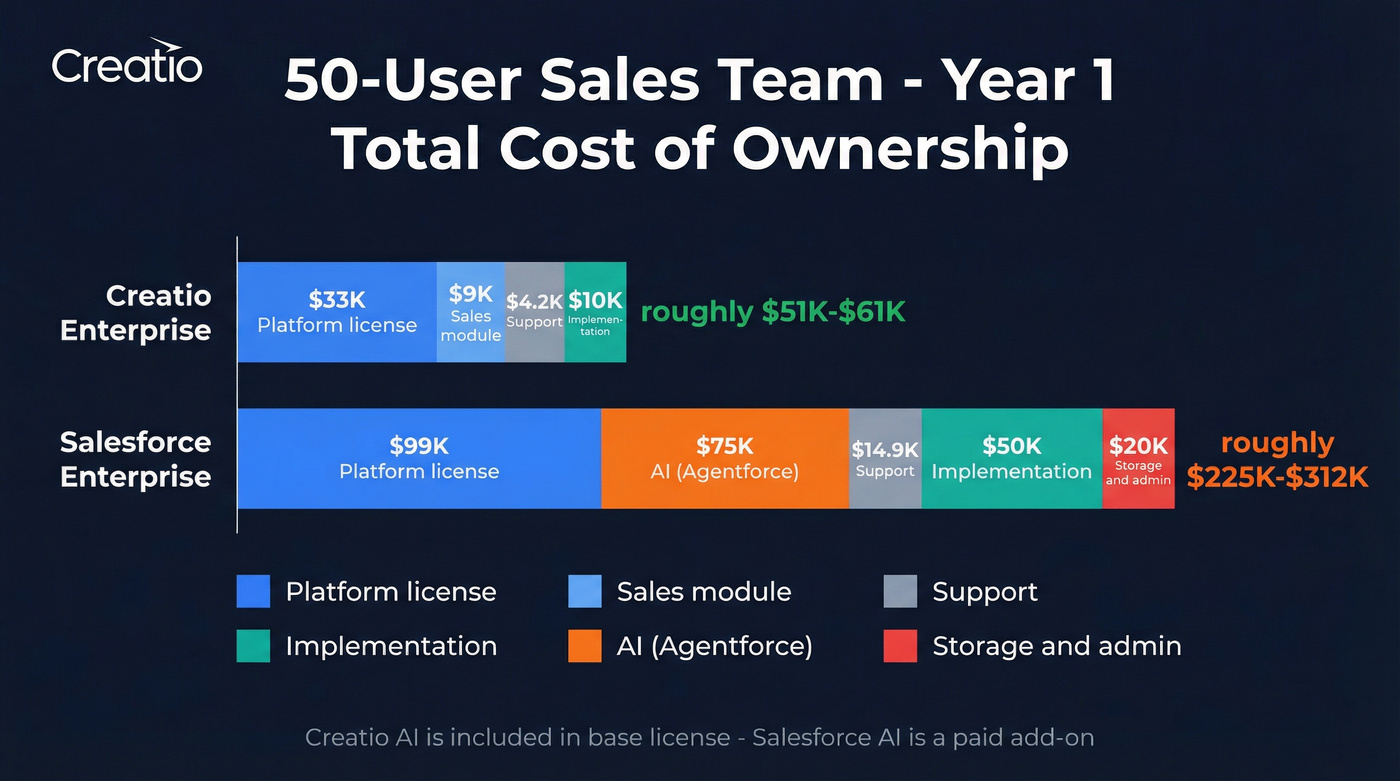
We've run these numbers for enough teams to know the sticker price is maybe 40% of the story. Here's what a 50-user sales team actually pays in Year 1:
| Cost Component | Creatio (Enterprise) | Salesforce (Enterprise) |
|---|---|---|
| Platform license | $33,000/yr | $99,000/yr |
| Sales module | $9,000/yr | Included |
| AI capabilities | Included | +$75,000/yr (Agentforce) |
| Implementation | $5,000-$15,000 | $20,000-$80,000 |
| Support (Business/Premier) | $4,200/yr | $14,850/yr |
| Storage overages | Minimal | $1,500-$3,000/yr |
| Admin/consultant costs | In-house (no-code) | $15,000-$40,000/yr |
| Year 1 Total (without AI add-on) | ~$51K-$61K | ~$150K-$237K |
| Year 1 Total (with AI add-on) | ~$51K-$61K | ~$225K-$312K |
Creatio's range stays tight because the no-code platform means your ops team handles most customization internally. Salesforce's range is enormous because implementation and consultant costs vary wildly by complexity.
Nucleus Research found organizations switching from legacy CRMs to Creatio report 37% lower TCO and 61% faster lead response times. That tracks with what we've seen in practice.
The Hidden Costs That Don't Show Up on the Pricing Page
The stat that should scare every Salesforce buyer: industry analyses show organizations spend up to 4x their original license cost annually on administration, configuration, and integration.
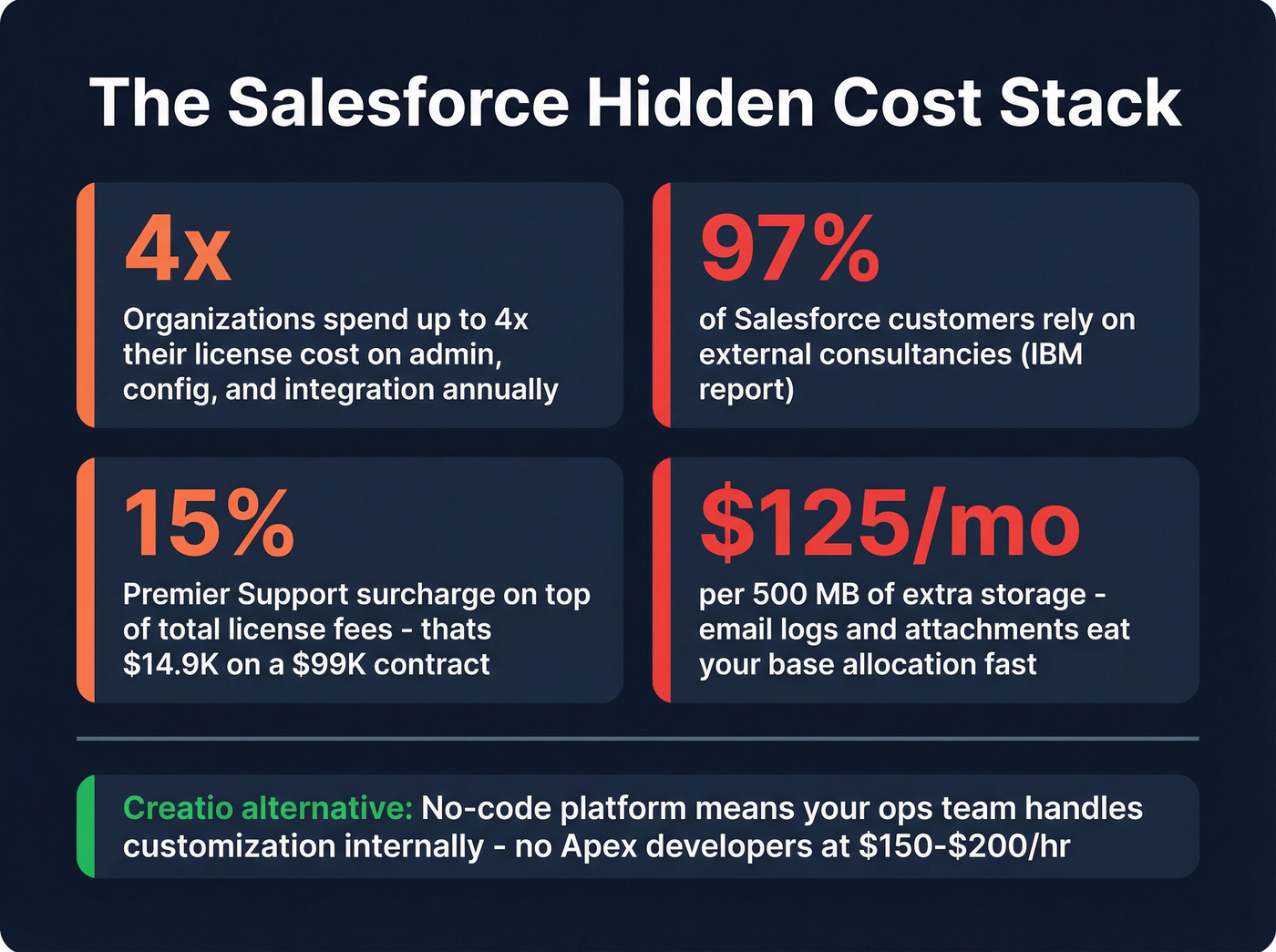
Salesforce's hidden cost stack:
- Premier support: 15% of your total license fees. On a $99K contract, that's nearly $15K/year just for faster response times.
- Consultant dependency: 97% of Salesforce customers rely on consultancies, per IBM's State of Salesforce report. That's not a bug - it's the business model.
- Storage overages: You get 1 GB of data storage plus 10 GB of file storage. Go over, and it's $125/month per 500 MB. Attachments, email logs, and activity data eat this fast.
- Implementation: Professional setup ranges from $5,000 to $80,000 depending on complexity - and ongoing maintenance means re-testing workflows every release cycle.
Creatio's hidden costs exist too. Data migration, training, and initial setup aren't free. But the no-code platform means you're not writing checks to Apex developers every time a workflow needs updating.
Feature Comparison - Sales, Service, AI, and Customization
No-Code vs Code-Heavy Customization
This is the fundamental philosophical split between these two platforms, and it drives almost every other difference in the comparison.
Creatio built its entire platform around the idea that business users - not developers - should modify workflows, create automations, and build custom applications. Salesforce's customization is deeper in absolute terms. Apex (its proprietary programming language) and Visualforce let you build virtually anything. But "anything" comes with a cost: you need developers who know Apex, and a senior Salesforce developer runs $150-$200/hour.

An independent analyst documented a 7,000-seat Creatio implementation with 100% user adoption - attributed directly to users' ability to adapt the system themselves. One customer at the same event reported functional replacement of a failed CRM implementation in a single weekend.
Salesforce's counter-argument is real: for deeply complex enterprise logic - multi-entity billing, custom CPQ workflows, regulatory compliance engines - Apex gives you control that drag-and-drop can't match. The question is whether your team actually needs that level of customization, or whether you're paying for capability you'll never touch.
Here's the thing: most companies buying Salesforce Enterprise are paying for a Ferrari and driving it to the grocery store. If your sales process is "qualify lead, demo, proposal, close," you don't need Apex. You need a CRM that works out of the box.
AI Capabilities - Included vs Add-On
| AI Feature | Creatio | Salesforce |
|---|---|---|
| Predictive scoring | Included | Agentforce add-on |
| Generative AI | Included | Agentforce add-on |
| AI agents | Included (Twins) | $125-$550/user/mo |
| Activity Capture | Manual config | Auto-logs emails/calendar |
| Min data required | Low | 1,000+ records |
| No-code AI config | Yes | Limited |
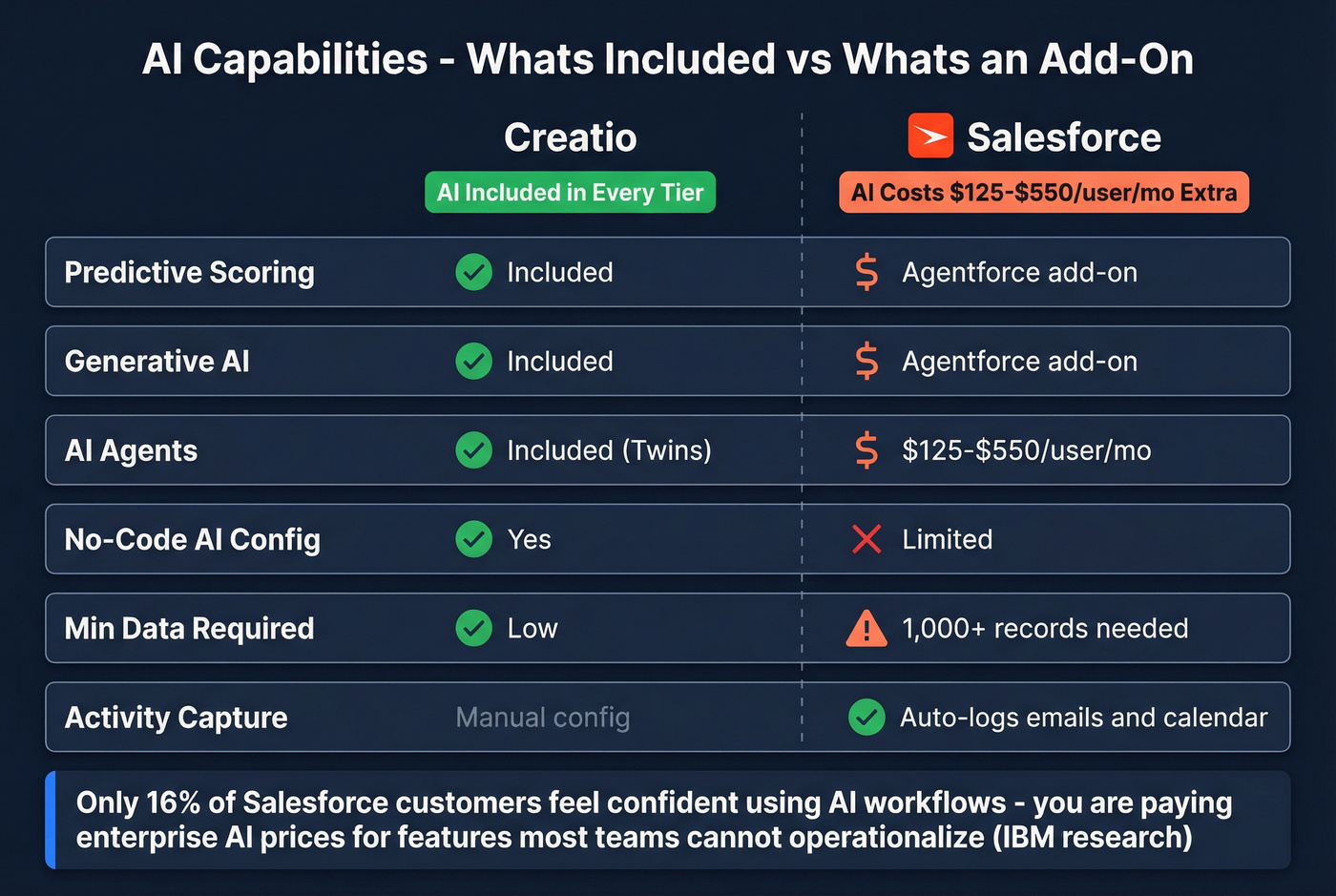
Creatio.ai ships with pre-configured agents for sales (account research, quote generation), marketing (campaign tasks), and service (ticket routing). The AI learns from your team's actual sales patterns and suggests next actions based on past outcomes.
Salesforce Einstein needs at least 1,000 historical records to start delivering useful predictions. For a startup or a team that just migrated, that's a cold start problem. Salesforce does win on Activity Capture - it auto-logs emails and calendar events without rep input, which is genuinely useful for pipeline hygiene. But the heavy hitters - Agentforce's agentic capabilities, Prompt Builder, and Tableau Next - all sit behind that $125-$550/user/month paywall.
Only 16% of Salesforce customers feel confident using AI workflows, per IBM's research. 45% are interested but don't know where to start. You're paying enterprise AI prices for a feature most teams can't operationalize.
Dashboards and Reporting
Salesforce edges Creatio here. On dashboard benchmarks, Salesforce scores around 90% versus Creatio's 80%. Salesforce's native Tableau integration and report builder give power users more flexibility for complex, multi-object reporting. Creatio's dashboards handle standard sales metrics well, but teams with heavy BI requirements will feel the gap.
Integration Ecosystem
Salesforce wins here, and it isn't close.
AppExchange has 5,000+ apps and 16,000+ partners, including ~9,000 consulting partners. Whatever niche tool you need - CPQ, contract management, territory planning - someone's built a Salesforce connector.
Creatio's marketplace runs 700+ add-ons. The gap is real. But Creatio compensates with strong REST/SOAP API support, Zapier integration, and popular iPaaS platforms. Its no-code tools also let you build custom integrations without developers, which partially offsets the smaller marketplace.
If your tech stack is deeply Salesforce-native (Pardot, Tableau, MuleSoft, Slack), switching to Creatio means rewiring those connections. That's a non-trivial project. If you're running a more standard stack (HubSpot Marketing, Outreach, Gong, etc.), the integration gap matters less.
Ease of Use and Implementation Speed
Nucleus Research found Creatio implementations run 70% faster than legacy CRM deployments. In practice, that means weeks instead of months.
Howdens, a UK building supplies company, had their first location live within 12 weeks of starting design and build. Their team called it "truly record time." Salesforce implementations? The range is enormous. A basic Starter setup takes days. An Enterprise deployment with custom objects, integrations, and data migration? Three to six months is standard, and I've seen projects stretch past a year.
The consultant dependency is the real kicker. IBM's State of Salesforce report found that 97% of Salesforce customers rely on consultancies. 34% of the entire Salesforce ecosystem workforce works for a consultancy. The platform's complexity creates a permanent services market around itself.
Reddit doesn't hold back on this. One r/CRM user described Salesforce Classic as looking "20 years out of date" and Lightning as "only 15." Another called it "configuration over convention taken to the absolute limit." Over on r/marketing, a user switching away wrote: "SF complexity and costs have gotten too much for us."
Creatio isn't friction-free, though. G2 reviewers note that "the initial setup required significant effort and time," and TechRadar flagged a steep learning curve, complex pricing structure, and limited timezone support as cons.
What the Analysts and Users Say
Analyst Scores - Forrester, Gartner, Nucleus
| Report | Salesforce | Creatio |
|---|---|---|
| Forrester Wave CRM 2025 | Leader (4.04 offering) | Strong Performer (3.80 strategy) |
| Gartner MQ SFA 2025 | Leader | Visionary |
| Gartner MQ B2B Marketing 2025 | - | Leader |
| Nucleus SFA Value Matrix | Leader | Leader |
| Forrester Low-Code 2024 | - | Only Leader |
Salesforce dominates the CRM analyst rankings - it scored second-highest on Current Offering (4.04/5, behind Oracle's 4.10) and tied for top Strategy score (4.26/5) in the Forrester Wave CRM 2025. Twenty years of market leadership and $12.4 billion in free cash flow buys a lot of product development.
But Creatio's trajectory is the story. Its Strategy score of 3.80 was the third-highest in the Forrester Wave - ahead of Pegasystems and Oracle. Forrester praised its roadmap for AI-driven CRM agents and scalable AI operationalization. One critique worth noting: Forrester flagged that Creatio doesn't yet give customers enough specific guidance on beginning AI journeys. The tools are there, but the hand-holding isn't.
Gartner named Creatio a Leader in B2B Marketing Automation for the third consecutive year. And the Forrester low-code recognition matters most for the Creatio thesis: it was the only Leader in the 2024 Forrester Wave for Low-Code Platforms for Citizen Developers. That's the foundation everything else is built on.
What Real Users Say on G2 and Reddit
| G2 Dimension | Creatio | Salesforce |
|---|---|---|
| Meets Requirements | 9.1 | 8.8 |
| Ease of Use | 9.0 | 8.2 |
| Ease of Setup | 8.4 | 7.8 |
| Ease of Admin | 8.6 | 7.9 |
| Quality of Support | 9.1 | 8.1 |
| Business Partner | 9.2 | 8.4 |
| Product Direction | 9.2 | 8.3 |
Creatio outscores Salesforce on every single G2 dimension. The gap is widest on Quality of Support (9.1 vs 8.1) and Product Direction (9.2 vs 8.3).
The caveat: Salesforce has 25,418 reviews to Creatio's 311. That's an 80x difference in sample size. Creatio's scores will shift as the user base grows and more complex deployments get reviewed. Salesforce's scores are battle-tested across every industry and company size.
Purplebricks, the UK real estate brand, deployed a fully customized Creatio platform in 4 months and saw a 35% increase in leads and 50% more conversions. Their CTO said: "We couldn't have done this with any other software solution I've come across." Emeria's CIO captured the switching sentiment: "We replaced Salesforce with Creatio to simplify our systems and drive more efficient automation across our companies."
Teams leaving Salesforce aren't chasing features. They're fleeing complexity.
Who Should Choose Which
Choose Creatio If...
You're a mid-market company (50-500 users) that values speed over ecosystem depth. Creatio's sweet spot is teams that need a CRM live in weeks, not months, with AI included from day one. The no-code platform means your ops team owns customization instead of an outside consultancy.
You're replacing a legacy system and want to consolidate. A financial services firm replaced up to 7 legacy systems with Creatio, achieving 70% faster workflow delivery and 30% cost savings in the first year. DB Schenker, a 140+ year global logistics leader, moved from email-based case management to Creatio's unified service platform.
You need on-premise deployment. Creatio offers both cloud and on-premise options - a real differentiator for regulated industries (finance, healthcare, government) where data residency requirements rule out cloud-only platforms.
Your budget is real. At $51K-$61K/year for 50 users versus $150K-$237K on Salesforce (without AI add-ons), the savings fund an entire headcount. For a company with deals averaging under $15K, that math matters a lot.
Choose Salesforce If...
You're a large enterprise (500+ users) with complex, multi-department needs. Salesforce's ecosystem depth - 5,000+ apps, 16,000+ partners, pre-packaged industry clouds - is unmatched. If you need Financial Services Cloud, Health Cloud, or Manufacturing Cloud, nobody else comes close.
Your team already runs on Salesforce. Switching costs are brutal. Data migration, integration rewiring, retraining, and the institutional knowledge embedded in your current Salesforce instance all have real dollar values. Unless your renewal is egregious, optimize before you migrate.
Brand trust matters to your buying committee. "No one gets fired for buying Salesforce" is still true in 2026. If your board or investors expect to see Salesforce in the tech stack, that's a real consideration - even if it's not a rational one.
What About Running Both?
Some teams - especially large enterprises with autonomous business units - run Creatio for specific departments (service, marketing ops) alongside Salesforce as the core sales CRM. Integration options include one-way sync, bi-directional sync, and middleware via Zapier or iPaaS tools. It works, but adds complexity. For most companies under 1,000 employees, pick one and commit.
Quick Alternatives Worth Considering
If neither Creatio nor Salesforce fits, three options deserve a look. Marketing-heavy teams wanting CRM + marketing hub in one should evaluate HubSpot (~$45-$150/user/month for Sales Hub). Microsoft shops get native Teams/Outlook integration with Dynamics 365 (~$65-$135/user/month). Budget-conscious SMBs under 20 users will find Zoho CRM ($14-$52/user/month) does 80% of what they need at a fraction of the price.
The Step After Choosing Your CRM - Data Quality
Neither Creatio nor Salesforce will save you if your contact data is garbage.
I've watched teams spend six months picking the perfect CRM, migrate 50,000 contacts, and then watch their first outbound sequence bounce at 25%. The CRM didn't fail - the data did. This is the part of the buying process almost everyone skips, and it's the part that determines whether your new CRM actually produces pipeline or just looks pretty in a demo.
Prospeo handles this problem directly. It integrates with both Salesforce and Creatio, verifies emails at 98% accuracy across 143M+ verified addresses, and refreshes every record on a 7-day cycle - roughly 6x faster than the industry average. The workflow: verify and enrich your contacts before they enter the CRM, then keep them fresh with ongoing enrichment via API or direct integration.

Salesforce hidden costs hit 4x your license. Before spending $225K+ on a 50-seat stack, make sure reps aren't wasting hours on dead contacts. Prospeo's CRM enrichment returns 50+ data points per contact at $0.01/email.
Stop paying enterprise prices for outdated contact data.
FAQ
Is Creatio really cheaper than Salesforce?
Yes - significantly. A 50-user sales team pays ~$51K-$61K/year on Creatio Enterprise versus $150K-$237K on Salesforce Enterprise, before Agentforce. Creatio includes AI in the base license; Salesforce charges $125-$550/user/month extra. The gap widens further once you factor in consultant dependency and storage overages.
Can Creatio handle enterprise-scale deployments?
Yes. An independent analyst documented a 7,000-seat implementation with 100% user adoption. Creatio also serves DB Schenker and financial institutions replacing up to 7 legacy systems. The mid-market is its strongest segment, but it scales to thousands of seats.
What are Salesforce's biggest hidden costs?
Implementation ($5K-$80K), Premier support (15% of license fees), storage overages ($125/month per 500 MB), Agentforce AI ($125-$550/user/month), and consultant dependency. IBM found 97% of Salesforce customers rely on consultancies - that alone can double your effective spend.
Does Creatio have enough integrations for a modern sales stack?
Creatio's marketplace has 700+ add-ons versus Salesforce's 5,000+. The gap is real, but Creatio's no-code tools let you build custom integrations without developers. It supports Zapier, REST/SOAP APIs, and popular iPaaS platforms. For most mid-market stacks, that covers the essentials.
How do I keep CRM data accurate after migrating?
Verify contacts before importing - not after. Use a data quality tool like Prospeo that verifies emails at 98% accuracy with a 7-day refresh cycle. Upload your migration list, verify in bulk, then import clean records. Ongoing enrichment via API keeps data fresh as contacts change roles.