

How to End a Cold Call the Right Way: Scripts for Every Scenario
It's 2:47 PM on a Tuesday. You've burned through 40 dials. Finally, someone picks up - and they're actually talking. They're asking questions. You can feel the energy shift. Then your brain goes blank: how do I actually land this? You fumble through a vague "so, uh, would you want to chat sometime?" and the prospect says "sure, send me something" and hangs up. Meeting: not booked.
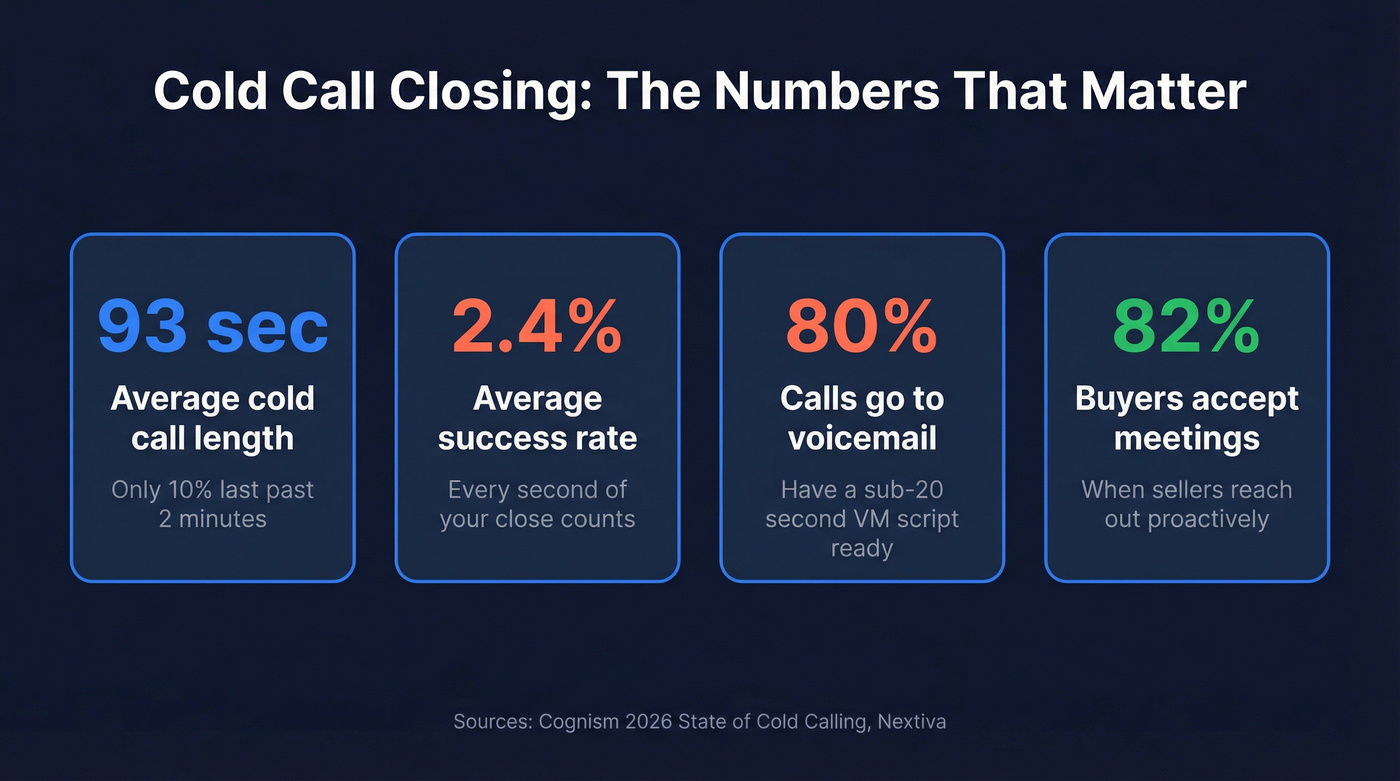
Knowing how to end a cold call is the difference between a booked meeting and a wasted dial. The close is where cold calls go to die - not because reps lack confidence, but because they don't have a repeatable framework for the last 15 seconds. Cognism's 2026 State of Cold Calling report puts the average cold call at just 93 seconds, with a success rate of roughly 2.4%. Your close needs to land fast, or it doesn't land at all.
What You Need (Quick Version)
Before the scripts and scenarios, here's the cheat sheet:
- You need two closes, not fifteen. One for interested prospects (propose a specific date and time) and one for objections (acknowledge, redirect, re-ask). Everything else is a variation.
- 93 seconds is your window. The average cold call lasts less than two minutes. Only 10% make it past the two-minute mark. If you're still "building rapport" at the 90-second mark, you've already lost.
- Most calls go to voicemail. 80% of them. Have a sub-20-second voicemail script ready before you start dialing.
- The first 5 minutes after hanging up are the highest-leverage window in your entire sales process. What you do post-call matters as much as the close itself.
Why Closing Technique Actually Matters on Cold Calls
Here's the thing: Gong analyzed 42,945 closing calls from over a million B2B sales recordings and found something counterintuitive. Won and lost closing calls look nearly identical - same talk-to-listen ratio, same number of questions, same speaker switches per minute. The difference between winning and losing a deal isn't what happens at the end. It's what happens at the beginning.
So why does closing technique matter on cold calls?
Because cold calls ARE the beginning. They're the earliest interaction in the sales cycle - the exact stage where the starkest differences between won and lost deals emerge. You're not closing a deal on a cold call. You're closing for a conversation. And that micro-commitment - getting 15 minutes on someone's calendar - is a fundamentally different skill than negotiating contract terms.
The demand is there. 82% of buyers accept meetings when sellers reach out proactively, and 69% accepted at least one cold call in a recent survey. Buyers aren't allergic to cold calls. They're allergic to bad ones. B2B buyers are also 5x more likely to engage with sales professionals who provide new insights rather than rehash what they already know. The gap isn't willingness. It's execution.
The reframe is simple: sell the conversation, not the product. The purchase isn't the next step in the sales process - in most cases, the next step is simply to talk more. And 57% of buyers say they prefer reps who don't pressure them, which is exactly why closing for a conversation works better than closing for a commitment. When you internalize that, your cold call CTA becomes lighter, more natural, and more effective.
Reading the Room Before You Close
You can't close well if you don't know where the prospect's head is. The last 20 seconds of a cold call should be shaped by what you heard in the first 60.

| Buying Signals | Disinterest Signals |
|---|---|
| Asks about pricing | One-word answers |
| Uses "we" or "our team" | Sounds distracted |
| Mentions internal needs | Flat "I'm good" tone |
| Asks about next steps | "Just send me an email" |
| Says "that's interesting" or "tell me more" | Repeatedly says "I'm not sure" |
| Engages with questions | Tries to end the call quickly |
The tone cues matter more than the words. If a prospect answers your opener with a flat "I'm good" without asking how you are, that's the first roadblock - their guard is up. But if they're leaning in, asking clarifying questions, using inclusive language like "we" - that's your green light.
Here's the distinction that matters: a prospect saying "just send me an email" after two minutes of engaged conversation means something completely different than the same words 15 seconds in. Context determines whether you're hearing a soft objection or a genuine request. Read the room, then pick your close.

A perfect close means nothing if you're dialing the wrong number. Prospeo gives you 125M+ verified mobile numbers with a 30% pickup rate - so you spend less time hitting voicemail and more time practicing that assumptive close on real decision-makers.
Stop perfecting your script on voicemail boxes. Dial numbers that pick up.
Closing a Cold Call That's Going Well
Five scripts for when the conversation has momentum. Each one targets a slightly different dynamic - pick the one that matches your style and the prospect's energy.

The Permission-Based Close
This works because it gives the prospect control while still driving toward a specific outcome. The 2-second pause after your ask is critical.
"The purpose of my call today was actually to set aside a half hour later this week - introduce myself and my company, and see if there's a fit. [2-second pause] Does Thursday at 2 work for you?"
The pause is what separates this from a pushy close. Rushing past the ask signals nervousness. Sitting in the silence signals confidence. Practitioners on r/sales consistently rank this as one of the highest-converting cold call closes, and we've seen it outperform more aggressive approaches in every bake-off we've run.
The Assumptive Close with a Specific Time
Most reps blow this one. Here's the bad version versus the good version:
Bad: "When works for you?" That's an open-ended question that invites "let me check and get back to you" (translation: never).
Good: "Great - I'd love to walk you through how we've helped teams like yours tackle this. Are you free Tuesday at 10 AM, or is Wednesday afternoon better?"
The two-option structure is deliberate. It frames the decision as when, not whether. It's easier for someone to say yes to a concrete option than to do the mental work of finding availability. One more edge: if you can mention a mutual connection, your chances of booking the meeting jump by 70%. Propose a specific time, give two options, and make it frictionless to say yes.
The Pre-Close + Close Combo
This one works by getting a micro-agreement before the actual ask. You're confirming the problem exists before proposing the solution.
"Based on what you've said about [specific pain point], it sounds like this is costing your team real time. Would it be worth 15 minutes to see how we've helped similar companies fix that? I'm thinking next Tuesday or Thursday."
The "based on what you've said" framing is powerful because it mirrors the prospect's own words back to them. It's hard to say no to your own problem.
The Cold Call Demo Offer
A practitioner on r/sales coined the "Ibuprofen Close," and it stuck with me because it's disarming in a way most scripts aren't. It explicitly acknowledges that you might not be the right fit - which paradoxically makes the prospect more willing to find out.
"Look, I'm not sure if what we have is going to be the ibuprofen for your every headache. But would it be worth 15 minutes to dig into your situation and see together if there's a fit?"
The honesty here is the weapon. In a world where every SDR sounds like they're reading from the same script, admitting uncertainty stands out. I've watched reps who use this consistently outbook their teammates who lead with confidence alone.
The Calendar-Invite-on-the-Phone Close
"Perfect - I'm sending you a calendar invite right now for Thursday at 2. You should see it pop up in a second. Got it? Great. I'll include a brief agenda so you know exactly what we'll cover."
This is the most underrated technique in cold calling. Once you get a verbal yes, don't hang up - send the calendar invite while you're still on the line. No-shows drop significantly when the invite lands in real time.
The key: have your calendar open before you even start dialing. If you need to fumble through tabs to find your scheduling tool, you've lost the moment.
How to End a Cold Call That's Going Badly
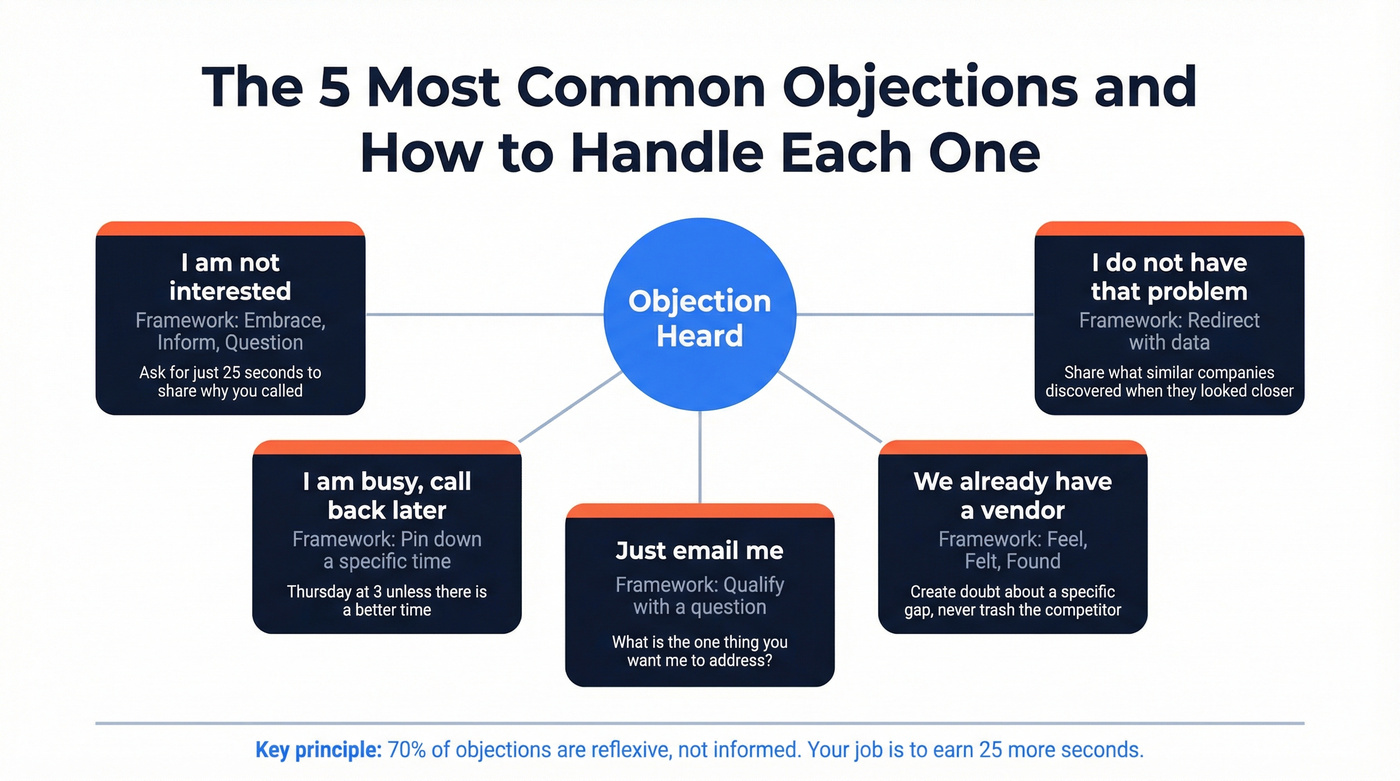
Not every call goes well. The top five objections reps face: "I'm not interested," "I don't have the problem you're describing," "I already have a solution," "I'm busy, call back later," and "could you email me instead?" Here's how to handle each one - and when to walk away.
"I'm Not Interested"
This is the most common objection and the most misunderstood. It's almost never a genuine, informed rejection. The prospect doesn't know enough about you to be truly uninterested - they're reflexively guarding their time.
Use the Embrace-Inform-Question framework: acknowledge the objection, provide a brief reframe, then ask an open-ended question.
"Totally fair - you don't have to be interested right now. Most of the folks I talk to weren't at first. Can I take 25 seconds to share why I called, and you can tell me if it's relevant?"
You're not arguing. You're asking for 25 seconds. That's a tiny commitment, and most people will grant it.
"I'm Busy, Call Back Later"
A deferral, not a rejection. The mistake most reps make is saying "sure, when's a good time?" and then never connecting again.
| What most reps do | What works |
|---|---|
| "Sure, when's a good time?" | "Can I take 25 seconds to share why I called?" |
| Accept vague "try next week" | Pin down: "I'll call Thursday at 3 unless there's a better time" |
| Log it and forget | Set a specific callback reminder with context notes |
"Totally understand - I'd hate to interrupt your day. Can I take 25 seconds to share why I called, and if it's not relevant, I'll call back at a better time?"
If they insist on a callback, get specific: "I'll plan on calling back Thursday at 3 unless there's a more convenient time for you." A vague "I'll try you next week" is a death sentence.
"Just Email Me"
About 70% of the time, "just email me" means "please go away." But 30% of the time, it's genuine - the prospect is in a meeting, driving, or just processes information better in writing. Your job is to figure out which one.
"Of course - I'll send that over today. Just so I can make it as useful as possible, what's the one thing you'd want me to address? That way it's not just another generic sales email."
The question at the end does two things: it qualifies whether they're genuinely interested, and it gives you intel to personalize the follow-up. If they give you a real answer, you've got a warm lead. If they say "just send whatever," you're dealing with a brush-off - send the email anyway, but don't count on it.
"We Already Have a Vendor"
This is actually one of the better objections to get. It means they've already bought into the category - you just need to create doubt about the current solution. The Feel-Felt-Found technique works well here:
"Makes total sense - most of the companies I talk to already have something in place. What a lot of them found was that [specific pain point your product solves] was still a gap. Is that something you've run into?"
Don't trash the competitor. Don't ask "are you happy with them?" (they'll say yes reflexively). Instead, name a specific problem that your solution addresses and see if it resonates.
The Graceful Exit (When It's Truly Over)
Sometimes the answer is genuinely no.
The prospect is hostile, completely outside your ICP, or has told you three times to stop calling. Knowing when to exit gracefully is a skill - and it preserves the relationship for future outreach.
No guilt trips. No "are you sure?" No last-ditch pitch. Just: "I appreciate your time - sounds like this isn't the right fit right now. If anything changes on your end, I'd love to reconnect. Have a great rest of your day."
A clean exit leaves the door open. I've seen prospects who said a hard no come back 6 months later because the rep was respectful on the way out. The long game matters.
How You Sound Matters More Than What You Say
Mehrabian's 7-38-55 rule gets cited constantly in sales training - and while it's often oversimplified, the core insight holds on phone calls: with body language removed, tone accounts for roughly 38% of how your message lands. The words themselves? Just 7%. On a cold call, how you close matters more than what you say.
Vocal delivery checklist for your close:
- Downward pitch on your ask. End your closing statements with a downward inflection. It sounds authoritative and confident. An upward inflection turns your close into a question - and questions are easy to deflect.
- The 2-second pause. After you propose a time, stop talking. Count to two in your head. The silence creates space for the prospect to process and respond. Rushing past the ask is the #1 delivery mistake.
- Slow it wayyy down. If you're new to sales, you're almost definitely speaking too fast. You should be speaking almost uncomfortably slow. Speed signals nervousness. Deliberate pacing signals control.
- Stand up. Use a standing desk or just stand during call blocks. Roll your shoulders back, chest out, look up. The energy transfers directly into your voice.
- Smile. It sounds ridiculous, but prospects can hear it. A smile adds warmth and makes you sound like a human being instead of a script-reading robot.
- Breathe from your diaphragm. Before a call block, try the 5-5-5 technique: inhale for 5 seconds, hold for 5, exhale for 5. It prevents vocal fatigue and projects more authority than speaking from your throat.
The best closers I've watched don't sound like they're closing. They sound like they're having a conversation and naturally suggesting the next step. That's the goal.
Five Mistakes That Kill Your Close
Asking "Is this a bad time?"
This opener decreases your chances of booking a meeting by 40%. It gives the prospect an easy out before you've delivered any value. Replace it with "Appreciate I caught you out of the blue - you got a minute?" Same acknowledgment, completely different energy.
Using urgency or scarcity language
"This offer expires Friday" or "we only have a few spots left" works in B2C. In B2B cold calls, it backfires. In one documented case, replacing urgency-based CTAs with data-backed proposals led to a 20% increase in win rate over two quarters. Pressure creates resistance. Data creates trust.
Talking about your product instead of the conversation
You're not closing a deal on a cold call. You're closing for a meeting. The moment you start listing features, you've shifted from "curious peer" to "salesperson" - and the prospect's guard goes up instantly.
Not proposing a specific time
"When works for you?" is the worst question in cold calling. It puts the cognitive burden on the prospect and almost always results in "let me check my calendar and get back to you." Propose Tuesday at 2 or Wednesday at 10. Make it easy to say yes.
Calling wrong numbers
The mistake that happens before you even dial. If a third of your contact data is stale, you're wasting hours on dial tones. Tools like Prospeo refresh mobile numbers every 7 days, so your call blocks actually reach humans instead of voicemail boxes attached to numbers that changed six months ago.
When the Call Goes to Voicemail
80% of your calls will go to voicemail. That's not a failure - it's an opportunity, if you treat it like one.
How prospects consume voicemails has changed. iOS 17+ and modern Android phones now transcribe voicemails in real time. Your prospects aren't listening to your message - they're reading it. That means old-school voicemails that bury the value behind "Hi, this is Mike from Acme, I'm reaching out because..." are dead on arrival. The first five seconds need to lead with value.
The sweet spot is 8-13 seconds. Three scripts built for the transcription era:
The Direct Value Prop:
"Hi [Name], this is [Your Name] from [Company] - we help [their industry] teams [specific result, e.g., 'cut churn by 40%']. Shooting you an email now with details. My number is [number]."
The Curiosity Hook:
"Hi [Name], [Your Name] from [Company]. I just noticed something about your [specific trigger - e.g., 'hiring page'] that I think you'll want to hear. Sending you a quick email now."
The Social Proof:
"Hi [Name], [Your Name] from [Company]. We just helped [similar company or competitor] [specific result]. Thought it'd be relevant for your team. Details in your inbox - my number is [number]."
No throat-clearing. No "I hope this message finds you well." Lead with the value prop, bridge to email, leave your number.
Here's what most reps miss: even unreturned voicemails lift email response rates by 2x when they're part of a structured multi-channel cadence. The voicemail isn't about getting a callback - it's about priming the prospect to open your email. Your voicemail should point directly to your cold email. That's the one-two punch.
The callback rate on B2B voicemails hovers around 2-5%. But when paired with email follow-up, engagement climbs to 8-10%. The voicemail is the assist, not the goal.
What to Do in the 5 Minutes After You Hang Up
The call ended. Now what? Following up within 5 minutes can increase conversion by up to 100x. What you do right now determines whether that conversation turns into pipeline or evaporates.
Step 1: Log the call immediately. Not in 20 minutes. Not at the end of your call block. Now. Capture the key pain point they mentioned, any names they dropped, and the specific next step you agreed on. Your memory degrades faster than you think.
Step 2: Send the calendar invite. If you booked a meeting, the invite should go out within 60 seconds of hanging up. Every minute you wait increases the no-show risk.
Step 3: Send a follow-up email. Reference something specific from the call - not a generic template. The prospect just gave you intel. Use it.
Step 4: Segment the lead. Every call outcome falls into one of three buckets:
- Hot: Agreed to next steps. Calendar invite sent. Follow up day-of with a brief confirmation email.
- Warm: Showed interest but non-committal. Enter a multi-touch cadence: Day 1 email, Day 3 value-add plus a professional network connection request mentioning the call, Day 5 phone follow-up, Day 8 social proof email, Day 10-14 "break-up" email.
- Cold: Polite but disengaged. Add to a longer nurture sequence. Don't burn the bridge.
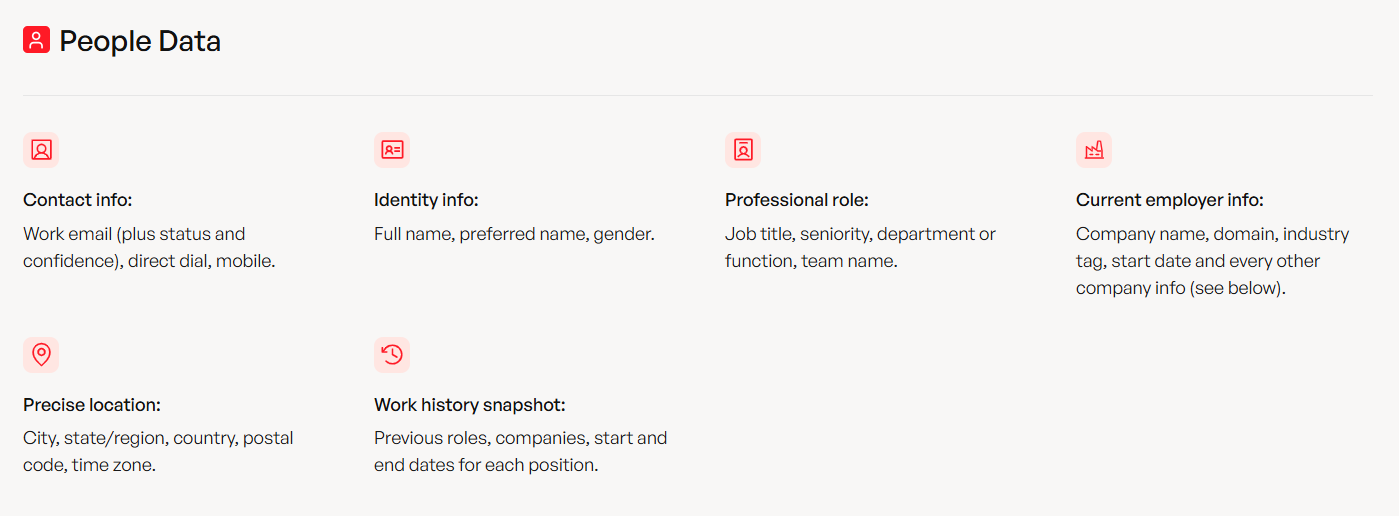
Step 5: Enrich the contact. Had a good conversation but only got a first name and company? Enrich the contact before you do anything else. Prospeo returns 50+ data points per contact - verified email, direct dial, company info, tech stack - so your follow-up email actually lands in the right inbox at roughly $0.01 per email with 98% accuracy.
Here's my frustration with most sales teams: they obsess over the close and completely neglect the post-call workflow. But 80% of sales require at least 5 follow-ups, and 44% of reps quit after one attempt. Multi-channel campaigns yield 28% higher conversion rates than email-only. The close on the phone is just the first domino. If your post-call system is broken, even a perfect close produces nothing.
FAQ
How long should a cold call last before you close?
Successful cold calls average 5 minutes and 50 seconds, but most end in 93 seconds. If you've held attention past 2 minutes, you're in the top 10% - that's your signal to transition to the close. Don't wait for the "perfect moment." It doesn't exist.
What's the best day and time to make cold calls in 2026?
Tuesday has the highest meeting-booking rate. Friday afternoons are underrated for C-suite - gatekeepers leave early and executives are more relaxed. Use Fridays for relationship-building calls, not hard closes. Skip Monday mornings when inboxes are overflowing.
How many times should you call a prospect before giving up?
Three calls capture 93% of total conversations; five calls capture 98.6%. Most reps stop at one - which is why they miss the vast majority of potential conversations. The drop-off from call 1 to call 2 is 73%, so a second attempt alone dramatically boosts your odds.
What should I do if every call goes to voicemail?
Leave an 8-13 second voicemail leading with your value prop, then immediately follow up with a cold email. Pairing voicemails with email in a multi-channel cadence lifts response rates by 2x. The voicemail primes the prospect to recognize your name when your email arrives.
How do I make sure I'm calling the right phone numbers?
Bad data is the silent killer of call blocks - stale numbers waste hours on dial tones. Use a B2B data platform that refreshes mobile numbers weekly and verifies them in real time. Test accuracy on a free tier before committing to anything.
You just nailed the close - now you need to follow up fast. Prospeo's Chrome extension finds verified emails in one click so your post-call follow-up lands in the right inbox within that critical 5-minute window. 98% email accuracy, zero bounces killing your momentum.
Turn every booked call into a confirmed meeting with verified contact data.