How to Handle Inbound Sales Calls (2026 Playbook + Scripts)
Inbound calls are won or lost in the first 90 seconds. The prospect's distracted, they're comparing you to at least one other option, and they usually open with "How much is it?" while they're half in a car, half in their inbox.
Here's the thing: if you treat inbound like "a quick demo," you'll waste the intent you didn't pay to create.
My hot take: if your inbound call feels "friendly" but doesn't end with a scheduled next step, it wasn't a good call. It was customer service.
Friendly doesn't close. A clean process closes.
Why inbound calls are harder than they look
Inbound calls feel easy because the prospect raised their hand, but that's exactly why they're dangerous: the buyer's running a fast audit, not starting a long sales journey. They're testing three things in real time - do you understand my situation, can you help, and are you going to waste my time - and they'll decide that before you finish your first explanation.

Here's the most common real-world scenario: they call from a noisy place (car, airport, open office), open with price, and mention they're also looking at one competitor. They want an answer in five minutes, not a product tour. If you answer price like a vending machine, you anchor the entire conversation on cost before you've earned value; if you dodge price, you sound slippery; if you open slides, you turn discovery into a lecture and the buyer stops giving you the context you need to win.
Inbound isn't about charisma. It's an operating system: tight opener, fast validation, timeboxed discovery, crisp recap, a recommendation, and a scheduled next step - plus ruthless speed-to-lead when you miss the call.
What you need (quick version)
If you want inbound calls to convert, you need three things: control, clarity, and speed - during the call and immediately after.

- Control = you set the agenda, timebox the conversation, and branch quickly (pricing-first vs demo request vs competitor comparison vs support handoff). You're not "dominating"--you're preventing rambling and keeping the buyer oriented.
- Clarity = you run a reflect-back recap ("Did I get that right?") and you close with an either/or next step. The buyer should leave the call feeling understood and knowing exactly what happens next.
- Speed = you answer fast, follow up fast, and multi-thread fast. Inbound intent decays by the hour; your process has to move in minutes.
Inbound call checklist (minimum viable system)
- A permission-based opener that sets expectations and earns the right to ask questions
- A timeboxed flow so you don't ramble when they're impatient
- A discovery spine (6-8 questions) that sounds natural
- A reflect-back recap so they feel understood (and you confirm accuracy)
- A next-step close that's either/or (not "want to meet sometime?")
- A speed-to-lead SLA for missed calls, forms, chat, and voicemail
- A follow-up template that's customized, not a generic PDF dump
- A manager scorecard so coaching isn't vibes-based
If you change only 3 things this week
- Use a permission-based opener (script below). It lowers defenses instantly and gives you control without sounding pushy.
- Do a reflect-back recap before you recommend anything. It prevents "that's not what I meant" whiplash and makes your recommendation land.
- Close with an either/or next step (two times). It's the simplest way to keep momentum without being aggressive.
60-second pre-call prep (what to check while it rings)
Inbound still rewards preparation - you just don't get 10 minutes. You get 60 seconds.
While the phone rings (or while the meeting starts), check:
- Source + page path: pricing page, integration page, careers page, support page - this tells you intent immediately.
- Company basics: industry + rough size (SMB vs mid-market vs enterprise changes the whole call).
- Role + seniority: are you talking to a user, evaluator, or buyer?
- Location/time zone: helps you schedule without friction.
- Existing customer flag: are they already in Salesforce/HubSpot as a customer, churned account, or open support ticket?
- One "smart guess" hypothesis: "Sounds like you're trying to fix X because Y." You'll validate it in the first minute.
This prep also avoids the #1 inbound embarrassment: spending 10 minutes discovering something your CRM already knew.
Know what kind of inbound call this is (and branch fast)
Inbound calls aren't one thing. Treating them like one thing is why reps either over-discover (annoying) or under-discover (shallow).
Use this quick decision tree in the first 60-90 seconds, then do the next action for that call type (not just a label).
Decision tree (branching logic)
1) Did they ask about price in the first sentence?
- Yes -> Pricing-first call
- No -> go next
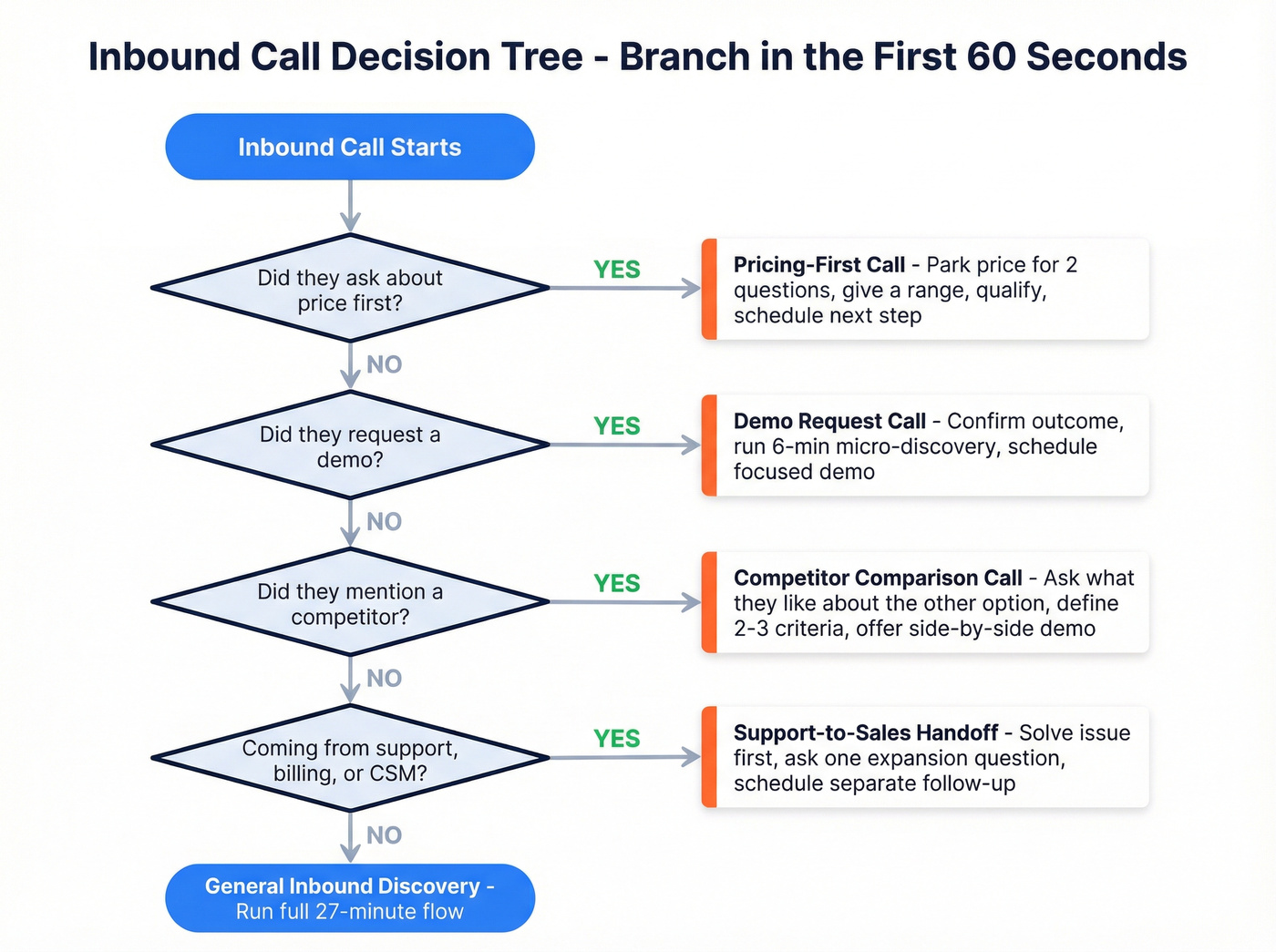
2) Did they explicitly request a demo/meeting?
- Yes -> Demo request call
- No -> go next
3) Did they mention another vendor by name?
- Yes -> Competitor comparison call
- No -> go next
4) Are they coming from support / CSM / billing?
- Yes -> Support-to-sales handoff
- No -> treat as general inbound discovery
What to do next (so branching actually helps)
- Pricing-first call: park price for 2 questions -> give a range -> qualify for fit -> schedule next step.
- Demo request call: confirm outcome + constraints -> do "micro-discovery" (6 minutes) -> schedule a focused demo (not a generic tour).
- Competitor comparison call: ask what they like about the other option -> define 2-3 decision criteria -> offer a side-by-side demo focused on those criteria.
- Support-to-sales handoff: solve/route the issue first -> then ask one expansion question if appropriate -> schedule a separate sales follow-up if there's real value.
Support-to-sales handoff micro-script (6-8 lines)
Use this to preserve trust and avoid the "sales hijacked my support call" vibe:
"Thanks for calling - before anything else, I want to make sure your issue gets handled. What's happening right now?" "Got it. I'm going to [route/create ticket/connect you] so this gets resolved. You'll get an update by [time]." "Quick question while I have you: is this issue blocking a larger goal like [outcome]?" "If yes: I can set up a separate 15-minute call to talk through options after support has you covered. Want to do that tomorrow at 2:45 or Thursday at 4:15?" "If no: let's focus on getting you unstuck today."
Use this if / Skip this if (so you don't overcomplicate it)
Use this branching if:
- You get a mix of "pricing?" calls and "book a demo" calls
- You have SDRs + AEs and need consistent handoffs
- Your team complains inbound is "random"
Skip this branching if:
- You only sell one simple plan and inbound is basically order-taking (If that's you, your biggest lever is speed-to-answer + clean scheduling, not deep discovery.)
Inbound isn't always real: 5 fast validation checks
A chunk of inbound is noise: burner emails, students, job seekers, vendors pitching you, existing customers calling "sales" because they can't find support, or competitors fishing for intel. Treat validation as part of professionalism, not paranoia.

Run these checks early - without making it awkward:
- Work identity: "What's your work email?" (If it's Gmail, ask why. Plenty of legit SMBs use it - but you should know.)
- Role fit: "What's your role in this project - are you the day-to-day owner or evaluating options?"
- Company fit: "Roughly how big is the team that would use this?"
- Intent: "What are you hoping changes after you implement something?"
- Timeline: "Are you trying to decide this month, or is this early research?"
If two or more answers don't add up, disqualify fast (script below) and move on. Inbound time's too expensive to spend on fake urgency.

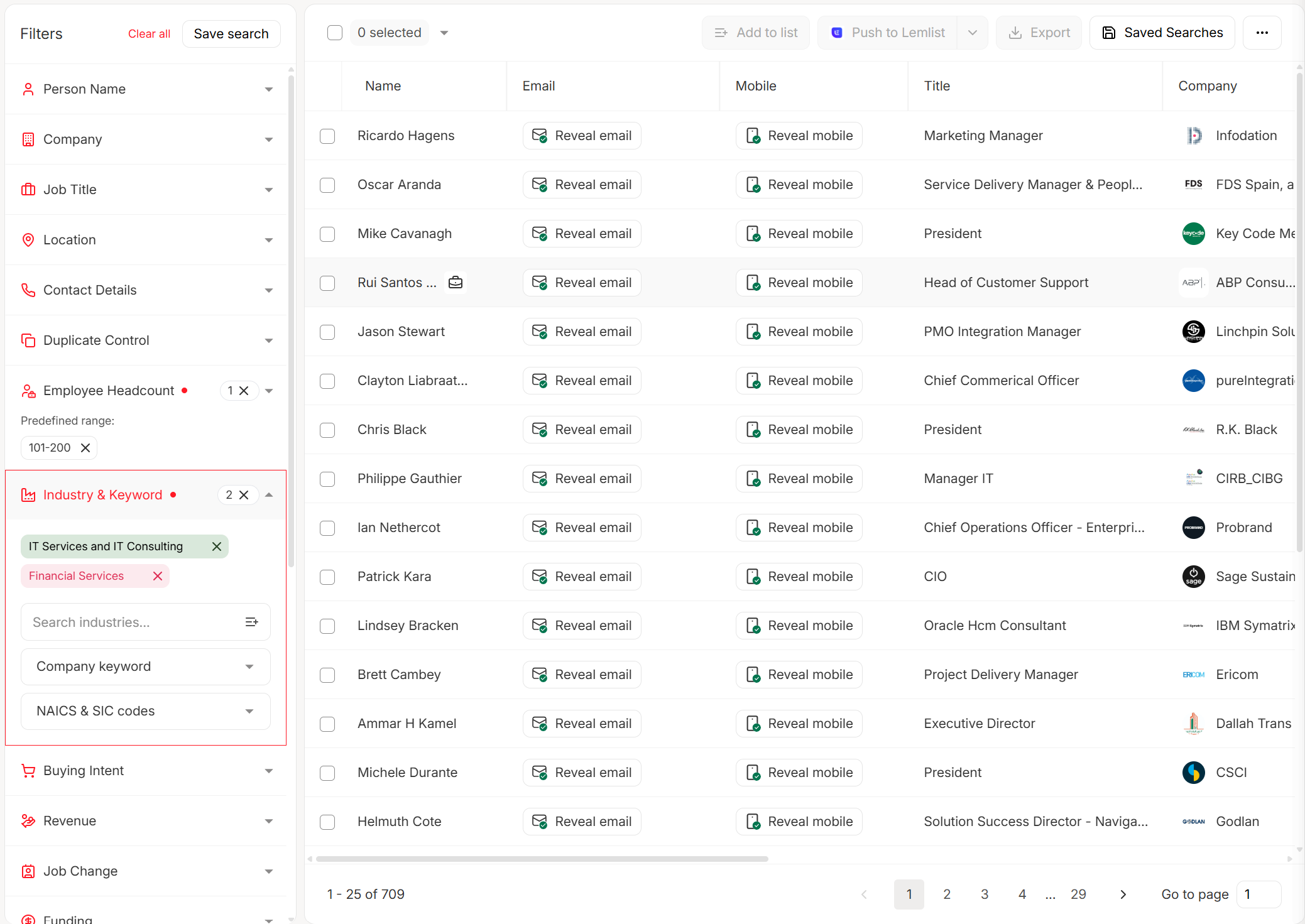
Your 60-second pre-call prep only works if your CRM data is fresh. Prospeo enriches every inbound lead with 50+ data points - role, seniority, company size, tech stack - on a 7-day refresh cycle. 83% of leads come back enriched. No stale records, no embarrassing discovery questions your system already knew the answer to.
Stop discovering what your CRM should already know.
The 27-minute flow: how to handle inbound sales calls end-to-end (copy/paste SOP)
This is the cleanest inbound structure we've seen work across SaaS, services, and "talk to sales" products. In our call reviews, the #1 failure isn't objection handling - it's reps letting the call drift until there's no time left to schedule anything.

Timeboxes (non-negotiable):
- First 2 minutes: set tone + control
- Next ~15 minutes: ask/listen
- ~3 minutes: reflect-back recap
- ~5 minutes: recommendation (without pitching)
- Final ~2 minutes: invitation + next step
Permission-based opener + agenda (first 30-60 seconds)
You're doing four jobs here:
- confirm you're talking to the right person
- set a collaborative tone
- earn permission to ask questions
- keep it human
Talk track (copy/paste):
"Thanks for calling - this is [Name]. Before we jump in, can I ask a quick question: what prompted you to reach out today?"
"Got it. My goal today is to understand where you're at, where you want to be, and then see if I can help. If I can't, I'll tell you. Sound good?"
"We've got about [X] minutes - here's what I suggest: I'll ask a few questions to understand the situation, I'll recap what I heard to make sure I'm not missing anything, then I'll recommend the best next step. Deal?"
Two gritty "human" lines that work:
- Name pronunciation: "I want to make sure I say your name right - did I get it?"
- Car call: "If you're driving, I'll keep this tight - two questions, then I'll give you a pricing range."
If they came in hot with "How much is it?" you still use the opener - just acknowledge and park it:
"Totally. We'll cover pricing. First, can I ask two quick questions so I don't give you a useless number?"
Discovery that doesn't sound like an interrogation (minutes 2-17)
Discovery fails when it feels like a checklist. The fix's simple: tell them why you're asking and connect questions to outcomes.
Your discovery spine (pick 6-8, not 20):
- "What are you using today to handle [problem]?"
- "What's working fine with that - and what's the part that's breaking?"
- "What triggered the search right now?"
- "What happens if this stays the same for the next 90 days?"
- "Who else will weigh in on the decision?"
- "What other vendors are you considering?"
- "What's your decision-making process from here?"
- "If we nailed this, what would 'success' look like?"
The transition line that makes it feel natural:
"Based on other companies we've worked with in [X industry], I see a few common challenges. But I'd rather hear it in your words - can I ask a couple quick questions?"
Coaching note: when you hear a real pain point, stop "progressing the list" and go deeper:
- "Say more about that."
- "What have you tried?"
- "What's the impact on the team?"
Reflect-back recap (minutes 17-20)
This is where trust gets built. A good recap makes the buyer think: "Finally, someone gets it."
Talk track (copy/paste):
"So from what I'm hearing, you're currently stuck at X... tried Y... because of Z... and you want [outcome] over the next 90 days. Did I get that right?"
Pause. Let them correct you. Corrections are gold - you just prevented a wrong recommendation.
Recommendation without pitching (minutes 20-25)
Recommendation isn't a feature dump. It's diagnosis -> prescription.
Talk track (copy/paste):
"What I've heard is you have [X problem]. Here's the approach I'd recommend: [simple approach]. You'd benefit from [Y and Z], mainly because it maps to what you said about [impact/outcome]."
Keep it tight:
- 1-2 outcomes you'll drive
- 1-2 capabilities that enable those outcomes
- 1 proof point (short)
- 1 fit condition (safe, not self-sabotage): "This works best when you have [volume/owner/process] in place."
Invitation close (minutes 25-27)
Inbound closes should feel like a mutual decision.
Talk track (copy/paste):
"Does this feel like a fit to you?"
If yes, schedule. If no, diagnose:
- "What would you need to see to feel confident?"
- "What's the biggest concern?"
If they only have 10 minutes: the compressed inbound flow
This happens constantly. Don't fight it - run a tighter clock.
0:00-1:00 (opener): permission + agenda
"Two questions, then I'll give you a pricing range and the best next step."
1:00-6:00 (micro-discovery):
- "What prompted you to reach out today?"
- "What are you using today?"
- "What's breaking / what's the impact?"
- "What does success look like?"
- "What's your timeline?"
6:00-7:30 (recap):
"Let me play back what I heard..."
7:30-9:00 (range + fit):
"Based on that, you're in the [$X-$Y] range because [two drivers]."
9:00-10:00 (either/or next step):
"Best next step is a 25-minute demo focused on [outcome]. 2:45 or 4:15?"
Talk ratio, call control, and what to stop doing (2026 benchmarks)
If you want one coaching metric that moves inbound conversion, it's talk ratio. Gong's benchmark is 43% talk / 57% listen - not because silence is virtuous, but because listening forces better discovery and sharper recommendations.
The bigger insight is consistency. Low performers swing their talk time by 10 points - 54% talk in won deals vs 64% talk in lost - while high performers keep a steady pattern regardless of outcome. When reps feel a deal slipping, they talk more, pitch more, and fill silence with features.
Coach it like an operator: if talk % spikes after minute 10, coach the rep to recap earlier (minute 12-14) and ask one impact question before recommending anything. That single adjustment usually drops talk time and raises relevance.
Gong benchmarks: https://www.gong.io/blog/the-best-sales-insights-of-2026
What to stop doing immediately
Stop answering questions with monologues. Answer, then ask: "Is that what you were trying to solve?" or "What's driving that question?"
Stop "educating" before you diagnose. Inbound buyers don't reward you for being informative. They reward you for being relevant.
Stop treating control like dominance. Control's just guiding the process: agenda, timeboxes, recap, next step.
Hard rule: no slides in discovery (here's the damage)
Slides feel "professional." In discovery, they're usually poison.
Gong Labs analyzed 803,402 meetings and found a negative correlation between using slides in discovery and earning a follow-up call. The mechanism's predictable:
- 21% fewer questions asked
- 25% longer monologues
- 15% more seller talk
Slides flip the meeting into presentation mode. The buyer stops volunteering context. You stop listening. And now you're guessing.
Data callout box: If you're using slides in discovery, you're paying a tax: fewer questions, longer monologues, more seller talk. That's the opposite of what wins inbound.
Save slides for later-stage alignment or a technical deep dive. Discovery's a conversation, not a webinar.
Gong analysis: https://www.gong.io/blog/this-sales-best-practice-is-actually-terrible-for-your-discovery-calls-and-its-not-what-you-think
Objection handling talk tracks (inbound-specific)
Inbound objections aren't "pushbacks." They're usually compression: the buyer's trying to get to an answer fast. Your job's to slow down just enough to keep it useful.
"How much is it?" (price-first opener)
Not that:
"It depends. Let me show you our platform..."
Say this (keep control + qualify):
"Happy to. Before I throw out numbers - what's most important: price, features, or availability?"
Then:
"Got it. Pricing typically lands in the [range] depending on [2 drivers]. To give you the right number, can I ask two quick questions about [usage/scale]?"
"Send me info" (keep control without being pushy)
"Send me info" usually means: they're busy, they're politely saying no, they don't want pressure, or they're in information-gathering mode.
Not that:
"Sure, what's your email?"
Say this (control question):
"Absolutely. What do you want to know more about - pricing, implementation, or whether it fits your use case?"
Then branch:
- If they name something: "Perfect - if I send a short recap on that, can we also pencil 15 minutes to confirm it fits your situation?"
- If they stay vague: "The fastest way to make it relevant is a quick 5-minute call - then I'll send exactly what matches. Do you have 5 minutes now or later today?"
Hard rule: customize info, don't send generic materials.
"Just looking / shopping around" (reframe to next step)
Say this (reframe):
"Makes sense. When people are shopping around, it usually means they're trying to avoid a bad decision. What are you comparing us against, and what matters most in the decision?"
Then:
"If we can answer those two points, the next step is a short demo focused on [their priority]. Want to do that?"
"Not ready / call me later" (micro-commitment close)
Say this (micro-commitment):
"Totally. Before I let you go - what needs to be true for this to be a priority?"
Then:
"Got it. I'll send a 5-line recap of what you told me plus the one recommendation I'd make. Should I follow up on Tuesday or Thursday?"
If they say: "Are you reading a script?"
This comes up when you sound too polished. Don't get defensive - get human and keep control.
Disarming response (use this):
"Fair question. I'm not reading - I've just got a checklist so I don't miss anything important. I'll keep it conversational. Mind if I ask two quick questions?"
Coaching guidance: write scripts as bullet prompts, not paragraphs. Reps should memorize the purpose (permission, recap, either/or close), not the exact words.
Disqualify fast (and politely): the script most teams avoid
Inbound rigor is a competitive advantage. If it's not a fit, say it early - buyers respect it, and your pipeline stays clean.
Talk track (copy/paste):
"Based on what you shared, I don't think we're the right fit because [reason tied to their situation]. I'd rather be direct than drag this out." "If you want, the best next step is [alternative category/tool/approach]." "If your situation changes - specifically if [fit condition becomes true]--call us back and we'll be able to help quickly."
This is also how you handle students/job seekers/vendors without being rude: you exit cleanly and move on.
Close for the next step (don't "close the deal" on inbound)
Inbound calls aren't where you close the deal. They're where you earn the next step while intent's high.
Two rules:
- Schedule the next step with 5 minutes left. If you wait until the end, you'll run out of time and end with "I'll email you."
- Use an either/or close. It removes friction and keeps momentum.
Either/or demo scheduling script
"The best next step is a 25-minute demo focused on [their outcome]. We have 2:45 or 4:15 open - which works better?"
Then confirm like an operator:
- "Who should join from your side?"
- "Anything you want me to prep so it's relevant?"
- "I'll send a calendar hold right now."
Next-step checklist (so it actually happens)
- Calendar invite sent during the call
- Clear agenda in the invite title ("Demo: [Outcome]")
- Confirm attendees + decision process
- Confirm success criteria for the next meeting
Speed-to-lead SLAs: handling inbound calls you miss
Speed-to-lead is where inbound teams quietly lose the most revenue.
For phone inbound, a classic service level target is 80/20 - answer 80% of calls in under 20 seconds. Mature teams push toward 90% in under 15 seconds during peak hours. It's aggressive, and it works.
For forms, the reality's ugly. Workato tested 114 B2B companies and found the average personalized email response was 11h 54m, the average call response was 14h 29m, and only 31% called at all; over 99% didn't respond within 5 minutes.
Hennessey's 2025 study of 1,300+ law firm websites (150,000 data points) gives a practical "good" bar: 13-minute median response time, 25% respond in under 5 minutes, 33% within 10 minutes, 56% within 1 hour, and 26% don't respond at all.
SLA table you can hand to RevOps
| Channel | Benchmark reality | Your SLA target | How to enforce (routing/ownership) |
|---|---|---|---|
| Phone inbound | 80/20 is standard | 80% <20s | Queue + overflow |
| Demo form | ~12h avg email response | <10 min | Round-robin + timer |
| Chat | Often "whenever" | <2 min | On-call rotation |
| Voicemail | Often same day | <15 min | Auto task + SMS |
Routing note: your phone system (Nextiva or any VoIP; Nextiva plans start around $15/month) should support queueing, overflow, and time-based routing so speed isn't dependent on one hero rep.
Missed inbound micro-playbook (first 10 minutes)
If you miss the call or a form comes in, do this - every time:
Minute 0-2: create ownership
- Auto-assign in round-robin.
- Auto-create a task with a 10-minute due time.
- Log the lead + source in Salesforce or HubSpot with a simple disposition field.
Minute 2-5: attempt #1 (call)
- Call immediately.
- If no answer, leave a 12-second voicemail: who you are, why you called, and a specific callback window.
Minute 5-7: attempt #2 (text/email)
- Send a short message: "Saw you reached out about [topic]. Can you do 2:45 or 4:15?"
- Keep it to two lines. No attachments.
Minute 7-10: book it
- Send a calendar link or propose two times.
- If they don't respond, schedule attempt #2 for later the same day.
Speed-to-lead isn't "follow up quickly." It's a timer + ownership + two attempts inside 10 minutes.
Post-call follow-up that actually converts (recap + multi-threading)
Most inbound follow-up is lazy: "Great chatting - here's our deck." That's abdication, and it drives me nuts because it's so avoidable.
To make follow-up operational (and coachable), standardize two artifacts: call notes for sales (so the next rep can pick up the thread) and a simple follow-up plan that triggers the right next action when the prospect goes quiet.
Recap email template (copy/paste)
Subject: Recap + next step for [Outcome]
- What you said: "You're currently [current state], and the biggest issue is [pain/impact]."
- What I recommend: "Based on that, the best next step is [demo/technical eval/trial] focused on [priority]."
- Next step: "We're set for [day/time]. If it helps, invite [role/person] since you mentioned they'll weigh in."
Then add one tailored asset max: a relevant case study or a 2-minute Loom walking through the exact workflow they asked about.
Multi-threading workflow (fast, not spammy)
Inbound deals stall when you only follow up with the person who called. Your job's to reach the stakeholders they mentioned while intent's still warm - especially when the caller isn't the economic buyer, which happens all the time in mid-market.
Workflow: enrich -> verify -> export -> send recap -> multi-thread.
In our experience, this is where Prospeo fits naturally: it's "The B2B data platform built for accuracy," with 98% verified email accuracy and a 7-day refresh cycle, so you can pull the right stakeholders and actually reach them the same day instead of guessing formats and burning deliverability. If you already have a CRM, use Prospeo's enrichment to fill gaps fast (83% enrichment match rate) and then send a tight recap to the people who'll really decide.
One more practical tip: verify before you hit send. If the data isn't verified, don't "hope" your sequence works - fix the record first.
One-page inbound call SOP (printable summary)
Use this as your team's "same clock, same language" sheet.
Flow + timeboxes
- 0-2: opener + agenda
- 2-17: discovery (6-8 questions)
- 17-20: recap
- 20-25: recommendation + fit condition
- 25-27: either/or next step
6 questions (default set)
- What prompted you to reach out?
- What are you using today?
- What's breaking / impact?
- What does success look like?
- Who else is involved?
- What's your timeline?
Non-negotiables
- No slides in discovery
- Recap before recommendation
- Calendar invite sent during the call
- SLA: forms <10 min, chat <2 min, voicemail <15 min, phone 80/20 (push 90/15 peak)
Manager scorecard + KPIs to coach (targets included)
Coaching inbound is simple when you score the behaviors that predict outcomes. In our weekly reviews, the fastest conversion lift comes from one thing: forcing a recap before any demo pitch. Reps hate it at first; buyers love it immediately.
KPI targets (operational, not motivational posters)
- Talk/listen ratio: target 43% talk / 57% listen
- Talk-time consistency: watch for the low-performer pattern (54% talk in won vs 64% in lost)
- Speed-to-answer (phone): 80/20 service level (push 90/15 peak)
- Form response time: <10 minutes during business hours
- Voicemail follow-up: <15 minutes
- Next step set rate: calendar invite sent before the call ends
Mini rubric (10-point quick grade)
- Opener + agenda (2 pts): permission-based, timeboxed
- Discovery quality (3 pts): 6-8 questions, outcome-led, no interrogation
- Recap (2 pts): reflect-back with "Did I get that right?"
- Recommendation (2 pts): maps to stated pain/outcome
- Next step (1 pt): either/or time, scheduled with 5 minutes left
FAQ
What should I say in the first 30 seconds of an inbound sales call?
Use a permission-based opener plus a timebox: thank them, ask what prompted the call, then propose a simple agenda (questions -> recap -> next step) in under 45 seconds. Add one human line (like confirming name pronunciation) and you'll sound real while still controlling the clock.
How do I handle "send me information" without losing the deal?
Ask what they want info on (pricing, implementation, or fit) and send a 5-line recap plus one relevant asset, not a generic deck. Then propose a micro-next step (5-15 minutes) with two time options so the "info" actually gets applied to their situation.
What speed-to-lead SLA should inbound teams aim for in 2026?
Phone: hit 80/20 (80% answered under 20 seconds) and push toward 90% under 15 seconds at peak hours. Forms: first response in under 10 minutes during business hours. Chat: under 2 minutes. Voicemail: under 15 minutes, with two attempts inside 10 minutes.
How can I follow up faster after an inbound call if contact data is missing?
Enrich the account the same day and multi-thread 2-3 stakeholders so momentum doesn't die with one contact. Tools like Prospeo help here because you can verify emails at 98% accuracy on a 7-day refresh cycle, then reach decision-makers fast without bouncing emails or guessing formats.
Summary: the simplest way to win inbound
If you're serious about how to handle inbound sales calls, stop trying to wing it with charm. Run the same clock every time: permission-based opener, 6-8 outcome-led questions, reflect-back recap, a tight recommendation, and an either/or next step - then back it up with average lead response time benchmarks, speed-to-lead SLAs and same-day follow-up that multi-threads the account.
Speed-to-lead dies when you're missing direct dials for callback. Prospeo gives you 125M+ verified mobile numbers with a 30% pickup rate - so when you miss an inbound call, your follow-up actually connects. At $0.01 per email and 98% accuracy, your follow-up sequence hits real inboxes, not spam traps.
Turn missed inbound calls into booked meetings in minutes.