How to Improve Sales Conversion Rate in 2026
Most advice on improving sales conversion rate is written for ecommerce marketers obsessing over button colors and checkout flows. That's not what you need. If you're running a B2B sales team and your VP just asked why pipeline isn't converting, you need funnel math, stage-by-stage benchmarks, and a diagnosis framework - not another article about A/B testing your hero image.
Ask any SDR manager what kills their numbers and you'll hear the same two things: bad data and slow follow-up. Everything else is downstream.
If You Only Do Three Things
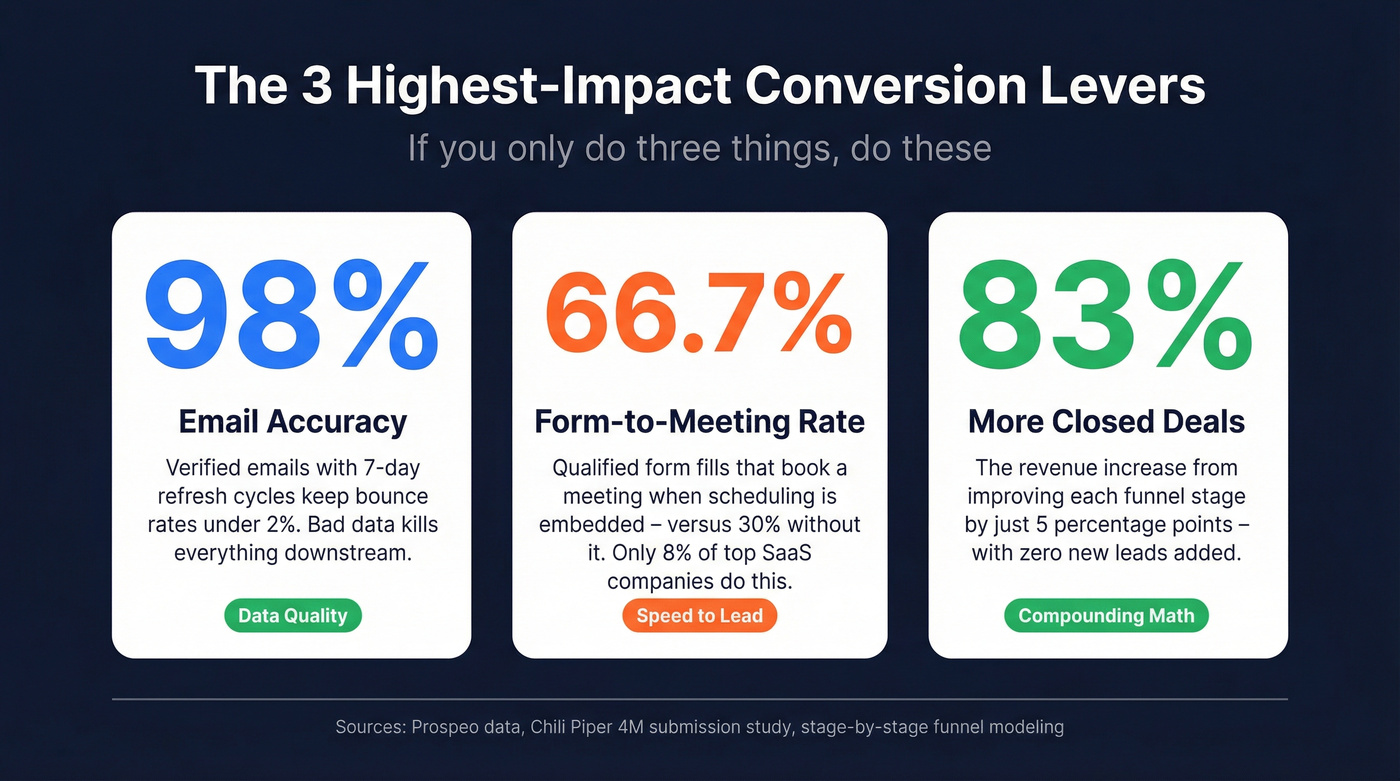
- Fix your data quality. Verified emails, direct dials, current titles. If 20% of your emails bounce, nothing downstream matters. Prospeo's email finder keeps bounce rates under 2% with 98% accuracy and a 7-day refresh cycle - start there. (If you need a stack comparison, see email ID validators and email checker tools.)
- Implement instant scheduling on forms. Chili Piper's analysis of 4 million form submissions found that 66.7% of qualified fills book a meeting with embedded scheduling, versus 30% without it. Only 8% of top B2B SaaS companies have done this. It's free money.
- Adopt a real qualification framework. MEDDPICC for enterprise , CHAMP for mid-market. BANT is dead if your deals are above $50K.
Now let's get into the details.
What Is Sales Conversion Rate?
Sales conversion rate measures how efficiently your funnel turns leads into customers:
(Closed Deals / Total Leads) x 100 = Conversion Rate
Close 15 deals from 500 leads last quarter? That's 3%. But the overall number hides more than it reveals. What you really need are stage-by-stage micro-conversions: Lead to MQL, MQL to SQL, SQL to Opportunity, Opportunity to Closed Won. Each stage leaks differently, and each leak demands a different fix.
One quick distinction: conversion rate and win rate aren't the same thing. Win rate measures Opportunity to Closed Won - just the bottom of the funnel. Conversion rate spans the entire journey. Both matter, but they diagnose different problems.
Benchmarks by Industry
These are visitor-to-lead conversion rates by industry, drawn from a dataset spanning January 2022 through mid-2025:
| Industry | Visitor-to-Lead Rate |
|---|---|
| B2B SaaS | 1.1% |
| IT & Managed Services | 1.5% |
| Financial Services | 1.9% |
| Manufacturing | 2.2% |
| Higher Education | 2.8% |
| Staffing & Recruiting | 2.9% |
| Legal Services | 7.4% |
Brutal numbers. Even Salesforce converts less than 5% of traffic into qualified leads. The real question is what happens after someone becomes a lead.
Here are stage-by-stage funnel benchmarks from the same source:
| Stage | B2B SaaS | eCommerce | Financial Svcs | Higher Ed |
|---|---|---|---|---|
| Lead to MQL | 39% | 23% | 29% | 45% |
| MQL to SQL | 38% | 58% | 38% | 46% |
| SQL to Opp | 42% | 66% | 49% | 61% |
| SQL to Close | 37% | 60% | 53% | 66% |
Stage averages look healthy because they measure post-lead conversion. The real drop happens at the top - getting quality leads into the funnel in the first place. Every percentage point you gain there compounds through every stage below it.
Diagnose Your Funnel First
Your VP wants conversion from 4% to 8% by next quarter. Where do you start? Not by spraying activity everywhere.
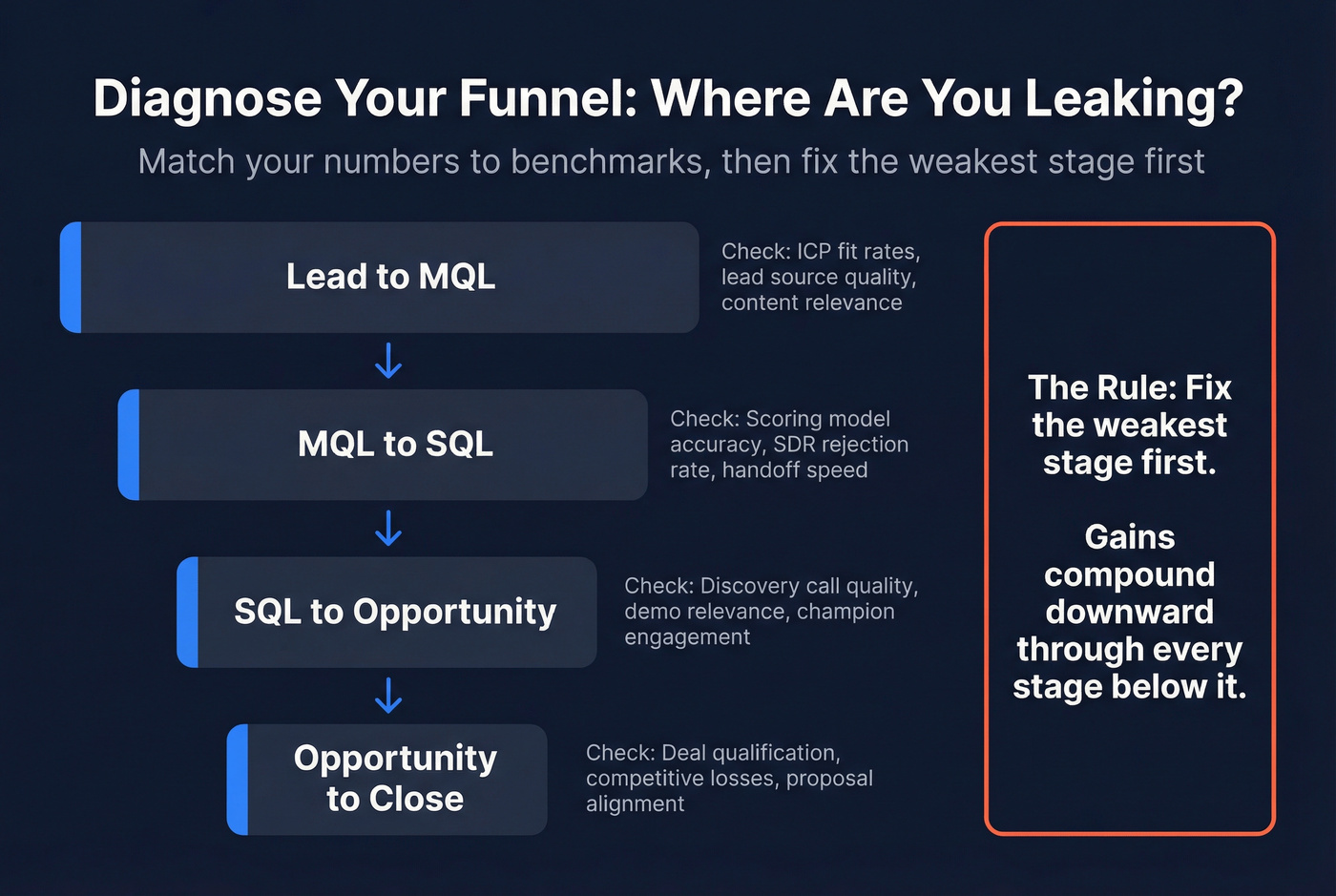
Map your actual stage-by-stage numbers against the benchmarks above. The leaking stage is where you focus:
- Lead to MQL: Are you attracting the right people, or is your top-of-funnel full of noise? Check ICP fit rates and lead source quality (and tighten account qualification).
- MQL to SQL: Is your qualification criteria too loose - or too tight? If MQLs pile up but SDRs reject 70%, your scoring model is broken (use a real lead qualification framework).
- SQL to Opportunity: Reps getting meetings but failing to advance? This usually signals a discovery or demo problem (see discovery call tips).
- Opportunity to Close: High pipeline, low close rate? Look at deal qualification, competitive losses, and whether proposals address the buyer's stated pain (track competitive win rate).
The compounding math means fixing the weakest stage delivers outsized returns. Don't guess. Measure.

Every funnel fix in this article depends on one thing: reaching the right people with verified data. Prospeo delivers 98% email accuracy on a 7-day refresh cycle, so your SDRs stop wasting pipeline on bounced emails and outdated titles. Snyk cut bounce rates from 35% to under 5% and grew AE-sourced pipeline 180%.
Stop diagnosing your funnel when the real problem is your data.
Strategies to Increase Conversions
Top of Funnel: Fix Your Data
Here's the thing: most conversion rate advice skips the single biggest lever at the top of the funnel - data quality. If your SDRs are sending 5,000 emails a month and 800 bounce, 200 hit spam folders, and another 500 go to people who left that company six months ago, your "conversion problem" is actually a data problem.
Emails sent to large, untargeted lists get 67% fewer replies than smaller, targeted sends. Deliverability thresholds are unforgiving - you need bounce rates under 2% and spam complaint rates below 0.01%. Blow past those, and your domain reputation tanks (use an email deliverability checklist and keep your CRM hygiene tight).

We've seen this play out firsthand. Snyk's AE team was running 35-40% bounce rates before switching their data provider - after cleaning up their contact data, bounces dropped under 5% and AE-sourced pipeline jumped 180%. The conversion rate improvement started before a single email went out.
Mid-Funnel: Qualify and Convert Faster
Two levers dominate mid-funnel conversion: qualification rigor and speed to lead. Getting these right is the fastest way to increase sales conversions without adding headcount (especially with a tighter SDR follow-up strategy).
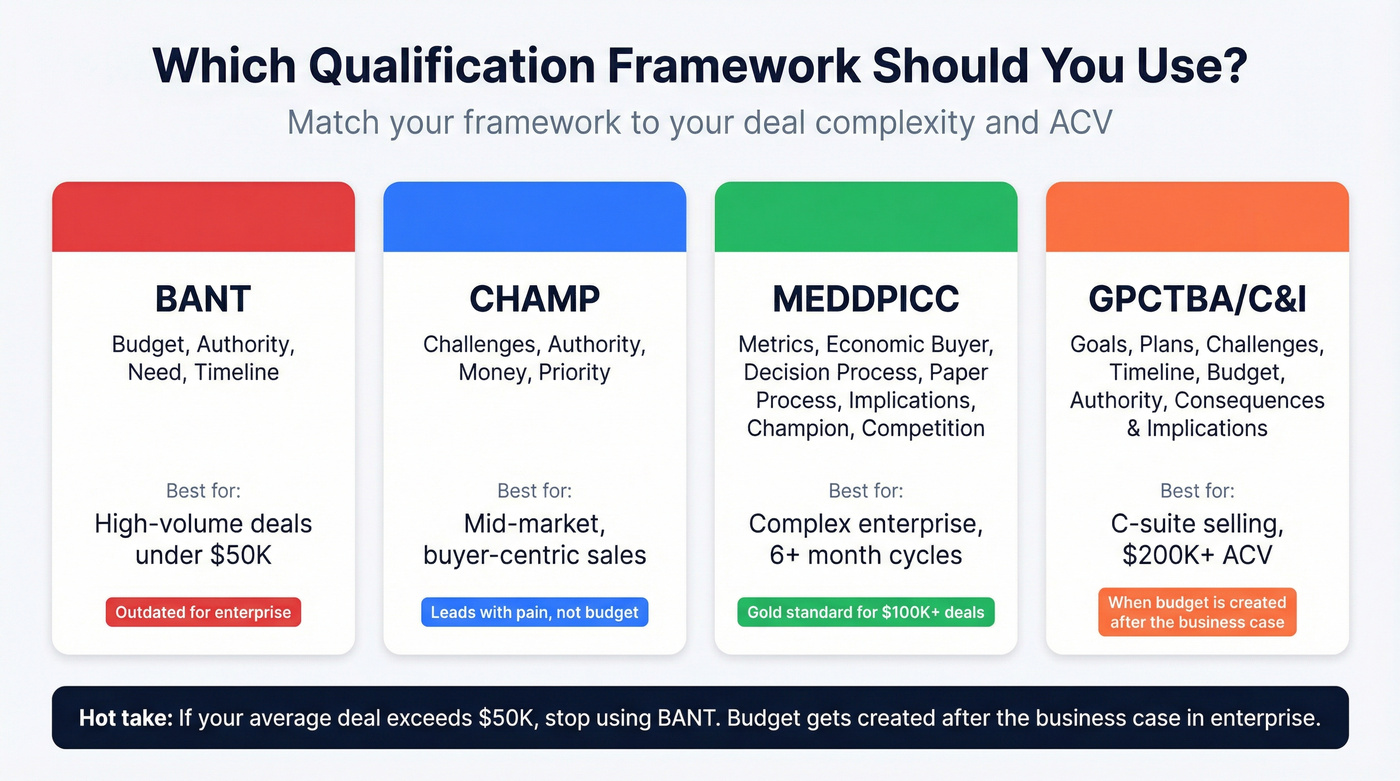
Modern B2B buying groups include 6-10+ stakeholders. Using a framework designed for simpler sales motions means you're qualifying on the wrong criteria:
| Framework | Focus | Best For |
|---|---|---|
| BANT | Budget, Authority, Need, Timeline | High-volume, sub-$50K deals |
| CHAMP | Challenges first, then Authority/Money/Priority | Mid-market, buyer-centric |
| MEDDIC/MEDDPICC | Full deal mechanics mapping | Complex enterprise, 6+ month cycles |
| GPCTBA/C&I | Goals, Plans, Challenges, Timeline, Budget, Authority | C-suite selling, $200K+ ACV |
Hot take: BANT is dead for enterprise. Stop using it if your average deal size exceeds $50K. When "budget" gets created after the business case - which is how most enterprise purchases work - leading with "do you have budget?" disqualifies real opportunities.
Now, speed to lead. That 4-million-submission dataset from Chili Piper shows 66.7% of qualified form fills book a meeting when scheduling is embedded in the form flow. Without it, you're at 30%. That's a 2x gap from a single operational change, and only 8% of top B2B SaaS companies have implemented it.
80% of consumers prefer personalized experiences, and that expectation carries into B2B. Personalized emails see 14% higher open rates. But personalization without qualification is just polished spam - get the framework right first (and upgrade your personalization in outbound sales).
Bottom of Funnel: Close More
Bottom-of-funnel optimization gets the most attention and often deserves the least. By the time a deal reaches Opportunity stage, conversion is already relatively high (37-66% depending on industry). Incremental improvements here are valuable but don't compound the way earlier-stage fixes do.
Three tactics consistently move close rates:
Case studies featuring companies similar to the prospect - same industry, same size, same problem - reduce perceived risk at the exact moment the buyer is calculating it. An objection handling library also pays dividends fast: document the objections your team hears most, write the best responses, and drill them weekly (build a real list of types of objections).
Don't ignore aged leads either. Data from homebuilding online sales programs shows that 18% of appointments in Q4 came from aged leads that reps re-engaged through prospecting. Dead pipeline isn't always dead. And Going changed two words on a CTA and saw a 104% increase in premium trial starts - small changes at the bottom can produce outsized results, but only when everything above is already working.
Skip bottom-of-funnel optimization entirely if your MQL-to-SQL rate is below benchmark. The compounding math favors earlier stages. Let's prove it.
The Compounding Math
This is the section that makes the "fix the funnel, not the volume" argument undeniable.
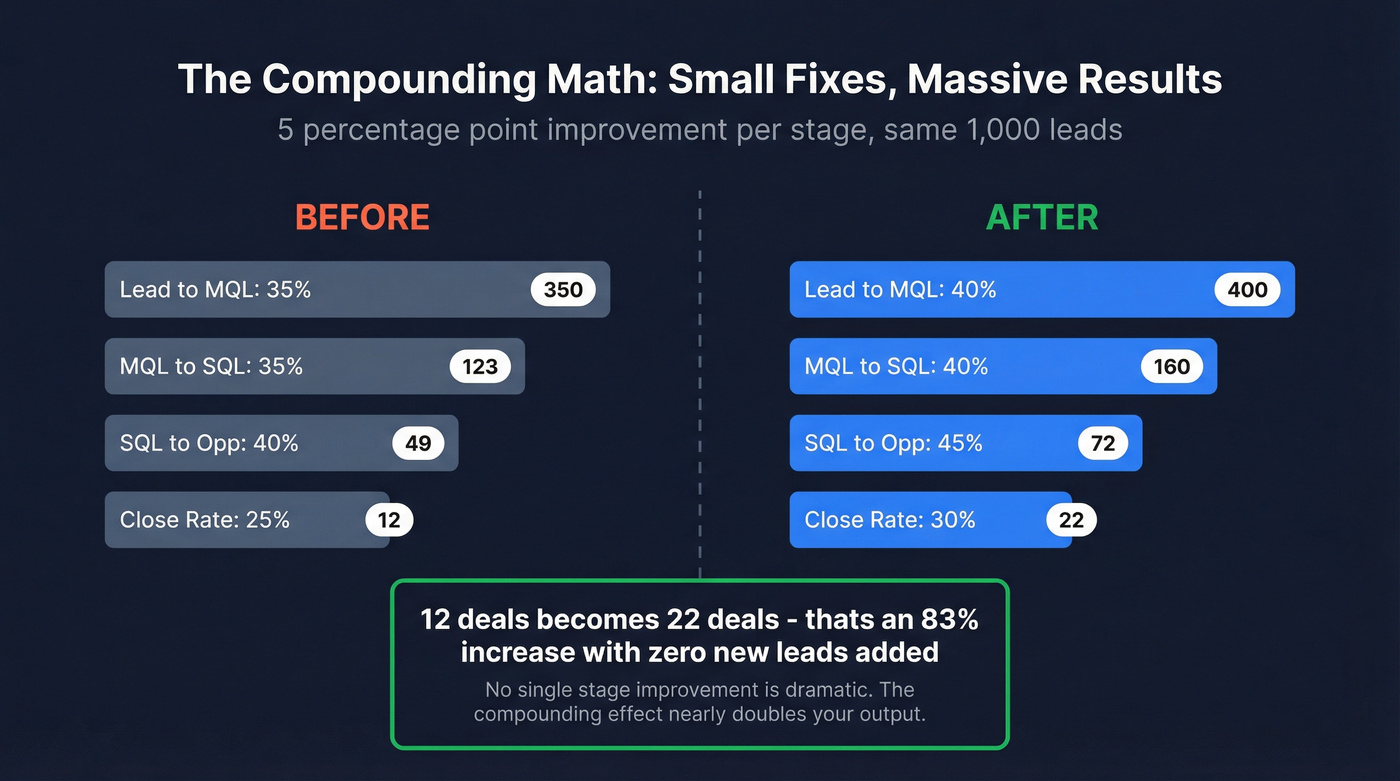
Say you have 1,000 leads per month and improve each stage by just 5 percentage points:
| Stage | Before | After |
|---|---|---|
| Lead to MQL | 35% (350) | 40% (400) |
| MQL to SQL | 35% (123) | 40% (160) |
| SQL to Opp | 40% (49) | 45% (72) |
| Close Rate | 25% (12) | 30% (22) |
Before: 12 closed deals. After: 22 closed deals. That's an 83% increase in revenue from four incremental improvements - with zero new leads added.
No single stage improvement is dramatic. Five percentage points is achievable in a quarter with focused effort. But the compounding effect across four stages nearly doubles your output. We've watched teams obsess over lead volume when the real problem is conversion efficiency - adding more leads to a leaky funnel just means more waste. Any serious strategy to improve sales conversion rate has to start with diagnosing stage-by-stage leaks rather than pumping more volume into the top.
Where AI Actually Helps
The average salesperson spends less than 3 hours per day actually selling. AI's biggest impact on conversion isn't some magical scoring algorithm - it's giving reps those hours back (and improving AI lead qualification).
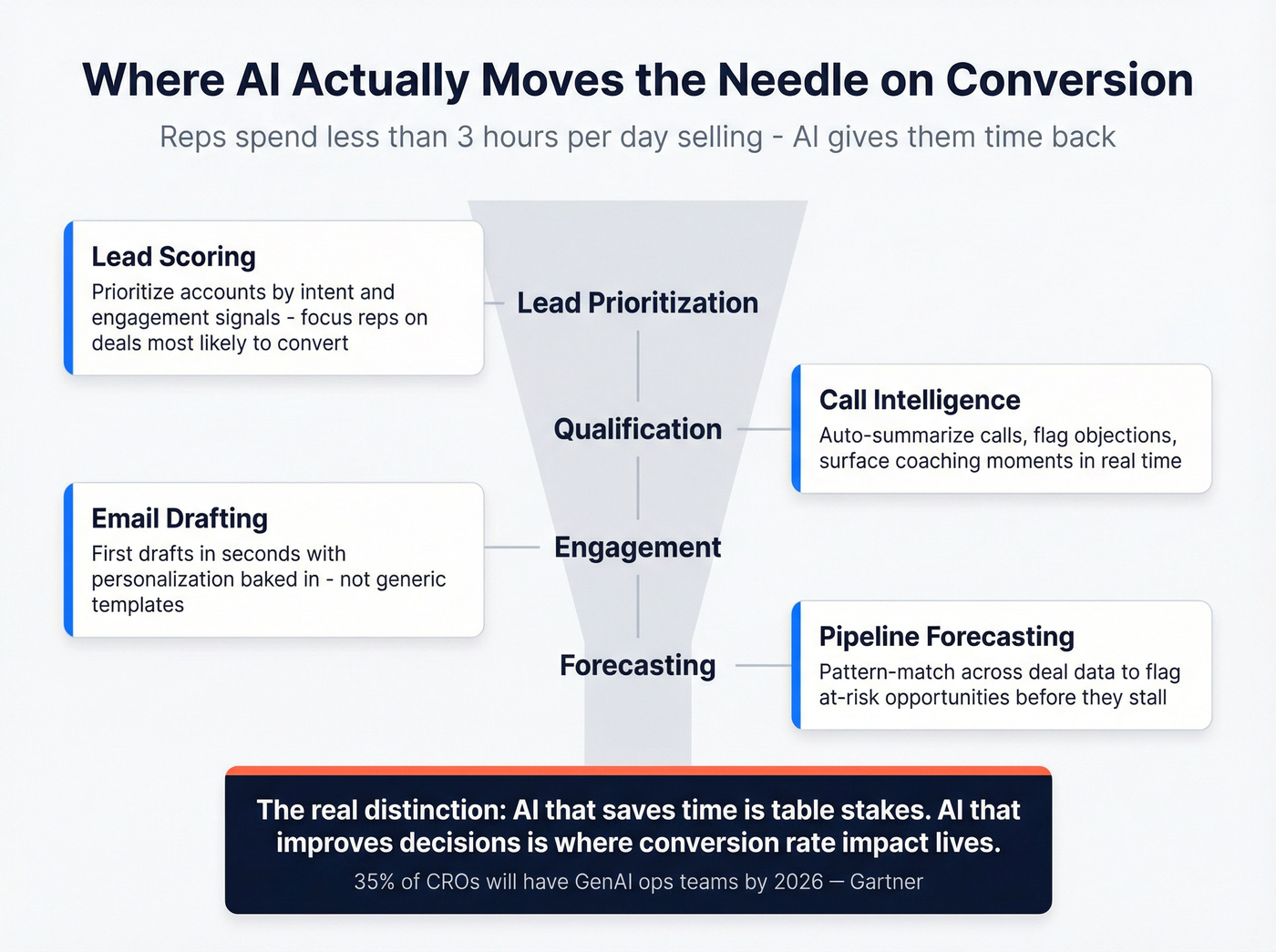
Four use cases that consistently lift funnel performance:
- Lead scoring - prioritizing accounts most likely to convert based on intent and engagement signals (see how to build a lead scoring system)
- Call intelligence - summarizing calls, flagging objections, identifying coaching moments
- Email drafting - first drafts in seconds, not minutes, with personalization baked in
- Forecasting - pattern-matching across pipeline data to flag at-risk deals early
Gartner projects that 35% of Chief Revenue Officers will have GenAI operations teams by 2026. The key distinction: AI that saves time is table stakes. AI that improves decisions - which deals to pursue, which contacts to prioritize, when to escalate - is where the real conversion rate impact lives.
Five Mistakes That Kill Conversion
These are the conversion killers we see most often in our work with sales teams, and none of them show up in a standard dashboard:
Bad data. Reps chasing bounced emails and disconnected numbers. If 20%+ of your outbound never reaches a human, your conversion rate is artificially depressed. Beyond conversion, bad data carries compliance risk - GDPR fines reach EUR 20M or 4% of global annual revenue.
Slow inbound follow-up. The gap between 30% and 66.7% form-to-meeting conversion is entirely about speed and scheduling friction. This one frustrates us because the fix is so straightforward and so few teams have done it.
No stage-by-stage tracking. If you only measure overall conversion rate, you can't diagnose where the funnel leaks. You're flying blind.
Slow landing pages. Pages that load in 1 second convert 3x better than pages that take 5 seconds. Check your mobile load times - they're almost always worse than you think.
Wrong qualification framework. Using BANT on a 6-month enterprise cycle with 8 stakeholders is like using a screwdriver as a hammer. The consensus on r/sales is pretty clear on this one: BANT works for transactional deals, and it actively hurts complex ones.
Eliminating even two of these can lift your numbers within a single quarter.
You just mapped your stage-by-stage leaks. Now fix the biggest one: top-of-funnel data quality. Prospeo's 30+ search filters - buyer intent, technographics, headcount growth, funding - let you build lists that convert from the first touchpoint. At $0.01 per email, fixing your data costs less than one lost deal.
Build targeted lists that compound conversions at every stage below.
FAQ
What's a good sales conversion rate?
B2B SaaS averages 1.1% visitor-to-lead and 37% SQL-to-close. "Good" depends on your industry and funnel stage - compare against the stage benchmarks above, because overall rates without stage context are meaningless.
How do you calculate it?
Divide closed deals by total leads, then multiply by 100. For actionable insight, calculate this at each funnel stage separately - Lead to MQL, MQL to SQL, SQL to Opportunity, and Opportunity to Closed Won.
Which funnel stage should I optimize first?
The one furthest below your industry benchmark. When in doubt, start earlier - improving Lead to MQL or MQL to SQL compounds through every downstream stage, delivering 2-3x more impact than bottom-of-funnel tweaks alone.
How does data quality affect conversions?
Directly and measurably. If 20-30% of your emails bounce, sequences never reach prospects and your domain reputation degrades. Clean, verified data is the foundation every other tactic depends on - teams that fix this first typically see the fastest conversion gains.
What's the difference between conversion rate and win rate?
Conversion rate measures leads-to-customers across the full funnel. Win rate measures only opportunities-to-closed-won at the bottom. Low win rate means your closing motion needs work; low conversion rate means something upstream is broken.