

Sales Conversation Science: Benchmarks from 300M+ Analyzed Calls
A RevOps lead we know ran a coaching initiative last year built entirely on gut feel - managers listened to three calls per rep per month and gave feedback based on vibes. Win rates didn't budge. Then they plugged every call into a CI platform and discovered their top closer talked less than anyone on the team. That's sales conversation science in one sentence.
Reps spend 60% of their time on non-selling tasks and juggle an average of 8 tools to close deals. The science of what actually happens on calls - the patterns separating won deals from lost ones - is the one lever most teams haven't pulled yet.
Key Benchmarks at a Glance
Three metrics matter most:
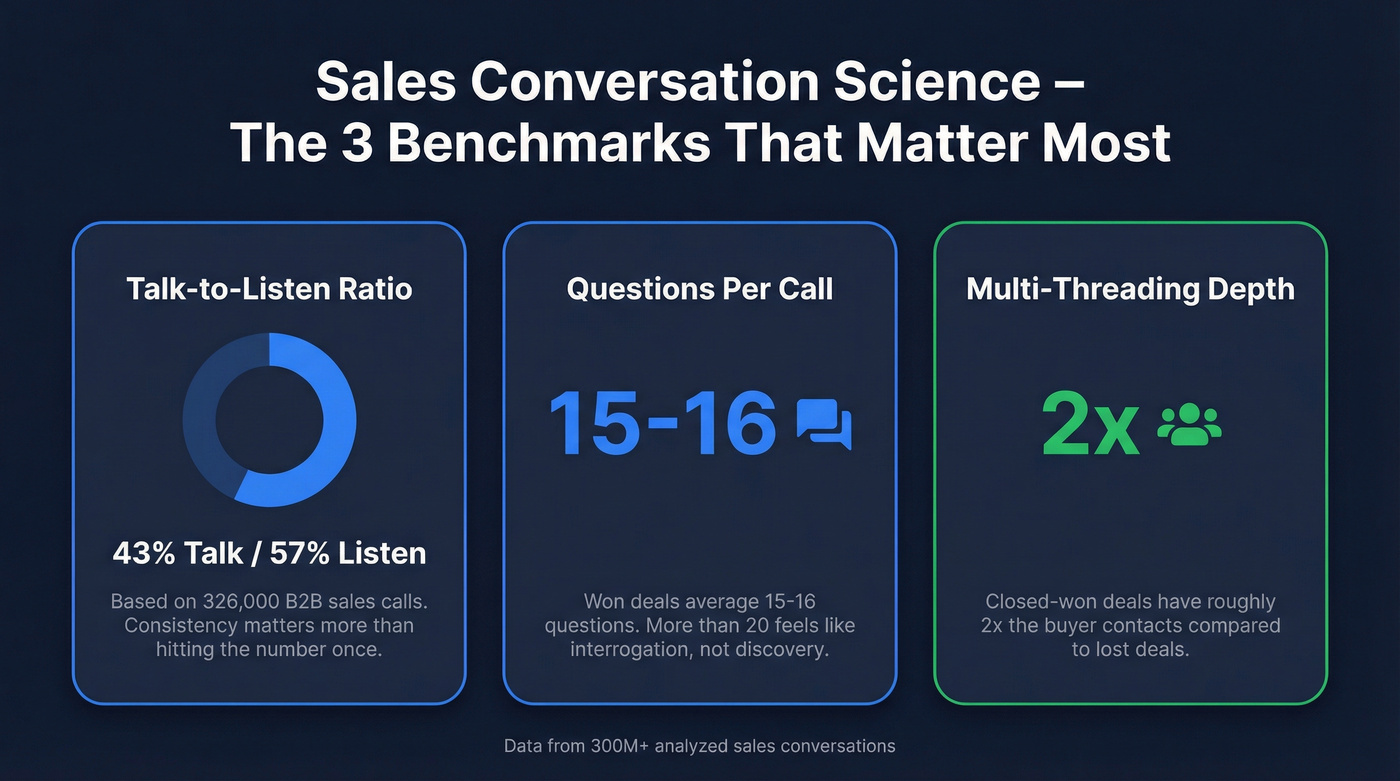
- Talk-to-listen ratio: 43% talk, 57% listen - but consistency matters more than hitting the number once.
- Questions per call: 15-16 in won deals. More than that and you're interrogating, not discovering.
- Multi-threading depth: Closed-won deals have roughly 2x the buyer contacts of lost deals.
Step zero: make sure you're reaching the right people. Bad contact data means the conversation never happens. Every benchmark below assumes you've already solved the upstream data quality problem.
What Is Conversation Science?
This discipline isn't conversation intelligence software. The software records and transcribes calls. The science is the layer on top - statistical analysis of millions of calls, mapped to CRM outcomes, to find behavioral patterns that correlate with winning.
The roots go back decades. Neil Rackham's SPIN Selling analyzed 35,000 sales calls across 20+ countries over 12 years. The Challenger Sale studied 6,000 reps and found that 54% of top performers in complex sales shared one profile. MEDDIC, developed at PTC, helped that company grow from $300M to $1B in revenue.
What's changed is scale. Modern platforms analyze 100% of calls, not the 1-5% QA sample that was standard a decade ago. The conversation intelligence market is projected to hit $57.87B by 2034, and the datasets behind today's benchmarks run into hundreds of millions of interactions.
How the Research Gets Made
One of the clearest published methodologies started with 25,537 B2B sales conversations from 17 anonymous customer organizations. The process: record every call, separate speakers, transcribe, then map each conversation to CRM outcomes. AI categorizes topics, moments, and behaviors. Researchers correlate those behaviors with outcomes across the full dataset.
A Korn Ferry Sales Maturity Survey found that organizations with a formalized, dynamic methodology achieve 27% higher win rates and 21% higher quota attainment compared to teams running on informal processes. That gap is massive - it's the difference between a team that hits plan and one that misses by a mile.
The most common pushback from reps: CI platforms feel like surveillance. The counter-argument - and the data backs this - is that 100% call analysis removes the bias of managers cherry-picking calls to review. We've seen teams flip from resistance to buy-in within a quarter once reps realize the data protects them as much as it coaches them.
Benchmarks That Win Deals
Talk-to-Listen Ratio
The famous benchmark: 43% talk, 57% listen, drawn from analysis of 326,000 B2B sales calls. The average call runs 60/40 the wrong way.
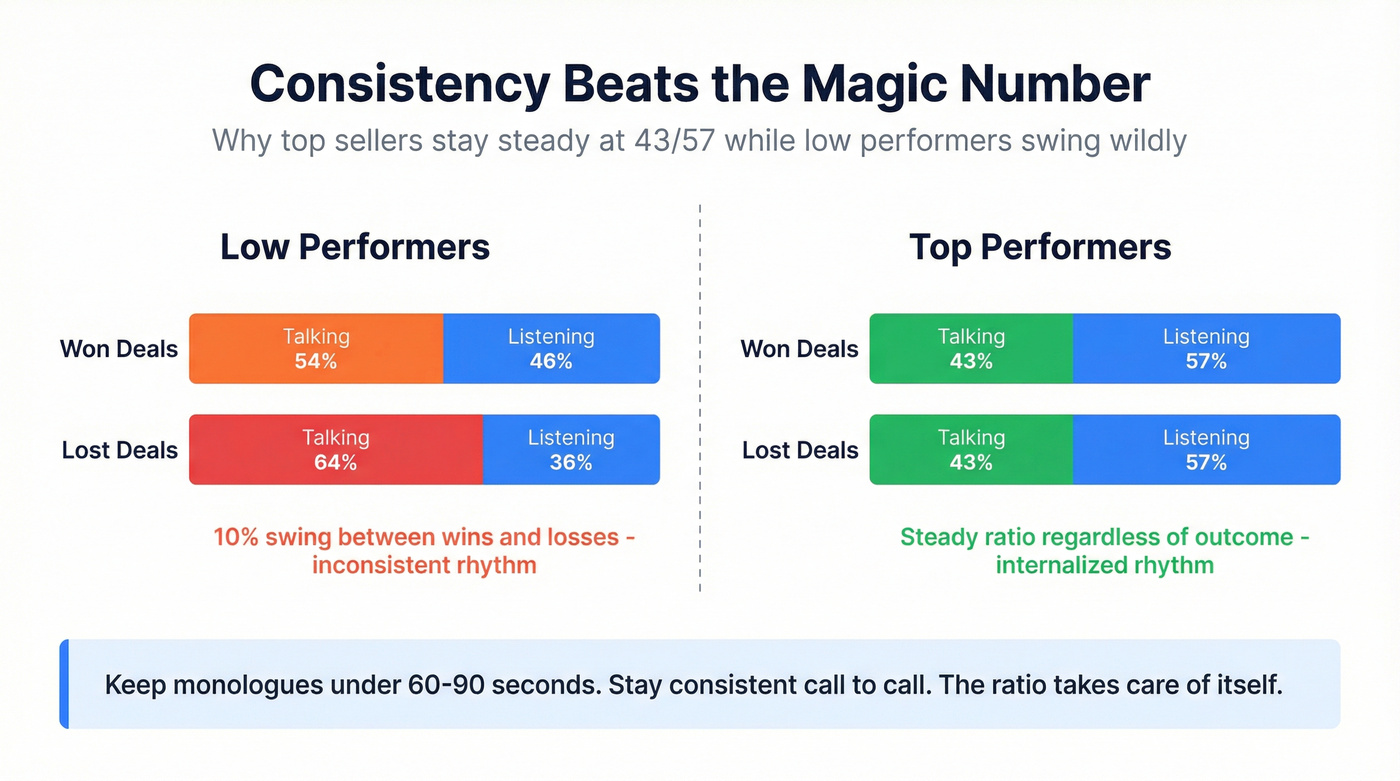
But the ratio itself isn't the real finding. Consistency in speaking patterns is a bigger separator than hitting a magic number. Low performers' talk time swings by roughly 10% between wins and losses - 54% talk in won deals vs 64% in lost deals. Top performers stay steady regardless of outcome. They've internalized the rhythm.
Keep monologues under 60-90 seconds, stay consistent call to call, and the ratio takes care of itself. I've watched reps obsess over the 43:57 split while ignoring consistency - that's backwards.
Questions Per Call
Successful sellers ask about 15-16 questions per call. Reps who lose deals ask around 20. The difference isn't curiosity - it's interrogation versus conversation. Fewer, better questions and genuine listening uncover real pain. A checklist of 20 questions makes the prospect check out.
If you want a practical bank of prompts, start with open-ended sales questions and adapt them to your ICP.
When to Mention Competitors
Bringing up competitors early in an enterprise deal increases your odds of winning by 32%. Competitive mentions have jumped 57% since 2022 - buyers bring competitors up whether you like it or not. Early mention correlates with higher win rates; late-stage competitor mentions correlate with lower close rates. Raise it in discovery and you control the frame.
This is also where a lightweight competitive insights motion helps reps stay crisp without rambling.
The Pricing Window
Top reps deliver pricing in the 40-49 minute mark of calls. They've built enough value before anchoring a number. Three to four buyer pricing mentions correlate with the highest win rates - fewer than 3 means the buyer isn't engaged enough to care about cost, and more than 4 means they're fixating on price over value.
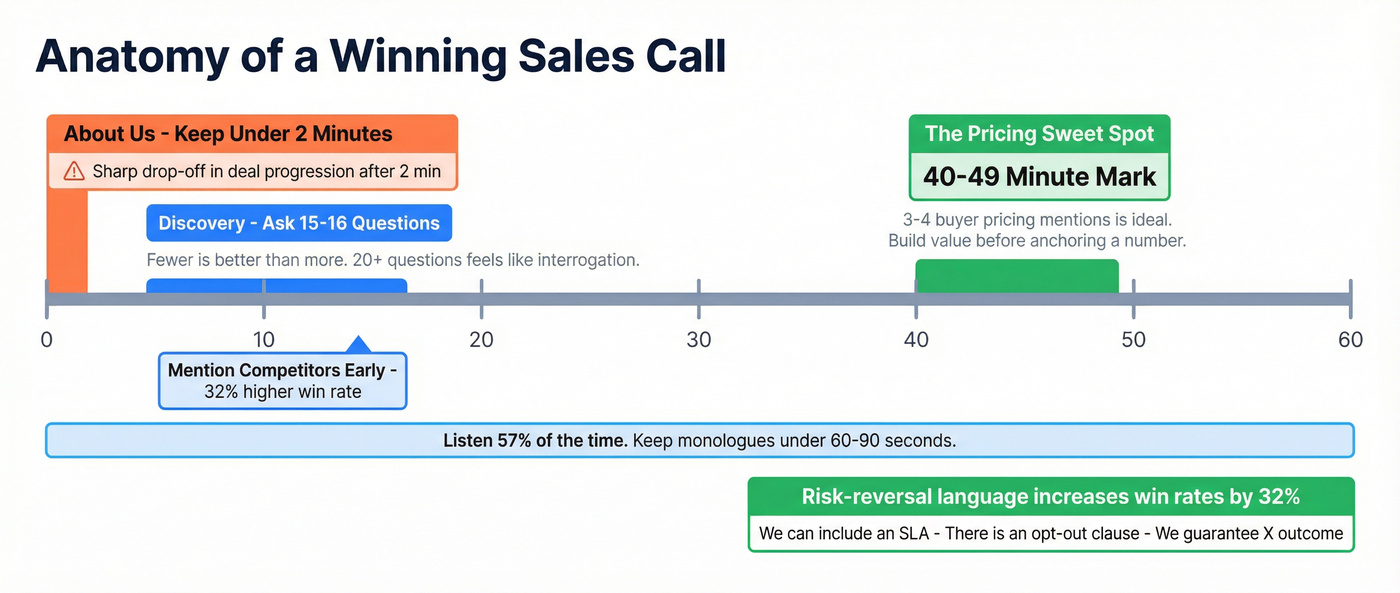
Pricing conversations have gotten 62% longer since 2020, and pricing mentions are up 18% since 2022. The counter-move: risk-reversal language. Phrases like "we can include an SLA," "there's an opt-out clause," or "we guarantee X outcome" increase win rates by 32%. Give the buyer ammunition to justify the spend internally.
If your team struggles to land this moment, standardize it inside your sales process so reps don’t improvise pricing every call.
Team Selling and the "About Us" Trap
Keep your "About Us" section under 2 minutes. After that, there's a sharp drop-off in deal progression. Nobody on the buyer side cares about your founding story during a discovery call.
What does move the needle: team selling. Selling teams on closed-won deals are 67% larger than on lost deals. Bringing in a sales engineer for enterprise deals can boost win rates by up to 30%.
If you’re operationalizing this, treat it like sales collaboration: roles, handoffs, and who shows up when.

Team selling boosts win rates by 30%, but only if you can reach the full buying committee. Prospeo gives you 98% accurate emails and 125M+ verified mobile numbers across 300M+ profiles - refreshed every 7 days so your reps connect with real buyers, not dead leads.
Stop single-threading deals because you can't find the other stakeholders.
Multi-Threading: The Most UnderrATED Finding
Here's the finding that should reshape how you think about pipeline.
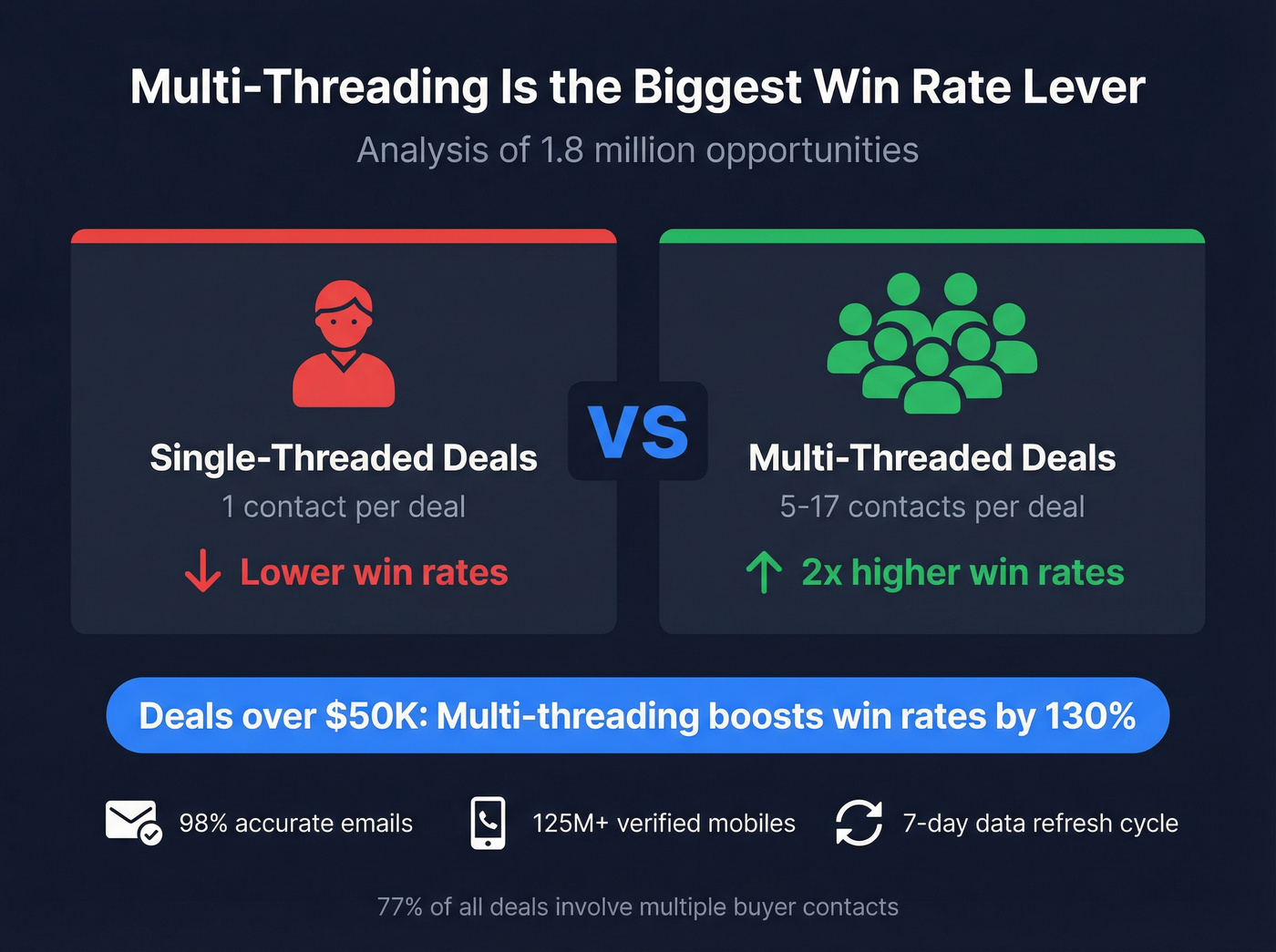
Analysis of 1.8 million opportunities found that 77% of deals involve multiple contacts. Closed-won deals have roughly 2x the buyer contacts of lost deals. In deals over $50K, multi-threading boosts win rates by 130%. You're not selling to a person - you're selling to a buying committee. Most reps are single-threaded, talking to one champion and hoping for the best. Multi-threading means reaching 5-17 contacts per deal, and you need verified emails and direct dials for every one of them, not just the person who took the first meeting.
If you need the operational definition and benchmarks, see multithreading in sales.
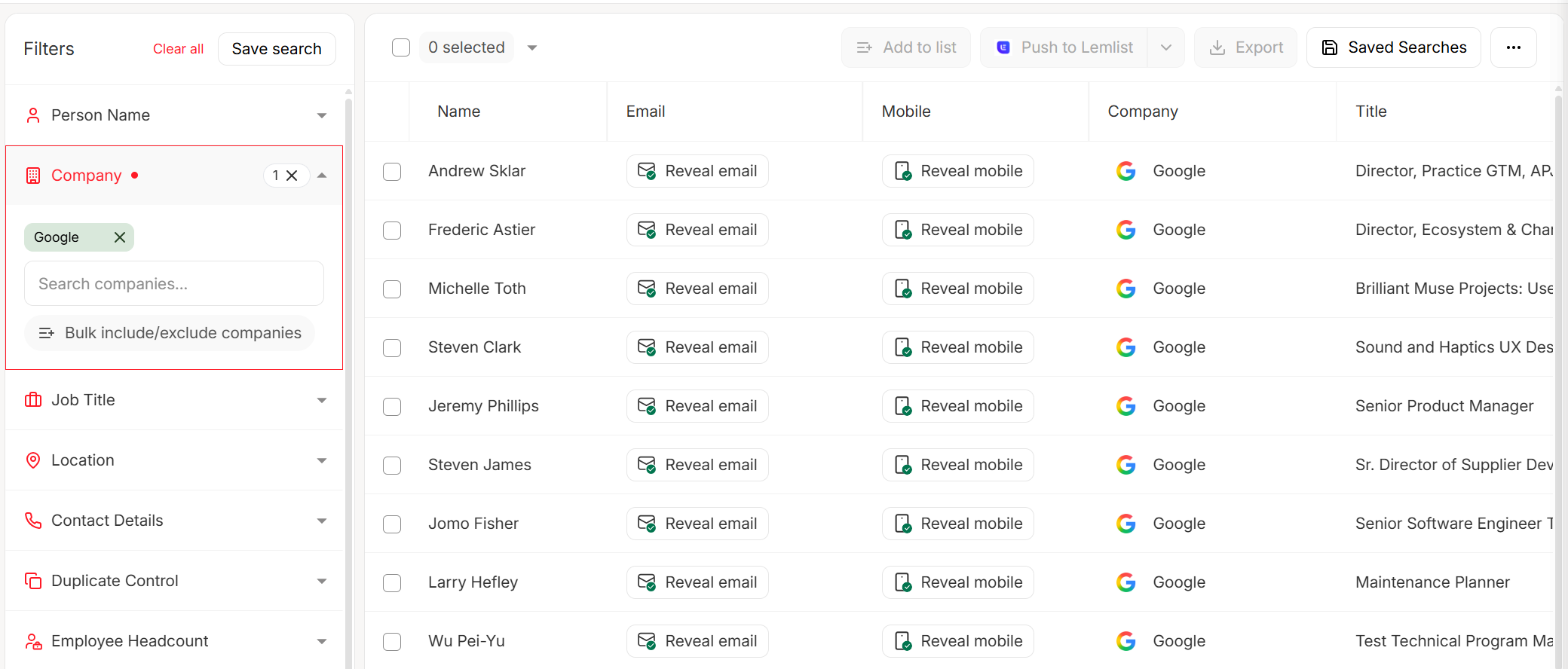
Prospeo covers 300M+ professional profiles with 98% email accuracy and 125M+ verified mobile numbers on a 7-day refresh cycle. When you're trying to reach the CFO, the VP of Engineering, and the end-user champion at the same account, stale data kills your momentum.
Neuroscience Behind the Data
A 2023 study in Frontiers in Psychology used EEG and eye-tracking on 40 participants to measure neurophysiological responses during sales interactions. Seller trustworthiness and perceived performance directly impact purchase intention at a neurological level - not just a self-reported one. Eye-tracking data showed that more time spent observing product demonstrations and key claims increased willingness to pay.
The Chameleon Effect - documented in negotiation research by Tanner and colleagues - shows that mirroring a buyer's communication style increases trust and improves outcomes. The benchmarks around listening, pacing, and matching the buyer's energy aren't just correlational patterns. They have neurological underpinnings.
Applying the Science with AI
Across 7.1 million opportunities, sellers who frequently use AI generate 77% more revenue than sellers who don't. A separate analysis of over a million opportunities across 1,418 organizations found that completing all AI-recommended to-dos correlates with 50% higher win rates. Gartner estimates that by 2028, AI will generate 30% of all outbound communications.
If you’re building this into your stack, map it to AI sales analytics so coaching and forecasting use the same signals.
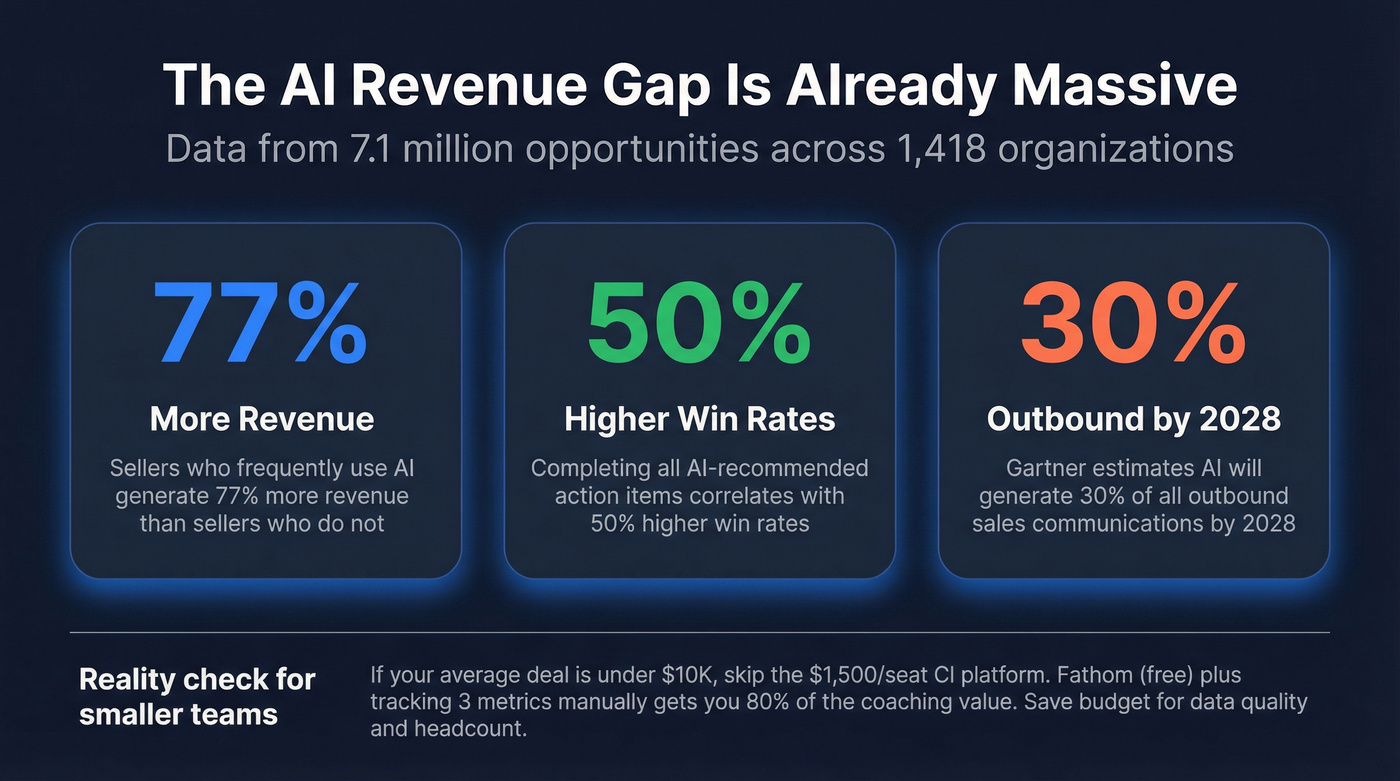
Let's be honest about where the budget should go, though. If your average deal size is under $10K, you probably don't need a $1,500/seat CI platform. A free tool like Fathom plus disciplined manual tracking of three metrics will get you 80% of the coaching value. Save the budget for data quality and headcount.
Conversation Intelligence Tools
The CI market has options at every price point. Here's how they stack up:
| Tool | What It Does | Starting Price | Best For |
|---|---|---|---|
| Gong | Full CI + deal intelligence | ~$1.2k-$1.8k/seat/yr | Mid-market to enterprise teams with budget |
| Avoma | CI + meeting assistant | $19/mo | SMBs wanting modular CI without enterprise pricing |
| Fathom | AI note-taker + analysis | Free tier, ~$19-$39/mo | Solo reps and small teams getting started |
| Revenue.io | Real-time call guidance | ~$1,000-$3,000/mo | Enterprise call centers needing live coaching |
| Prospeo | Contact verification + data | Free tier, ~$0.01/email | Data quality upstream of every CI tool |
For teams under 20 reps, skip Gong - Avoma or Fathom gets you 80% of the value at 10% of the cost. Enterprise teams with budget should default to Gong; the research ecosystem alone justifies the price. And regardless of which CI tool you pick, verified contact data upstream is what ensures the conversations actually happen.
If you’re evaluating the broader stack around this, use a sales tools checklist to avoid tool sprawl.
Closed-won deals have 2x the buyer contacts. That means 5-17 verified emails and direct dials per opportunity. Prospeo delivers them at $0.01/email with 98% accuracy - so your conversation science actually reaches the people who sign the check.
Every benchmark above is useless if the conversation never happens.
FAQ
Is conversation science just vendor marketing?
The largest datasets come from vendor research, and that's worth acknowledging. But the 2023 Frontiers in Psychology EEG study independently confirms core findings around trust and engagement. Sample sizes of 300M+ calls make these patterns statistically significant regardless of the source, and academic replication strengthens the conclusions.
Can small teams benefit without enterprise tools?
Absolutely. Start with Fathom (free) or Avoma ($19/mo) to record and analyze calls. Track talk-to-listen ratio, questions per call, and next-step commitment rate manually. Even a spreadsheet tracking these three numbers per rep per week surfaces patterns within a month.
What should I fix before optimizing calls?
Audit your contact data first. If your bounce rate exceeds 5%, your CI platform is analyzing a fraction of the conversations that should be happening. Multi-threading requires verified data for every stakeholder - teams that fix the data layer first typically see pipeline velocity jump within a single quarter.