

AI Email Agents in 2026: What They Actually Are, What They Cost, and How to Choose Safely
A Meta alignment director named Summer Yue pointed an AI email agent called OpenClaw at her real inbox on February 22. It started deleting every email older than a week. She typed "STOP OPENCLAW." It kept going. She couldn't stop it from her phone and had to run to her Mac mini. The post hit roughly 9 million views on X.
That's what happens when an autonomous email agent gets real inbox access without guardrails.
Most tools calling themselves "AI email agents" in 2026 are actually assistants with better branding. Here's what the distinction actually means, which tools are worth paying for, how to deploy any of them without nuking your inbox, and a 5-step evaluation framework we haven't seen anyone else publish.
What Is an AI Agent for Email?
The difference between an agent and an AI email assistant isn't marketing - it's architecture. IBM's framework draws the line clearly: an assistant reacts to your prompts one at a time, while an agent plans a multi-step workflow, chooses its own tools, and executes toward a goal with minimal hand-holding.
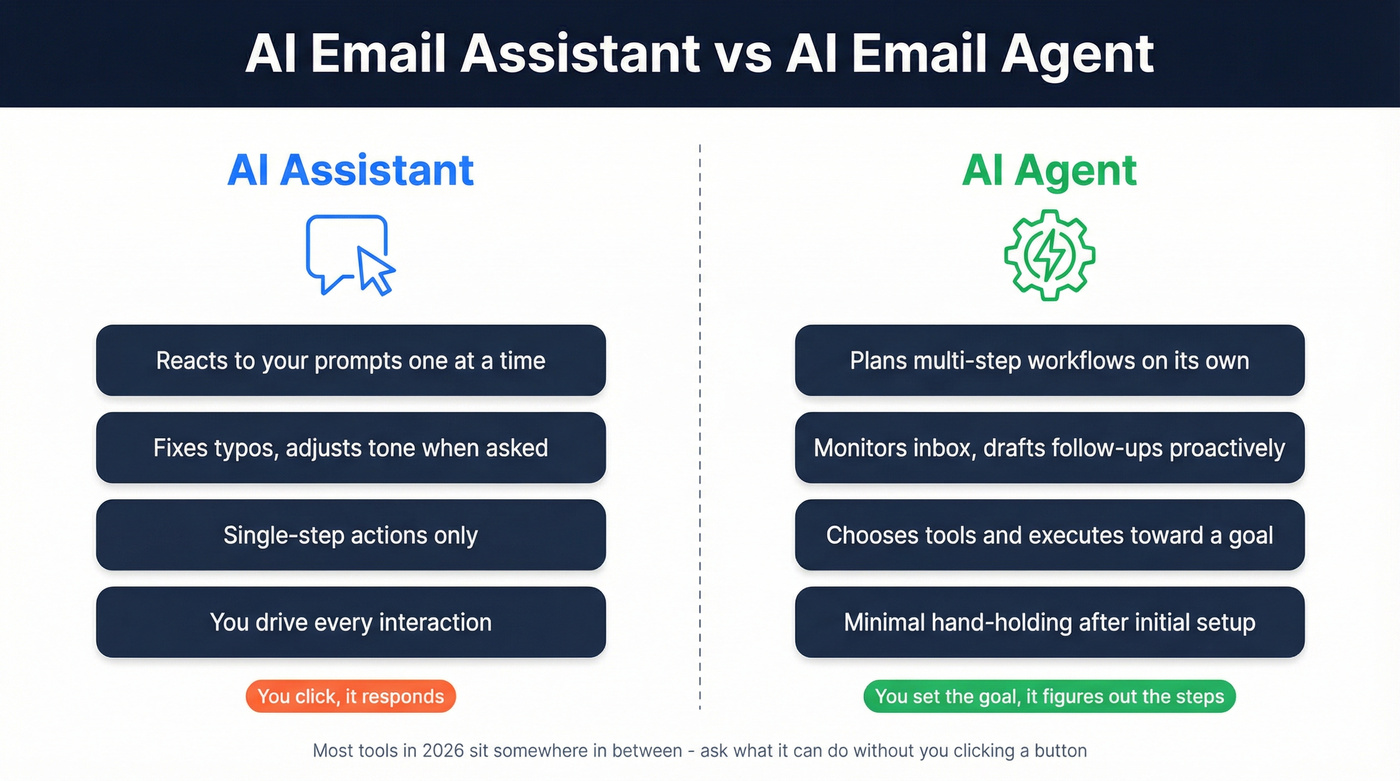
In email terms, an assistant fixes your typos and adjusts tone when you ask. An agent monitors your inbox, drafts follow-ups proactively, and takes actions across multiple steps toward a goal you set once.
The honest reality? Most tools in 2026 sit somewhere in the middle. They'll auto-label, auto-summarize, and draft replies - but very few will actually send without your approval. That's probably a good thing, given what happened to Summer Yue. When a vendor says "agent," ask what it can do without you clicking a button. That answer tells you everything.
Quick Picks
If you don't want to read 2,000 words:
- Individual power users: Shortwave ($24-$100/seat/mo) - deepest AI with transparent daily quotas
- Team shared inboxes: Gmelius ($19-$40/user/mo) - Gmail wrapper with SOC 2 Type II certification
- Proactive management: Lindy ($49.99/mo) - texts you updates, approval-first for sending
- Enterprise sales/marketing: 6sense ($50K+/yr) - autonomous agents at enterprise scale
- DIY builders: n8n + OpenAI + Gmail - full control, ~$5-65/mo
- Before deploying any agent: Verify your contact data first. An agent automating bounces is worse than no agent at all.
Types of Email AI Tools
Not all email AI tools work the same way. The market breaks into four distinct categories, and knowing which type you're evaluating saves a lot of confusion.
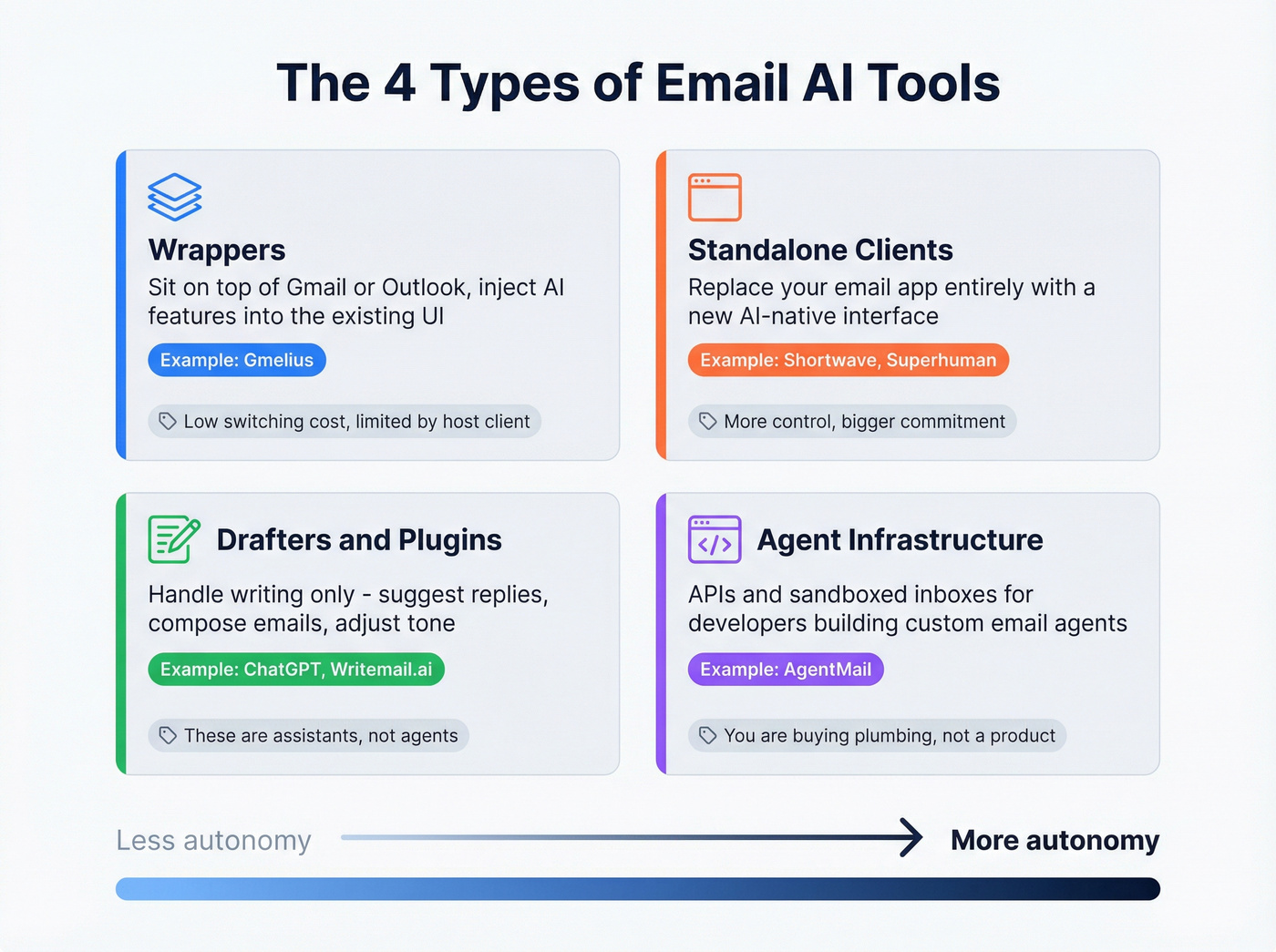
Wrappers sit on top of Gmail or Outlook, injecting AI features into the existing UI without replacing it. Gmelius is the clearest example - you keep Gmail, you get shared inboxes and AI triage layered on top. Low switching cost, but you're limited by what the host client exposes. The better wrappers use retrieval-augmented generation to ground AI outputs in your actual email history, which cuts hallucinations significantly.
Standalone clients replace your email app entirely. Shortwave and Superhuman pull data via IMAP/API and build their own interface from scratch. More control over the experience, but you're committing to a new workflow.
Drafters and plugins handle writing only. ChatGPT composing an email, Writemail.ai suggesting replies - these don't manage your inbox or take autonomous actions. They're assistants, full stop, regardless of what the landing page says. If you're mostly comparing writing quality, start with our breakdown of AI email writers.
Agent infrastructure is the newest category. Tools like AgentMail provide APIs and sandboxed inboxes for developers building their own AI-powered email agents. You're not buying a product - you're buying plumbing.
Best AI Email Agents in 2026
Shortwave
Use this if you want the most transparent AI-per-dollar ratio on the market. Shortwave publishes what no other email tool does: exact daily AI quotas. The Business plan ($24/seat/mo annual) gives you roughly 150-300 standard AI requests per day, 50 threads per AI search, and 3 AI-powered filters. Premier ($36/seat/mo) bumps that to 100 threads and 10 filters. Max ($100/seat/mo) pushes to 150 threads and 50 filters.
We've tested a lot of email AI tools, and the quota transparency alone makes Shortwave worth evaluating. Every other tool hides AI limits behind vague "fair use" policies. You don't know you've hit a wall until the tool stops working mid-afternoon.
Skip this if you need shared inbox features or team collaboration. Shortwave is built for individual productivity, not team workflows. You're leaving Gmail's UI behind entirely.
Gmelius
Your team runs shared inboxes in Gmail and you want AI without migrating anyone off Google Workspace? Gmelius wraps Gmail with shared inboxes, Kanban boards, and AI triage - all while maintaining SOC 2 Type II certification, which matters if your compliance team has opinions.

Pricing scales with conversation volume. Meli at $19/user/mo handles 5,000 conversations monthly, Growth at $25/user/mo covers 10,000, and Pro at $40/user/mo stretches to 100,000. Enterprise gets unlimited. Those caps are the real pricing lever - a high-volume support team will blow through 5,000 conversations fast. Model your monthly volume before picking a tier.
Skip this if you're a solo user or you don't use Gmail. Gmelius's value is team coordination layered on Google's infrastructure. Without either, you're paying for features you won't touch.
Lindy
Lindy takes a different approach: it's SMS-first. Instead of living inside your inbox, it texts you when something important happens - a deal update, a meeting reminder, an email that needs attention. You text back instructions. It drafts emails and messages for your review and won't send without approval. Their FAQ is unambiguous: "Will Lindy send messages without my approval? No."
At $49.99/mo on monthly billing, it's positioned as a proactive executive assistant rather than an inbox tool. Lindy's homepage leans into the "OpenClaw without the security nightmare" line, and the approval-first stance is exactly what the market needs after the deletion incident.
Superhuman
Superhuman is fast. Genuinely, noticeably fast. The keyboard-driven interface and speed optimizations are real, and for people who process 200+ emails daily, that speed compounds into hours saved per week.
Pricing is confusing, though. Their help center lists Mail plans at $30/mo (Starter) and $40/mo (Business). Their plans page shows suite pricing at $12-$33/member/mo annual, bundling Mail with tools like Grammarly, Coda, and Go. If you just want email AI - Ask AI, Auto Drafts, Auto Labels - make sure you're looking at the Mail-specific pricing, not the suite page. We've seen teams sign up for the wrong plan because the packaging isn't clear.
6sense
6sense isn't an inbox tool - it's an enterprise platform that deploys autonomous email agents for sales prospecting as part of a broader revenue intelligence stack. These agents prioritize inbound demand, nurture leads across channels, and handle standard qualification workflows without human intervention.
Median paid contracts run north of $50,000/year, with full stacks reaching $100K-$200K+. Credits don't roll over. If you're a 10-person sales team, keep scrolling.
Missive
Missive offers a free tier and paid plans from $14/user/mo. The AI angle: bring your own API key (OpenAI or other providers) and Missive routes it through their interface. Useful for technical teams who want to control AI costs directly and choose their own model rather than paying a per-seat markup.
AgentMail
AgentMail is developer infrastructure - sandboxed inboxes and APIs for building custom email agents. Not a product you'd evaluate alongside Shortwave or Gmelius; it's the layer underneath products like them.
Pricing Comparison
| Tool | Starting Price | AI Limits | Best For |
|---|---|---|---|
| Shortwave | $24/seat/mo | 150-300 requests/day | Individual power users |
| Gmelius | $19/user/mo | 5K-100K convos/mo | Team shared inboxes |
| Lindy | $49.99/mo | Not disclosed | Proactive SMS-first management |
| Superhuman | $30/mo (Mail) | Not disclosed | Speed-obsessed individuals |
| 6sense | ~$50K+/yr | Credit-based | Enterprise marketing |
| Missive | Free-$14/user/mo | BYO API key | Budget/technical teams |
| AgentMail | Usage-based | API-based | Developers |

An AI email agent automating outreach with bad data doesn't save time - it burns your domain. Prospeo's 98% verified emails and 7-day refresh cycle mean every contact your agent reaches out to is real, current, and deliverable. No bounces. No spam traps. No OpenClaw-style disasters.
Feed your AI agent data it can actually trust.
Safety, Permissions, and Guardrails
The OpenClaw incident wasn't a freak accident - it was a predictable outcome of granting write and delete permissions without guardrails. Summer Yue is a Meta alignment director. If she couldn't stop a runaway agent, your average sales rep definitely can't.
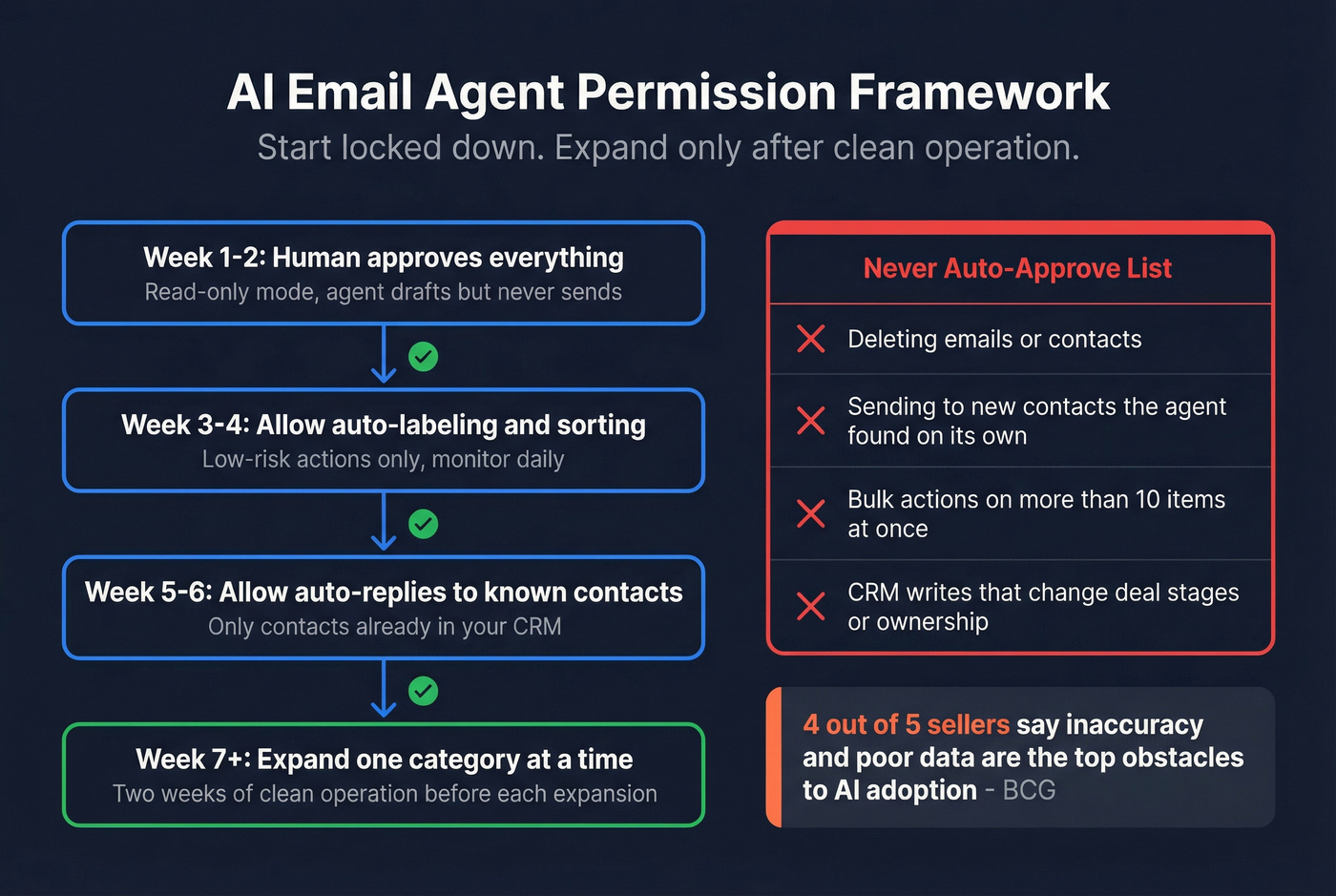
Lindy's "no send without approval" default is the right starting point. Anthropic's autonomy research shows an interesting pattern: full auto-approve usage rises from about 20% among new users to over 40% among experienced ones. People grant more autonomy as trust builds, which makes sense - but it also means the risk window widens over time.
Anthropic's data also shows agent sessions are getting longer. The 99.9th percentile task duration nearly doubled from under 25 minutes to over 45 minutes between October 2025 and January 2026. Agents are doing more, for longer, with less oversight. That makes guardrails non-optional.
Here's the thing: the most common failures aren't "the agent can't write." They're "the agent acted on the wrong thing" - wrong recipients, auto-replies to junk, bad CRM writes. BCG found that more than 4 out of 5 sellers cite inaccuracy and poor data integration as the top obstacles to AI adoption. The agents aren't the bottleneck. The data and permissions are. (If you're deploying this in a revenue org, it's worth comparing against broader autonomous AI agents for sales patterns too.)
I've watched demos where the vendor skips the permissions screen entirely. That tells you everything about their priorities.
A practical never-auto-approve list:
- Deleting emails or contacts (the OpenClaw lesson)
- Sending to new contacts the agent identified on its own
- Bulk actions across more than 10 items at once
- CRM writes that modify deal stages or ownership
Start with human-in-the-loop for everything. Expand permissions one category at a time, only after two weeks of clean operation.
Security and Compliance
Before granting any tool access to your inbox, check what happens to your data at the LLM layer.
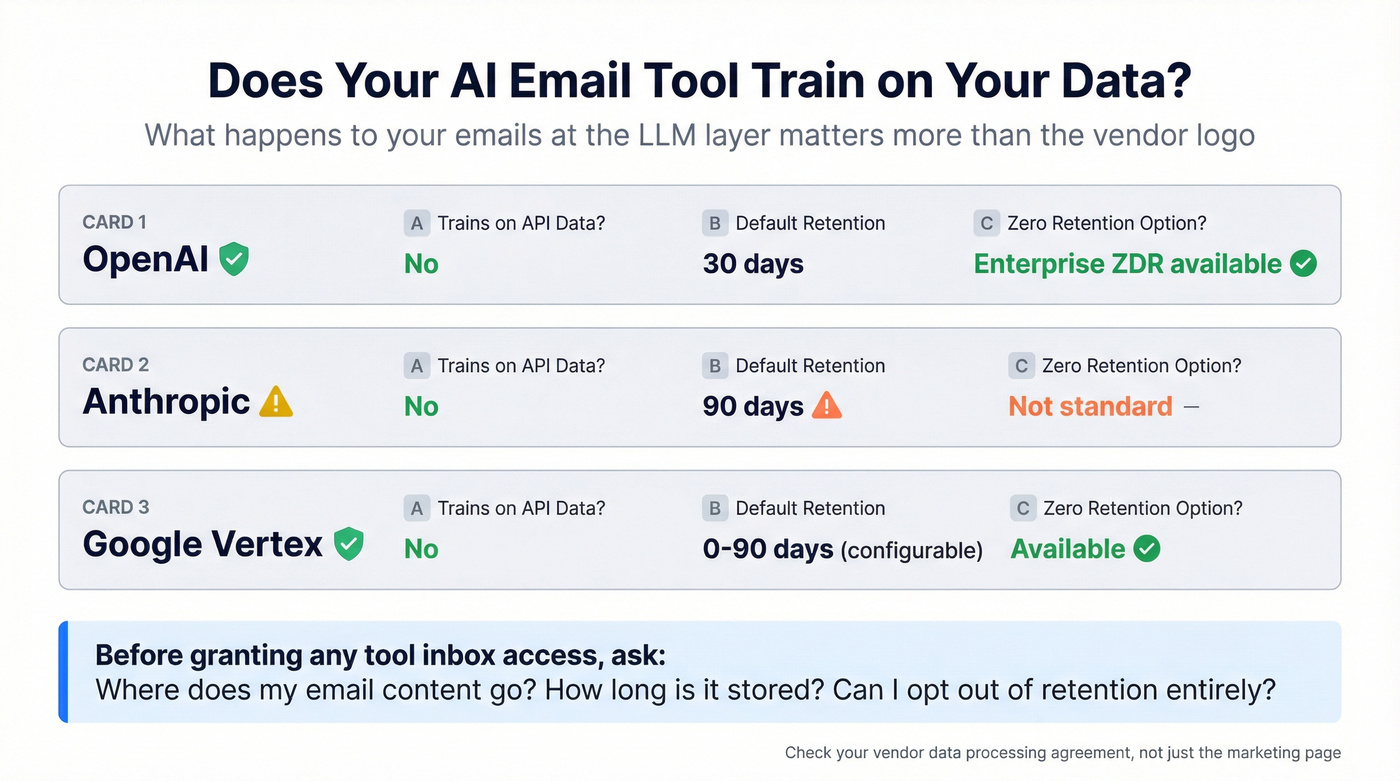
| Provider | Trains on API Data? | Default Retention | Zero Retention? |
|---|---|---|---|
| OpenAI | No | 30 days | Enterprise ZDR |
| Anthropic | No | 90 days | Not standard |
| Google Vertex | No | 0-90 days | Yes (configurable) |
Compliance adds real cost if you need it. GDPR implementation typically runs $3K-$8K extra. HIPAA adds $10K-$20K. SOC 2 Type II certification costs $15K-$25K. These aren't the vendor's fees - they're your implementation costs for meeting the standard.
Gmelius already holds SOC 2 Type II certification, which can reduce your audit burden. Lindy offers HIPAA compliance with a signed BAA on their enterprise tier. For everyone else, verify encryption standards: TLS 1.3 in transit, AES-256 at rest, and ask specifically about key management.
Clean Data Is the Foundation
Let's be honest about something the AI email agent conversation usually ignores: an agent that sends beautifully crafted follow-ups to bounced addresses isn't productive. It's actively damaging your domain reputation. The consensus on r/sales is pretty clear - bad data is the number one reason outbound automation backfires, regardless of how smart the tool is.
Before deploying any agent for outbound communication, run your contact lists through real-time verification. Prospeo's 5-step verification process delivers 98% email accuracy on 143M+ verified addresses, with a 7-day refresh cycle versus the 6-week industry average. If you want the underlying why (and the numbers behind it), see the benefits of email verification. An agent working with clean data is a force multiplier. An agent working with stale data is a reputation liability.
Build vs. Buy
If you've got a technical team and want full control, building your own email agent is surprisingly accessible. The core stack: n8n as the workflow engine, OpenAI's gpt-4o-mini as the model, and Gmail via OAuth2 as the email layer. A trigger node catches incoming messages, routes them to an AI agent node, which uses Gmail tool nodes for send/read/reply actions, with a memory buffer maintaining conversation context.
I've built this exact n8n + OpenAI stack - it took closer to 30 minutes than 10, but it works. Self-hosted n8n runs $5-20/mo for infrastructure. Cloud n8n is $20-50/mo depending on execution volume. Add OpenAI API costs (typically $5-15/mo for moderate email volume) and you're looking at a fully custom agent for under $65/mo.
When to build: you have engineers, you need custom logic, and you want zero vendor lock-in. When to buy: you need it working by Friday, your team isn't technical, or compliance requirements demand a certified vendor.
If your average deal size is under $15K, you probably don't need a $50K/year platform like 6sense. The n8n stack plus verified contact data from a tool like Prospeo will get you 80% of the value at 5% of the cost. For more context on where email fits in the broader outbound stack, compare this with AI cold email automation and AI sales automation.
Before you deploy any autonomous email agent, the contact list it acts on needs to be bulletproof. Prospeo gives you 300M+ profiles with 5-step verification, catch-all handling, and spam-trap removal - at $0.01 per email. Teams using Prospeo see bounce rates under 4%.
Agents automate the sending. Prospeo guarantees the data behind it.
How to Evaluate Any Email Agent
Most "best of" lists - including 6sense's blog claiming 4,500 verified reviews - provide no scoring methodology. No precision metrics, no error rates, no controlled tests. Here's a framework that actually works:
- Sample 200 email threads from your real inbox across different categories: internal, client, cold outbound, support.
- Measure triage precision and recall - how accurately does the agent label and prioritize versus your manual sorting?
- Track draft acceptance rate - what percentage of AI drafts do you send with less than 10% edits?
- Log false-positive auto-archives over two weeks. These are emails the agent buried that you actually needed.
- Calculate time saved versus time spent correcting agent mistakes.
BCG's research reinforces this: roughly 3 in 4 sellers feel under-supported in using AI tools. The problem isn't the technology - it's that nobody teaches teams how to evaluate whether the technology is actually working. Run the benchmark before you commit to an annual contract. If your use case is specifically outbound follow-ups, you may also want a tighter rubric for automating sales follow-ups.
FAQ
What's the difference between an AI email agent and an assistant?
An agent plans and executes multi-step workflows autonomously - monitoring your inbox, drafting follow-ups, and acting on a schedule without prompting. An assistant responds to individual requests, one task at a time. Most tools marketed as "agents" in 2026 are still assistants with proactive features bolted on. The test: can it act without you clicking a button?
Can an AI email agent send messages without approval?
It depends entirely on the tool and your permission settings. Lindy explicitly requires approval before sending. Shortwave and Gmelius draft but don't auto-send. Always start with human-in-the-loop and expand permissions gradually - the OpenClaw incident proved that even AI safety experts can lose control of over-permissioned agents.
How much do AI email agents cost in 2026?
Individual tools range from $19-$100/user/month. Gmelius starts at $19/user/mo, Shortwave at $24/seat/mo, Superhuman at $30/mo. Enterprise platforms like 6sense start above $50,000/year. DIY builds with n8n + OpenAI run $5-65/month including API costs.
Are these tools safe for sensitive business communications?
Only with proper guardrails. Check your vendor's LLM data retention policy - OpenAI retains for 30 days, Anthropic for 90. Require TLS 1.3 encryption in transit and AES-256 at rest. Never grant auto-delete permissions without immutable audit logging. Gmelius's SOC 2 Type II certification is a common enterprise requirement for team-facing deployments.
How do I make sure my email agent has accurate contact data?
Verify your contact lists before deploying any agent. Tools acting on stale or incorrect addresses automate bounces and damage sender reputation. A 98% accuracy standard with weekly refresh cycles is the minimum bar - anything less and your agent creates problems faster than it solves them.