

Positive Attitude in Sales Isn't About Being Happy - It's About Having Systems
It's your 47th cold call of the day. Zero appointments. Your manager claps you on the shoulder and says "stay positive." You want to throw your headset across the room.
That advice isn't wrong - it's just incomplete. A positive attitude in sales isn't a personality trait you're born with or a vibe you summon on command. It's a system you build, maintain, and lean on when the math of the job grinds against your ego. We've watched entire teams spiral not because they lacked talent, but because nobody gave them a framework for handling the daily grind.
Three things actually move the needle:
- A daily reframing practice using the 3C method - Catch it, Check it, Change it
- Rejection normalization through real stats (a 2% cold call conversion rate is normal, not failure)
- Clean prospect data so you stop wasting energy dialing ghosts and watching emails bounce
Everything below expands on those three levers with data, scripts, and a daily routine you can start tomorrow.
Why Mindset Is a Business Problem
Let's talk dollars, not feelings. In the widely cited Seligman/MetLife optimism research, optimistic insurance agents outsold their pessimistic peers by 37%, and the top decile of optimists outsold by 88%. Positive thinking in sales isn't motivational fluff - it's backed by decades of performance data.
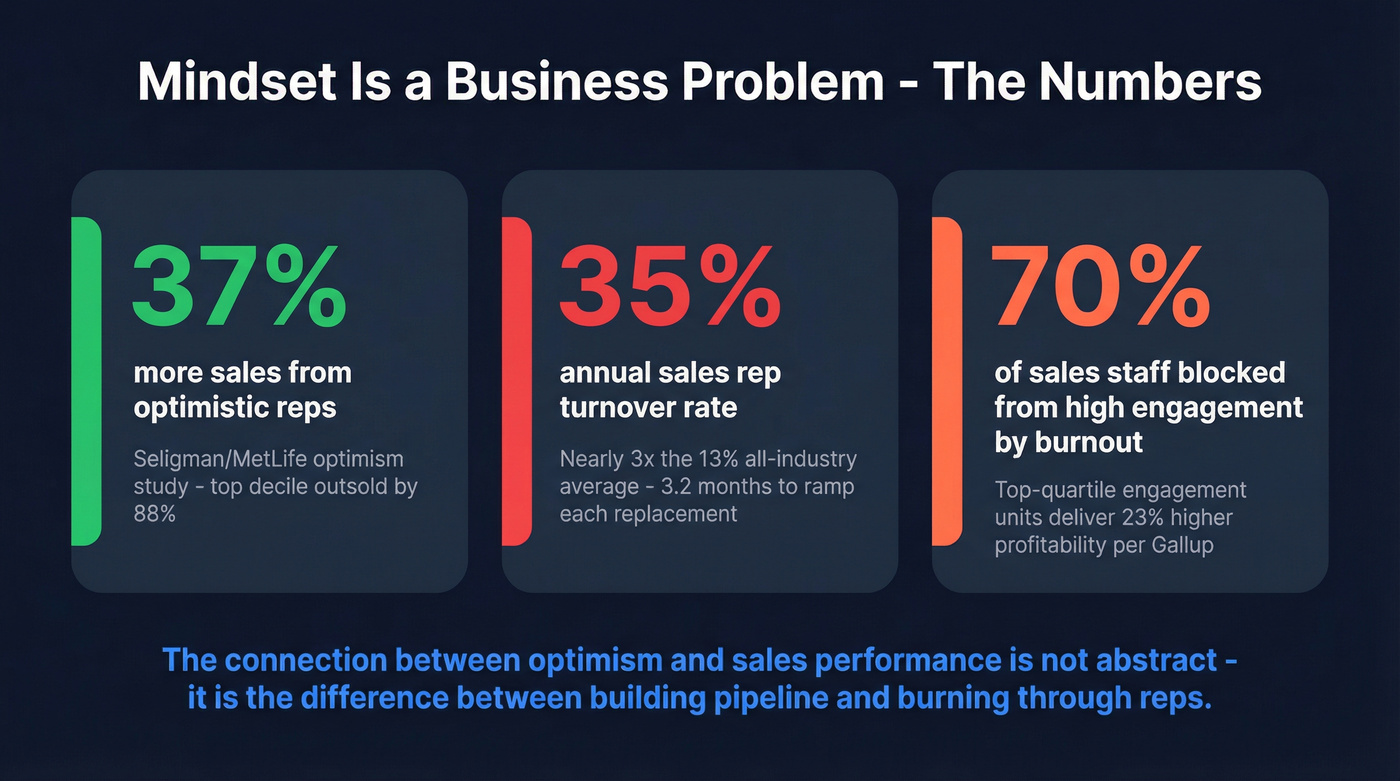
Now layer on the turnover crisis. Average sales rep turnover runs 35% - nearly three times the 13% all-industry average. It takes 3.2 months to ramp a new rep to full productivity. When reps burn out and leave, you're not just replacing a person - you're resetting ramp time and momentum for the whole team.
The engagement numbers are worse. Burnout blocks 70% of sales staff from reaching high engagement, while Gallup's data shows top-quartile engagement units deliver 23% higher profitability. The connection between optimism and sales performance isn't abstract. It's the difference between a team that builds pipeline and one that burns through reps.
The Toxic Positivity Trap
"Just stay positive" without tools or coaching doesn't build resilience. It accelerates burnout.
Forced positivity - the kind where you're told to smile through a terrible quarter with no support - increases emotional suppression. Reps learn to bury frustration instead of processing it, and buried frustration doesn't disappear. It compounds into cynicism, disengagement, and eventually a resignation letter.
The productive path isn't "be happy." It's acknowledge, process, reframe. You feel the sting of a lost deal. You sit with it for a minute. Then you run it through a structured reframe. The difference between toxic positivity and productive positivity is whether you have a system or just a slogan.
Rejection Is Arithmetic, Not Personal
If you internalize every "no," you won't last six months. So let's normalize the math:
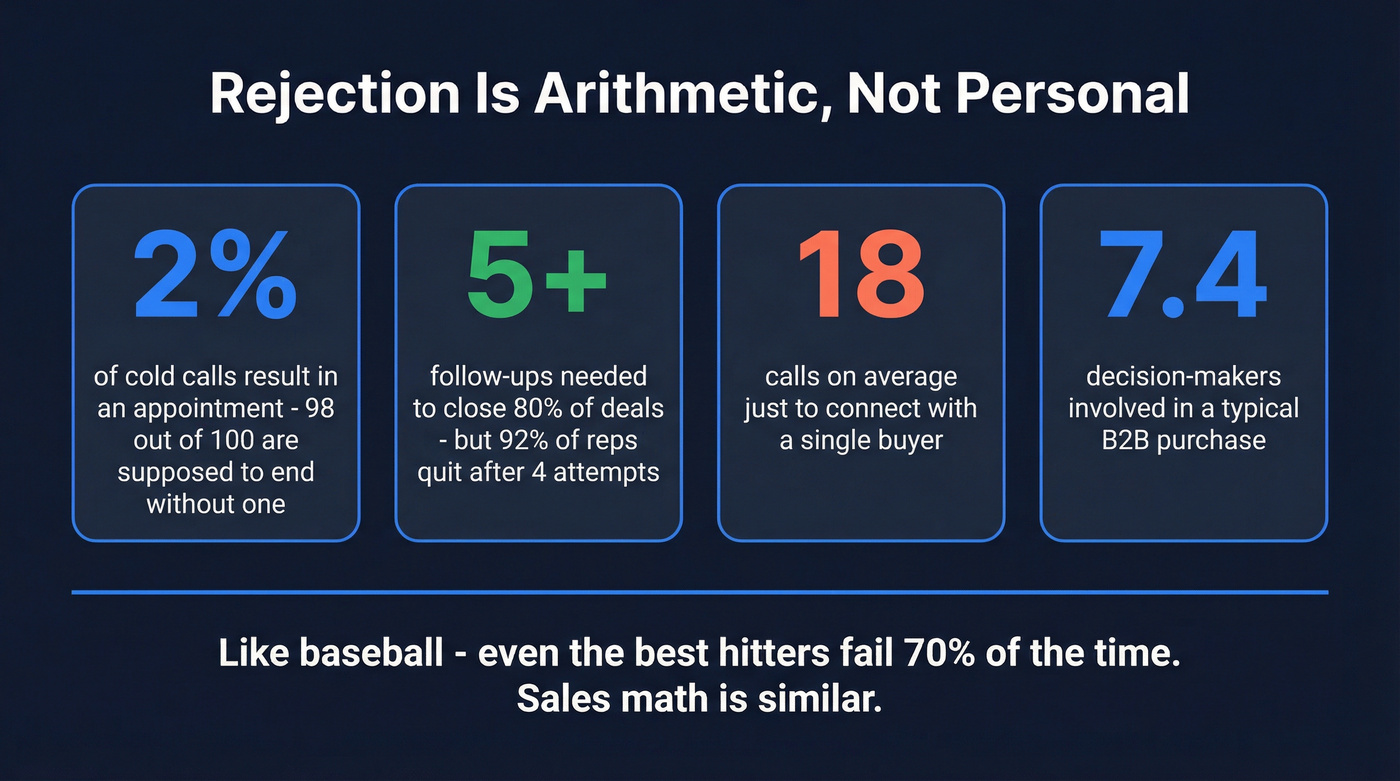
- 2% of cold calls result in an appointment. That means 98 out of 100 calls are supposed to end without one. (If you want the full context, see our B2B cold calling guide.)
- 80% of sales require 5+ follow-ups, but 92% of reps quit after 4 attempts.
- It takes an average of 18 calls just to connect with a buyer.
- A typical B2B purchase involves 7.4 decision-makers. You're not selling to one person - you're navigating a committee.
Even the best hitters in baseball fail 70% of the time at the plate. Sales math is similar. And here's the kicker: 70% of the buyer's journey is already complete before a prospect talks to a rep. Most of your "rejections" are just bad timing, not bad selling.
Ask any rep on r/sales what keeps them going through a bad month, and the answers cluster around the same theme: systems, not vibes. The reps who internalize the math don't become numb - they become strategic. They stop measuring success by individual call outcomes and start measuring it by activity volume and process quality.

You can't reframe your way out of dialing disconnected numbers and bouncing emails. When 35% of your list is dead data, even the best mindset crumbles. Prospeo delivers 98% verified emails refreshed every 7 days - so your energy goes toward real conversations, not ghost contacts.
Fix your data before you try to fix your attitude.
The Reframing Toolkit
Catch It, Check It, Change It
The 3C framework is cognitive restructuring made practical for sales:
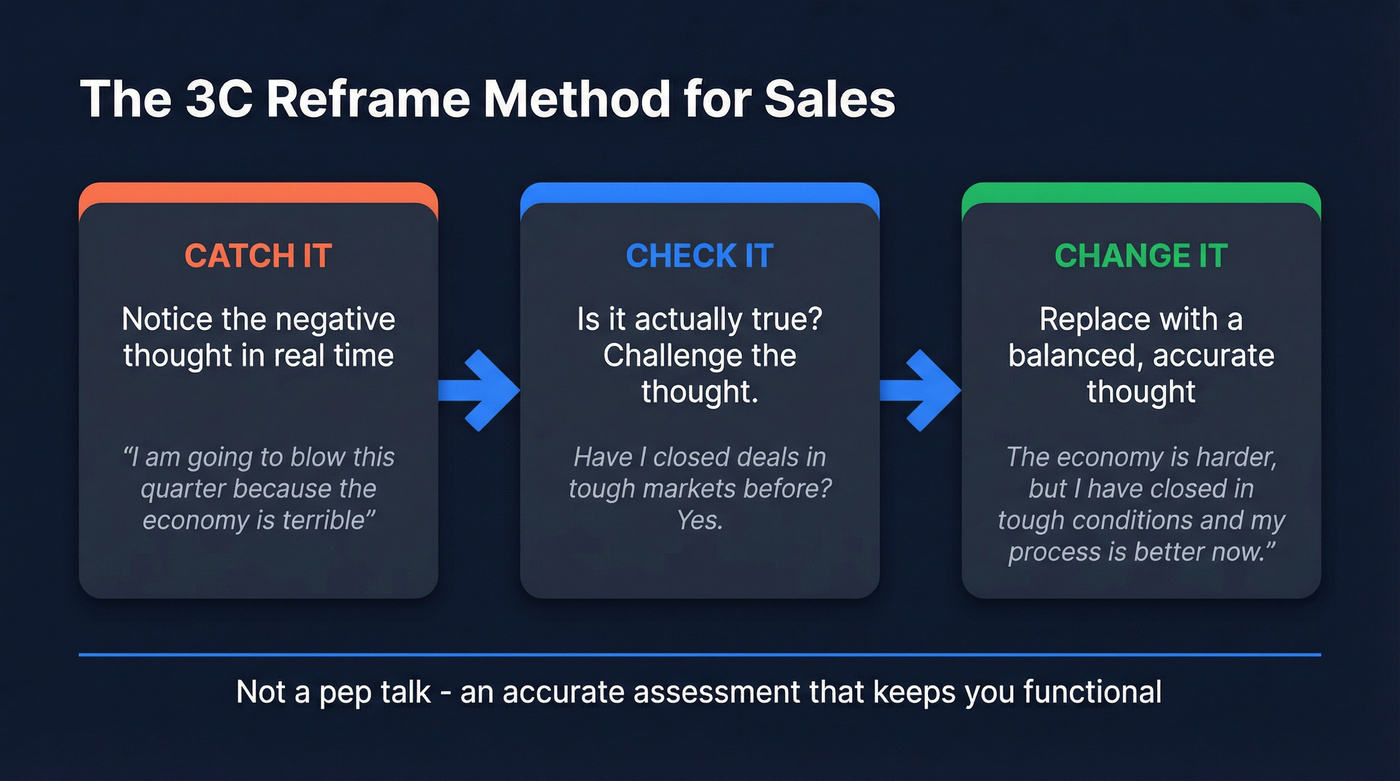
Catch it. Notice the negative self-talk in real time. "I'm going to blow this quarter because the economy is terrible" - catch that thought before it spirals.
Check it. Is it true? Have you closed deals in tough markets before? The answer is almost always yes. The thought isn't a fact - it's a stress response wearing a fact costume.
Change it. Replace it with something balanced: "The economy is making this harder, but I've closed in tough conditions before, and I'm running a better process than last quarter." That's not a pep talk. It's an accurate assessment that keeps you functional.
Pair this with behavior activation: calendar-block your hardest tasks and break a daunting pipeline target into daily call blocks. Small steps that build momentum beat willpower every time. (If you're building this into a repeatable motion, start with a prospecting workflow.)
Scripts for the Moments That Break You
Here's the thing - most reps don't freeze because they lack product knowledge. They freeze because the emotional hit of rejection short-circuits their thinking. These redirects keep you in the conversation instead of retreating into your head:
"Not worth the price" - "What's important to you in a product like this?" (More options: best open-ended sales questions.)
Silence after your pitch - "What are you thinking about right now?"
Lost the deal - "What can I learn from this?" (Related: closed lost.)
Don't know the answer - "I'll check with my team and follow up tomorrow. Does that work?"
These aren't magic phrases. They shift you from defending your pitch to understanding the buyer, turning rejection into a feedback loop instead of a dead end.
The Daily System
Systems beat motivation. Here's a routine that takes less than 15 minutes total:
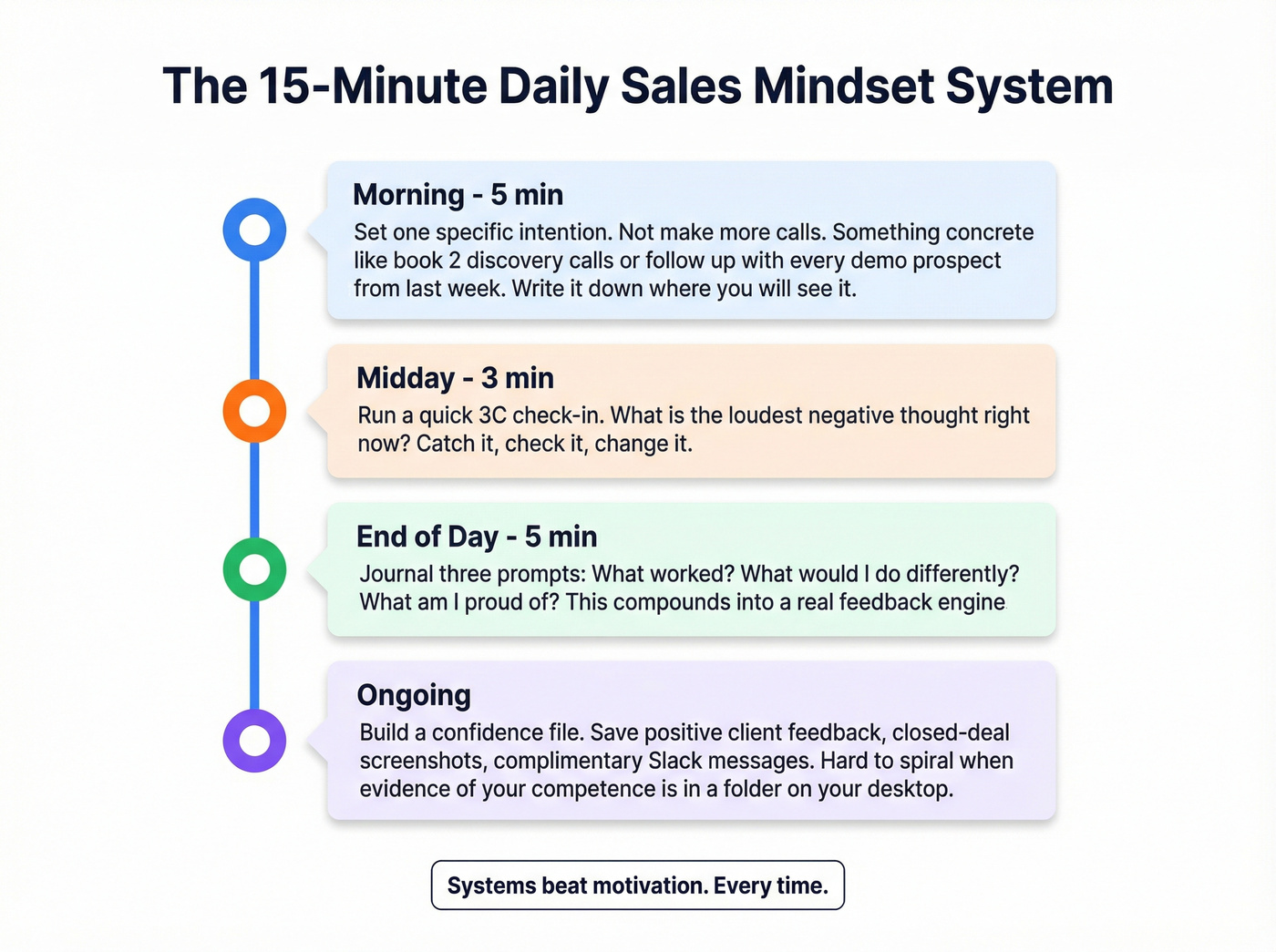
Morning (5 min): Set one specific intention. Not "make more calls" - something concrete like "book 2 discovery calls" or "follow up with every prospect from last week's demos." Write it down where you'll see it. (If you want a tighter structure, use a cold call checklist.)
Midday (3 min): Run a quick 3C check-in. What's the loudest negative thought right now? Catch it, check it, change it.
End of day (5 min): Journal three prompts - "What worked? What would I do differently? What am I proud of?" This isn't therapy. It's a performance review you give yourself daily, and it compounds over weeks into a real feedback engine.
Ongoing: Build a confidence file. Save positive client feedback, closed-deal screenshots, complimentary Slack messages. We've seen this single habit pull reps out of multi-day slumps faster than anything else - it's hard to spiral when the evidence of your competence is sitting in a folder on your desktop.
Fix Your Inputs Before Your Mindset
Here's our hot take: most sales attitude problems aren't attitude problems at all. They're data problems wearing an attitude costume.
You can reframe rejection all day. You can't reframe a bounced email or a disconnected phone number. The average sales rep makes 52 calls per day. When your contact data is outdated, you rack up wasted dials and bounces that erode your confidence before a single real conversation happens. I've seen reps go from "I'm terrible at this job" to "oh, my list was garbage" in the span of one data cleanup - and their numbers followed.
The oldest advice on sales floors everywhere - control the controllables - starts with your data. Tools like Prospeo deliver 98% email accuracy and 125M+ verified mobile numbers with a 30% pickup rate, all refreshed on a 7-day cycle. When every dial and every send has a real chance of landing, that alone changes how you feel about the next hour of work. Maintaining a positive attitude in sales is much easier when the controllable inputs are already working in your favor. (If you're seeing decay, start with B2B contact data decay and a CRM hygiene routine.)

The article's math is clear: it takes 18 calls to reach a buyer and 5+ follow-ups to close. You can't afford to waste any of those touches on wrong numbers. Prospeo gives you 125M+ verified mobile numbers with a 30% pickup rate - 3x the industry average - so every dial counts.
Turn rejection math into connection math for $0.01 per lead.
FAQ
Does a positive sales mindset actually improve numbers?
Yes. In the Seligman/MetLife optimism research, optimistic sales agents outsold peers by 37%, with the top decile outselling by 88%. Gallup's engagement data shows top-quartile units deliver 23% higher profitability. Attitude isn't a soft skill - it's a performance multiplier with measurable revenue impact.
How do I stay positive after repeated rejection?
Normalize the numbers first: 2% of cold calls convert, and 80% of deals need 5+ follow-ups. Rejection is the default outcome, not a personal verdict. Use the 3C reframe method daily and build a confidence file of past wins you can review when momentum stalls. Better systems beat thicker skin every time.
What's the fastest way to reduce daily frustration on the phones?
Fix your contact data. Verified emails and direct dials eliminate wasted dials and bounces - the biggest controllable source of rep frustration. Pair clean data with a 5-minute morning intention routine and you've addressed the two biggest controllable factors in your first week.