

What Is an Inbound Sales Development Representative?
Monday morning. Three hundred webinar leads just hit Salesforce, and the clock's already ticking. That's the life of an inbound sales development representative - the person who turns marketing's hand-raisers into real pipeline before the leads go cold.
The Quick Version
An inbound SDR qualifies warm leads generated by marketing, books meetings for account executives, and moves on. The role pays roughly $51,244 base on average, with around $80K OTE as a common benchmark. The single metric that separates great inbound reps from average ones? Speed-to-lead. Most who hit quota consistently promote to AE within 12-18 months.
What Does an Inbound SDR Actually Do?
Marketing generates the leads. Sales closes them. The inbound SDR is the bridge.
When someone downloads an ebook, requests a demo, or signs up for a webinar, the inbound rep is the first human touchpoint. Their core jobs fall into four buckets: qualifying inbound leads, making first outreach, nurturing prospects who aren't ready yet, and handing qualified opportunities to closers. They don't close deals - they create them.
In high-performing B2B companies, SDRs contribute 30-45% of pipeline revenue. That's not a support function. That's the engine.
Inbound SDR vs Outbound SDR
The two roles share a title but run completely different playbooks.
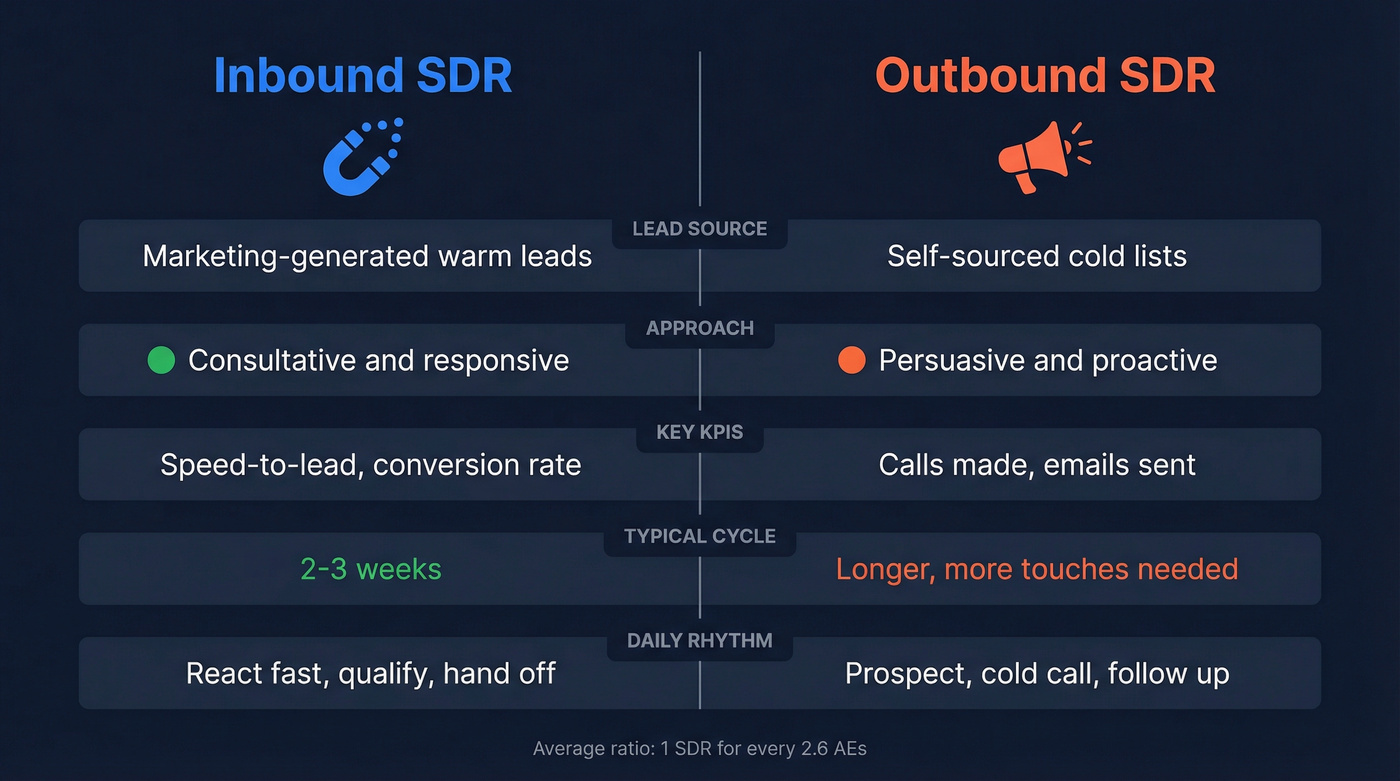
| Dimension | Inbound SDR | Outbound SDR |
|---|---|---|
| Lead source | Marketing-generated | Self-sourced (cold lists) |
| Lead temperature | Warm | Cold |
| Approach | Consultative, responsive | Persuasive, proactive |
| Key KPIs | Speed-to-lead, conversion rate | Calls made, emails sent |
| Typical cycle | 2-3 weeks | Longer, more touches needed |
Inbound reps respond. Outbound reps initiate. Both feed the same pipeline, but the skills and daily rhythms differ enough that most teams specialize. On average, orgs run about 1 SDR for every 2.6 AEs - so one strong inbound rep can keep nearly three closers fed.
Core Responsibilities
Here's what the day-to-day actually looks like, pulled from real job descriptions we've reviewed:
- Qualify warm inbound leads from webinars, trials, demo requests, and content downloads
- Make first contact fast via phone, email, or chat within SLA windows (ideally under 5 minutes)
- Manage multiple channels simultaneously - calls, emails, live chat, referrals
- Log everything in the CRM - Salesforce is the standard; every touchpoint gets documented
- Nurture leads that aren't ready on a cadence until they're sales-ready
- Hand off qualified opportunities to AEs with context, notes, and a warm introduction
Ask any inbound SDR what the hardest part of the job is and you'll get the same answer. It's not qualifying leads. It's fighting the CRM to log everything before the next call comes in.

Inbound SDRs handle 300 leads a month. If even 10% bounce, that's 30 dead opportunities and a wrecked sender reputation. Prospeo's 5-step email verification catches bad data before it hits your cadence - 98% accuracy, 7-day refresh cycle, $0.01 per email.
Stop losing speed-to-lead to bounced emails. Verify before you dial.
Metrics That Matter
This is where inbound reps live or die.
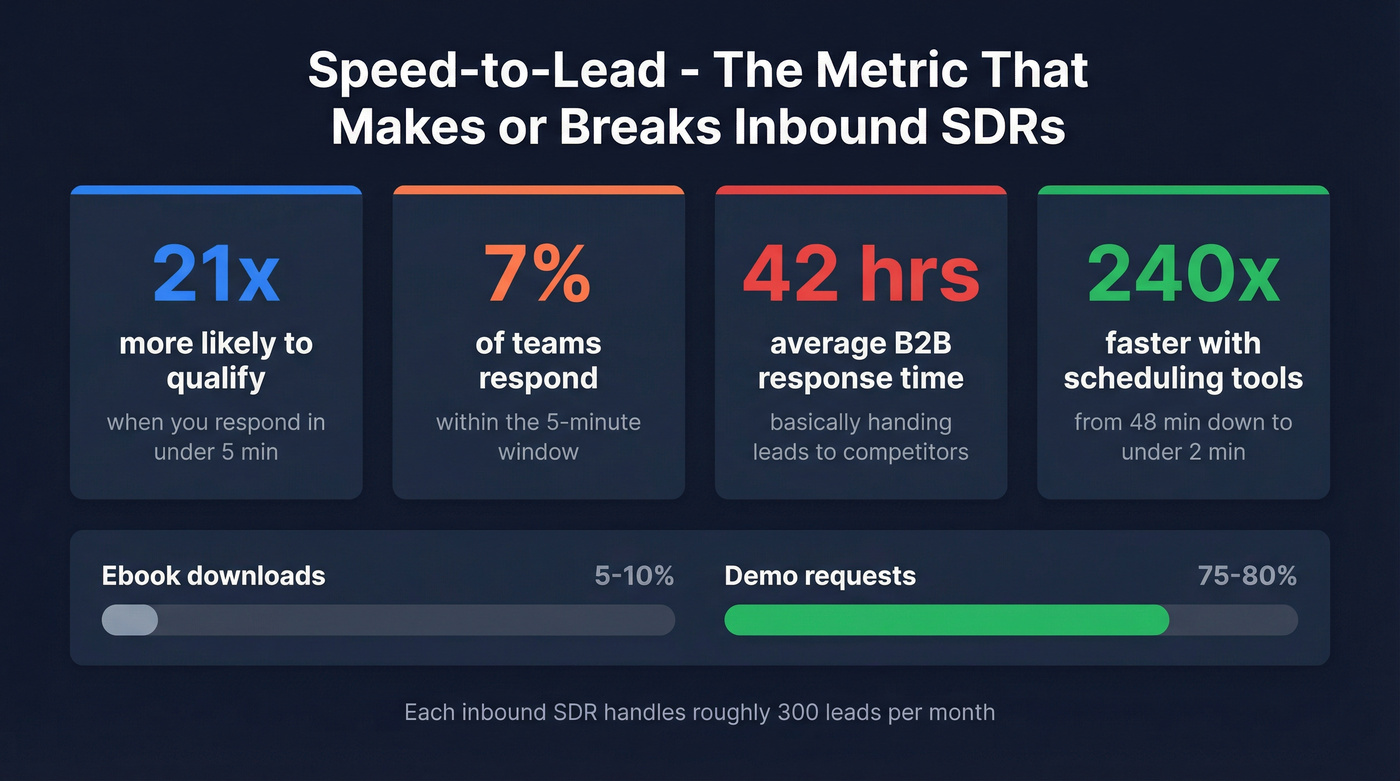
Each SDR can handle roughly 15 leads per day - about 300 per month. Conversion rates swing wildly depending on intent level. Low-intent leads like ebook downloads convert to meetings at just 5-10%. High-intent leads like demo requests? That jumps to 75-80%.
Speed-to-lead is the metric that matters most. Responding within 5 minutes makes you 21x more likely to qualify the lead versus waiting 30 minutes - and 100x more likely to connect at all. Yet only 7% of teams respond within that window. The average B2B response time sits at a brutal 42 hours. Let's be honest: if you're taking two days to call back a demo request, you've already lost. Teams that integrate scheduling tools into their forms cut average response time from 48 minutes to under 2 minutes - a 240x improvement.

Your 5-minute SLA means nothing if the lead's email bounces. We've seen teams cut their bounce rate from 35% to under 4% just by verifying contacts before outreach. Quota attainment across SDR teams hovers around 52-60%, and bad data is one of the silent killers dragging that number down.
Skills and Tools
The best inbound SDRs maintain a talk-to-listen ratio of about 43:57. They ask sharp questions, then shut up. For qualification frameworks, BANT (Budget, Authority, Need, Timeline) works for faster sales cycles. MEDDIC is better for enterprise deals where you need to map decision processes.
The standard stack looks like this: a CRM like Salesforce or HubSpot (free tier available), a sales engagement platform like Outreach.io (~$100-$150/user/month), and a scheduling tool like Chili Piper (~$45/mo). For lead enrichment and email verification, Prospeo gives inbound SDRs access to 300M+ profiles and 125M+ verified mobiles with a free tier to start.
One more thing worth flagging - forms with fewer than five questions convert at a 200% higher rate than longer ones. Keep your intake forms tight.
Demo requests convert at 75-80% - but only if you reach the right person. Prospeo gives inbound SDRs instant access to 125M+ verified mobile numbers and 143M+ verified emails so your first touch actually connects.
Turn every hand-raiser into a booked meeting with data that picks up.
Salary Benchmarks in 2026
Based on 985 salary profiles from PayScale/Salary) (updated January 2026):
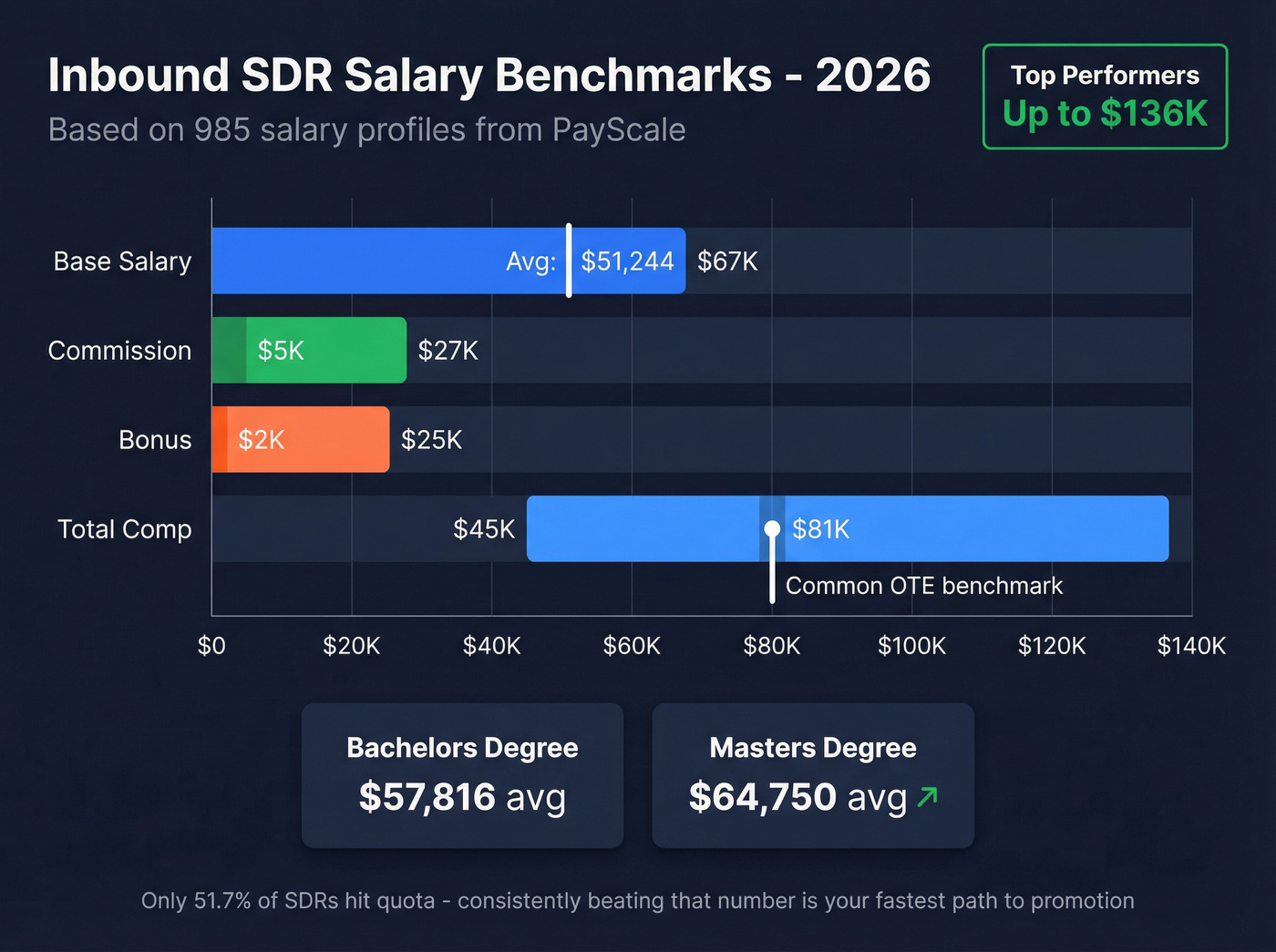
| Component | Range |
|---|---|
| Base salary | $40K-$67K (avg $51,244) |
| Commission | $5K-$27K |
| Bonus | $2K-$25K |
| Total comp | $45K-$81K |
| OTE (common benchmark) | ~$80K |
| Top performers | Up to $136K |
Experience matters less than you'd think. Entry-level SDRs (0-1 years) average about $51K base, while those with 15+ years still only hit ~$65K base. The real money comes from variable comp and promotion. Education has a clearer correlation - bachelor's degree holders average $57,816 versus $64,750 for those with a master's.
Here's the reality: only about 51.7% of SDRs hit quota. If you're consistently above that line, you're more valuable than your base salary suggests - and you should be building your promotion case now.
Career Path After the SDR Role
Most inbound SDRs promote to account executive within 12-18 months. High performers make the jump in 10-12 months. The benchmark: hit 90%+ quota for two straight quarters.
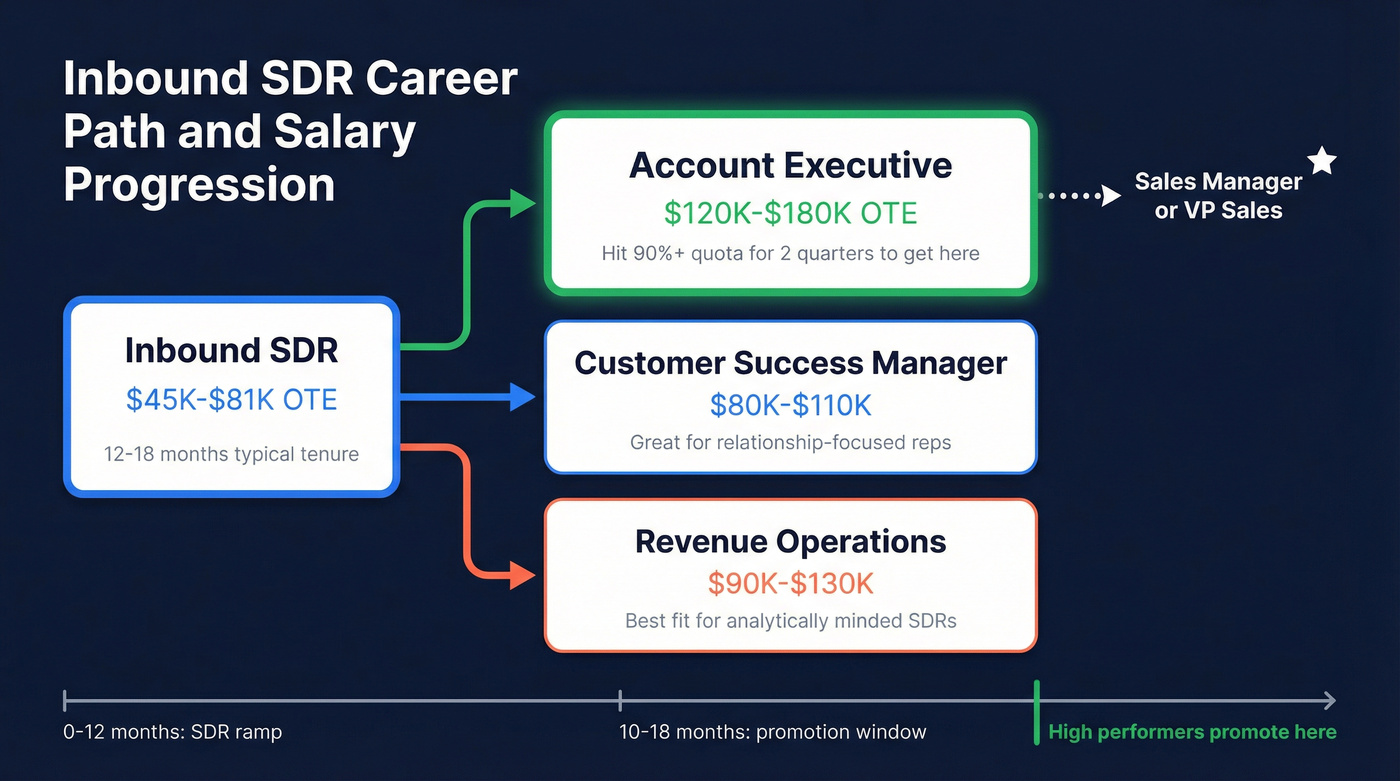
The AE jump is where comp gets interesting - mid-market AE OTE runs $120K-$180K, roughly double SDR pay. But AE isn't the only path. Customer Success Manager roles pay $80K-$110K and suit SDRs who prefer relationship management over hunting. Revenue Operations ($90K-$130K) is a strong fit for the analytically minded. The running joke in SDR Slack channels is that 18 months feels like 5 years - but the AE paycheck makes it worth it.
Skip this if it doesn't apply: If your average deal size is under $10K, you probably don't need a dedicated inbound SDR team at all. Route those leads straight to AEs with good scheduling automation and save the headcount for outbound, where the ROI on specialization is clearer.
FAQ
How many leads should an inbound SDR handle per day?
About 15 per day, or 300 per month. Expect 5-10% conversion for content downloads but 75-80% for demo requests. Prioritize high-intent leads first and work lower-intent contacts on a nurture cadence.
Is inbound SDR a good first sales job?
It's the strongest entry point into B2B sales. You learn qualification, CRM hygiene, and pipeline mechanics with warm leads instead of cold rejection. Most reps promote to AE within 12-18 months, where OTE doubles.
What's the most important metric for an inbound sales development representative?
Speed-to-lead. Responding within 5 minutes makes you 21x more likely to qualify a lead than waiting 30 minutes. Only 7% of B2B teams hit that window - doing so is the single fastest way to outperform quota.