

7 Benefits of Email Verification (With Real Numbers)
Email verification doesn't improve deliverability. It prevents you from destroying it.
That's a distinction most guides skip, and it's the reason teams with "great content" still land in spam folders. Here are the real benefits of email verification, why they matter more in 2026 than ever, and the mistakes quietly costing you money.
What You Need (Quick Version)
Verifying your list prevents you from torching your sender reputation, keeps you compliant with Gmail and Yahoo's enforcement rules, and saves real money on ESP billing. If you're doing outbound, use a platform that verifies before you ever export - like Prospeo. If you're cleaning an existing marketing list, bulk tools like ZeroBounce (~$10 per 1,000 emails) or NeverBounce (~$8 per 1,000) handle the job.
The Scale of the Problem
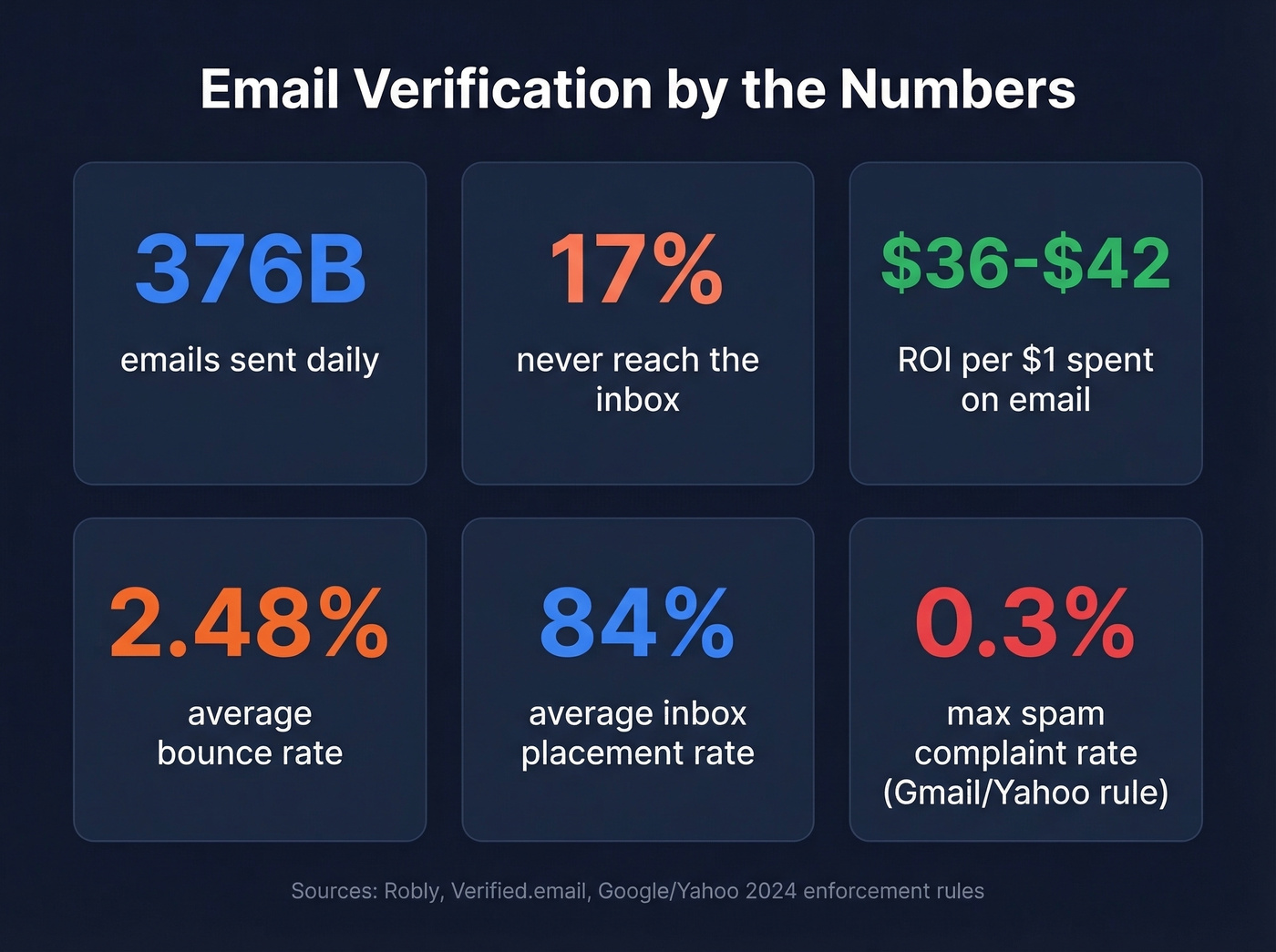
[376 billion emails](https://www.statista.com/statistics/456500/daily-number-of-e-mails-worldwide/) go out every day. Roughly [17% never reach the inbox](https://www.retaildive.com/news/study-20-of-marketing-e-mails-dont-reach-the-inbox/448911/). That's not a rounding error - it's pipeline, revenue, and reputation evaporating before a human ever sees your message.
Email still generates [$36-$42 per $1 spent](https://www.litmus.com/resources/email-marketing-roi), the highest-ROI channel in B2B. But that ROI assumes your emails actually arrive. Verification is the infrastructure that makes the math work.
How Email Verification Works
Verification is a five-step pipeline that filters out bad addresses before they damage your domain. A syntax check catches formatting errors. An MX lookup confirms the recipient's domain has a mail server. The SMTP handshake pings that server to confirm the mailbox exists. Catch-all detection flags domains that accept everything - these need separate handling. Finally, spam-trap and honeypot removal strips addresses planted to catch senders with dirty lists.
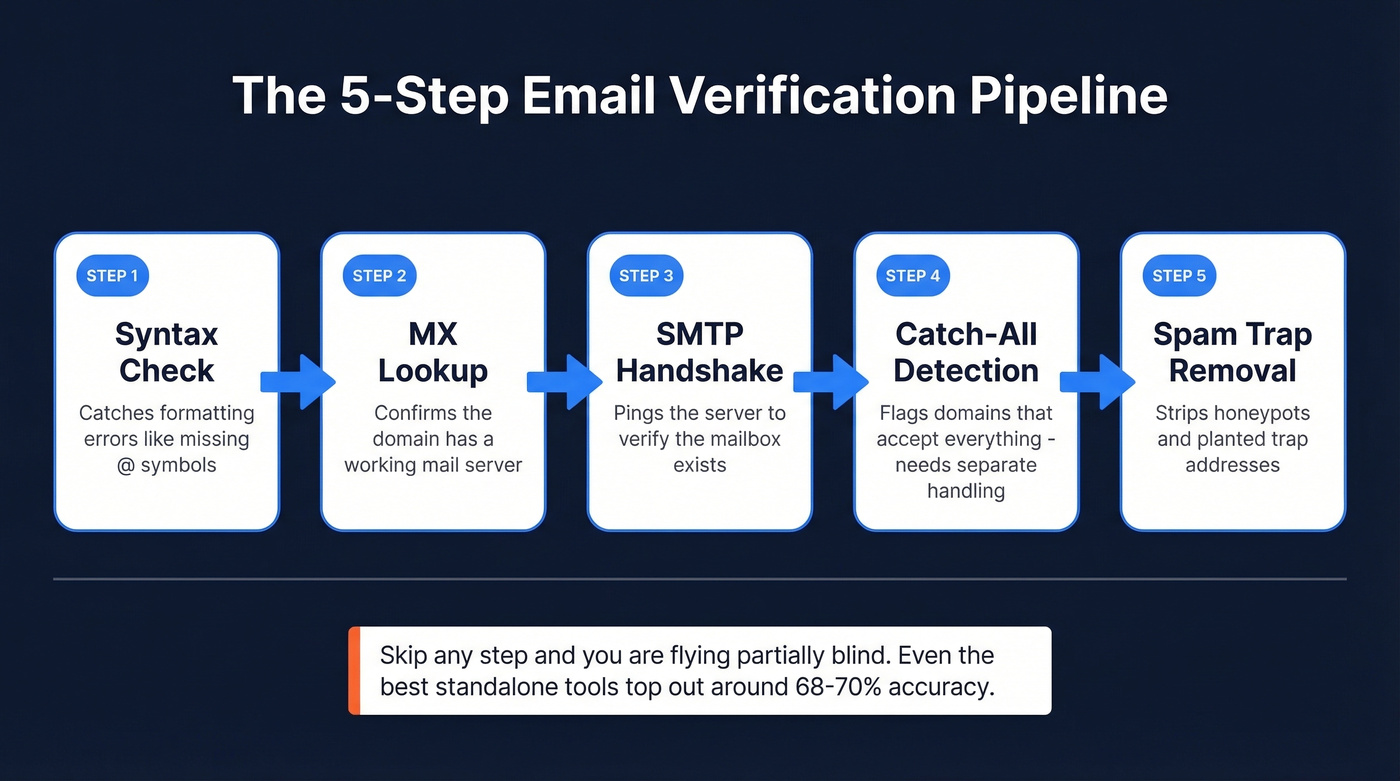
Skip any step and you're flying partially blind. Here's the uncomfortable truth: even the best standalone verification tools top out around 68-70% accuracy on real business emails in Hunter's published benchmark. Process beats any single tool.

Most tools find emails first and verify later - if at all. Prospeo's proprietary 5-step verification pipeline catches catch-all traps, honeypots, and dead mailboxes before you export a single address. 98% email accuracy. 7-day data refresh so your list never decays.
Stop cleaning lists. Start with clean data from the source.
7 Verification Benefits That Impact Revenue
1. Lower Bounce Rates
The average email bounce rate sits at 2.48%. Your target: under 2%, with hard bounces below 1%. Exceed those thresholds consistently and your ESP will flag your account - or suspend it entirely. Verification eliminates hard bounces almost entirely by catching dead addresses before you hit send.
2. Stronger Sender Reputation
Your sender reputation is split between IP and domain reputation, scored 0-100 and varying per mailbox provider. Every bounce and spam complaint chips away at both. Once reputation drops, recovery takes days to weeks - sometimes longer if you've been blacklisted. Check your blacklist status with MXToolbox or SenderScore.org and fix the root cause before requesting removal. (If you need a playbook, see improve sender reputation and email reputation tools.)
3. Better Inbox Placement
Average inbox placement is 84%. About 10.5% land in spam, and the rest are blocked, missing, or otherwise fail to arrive. Verification won't fix your subject lines, but it removes the biggest preventable cause of poor placement: sending to addresses that don't exist. (For the rest of the stack, use an email deliverability guide.)
4. Gmail and Yahoo Compliance
Since February 2024, bulk senders must implement SPF, DKIM, and DMARC offer one-click unsubscribe, and keep spam complaints below 0.3%. Non-compliant emails now face temporary or permanent rejection. Sending to invalid addresses inflates bounce rates and triggers exactly the enforcement these rules target. (If you're troubleshooting alignment, see DMARC alignment and SPF record examples.)
5. Lower ESP Costs
We've watched this play out dozens of times. You're on a 50,000-contact ESP plan at $150/month. If 15-20% of those contacts are invalid, you're paying $24-$30/month to store addresses that'll never convert - $288-$360/year in pure waste, compounding as your list grows. Verification trims the fat immediately.
6. Higher Engagement and ROI
Removing invalid and inactive addresses focuses your sends on real humans. Open rates climb, click rates improve, and your engagement signals tell mailbox providers you're legitimate. Clean lists also improve automation trigger accuracy - fewer false sends, better journey logic. (To tighten measurement, use a click rate formula in email marketing.)
One caveat: Apple Mail Privacy Protection inflates open rates, so track clicks and conversions as your true north.
7. Fraud Prevention and Legal Protection
Verification doubles as a fraud-prevention layer. It catches fake signups, promotional abuse, and bot-generated addresses - reducing your reliance on CAPTCHA at registration. On the legal side, email addresses qualify as personal data under GDPR. Sending to unverified addresses, especially purchased lists, creates compliance exposure. Cumulative GDPR fines have reached ~EUR 5.88 billion across 2,245 enforcement actions. Verification doesn't replace consent, but it ensures you're not processing data that's demonstrably invalid. (If you're buying data, read Is It Illegal to Buy Email Lists?.)
5 Verification Mistakes That Cost You Money
Treating verification as a one-time event. After four weeks, roughly 2% of a verified list goes invalid. People change jobs, domains shut down. Platforms with a 7-day data refresh cycle prevent decay before it starts.
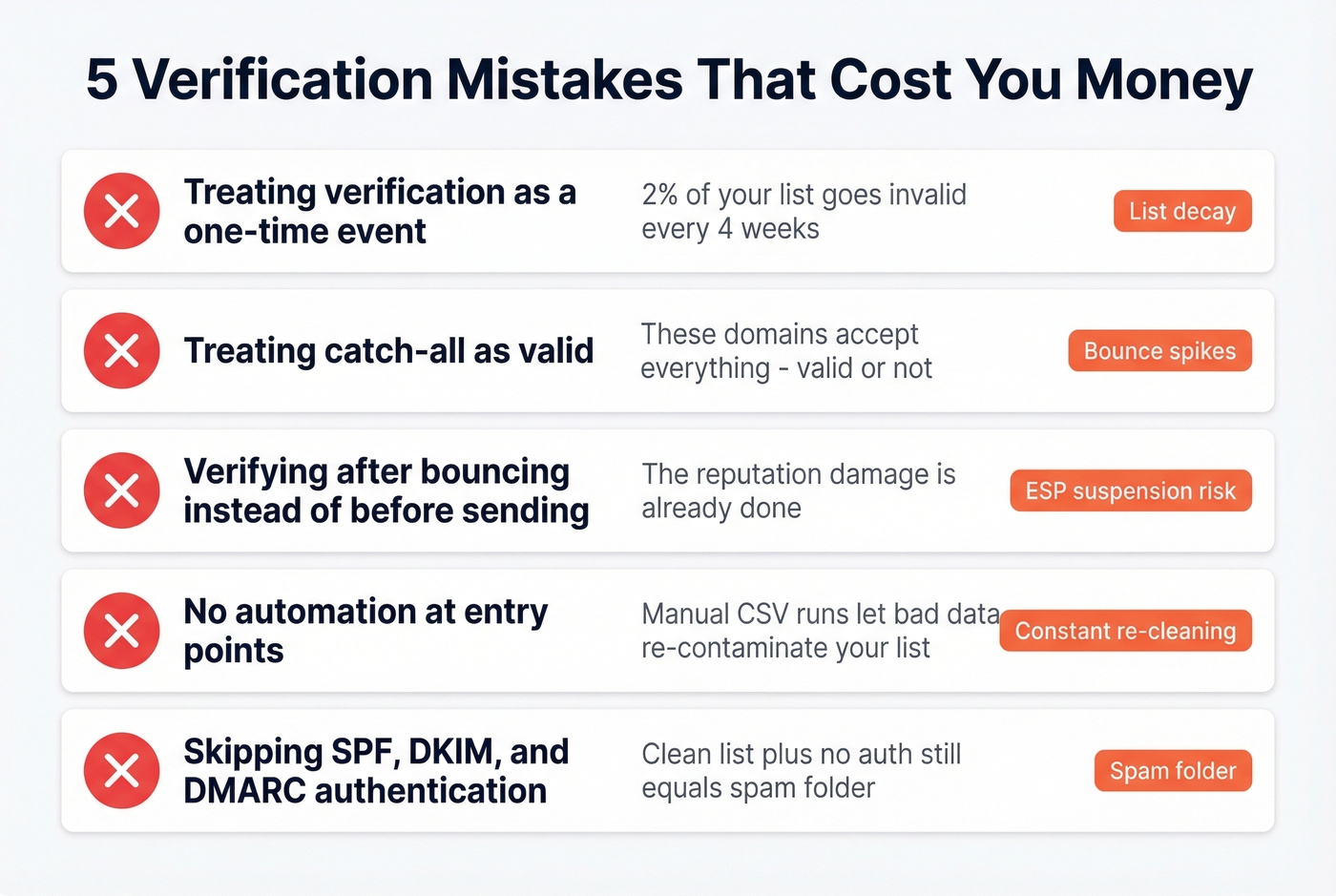
Treating catch-all as "valid." Catch-all domains accept every address - valid or not. Segment them separately and send at lower volume with careful monitoring. We've seen teams blast catch-all addresses at full volume and wonder why their bounce rate spiked overnight.
Verifying after bouncing instead of before sending. If your ESP already flagged a 6% bounce rate, the damage is done. Gmail rate-limits senders with high bounce histories. Verify before the first send, not after.
No automation. Manual CSV runs are fine for cleanup. But if new form submissions, CRM imports, and list purchases don't pass through real-time API verification, you're constantly re-contaminating your list. (Outbound teams should also watch email velocity.)
Skipping authentication. Verification without SPF, DKIM, and DMARC is half the job. You can have a perfectly clean list and still land in spam because your domain isn't authenticated.
How to Build a Verification Workflow
Step 1: Export your current list and run a bulk verification pass. Delete every invalid address.
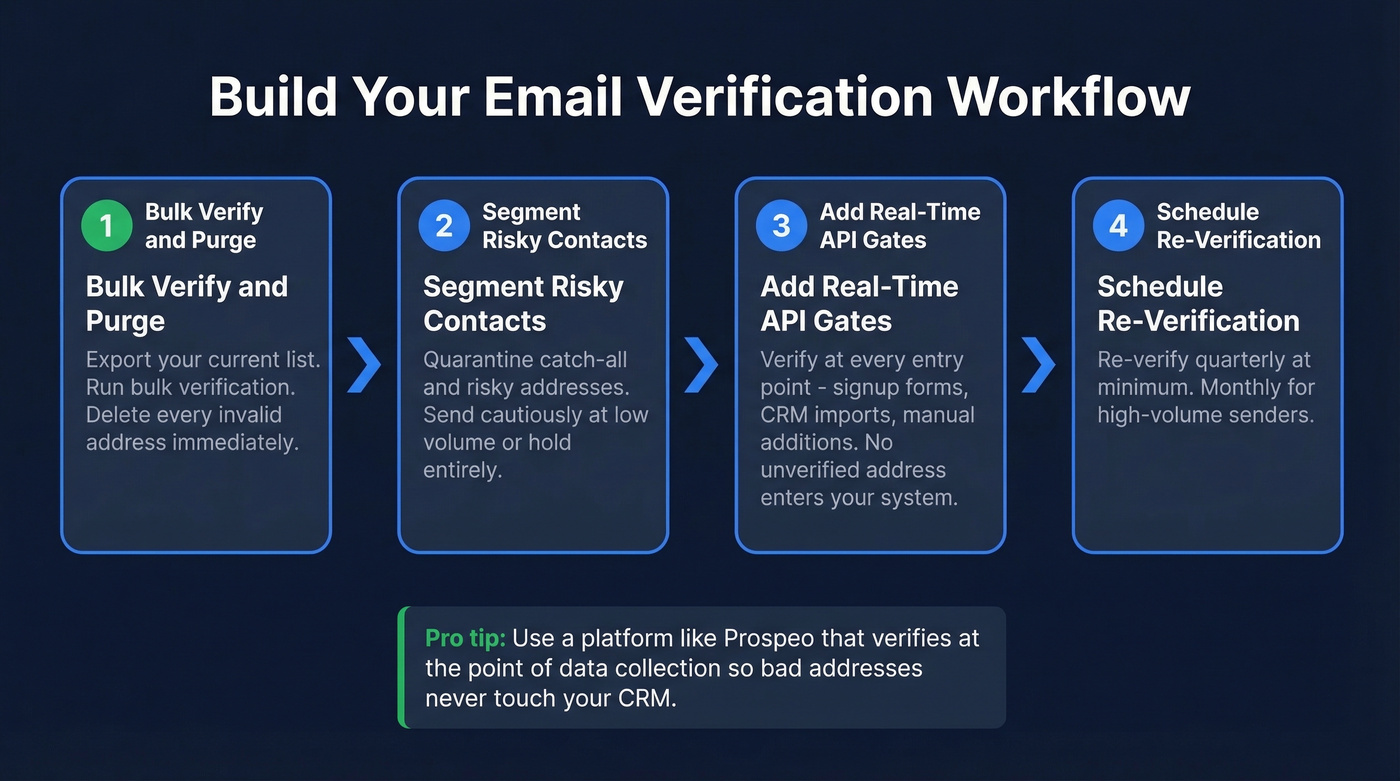
Step 2: Segment the results. Risky and catch-all addresses go into quarantine - send cautiously or not at all.
Step 3: Set up real-time API verification at every entry point: signup forms, CRM imports, manual additions. No unverified address enters your system.
Step 4: Re-verify quarterly. Monthly if you're a high-volume sender.
For outbound teams, the smarter approach is a platform that verifies at the point of data collection so bad addresses never touch your CRM. The benefits of verified leads compound quickly: fewer bounces, cleaner CRM data, and higher reply rates from day one. Prospeo runs every email through a proprietary 5-step verification process, delivering 98% email accuracy with catch-all handling and spam-trap removal built in. Real results: Meritt dropped bounce rates from 35% to under 4%, and Snyk went from 35-40% bounces to under 5% across 50 AEs.
Choosing a Verification Tool
Let's be honest about what matters here. Pick a tool that explains its classification logic, not just the verdict. A common complaint on r/Emailmarketing is credit-based pricing with zero transparency on why an address was flagged "risky." We've tested most of the major tools on this list - transparency in classification matters more than a marginal accuracy difference. (If you're comparing vendors, start with Bouncer alternatives.)
Skip tools that only give you a binary valid/invalid result. You need to see the breakdown: syntax pass, MX pass, SMTP response, catch-all status, spam-trap flag. Without that granularity, you can't make informed decisions about borderline addresses, and those borderline addresses are where the real risk lives.
You just read how 2% of a verified list goes invalid every four weeks. Prospeo refreshes all 300M+ profiles every 7 days - not the 6-week industry average. That means no quarterly re-verification runs, no bounce spikes, no reputation damage from stale data. At $0.01 per email, it costs less than the ESP fees you're wasting on dead contacts.
Kill list decay before it kills your deliverability.
FAQ
How often should I verify my email list?
Quarterly at minimum. Lists decay roughly 2% per month, meaning a 50,000-contact list loses ~1,000 valid addresses every four weeks. High-volume senders should verify monthly or implement real-time API verification at every entry point to catch bad addresses on intake.
What's the difference between verification and validation?
Validation checks format and syntax - a missing "@" symbol, for example. Verification goes further, confirming via SMTP handshake that the mailbox exists and can receive mail. Most modern tools do both in a single pass.
Can verification guarantee 100% deliverability?
No. Even top tools reach roughly 70% accuracy on business emails in Hunter's published benchmark. Deliverability also depends on SPF/DKIM/DMARC authentication, content quality, sending volume, and domain warm-up. Verification removes the biggest variable - invalid addresses - but it's one layer in a multi-layer stack.