

The Click Rate Formula in Email Marketing - And Why Your Numbers Are Probably Wrong
Your marketing manager says click rate is 4.2%. Your VP says it's 11%. They're both looking at the same campaign. The problem isn't math - it's that they're using different formulas with different denominators, and neither checked which one their ESP actually reports.
This debate shows up on r/Emailmarketing constantly, and both sides always think they're right. Three separate calculations exist for the click rate formula in email marketing, and your ESP probably uses one while calling it something else. Let's sort this out in about three minutes.
The Three Formulas, Explained
Click Rate (Clicks / Delivered)
Take the number of clicks, divide by emails delivered, multiply by 100. Use delivered - not sent - as your denominator, because "sent" includes bounces, which inflates the base and deflates your rate.
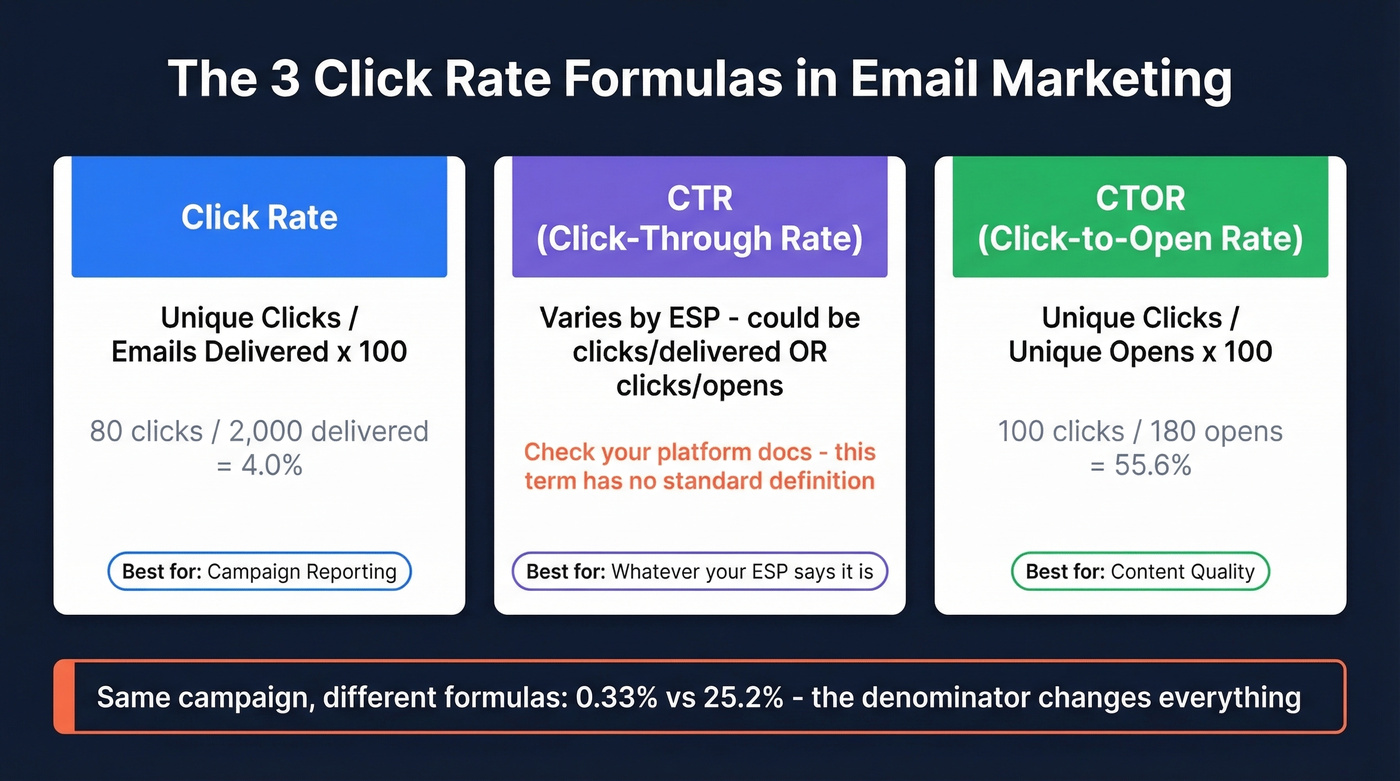
AWeber uses this definition explicitly. Their worked example: 2,000 emails delivered, 80 clicks = 4% click rate. It's the most stable denominator because "delivered" doesn't shift with privacy changes. Use this for campaign-level reporting and cross-campaign comparisons.
One distinction most ESPs bury: unique clicks count each person once, while total clicks count every click event including repeats. Unique measures reach; total measures engagement depth. Most platforms default to unique, but check yours.
Click-Through Rate (CTR)
Here's where it gets messy.
Different platforms use "CTR" to mean different things. Many email analytics resources define CTR as clicks divided by delivered. AWeber defines CTR as clicks divided by opens - what most teams would call click-to-open rate. Mailchimp distinguishes click rate and click-through rate as separate metrics entirely.
Before you compare CTR numbers across platforms, check what your ESP actually means by the term. You might be comparing apples to spark plugs.
Click-to-Open Rate (CTOR)
Formula: unique clicks / unique opens x 100. Campaign Monitor's example: 100 unique clicks from 180 unique opens = 55% CTOR.
CTOR isolates content quality - of the people who opened, how many found something worth clicking? But Apple Mail Privacy Protection has made the "opens" number unreliable for a large chunk of your list, so treat this metric with skepticism.
The denominator difference is dramatic. Klipfolio ran the math on a 100,000-contact campaign with 1,423 opens: clicks divided by total recipients = 0.33%. Clicks divided by opens = 25.2%. Same campaign, wildly different story.
| Metric | Formula | Best For |
|---|---|---|
| Click rate | Clicks / delivered | Campaign reporting |
| CTR | Varies by ESP | Check your platform |
| CTOR | Clicks / opens | Content quality |
Why ESPs Can't Agree on Names
There's no industry standard. AWeber explicitly splits "click rate" (clicks / delivered) from "CTR" (clicks / opens). ActiveCampaign calls clicks / delivered "CTR." Klaviyo defaults to unique metrics in its main campaign view.
This is exactly why that scenario from the intro happens constantly. Two marketers using two different ESPs will define "CTR" differently and both think they're right. The fix is boring but necessary: document which formula your ESP uses, and standardize your internal reporting language. We've wasted hours debugging "performance drops" that turned out to be nothing more than a platform migration changing the default denominator.

You just learned that different ESPs define CTR differently - but every formula shares one thing: a bad denominator wrecks your numbers. Invalid emails inflate your delivered count and tank your click rate before a single subscriber reads a word. Prospeo's 5-step email verification catches bad addresses at 98% accuracy, with a 7-day refresh cycle so your list stays clean between sends.
Fix the denominator first. Start with 75 free verifications.
Email CTR Benchmarks by Industry
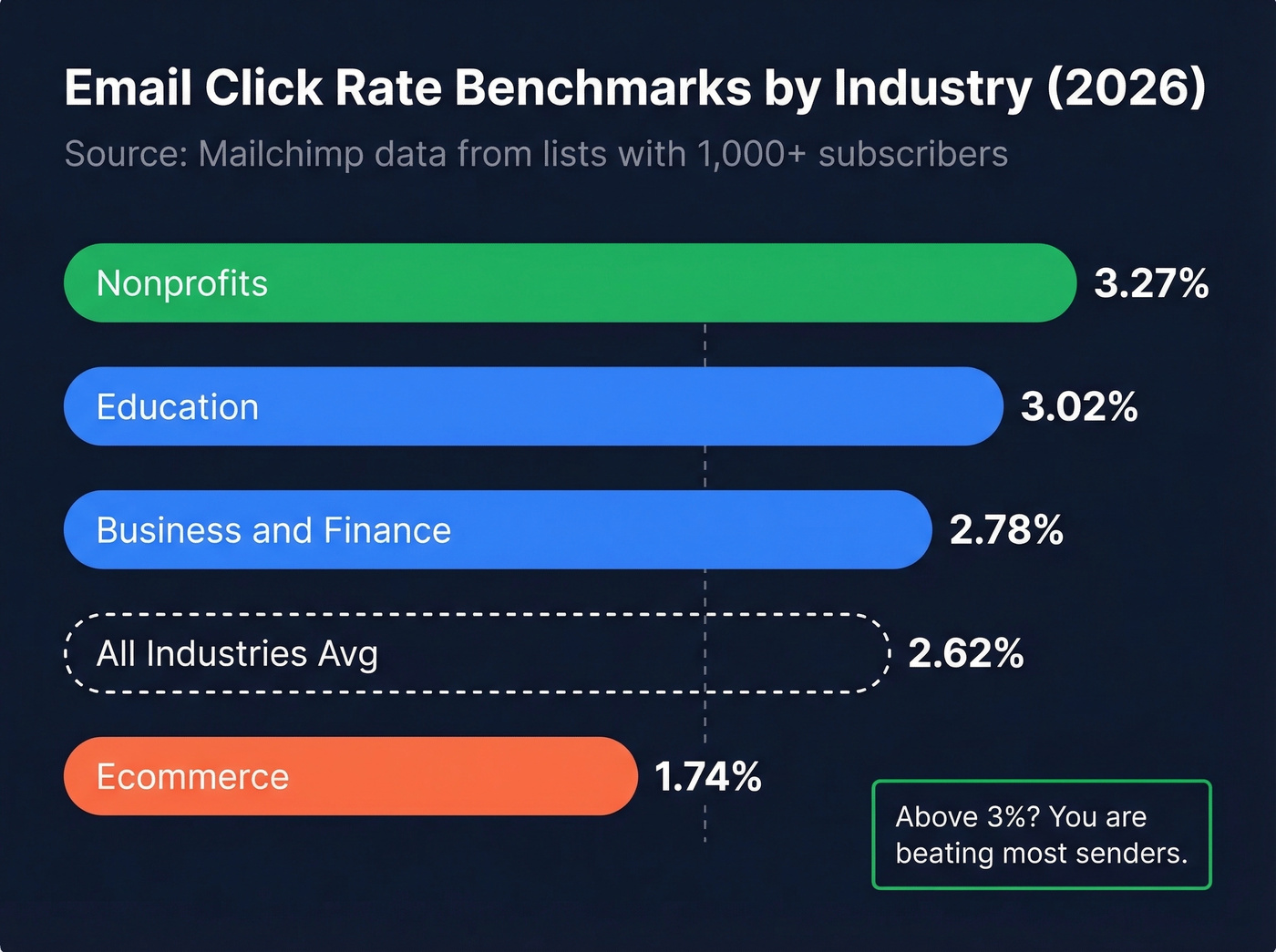
Mailchimp's benchmarks - based on billions of emails delivered to lists with 1,000+ subscribers - give the broadest reliable dataset:
| Industry | Avg Open Rate | Avg Click Rate |
|---|---|---|
| All users | 35.63% | 2.62% |
| Ecommerce | 29.81% | 1.74% |
| Nonprofits | 40.04% | 3.27% |
| Education | 35.64% | 3.02% |
| Business/Finance | 31.35% | 2.78% |
Campaign Monitor's averages tell a similar story: 21.5% open rate, 2.3% CTR, 10.5% CTOR across industries.
Let's be honest: if your click rate is above 3%, you're doing better than most. Stop obsessing over open rates - they're inflated by Apple MPP anyway. The click rate column is the only trustworthy number in any benchmark table right now.
What's Inflating Your Numbers
Apple MPP Broke Open Rates
Apple Mail Privacy Protection pre-fetches tracking pixels via proxy servers, recording an "open" even if the subscriber never read the email. That means CTOR - which uses opens as the denominator - is less reliable than it used to be. Apple's Link Tracking Protection can also strip UTMs from links in Mail and Safari, breaking your attribution even on real clicks.
Focus on clicks, replies, and conversions. Those require real human action.
Bot Clicks Are Inflating CTR
This one's frustrating. Security scanners and mailbox providers auto-click links to check for phishing, and those clicks show up in your reports as if a real person engaged. Validity's 2026 analysis flags three detection signals:
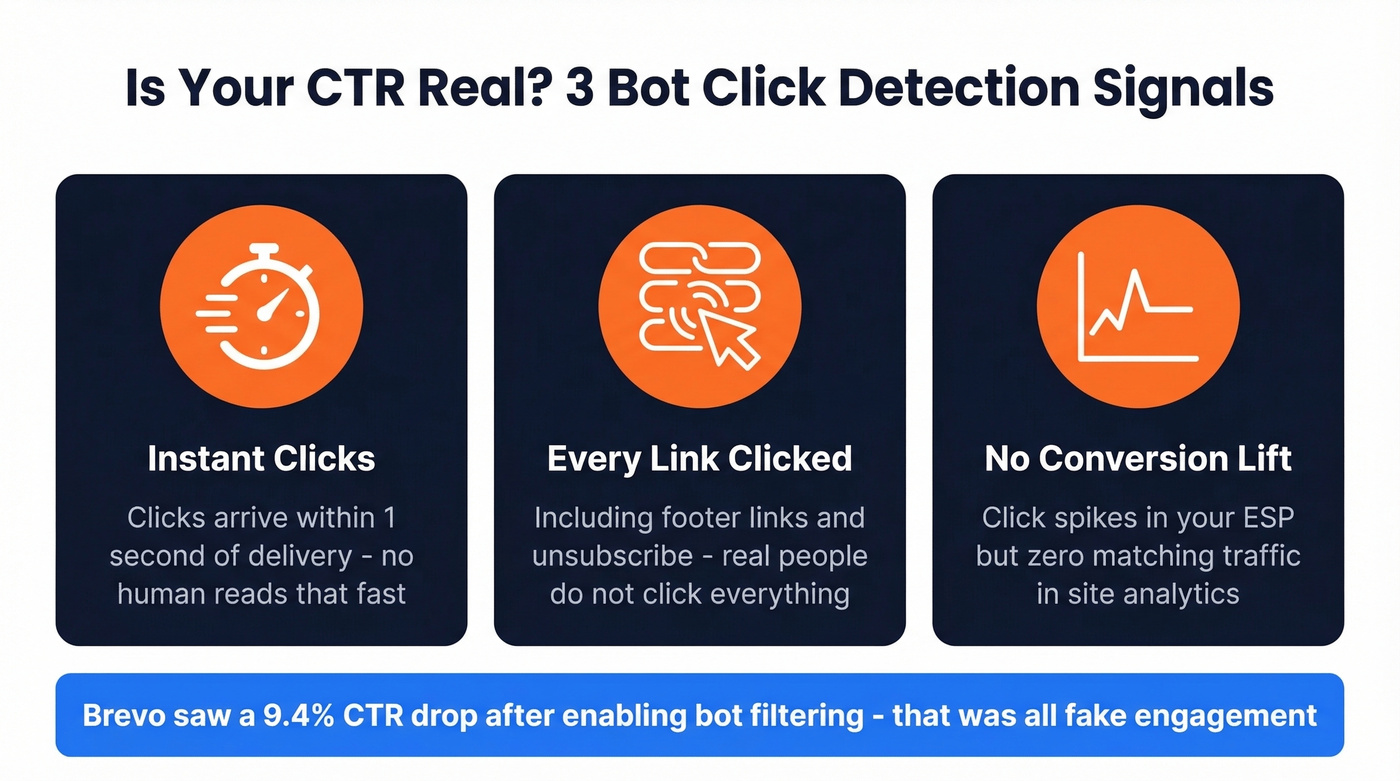
- Instant clicks - within one second of delivery
- All links clicked - including footer and unsubscribe links
- Click spikes with no conversion lift - traffic doesn't show up in your site analytics
Enabling bot filtering changes your numbers fast. Brevo reported that turning on bot filtering dropped their newsletter CTR by 9.4%. Klaviyo stopped counting machine clicks in September 2024, and users saw what looked like a cliff - but it was just cleaner data. We've seen teams panic over a "performance drop" that was actually their first honest metric in months.
ActiveCampaign's BotSense is available on Pro/Enterprise plans. Constant Contact filters by default using known non-human user agents. HubSpot supports custom rules but they aren't retroactive.
Check what your platform offers and turn it on. Your reported CTR will drop, but the remaining numbers will actually mean something.
How to Improve Your Email Click Rate
Clean your list first. We've seen lists where 15%+ of addresses are invalid - and the click rate math never recovers until you purge them. Bounces inflate your denominator and tank deliverability before anyone reads a word. Prospeo's real-time email verification catches bad addresses at 98% accuracy, and the free tier covers 75 verifications per month - enough to audit a segment before your next send.
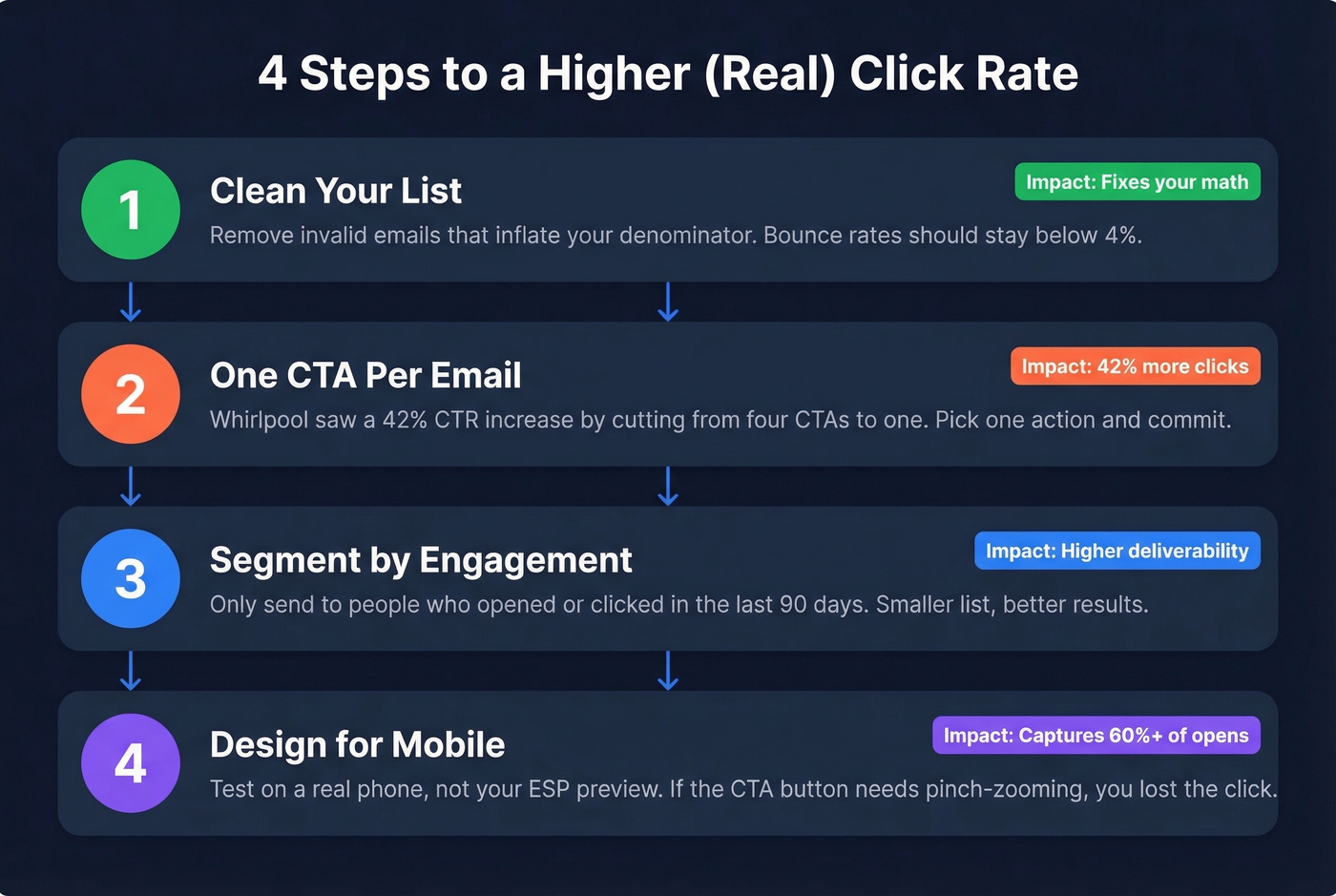
One CTA per email. Whirlpool increased CTR by 42% by reducing from four CTAs to one. Every additional link competes for attention and dilutes the action you actually want. If you want examples, start with email call to action best practices.
Segment by engagement. Send to people who opened or clicked in the last 90 days. Smaller list, higher click rate, better deliverability. If you're blasting your entire database every Tuesday, skip that habit before you try anything else. Pair this with targeted email campaigns to keep relevance high.
Design for mobile. If your CTA button requires pinch-zooming, you've already lost the click. Test on a real phone, not just your ESP's preview pane. Tighten the copy with proven email copywriting patterns.
Bot clicks, Apple MPP noise, and stale contacts make honest click rate reporting nearly impossible. The one variable you can actually control? Data quality. Prospeo verifies 143M+ emails at 98% accuracy for ~$0.01 each - no contracts, no sales calls. Teams using verified lists see bounce rates drop below 4% and real engagement metrics they can finally trust.
Stop optimizing metrics built on bad data.
FAQ
What's a good click rate for email marketing?
Mailchimp's data shows a 2.62% average across all industries. Ecommerce trends lower at ~1.74%, nonprofits higher at ~3.27%. Your own historical data is the best benchmark - industry averages are useful for context, not as absolute targets.
Is CTR the same as click rate?
It depends entirely on your ESP. AWeber calls clicks / delivered "click rate" and clicks / opens "CTR." ActiveCampaign calls clicks / delivered "CTR." Always check your platform's documentation before comparing numbers across tools.
How do I know if bot clicks are inflating my CTR?
Look for clicks within one second of delivery, clicks on every link including footer links, and click spikes with no corresponding site traffic or conversions. Enable your ESP's bot filtering - Brevo saw a 9.4% CTR drop after turning it on, revealing how much non-human activity was padding their numbers.
Does list quality affect click rate formula results?
Yes. Invalid addresses inflate your "delivered" denominator with emails that never reach a real inbox, dragging down click rate. Cleaning your list with a verification tool removes bad addresses before they distort your metrics or hurt sender reputation.