

Email Copywriting: The 2026 Guide to Emails That Convert
You got a 32% open rate on your last campaign. Your boss is thrilled. But the click rate? 0.8%. Something between the subject line and the CTA is broken, and no amount of emoji testing will fix it.
The real conversion gap in email copywriting isn't opens - it's what happens after someone opens.
What You Need (Quick Version)
Most advice about writing email copy obsesses over subject lines, but the real conversion gap lives between opens and clicks. This guide gives you six frameworks to fix body copy, 2026 benchmarks so you know what "good" looks like, device-specific subject line limits, and the data-quality step most guides skip entirely.
If you learn one framework, learn PAS. If you fix one thing today, cut to a single CTA per email. If your emails are bouncing, verify your list before you write another word.
The Opens-vs-Clicks Problem
Open rates are vanity. Clicks are money.
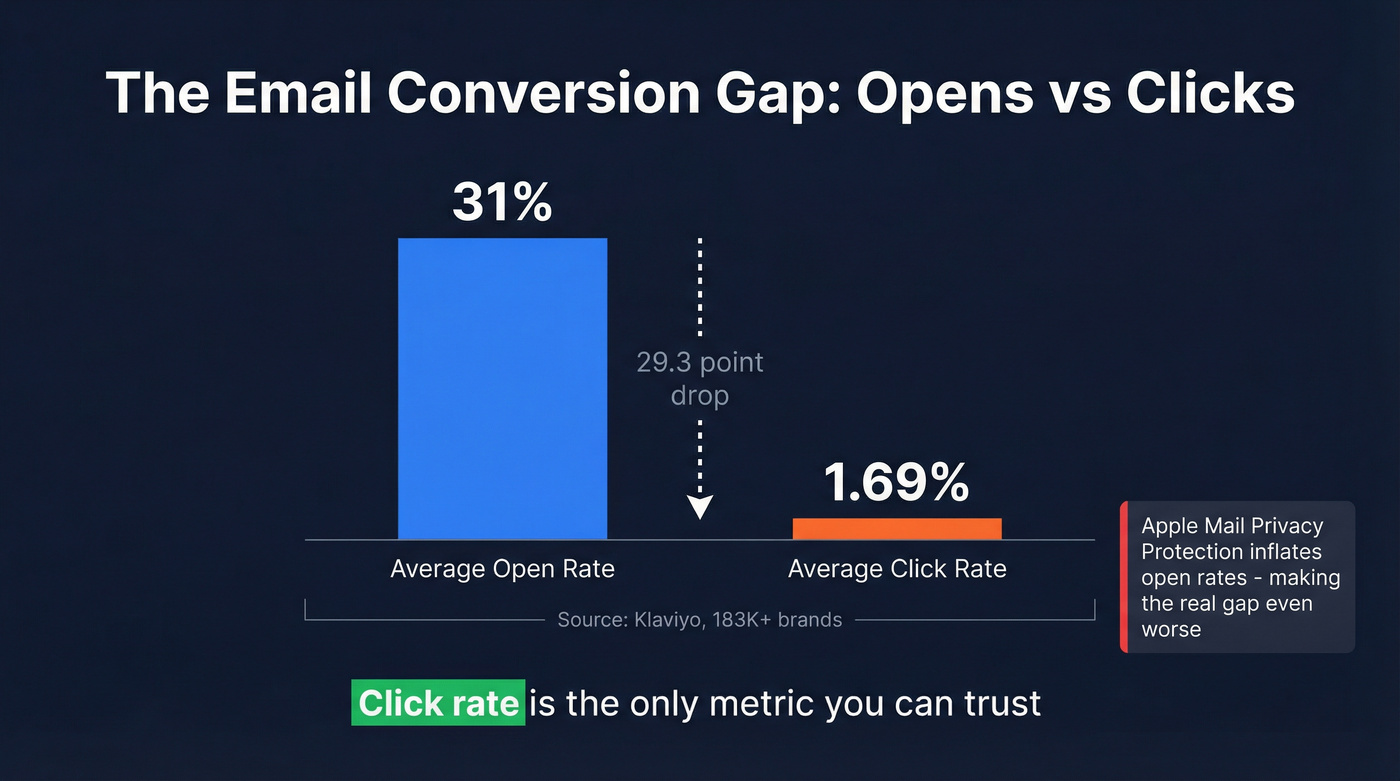
Across 183,000+ brands on Klaviyo, the average campaign open rate sits at 31%. The average click rate? Just 1.69%. That's about a 29.3-point drop from "saw it" to "did something about it." Even top-10% performers only hit 3.38% click rates on campaigns.
Apple Mail Privacy Protection has made this worse by inflating open rates. Every Apple Mail user who loads your email gets counted as an "open" whether they read it or not. So that 31% number is generous. Click rate is the only metric you can trust to tell you whether your copy actually worked.
Here's the thing: we've audited dozens of email programs, and the pattern is always the same. Teams spend 80% of their optimization energy on subject lines and 20% on everything else. That ratio should be flipped. If you want to write emails that convert, start with what happens after the open.
2026 Email Benchmarks
Before you can fix your copy, you need to know what "good" looks like.
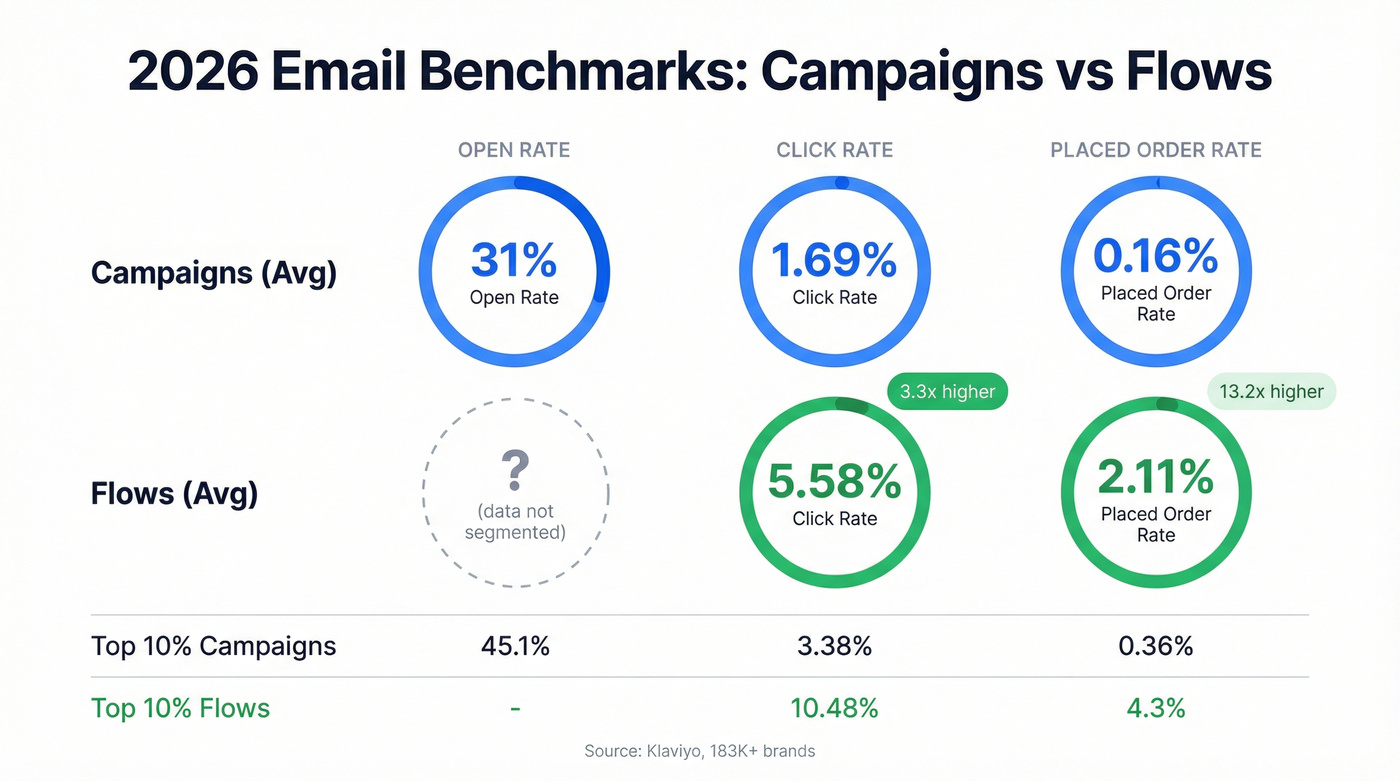
| Metric | Campaign Avg | Campaign Top 10% | Flow Avg | Flow Top 10% |
|---|---|---|---|---|
| Open Rate | 31% | 45.1% | Higher* | Higher* |
| Click Rate | 1.69% | 3.38% | 5.58% | 10.48% |
| Placed Order | 0.16% | 0.36% | 2.11% | 4.3% |
Klaviyo, 183K+ brands. Flow open rates not segmented in the same report.
Automated flows outperform campaigns by roughly 3.3x on click rate and 13.2x on placed order rate. That's not a rounding error. Flows work because they're triggered by behavior - someone abandoned a cart, signed up, or hit a milestone. The copy is contextual, and context drives clicks.
ActiveCampaign's benchmarks tell a slightly different story: 39.26% average open rate and 6.21% average click rate across their customer base. The higher numbers likely reflect a different mix of email types including transactional, so don't compare these directly to Klaviyo's campaign-only data.
If your campaigns are below 1.69% click rate, your copy needs work. If you're above 3.38%, you're in the top 10%.
Anatomy of a High-Converting Email
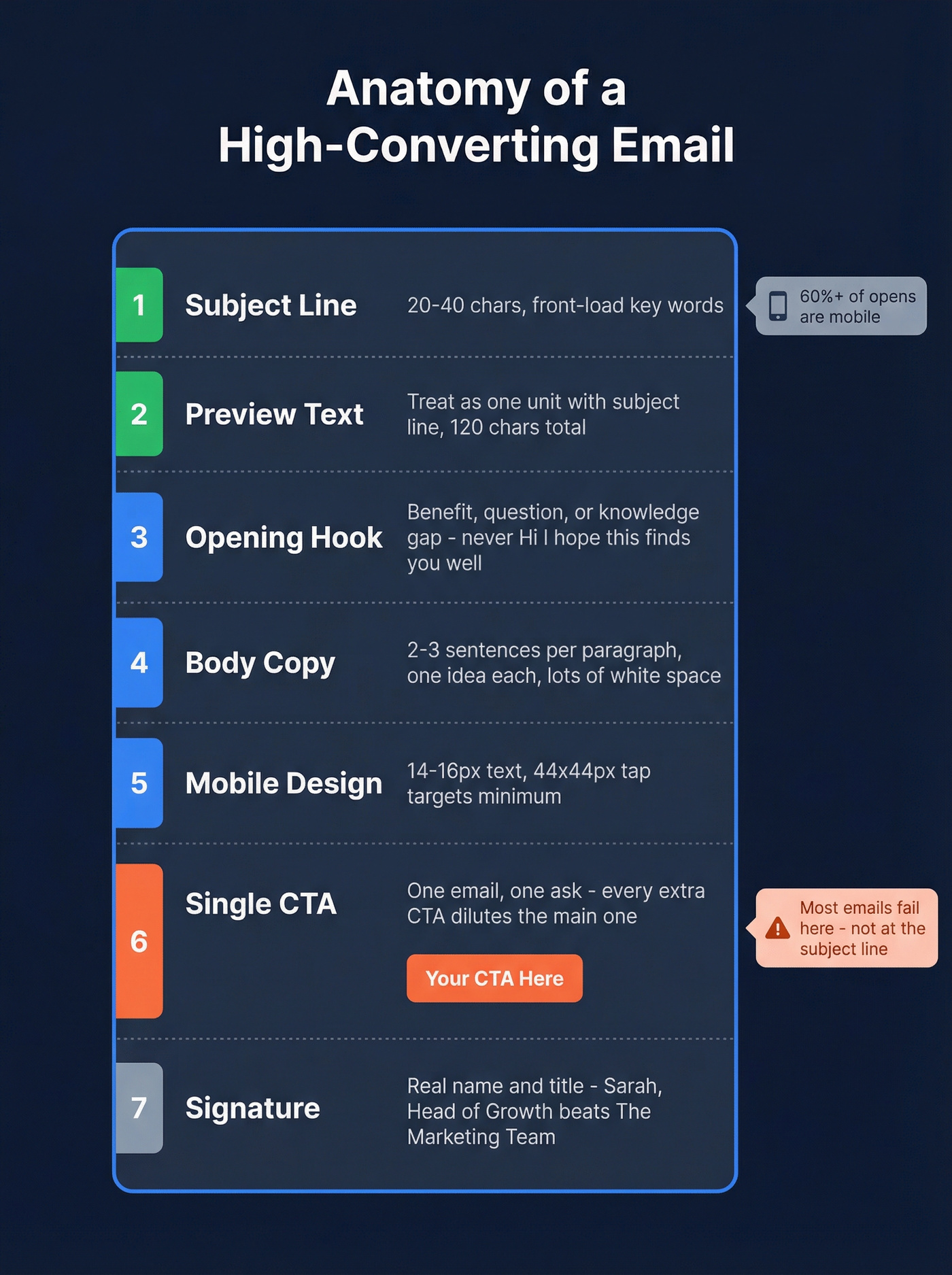
Every email that converts shares the same structural DNA. Understanding how to write email copy at a structural level matters more than any single tactic.
Subject Line
The sweet spot is 20-40 characters - roughly 7 words. That's not arbitrary. It's driven by device truncation.
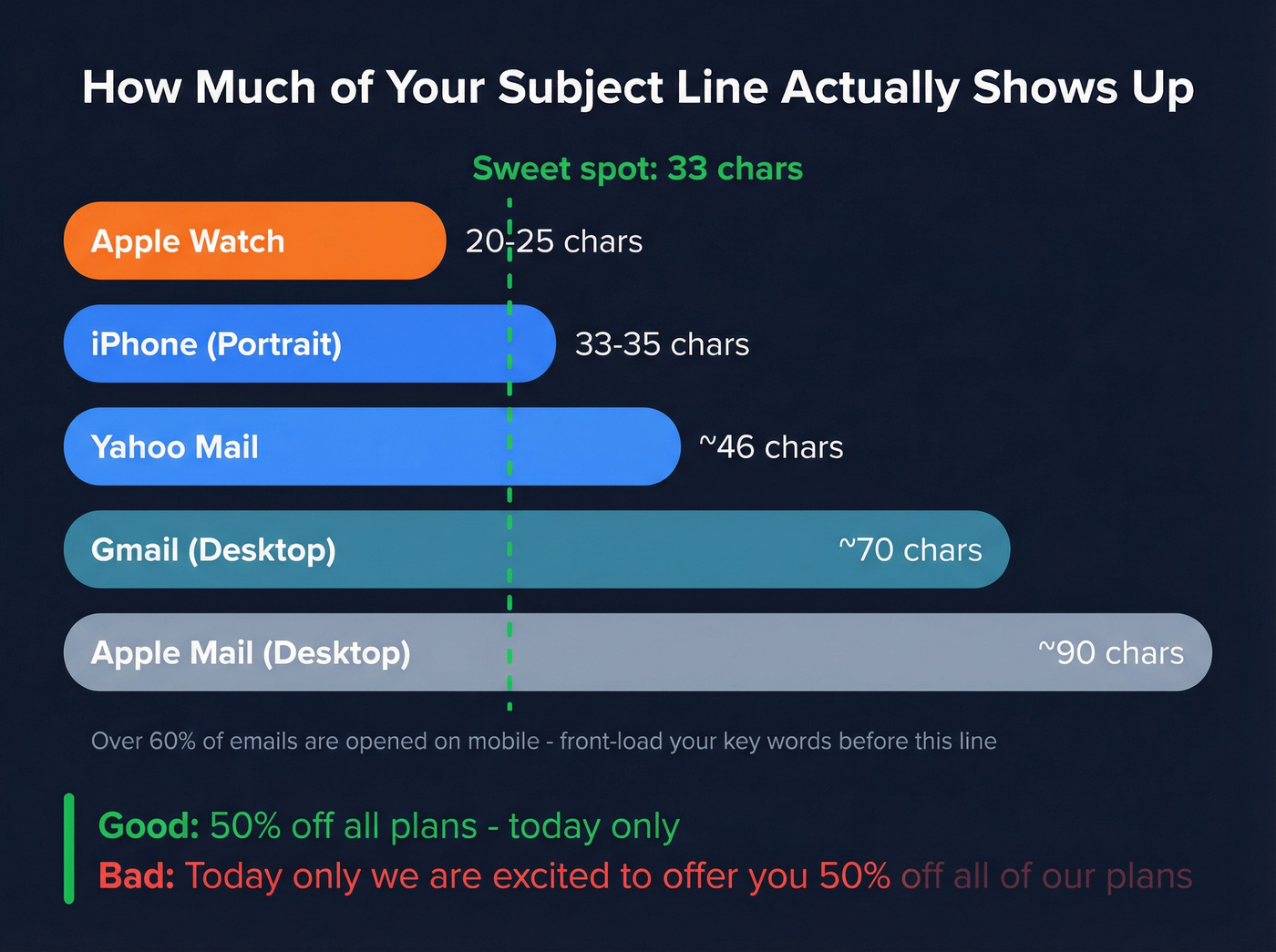
| Device/Client | Visible Characters |
|---|---|
| iPhone (portrait) | 33-35 |
| Apple Watch | 20-25 |
| Gmail (desktop) | ~70 |
| Yahoo Mail | ~46 |
| Apple Mail | ~90 |
Over 60% of emails are opened on mobile. Your subject line needs to land its punch in the first 33 characters, because that's all an iPhone shows. Front-load the most important words. "50% off all plans - today only" beats "Today only: we're excited to offer you 50% off all of our plans."
Personalized subject lines are the second-most effective email strategy per Brafton's framework breakdown citing Litmus State of Email - and personalization means more than {first_name}. Reference a product category, a behavior, or a segment-specific pain point.
Preview Text
The preheader is your subject line's wingman. Most email platforms let you set it explicitly. If you don't, the email client pulls the first line of body text - usually "View in browser" or your company address. That's wasted real estate.
Combined, your subject line and preview text share roughly 120 characters of visible space on most mobile clients. Treat them as a single unit.
Opening Hook
You have about two seconds after the open. The first sentence needs to state a benefit, ask a question the reader cares about, or create a knowledge gap. "Hi [Name], I hope this email finds you well" does none of those.
Body Structure
Short paragraphs. One idea per paragraph. Two to three sentences max. White space isn't wasted space - it's what makes your email scannable on a phone screen. Walls of text are the fastest way to lose a reader who opened with genuine interest.
Mobile Design
Design for thumbs, not cursors. CTA buttons need a minimum tap target of 44x44 pixels - anything smaller and mobile users will miss or misclick. Body text should be 14-16px minimum. Nobody is pinch-to-zooming your promotional email.
Single CTA
One email, one ask. Every additional CTA you add dilutes the primary one. If you're asking someone to read a blog post, download a guide, AND book a demo, you're asking them to choose - and most will choose nothing.
Signature
A real name with a real title builds trust. "The Marketing Team" converts worse than "Sarah, Head of Growth." People reply to people.
6 Frameworks That Make Email Copy Convert
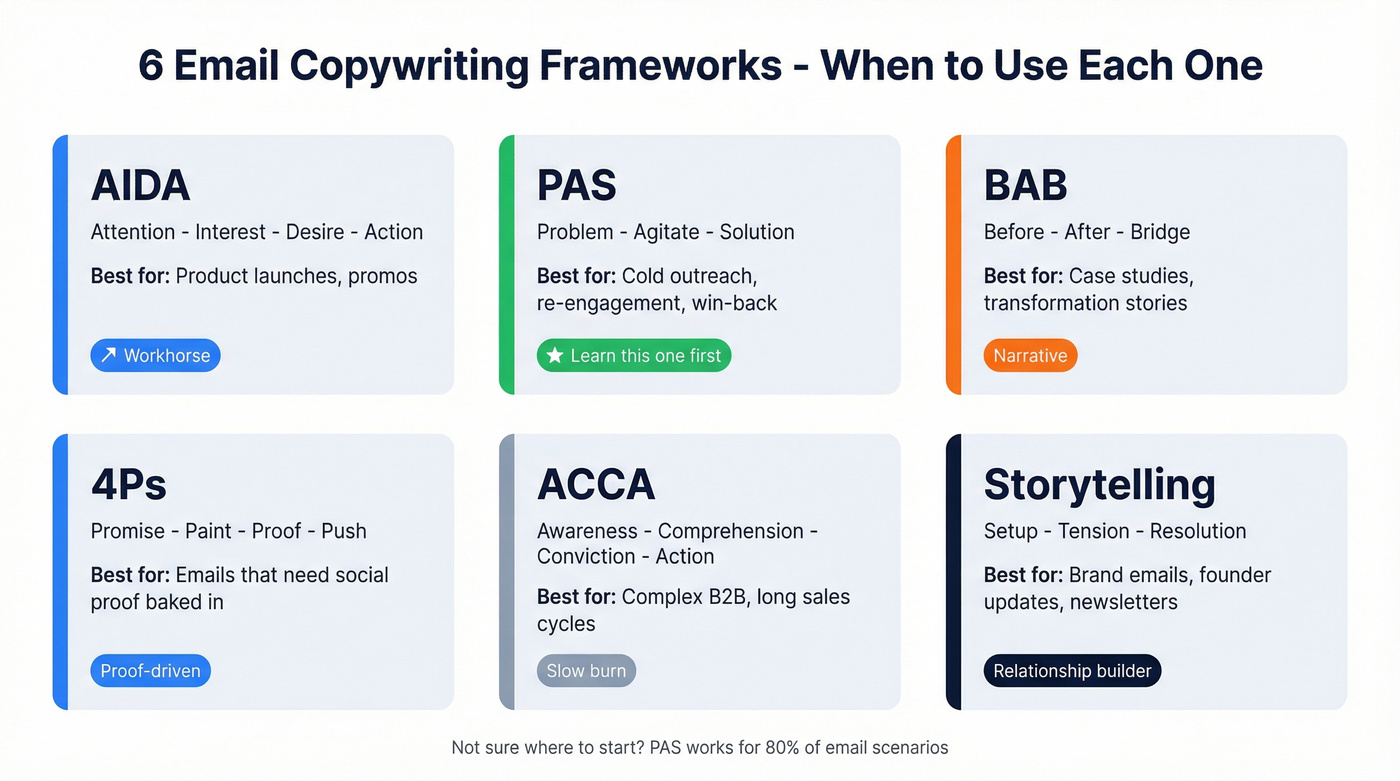
Frameworks aren't creative crutches - they're structural shortcuts that keep your copy focused. Here are six that work, with examples so you can see the difference.
AIDA (Attention, Interest, Desire, Action)
AIDA moves the reader through a logical sequence: grab attention, build interest with a relevant detail, create desire with a benefit, then ask for action. It's the workhorse framework for product launches and promotional campaigns.
Before: "We just launched our new reporting dashboard. It has lots of features. Check it out."
After: "Your weekly reports take 3 hours to build. Our new dashboard pulls live data from Salesforce, HubSpot, and GA4 into one view. Teams using it cut reporting time by 60% in the first month. See it in action - [watch the 2-min demo]."
PAS (Problem, Agitate, Solution)
If you learn one framework, make it this one. PAS works because it starts with the reader's pain, makes that pain feel urgent, then offers the fix. It's the best framework for re-engagement, win-back, and cold outreach - and it's the foundation of conversion-focused messaging.
Before: "We noticed you haven't logged in recently. Come back and check out our new features!"
After: "Your last three webinars drew fewer than 50 registrants. Your next event is two weeks away, and registration is flat. Our new promotion engine auto-sends targeted invites to your warmest contacts - [set it up in 5 minutes]."
That PAS example comes from Brafton's framework breakdown, and it illustrates why specificity matters. "Your last three webinars" is infinitely more compelling than "struggling with event attendance?"
BAB (Before, After, Bridge)
BAB paints a picture of the reader's current state, shows them the better future, then bridges the gap. It's ideal for case study emails and transformation narratives. Here's how a SaaS company might use it:
Subject: How [Company X] reclaimed 14 hours per week
Last quarter, their sales team spent 14 hours per week on manual data entry. Reps were buried in spreadsheets instead of making calls. After implementing an automation layer, those 14 hours went back to selling - and pipeline grew 40% in one quarter. Here's their exact playbook ->
Notice there's no "before/after" label needed. The narrative structure does the work. BAB emails read like mini stories, which is why they pair so well with case study content.
4Ps (Promise, Paint, Proof, Push)
The 4Ps framework forces you to include social proof as a structural requirement, not an afterthought. Promise a benefit, paint the picture, prove it with data or a testimonial, then push toward action.
Before: "Try our email tool - it's great for deliverability."
After: "Get 95%+ inbox placement on every send. Picture launching a campaign and watching replies roll in instead of bounces. Companies using this approach report 94%+ deliverability with zero domain flags. Start your free trial ->"
The "Proof" element is what separates this from generic benefit-driven copy. Without it, you're just making promises. With it, you're making a case.
ACCA (Awareness, Comprehension, Conviction, Action)
Skip this framework if your product is simple or your sales cycle is short. ACCA works best for complex B2B products where the reader needs to understand the problem before they'll act. It's slower than PAS but more thorough.
Imagine you're selling a compliance platform. Your reader doesn't know SOC 2 requirements changed - so you can't jump to the solution. You need to build awareness first, then comprehension of the gap, then conviction through proof:
"SOC 2 audits now require continuous monitoring, not annual snapshots. That means your current quarterly review process leaves 9-month gaps in your compliance posture. 340 companies passed their SOC 2 audit on the first attempt using continuous monitoring. Book a 15-min compliance review ->"
Storytelling
Storytelling breaks every "rule" about brevity and structure - and works anyway, when done well. It's best for brand emails, founder updates, and newsletters where the relationship matters more than the click.
The key is compression. A story email isn't a blog post. It's a 150-word narrative with a clear emotional arc: setup, tension, resolution. The CTA flows naturally from the resolution. "That's why we built X" or "That's what this week's guide covers" - the story does the selling.

Your email copy can't convert if it never reaches the inbox. Bounced emails destroy sender reputation and tank deliverability for every campaign that follows. Prospeo's 5-step verification delivers 98% email accuracy - so the copy you spent hours perfecting actually lands in front of real buyers.
Fix your list before you write another word.
Writing Copy by Email Type
Different email types demand different copy approaches. Let's break down the ones that matter most.
Welcome Emails
74% of subscribers expect a welcome email immediately after signing up. Deliver on the opt-in promise in the first sentence. If they signed up for a discount code, lead with the code. If they signed up for a newsletter, give them the best piece of content you've published. Don't waste this email on "thanks for subscribing."
Promotional / Sales Emails
One offer. One CTA. One proof element. The proof element is what most promotional emails miss - a stat, a testimonial, a before/after number. Without proof, you're just another brand saying "buy this."
Hims does this well: their promotional emails pair a single product with a single clinical stat, and the CTA is always the same action. No decision fatigue.
Cart Abandonment
Specificity wins. Show the actual product they left behind, not a generic "you forgot something." Include the product image, the price, and a single "complete your order" button. The copy barely matters here - the product image does the heavy lifting.
Re-engagement / Win-back
PAS is your framework. Acknowledge the silence, agitate the cost of inaction, and offer a reason to come back. Skip this if your product hasn't changed - you need something new to say, or you're just reminding people why they left. If you need ideas, start with re-engagement subject lines.
Cold Outreach
Personalization beyond {first_name} is non-negotiable. Reference something specific: a recent funding round, a job posting that signals a pain point, a mutual connection. Keep it under 100 words. One soft CTA - "worth a quick chat?" beats "book a 30-minute demo." If you want a starting point, use an outreach email template.
This is where data quality becomes the bottleneck, and we'll get to that in a minute.
Cold Email vs Marketing Email
Cold email and marketing email share a medium but follow completely different rules. Confusing the two is one of the most common mistakes people make when writing email copy.
Marketing email goes to people who opted in. Cold email goes to people who didn't. That single difference changes everything: the length (shorter for cold), the CTA (soft ask vs direct), the personalization depth (surface-level vs research-backed), and the compliance requirements.
Cold email reply rates run in the low single digits as an industry norm. A 3-5% positive reply rate on a well-targeted cold campaign is genuinely good. That means your list quality matters more than your copy quality - a frustrating truth for anyone who's spent hours perfecting their email copy only to watch half the list bounce.
The best cold email copy in the world bounces off a dead address. Before you send, verify your list. Prospeo checks against 143M+ verified emails with 98% accuracy and a 7-day refresh cycle, so you're not emailing someone who left the company last quarter.
Real Email Copywriting Examples
Theory is useful. Examples are better.
Dell - The GIF Email
Dell ran a GIF-centered email showcasing a laptop's convertible form factor. The results: +42% click-through rate, +103% conversion rate, and +109% revenue compared to their standard product emails. The lesson isn't "use GIFs." It's that format experiments can outperform copy tweaks. Sometimes the best thing you can do for your email isn't rewrite the headline - it's rethink the medium entirely.
Brooklinen - Subject Line Voice
Brooklinen sells sheets. Not exactly a category that screams creativity. But their subject lines - "zero bull sheet," "holy sheet" - turned a commodity product into a brand people actually want to hear from. Brand voice beats best-practice templates every time. A subject line that sounds like your brand will outperform a "perfectly optimized" subject line that sounds like everyone else's.
Graza - The Anti-Design Email
Graza, the olive oil brand, sends plain-text-style emails from their founder that read like a note from a friend. No hero images, no polished layouts - just a short story about the product, a link, and a sign-off. Their engagement rates consistently beat their designed templates.
When your audience is drowning in polished marketing emails, looking different is a strategy.
Chubbies - Breaking the One-CTA Rule
Chubbies regularly sends emails with multiple CTAs, humor-heavy copy, and layouts that break every "rule" in this guide. And it works - because their audience expects it. The brand consistency is the permission slip. They've earned the right to break rules by being relentlessly on-brand.
Our take: Know the rules, then decide which to break based on your data. One CTA is the default because it works for most brands. But if your audience engages with chaotic, multi-link emails, the data gives you permission. Rules are defaults, not laws.
7 Mistakes That Kill Conversions
Multiple CTAs. Every additional button dilutes the primary action. One email, one ask. If you can't pick one CTA, your email is trying to do too much.
Walls of text. No whitespace, no paragraph breaks, no visual breathing room. On mobile, a 200-word paragraph looks like a novel.
Burying the offer below the fold. Readers skim. If your CTA or key benefit requires scrolling past three paragraphs of setup, most people will never see it. Lead with the value.
Ignoring mobile truncation. Your 65-character subject line looks great on desktop. On an iPhone, the reader sees 33 characters and a "..." That truncation might cut your subject line right before the benefit.
All caps and excessive punctuation. "FREE!!! DON'T MISS OUT!!!" doesn't convey urgency. It conveys desperation - and spam filters agree.
Writing about yourself instead of the reader. "We're excited to announce" is about you. "You can now do X" is about them. Flip every sentence to the reader's perspective.
Sending to unverified lists. This is the mistake that compounds. Bad addresses bounce. Bounces damage your sender reputation. Damaged reputation means your future emails - even to valid addresses - land in spam. Verify before you send. (If you're troubleshooting bounces, start with hard bounces.)
Your Copy Won't Matter If Data Is Bad
None of the frameworks, subject line tactics, or CTA optimization matters if your emails don't reach the inbox.
The deliverability spiral works like this: you send to a list with 15% invalid addresses. Those bounce. Your email service provider flags your sending domain. Your sender reputation drops. Now your next campaign - even to perfectly valid addresses - gets routed to spam for 30% of recipients. One bad send creates a cascading problem that takes weeks to recover from.
SPF, DKIM, and DMARC authentication are non-negotiable. Every domain should have them configured. But authentication only proves you're a legitimate sender - it doesn't prove your list is clean. If you need the setup details, use this SPF, DKIM, DMARC guide.
We use Prospeo for list verification on our own campaigns. Upload a CSV or connect your CRM, and it returns verified emails with 50+ data points per contact. The 7-day data refresh means your list stays clean without manual scrubbing, and at roughly $0.01 per email with a free tier of 75 emails/month, it's the cheapest insurance policy your email program can buy. (If you're comparing options, see our list of email checker tools.)

Personalization beyond {first_name} requires real data. Prospeo gives you 50+ data points per contact - job title, tech stack, funding stage, buyer intent - so every email you send references something the reader actually cares about. That's how you close the 29-point gap between opens and clicks.
Write emails that convert because the data behind them is right.
AI Tools for Drafting Emails
AI is a first-draft machine, not a copywriter. That distinction matters. These tools generate variants, beat blank-page syndrome, and speed up iteration - but every output needs a human pass for voice, specificity, and the kind of nuance that frameworks provide. If you're building sequences, AI in email marketing is where to start.
| Tool | Best For | Starting Price |
|---|---|---|
| Copy.ai | Email generation | $24/mo (5 seats) |
| Jasper | Brand voice at scale | $59/mo per seat |
| Writesonic | Versatile content | $39/mo |
| QuillBot | Editing/paraphrasing | $8.33/mo |
| Grammarly | Proofreading | Free / $12/mo |
| ChatGPT | Quick drafts | Free / $20/mo |
The consensus on r/copywriting and r/emailmarketing is that AI-generated emails sound generic - like they were written by a committee. That's a prompting problem, not a tool problem. Use the frameworks from earlier as your prompt structure: "Write a PAS email for [audience] about [problem]. The agitation should reference [specific pain]. Keep it under 100 words." You'll get dramatically better output than "write me a marketing email."
Look, if you're using ChatGPT to draft emails and then editing for voice, you're already doing what 90% of the paid tools offer. The premium tools earn their price when you need brand voice consistency across a team or high-volume variant testing.
FAQ
What's a good email click rate in 2026?
Klaviyo's data across 183K+ brands shows 1.69% average click rate for campaigns, with top 10% hitting 3.38%. Automated flows average 5.58%. Click rate matters more than open rate because Apple Mail Privacy Protection inflates opens artificially. If you're above 2% on campaigns, you're doing well.
How long should a marketing email be?
Promotional emails perform best at 50-125 words; newsletters can run 200-500 words. Can you cut a sentence without losing meaning? Cut it. Every word that doesn't earn its place is friction between the reader and your CTA.
What's the best email subject line length?
Aim for 20-40 characters, roughly 7 words. iPhone shows 33-35 characters in portrait mode; Apple Watch shows just 20-25. Front-load the most important words so truncation doesn't cut your benefit.
How do I verify my email list before sending?
Upload your CSV to a verification tool that checks addresses in real time. At roughly $0.01 per email, verification is far cheaper than recovering from a bounced campaign that tanks your sender reputation.
How much do email copywriters charge?
Freelancers charge $20-$2,000 per email depending on complexity, list size, and scope. Full-channel retainers covering copy, sending, deliverability management, and list health run $10k-$20k/month. The premium comes from owning the full email channel, not just the words.