7 CRM Limitations Nobody Quantifies - and How to Fix Them
Your VP pulls a pipeline report on Monday morning and the number is off by 30%. Not because the model is wrong, but because half the contacts underneath it are outdated, duplicated, or missing fields entirely. That's one of the most common CRM limitations playing out in real time. Most of these problems aren't software failures. They're data problems wearing a software mask.
CRM data decays 34% per year. No AI feature or workflow automation fixes a rotting foundation. The three moves that actually reduce CRM pain: enforce data governance from day one, verify contact data with an external tool before it enters your CRM, and negotiate data portability into every vendor contract.
7 CRM Shortcomings That Cost You Revenue
Data Quality and Decay
This is the meta-limitation - the one that makes every other problem worse. 80% of CRM data is inaccurate, and 70% of revenue leaders report a lack of confidence in their own records. People change jobs, companies rebrand, phone numbers rotate. The result: businesses lose 15-25% of revenue due to bad data, and Gartner pegs the average enterprise cost of poor data quality at $15M annually.
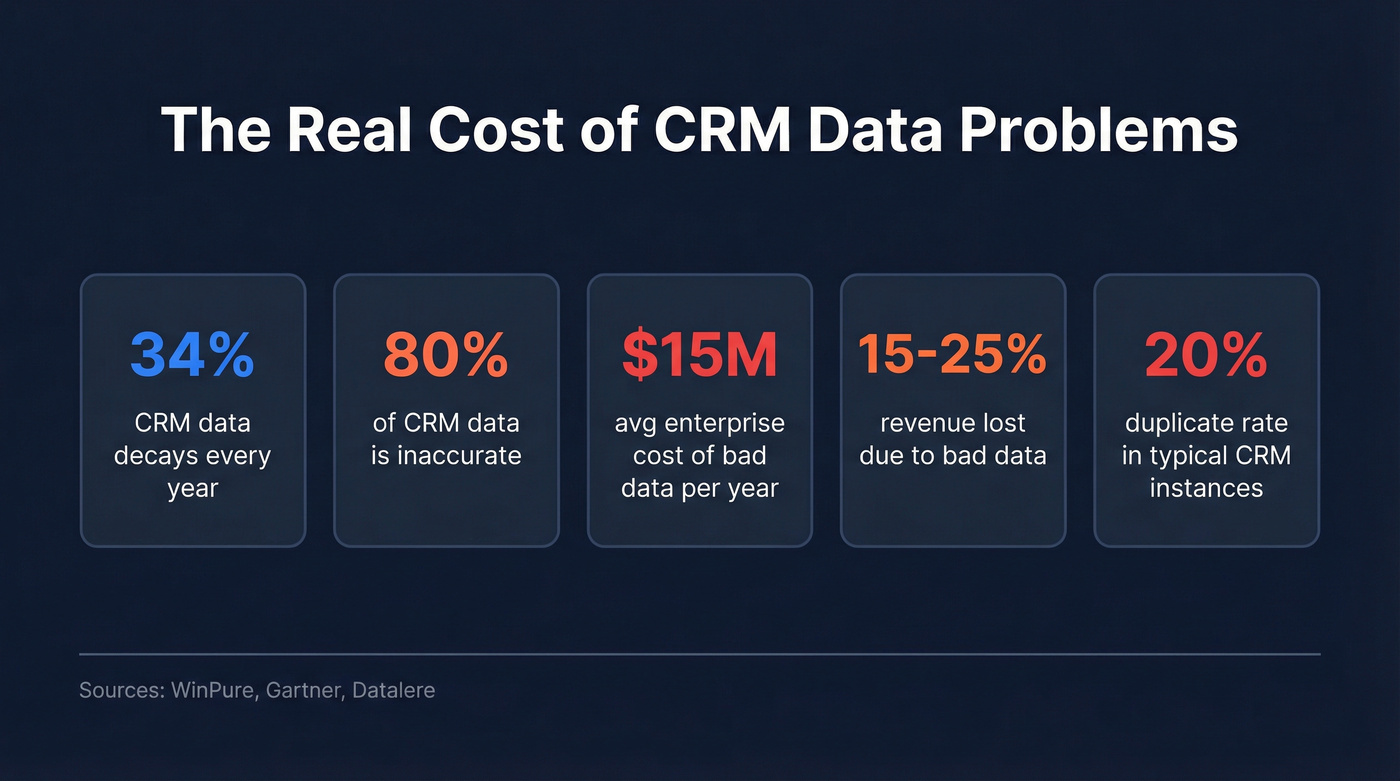
It gets worse operationally. Duplication rates can hit 20% in CRM instances, and 65% of companies still rely on Excel to scrub records manually. That's not a data strategy - it's triage. These shortcomings compound over time: the longer you wait to address decay, the more expensive the cleanup becomes.
Here's the thing: your CRM can't verify its own data. That's not what it's built for. Tools like Prospeo fill that gap with 98% email accuracy and a 7-day refresh cycle, catching decay before it compounds into a forecasting disaster. (If you want to go deeper on benchmarks and why this happens, see B2B contact data decay.)

User Adoption and Rep Resistance
Only 47% of sellers use their CRM regularly. Think about that - you're paying for a system that more than half your team actively avoids. Reps spend 19% of their time on manual data entry, time they're not selling, and 18% say this has directly caused lost opportunities and revenue.
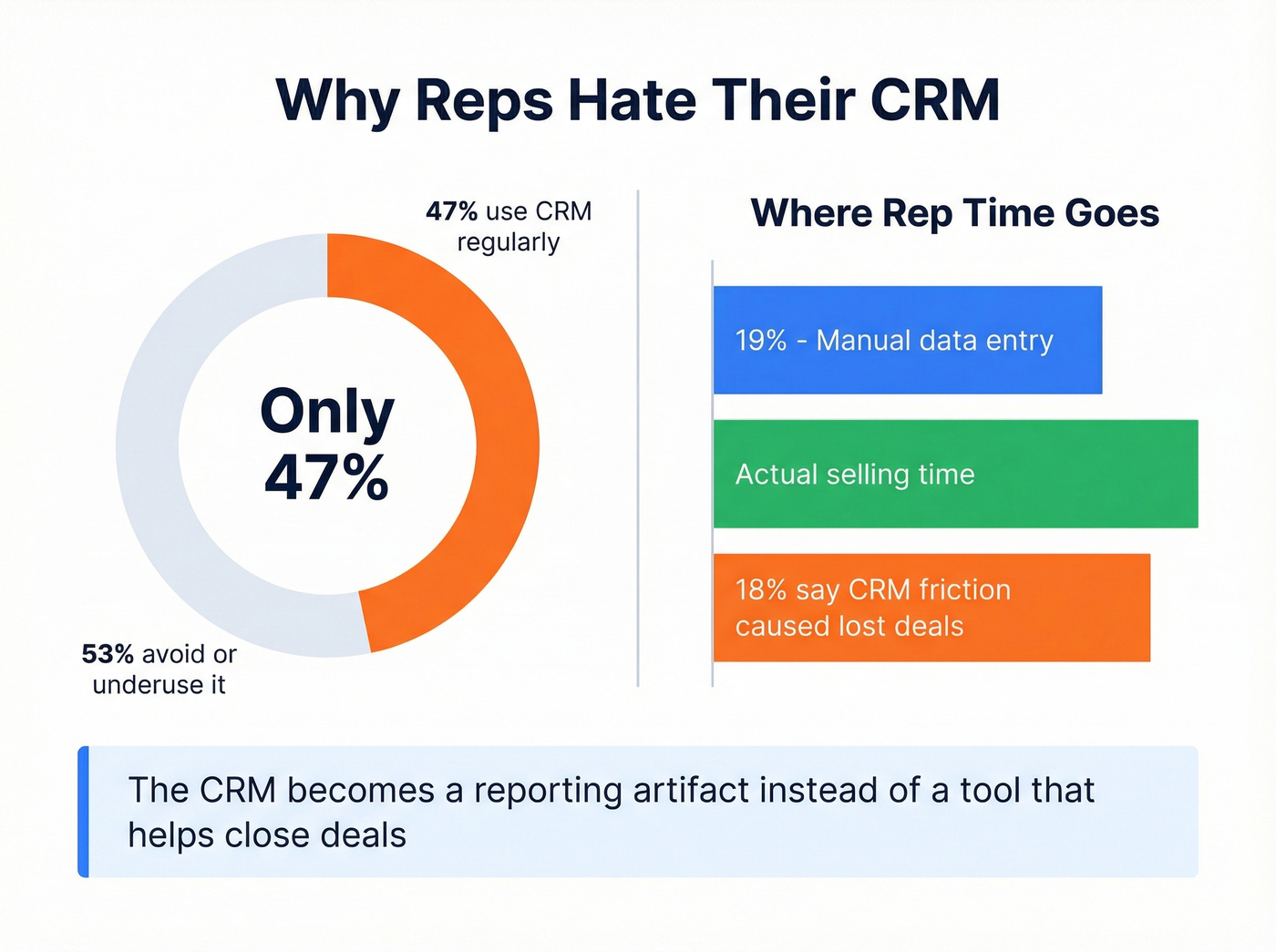
There's a deeper issue too. A traditional contact-based CRM can depersonalize customer relationships, prioritizing pipeline metrics over actual human moments. When 53% of sales leaders say their CRM causes friction, the tool has become a reporting artifact rather than something that helps close deals. We've seen this firsthand with teams we work with: the SDRs who hate their CRM the most are usually the ones stuck logging activity into a system that gives them nothing useful back.
Hidden Costs and Real TCO
The license fee is just the beginning. Here's what CRM technology actually costs when you add implementation, training, admin headcount, integration middleware, and ongoing data cleanup:
| Salesforce | HubSpot | Zoho CRM | |
|---|---|---|---|
| License | $25-300/user/mo | Free-~$150/user/mo | Free-$45/user/mo |
| Onboarding | $5K-100K+ | $1,500-$3,500 | Minimal |
| Key limitation | Admin complexity | Feature gating on free/starter | Scalability ceiling |
| Typical TCO (mid-market) | $50-150K/yr | $25-75K/yr | $10-30K/yr |
That Salesforce Enterprise-tier pricing looks manageable until you factor in the dedicated admin, the SI partner on retainer, and the quarterly data cleanup sprints. We've seen mid-market teams spend more on CRM maintenance than on the reps using it. Without a clear plan, spending spirals while the benefits of tracking remain unrealized. (If you're trying to quantify the downstream impact, start with deal forecast accuracy.)

CRM data decays 34% per year, but your CRM can't verify its own records. Prospeo's 7-day refresh cycle and 98% email accuracy catch decay before it wrecks your pipeline. Enrich your entire CRM with 50+ data points per contact at a 92% match rate - no manual scrubbing required.
Stop paying to maintain a database full of dead contacts.
Integration Fragmentation
Frank Palermo put it well in a CRMbuyer analysis: a CRM "cannot function as an isolated kingdom of customer records." But that's exactly what happens. Marketing automation data lives in one system, ERP data in another, accounting in a third. Connecting them is costly, complex, and introduces sync lag that makes real-time reporting impossible.
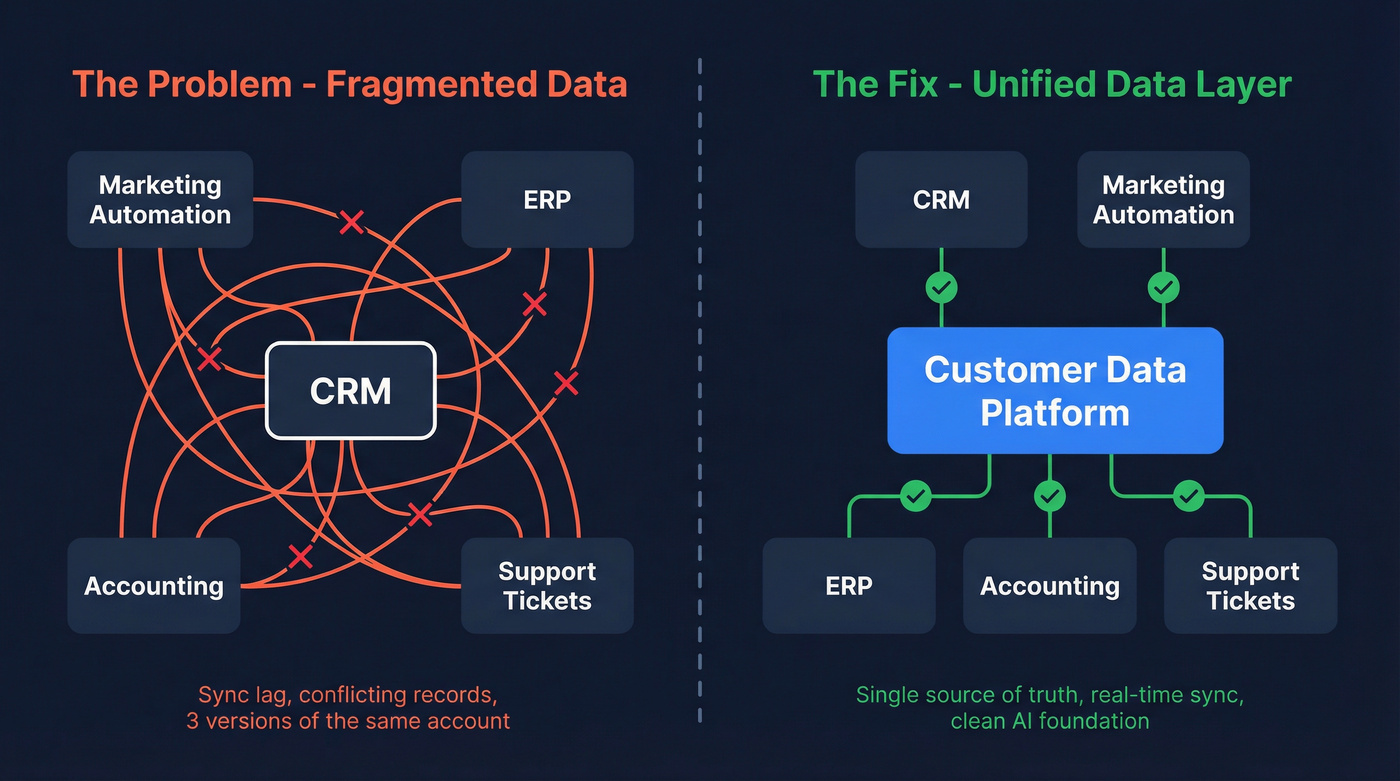
The architectural fix is a Customer Data Platform that centralizes data from CRM and adjacent systems to deliver a true 360 view of every customer account. Most teams bolt on integrations reactively rather than designing a unified data layer upfront - and then wonder why their "single source of truth" has three conflicting versions of the same account.
Vendor Lock-In and Switching Costs
CRM vendors don't make it easy to leave. Proprietary data formats, limited export APIs, excessive exit fees, and contract clauses that say "you own your data" while making extraction practically impossible. We've watched Salesforce-to-HubSpot migrations stall for months over field mismatches, deduplication errors, and broken integrations that nobody mapped during planning.
The fix is boring but essential: negotiate data portability into every vendor contract before you sign. Specify export formats, timelines, and zero exit fees. If GDPR applies to you, data portability gives you legal leverage - use it.
Compliance and Privacy Burden
Your CRM supports GDPR compliance in theory, but the operational burden of actually enforcing it falls on your team, not the software. Most implementations leave access controls wide open. The requirements that matter most for CRM teams:
- Consent management - lawful basis for every contact record
- Data minimization - don't store what you don't need
- 72-hour breach notification - your CRM must support rapid incident response
- Data subject rights - access, correction, and deletion on request
- Audit trails - who accessed what, when, and why
Skip this section if you're selling exclusively in the US with no EU customers. But if there's any chance a European contact lands in your CRM, these aren't optional. (For a practical outbound angle, see GDPR for Sales and Marketing.)
AI Won't Fix Broken Foundations
Every CRM vendor is racing to ship AI features. But 67% of companies can't scale AI according to McKinsey, and the primary blocker is data quality - not model sophistication. AI inherits every problem in your CRM. Feed it duplicated, outdated, incomplete records and you get biased scoring models, hallucinated insights, and over-automated workflows that frustrate customers.
If your average deal size is under $25k and your CRM data hasn't been cleaned in the last quarter, every dollar you spend on CRM AI features is wasted. Fix the foundation first. Smart views and AI-powered account plans are only as good as the data underneath them. (Related: AI CRM data entry automation.)
How to Fix These Drawbacks
No single move eliminates CRM limitations, but these four reduce the damage dramatically.
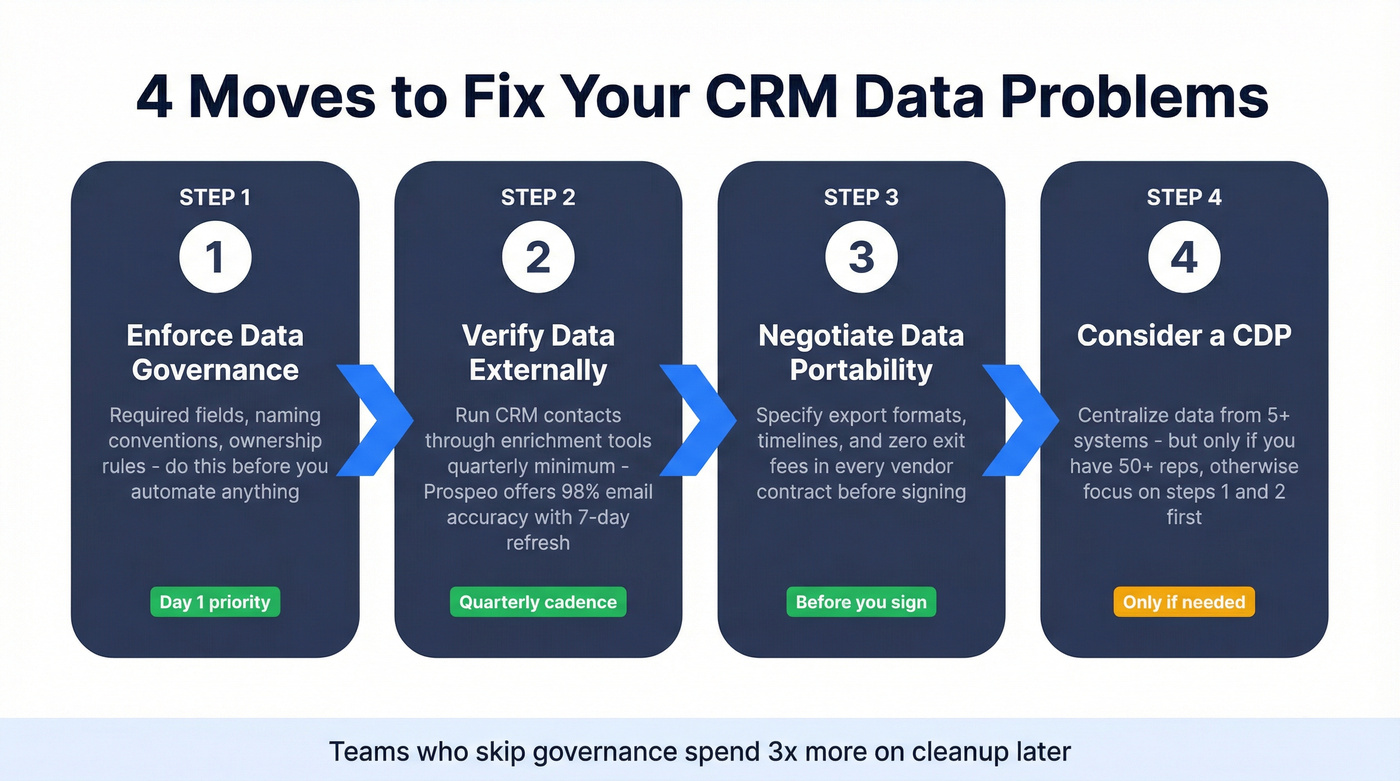
Enforce data governance from day one. Required fields, standardized naming conventions, clear ownership rules. This prevents most of the mess. Define what your CRM processes should look like before you automate anything - the Reddit consensus on r/salesforce is that teams who skip this step spend 3x more on cleanup later.
Verify contact data externally, quarterly minimum. Run your CRM contact lists through an enrichment tool on a regular cadence. Prospeo's native integrations with Salesforce and HubSpot make this fast to set up, and the 7-day refresh cycle catches decay before it compounds. At 98% email accuracy and an 83% enrichment match rate returning 50+ data points per contact, you're turning a stale database into something your reps actually trust. (If you're evaluating vendors, start with an email ID validator.)
Negotiate data portability into contracts. Specify export formats, timelines, and zero exit fees before you sign. Don't assume "you own your data" means you can actually get it out.
Consider a CDP for fragmented data. If your CRM is one of five systems holding customer data, a Customer Data Platform centralizes everything and gives AI features a clean foundation to work from. For teams with fewer than 50 reps, this is probably overkill - focus on governance and verification first.
AI features can't fix broken foundations. Before you spend another dollar on CRM intelligence, make sure the data underneath is actually accurate. Prospeo verifies emails through a 5-step process, removes spam traps and duplicates, and refreshes records every 7 days - not every 6 weeks.
Clean data in, clean insights out. Start at $0.01 per verified email.
FAQ
What's the biggest limitation of CRM software?
Data quality. CRM data decays by 34% per year - outdated contacts, duplicates, and incomplete records undermine every report, forecast, and AI feature built on top. External verification tools catch decay before it compounds into real revenue loss.
Why do CRM implementations fail?
Low user adoption is the top cause. Only 47% of sellers use their CRM regularly, and 18% say this has directly caused lost revenue. Overly complex setups and poor training accelerate abandonment - a CRM is a full operational system, not just a digital address book.
How much does a CRM really cost?
Far more than the license fee. Total cost of ownership - including implementation, training, admin, integrations, and data cleanup - runs $5-25K/year for SMBs, $25-100K for mid-market, and $100-500K+ for enterprise.
What are the most common CRM limitations for sales teams?
Data decay, low user adoption, hidden costs, integration fragmentation, vendor lock-in, compliance burden, and AI that can't overcome bad data. Data quality is the root cause behind most of the others - leading to lost deals, inaccurate forecasts, and reps who stop trusting the system entirely.