

The 10 Best AI Sales Automation Tools in 2026
Your team's sending 500 emails a day and getting a 1.2% reply rate. The instinct is to buy an AI sales automation tool that sends more emails, faster. That instinct is wrong - and it's why 88% of companies now use AI regularly but most still can't translate it into bottom-line impact at scale. The gap isn't the AI. It's the data feeding it.
Every tool on this list is only as good as the contact data underneath it. Automate bad data and you just burn your domain faster. We've ranked these tools not just on features, but on whether they actually move pipeline - starting with the data layer most teams skip. (If you’re evaluating providers, start with our B2B database breakdown.)
Our Picks
| Use Case | Tool | Starting Price |
|---|---|---|
| Data accuracy & enrichment | Prospeo | Free (75 emails/mo) |
| All-in-one outreach | Apollo.io | Free / from $49-$59/mo |
| Workflow automation | Clay | $149/mo |
| Conversation intel | Avoma | $29/mo (CI from $69/mo) |
| Enterprise engagement | Outreach | ~$100/user/mo |
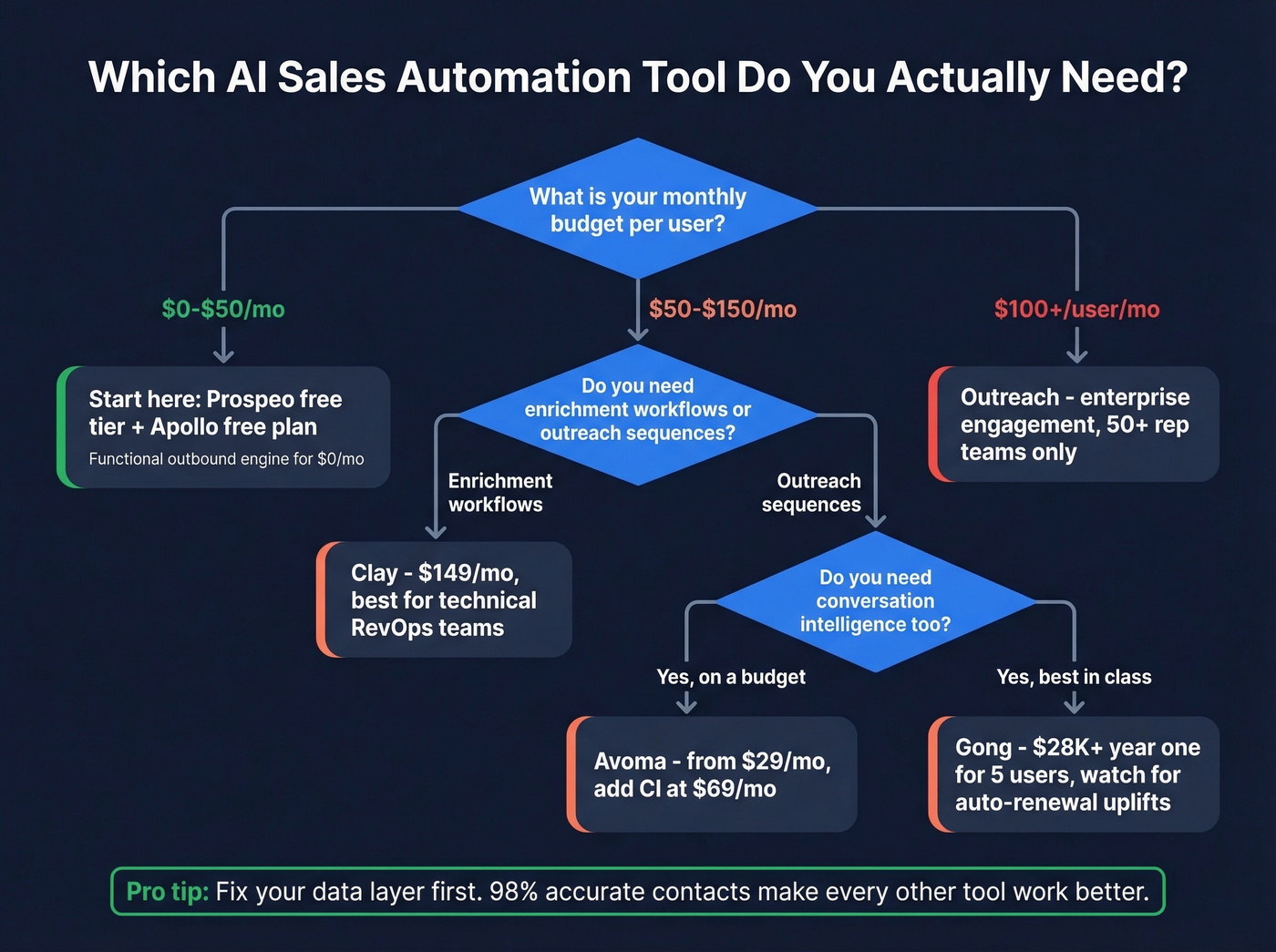
Building from scratch? Prospeo's free tier plus Apollo's free plan gives you a functional outbound engine for $0/month. Add Avoma for meeting notes starting at $29/mo. Scale from there.
What AI Sales Automation Actually Does in 2026
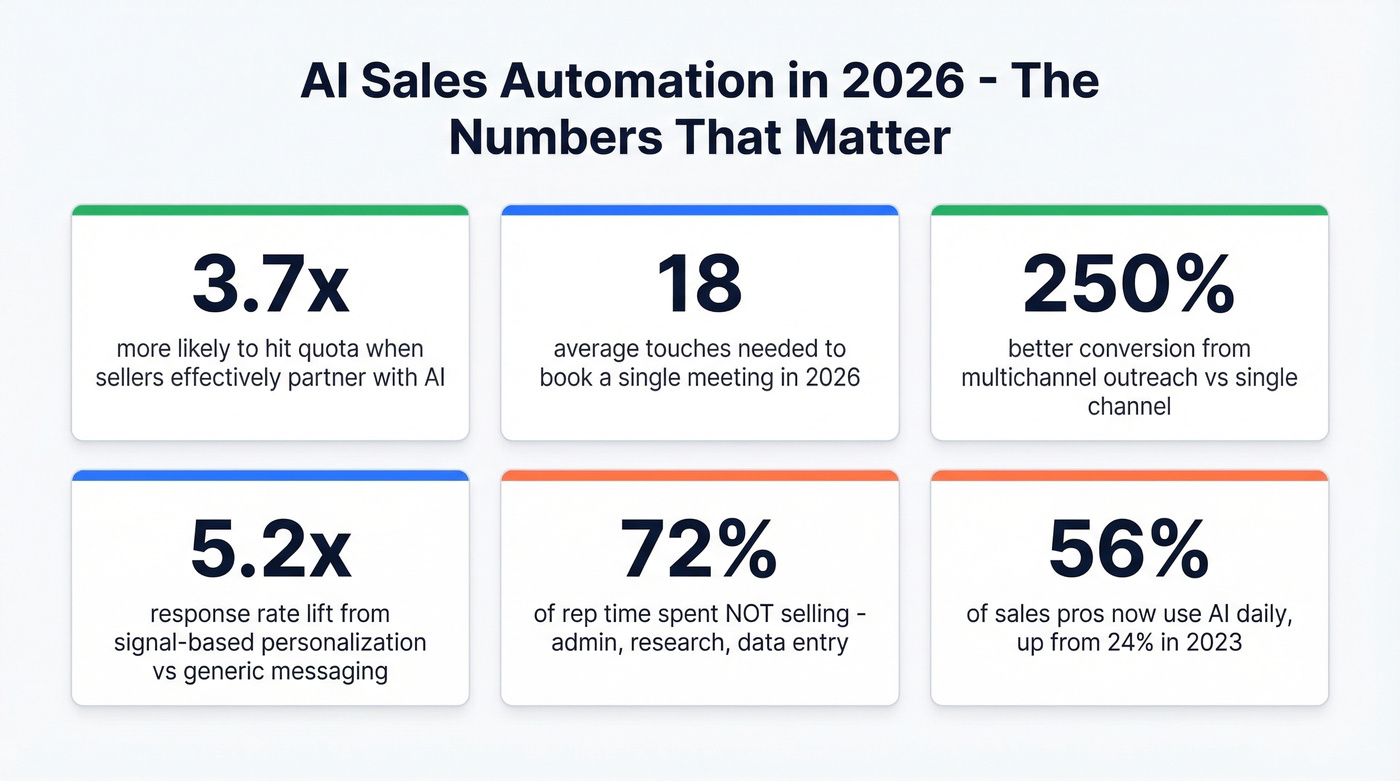
The AI sales tools market hit $3B in 2025 and is growing ~13% annually. Sellers who effectively partner with AI are 3.7x more likely to meet quota, and 56% of sales professionals now use AI daily - up from 24% in 2023. That money and attention flows into five categories, and understanding them prevents you from buying the wrong thing:
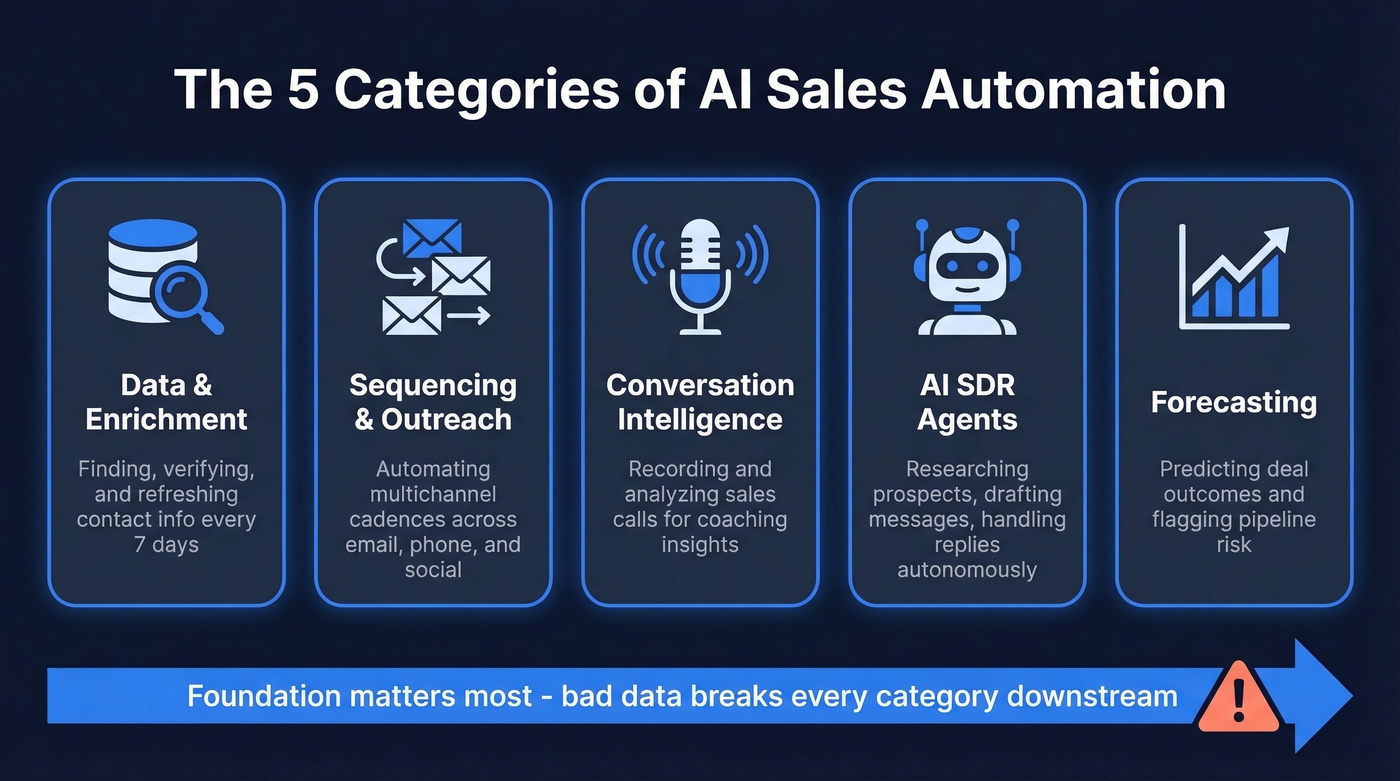
- Data and enrichment - finding, verifying, and refreshing contact information (see data enrichment tools)
- Sequencing and outreach - automating multichannel cadences across email, phone, and social (more on outbound email automation)
- Conversation intelligence - recording and analyzing sales calls
- AI SDR agents - researching prospects, drafting messages, handling replies semi-autonomously (compare options in AI SDR software)
- Forecasting - predicting deal outcomes and flagging pipeline risk
Here's the thing: it takes 18 touches to book a meeting in 2026, and multichannel outreach converts 250% better than single-channel. Signal-specific personalization drives an 18% response rate versus 3.4% for generic messaging - a 5.2x lift (see what actually works in AI email personalization). Reps still spend only ~28% of their time actually selling. These tools are meant to reclaim the other 72%, but only if the foundation is right.
The 10 Best Tools, Ranked
Prospeo
Best for: The verified data foundation that makes everything else work.
Prospeo covers 300M+ professional profiles, 143M+ verified emails, and 125M+ verified mobile numbers - all refreshed every 7 days. The industry average refresh cycle is 6 weeks, which means most competitors serve stale contacts while you're trying to run real-time outreach. The email finder hits 98% accuracy through a proprietary 5-step verification process with catch-all handling, spam-trap removal, and honeypot filtering (if you’re comparing verifiers, see email verifier tools).
At $0.01 per lead, it's 90% cheaper than ZoomInfo. Teams book 26% more meetings compared to ZoomInfo and 35% more compared to Apollo. Snyk's 50-person AE team saw bounce rates drop from 35-40% to under 5%, with AE-sourced pipeline up 180%. Meritt tripled pipeline from $100K to $300K per week.

The B2B database includes 30+ search filters - buyer intent powered by Bombora across 15,000 topics, technographics, job change signals, headcount growth, and funding data. Native integrations cover Salesforce, HubSpot, Outreach, Clay, Instantly, Lemlist, Smartlead, Zapier, and Make.
Use this if: You need a data layer that won't embarrass your outreach tools with bounces and bad numbers (especially if you’re working through sales pipeline challenges).
Skip this if: You want a built-in sequencer - pair Prospeo with a dedicated outreach platform instead.
Apollo.io
Best for: All-in-one outreach on a budget.
Apollo's the obvious starting point for SMB teams that want prospecting, sequencing, and a dialer in one platform. The free tier is genuinely usable - you get basic contact access and up to 2 sequences. Paid plans start around $49-$59/user/month depending on billing and go up to $119/user/month for Organization (minimum 3 seats), with a 210M+ contact database and a G2 rating of 4.7/5.
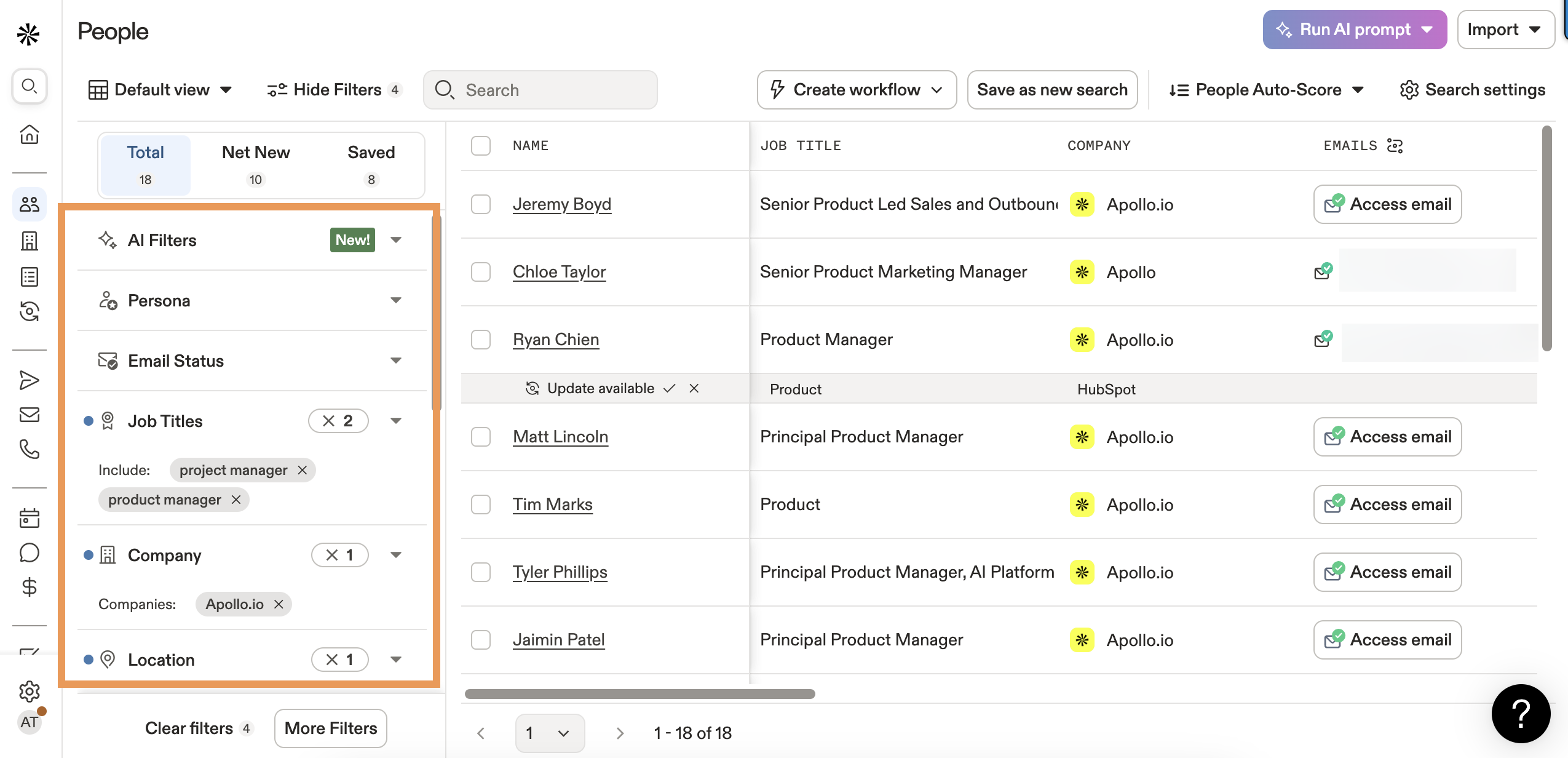
Use this if: You want one tool that handles list building through email sequences without stitching together five products.
Clay
Best for: Complex enrichment workflows for technical teams.
Clay is a powerhouse if you have the patience to learn it. It chains together dozens of data sources into automated enrichment waterfalls - think "find the company, pull technographics, enrich with mobile numbers, score by intent, push to sequencer" in one table. This kind of workflow automation is what separates teams that personalize at scale from teams that just blast (see Clay list building).
Plans start at $149/mo (Starter) and scale to $800/mo (Pro). Enterprise contracts hit a median of $30,400/year based on Vendr data from 19 purchases, with some running up to $154K/year.
The tradeoff is real. A survey of 500+ GTM pros found 42% cite credit burn as their top complaint, and 28% flag the steep learning curve. Smart teams test with 10 rows before running a full table, and filter aggressively before enriching. Budget alternatives like Airscale or building with n8n plus your own API keys are common workarounds for teams priced out of Clay.
Use this if: You have a RevOps person who thinks in spreadsheets and APIs, and you need multi-source enrichment beyond what any single database offers.
Skip this if: You want plug-and-play simplicity. Clay rewards power users and punishes everyone else.
Outreach
Outreach is the enterprise engagement platform that sales leaders default to when they outgrow Apollo or Salesloft. Base pricing runs $100-$140/user/month for the Engage module, with add-ons for conversation intelligence, deal management, and forecasting stacking another $30-50/user/month each. Annual contracts are required (if you’re deciding at this layer, see how to choose a sales engagement platform).
A 50-user Engage deployment lists at ~$72,000/year before discounts, plus $5,000-$25,000 for implementation. G2 gives it 4.3/5 - notably lower than some competitors. The most common complaints are opaque pricing, add-on sprawl, and a 2-4 week ramp time. If you're under 20 reps, it's overkill.
Gong
Gong earns its 4.8/5 on G2 for a reason - the conversation intelligence is genuinely best-in-class. But the pricing structure is complex. You're looking at a platform fee of $5K-$50K/year depending on team size, plus $100-$250/user/month for licenses, plus $15K-$65K for implementation.
A 5-user deployment runs roughly $28K in year one. Watch for auto-renewal uplifts of 5-15% and multi-year lock-ins with early termination penalties. Gong is incredible for coaching and deal visibility, but the total cost of ownership surprises almost everyone.
Avoma
Avoma is the conversation intelligence tool you buy when Gong's pricing makes your finance team flinch. Plans start at $29/mo and scale to $99/mo, covering AI meeting notes, call analytics, and coaching scorecards. Conversation intelligence kicks in at $69/mo.
For teams that need call recording and analysis without a five-figure platform fee, it's the clear budget pick. The feature set is narrower than Gong's, but for most teams under 50 reps, narrower is fine. We've seen operators book 1-2 meetings per week using a simple Apollo + AI outreach + Avoma stack - no enterprise tools needed.
Reply
Reply combines multichannel sequencing - email, calls, social, SMS - with emerging AI SDR agent capabilities. Starting at $99/user/month, it sits between Apollo's simplicity and Outreach's enterprise complexity. The AI agent features can research prospects, draft personalized messages, and handle initial replies, which makes it useful for teams experimenting with autonomous outreach without committing to a $35K+/year dedicated agent platform.
Lavender
AI email coaching that scores your drafts in real time and suggests improvements. Free tier available, paid plans from $29/mo (as low as $27/user/mo on annual billing). G2 4.8/5. Pair it with any sequencer to lift reply rates without changing your stack. The ROI math is simple: if Lavender improves your reply rate by even 2 percentage points, it pays for itself in the first week.
Salesforce Agentforce
Salesforce's native AI agent layer. Agentforce 1 Sales runs $550/user/month billed annually - steep, but if you're already deep in the Salesforce ecosystem, it eliminates integration headaches. Best for existing Salesforce shops with budget to match. Everyone else should look elsewhere.
Regie.ai
Enterprise AI content generation for outbound sequences. Starting at $35,000/year, it's built for large teams that need consistent messaging at scale across dozens of reps and multiple personas. Skip it if you're under 50 reps - the per-seat economics don't make sense below that threshold.

Every AI sales automation tool on this list runs on contact data. Bad data means burned domains, wasted sequences, and AI that optimizes for failure. Prospeo's 98% email accuracy and 7-day refresh cycle give your automation stack a foundation that actually converts - it's why Snyk's 50 AEs saw pipeline jump 180%.
Fix the data layer first. Everything else compounds from there.
What AI Sales Automation Actually Costs
| Tool | Starting Price | ~Annual (10 users) | Implementation | Contract |
|---|---|---|---|---|
| Prospeo | Free / ~$0.01/lead | $1,200-$4,800 | $0 | None |
| Apollo.io | Free / from $49-$59/mo | $5,880-$14,280 | $0 | Monthly OK |
| Clay | $149/mo | $17,880-$96,000 | $0 | Monthly OK |
| Outreach | ~$100/user/mo | $72,000+ | $5K-$25K | Annual |
| Gong | ~$100/user/mo + fees | $70,000-$120,000 | $15K-$65K | Annual |
| Avoma | $29/mo | $3,480-$11,880 | $0 | Monthly OK |
| Reply | $99/user/mo | $11,880 | $0 | Monthly OK |
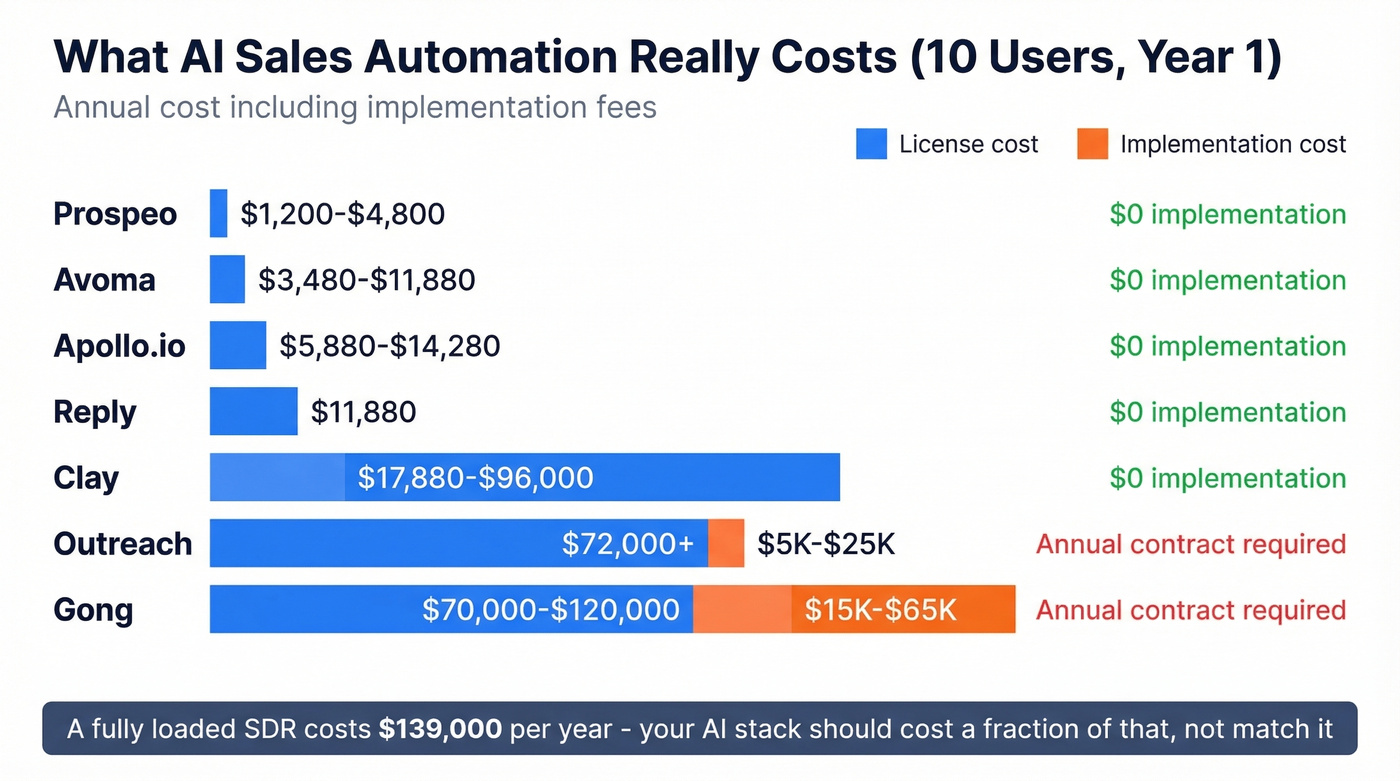
The hidden costs that kill budgets: Clay's credit burn, Apollo's non-rolling credits, Gong's platform fees that scale with headcount, and Outreach's add-on modules that double your per-seat cost. A fully loaded SDR costs $139,000/year. Your AI stack should cost a fraction of that - not match it.
Let's be honest: most teams with deal sizes under $15K don't need Gong, Outreach, or any tool with a five-figure annual commitment. A $200/month stack built on accurate data and a solid sequencer will outperform a $5,000/month stack built on ~79% accurate emails. Smarter automation starts with better data, not bigger contracts.
You don't need a $72K/year engagement platform to book more meetings. Teams using Prospeo book 26% more meetings than ZoomInfo users and 35% more than Apollo - at $0.01 per lead. Pair 300M+ verified profiles with any sequencer on this list and watch reply rates climb.
Stop automating bad data. Start with 143M+ verified emails.
Mistakes That Kill ROI
88% of organizations use AI regularly. Here's why so many still can't turn it into scaled financial impact:
Automating everything at once. Start with one workflow - email personalization or lead enrichment - and prove ROI before expanding. Teams that roll out five tools simultaneously end up configuring none of them properly.
Ignoring data quality. Garbage in, garbage out isn't a cliche - it's the #1 reason AI outreach fails. If your contact data bounces at 15%+, no amount of personalization saves you. Fix the data layer first. We've watched teams spend $3K/month on sequencing tools while feeding them unverified lists, then wonder why their domain reputation tanks (see how to check domain reputation).
No success metrics defined. If you can't articulate what "working" looks like before you buy, you won't recognize it after. Pick 2-3 KPIs - reply rate, meetings booked, cost per opportunity - and measure before and after.
Choosing tools on hype. The consensus on r/sales is pretty clear: start from the problem, not the tool. Sometimes Zapier plus a good database beats a $35K/year AI agent platform. The flashiest demo doesn't always produce the best pipeline (use these pipeline generation ideas to pressure-test what you actually need).
Treating your CRM as the entire system. There's a growing distinction between a CRM as system of record vs. an AI layer as system of action. Your CRM stores deal data; your automation tools act on it. Confusing the two leads to bloated CRM budgets and underused intelligence layers (see CRM automation software).
Skipping edge-case testing. Spend 30% of your setup time testing weird inputs - unusual company names, international formats, edge-case job titles. The failures that embarrass you in production are always the ones you didn't test.
How to Choose by Team Size
Solo founder / startup (1-2 reps): Prospeo's free tier plus Apollo's free plan. Total cost: $0/month. You get verified data and basic sequencing without spending a dollar until you've validated your ICP (start with an ideal customer profile).
SMB (5-20 reps): Add a paid data plan, Apollo Basic or Reply for sequencing, and Lavender for email coaching. Budget: $300-$600/month total. This stack handles enrichment, sequencing, and optimization without enterprise overhead - enough tooling to compete with larger teams, without the cost structure that sinks margins.
Mid-market (20-100 reps): Layer in Outreach or Gong - pick one, not both initially. Add Clay for complex enrichment workflows if you have RevOps support. At this scale, automated workflows shift from "nice to have" to essential because the volume of leads and touchpoints makes manual management impossible. Budget: $3,000-$10,000/month depending on modules.
Enterprise (100+ reps): Full stack - dedicated data enrichment, Outreach for engagement, Gong for conversation intelligence. Layer in Salesforce Agentforce if you're a Salesforce shop. At this tier, tools should integrate natively with your existing systems rather than requiring custom middleware. Budget: $15,000-$40,000/month, but still cheaper than the ZoomInfo + Outreach + Gong bundle most enterprises default to.
The outreach and intelligence layers change as you scale. The need for accurate, fresh contact data doesn't.
FAQ
Is AI replacing SDRs?
No. AI augments reps by handling research, drafting, and data tasks - humans own strategy and relationships. The SDR role is evolving, not disappearing. Automating recurring tasks like data entry, follow-up scheduling, and CRM updates frees reps to focus on conversations that close deals.
What's the average ROI timeline?
Expect productivity gains within 30-60 days and meaningful pipeline impact in 3-6 months. Consistent use and clean data are prerequisites - teams that skip data hygiene see slower returns regardless of which platform they choose.
How important is data quality for AI sales automation?
It's the single biggest factor. AI outreach amplifies whatever data you feed it - a 98% accuracy rate prevents the bounces that burn your sender domain and waste every dollar spent on sequencing.
Can small teams afford these tools?
Yes. Free tiers from Prospeo and Apollo give you a functional outreach stack for $0/month. Paid plans covering enrichment, sequencing, and email coaching start under $100/month combined - less than a single business lunch.
What's the difference between AI copilots and AI agents?
Copilots assist - drafting emails, suggesting next steps, scoring leads. Agents act autonomously - researching prospects, sending sequences, handling replies. Most teams start with copilots and dial up autonomy as they build trust in the system's judgment.