

AI SDR Software: The Tools That Work, the Ones That Don't, and What to Do First
A RevOps lead we know ran a 90-day pilot with three AI SDR tools last quarter. One burned through his domain reputation in two weeks. Another booked meetings with people who'd never heard of the company - the AI had hallucinated their job titles. The third actually worked, but only after he spent a month fixing the data feeding it.
That's the market right now. The category is projected to grow from $4.27B to $18.19B by 2032, and every vendor is racing to claim their slice. But practitioners on r/gtmengineering report 50-70% churn within 3 months - compared to the 5-10% churn healthy SaaS products target. Most teams don't fail because the AI is bad. They fail because they skip the prerequisites.
What follows: the data foundation you need before buying anything, the tools worth your money, the ones that aren't, and a 90-day playbook so you don't become a churn statistic.
Our Picks
| Category | Tool | Starting Price | Why |
|---|---|---|---|
| Best data foundation | Prospeo | Free (75 emails + 100 extension credits/mo) | 98% accuracy, stops bounces before they start |
| Best mid-market | Amplemarket | $600/mo (Startup, annual) | Top G2 rating, multichannel |
| Best all-in-one under $1K | AiSDR | $900/mo billed quarterly | Unlimited seats, credit-based model |
| Best budget entry | Reply.io (Jason AI) | $59/user/mo | AI bolt-on to a solid sequencer |
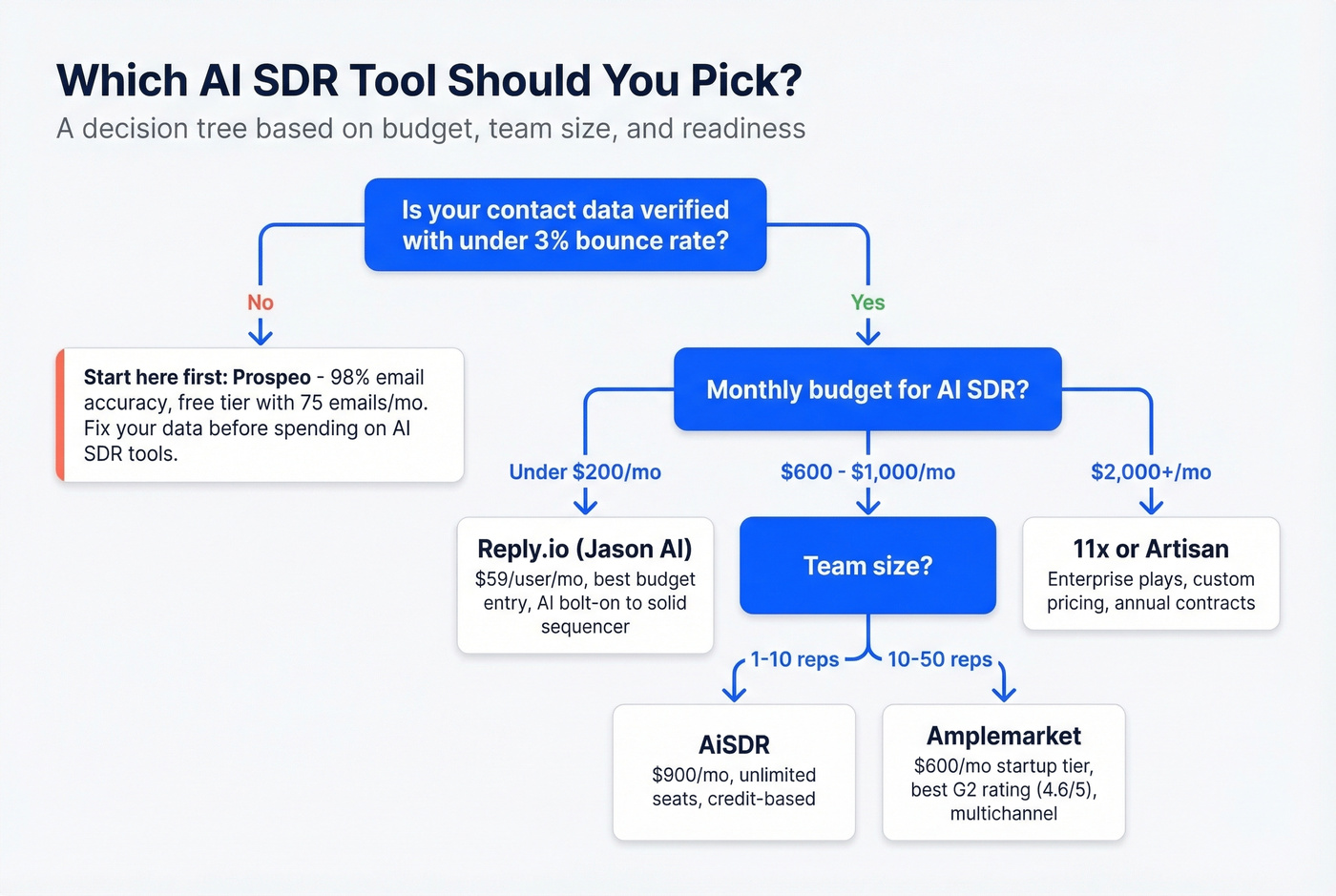
Short on time? Get your data right first, then pick the tool that matches your budget and team size. Every option below assumes clean, verified contact data. Without it, you're paying $900+/month to send emails to spam.
What Is AI SDR Software?
AI SDR software automates the work junior sales development reps do manually - prospecting, writing personalized outreach across email and phone and social, qualifying inbound leads, following up, and booking meetings. The "AI" part means these tools operate semi-autonomously or fully autonomously, making decisions about who to contact, what to say, and when to follow up. Think of each platform as a digital teammate running your outbound playbook around the clock.
Don't confuse AI SDRs with email sequencing tools like Instantly or Smartlead. Sequencers send emails on a schedule you define. AI SDRs decide the schedule, write the copy, pick the prospects, and adapt based on responses. And don't confuse them with CRMs - Salesforce tracks your pipeline, it doesn't fill it.
Why Most Implementations Fail
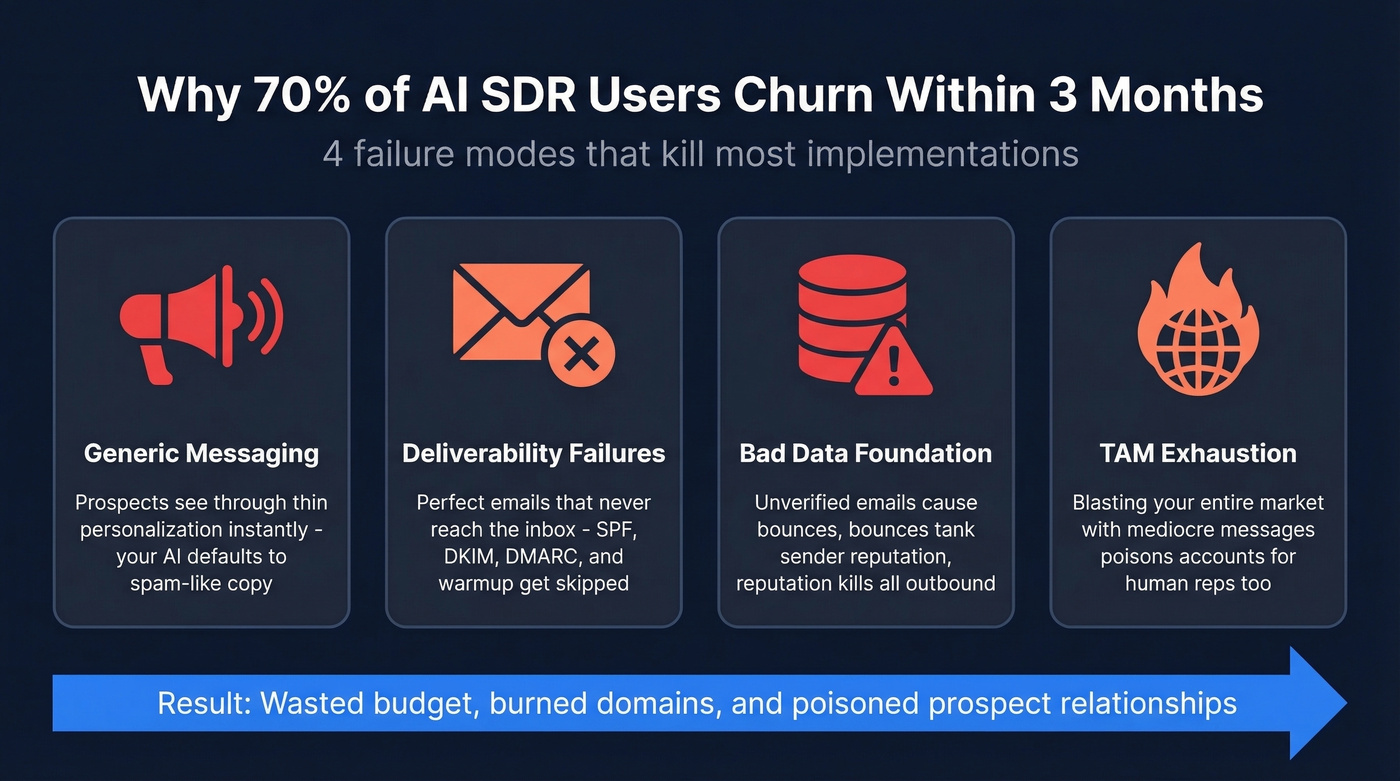
Four failure modes account for nearly every disaster we've seen. Understanding them before you buy saves months of wasted budget.
Generic, Robotic Messaging
Prospects can tell. The r/gtmengineering thread that surfaced the 50-70% churn stat breaks the outbound world into three camps: teams that blast volume with generic copy, teams that do deep manual research that doesn't scale, and teams that only pursue intent-triggered warm leads. AI SDR tools promise to combine the scale of camp one with the personalization of camp two. In practice, most default to camp one with a thin personalization veneer.
Prospects see through "I noticed your company just..." openers instantly.
Deliverability Failures
Your AI can write perfect emails that never reach the inbox. SPF, DKIM, and DMARC authentication are table stakes. Warmup is non-negotiable - sudden volume spikes trigger spam filters immediately. One Reddit user described emails landing in spam even with "solid email infrastructure" using Apollo + Smartlead. Infrastructure isn't a set-it-and-forget-it task.
Bad Data Feeding the AI
This is the one nobody talks about. Your AI SDR is only as good as the contact data it's working from. Feed it unverified emails and you get bounces. Bounces tank your sender reputation. Tanked sender reputation means even your CEO's emails start hitting spam. It's a cascade, and it happens fast.
TAM Exhaustion
An AI agent blasting your entire addressable market with mediocre messaging burns bridges you can't rebuild. Once a prospect gets three robotic emails from you, that account is poisoned for your human reps too.
A Regie.ai user on r/sales captured this perfectly: the tool sped up sequence creation significantly, but after deeper integration, engagement and open rates didn't budge. Speed means nothing if you're speeding toward spam folders.
The Data Quality Prerequisite
Here's the thing every AI SDR listicle skips: the data layer. You can pick the best platform on the market, configure it perfectly, and still fail if your contact data is garbage.
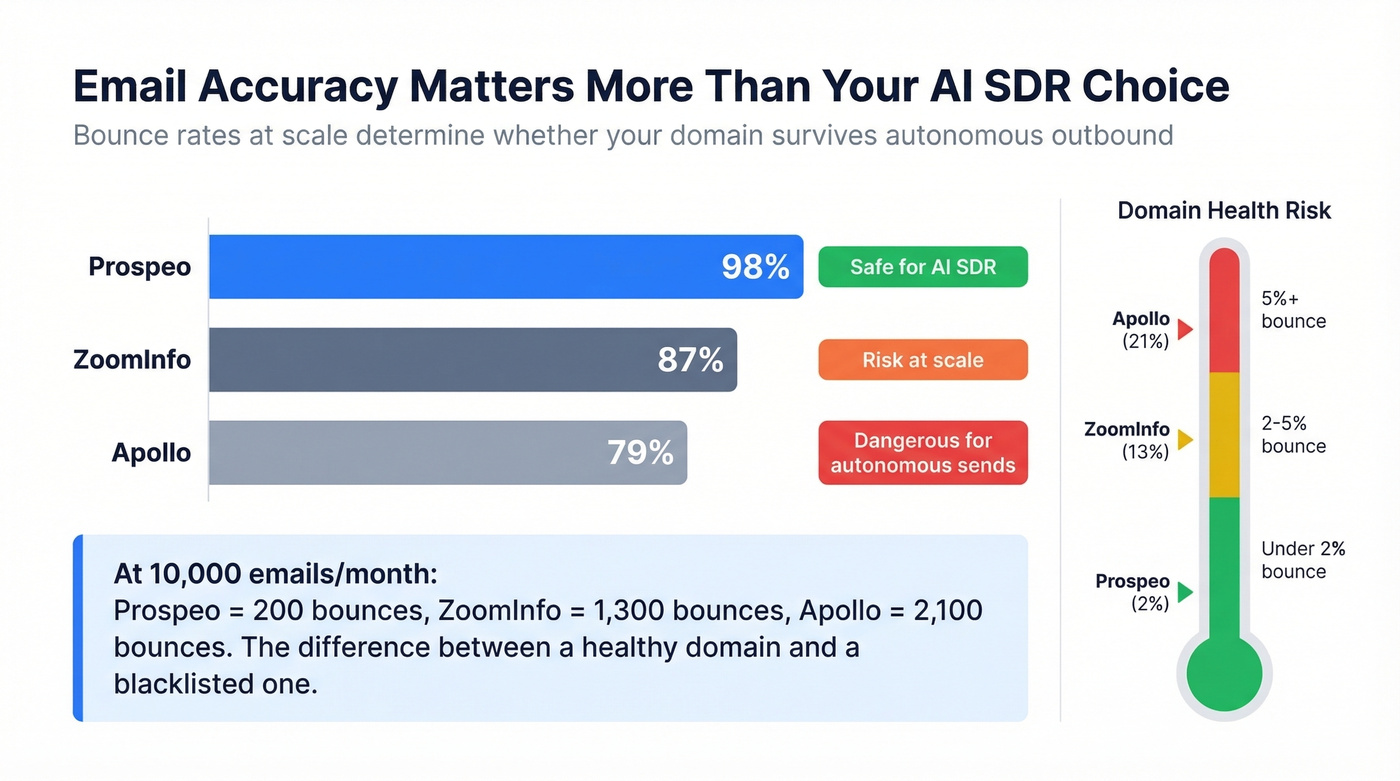
The numbers tell the story. Prospeo delivers 98% email accuracy - versus 87% for ZoomInfo and 79% for Apollo. That gap isn't academic. It's the difference between a manageable bounce rate and a deliverability-killing one at scale. High bounce rates don't just waste credits; they destroy your domain reputation across every email you send, including the ones your human reps are writing manually.
The platform covers 300M+ professional profiles, 143M+ verified emails, and 125M+ verified mobile numbers on a 7-day refresh cycle - the industry average is 6 weeks. That refresh cadence matters enormously for autonomous outreach because AI agents operate without human oversight on each send. A human rep might notice a bounced email and adjust. An AI SDR will keep hammering invalid addresses until your domain is flagged. Intent data tracking 15,000 topics via Bombora means your AI can prioritize prospects actively researching solutions, not just people who match a firmographic filter.

We've seen the results firsthand. One outbound agency cut bounce rates from 35% to under 4% and tripled their pipeline - from $100K to $300K per week. Another team of 50 AEs saw bounce rates drop from 35-40% to under 5%, with AE-sourced pipeline up 180% and 200+ new opportunities per month. These aren't hypothetical improvements. They're the kind of data quality gains that determine whether your AI SDR investment pays off or becomes an expensive domain-reputation liability.
Picture this: you're paying $900/month for an autonomous sales agent, but feeding it unverified addresses from a stale database. Your bounce rate creeps past 10%, then 15%. Gmail and Outlook start flagging your domain. Now your CEO's investor updates are landing in spam too. We've watched this exact pattern play out at three companies in the last year alone.

70% of AI SDR users churn within 3 months - most because of bad data, not bad AI. Prospeo's 98% email accuracy and 7-day refresh cycle stop the bounce-rate cascade before it starts. Feed your AI SDR verified contacts from 300M+ profiles, not stale records that torch your domain.
Stop paying $900/month to send emails to spam folders.
Your AI SDR operates without human oversight on every send. One bad batch of contacts and your domain reputation is gone - for every rep, every channel, every email your company sends. Prospeo delivers 98% email accuracy at $0.01/lead with a 7-day refresh cycle. That's the data layer your autonomous agent needs to actually book meetings.
Build the data foundation before you automate outbound.
Pricing Comparison for AI SDR Platforms
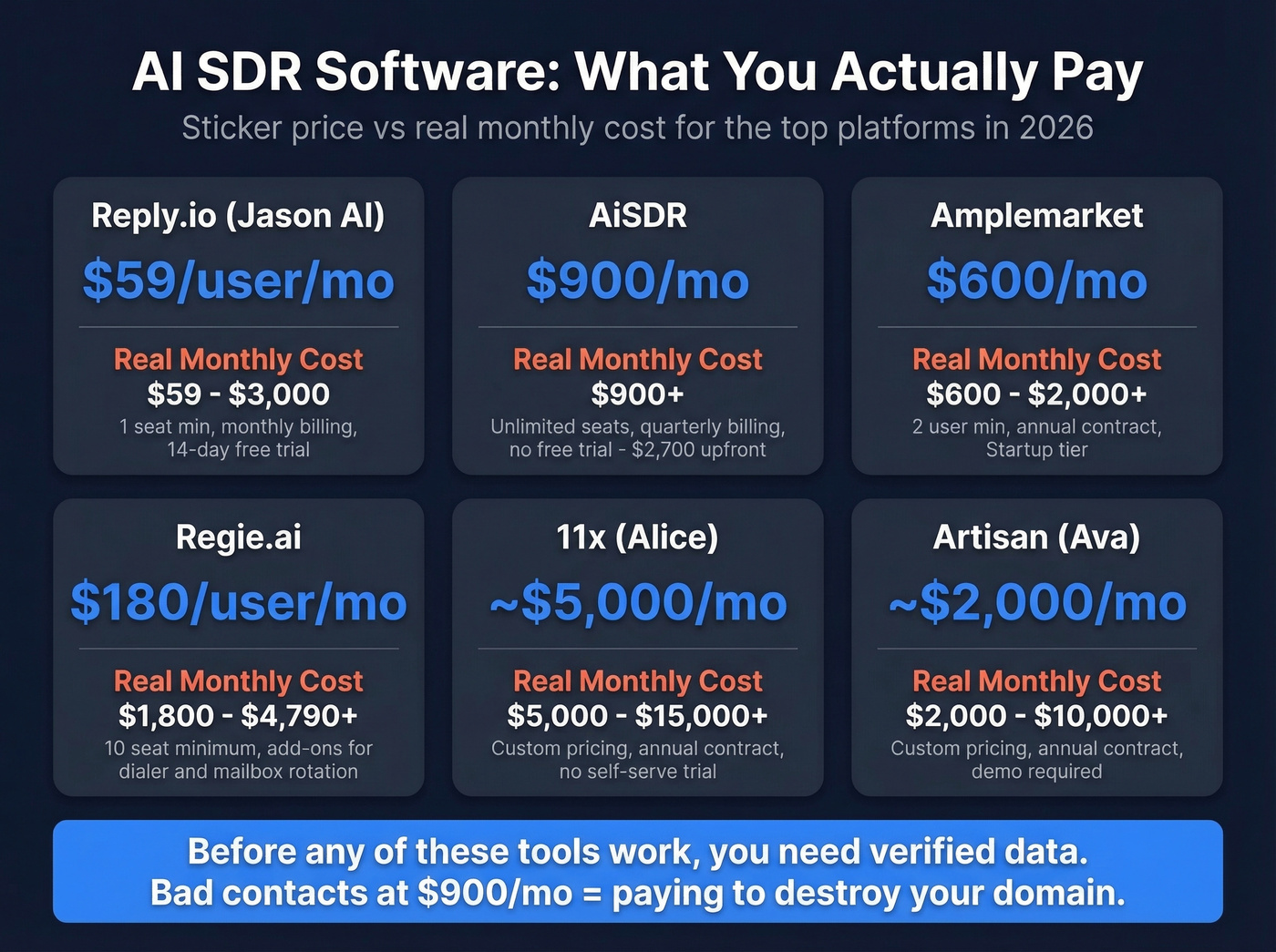
The sticker price is rarely the real price. Here's what these tools actually cost.
| Tool | Starting Price | Seat Min | Contract | Real Monthly Cost |
|---|---|---|---|---|
| Reply.io (Jason AI) | $59/user/mo | 1 | Monthly | $59-$3,000 |
| AiSDR | $900/mo | Unlimited | Quarterly | ~$900+ |
| Amplemarket | $600/mo (Startup, annual) | 2 users | Annual | $600-$2,000+ |
| Regie.ai | $180/user/mo | 10 seats | Annual | $1,800+ floor |
| 11x (Alice) | ~$5,000/mo | Custom | Annual | $5,000-$15,000+ |
| Artisan (Ava) | ~$2,000/mo | Custom | Annual | $2,000-$10,000+ |
| Clay | Free / $149/mo | None | Monthly | $0-$800+ |
| Apollo.io | Free / $49/user/mo | 1 | Monthly | $0-$99+ |
Free trials: Reply.io (14-day), Clay (14-day Pro trial), and Apollo (14-day trials for paid plans). AiSDR, Amplemarket, Regie.ai, and Artisan all require demos. 11x offers no self-serve trial and doesn't publish pricing.
The hidden costs are where budgets blow up. Regie.ai's AI SEP plan is $180/user/month - but with a 10-seat minimum, your floor is $1,800/month before add-ons. Add Mailbox Rotation at $50/user/month ($500/month at 10 users) and a Parallel Dialer at $249/user/month ($2,490/month at 10 users), and you're at $4,790/month before you've touched anything else.
Then there's the "AI SDR vs lead gen agency" question. One Reddit user got scammed by an agency charging $1,000 per campaign with "ZoomInfo premium data" - no report delivered after a month. AI SDR tools are at least accountable to metrics. But they're only worth it if you're feeding them clean data.
Best AI SDR Tools in 2026
Amplemarket - Best for Mid-Market
Use this if you're a 10-50 person sales team running multichannel outbound and want the most battle-tested option. Amplemarket's 4.6/5 G2 rating from 596 reviews is the strongest social proof in the category - nobody else comes close on review volume.

G2 benchmarks show about 1 month to implement and 8 months to positive ROI. That's honest - any vendor promising ROI in 30 days is lying. The platform connects to 17 integrations including Clay, HubSpot, and Salesforce, so it fits into existing stacks without ripping anything out.
Skip this if you're targeting international leads heavily. G2 reviewers consistently flag data accuracy issues outside North America. The Startup plan runs $600/month on annual billing with 2 users and 30k contacts; higher tiers are custom.
AiSDR - Best All-in-One Under $1K
At $900/month billed quarterly, AiSDR includes unlimited seats - a genuine differentiator when most competitors charge per user. The platform is credit-based rather than seat-based, which positions it as a mid-price sweet spot: more capable than budget sequencers, less expensive than enterprise plays like 11x.
The catch: no public free trial. That means you're betting $2,700 (one quarter) on a demo and sales pitch. For teams selling sub-$15k deals, that's a meaningful commitment. The credit-based model also means you need to monitor burn rate carefully - unlimited seats don't help if you exhaust credits in week two.
Reply.io (Jason AI) - Best Budget Entry
Already on Reply.io for sequencing? Jason AI bolts on AI capabilities without switching platforms. The pricing ladder is accessible: Email Volume at $59/user/month, Multichannel at $99/user/month, and dedicated AI SDR plans ranging from $500 to $3,000/month on annual billing depending on volume and features.
Jason AI adds AI-generated sequences, autonomous follow-ups, and basic lead qualification on top of Reply's established infrastructure. It's not the most sophisticated option on the market, but it's the easiest on-ramp for teams that want to test autonomous outreach without a $900+/month commitment. You'll still need a separate data source for contact discovery - pair it with a verified email provider and you've got a functional stack for under $200/month.
11x (Alice) - Enterprise-Only Bet
11x doesn't publish pricing and doesn't offer a self-serve free trial. Expect $5,000-$15,000+/month, demo-only access, and annual contracts.
G2 gives it 4.4/5 from 27 reviews - solid but thin. Users praise the time savings and support once configured. A common limitation: personalization leans on static research rather than real-time buying signals like job changes or funding rounds.
Skip this if your annual budget is under $60K.
Regie.ai - Power Tool with Hidden Costs
Regie.ai's AI SEP plan runs $180/user/month with a 10-seat minimum - that's an $1,800/month floor before you've added anything. The Force Multiplier tier jumps to $499/user/month with a 5-seat minimum and includes enrichment credits. Add mailbox rotation and a parallel dialer, and you're looking at $4,000+/month easily.
A Reddit user's experience captures the pattern: initial excitement about sequence creation speed, then frustration when HubSpot integration broke down and engagement rates didn't improve. Annual contracts only. Demand a pilot period.
Artisan (Ava) - Proceed with Caution
Artisan talks a big game, but the early evidence is concerning. A Gartner Peer Insights review - just one review, rated 1.0 - describes robotic messaging, no Salesforce integration, poor support, and cancellation after the first month. Custom pricing, typically $2,000-$10,000+/month. Demand a thorough pilot with clear success metrics before signing anything.
Clay - Not an SDR, but a Great Foundation
Let's be clear: Clay isn't an AI SDR. It's an enrichment and workflow automation layer that pairs beautifully with autonomous outreach tools. The free plan gives you 1,200 credits/year. Paid plans run from $149/month to $800/month, with enterprise contracts averaging $30,400/year on Vendr. The credit-burn warning is real - teams that don't monitor usage can blow through credits fast. Clay's waterfall enrichment logic combined with a high-accuracy data source makes a powerful foundation for any AI-powered sales platform.
Apollo.io - Good Enough to Start
Apollo is a common "starter" option, and for good reason: free tier, paid plans from $49/user/month, and a database plus basic AI sequencing in one platform. It's the path of least resistance for teams testing autonomous outreach for the first time.
The limitation is data quality. Apollo's email accuracy runs around 79% - workable for small volumes, dangerous at scale. If you're sending 500 emails a month, the accuracy gap won't matter much. At 5,000/month, it absolutely will. Many teams start on Apollo and layer a dedicated verification tool on top as they scale.
Quick Mentions
- Luru - $500/agent/month, add or remove agents anytime. Interesting for teams wanting flexible AI agent capacity without annual commitments.
- Salesforce Agentforce - Usage-based pricing within the Salesforce ecosystem. Only makes sense if you're already deep in Salesforce. Don't buy Salesforce to get this.
- Agent Frank (Salesforge) - ~$416/month based on user reports. Budget-friendly but limited community feedback.
- Instantly - Sending infrastructure, not an AI SDR. Great for deliverability and warmup, but you still need a brain on top.
- Smartlead - Same category as Instantly - a sending tool, not an autonomous SDR. Pairs well with dedicated AI platforms.
AI SDR vs Human SDR vs Hybrid
The data here is striking but incomplete.
| Metric | AI SDR | Human SDR | Hybrid |
|---|---|---|---|
| Cost per qualified lead | ~$39 | ~$262 | Varies |
| Response time | Under 1 minute | ~42 hours | Minutes |
| Revenue generated (6-mo) | $56K | $147K | 2.5x growth |
| Meeting show rate | 52% | 71% | ~65% |
| Productivity boost | - | - | 35% |
AI SDRs are 54x cheaper per lead, but human SDRs generated 2.6x more revenue in a head-to-head experiment. Humans also achieve significantly higher meeting show rates - 71% vs 52%. The meetings AI books tend to be lower quality, with prospects who are less committed.
Our take: If your average deal size is under $10K, you probably don't need an AI SDR at all. A well-configured outbound email automation tool with verified data will get you 80% of the way there at 10% of the cost. These tools earn their keep on mid-market and enterprise deals where the volume of personalized touches justifies the spend.
The answer isn't AI or human. It's hybrid. Teams running both see 35% productivity gains and 2.5x revenue growth. AI handles the volume - first touches, follow-ups, qualification of inbound leads. Humans handle the high-value conversations, complex deals, and accounts where a robotic opener would be a dealbreaker.
The hybrid model works best when both AI and human SDRs are working from the same verified data. If your AI agent is pulling from one database and your human reps from another, you'll get conflicting information, duplicate outreach, and confused prospects.
Who should NOT buy right now: Teams with fewer than 500 target accounts (just do it manually), teams selling exclusively to C-suite at Fortune 500 (AI messaging isn't there yet for that audience), and anyone who hasn't fixed their deliverability infrastructure first.
90-Day Implementation Playbook
Week 1-2: Foundation
- Set up SPF, DKIM, and DMARC on all sending domains. No exceptions.
- Purchase and warm up secondary sending domains - minimum 2 weeks of gradual volume ramp.
- Run your existing contact list through email verification. If more than 10% bounce, your list needs rebuilding before you load it into any AI SDR.
- Define your ICP with specific firmographic and intent criteria.
Week 3-4: Configuration
- Configure your chosen tool. Upload verified contacts only.
- Build initial sequences with 3-5 variations. Don't let the AI run unsupervised on day one - review the first 50 messages manually.
- Set up CRM sync and make sure deduplication is working.
- Evaluate whether the platform handles personalization well or defaults to generic templates.
- Target by end of Week 4: Infrastructure fully warmed, first 200-500 verified sends out the door.
Month 2: Monitor and Tune
- Track bounce rate (target: under 5%), reply rate (target: above 2%), and meeting quality.
- Tune AI prompts based on what's getting responses. Kill sequences with reply rates under 1%.
- Review AI-generated messages weekly for hallucinations or tone issues.
- Target by end of Month 2: 2-5 qualified meetings from 1,000 verified sends.
Month 3: Evaluate
- Calculate true cost per qualified meeting, including all tool costs, data costs, and time spent managing the AI.
- If bounce rate is still above 5%, the problem is data, not the tool. Fix the input before scaling the output.
- If reply rate is below 2% with clean data and good deliverability, the problem is messaging. Consider switching platforms or adjusting your ICP.
- Decision point: Scale what's working, cut what isn't, or pivot to a different tool entirely.
FAQ
What is AI SDR software?
AI SDR software automates outbound sales development - prospecting, personalized outreach across email, phone, and social, lead qualification, and meeting booking - using AI agents that operate autonomously. Unlike basic email sequencers, these platforms make decisions about who to contact, what to say, and when to follow up, adapting messaging and timing based on prospect behavior.
How much does it cost?
Most mid-market tools cost $500-$5,000 per month. Budget options like Reply.io start at $59/user/month, while enterprise platforms like 11x run $5,000-$15,000+/month. Factor in add-ons like mailbox rotation, data enrichment, and deliverability infrastructure - real costs typically run 30-50% higher than listed prices.
Can AI SDRs fully replace humans?
Not yet. AI SDRs cost roughly $39 per qualified lead versus $262 for humans, but human reps generate 2.6x more revenue and achieve 71% meeting show rates versus 52% for AI. The best-performing teams use a hybrid model where AI handles volume and first touches while humans manage high-value conversations and complex deals.
Why do most implementations fail?
Three reasons: bad contact data causing deliverability failures, generic messaging that prospects immediately recognize as automated, and unrealistic expectations about setup time. The 50-70% churn rate within 3 months reflects teams that skip data quality and deliverability prerequisites, then blame the tool when results don't materialize.
What data tools pair best with AI SDR software?
Your autonomous sales agent is only as good as the data feeding it. A 98% email accuracy rate and a weekly refresh cycle prevent the bounce-rate spikes that kill campaigns. Tools like Prospeo integrate natively with Instantly, Smartlead, Lemlist, Clay, Zapier, and Make. Clay adds waterfall enrichment on top. Most platforms connect via Zapier or native integrations to pull verified contacts directly.