

Competitive Insights: How to Build a CI Program That Actually Drives Revenue
It's Tuesday morning. Your CEO drops a Slack message: "Did you see [competitor] just launched usage-based pricing? What's our response?" You open the shared drive, find a battlecard from Q1, and realize it still lists their old per-seat model. You've got nothing. Your reps have got nothing. And the deals in pipeline against that competitor just got harder.
This is what happens when competitive insights are treated as a nice-to-have instead of a system.
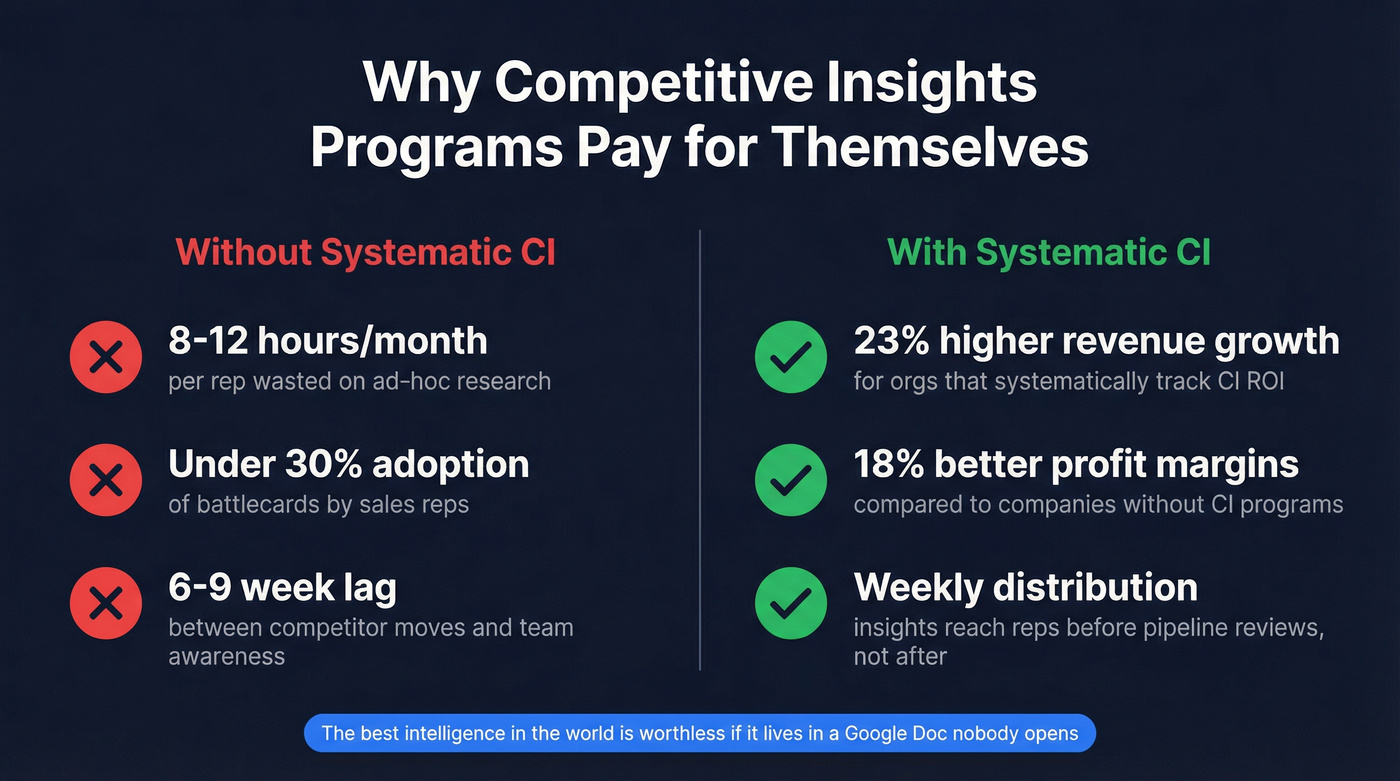
Sales reps spend 8-12 hours per month doing their own ad-hoc competitor research. Battlecards go stale within 30 days, and fewer than 30% of reps bother accessing them. The gap between what your team knows and what they need to know is costing you deals right now - not next quarter, not eventually, but on the calls happening this week.
What You Need (Quick Version)
If you're starting from zero, you need three things:
Three to five Key Intelligence Questions from your stakeholders - not a list of 50 competitors, but the specific questions your CEO, sales leader, and product team actually need answered. We cover how to define these in the CI system section.
A monitoring stack that doesn't require a $10k-$60k/year platform. Google Alerts, Semrush's free tier, and a Notion database are enough to get a program off the ground. The full tech stack breakdown is below.
A distribution cadence that gets insights to sales weekly, not quarterly. The best intelligence in the world is worthless if it lives in a Google Doc nobody opens.
If you already have a CI program, the biggest ROI unlock is connecting competitor intelligence to execution - verified contact data and intent signals so you can act on what you learn, not just know things.
What Competitive Insights Actually Are
Competitive insights aren't a spreadsheet of competitor features or a pricing page screenshot. They're the layer of analysis that turns raw data into something a rep can use to win a deal or a product leader can use to make a roadmap decision.
Klue's framework draws a useful distinction. Knowing that a competitor typically costs $20K annually is data. Knowing that they discount aggressively in Q4, that their procurement process breaks down on multi-year commitments, and that you can counter by offering a paid pilot - that's an insight. One is a fact. The other changes behavior.
The tactical vs. strategic split matters too. Tactical insights drive immediate reactions: matching a flash sale, tweaking ad copy, adding a feature that just became table stakes. Strategic insights shape direction: where the market's heading, which segments are underserved, whether a competitor's hiring patterns signal a pivot.
Organizations that systematically track CI ROI see 23% higher revenue growth and 18% better profit margins than those that don't. That's not a rounding error.
The Cost of Bad CI
A 50-person sales org where reps spend 8-12 hours per month on competitor research racks up roughly $195,000-$292,500 per year in direct labor costs. That's not a CI budget - that's reps doing CI badly instead of selling. Product marketing spends another 30-40 hours per quarter on battlecard maintenance, and that effort is wasted if the cards are already stale by the time reps see them.
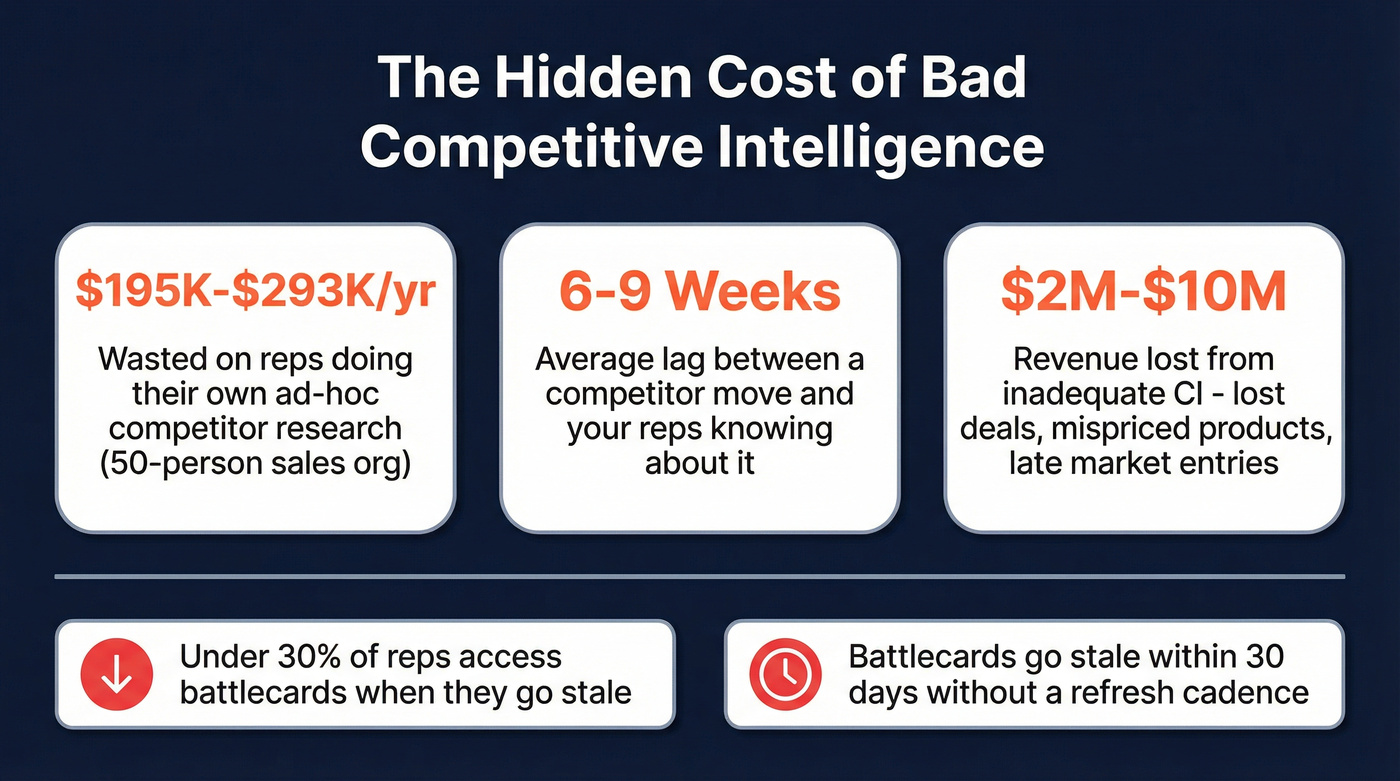
The lag is even more damaging. In a manual CI process, the gap between a competitor making a move and your reps knowing about it runs 6-9 weeks. Your competitor launches a new pricing tier, and for two months your reps walk into calls with outdated talk tracks. Without a buyer information advantage, your team is always one step behind.
Companies lose $2-$10 million from inadequate competitive intelligence - through lost deals, mispriced products, and late market entries. When battlecards are stale and reps don't trust them, adoption craters below 30%. Reps start freelancing their own competitive narratives, which means inconsistent messaging across the org.
Here's the scenario that should keep product marketers up at night. Your SDR calls into an account that's actively evaluating your biggest competitor. The SDR has no idea - no talk track, no objection handling, no positioning. The prospect mentions the competitor by name, and your rep fumbles. That deal was losable from the first touch.
10 Types That Drive Revenue
Most frameworks list five or seven categories of intelligence. That's not enough. Here are the ten types that actually matter for revenue teams in 2026, expanded beyond Sprinklr's taxonomy to cover the full picture.
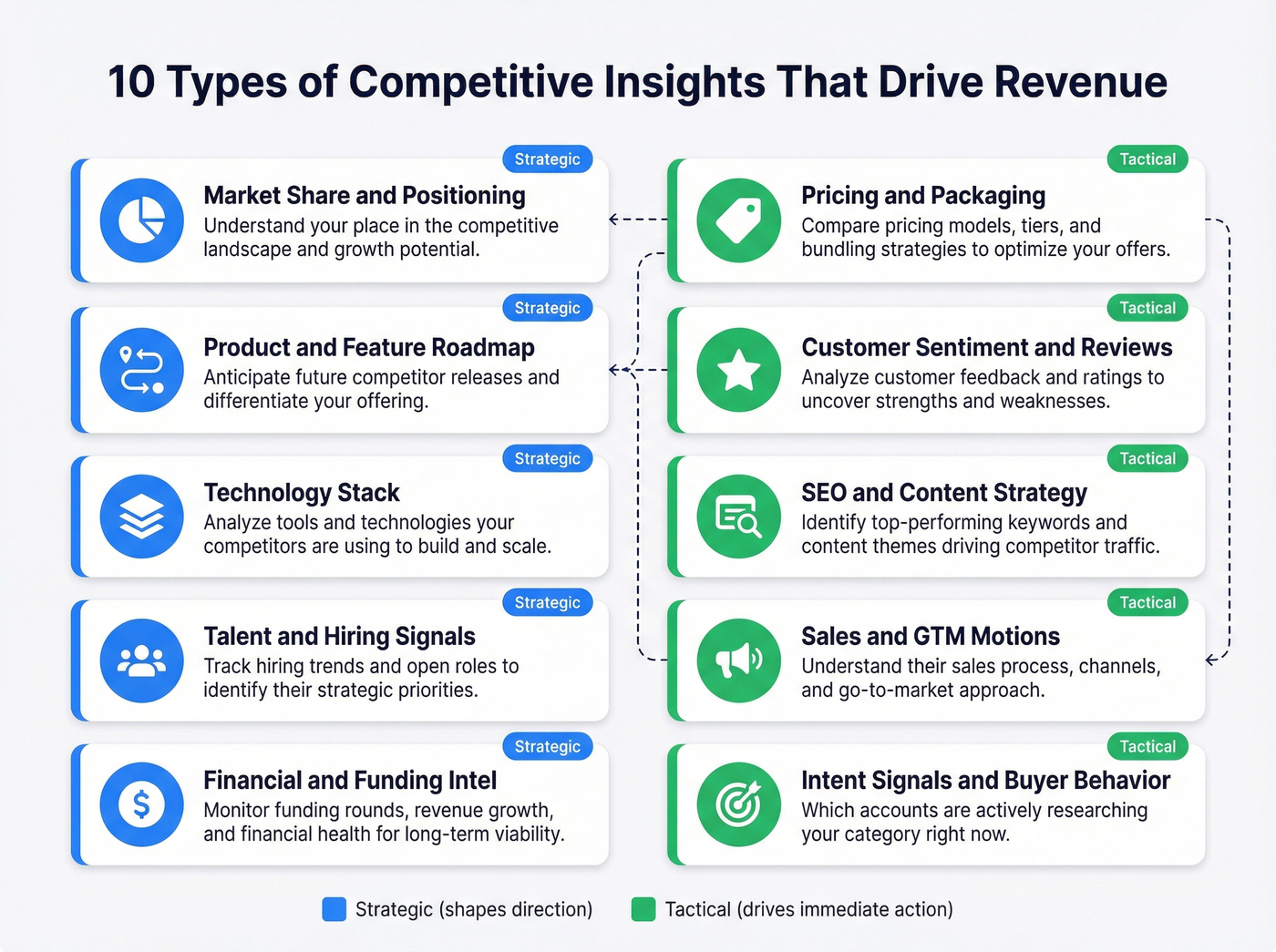
1. Market share and positioning - Where competitors sit in the market, how they're perceived, and how that's shifting. This is your strategic foundation.
2. Pricing and packaging - Not just what they charge, but how they structure deals, where they discount, and what triggers pricing changes.
3. Product and feature roadmap - What they're building, what they've shipped, and what's conspicuously absent. Job postings and patent filings are underrated sources here.
4. Customer sentiment and reviews - What their customers love, hate, and complain about on G2, Reddit, and in win/loss interviews. This is positioning gold. It matters more than most teams realize: 70% of consumers switch brands for better quality, which means your competitor's unhappy customers are your warmest prospects.
5. SEO and content strategy - What keywords they're targeting, what content they're investing in, and where they're gaining or losing organic visibility.
6. Technology stack - What tools they run internally via technographic data and what that signals about their operations and priorities.
7. Talent and hiring signals - A competitor hiring five enterprise AEs in DACH tells you more about their strategy than any press release.
8. Sales and GTM motions - How they sell, what their demo flow looks like, how aggressive their outbound is, and what channels they prioritize. Buyer conversation insights from recorded calls and demo teardowns are especially valuable - they reveal how competitors frame their value in real time.
9. Intent signals and buyer behavior - Which accounts are actively researching your category or your competitors. This is where intelligence meets execution: you stop reacting and start intercepting.
10. Financial and funding intelligence - Revenue estimates, funding rounds, burn rate signals, and earnings calls for public companies.
| Insight Type | Tactical or Strategic | Key Sources | Update Cadence |
|---|---|---|---|
| Market share | Strategic | Analyst reports, win/loss | Quarterly |
| Pricing & packaging | Both | Competitor sites, G2 | Monthly |
| Product roadmap | Strategic | Changelogs, job posts | Monthly |
| Customer sentiment | Tactical | G2, Reddit, Gong calls | Bi-weekly |
| SEO & content | Tactical | Semrush, Ahrefs | Monthly |
| Technology stack | Strategic | Wappalyzer, BuiltWith | Quarterly |
| Talent & hiring | Strategic | Job boards, press | Monthly |
| Sales & GTM motions | Tactical | Mystery shopping, reps | Quarterly |
| Intent signals | Tactical | Bombora, G2 Buyer Intent | Weekly |
| Financial intel | Strategic | Crunchbase, SEC filings | Quarterly |
How to Build a CI System That Works
The biggest mistake teams make is starting with competitors. They list 30 companies, set up Google Alerts for all of them, and drown in noise within two weeks. The stakeholder-first approach flips this entirely.
Step 1: Start With Stakeholders
Product marketers own CI nearly 80% of the time, but sales is the number one consumer. Before you monitor a single competitor, sit down with your CEO, VP of Sales, Head of Product, and demand gen lead. Ask each one: "What competitive question, if answered, would change a decision you're making this quarter?"
You'll get answers like "Why are we losing to [competitor] in mid-market deals?" or "Is [adjacent player] going to enter our segment?" Those are your starting points - not a list of logos.
Step 2: Define Your KIQs
KIQs are the filter that prevents information overload. Three to five is the right number. Each KIQ should be specific enough to be answerable and broad enough to stay relevant for a quarter. "What is Competitor X's pricing strategy for enterprise deals?" is a good KIQ. "What is Competitor X doing?" is not.
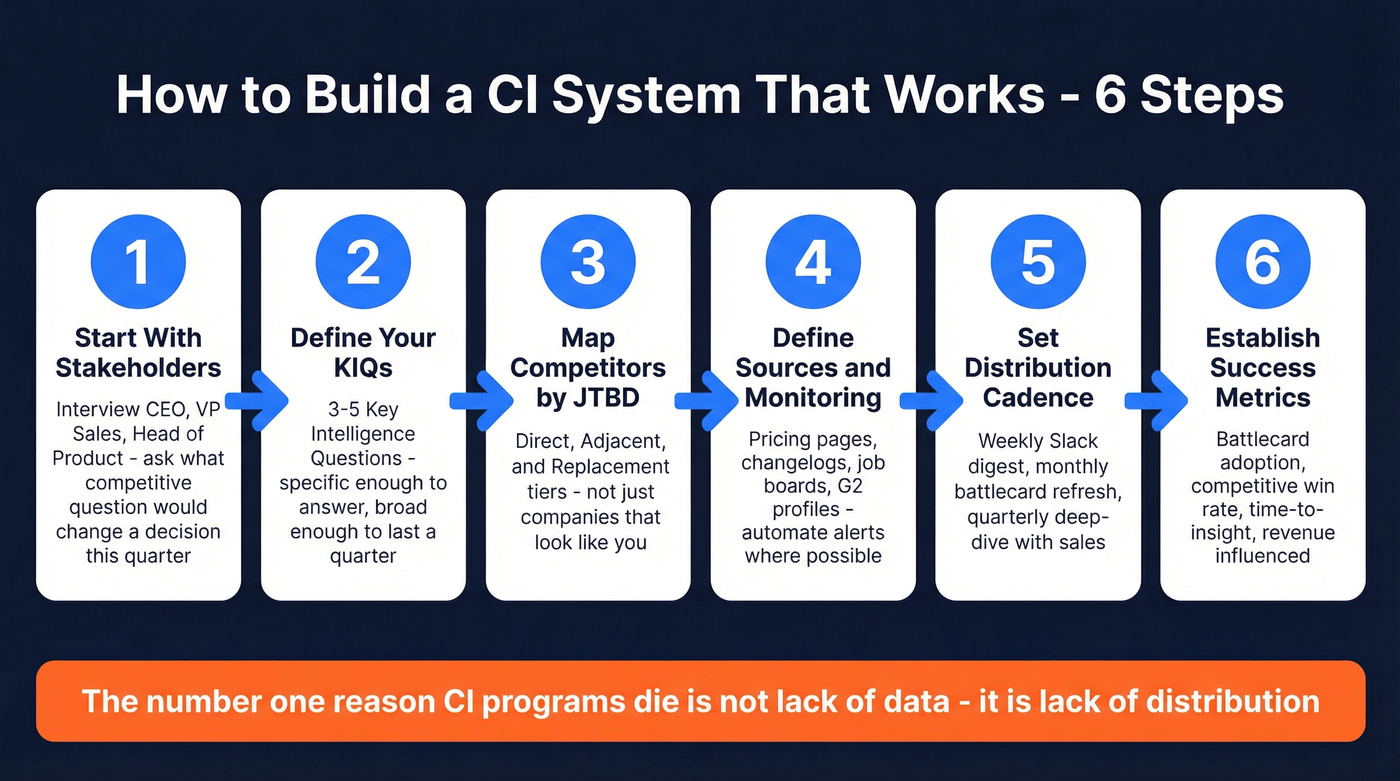
Step 3: Map Competitors by JTBD
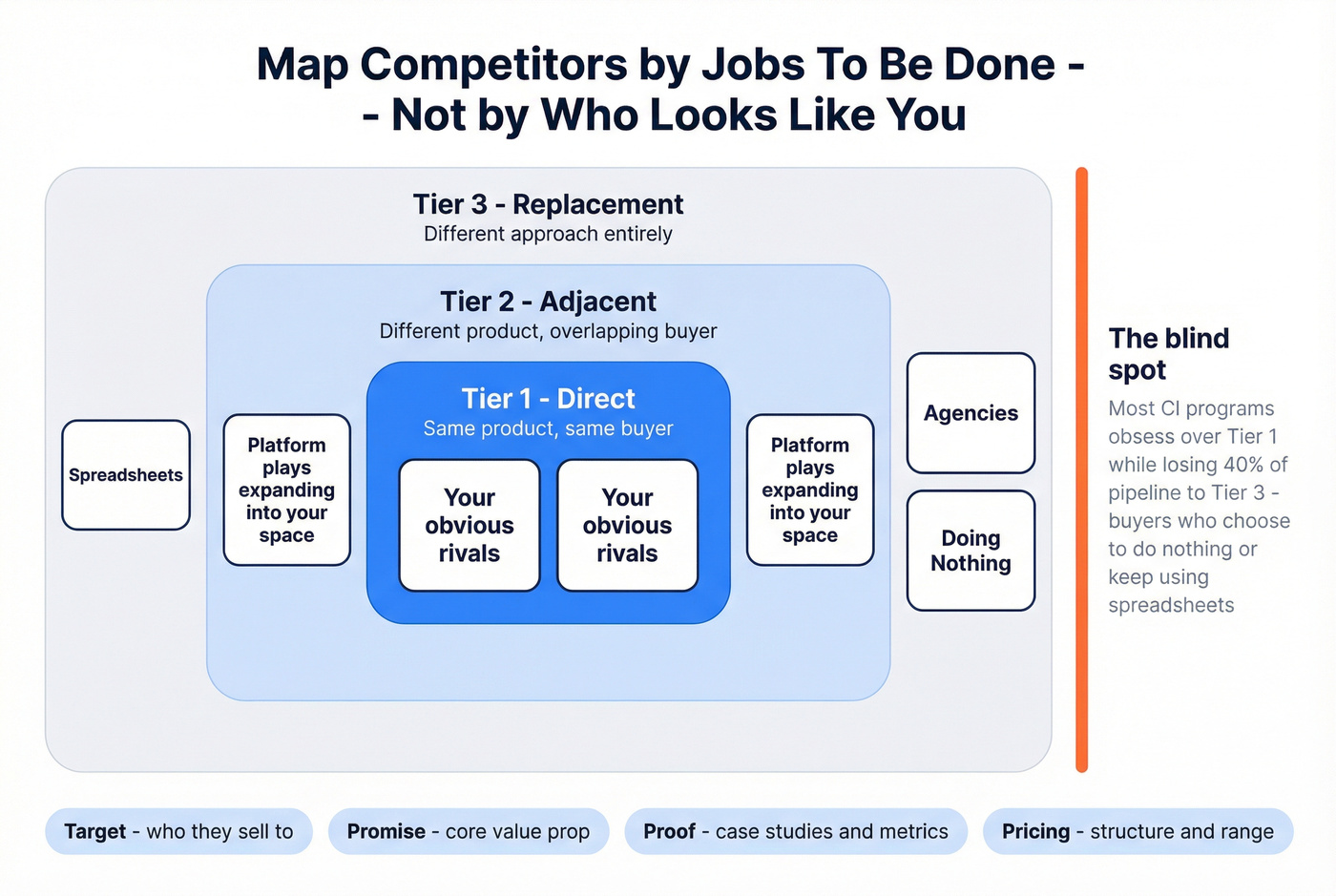
Stop thinking about competitors as "companies that look like us." Think about them as anything that solves the same job your buyer is hiring you for. This gives you three tiers:
| Tier | Definition | Example |
|---|---|---|
| Direct | Same product, same buyer | Your obvious competitors |
| Adjacent | Different product, overlapping buyer | Platform plays expanding into your space |
| Replacement | Different approach entirely | Spreadsheets, agencies, doing nothing |
Most CI programs over-index on direct competitors and completely miss the replacement alternatives. We've seen teams obsess over a feature-for-feature rival while losing 40% of their pipeline to "we'll just keep using spreadsheets."
For each competitor that makes the cut, capture four things:
| Field | What to Capture | Example |
|---|---|---|
| Target | Who they sell to | Mid-market SaaS, 50-500 employees |
| Promise | Core value prop | "All-in-one revenue platform" |
| Proof | Case studies, metrics cited | "3x pipeline in 90 days" |
| Pricing | Structure and range | $25K-$80K/yr, per-seat, annual only |
This reveals white space fast - where competitors cluster and where nobody's competing.
Step 4: Define Sources and Monitoring
For each KIQ, map the specific sources you'll monitor. Don't try to watch everything. A competitor's pricing page, changelog, job board, and G2 profile cover most of what revenue teams care about. Set up automated alerts where possible and assign a human review cadence for the rest.
Step 5: Set a Distribution Cadence
Let's be honest: the #1 reason CI programs die isn't lack of data - it's lack of distribution. In PMM communities, the most common complaint isn't "we don't have tools." It's "our insights never reach the people closing deals."
Weekly Slack digest - three to five bullet points on competitor moves, delivered Monday morning before pipeline reviews.
Monthly battlecard refresh - even if nothing major changed, update the "last reviewed" date so reps trust the content.
Quarterly deep-dive - a 30-minute session with sales leadership covering strategic shifts and emerging threats.
If your battlecards were last updated in Q1 and it's Q3, your reps have already stopped reading them.
Step 6: Establish Success Metrics
Before you launch, define how you'll measure the program. At minimum, track battlecard adoption rate, competitive win rate, and sales cycle length on competitive deals. Tag CRM opportunities as "competitive" from day one - you'll need the baseline data when it's time to prove ROI. (If you want a deeper framework, start with competitive win rate and how to operationalize it.)

Your CI program found that a competitor's customers are unhappy. Now what? Prospeo turns competitive insights into pipeline with 143M+ verified emails, intent data tracking 15,000 topics, and a 7-day refresh cycle - so you reach the right buyers before your competitor fixes the problem.
Stop collecting intelligence you can't act on.
Your CI Tech Stack
You don't need a $10k-$60k/year CI platform to start. You need a stack that covers four stages: Discovery, Analysis, Visualization, and Action. The Valona intelligence stack model frames this well, and analyst coverage - including Forrester Wave Q4 2024 and Gartner's 2024 Market Guide - reinforces that no single tool covers everything.
| Stack Stage | What It Does | Tool Examples | Price Range |
|---|---|---|---|
| Discovery | Monitors competitor activity | Semrush, Crayon, Google Alerts | Free-$500/mo |
| Analysis | Structures and interprets data | Klue, AlphaSense, Contify | $800-$8K+/mo |
| Visualization | Makes insights consumable | Notion, Klue battlecards | Free-included |
| Action | Turns insights into outreach | Prospeo, Outreach, HubSpot | Free-$150+/mo |
Starter kit for teams with no budget: Google Alerts (free) + Semrush's free tier + a Notion database. This gets you basic monitoring, SEO competitive data, and a structured place to store insights. You can run a functional CI program on this for months. When you're ready to upgrade, Semrush's paid plans run around $140-$500/month and unlock deeper competitive research.
For teams ready to invest: Tools like Klue and Crayon typically land in the $10k-$60k/year range depending on seats and scope, with larger deployments reaching $75k-$250k+/year. Contify and Valona are common options in this category too. AlphaSense is an enterprise-grade research platform used for deep financial, market, and expert research.
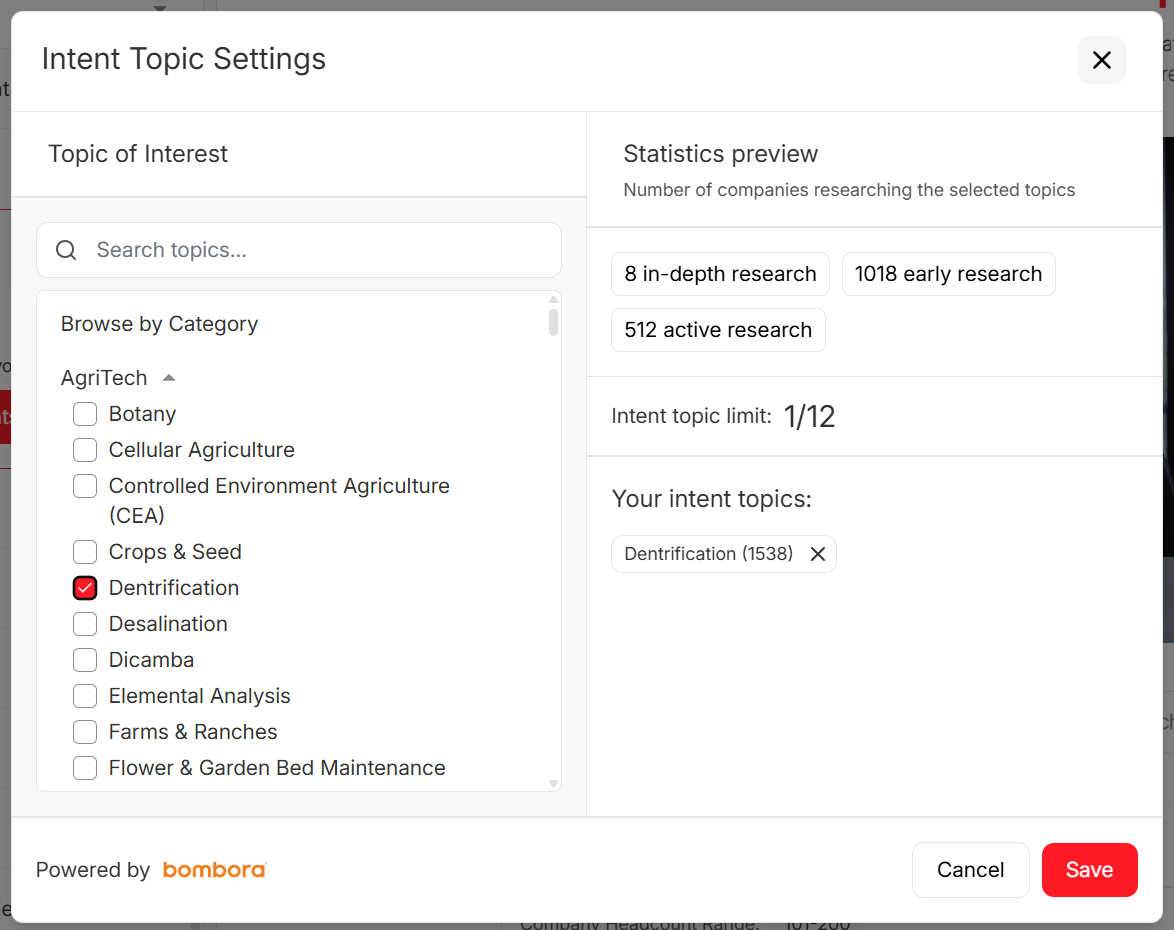
The execution layer most teams miss: Competitive intelligence without execution is trivia. You know a competitor is vulnerable in mid-market fintech - now what? This is where the action layer of your stack earns its keep. Prospeo's B2B database covers 300M+ profiles with 98% email accuracy and a 7-day refresh cycle, and you can layer in intent data across 15,000 Bombora topics to prioritize accounts actively researching your category. The free tier starts at 75 emails per month, and paid plans run from ~$39/mo - a fraction of what you'd spend on a dedicated CI platform.
Ethical CI: The Traffic Light Framework
Ethics isn't optional in competitive intelligence - it's a competitive advantage. One misstep can destroy trust and create legal exposure that dwarfs any intelligence value.
The Traffic Light Framework makes this simple:
| Status | Methods | Examples |
|---|---|---|
| 🟢 Green | Public, freely available | Pricing pages, G2 reviews, job postings, press releases, public webinars |
| 🟡 Yellow | Proceed with legal review | Former employee feedback, private communities, customer intel near NDA boundaries |
| 🔴 Red | Unethical or illegal - never | Impersonating prospects, leaked docs, paying for insider info, encouraging NDA violations |
The FAIR model from SCIP offers another lens - Findable, Accessible, Interpretable, Reproducible - though the Traffic Light Framework is more immediately actionable for most teams.
Every CI program should also have a Competitive Intelligence Charter: a document with legal sign-off that covers Objectives, Scope, Methods, Roles, and Escalation. It doesn't need to be 20 pages. A one-pager that answers "what are we allowed to do, who's responsible, and what happens when something's ambiguous?" is enough. Build this before you need it, not after someone crosses a line.
Seven Mistakes That Kill CI Programs
You're probably making at least two of these.
1. Gathering data without KIQs. Without Key Intelligence Questions, you'll collect everything and analyze nothing. Information overload is the #1 reason CI programs stall.
2. Monitoring 50 competitors instead of five. Three to five direct competitors and one to two adjacent threats is the right scope. Anything beyond that creates noise that drowns out signal.
3. Over-indexing on price. Tracking competitor pricing is important. Making it the centerpiece of your CI program drives discounting behavior and margin erosion. Price is one data point in a broader value equation.
4. Ignoring competitor audience analysis. You know what competitors charge and what they build. Do you know who their customers actually are and why they buy? Reviews and win/loss interviews are the starting point most teams skip.
5. Quarterly battlecard updates. Battlecards go stale within 30 days. Quarterly refreshes guarantee your reps work with outdated information for 60+ days per cycle. Monthly is the minimum.
6. Keeping CI siloed in product marketing. Product marketing owns CI, but sales, product, and leadership all consume it. If insights don't flow to the people making decisions, you've built a library nobody visits.
7. Not measuring ROI. If you can't tie CI to revenue, you'll lose headcount at the next budget review. Companies lose $2-$10 million from inadequate CI, but you need to prove the inverse - that your program is preventing those losses.
Here's the thing: if your average deal size is under $15K, you probably don't need a $10k-$60k/year CI platform. A disciplined process with free tools will outperform an expensive platform that nobody uses. The bottleneck is almost never the tooling - it's the distribution and adoption. Skip the enterprise CI software until you've proven the process works with what you've got.
Measuring CI ROI
The hardest part of running a CI program isn't gathering intelligence - it's proving it matters. Here are the benchmark ranges that mature programs report, based on SCIP research:
| Metric | Benchmark Range |
|---|---|
| Win rate improvement | 8-18% |
| Sales cycle reduction | 15-25% |
| Market share gains | 0.5-2.3% annually |
| Pricing optimization | 3-15% revenue increase |
| CI-informed market entries | 67% higher success rate |
| R&D cycle time reduction | 15-25% |
| Competitive win rate lift (with automation) | 30-40% |
| Manual research time saved | 85-95% with automation |
The simplest place to start: tag CRM deals as "competitive" and compare win rates before and after CI enablement. If your competitive win rate moves from 35% to 45%, you can calculate the revenue impact directly. (To make this measurable, align on CRM lead source tracking and consistent opportunity tagging.)
Organizations with mature CI measurement frameworks see 3.2x higher investment in their CI programs. Proving ROI doesn't just justify your budget - it grows it.
AI and Insights-Driven Selling in 2026
The manual CI process - scanning websites, reading press releases, updating spreadsheets - is being automated away. AI hasn't replaced CI analysts, but it's eliminated the excuse for not having a CI program.
AlphaSense now indexes 10,000+ external data sources and 175,000+ expert call transcripts across 35,000+ companies. Their generative AI features - Smart Summaries, generative search with source citations - compress what used to take a junior analyst a full day into minutes. The 6-9 week lag from competitor move to rep knowledge? Real-time monitoring tools have collapsed that to days.
What's changed most in 2026 isn't the tools - it's the accessibility. A solo product marketer can now run a functional CI operation that would've required a three-person team five years ago. Automated monitoring catches competitor changes. AI summarizes the signal. Intent data tells you which accounts to prioritize. Verified contact data lets you act immediately.
The teams winning right now aren't the ones with the biggest CI budgets. They're the ones who've connected the intelligence loop end-to-end: from competitive insights to prioritization to execution, without a handoff gap in between. That's the shift from passive research to insights-driven selling - where every rep walks into a call armed with a buyer information advantage that the other vendor can't match. (If you want to operationalize this, build a signal-based outbound motion around those triggers.)
Your reps waste 8-12 hours monthly on ad-hoc competitor research with stale data. Prospeo's intent signals show which accounts are actively evaluating your competitors right now - paired with 98% accurate emails and 125M+ verified mobiles so reps spend time selling, not searching.
Intercept competitor deals instead of reacting to them.
FAQ
What's the difference between competitive intelligence and competitive analysis?
Competitive intelligence is the ongoing process of gathering, analyzing, and distributing actionable insights about competitors and the market. Competitive analysis is a point-in-time exercise - a SWOT, a feature comparison, a pricing teardown. Intelligence is a program; analysis is a deliverable within it.
How many competitors should I track?
Three to five direct competitors and one to two adjacent threats. Going wider creates information overload without proportional value. Use the Jobs-to-Be-Done framework to identify which competitors actually matter to your buyers - not just the ones your CEO mentions in all-hands meetings.
How often should battlecards be updated?
Monthly at minimum. Battlecards go stale within 30 days, and fewer than 30% of reps access them regularly. Automated monitoring tools can flag competitor changes in real time, making monthly refreshes manageable even for one-person CI operations.
How do you measure CI ROI?
Tag CRM deals as "competitive" and compare win rates before and after CI enablement. Mature programs report 8-18% win rate improvement and 15-25% shorter sales cycles. That single before-and-after metric can justify your entire program budget.
What free tools can I use to act on competitor intelligence?
Google Alerts and Semrush's free tier handle monitoring. For execution, Prospeo's free plan includes 75 verified emails per month with intent data filters - enough to start targeting accounts where a competitor is vulnerable. Pair that with a Notion database for organizing findings and you've got a functional CI-to-outreach workflow at zero cost.