How to Identify Anonymous Website Visitors - and Actually Do Something With the Data
12,000 visitors hit your site last month. 47 filled out a form. That's a 0.39% conversion rate, and the other 11,953 are ghosts - gone before you ever knew they existed.
The visitor identification market was valued at $3.55B in 2024 and is projected to hit $9.99B by 2032, growing at a 12.4% CAGR. The reason is simple: 97% of B2B website visitors leave without identifying themselves, and every one of them represents pipeline you're leaving on the table. Knowing how to identify anonymous website visitors isn't a nice-to-have anymore. It's table stakes.
The Quick Version
The workflow is straightforward: identify the company visiting your site, enrich that company into actual contacts with verified emails and phones, then route those contacts into outreach sequences. Pick your tier by budget:
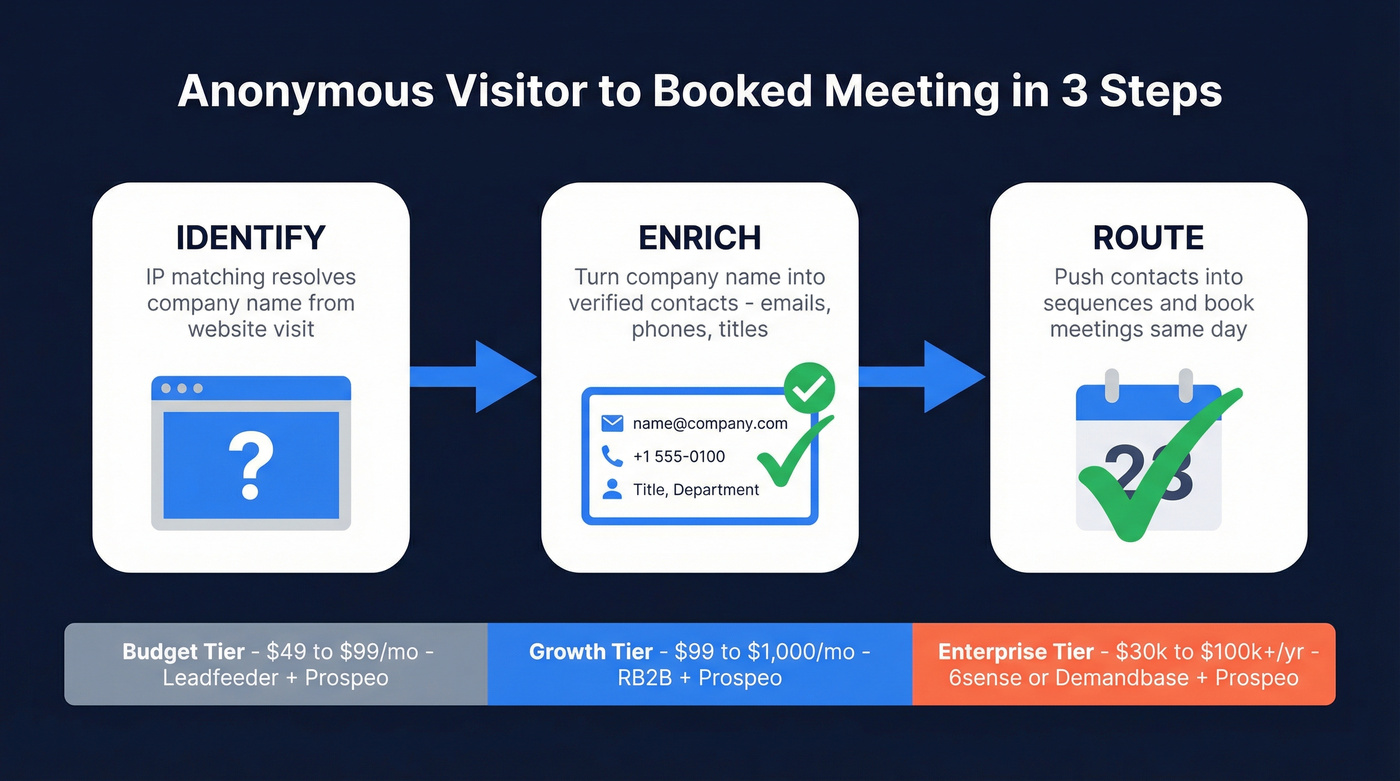
- Enterprise, ~$30-100k+/year - 6sense or Demandbase for account-level identification and intent, plus Prospeo's API for contact enrichment at scale
How Visitor Identification Actually Works
Every device that loads your website sends an IP address. Visitor identification tools take that IP and match it against databases compiled from registries like ARIN and RIPE, ISP allocation records, and business network registrations. When someone visits from a corporate network with a static IP, the tool resolves that IP to a company name and pulls firmographic data - industry, headcount, revenue, location.
That's company-level identification. You learn "someone from Acme Corp visited your pricing page," but not who.
Person-level identification goes further, using identity graphs that stitch together device fingerprints, browser signals, and email-to-device mappings to resolve an individual. It's more powerful but also more invasive, more expensive, and faces heavier regulatory scrutiny. Company-level is safer and cheaper. Person-level gives you names but tends to be geographically limited - tools like RB2B are US-focused.
What Accuracy to Realistically Expect
Here's the thing most guides skip: match rates depend almost entirely on your visitors' network types.
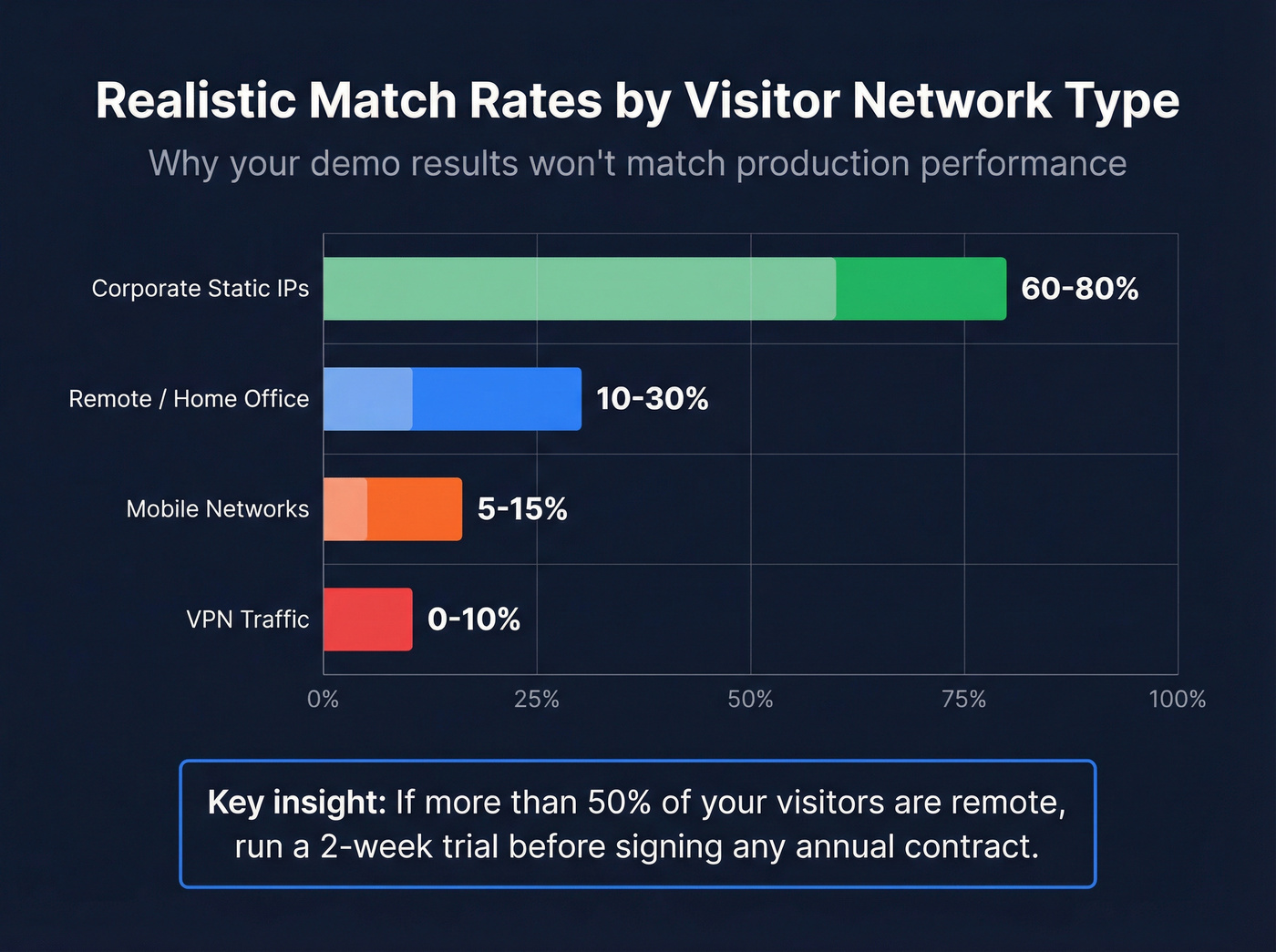
| Network Type | Expected Match Rate |
|---|---|
| Corporate static IPs | 60-80% |
| Remote / home office | 10-30% |
| Mobile networks | 5-15% |
| VPN traffic | 0-10% |
If your buyers are enterprise IT teams working from corporate offices, you'll see strong identification rates. If they're startup founders working from coffee shops on mobile hotspots, your tool will miss most of them.
The vendor accuracy gap makes this worse. An industry accuracy audit found that two out of three providers tested were 70-95% inaccurate, with legacy vendors averaging just 5-30% true accuracy. Top performers hit 65-85%. The variance is enormous.
We've heard the same frustration from B2B marketing teams over and over: match rates crater once your audience goes remote. The tools look great in demos - corporate IP traffic, clean matches - but underperform in production with mixed traffic. In our experience, teams with more than 50% remote visitors should budget for a 2-week trial before committing to any annual contract. Ask your vendor what their match rate is for remote workers specifically. If they dodge the question, you have your answer.

Visitor ID tools tell you Acme Corp visited your pricing page. Prospeo tells you the VP of Engineering's verified email and direct dial. Enrich any company into actionable contacts with 98% email accuracy and 125M+ verified mobiles - at $0.01 per email.
Stop watching anonymous traffic. Start booking meetings with the people behind it.
Visitor Identification Tools - Pricing Compared
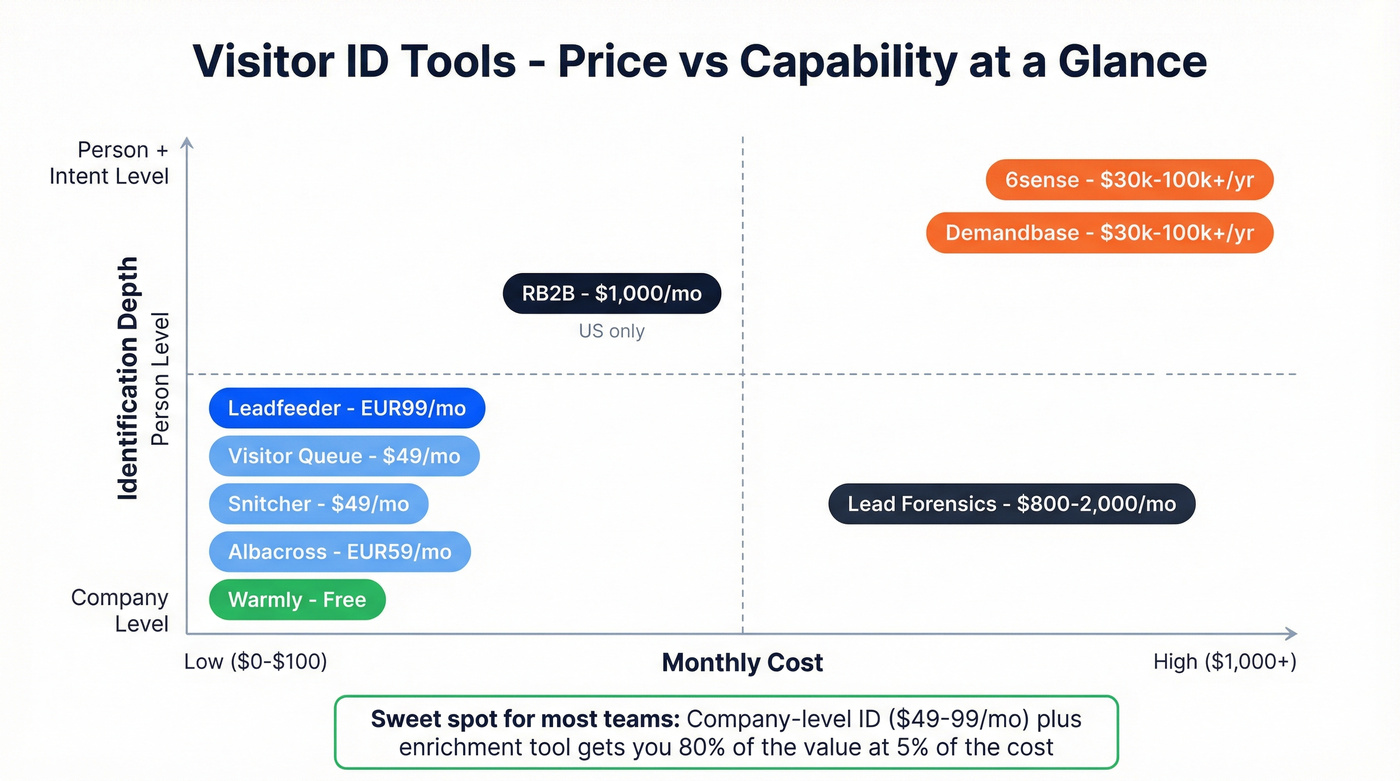
| Tool | ID Level | Starting Price | Best For |
|---|---|---|---|
| Leadfeeder (Dealfront) | Company | Free; paid from EUR99/mo | Default starting point, works globally |
| RB2B | Person (US-focused) | Free tier; $1,000/mo paid | US-only teams that need individual names |
| Visitor Queue | Company | $49/mo | Solo founders and low-traffic sites |
| Snitcher | Company | $49/mo | EU-based teams needing GDPR-safe defaults |
| Albacross | Company | EUR59/mo (annual) | European mid-market with ad retargeting needs |
| Warmly | Company | Free plan available | Early-stage testing before committing budget |
| 6sense | Account + Intent | ~$30-100k+/yr | Enterprise Salesforce ABM workflows |
| Demandbase | Account + Intent | ~$30-100k+/yr | Enterprise ad retargeting and ABM |
| Lead Forensics | Company | Custom (~$800-2,000/mo) | High-volume B2B sites needing dedicated support |
Leadfeeder: The Default Starting Point
For most teams, start here. The free tier lets you validate the concept before spending anything, it works globally, and the custom feeds and filtering by behavior, acquisition source, and company size give you enough segmentation to route leads intelligently. At EUR99/mo for paid, it's hard to argue against at least testing it. We've run Leadfeeder alongside RB2B on the same site - the company-level data was more actionable for outbound because we could enrich it into verified contacts immediately rather than waiting on person-level matches that only covered US traffic.
RB2B: Skip If / Buy If
Skip if your traffic is primarily non-US or you sell into European markets. GDPR compliance is a real concern and the tool is US-focused. Buy if you're a US-focused team with high-intent traffic and the $1,000/mo price tag - about 10x Leadfeeder's cost - fits your budget. Person-level identification sounds like magic, and for the right use case it delivers. For everyone else, company-level ID plus enrichment gets you to the same place for less money.
Budget Options: $49-59/mo
Visitor Queue, Snitcher, and Albacross are solid picks in this range - choose based on geography. Snitcher and Albacross lean European with stronger GDPR defaults. Visitor Queue is the simplest setup for low-traffic sites. Warmly's free plan works for early-stage testing but lacks the depth you'll need once you're ready to operationalize.
Enterprise: 6sense and Demandbase
These are ABM platforms that happen to include visitor identification. If you're already running one for intent and account scoring, use the visitor ID feature. Don't buy a $50k+ platform just for visitor identification - that's like buying a Tesla to use the cup holders.
Our take: Most teams with deal sizes under $15k don't need person-level identification or enterprise ABM platforms. Company-level ID at $49-99/mo, paired with a good data enrichment tool, will get you 80% of the value at 5% of the cost. The bottleneck is never identification - it's what you do with the data afterward.
From Company Name to Booked Meeting
The most common complaint from teams that deploy visitor ID tools: the data looks great in week one when you're watching it, and useless by month three when nobody's routing it to SDRs. Identification was never the hard part. Turning "Acme Corp visited your pricing page" into a meeting on the calendar - that's where things break down. Without a system to act on the anonymous traffic you surface, the data just sits there.
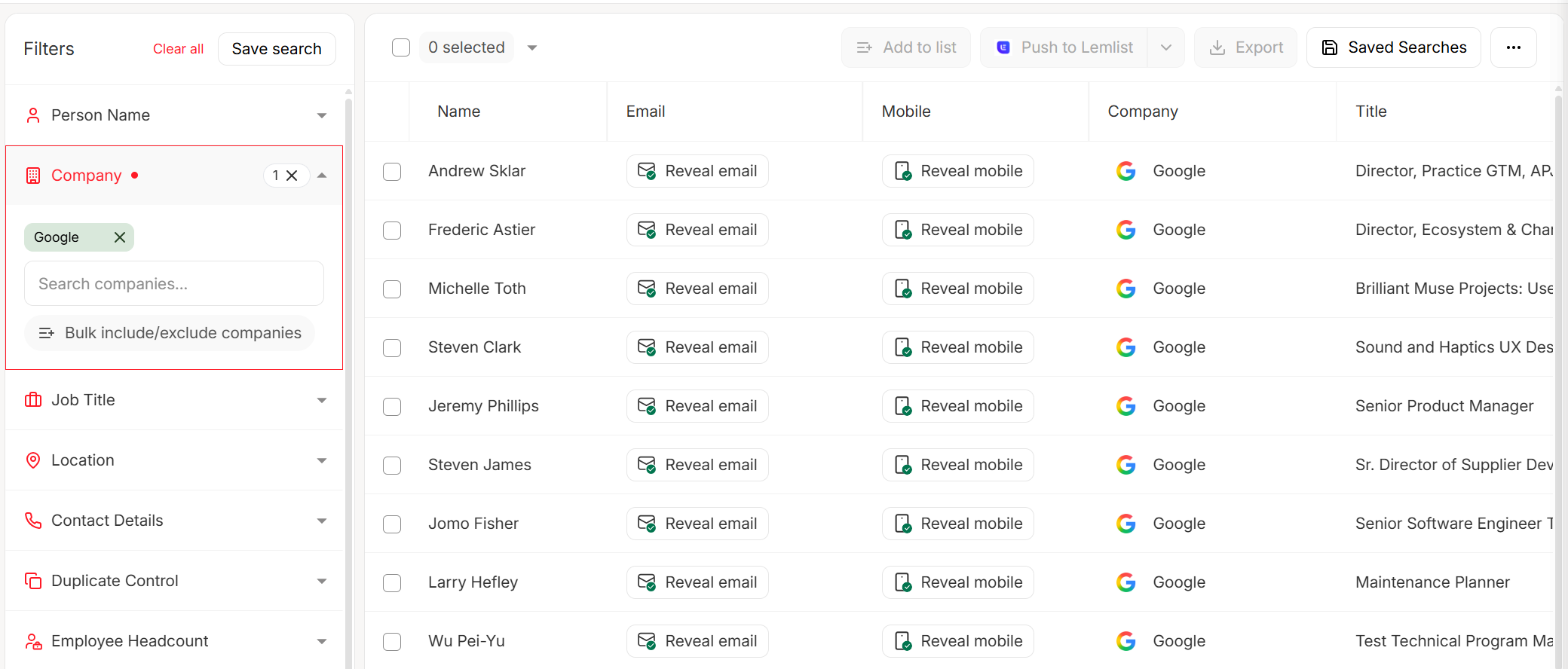
That's where enrichment changes the equation. Prospeo lets you search by company name across 300M+ professional profiles, filter by title and department using 30+ search filters, and export verified contacts with 98% email accuracy and 125M+ verified mobile numbers. Data refreshes every 7 days - not the 6-week industry average - so you're not reaching out to someone who changed jobs last month.
The workflow becomes: visitor ID tool flags Acme Corp -> Prospeo search returns 3 verified decision-maker contacts -> contacts push directly into Lemlist, Instantly, or your CRM -> SDR sends a personalized sequence referencing the pricing page visit. Same-day turnaround from anonymous visit to booked meeting.
Match rates crater with remote traffic, but your enrichment doesn't have to. Prospeo's 300M+ profile database with 7-day refresh turns company-level visitor data into verified contacts - names, emails, phones, 50+ data points - regardless of how the visitor connected.
Turn every identified company into a pipeline opportunity in under 60 seconds.
3-Month Rollout Plan
Don't try to boil the ocean. We've seen teams install a visitor ID pixel site-wide, get flooded with 5,000 company names in week one, and do absolutely nothing with the data. Start small.
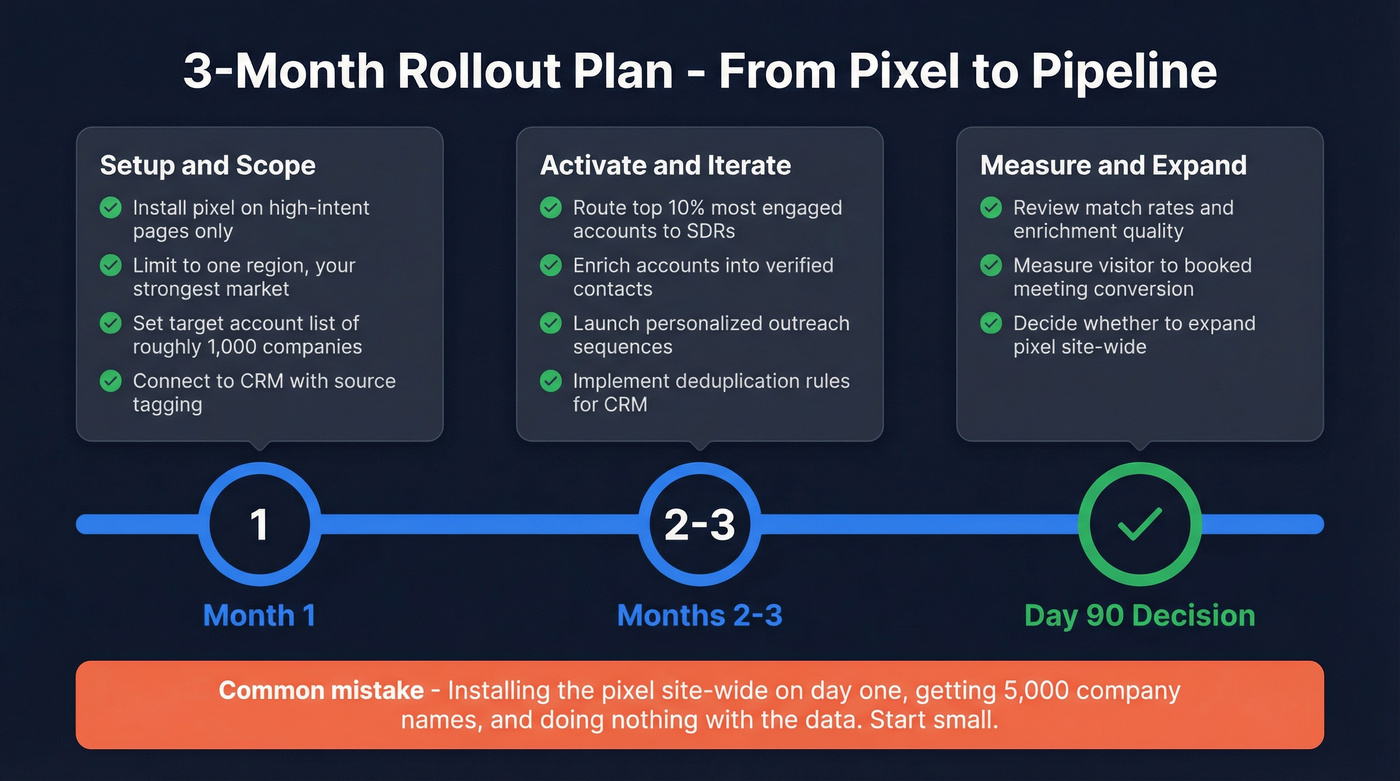
Month 1: Setup and Scope
Install the tracking pixel on high-intent pages only - pricing, demo request, case studies, comparison pages. Limit to one region, starting with your strongest market. Set a target account list of roughly 1,000 companies you'd actually want to sell to, and connect your visitor ID tool to your CRM with proper source tagging so you can measure ROI cleanly.
Months 2-3: Activate and Iterate
Route the top 10% most engaged accounts - roughly 100 companies showing repeat visits or multi-page sessions - to SDRs. Enrich those accounts into verified contacts and launch personalized outreach sequences. Implement deduplication rules so visitor ID data doesn't create duplicate CRM records. If an account already has an assigned AE, route to them instead. Nothing kills a deal faster than an SDR cold-calling an account that's already mid-pipeline with a different rep.
After 90 days, you'll have real data on match rates, enrichment quality, and conversion from identified visitor to booked meeting. That's when you decide whether to expand the pixel site-wide.
Compliance Checklist
If you're using tracking pixels or cookies for visitor identification, cookie consent requirements under GDPR mandate explicit opt-in before those scripts fire. The minimum you need:
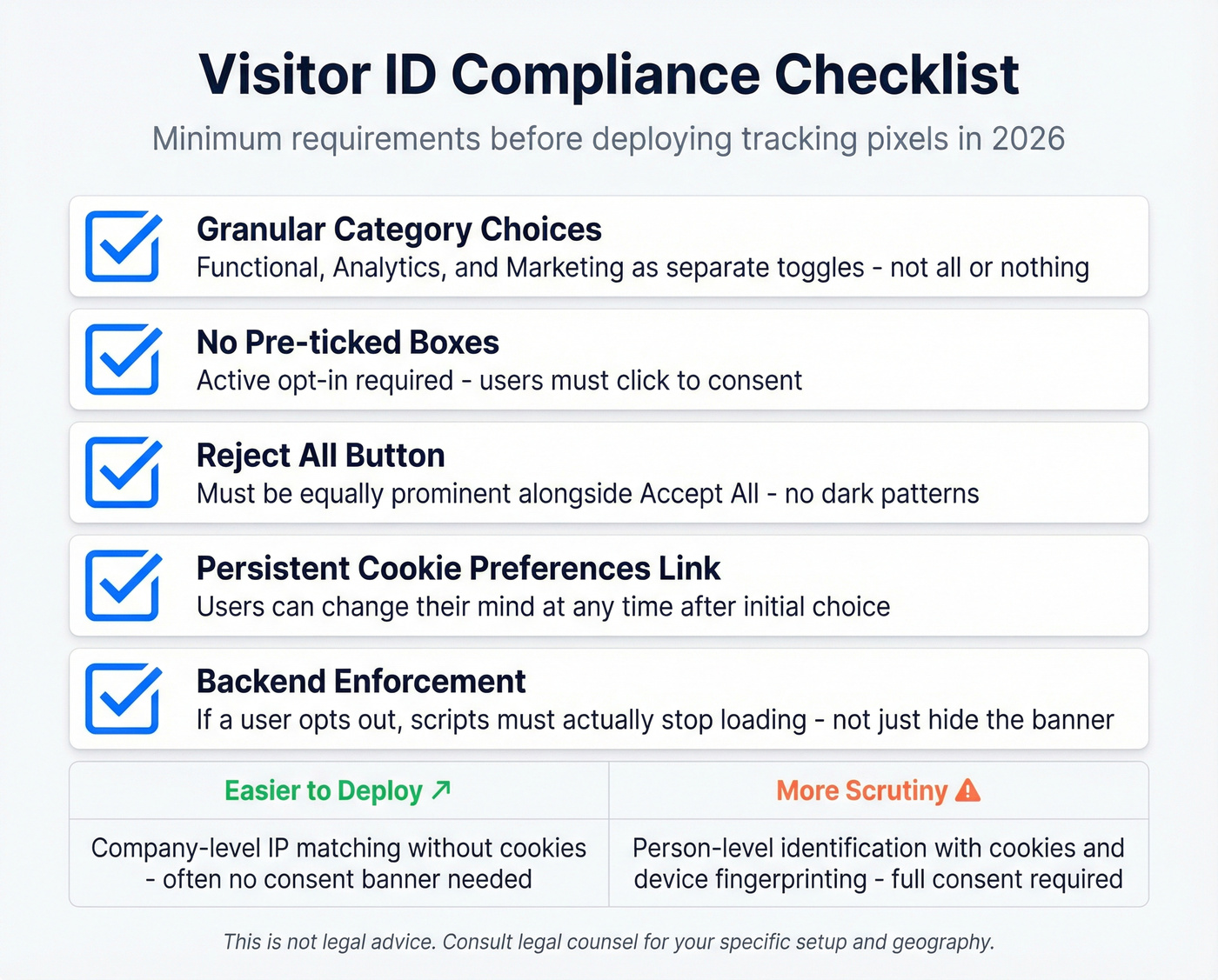
- Granular category choices - Functional, Analytics, Marketing as separate toggles, not all-or-nothing
- No pre-ticked boxes - active opt-in required
- A Reject All button alongside Accept All
- A persistent Cookie Preferences link so users can change their mind later
- Backend enforcement - if a user opts out, those scripts must actually stop loading
Company-level IP matching without cookies is often easier to deploy than cookie-based tracking. Person-level identification faces more scrutiny. When in doubt, consult legal counsel for your specific setup and geography rather than relying on vendor assurances.
FAQ
Can I identify individual people visiting my website?
Person-level tools like RB2B can resolve individual visitors but are US-focused and face regulatory scrutiny in Europe. For most B2B teams, the better path is pairing a company-level visitor ID tool with an enrichment platform to find verified emails and direct dials for decision-makers at identified companies.
How accurate are visitor identification tools?
Corporate IPs yield 60-80% match rates, but remote workers drop to 10-30% and VPN traffic is nearly invisible. An industry audit found legacy vendors averaged just 5-30% true accuracy while top performers hit 65-85%. Always run a paid trial before committing to an annual contract.
Do I need cookie consent for visitor identification?
Yes, if you use tracking pixels or cookies - GDPR requires explicit opt-in before non-essential cookies fire. IP-based company matching without cookies is often easier to deploy and avoids most consent requirements. Get legal advice for your specific setup.
What's the best way to turn anonymous web traffic into B2B pipeline?
Start with a company-level identification tool like Leadfeeder or Snitcher on your highest-intent pages, then enrich identified companies into verified decision-maker contacts. Route those contacts into outreach sequences the same day - speed matters more than volume when converting anonymous visits into meetings.