

Email Sequences: What Actually Works in 2026 (Based on 500K Sends and 183K Brands)
A RevOps lead we know ran a 5-email cold sequence to 2,000 prospects last quarter. By email four, his domain reputation was in the gutter - bounces hit 14%, spam complaints spiked, and Google started routing his team's regular business emails to junk. He didn't have a copy problem. He had a data problem, a sequence length problem, and a deliverability problem all at once.
Here's how to avoid making the same mistakes.
The Short Version
- Automated sequences crush one-off campaigns. Across 183,000+ brands, behavior-triggered flows get 3.3x the click rate and roughly 13.2x the placed-order rate vs. batch campaigns. If you're still batch-sending, stop.
- For cold outreach, shorter wins. 2-step sequences outperformed 5-step by ~50% across 12 campaigns. Verify your list first - 15% bounces can kill a domain in 30 days.
- For marketing, master three sequences before adding complexity. Welcome, abandoned cart, and one nurture flow. Get those right, then expand.
What Is an Email Sequence?
An email sequence is a series of pre-written emails sent automatically based on a trigger - someone signs up, abandons a cart, downloads a resource, or matches a time-based schedule. The trigger is what separates a sequence from a newsletter blast. Newsletters go to everyone on a list at the same time. Sequences respond to individual behavior.
You'll hear "sequence" and "drip campaign" used interchangeably. The practical difference: sequences are usually trigger-based (a user does something, emails fire), while drip campaigns are time-based (every subscriber gets email #1 on Day 0, email #2 on Day 3, regardless of behavior). Most modern tools blend both approaches, so the distinction matters less than the underlying logic of your automation.
The performance gap between automated sequences and one-off campaigns is massive. Klaviyo's 2026 benchmark data across 183,000+ brands shows automated flows averaging a 5.58% click rate and 2.11% placed-order rate - compared to 1.69% click and 0.16% placed-order for campaigns. That's not a marginal improvement. It's a fundamentally different approach to the same channel.
2026 Benchmarks: What Good Looks Like
Let's ground this in real numbers.
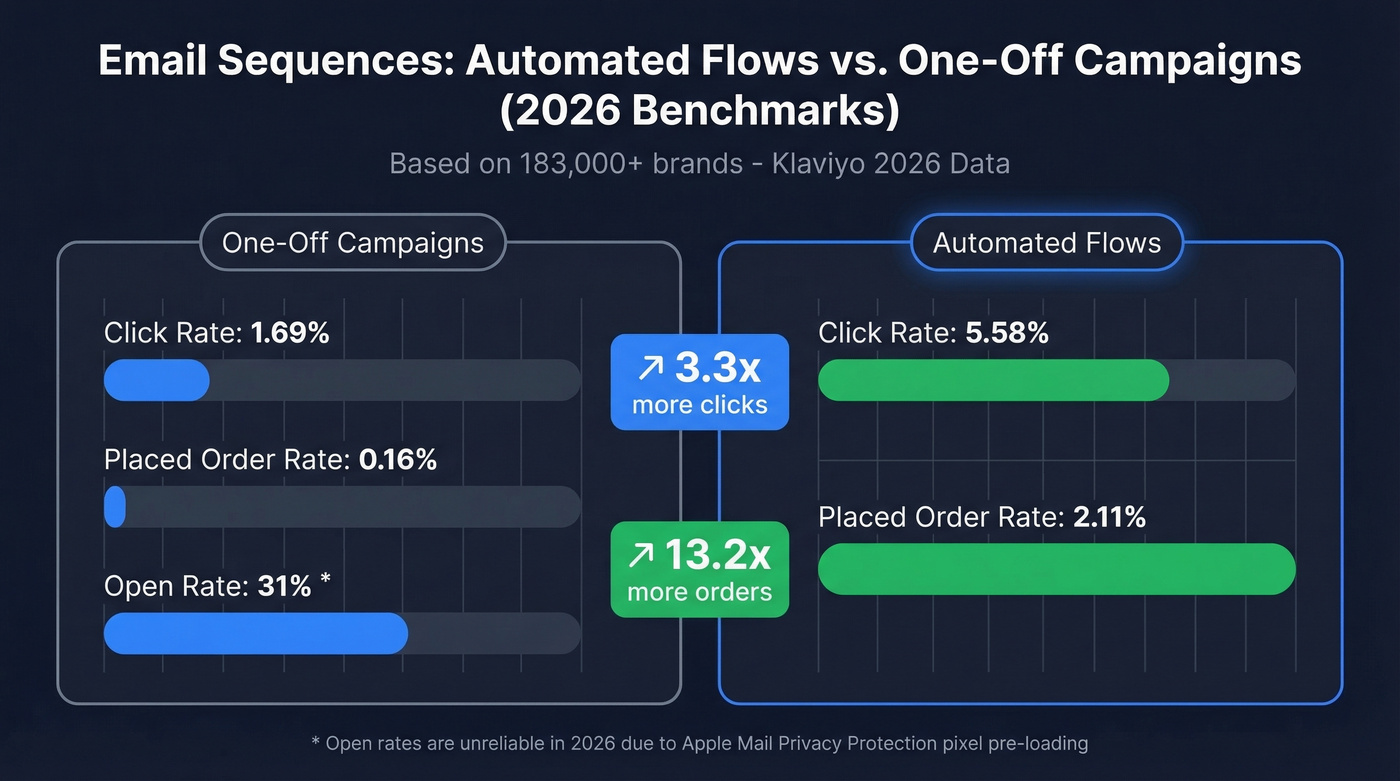
Campaigns (One-Off)
| Metric | Average | Top 10% |
|---|---|---|
| Open Rate | 31% | 45.1% |
| Click Rate | 1.69% | 3.38% |
| Placed Order Rate | 0.16% | 0.36% |
Automated Flows
| Metric | Average | Top 10% |
|---|---|---|
| Click Rate | 5.58% | 10.48% |
| Placed Order Rate | 2.11% | 4.3% |
Open rates are directional at best in 2026. Apple's Mail Privacy Protection inflates them by pre-loading tracking pixels, so a reported 31% open rate could really be 20% or 40%. Don't optimize around opens. Track clicks for marketing sequences and replies for cold outreach.
For cold email specifically, a 2-4% reply rate at scale is solid. Anyone consistently claiming double-digit reply rates is working tiny samples or cherry-picking campaigns. Directional CTR data from Enflow puts welcome sequences at 4.9% and abandoned cart at 6.3%, both well above generic promotional blasts at 2.4%.
Here's the thing: the gap between average and top 10% is enormous. Top-decile automated flows convert at 4.3% placed-order rate - that's roughly 27x the campaign average. The difference isn't magic copy. It's targeting, timing, and data quality.
Core Sequence Types (With Templates)
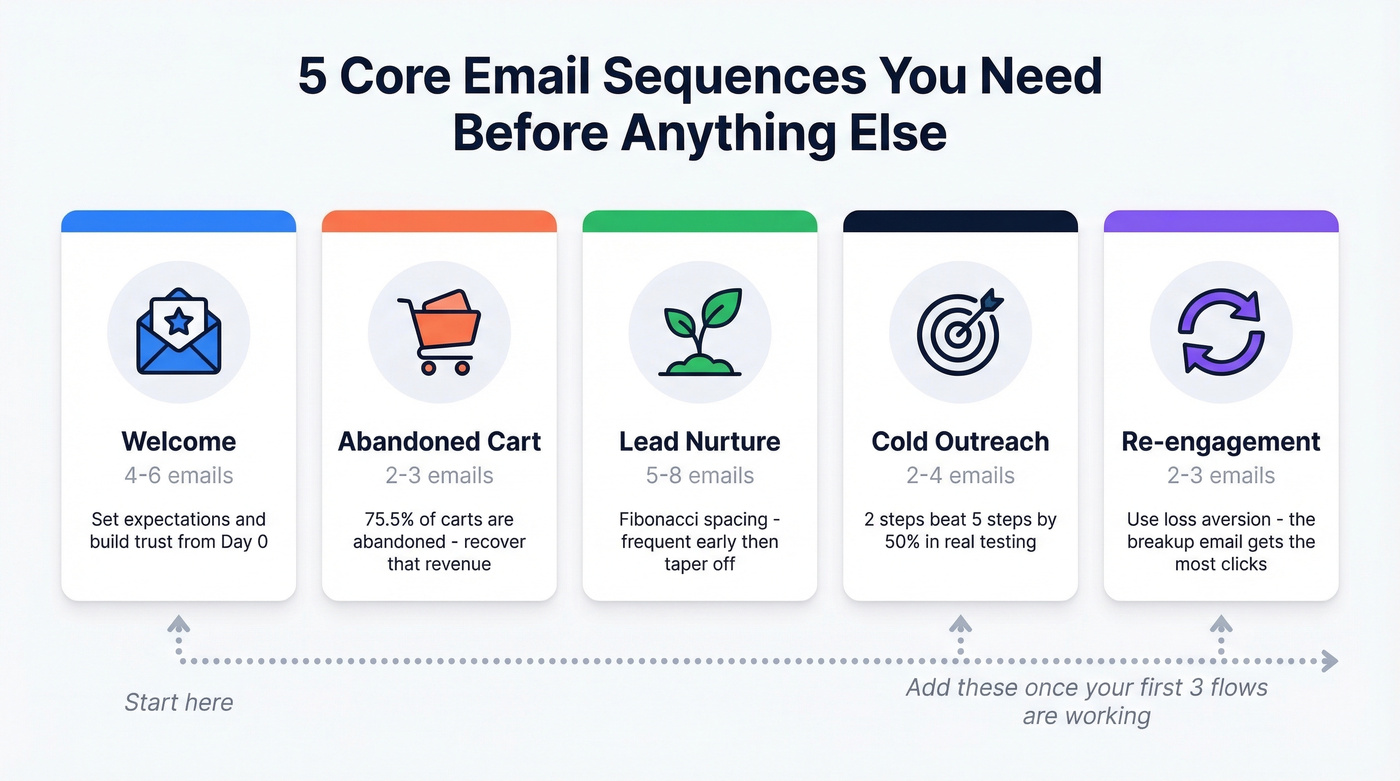
You don't need 13 types. Master these core flows first, then add complexity only when data supports it.
Welcome Sequence
Four to six emails, triggered immediately on signup. 74.4% of subscribers expect a welcome email - if you're not sending one, you're wasting your highest-engagement window.
Val Geisler's Dinner Party framework is the cleanest structure we've seen. Email 1 welcomes and sets expectations - what they'll get and how often. Email 2 establishes your expertise. Email 3 teaches something genuinely useful. Email 4 asks them to self-segment by topic interest. Space these 1-2 days apart early, then stretch to 3-4 days for emails 5-6 if you extend the series.
AI send-time optimization is a legitimate use here. Tools like ActiveCampaign and Klaviyo can analyze subscriber behavior and deliver each welcome email when that specific person is most likely to engage - a small edge that compounds across a 4-6 email series.
Template - Welcome Email #1:
Subject: You're in - here's what happens next
Hey [First Name],
Welcome to [Brand]. Every Tuesday, you'll get one actionable [topic] tip - no fluff, no pitches.
To kick things off, here's the resource that 4,000+ subscribers have bookmarked: [Link to best-performing asset].
Talk soon, [Your name]
Abandoned Cart
Two to three emails. Timing matters more than copy here.
Send email 1 at the 1-hour mark - a friendly reminder with a link back to the cart. Email 2 goes out at 24 hours and adds social proof or addresses common objections. Email 3 at 72 hours can include a small incentive if margins allow. The numbers justify the effort: 75.5% of carts are abandoned, abandoned cart emails average 46.1% open rates and 13.3% click rates, and 35%+ of clickers complete the purchase. If you're running an ecommerce store and don't have this flow set up, you're leaving real money on the table.
Lead Nurture
Five to eight emails using a Fibonacci-inspired cadence: Day 0, 1, 2, 3, 5, 8, 13. The logic is simple - send more frequently when interest is highest right after the trigger, then taper off as urgency fades. This spacing model isn't scientifically proven in a lab, but it maps well to how engagement naturally decays, and we've seen it outperform fixed-interval cadences in our own testing.
Structure the content arc as: educational value, then case study or proof, then soft CTA, then direct ask. Don't pitch in email 1. Earn the right to ask by email 5. A/B test your subject lines on emails 2 and 3 - those are the inflection points where engagement either holds or drops off a cliff.
Cold Outreach
Two to four emails. Not five. Not seven.
We'll go deep on this in the next section, but the short version: emails 3-5 almost never converted in that 500K-send dataset, and they increased unsubscribes and spam complaints. Keep it tight. Lead with a soft ask - a resource or case study - not a meeting request. Keep each email under 150 words.
Template - Cold Outreach Email #1:
Subject: Quick question about [prospect's specific challenge]
Hi [First Name],
Noticed [Company] is [specific observation - hiring SDRs, expanding into new market, using competitor tool]. We helped [similar company] cut [metric] by [result] in [timeframe].
Wrote up a short breakdown of how - want me to send it over?
[Your name]
Re-engagement / Win-back
Two to three emails for subscribers who've gone dark. Email 1 asks "Still interested?" with a clear value reminder. Email 2 delivers a compelling piece of content or offer. Email 3 is the breakup - "We're removing you from the list unless you click." That final email often gets the highest engagement because loss aversion kicks in. Skip this flow if your list is under 1,000 contacts - the volume won't justify the setup time.
Post-Purchase / Onboarding
Three to five emails. Confirmation on Day 0, quick-start tips on Day 1-2, deeper feature education on Day 5-7, then an upsell or review request on Day 14+. The goal is reducing buyer's remorse and driving product adoption. Don't ask for a review until they've had enough time to form an opinion.

That RevOps lead's 14% bounce rate? It starts with bad data, not bad copy. Prospeo's 5-step email verification delivers 98% accuracy - so your sequences actually reach inboxes instead of destroying your domain reputation.
Stop burning domains. Start with emails that are actually verified.
What 500K Cold Sends Revealed
A detailed breakdown of 500,000 cold emails sent over three months revealed several counterintuitive findings that challenge conventional outbound wisdom.
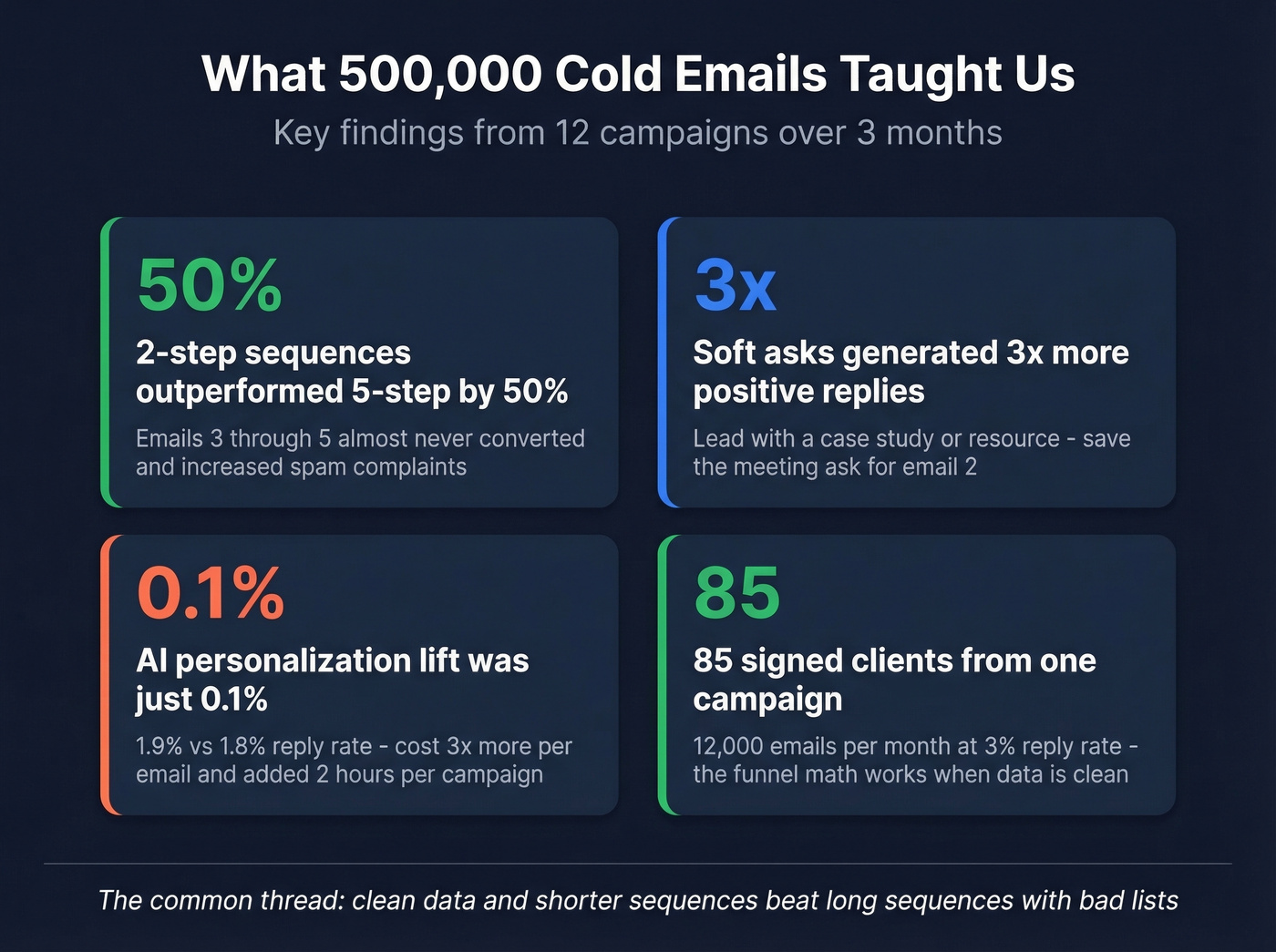
2-step beats 5-step. Across 12 campaigns, 2-step sequences outperformed 5-step by roughly 50%. Emails 3 through 5 almost never converted and actively increased complaints. The consensus on r/coldemail backs this up: shorter sequences with better targeting beat longer sequences with mediocre lists every time.
Soft asks crush meeting requests. Leading with a case study, resource, or value asset generated ~3x the positive reply rate compared to asking for a meeting in email 1. Tested across 15-20 campaigns. The meeting ask isn't dead - it just belongs in email 2, after you've earned a reply.
AI personalization is mostly theater. Heavy AI personalization produced a 1.9% reply rate vs. 1.8% for simple relevance-based emails. That 0.1% lift cost 3x more per email and added ~2 hours of workflow complexity per campaign. Simple relevance - mentioning the prospect's industry, a recent company event, or a specific pain point - gets you 95% of the way there at a fraction of the cost.
The funnel math works like this. Send 12,000 emails per month at a 3% reply rate and you get ~360 replies. Filter out out-of-office and auto-replies (roughly half) and you're at 180 usable responses. Convert half to calls and you've got ~90 meetings per month. One campaign from that dataset produced 694 positive replies and 85 signed clients - proof the math works at scale when the data is clean.
Multi-channel sequencing matters, but order matters more. Sequential multi-channel - email first, then social touches after engagement signals, phone on high-intent replies - produced a 30% higher positive reply rate than blasting all channels simultaneously. Sequential feels less aggressive and lets you calibrate effort to interest.
One critical piece: the team behind those 500K sends kept bounce rates under 3% by running every list through a verification waterfall. That's the part most people skip, and it's the part that matters most.
Timing and Cadence Cheat Sheet
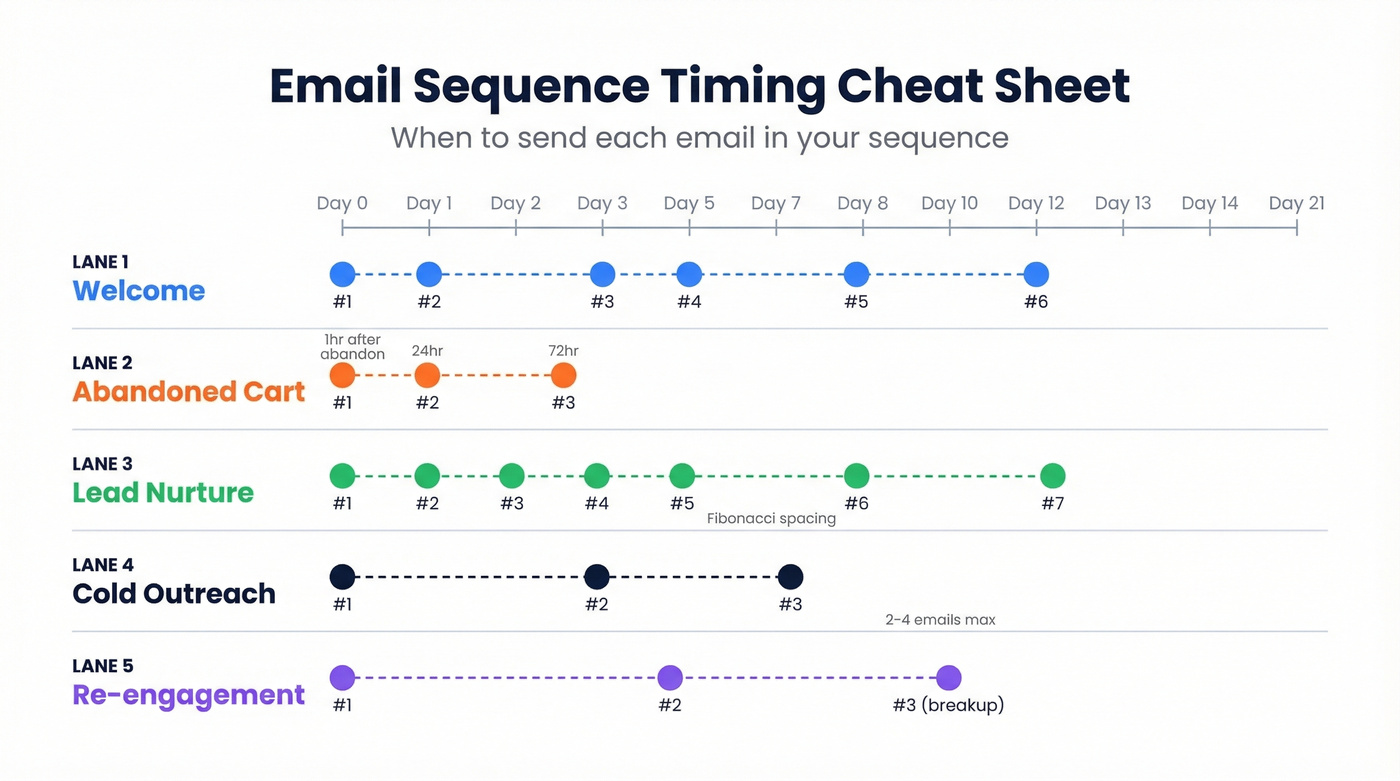
| Sequence Type | Email Count | Timing Between Sends |
|---|---|---|
| Welcome | 4-6 | Day 0, 1, 3, 5, 8, 12 |
| Abandoned Cart | 2-3 | 1hr, 24hr, 72hr |
| Lead Nurture | 5-8 | Fibonacci: Day 0, 1, 2, 3, 5, 8, 13 |
| Cold Outreach | 2-4 | 3-4 days between touches |
| Re-engagement | 2-3 | Day 0, 5, 10 |
| Post-Purchase | 3-5 | Day 0, 2, 7, 14, 21 |
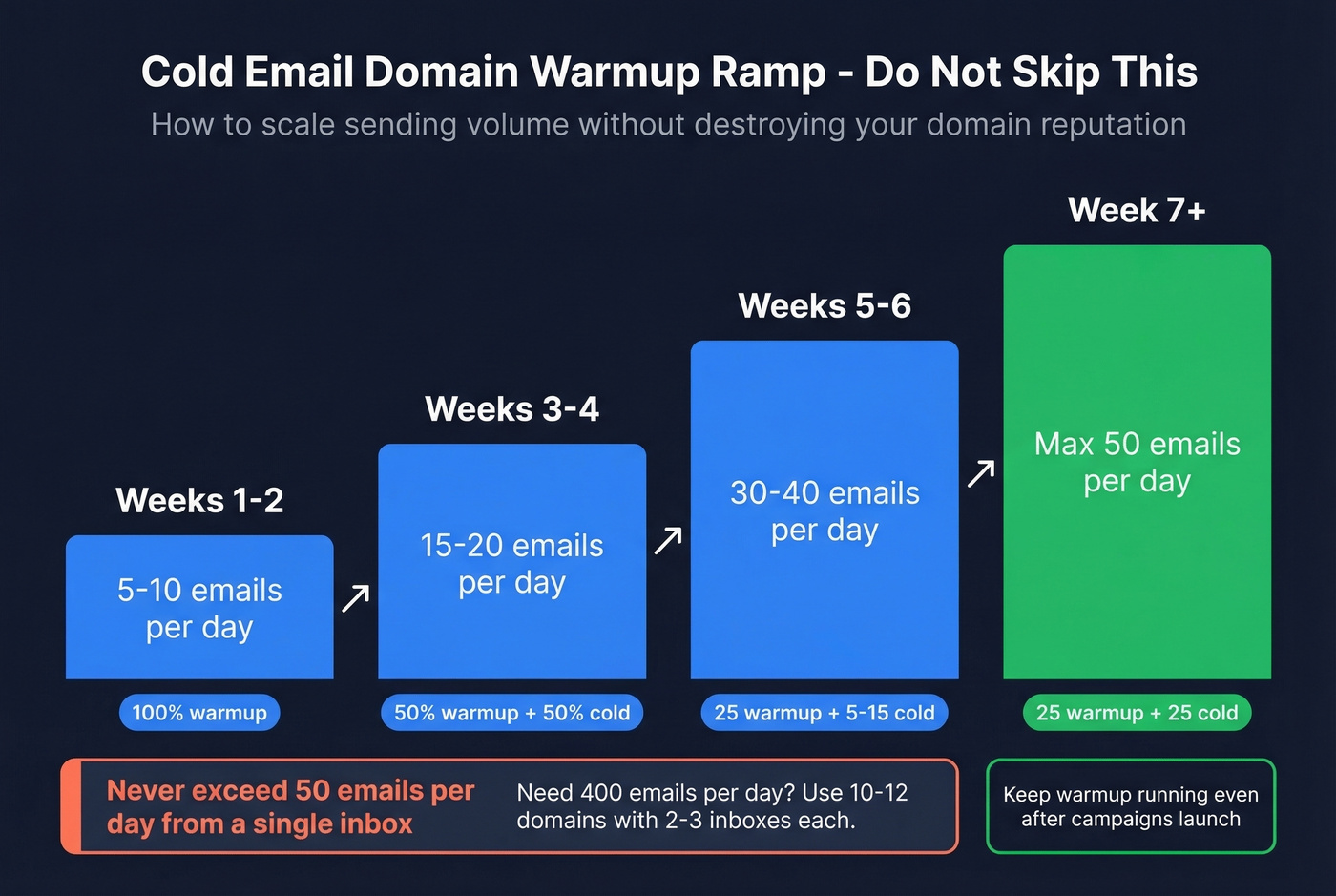
For cold email specifically, your sending volume is constrained by deliverability infrastructure. Here's the warmup ramp that keeps domains healthy:
| Week | Emails/Day per Inbox | Split |
|---|---|---|
| Weeks 1-2 | 5-10 | All warmup |
| Weeks 3-4 | 15-20 | 50/50 warmup + cold |
| Weeks 5-6 | 30-40 | 25 warmup + 5-15 cold |
| Week 7+ | Max 50 | 25 warmup + 25 cold |
Never exceed 50 emails per day from a single inbox. To send ~400 emails per day, you need roughly 10-12 domains with 2-3 inboxes each. Run warmup for a minimum of 14 days - 21 is better - and keep warmup running even after campaigns launch.
Deliverability: The Part Every Guide Skips
Real talk: it's 2026 and most guides on building an email sequence still don't mention deliverability. They'll give you 47 subject line templates and zero advice on DNS authentication. That's like teaching someone to drive without mentioning brakes.
Gmail filters 99.9% of spam before it reaches users. Your sequenced emails are competing against that filter, and the filter gets smarter every quarter. Here's the baseline checklist.
DNS authentication. Set up SPF, DKIM, and DMARC on every sending domain. Start DMARC at p=none for report-only, then move to p=quarantine once you've confirmed SPF/DKIM alignment, and eventually p=reject. This takes ~15-20 minutes per domain and is the single highest-ROI deliverability investment you'll make. (If you want the technical details, start with DMARC alignment and a clean SPF record.)
Never send cold email from your primary domain. Buy secondary domains - variations of your main domain - and use those exclusively for outbound. If a sending domain gets flagged, your main business email stays clean.
Hit these thresholds or stop sending. Bounce rate under 2%. Spam complaints under 0.1%. If you're above either number, pause campaigns and fix your list before continuing. A 15% bounce rate can permanently damage a domain within 30 days. (More detail: email bounce rate benchmarks and fixes.)
Skip open-rate tracking on cold email. Tracking pixels hurt deliverability because inbox providers flag them as signals of bulk sending. Focus on reply rates instead. For marketing sequences, open rates are directional at best thanks to Apple MPP. (Related: email tracking pixels.)
Use spintax for variation. Sending thousands of identical emails is a spam signal. Spintax creates natural variation in your copy - different greetings, sentence structures, and CTAs - so each email looks unique to inbox providers.
Run seed list tests. Monitor inbox placement across Gmail, Outlook, and Yahoo before scaling. You want to land in the primary inbox, not promotions or spam.
The #1 reason sequences fail isn't bad copy - it's bad data. Buying "verified" lists from database providers produced 8-15% bounce rates in our testing. Prospeo's 5-step verification process, including catch-all handling, spam-trap removal, and honeypot filtering, keeps bounce rates under 3% at ~$0.01 per email. Stack Optimize built to $1M ARR while maintaining 94%+ deliverability with zero domain flags across their entire client base using this approach.
Shorter cold sequences only work when every email lands. Prospeo refreshes 300M+ profiles every 7 days - not every 6 weeks like competitors - so your 2-step sequence hits real, active inboxes at $0.01 per email.
Two emails is all you need when the data is right.
Best Tools for Building Sequences
Every comparison ranks the publisher's tool #1. We'll do the same - Prospeo is our product - but we're the verification and data layer, not a sending tool. You'll need both.
For teams where the average deal size is under $10k, you probably don't need a $15k/year all-in-one platform. A $30/month sending tool paired with accurate data will outperform an enterprise suite filled with stale contacts. The bottleneck is almost never the sending tool. It's the data going into it.
Marketing Automation:
| Tool | Starting Price | Best For |
|---|---|---|
| MailerLite | $15/mo (1K contacts) | Best value for SMBs |
| ActiveCampaign | $19/mo (1K contacts) | Advanced segmentation + lead scoring |
| Klaviyo | $20/mo (500 contacts) | Ecommerce / DTC |
| Brevo | Free (300/day) | Budget / getting started |
| GetResponse | $19/mo (1K contacts) | All-in-one marketing |
| Drip | $39/mo (2.5K contacts) | Ecommerce automation |
On r/EmailMarketing, MailerLite consistently gets praised for delivering 90% of ActiveCampaign's functionality at half the price. It's the right pick for most teams under 10K contacts. Klaviyo is the clear winner for ecommerce and DTC - its revenue attribution alone justifies the price. ActiveCampaign wins when you need complex segmentation and lead scoring for B2B.
Cold Outreach + Data:
| Tool | Starting Price | Best For |
|---|---|---|
| Prospeo | Free tier; ~$0.01/email | Email verification + B2B data (98% accuracy) |
| Instantly | ~$30/mo | High-volume cold sending |
| Smartlead | ~$39/mo | Multi-inbox rotation |
| Lemlist | ~$39/mo/user | Personalized cold outreach |
If you're building outbound at scale, pair your sending tool with a real email deliverability guide and keep an eye on email velocity so you don't burn domains.
Email Sequence FAQ
How many emails should be in a sequence?
Welcome: 4-6 emails. Abandoned cart: 2-3. Cold outreach: 2-4 - data from 500K sends shows emails 3-5 rarely converted and increased spam complaints. Nurture: 5-8. Start shorter and extend only if engagement data supports it.
What's a good reply rate for cold email sequences?
At scale, 2-4% is solid and sustainable. Anyone claiming consistent double-digit reply rates is working tiny, highly targeted samples. At 3% across 12,000 emails per month, expect roughly 360 replies and ~90 meetings after filtering.
What's an email sequence vs. a drip campaign?
Sequences are triggered by user behavior - a signup, cart abandonment, or page visit. Drip campaigns send on a fixed schedule regardless of actions. The terms get used interchangeably, and most modern tools blend both. What matters is whether your emails respond to behavior or just follow a calendar.
How do I stop my sequences from going to spam?
Should I track open rates on my sequences?
For marketing flows, open rates are directional at best - Apple MPP inflates them by pre-loading tracking pixels. For cold email, skip open-rate tracking entirely since tracking pixels hurt deliverability. Focus on reply rates for outbound and click-through rates for marketing.