

Firmographics: What They Are, Why They Matter, and How to Use Them
Your VP of Sales just asked you to "define the ICP." You pull up the CRM, export closed-won deals, and realize half the records don't even have an industry field filled in. The other half list "Technology" as if that narrows anything down. This is the firmographics problem - and it's costing your team pipeline every quarter.
What Is Firmographic Data?
Firmographics are descriptive attributes of businesses used to classify and segment companies in B2B markets. Just as demographics describe individuals - age, income, education - firmographic data describes organizations: their industry, size, revenue, location, ownership structure, and growth trajectory.
The concept traces back to Bonoma and Shapiro's nested model of industrial market segmentation, introduced in 1984. Webster (2005) later critiqued pure firmographic approaches for missing behavioral and situational variables - a criticism that actually reinforces the layered approach this guide advocates. Firmographic data alone isn't enough. But it's the foundation every other layer builds on.
In practical terms, it's a set of company-level characteristics - industry, employee count, annual revenue, headquarters location, and ownership type - used by B2B teams to segment markets, define ideal customer profiles, and prioritize accounts.
Why Firmographic Segmentation Matters
Companies using advanced segmentation see 2-3x higher conversion rates than those relying on broad targeting. That's not marginal. It's the difference between a pipeline that converts and one that stalls.
Industry-specific messaging increases response rates by 31%. Segmenting by maturity stage shortens sales cycles by 11%. B2B marketers using account-based tactics achieve 81% higher ROI than those running broad campaigns. These numbers translate directly into revenue when applied consistently across your go-to-market motion.

The average B2B cost per lead runs ~$200, with demo requests climbing to $600-$800. When you're spending that kind of money, sending the wrong message to the wrong segment isn't just inefficient - it's expensive. Seventy-one percent of B2B companies already segment by industry, and 64% segment by company size. If you aren't using these data points in your strategy at least that far, you're behind the baseline.
Complete List of Firmographic Attributes
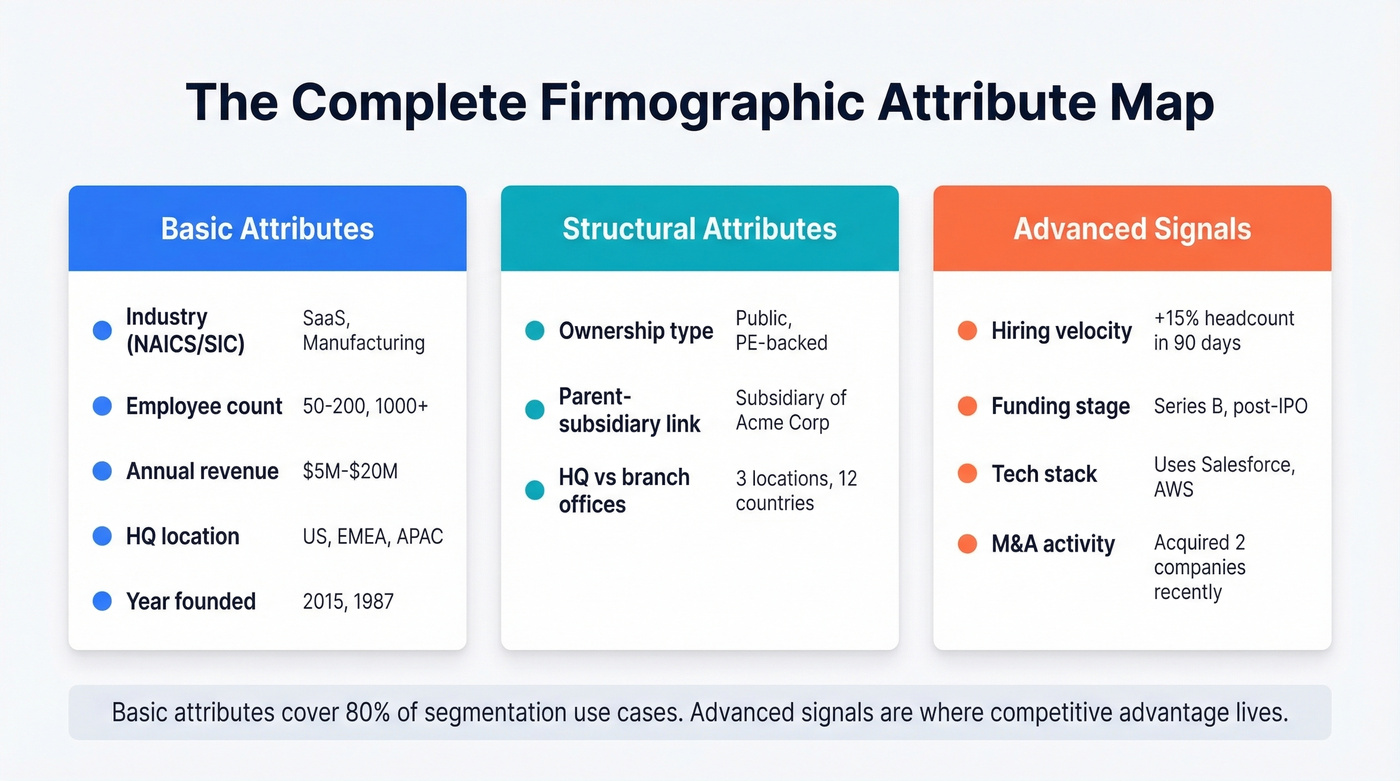
Most guides list five or six variables and call it a day. Here's the full picture:
| Category | Variable | Example Values |
|---|---|---|
| Basic | Industry (NAICS/SIC) | SaaS, Manufacturing |
| Basic | Employee count | 50-200, 1,000+ |
| Basic | Annual revenue | $5M-$20M |
| Basic | HQ location | US, EMEA, APAC |
| Basic | Year founded | 2015, 1987 |
| Structural | Ownership type | Public, private, PE-backed |
| Structural | Parent-subsidiary link | Subsidiary of Acme Corp |
| Structural | HQ vs branch offices | 3 locations, 12 countries |
| Advanced | Hiring velocity | +15% headcount in 90 days |
| Advanced | Funding stage | Series B, post-IPO |
| Advanced | Tech stack | Uses Salesforce, AWS |
| Advanced | M&A activity | Acquired 2 companies recently |
The basic five - industry, headcount, revenue, location, year founded - cover most segmentation use cases. But the advanced data points are where competitive advantage lives. Hiring velocity signals budget expansion. Funding stage predicts buying power. Tech stack data reveals integration fit that revenue figures never will.
Why NAICS and SIC Codes Fall Short
SIC codes were created in 1937 and last updated in 1987. NAICS came along in 1997 with over 1,000 industry codes, but it still struggles with how modern businesses actually operate.
Here's a concrete example from Gradient Works: ZoomInfo lists 339,506 companies under "Software." Filter to US/Canada with more than 100 employees and you still get 9,839 accounts. That's not a segment - it's a haystack. You need sub-industry classification, tech stack data, and growth signals to make industry codes actionable.
Firmographics vs Technographics vs Intent Data
Firmographic information alone is a phonebook. It tells you who exists, not who's buying. The clearest framework for combining data types is the onion model.
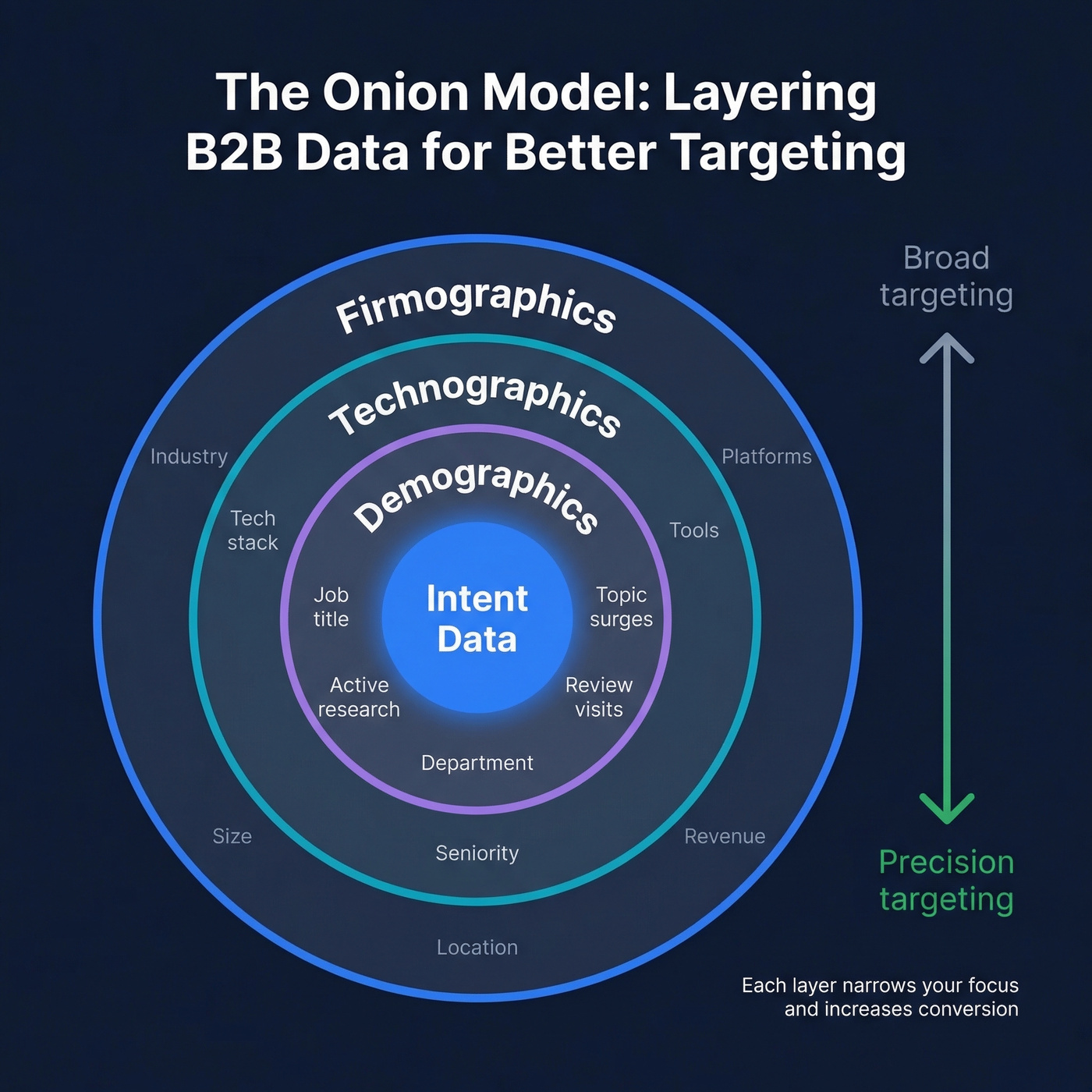
Start with company-level attributes to build your shortlist: organizations in the right industry, size, and geography. Layer technographics to refine fit - do they use a competing product? Are they on a compatible tech stack? Add decision-maker demographics to identify the right contacts. Then prioritize with intent data to find who's actively researching solutions right now.
| Data Layer | What It Tells You | Source Examples |
|---|---|---|
| Firmographics | What a company is | Data providers, SEC filings |
| Technographics | What a company uses | BuiltWith, job postings |
| Demographics | Who makes decisions | Professional profiles |
| Intent data | Who's buying now | Bombora, G2, review sites |
Each layer alone has limitations. Company-level data is too broad and commoditized - every competitor has the same list. Technographics go stale as companies swap tools. Intent data without firmographic context sends you chasing accounts that'll never close. The layered approach is what separates teams that hit quota from teams that spray and pray.
Here's the thing: if your average deal size is under $10k, you probably don't need all four layers. Company attributes plus one signal - tech stack or intent - will get you most of the way there without the data cost or operational complexity of a full stack.

You just read why layering firmographics with technographics and intent data separates top teams from everyone else. Prospeo gives you all three layers in one platform - 30+ filters including industry, headcount, revenue, tech stack, hiring velocity, funding stage, and 15,000 Bombora intent topics. Every record is refreshed every 7 days, not every 6 weeks.
Filter by the exact firmographic and intent signals that define your ICP.
How to Build an ICP Scoring Model
Segments tell you where to play. Scoring tells you who to prioritize within each segment.
The a16z Five Questions
Before building a full rubric, run through a16z's Five Question Framework: Who are your best customers? What traits do they share? What objections come from lost deals? Where are the easiest upsells? What do competitor customers have in common?
Use cohort triangulation - cross-reference revenue growth, shortest sales cycles, and best retention - to avoid over-indexing on deal size alone. This takes an afternoon and gives you the inputs for the full model below.
The 100-Point Rubric
Pull 50-100 closed-won deals from the last 12 months. Tag each with firmographic, technographic, and behavioral attributes. Look for variables that appear in 60% or more of your best accounts - those are your scoring criteria.
| Criteria | Weight | Tier A (80-100) | Tier B (50-79) | Tier C (0-49) |
|---|---|---|---|---|
| Industry | 25 pts | Target vertical | Adjacent | Non-target |
| Headcount | 20 pts | 200-2,000 | 50-199 or 2K-10K | <50 or >10K |
| Revenue | 20 pts | $10M-$500M | $1M-$10M | <$1M |
| Tech stack fit | 20 pts | Uses competitor | Uses adjacent | No fit signals |
| Intent signals | 15 pts | Active research | Passive interest | None detected |
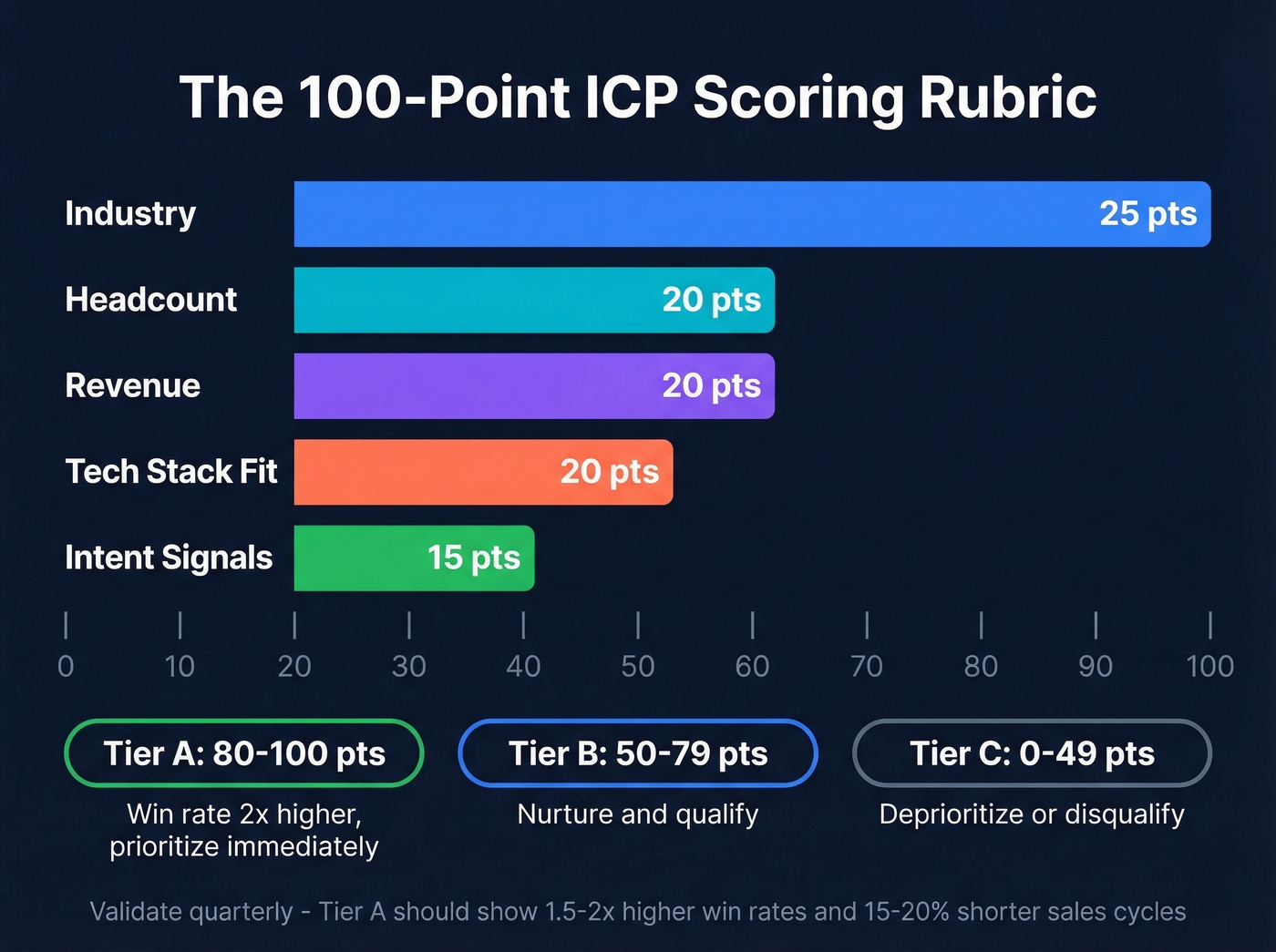
Validate quarterly. Tier A accounts should show win rates 1.5-2x higher than Tier B and sales cycles 15-20% shorter. If they don't, your criteria need recalibrating. We've found that indicators like revenue growth rate and hiring velocity work well as tiebreakers between accounts that score similarly on the core rubric.
How to Segment Using Firmographic Data
Remember that ICP request from your VP? Here's the five-step process that works, based on the Umbrex segmentation framework. Expect 2-6 weeks depending on data quality.
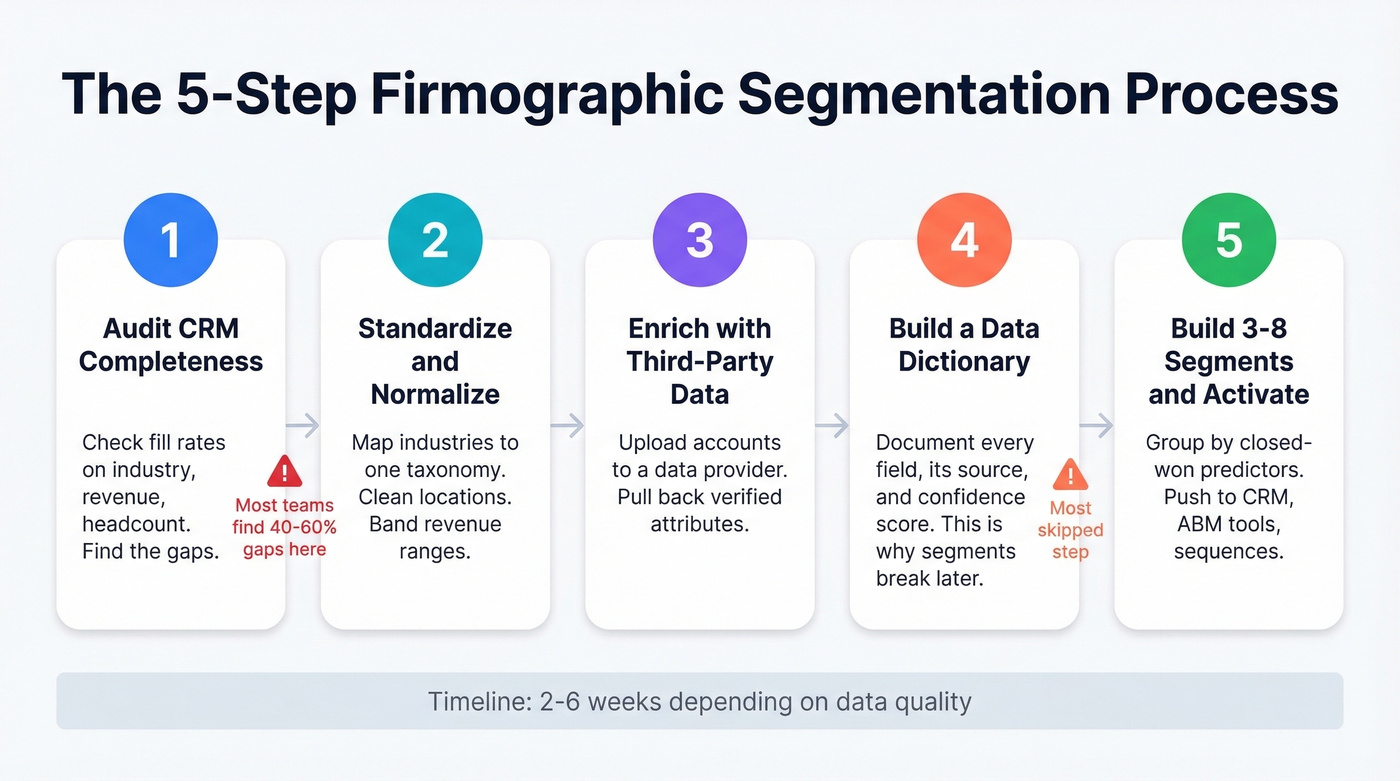
Step 1: Audit your CRM completeness. Pull every account and check fill rates on core fields. If industry is populated on 40% of records and revenue on 15%, you know where the gaps are.
Step 2: Standardize and normalize. Map all industry values to a consistent taxonomy. Normalize revenue into bands. Clean up location data so "NYC," "New York," and "New York City" resolve to the same value.
Step 3: Enrich with third-party data. Upload your account list to a data provider and pull back enriched company attributes - industry, headcount, revenue, funding stage, and tech stack.
Step 4: Build your data dictionary. Document every field, its source, and assign confidence scores. This step gets skipped constantly and it's why segments break six months later - nobody remembers which revenue figures came from self-reported forms versus verified sources.
Step 5: Build 3-8 segments and activate. Group accounts by the variables that predict closed-won deals. Push segments into your CRM, ABM platform, and sequencing tools. Three segments is often better than eight - you need enough accounts in each to run meaningful campaigns. A segment that lives in a spreadsheet isn't a segment. It's a wish.
Where to Source Firmographic Data
One Reddit practitioner building a B2B segmentation project listed Equifax, Experian, and Dun & Bradstreet as their vendor shortlist - then called D&B's offerings "very complicated" to even compare. Another r/sales thread put it bluntly: "Every data vendor says 95%+ accuracy. Run your own test on 500 records before you sign anything." Good advice.
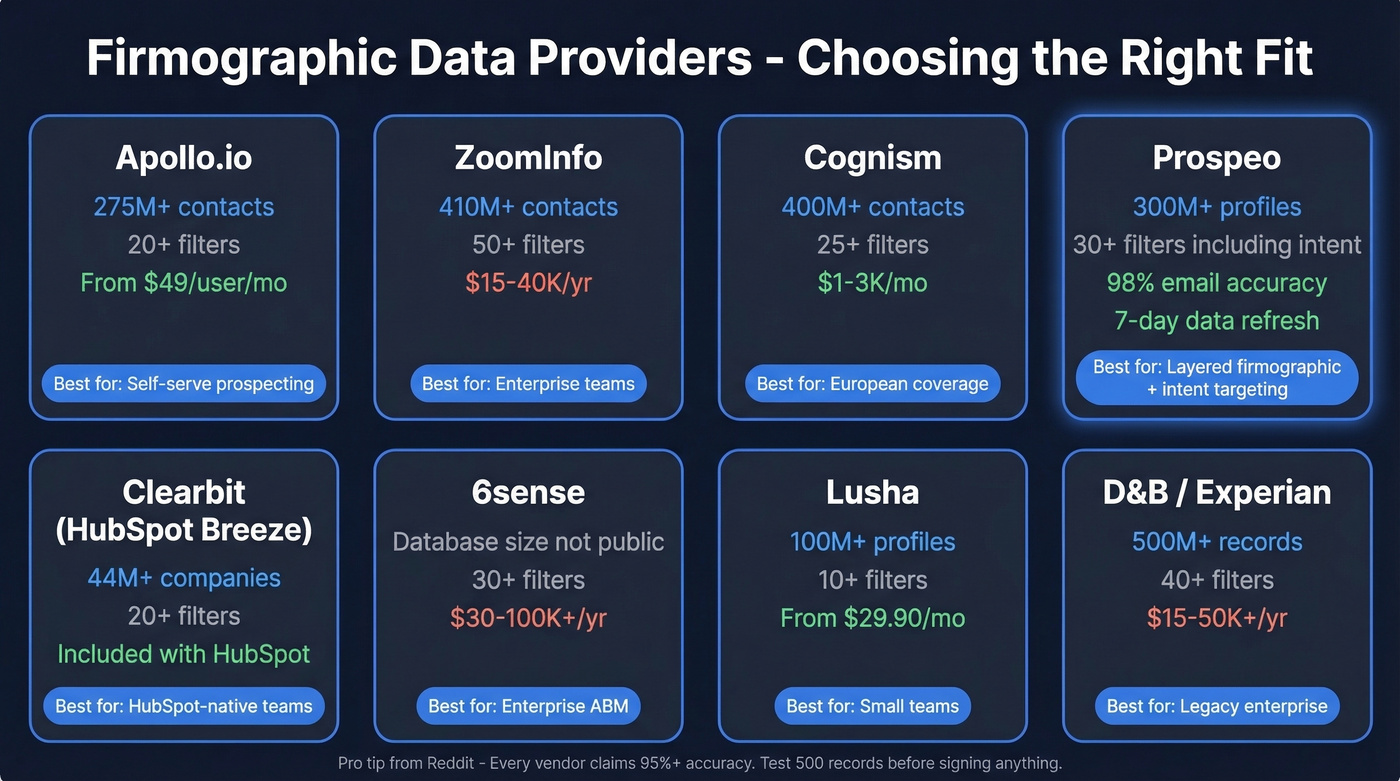
Here's the rundown, sorted by what you actually need:
| Provider | Database Size | Firmographic Filters | Starting Price | Best For |
|---|---|---|---|---|
| Apollo.io | 275M+ contacts | 20+ | $49/user/mo | Self-serve prospecting |
| ZoomInfo | 410M+ contacts | 50+ | ~$15-40K/yr | Enterprise teams |
| Lusha | 100M+ profiles | 10+ | $29.90/mo | Small teams |
| Cognism | 400M+ contacts | 25+ | ~$1-3K/mo | European coverage |
| Coresignal | 75M company records | Bulk/API | $49/mo | API/bulk pipelines |
| Clearbit (HubSpot Breeze) | 44M+ companies | 20+ | Included w/ HubSpot Starter+ | HubSpot-native teams |
| 6sense | Not public | 30+ | ~$30-100K+/yr | Enterprise ABM |
| D&B/Experian | 500M+ records | 40+ | ~$15-50K+/yr | Legacy enterprise |

Prospeo covers 300M+ professional profiles with 143M+ verified emails at 98% accuracy. The 30+ search filters span industry, headcount growth, revenue, funding stage, technographics, and buyer intent across 15,000 Bombora topics. A 7-day data refresh cycle - versus the 6-week industry average - helps keep bounce rates under 4%. Pricing starts free, with paid plans at ~$0.01 per email and no contracts.
Apollo.io is a common starting point for budget-conscious teams. At $49/user/month, you get 275M+ contacts with solid filters. It's where a lot of teams start before they outgrow the data quality.
ZoomInfo is the enterprise standard - 110M+ companies with 35M+ non-HQ locations, 410M+ contacts, and deep coverage. But with intent add-ons, contracts often land in the $30-100K+/year range depending on seats and modules. That's real money for a Series A company.
Cognism is strong for European coverage, especially if you're selling into EMEA. US coverage is thinner than ZoomInfo or Apollo.
Lusha, Coresignal, and Clearbit each serve narrower use cases well - small teams, API-first data pipelines, and HubSpot-native workflows respectively. 6sense plays in enterprise ABM at $30-100K+/year. D&B and Experian are legacy options with deep records but long procurement cycles and five-figure minimums. SalesIntel is known for human-verified contacts with custom pricing - worth evaluating if verification quality is your top concern.
Let's be honest: in our experience testing these platforms, the accuracy claims on vendor websites rarely match reality. We'd echo that r/sales advice - run a 500-record test before committing budget.
Keeping Your Data Accurate
B2B data decays at 2.1% per month on average. After a year, over 70% of contacts have changed. IBM estimates poor data quality costs U.S. businesses $3.1 trillion annually. Most providers serve cached records aged 30-90 days - by the time you email that "verified" contact, they've already moved on.
Build a quality cadence around six dimensions: accuracy, completeness, consistency, timeliness, uniqueness, and validity. Re-verify active account lists every 90 days at minimum. Automate deduplication at entry. Run quarterly audits on your highest-value segments.
The teams that treat data quality as an ongoing process - not a one-time purchase - are the ones maintaining high deliverability.
Common Analysis Mistakes
Relying solely on industry codes. NAICS is a starting point, not a strategy. "Software" isn't a segment - it's 339,000 companies. Layer sub-industry, tech stack, and growth signals.
Ignoring timing. The Minimum Viable Segment concept nails this: the smallest group of buyers who share the same struggle, at the same moment, with the same urgency to act. A practitioner on r/datascience described spending three months building "perfect" segments only to realize none of the accounts were in a buying cycle. Company-level attributes tell you who could buy. Intent data tells you who will buy now. You need both.
Over-segmenting. You don't need 12 variables. You need 4-5 that actually predict closed-won deals. Every variable beyond that adds complexity without improving conversion. Test ruthlessly and cut what doesn't correlate. Skip the urge to build a "perfect" model - a good-enough model that ships beats a perfect one that sits in a spreadsheet.
Using stale data without a refresh cadence. If your last enrichment was six months ago, a quarter of your records are already wrong. Set a 90-day re-verification cycle and stick to it.
Treating firmographics as sufficient. Company attributes without intent and technographic layers is a phonebook. It tells you who exists. It doesn't tell you who's buying, what they use, or when they'll be ready.
Your ICP scoring model is only as good as the data feeding it. Incomplete industry fields and outdated headcount numbers break every tier you build. Prospeo returns 50+ data points per contact at a 92% match rate - firmographics, technographics, and growth signals included - so your scoring rubric actually works.
Enrich your CRM with accurate firmographic data at $0.01 per lead.
FAQ
What's the difference between firmographics and demographics?
Demographics describe individuals - age, income, education, job title. Firmographics describe companies - industry, revenue, headcount, location, ownership type. Use demographics to target people; use firmographic attributes to target accounts. It's the B2B equivalent of consumer demographics applied at the organizational level.
What are the most important firmographic variables?
Industry, employee count, annual revenue, location, and ownership type cover 80%+ of segmentation use cases. For precision targeting, layer technographics and intent data on top. High-value additions include year founded, funding stage, and parent-subsidiary relationships.
How often should I refresh firmographic data?
Re-verify every 90 days at minimum. B2B data decays 2.1% per month - after a year, over 70% of records have changed. A 7-day refresh cycle, like the one Prospeo runs, keeps records current automatically versus the 6-week average at most providers.
Can I get firmographic data for free?
Basic data - industry, HQ location, employee range - is available from public sources like SEC filings and company websites. For verified, enriched data at scale, expect to pay $0.01-$1+ per record. Some platforms offer free tiers to get started; Prospeo's includes 75 email credits per month with full access to 30+ search filters.
What's the difference between firmographics and technographics?
Firmographics describe what a company is - size, industry, revenue, location. Technographics describe what a company uses - CRM, cloud platform, marketing tools, security stack. Use both together: firmographic attributes to build the shortlist, technographics to qualify fit.