

The Complete Guide to CRM Management Systems in 2026
A 10-person sales team spends $14/user/month on a CRM management system, thinks they're getting a deal, then burns $40,000 on implementation, training, and a consultant to fix the mess six months later. That's the trap nobody warns you about.
The frustrating part? Businesses that get implementation right earn $8.71 for every $1 spent on CRM. And 91% of companies with 10+ employees already use one, so the question isn't whether you need customer relationship management software - it's whether you'll pick the right one and avoid the hidden costs that eat your ROI alive. CRM adoption also boosts customer retention by 27%, which makes the stakes even higher.
Here's how to avoid the trap - and which platforms are actually worth your money right now.
Quick Recommendations by Size
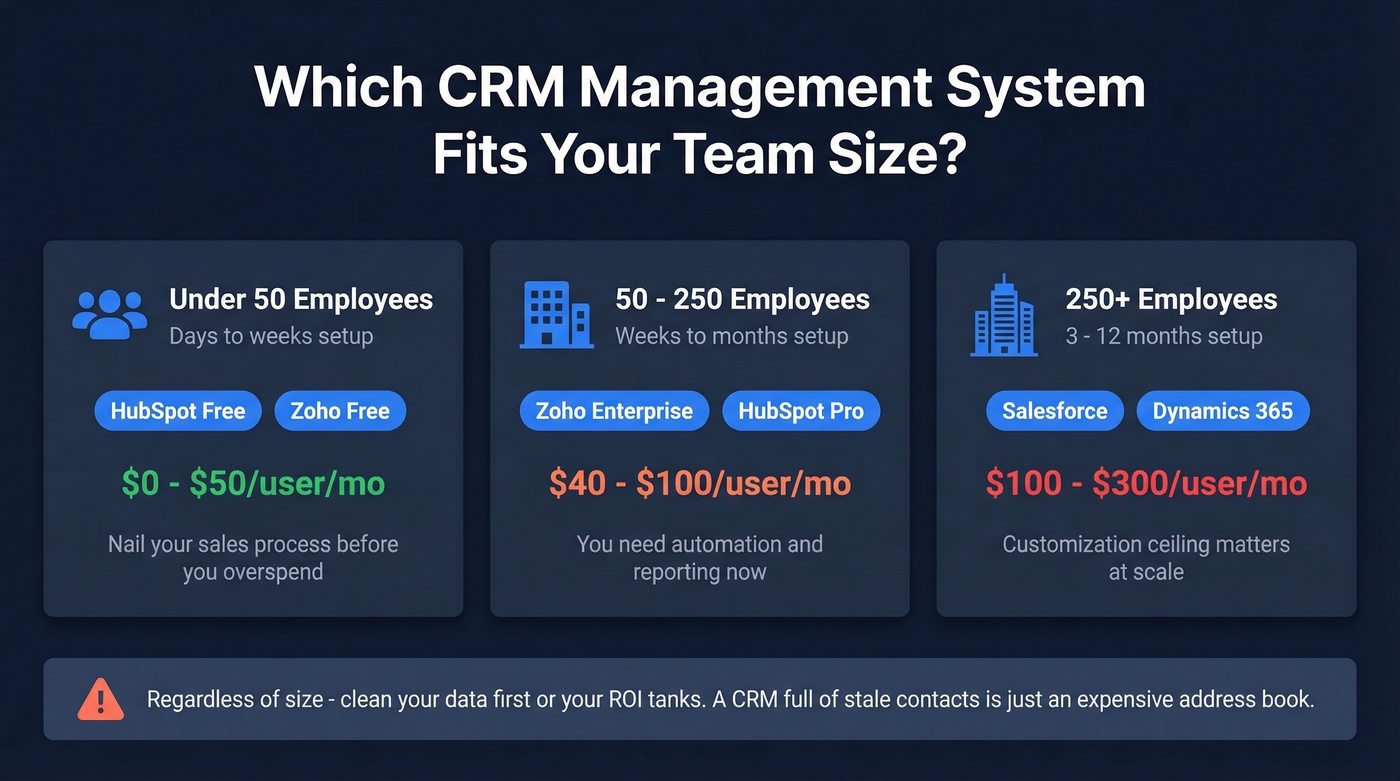
- Under 50 employees: HubSpot Free or Zoho CRM Free. Don't overspend before you've nailed your sales process.
- 50-250 employees: Zoho CRM Enterprise or HubSpot Professional. You need automation and reporting without a six-month implementation.
- 250+ employees: Salesforce or Microsoft Dynamics 365. You'll pay for it, but the customization ceiling matters at this scale.
- Regardless of CRM: Clean your data first or your ROI tanks. A CRM full of stale contacts is just an expensive address book.
| Segment | Best Fit | Price Range | Setup Time |
|---|---|---|---|
| SMB (<50) | HubSpot Free, Zoho Free | $0-$50/user/mo | Days to weeks |
| Mid-market (50-250) | Zoho Enterprise, HubSpot Pro | $40-$100/user/mo | Weeks to months |
| Enterprise (250+) | Salesforce, Dynamics 365 | $100-$300/user/mo | 3-12 months |
What Is a CRM Management System?
A CRM management system is software that centralizes every interaction your company has with customers and prospects - contacts, deals, emails, calls, support tickets - into one searchable database. "CRM" and "CRM management system" mean the same thing. The industry just can't agree on how many words to use.
The global CRM market hit $112.91 billion in 2025 and is projected to reach $320.99 billion by 2034 at a 12.40% CAGR, with North America accounting for 31.70% of that market share. That growth isn't hype - the top 10 vendors control 54.2% of the total market, which means the platform you choose will likely come from a short list of proven players.
CRMs generally fall into three categories:
| Type | What It Does | Best For |
|---|---|---|
| Operational | Automates sales, marketing, service | Day-to-day pipeline mgmt |
| Analytical | Mines data for patterns, forecasts | Revenue ops, leadership |
| Collaborative | Shares data across departments | Cross-functional teams |
Most modern platforms blend all three. Salesforce leans analytical and operational. HubSpot leads with operational simplicity. Zoho tries to do everything - and mostly succeeds.
Core Features to Evaluate
Not every CRM feature matters equally. Here's what actually drives results for most teams.
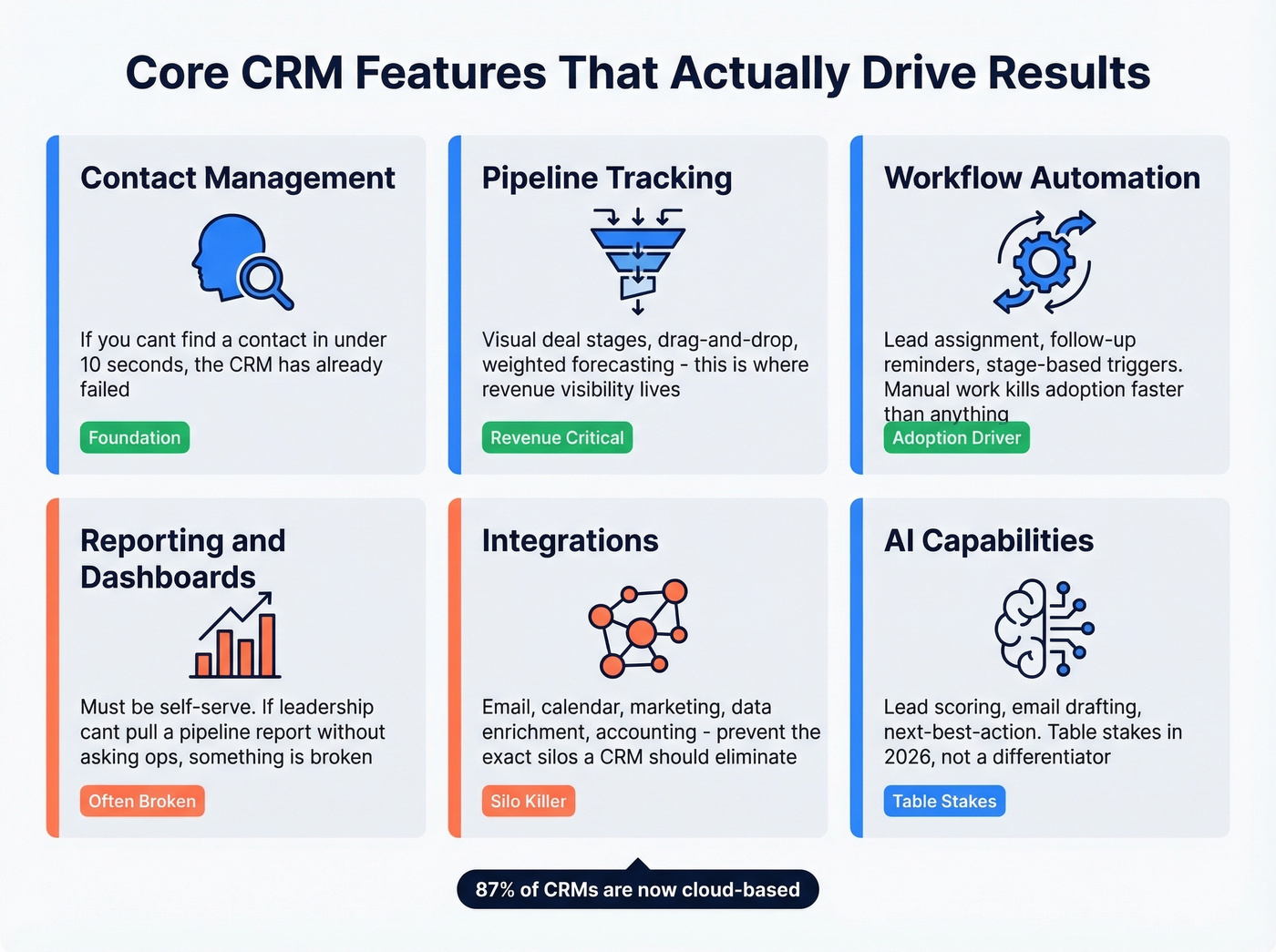
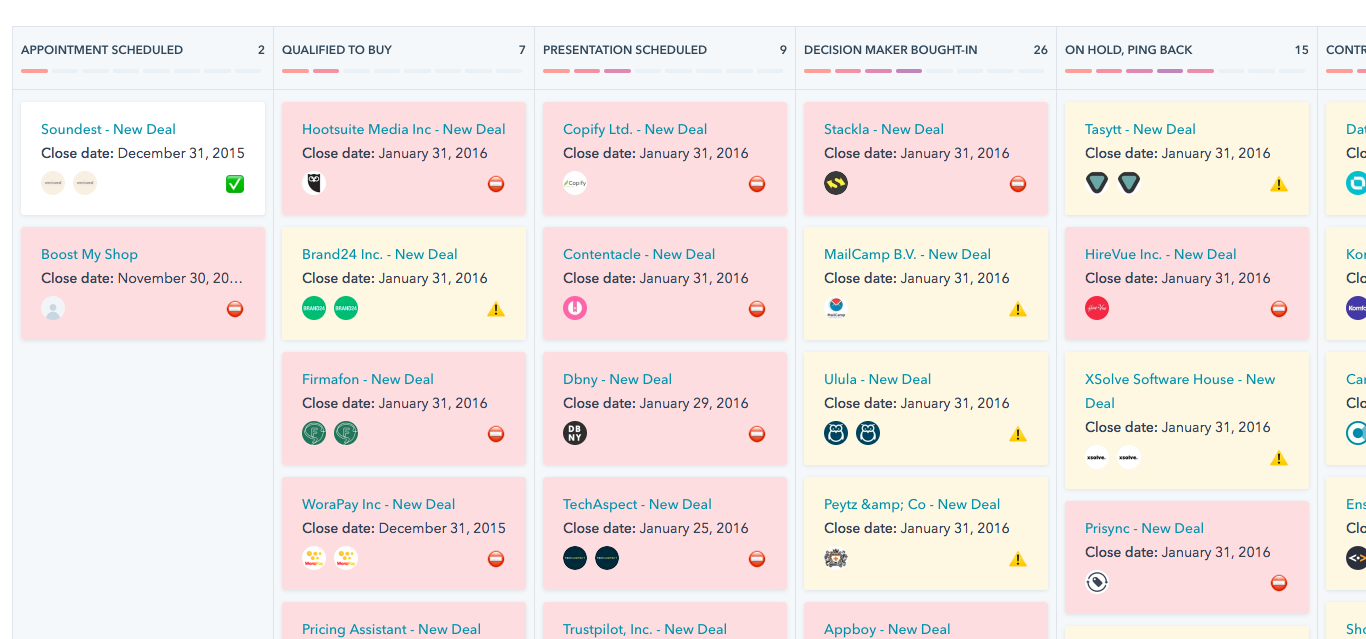
Contact management is the foundation. If you can't find a contact in under 10 seconds, the CRM has already failed. Pipeline tracking - visual deal stages, drag-and-drop movement, weighted forecasting - is where revenue visibility lives. Workflow automation covers lead assignment, follow-up reminders, and stage-based email triggers. Manual work kills adoption faster than anything else.
Reporting and dashboards need to be self-serve. If leadership can't pull a pipeline report without asking ops, something's broken. Integrations with email, calendar, marketing automation, data enrichment, and accounting prevent the exact silos a CRM is supposed to eliminate. And AI capabilities like lead scoring, email drafting, and next-best-action suggestions are table stakes in 2026, not a differentiator.
87% of CRMs are now cloud-based. You shouldn't be evaluating on-premise options unless you have a very specific compliance reason.
AI in CRM - What Actually Matters
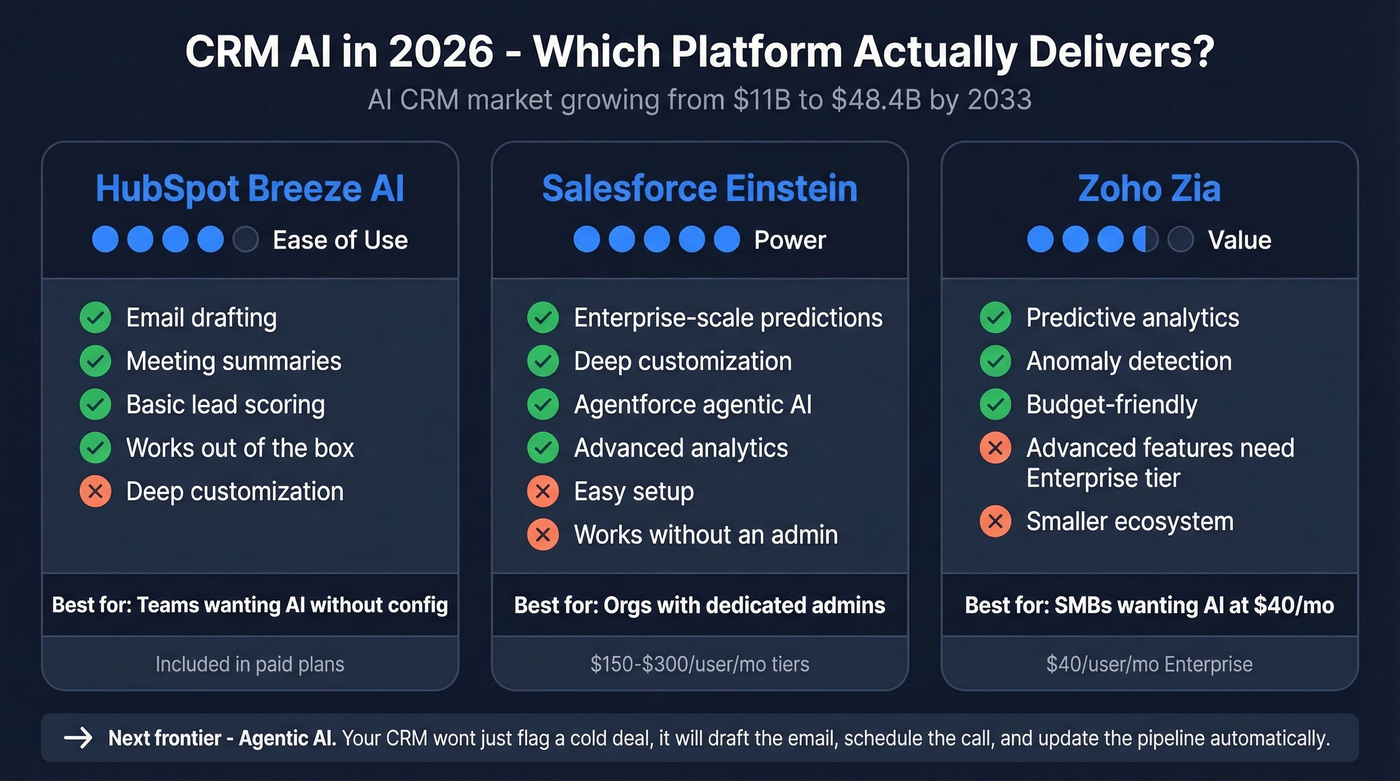
The AI CRM market is projected to grow from $11.04 billion to $48.4 billion by 2033. Every vendor has an AI story. Most of them are marketing fluff layered on top of basic automation.
Three platforms have genuinely useful AI right now:
| Platform | AI Brand | Strength | Best For |
|---|---|---|---|
| HubSpot | Breeze AI | Ease of use, fast setup | Teams wanting AI without config |
| Salesforce | Salesforce Einstein | Enterprise scale, deep customization | Orgs with dedicated admins |
| Zoho | Zia | Budget-friendly automation | SMBs wanting AI at $40/mo |
HubSpot's AI works out of the box - email drafting, meeting summaries, basic lead scoring. It's not the most powerful, but it's the most likely to actually get used. Salesforce Einstein is the opposite: incredibly capable, but you need an admin or a consultant to configure it properly. Zoho's Zia sits in between, offering predictive analytics and anomaly detection at a fraction of the cost, though the more advanced capabilities live in Enterprise and Ultimate tiers.
The next frontier is agentic AI - autonomous agents that don't just suggest actions but execute them. Salesforce is pushing this hard with Agentforce, and HubSpot is building similar capabilities into Breeze. Within 18 months, your CRM's AI won't just flag a cold deal - it'll draft the re-engagement email, schedule the call, and update the pipeline stage without human intervention. Teams that pick platforms investing in agentic AI now will have a real head start.
One related criterion worth watching: MCP (Model Context Protocol) readiness. This is the ability for your CRM to connect with third-party AI tools like ChatGPT or Claude, letting them read and write CRM data directly. It's early, but teams that pick MCP-ready platforms now won't need to rip and replace when AI agents become standard workflow components.

A CRM full of stale contacts is just an expensive address book. Prospeo enriches your CRM with 50+ data points per contact at a 92% match rate - emails verified at 98% accuracy, refreshed every 7 days. Native integrations with Salesforce and HubSpot mean your pipeline stays clean without manual work.
Stop paying for a CRM that runs on bad data.
Best Platforms Compared for 2026
| Tool | Best For | Starting Price | Key Strength | Key Weakness |
|---|---|---|---|---|
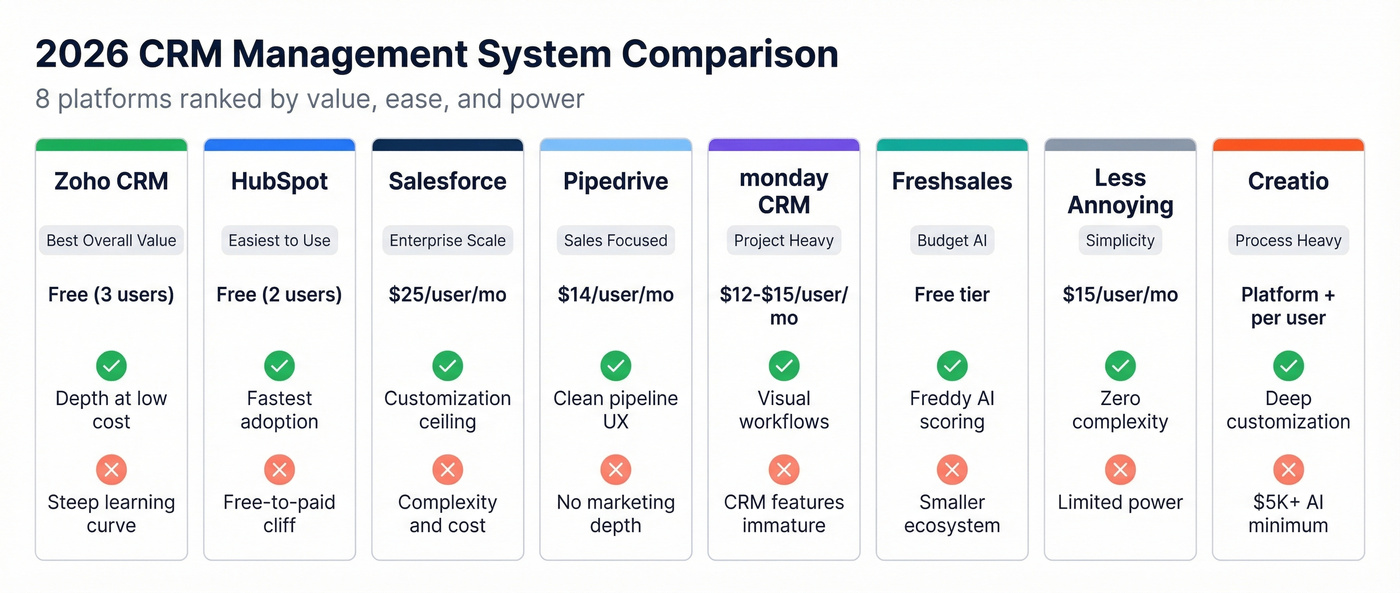
| Zoho CRM | Overall value | Free (3 users) | Depth at low cost | Steep learning curve |
| HubSpot | Ease of use | Free (2 users) | Fastest to adopt | Free-to-paid cliff |
| Salesforce | Enterprise scale | ~$25/user/mo | Customization ceiling | Complexity + cost |
| Pipedrive | Sales-focused teams | $14/user/mo | Clean pipeline UX | No marketing depth |
| monday CRM | Project-heavy teams | $12-$15/user/mo | Visual workflows | CRM features immature |
| Freshsales | Budget AI CRM | Free tier available | Freddy AI lead scoring | Smaller ecosystem |
| Less Annoying | Simplicity seekers | $15/user/mo | Zero complexity | Limited power |
| Creatio | Process-heavy orgs | Platform + per-user | Deep customization | $5K+ AI minimum |
Zoho CRM
Use this if you want the most features per dollar spent and don't mind a learning curve. Skip this if you need something your team can master in an afternoon.
Zoho CRM earned PCMag's Editors' Choice at 4.5/5 - it packs enterprise-grade functionality into SMB pricing. The free tier covers 3 users. Standard runs $14/user/month on an annual plan, Professional $23, Enterprise $40, and Ultimate $52. That Enterprise tier at $40/user/month gives you Zia AI, custom modules, and advanced analytics that typically cost far more on higher-end platforms.
The tradeoff is real, though. Zoho's interface isn't ugly, but it's dense. Advanced features like Blueprint workflows and Canvas design require genuine investment to learn. We've seen teams underutilize Zoho badly because nobody took the time to configure it properly - they end up using maybe 15% of what they're paying for. If you're willing to spend a week on setup, the payoff is enormous. If you want plug-and-play, look at HubSpot.

HubSpot CRM
HubSpot is the CRM people actually use. That sounds like a backhanded compliment, but adoption is the single biggest predictor of CRM ROI, and HubSpot wins on adoption by a mile.
The free tier gets you 2 users and 1,000 contacts - enough to validate your process, not enough to scale. Starter runs $15/user/month. Professional jumps to $50/user/month. That free-to-paid cliff is steep: you'll hit the 1,000-contact limit faster than you expect, and suddenly you're looking at a $150/month bill for a 10-person team on Starter. HubSpot carries a 4.0/5 from PCMag and is consistently rated "Easiest to Use," and the unified marketing-sales-service stack is genuinely best-in-class. If your marketing team is already on HubSpot, adding CRM is a no-brainer. New reps can be productive in hours, not weeks.
Salesforce
Salesforce owns 26.1% of the CRM market. For organizations above 250 employees with complex sales processes, it's still the right choice - and the Starter Suite at ~$25/user/month is surprisingly accessible for smaller teams that know they'll grow into it. The platform carries a G2 4.4/5 across 25,479 reviews, showing massive adoption and a lot of real-world feedback.
Here's the thing: Salesforce is overkill for 80% of teams under 100 employees. Enterprise pricing runs $150-$300/user/month before implementation costs, and those implementation costs are where the real money goes. A mid-market Salesforce deployment can easily run $50,000-$150,000 in the first year when you factor in consulting, data migration, and customization. The platform's power is undeniable - the question is whether your team will ever use more than 20% of it.
Skip Salesforce if you don't have a dedicated admin or RevOps person. Without that investment in configuration, you're paying Ferrari prices for a car stuck in first gear.
Pipedrive
Pipedrive is the anti-Salesforce. One thing, done exceptionally well: pipeline management.
The Lite plan starts at $14/user/month on an annual plan, with Growth at $39 and Premium at $59. The pipeline UI is the cleanest in the category - drag-and-drop deals, visual forecasting, activity-based selling methodology baked in. For a 10-person outbound team that just needs to track deals and follow-ups, nothing else comes close. The gap shows up when you need marketing automation, customer service tools, or deep reporting. Pipedrive knows what it is and stays in its lane.
monday CRM
monday CRM makes sense if your team already lives in monday.com for project management. The visual workflow builder is excellent, and the Basic plan at $12-$15/user/month is competitive. CRM-specific features like lead scoring, email tracking, and pipeline automation are functional but less mature than dedicated platforms. For teams where deals involve heavy cross-functional coordination, that project-management DNA is genuinely useful. For everyone else, pick a purpose-built CRM.
Freshsales
Freshsales is the budget AI play. There's a free tier, and paid plans start around $9/user/month. Freddy AI handles lead scoring, deal insights, and basic forecasting at price points where competitors charge 3-4x more. The ecosystem is smaller - fewer integrations, less community support, thinner documentation. But for a startup that wants AI-powered lead prioritization without Salesforce pricing, Freshsales delivers outsized value.
Less Annoying CRM
One plan. $15/user/month. Zero complexity.
If you're a 5-person team that's been managing contacts in spreadsheets and just needs something better, this is it. Don't overthink it.
Creatio
Enterprise-oriented platform with deep process automation. Pricing combines a platform fee with per-user costs (expect $25-$50/user/month for the platform, plus modules), and AI tokens start at a $5,000/year minimum. Best for organizations with complex, multi-step workflows that need heavy customization. Not for SMBs.
CRM Pricing - What You'll Actually Pay
| Tool | Free Tier | Entry Paid | Mid-Tier | Enterprise |
|---|---|---|---|---|
| Zoho CRM | 3 users | $14/user/mo | $40/user/mo | $52/user/mo |
| HubSpot | 2 users, 1K contacts | $15/user/mo | $50/user/mo | $75/user/mo |
| Salesforce | No | ~$25/user/mo | ~$100/user/mo | $150-$300/user/mo |
| Pipedrive | No | $14/user/mo | $39/user/mo | $79/user/mo |
| monday CRM | No | $12-$15/user/mo | $17-$20/user/mo | Custom |
| Freshsales | Yes | ~$9/user/mo | ~$39/user/mo | ~$59/user/mo |
| Less Annoying | No | $15/user/mo | - | - |
| Creatio | No | Platform + per-user | Custom | $5K+ AI minimum |
The number that matters more than any line item: a $20/user/month CRM can cost 3-10x more after implementation, training, data migration, and ongoing admin. That's your total cost of ownership, and it's where budget planning falls apart. A 50-person team on Salesforce at $100/user/month isn't paying $60,000/year - they're paying $60,000 in licenses plus $40,000-$100,000 in everything else.
Let's be honest about something: if your average deal size is under $10,000, you probably don't need a CRM that costs more than $30/user/month. The ROI math doesn't work. A $100/user/month platform needs to generate significantly more pipeline per rep to justify itself, and most SMB teams never reach that threshold. Spend the difference on better data and outbound tooling instead.
How to Choose by Company Size
The "Goldilocks zone" for CRM selection is the 50-250 employee range. Too small for enterprise platforms, too big for basic tools.
Under 50 employees: Start with HubSpot Free or Zoho Free. Your priority is adoption, not features. Pick the one your reps will actually open every morning. Implementation should take days, not weeks. Budget $0-$50/user/month.
50-250 employees: This is where you need automation, custom reporting, and integrations that actually work. Zoho Enterprise at $40/user/month or HubSpot Professional at $50/user/month hit the sweet spot. Implementation runs 2-8 weeks. Budget $40-$100/user/month plus 2-3x for setup costs.
250+ employees: Salesforce or Dynamics 365. You need the customization ceiling, the integration ecosystem, and the admin tooling. Implementation takes 3-12 months. Budget $100-$300/user/month plus significant professional services. Make sure you have dedicated CRM admin headcount before signing.
One risk that grows with company size: over-segmenting your customers. Aggressive automation and lead scoring can create a two-tier experience where high-value prospects get white-glove treatment and everyone else gets ignored. That's a retention problem disguised as an efficiency gain. Build guardrails into your workflows to ensure baseline service quality across all segments.
Implementation Mistakes That Kill ROI
Posts in r/CRM about "biggest mistake when rolling out a new CRM" consistently circle back to the same five failures. We see them constantly too.
Poor adoption. The CRM works great. Nobody uses it. This happens when leadership buys a platform without involving the people who'll live in it daily. The fix: role-relevant training, leadership modeling usage, and workflows that match how reps actually sell - not how management wishes they sold. If your CRM adds steps to a rep's day instead of removing them, adoption will crater.
Bad data quality. Garbage in, garbage out. Your team imports 10,000 contacts from a trade show, half the emails are outdated, and suddenly your bounce rate is 25%. Set up validation rules, standardize data formats, and deduplicate on import. Tools like Prospeo verify and deduplicate contact data before it enters your CRM, preventing the data quality problem that quietly destroys CRM ROI.
Weak integrations. A CRM that doesn't talk to your email, calendar, marketing platform, and enrichment tools creates the exact silos it was supposed to eliminate. Prioritize API-first platforms with real-time sync. Batch imports that run overnight are a recipe for stale data.
Over-complicated workflows. More automation isn't always better. We've watched teams build 47-step workflows that nobody understands and nobody can debug. Start with 3-5 core automations. Add complexity only when you've proven the simple version works.
Hidden cost surprises. The quote says $20/user/month. The invoice says $60/user/month after add-ons, API access, premium support, and the "advanced reporting" module you assumed was included. Read the feature matrix before you sign. Ask specifically what's not included in the tier you're buying.
Your CRM Data Problem
Six months after launch, your CRM has 15,000 contacts. 4,500 of them have changed jobs. Another 2,000 have new email addresses. Your reps don't know which records to trust, so they stop trusting any of them. By month nine, half the team is back to spreadsheets.
Contact data decays at roughly 30% per year. People change jobs, companies rebrand, email domains shift. Your CRM management system doesn't solve this - it just stores whatever you feed it. You need a data layer underneath.
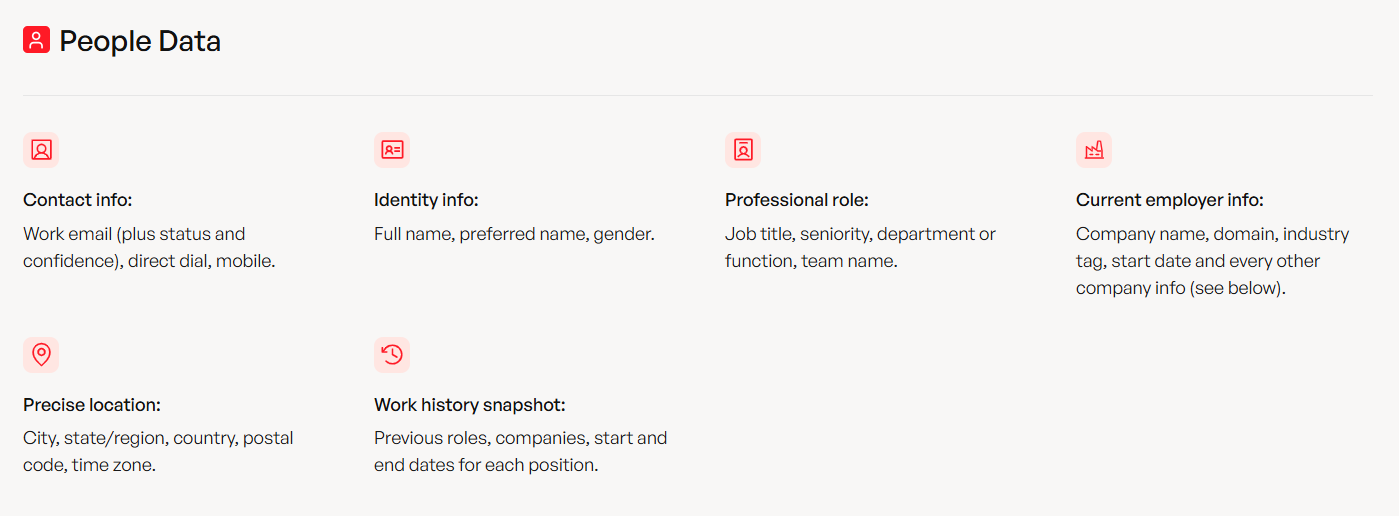
Prospeo handles this at scale with 98% email accuracy, a 92% API match rate, and 50+ data points per enrichment. The 7-day refresh cycle keeps records current - not the 6-week industry average that lets thousands of contacts go stale between updates. Native integrations with Salesforce and HubSpot mean enrichment runs automatically, not as a quarterly cleanup project.
The CRM you pick matters. The data inside it matters more. If you're comparing options, start with a quick scan of examples of a CRM and then shortlist the best-fit contact management tools for your team.
You just picked a CRM. Now fill it with contacts that actually convert. Prospeo gives you 300M+ verified profiles with 30+ filters - buyer intent, technographics, funding, headcount growth - so every record entering your system is a real prospect, not dead weight. At $0.01 per email, it costs less than the coffee your reps drink while manually researching leads.
Build pipeline-ready lists before your CRM goes live.
FAQ
What's the difference between CRM and CRM management system?
They're the same thing. "CRM management system" is the full term; "CRM" is the shorthand everyone uses. Both refer to software that manages customer relationships, sales pipelines, and contact data in a centralized database.
How much does a CRM cost for a small business?
Most SMB CRMs cost $10-$50/user/month. HubSpot, Zoho, and Freshsales all offer free tiers. Budget 2-3x the subscription cost for implementation and training - that's where the real expense hides.
Which CRM is easiest to set up?
HubSpot and Pipedrive are consistently rated easiest to implement. Less Annoying CRM is the simplest option if you want zero learning curve and don't need advanced features. Most teams are productive within a day.
Is Salesforce worth it for small teams?
Usually not. Salesforce's Starter Suite at ~$25/user/month is viable, but the platform's complexity and ecosystem overhead make Zoho or HubSpot better fits for teams under 50. You'll spend more on configuration than on licenses.
How do I keep my CRM data accurate?
Use validation rules, deduplicate regularly, and run contacts through a verification tool before importing. A 7-day data refresh cycle - like what Prospeo offers with 98% email accuracy - keeps records current automatically, which is far better than the industry-standard 6-week refresh that lets thousands of contacts go stale.