

The 2026 Guide to Outbounding: Strategy, Channels, Tools, and What's Actually Changed
It's Monday morning. Your outbounding motion sent 2,000 emails last week. Reply rate: 0.8%. Two bounced domains. The deliverability dashboard looks like a crime scene. Meanwhile, your VP is asking why pipeline is down and whether you should "just do more LinkedIn."
This is what seller-initiated prospecting looks like when the fundamentals are broken - and in 2026, the fundamentals have shifted underneath most teams without them noticing.
75% of B2B buyers say they'd prefer a rep-free sales experience. Reps get roughly 5% of face time with potential buyers. The window for outbound to work is narrower than ever, which means the margin for error on data quality, deliverability, and targeting is basically zero. The old playbook - buy a list, blast it, hope for meetings - doesn't just underperform now. It actively damages your ability to sell.
Here's the thing: outbound still works. It works extremely well, actually. But only if you understand what's changed and rebuild your approach around three pillars most teams are still ignoring.
What You Need (Quick Version)
If you're short on time, here's the framework. Successful outbounding in 2026 requires three things:
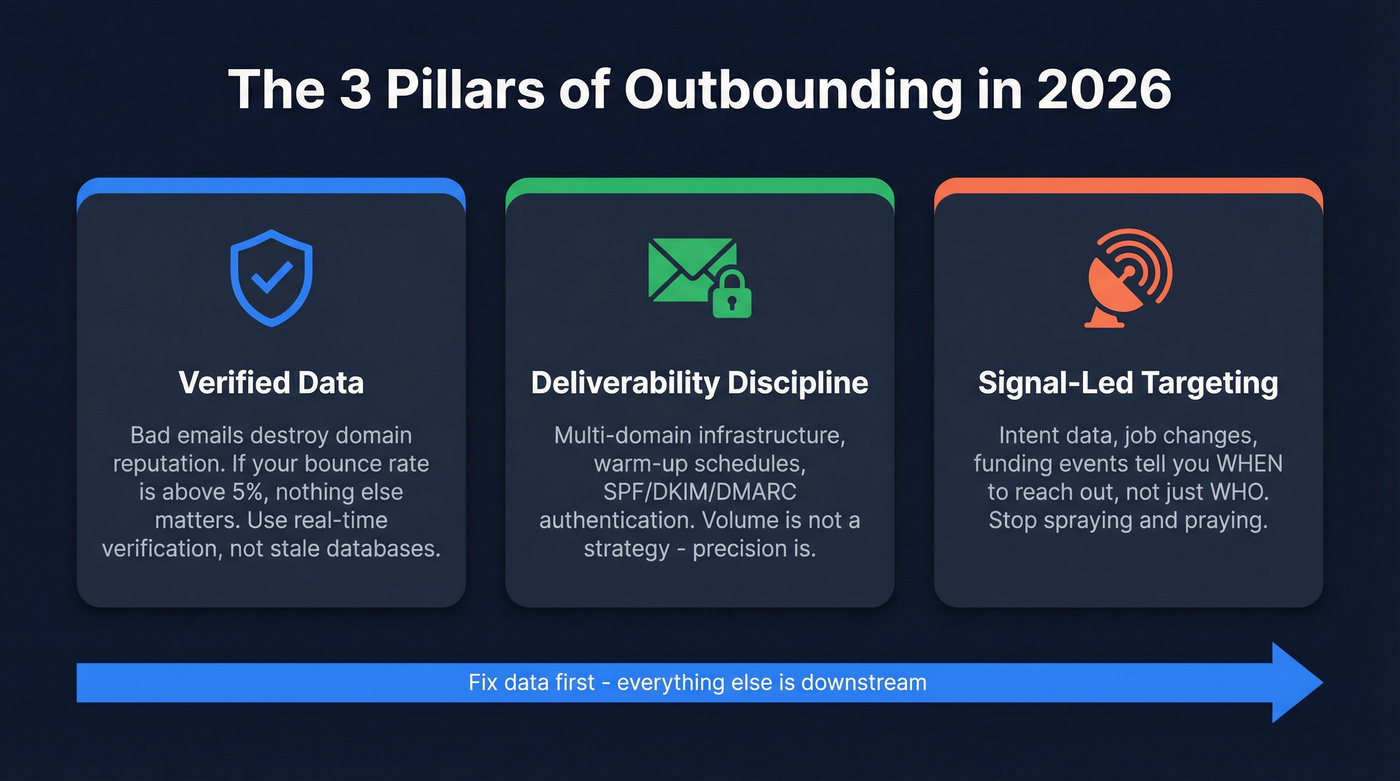
- Verified data, not stale databases. Bad emails destroy domain reputation, tank deliverability, and waste SDR hours. If your bounce rate is above 5%, nothing else matters. (If you want a deeper validator breakdown, see email accuracy.)
- Deliverability discipline, not volume. Sending 500 emails from one domain isn't a strategy. It's a way to get flagged. Multi-domain infrastructure, warm-up schedules, and authentication are table stakes.
- Signal-led targeting, not spray-and-pray. Intent data, job changes, funding events - these signals tell you when to reach out, not just who to reach out to. (More on this in our signal-based outbound playbook.)
Fix your data first. Everything else is downstream.
What Is Outbounding?
Outbound is seller-initiated contact - email, phone, social, video, direct mail - designed to start conversations with prospects who haven't raised their hand. It's the opposite of waiting for inbound leads to show up. You pick the accounts, you craft the message, you control the timing.
William (Skip) Miller's Outbounding book helped popularize the term back in 2020. The core idea - that sellers need to proactively create pipeline rather than rely on marketing - still holds. But 2020 is a lifetime ago in sales. The channels, the tools, the compliance landscape, and buyer expectations have all shifted dramatically. If you're looking for Miller's key principles updated for 2026 realities, you're in the right place.
Only 28% of a salesperson's time is actually spent selling. The rest disappears into research, data entry, CRM hygiene, and internal meetings. Modern outbound prospecting is about compressing that non-selling time through better data, smarter automation, and AI-assisted workflows so the human hours go toward conversations that actually move deals forward. (If you're rebuilding the system end-to-end, start with a prospecting workflow.)
Why Outbound Still Wins
When inbound dries up - and it always does eventually - outbound is the only lever you fully control. You don't wait for Google's algorithm to bless you. You don't hope a webinar attendee converts. You pick the company, find the buyer, and start the conversation. (For the full comparison, see inbound vs outbound sales.)
Outbound gets you to targeted pipeline faster. If you need meetings with VP-level buyers at mid-market SaaS companies in the next 30 days, no amount of content marketing will deliver that. Outbound will. Inbound scales at lower marginal cost over time, but it's slower and less predictable. The best revenue teams run both - outbound for speed and precision, inbound for compounding returns.
The tension is obvious: buyers say they want a rep-free experience, but complex B2B deals still require human-initiated conversations. A $75K annual contract with a 6-month implementation doesn't close itself through a self-serve checkout. Someone has to start that conversation. The question isn't whether to do outbound - it's whether you're doing it well enough to earn the buyer's attention in a world where 70% of sales time goes to non-selling activities.
Hot take: If your deal size sits below $10K ACV, you probably don't need a sophisticated outbound motion at all. Self-serve, product-led growth, and inbound will get you there more efficiently. Outbound earns its keep on complex deals where the cost of a missed opportunity dwarfs the cost of an SDR's time.
Building Your ICP for Outbound Success
Most outbound failures start here - not with bad messaging, but with targeting the wrong accounts entirely. Your ICP needs to be built on four signal types, not just firmographics. (If you want a scoring approach, use account qualification.)
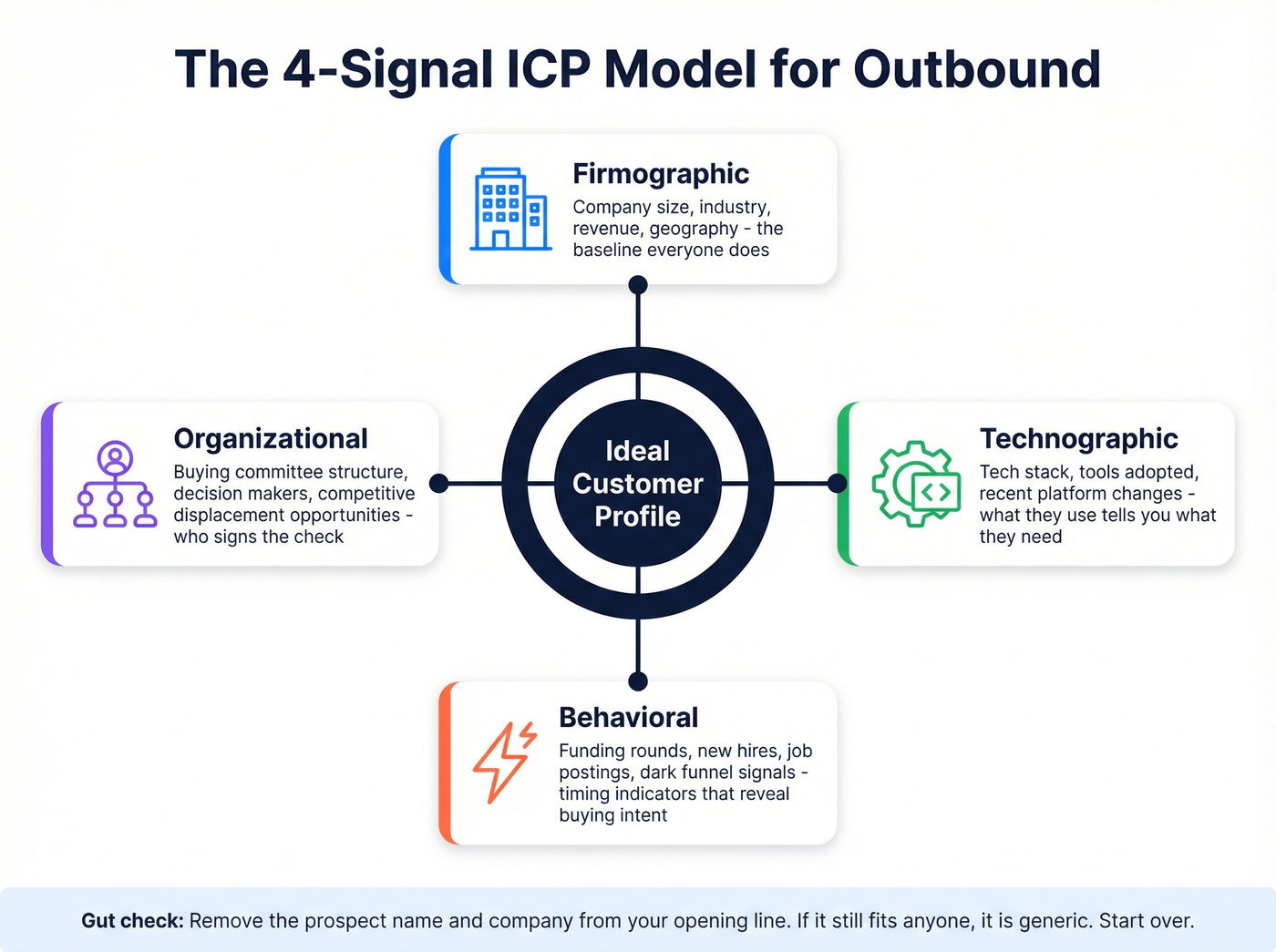
The 4-Signal ICP Model:
- Firmographic - company size, industry, revenue, geography. This is the baseline. Everyone does this. It's necessary but not sufficient.
- Technographic - what tools they use. If you're selling a Salesforce integration, knowing they run Salesforce is table stakes. Knowing they just adopted Outreach tells you they're investing in outbound infrastructure.
- Behavioral - recent funding rounds, new hires in your buyer's department, job postings that signal pain. A company posting for three SDRs is building an outbound motion. That's a signal. This category also includes "dark funnel" signals - community conversations, open-source contributions, social engagement - that traditional CRMs don't capture but reveal genuine buying intent.
- Organizational - buying committee structure, competitive displacement opportunities, decision-making patterns. Who actually signs the check? Tailor messaging differently for executive sponsors focused on strategic outcomes versus end-users and evaluators focused on day-to-day functionality.
Segment across these dimensions: company size, industry, tech stack, buyer role, and lifecycle stage. Build 2-3 outreach variations per segment. A quick gut check from ColdIQ's framework: remove the prospect's name and company from your opening line. If it still fits anyone, it's generic. Start over. (For a tighter segmentation lens, see behavioral segmentation.)
The Modern Outbound Sequence
The old 12-touch, 6-week cadence is dead. Buyers notice when they're being "run through a list," and long sequences signal desperation. The current best practice is 5-7 touches over 2-3 weeks, with each channel doing a distinct job. (Need templates? Use these best sales sequences.)
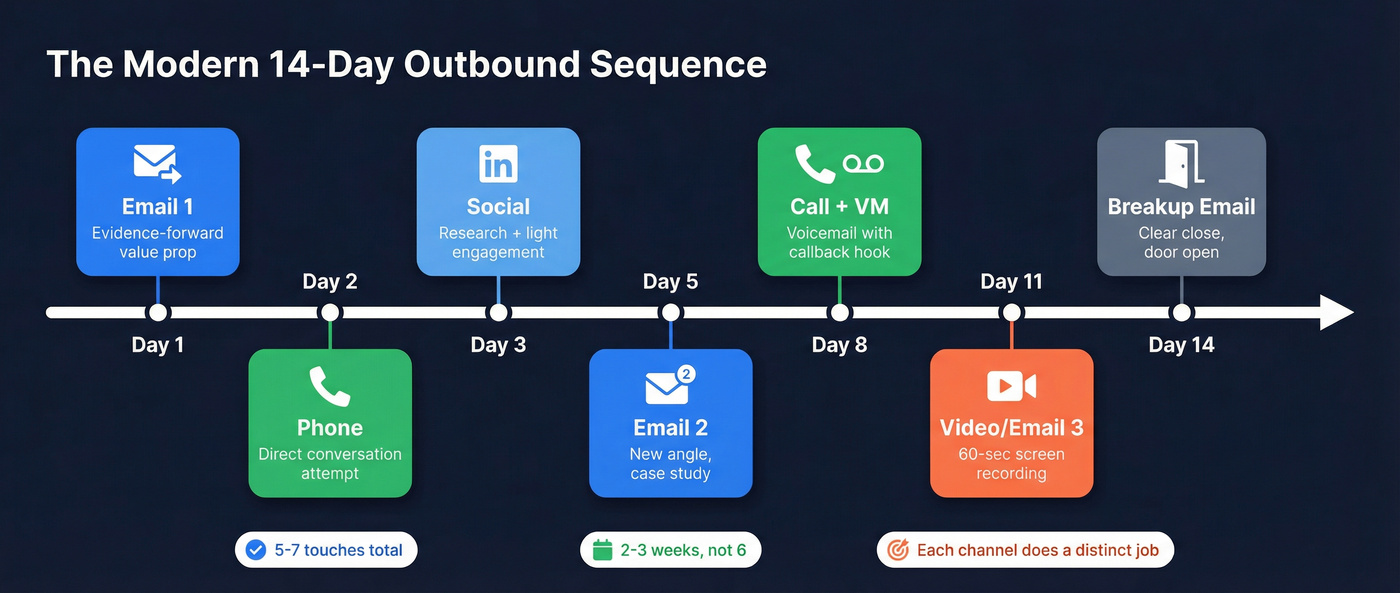
Here's a concrete sequence template:
| Day | Channel | Purpose |
|---|---|---|
| 1 | Evidence-forward value prop | |
| 2 | Phone | Direct conversation attempt |
| 3 | Social | Research + light engagement |
| 5 | Email #2 | New angle, case study |
| 8 | Call + VM | Voicemail with callback hook |
| 11 | Video/Email #3 | 60-sec screen recording |
| 14 | Breakup email | Clear close, door open |
Each channel has a specific role. Email is for delivering evidence - case studies, relevant data points, specific observations about their business. Phone is for objection rehearsal and real-time conversation. Social works best for research and light social proof; a connection request with no message reads as noise. Video shines in technical sales, where a 60-second screen recording tied to their environment outperforms any templated email. (If phone is part of your mix, keep a cold call checklist handy.)
Some teams are taking this further by separating the research function entirely - hiring dedicated researchers so SDRs spend more time in conversations and less time tab-switching between data sources. Outreach's internal "Agoge Tribe" experiment with new SDRs hit 243% of quota using this model. You don't need to hire researchers on day one, but the principle holds: every minute an SDR spends on research is a minute they're not selling.
Personalization Tiers
Don't spend 20 minutes personalizing an email to a company that's a marginal fit. Layer it:
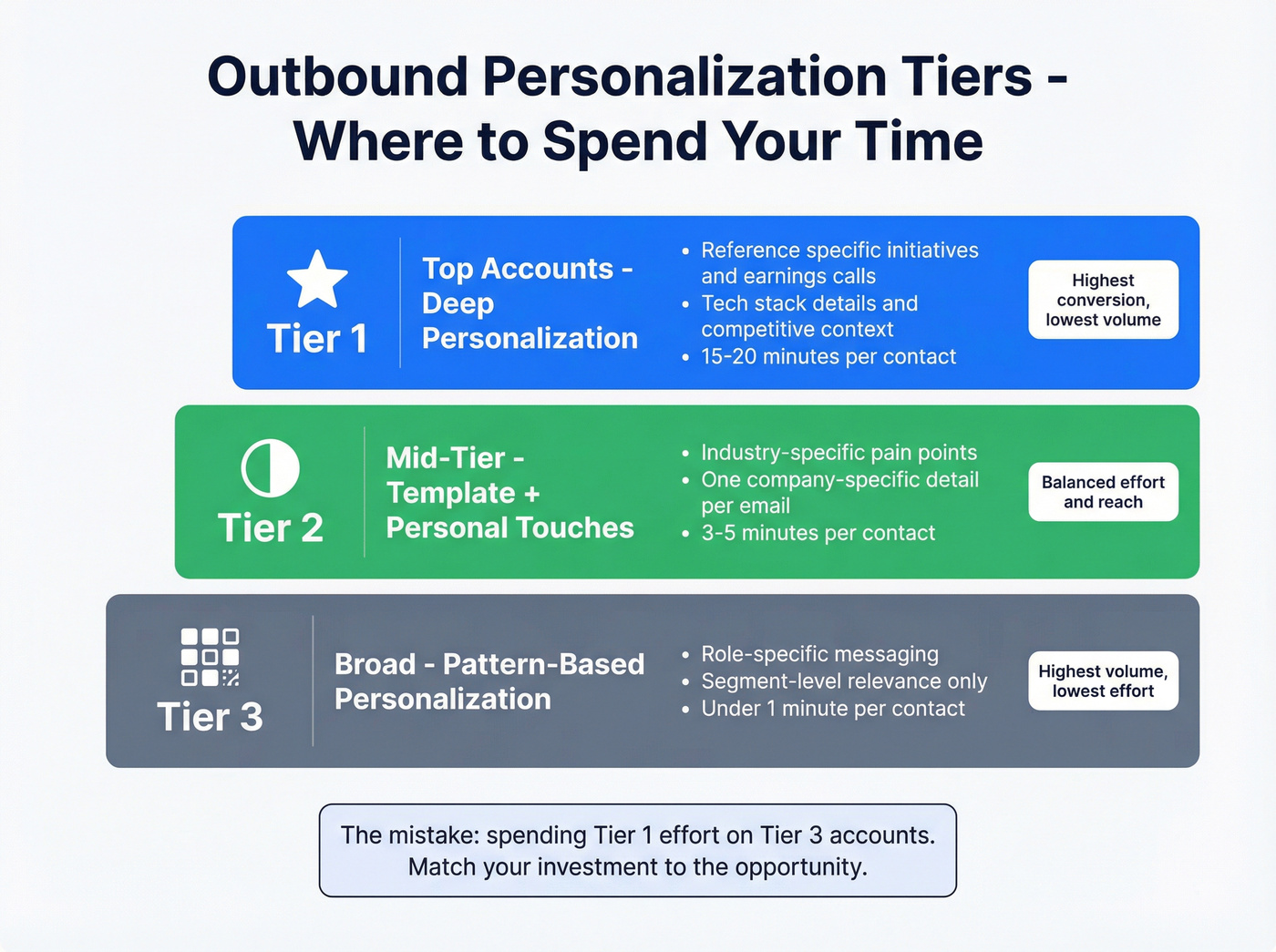
- Top accounts (Tier 1): Deep personalization. Reference specific initiatives, recent earnings calls, tech stack details. Worth 15-20 minutes per contact.
- Mid-tier (Tier 2): Template with 2-3 personalized elements. Industry-specific pain points plus one company-specific detail. 3-5 minutes per contact.
- Broad (Tier 3): Pattern-based personalization. Role-specific messaging with segment-level relevance. Under 1 minute per contact.

You just read it: if your bounce rate is above 5%, nothing else in your outbound motion matters. Prospeo delivers 98% email accuracy with a 7-day refresh cycle - not the 6-week industry average that tanks your domain reputation mid-sequence.
Stop outbounding with stale data. Start with emails that actually land.
Email Deliverability - The Hidden Killer
You can write the best cold email ever crafted. If it lands in spam, nobody reads it. Deliverability is the unglamorous foundation that determines whether your outbound motion works or silently fails. Only 83-87% of emails reach the inbox - roughly 1 in 6 doesn't make it. (If you want the full system, use this email deliverability checklist.)
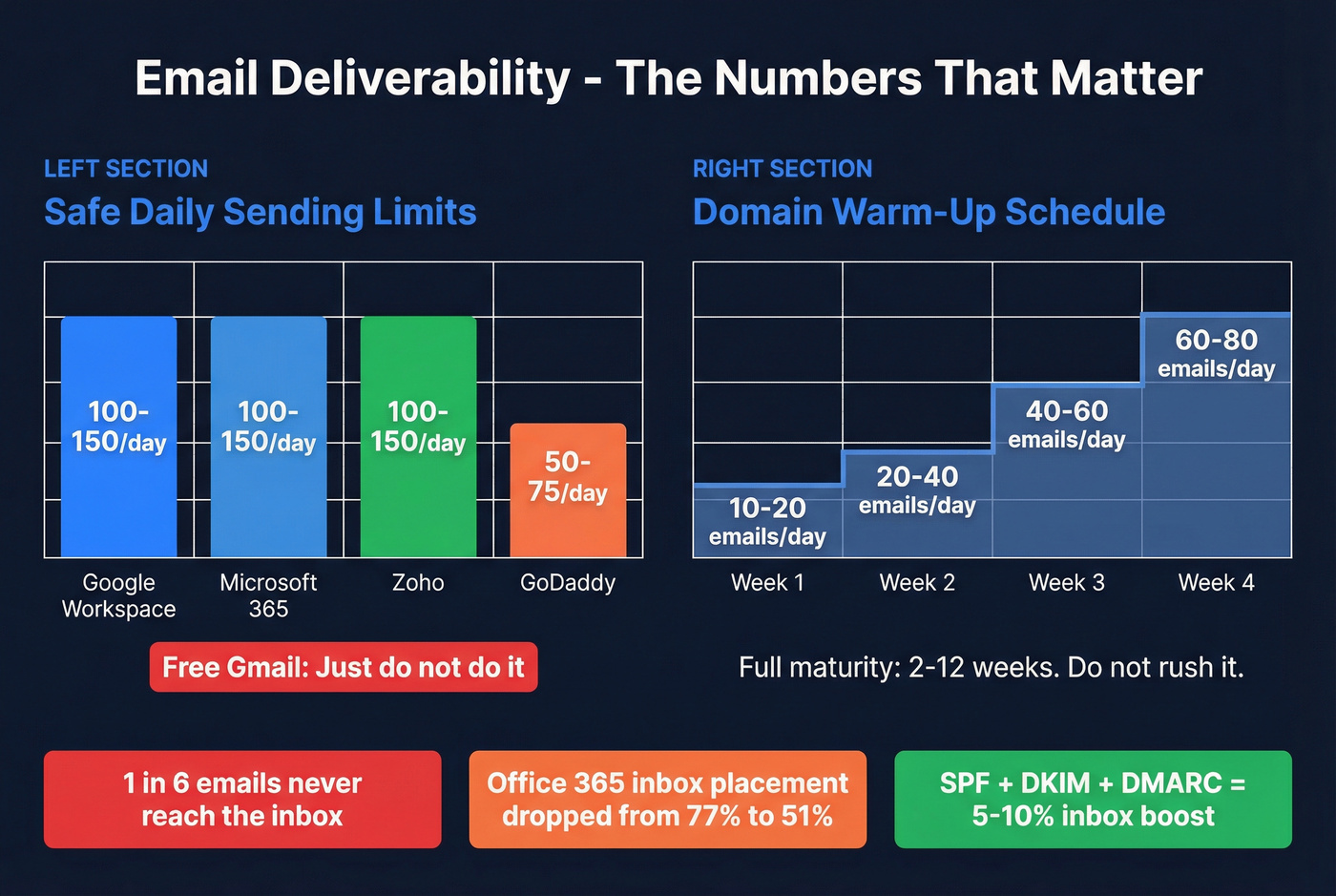
Safe Sending Limits by Provider:
| Provider | Technical Limit | Safe Daily Limit |
|---|---|---|
| Google Workspace | 2,000/day | 100-150/day |
| Microsoft 365 | 10,000 recipients | 100-150/day |
| GoDaddy | 250 recipients | 50-75/day |
| Zoho | ~1,000 | 100-150/day |
| Free Gmail | 500/day | Don't. |
Domain Warm-Up Schedule:
| Week | Daily Volume |
|---|---|
| 1 | 10-20 |
| 2 | 20-40 |
| 3 | 40-60 |
| 4 | 60-80 |
Full maturity takes 2-12 weeks depending on the domain. Don't rush it.
The scaling strategy is multi-domain: send 100/day from 5 domains instead of 500 from 1. Never use your primary corporate domain for cold outbound. Gmail and Yahoo enforce a bulk-sender threshold at 5,000+ emails per day, with complaint rate enforcement at 0.3% (target 0.1%). A bounce rate above 3-5% actively harms your sender reputation. (If you need a deeper infrastructure view, see email sending infrastructure.)
Here's a stat that should worry Microsoft-heavy teams: Office 365 inbox placement dropped from 77.4% to 50.7% year-over-year. If half your prospects are on Outlook, nearly half your emails aren't reaching them.
Authentication is non-negotiable. SPF, DKIM, and DMARC properly configured can boost inbox placement by 5-10 percentage points versus unauthenticated domains. And email verification catches bad addresses before they damage your domain - a 5-step verification process that handles catch-all domains, removes spam traps, and filters honeypots keeps campaigns clean and protects sender reputation.
Data Quality - The Real Foundation
Most outbound failures are data failures, not messaging failures. We've seen this pattern repeatedly: a team spends weeks perfecting their sequences, A/B testing subject lines, and workshopping talk tracks - then launches against a list where 35% of the emails bounce and half the phone numbers are disconnected. The messaging was never the problem. (If you want a KPI-driven approach, see data quality.)
Think about the SDR experience for a second. Four hours of research. Build a list of 50 prospects. Start dialing. Half the phone numbers are wrong. A third of the emails bounce. The domain gets flagged. Now you're spending the next two weeks rebuilding sender reputation instead of booking meetings. This is what happens when teams run on stale databases with long refresh cycles, and it's genuinely infuriating because it's entirely preventable.

The proof is in the customer results. Snyk's 50-person AE team went from 35-40% bounce rates to under 5%, with AE-sourced pipeline up 180% and 200+ new opportunities per month. Meritt tripled pipeline from $100K to $300K per week while dropping bounce rates from 35% to under 4%. Stack Optimize built from $0 to $1M ARR with 94%+ client deliverability, sub-3% bounce rates, and zero domain flags across all clients.
Signal-led targeting only works when you can act on the signals. Prospeo combines intent data across 15,000 topics, technographic filters, job change alerts, and funding signals - all layered on 300M+ profiles with verified direct dials.
Build the signal-led outbound list your sequence deserves.
AI and the New Outbound Playbook
45% of high-performing sales teams have adopted hybrid human-AI SDR models. Among teams using AI SDR tools, 100% report saving time on prospecting activities, and 40% save 4-7 hours per week. This isn't theoretical anymore - it's operational. (If you're evaluating options, start with AI SDR for SMB and enterprise.)
The biggest gains are in research compression. LivePerson reduced per-prospect research time from 20 minutes to 2 minutes and saw a 35% lift in engagement rates. Teams using AI-powered prospecting report up to 90% reduction in research time. That's not about replacing SDRs - it's about freeing them to spend time on conversations instead of copying data between browser tabs.
But let's be honest about the backlash. "AI personalization fatigue" is real, and it's becoming one of the biggest threats to outbound effectiveness. Prospects can spot a shallow AI-generated first line instantly - the ones that reference a podcast appearance from 2019 or congratulate someone on a job change from eight months ago. As ColdIQ's GTM lead put it: "People are fatigued by plain AI personalization... you have to go deeper than personalizing the first sentence... stack different layers of personalization and relevance."
The winning approach is layered. AI handles research, data enrichment, and draft generation. Humans add judgment, context, and the kind of insight that comes from actually understanding the prospect's business. The tool consolidation trend reinforces this - organizations are moving from 8-12 point solutions down to 4-6 integrated platforms that handle the full workflow without constant context-switching.
Mistakes That Kill Your Pipeline
These come directly from patterns we see across dozens of outbound teams. Most are avoidable.
- Targeting wrong accounts. Your ICP is aspirational, not validated. You're emailing companies that would never buy.
- No ICP segmentation. Treating a 50-person startup and a 5,000-person enterprise with the same messaging.
- Ignoring personas. Emailing the CTO with a message written for the VP of Sales.
- Generic messaging. If you remove the prospect's name and it still works for anyone, it's generic.
- Single-channel reliance. Email-only outbound leaves 60-70% of potential touchpoints on the table.
- Volume over fit. Sending 1,000 emails to a mediocre list instead of 200 to a great one.
- Stale ICP. Your ideal customer profile from 18 months ago doesn't reflect today's market.
- Skipping discovery. Jumping to a demo before understanding the prospect's actual problem.
- Pitching too soon. First touch shouldn't be a feature dump. It should earn the next conversation.
- Not learning from feedback. 44% of reps give up after one "no." Objections are data. Use them.
The bonus mistake for 2026: relying on AI personalization as a substitute for relevance. A perfectly generated first line means nothing if the underlying offer doesn't match the prospect's actual pain.
The Outbound Tech Stack
You don't need 10 tools. You need 3-4 that actually integrate. Here's how the categories break down.
| Tool | Category | Starting Price | Best For |
|---|---|---|---|
| Prospeo | Data & Verification | ~$0.01/email, free tier | Verified emails + mobiles |
| Apollo.io | All-in-One Prospecting | Free; Pro $49/user/mo | SMB all-in-one prospecting |
| Clay | Enrichment & Workflows | From $134/mo | Custom enrichment sequences |
| Smartlead | Email Automation | From $39/mo | Multi-inbox cold email |
| Instantly | Email Automation | From $30/mo | Budget cold email at scale |
| Outreach | Sales Engagement | ~$100-150/user/mo | Enterprise sequences |
| Salesloft | Sales Engagement | ~$100-150/user/mo | Enterprise sequences |
| Lavender | AI Email Coaching | From $29/user/mo | Real-time writing feedback |
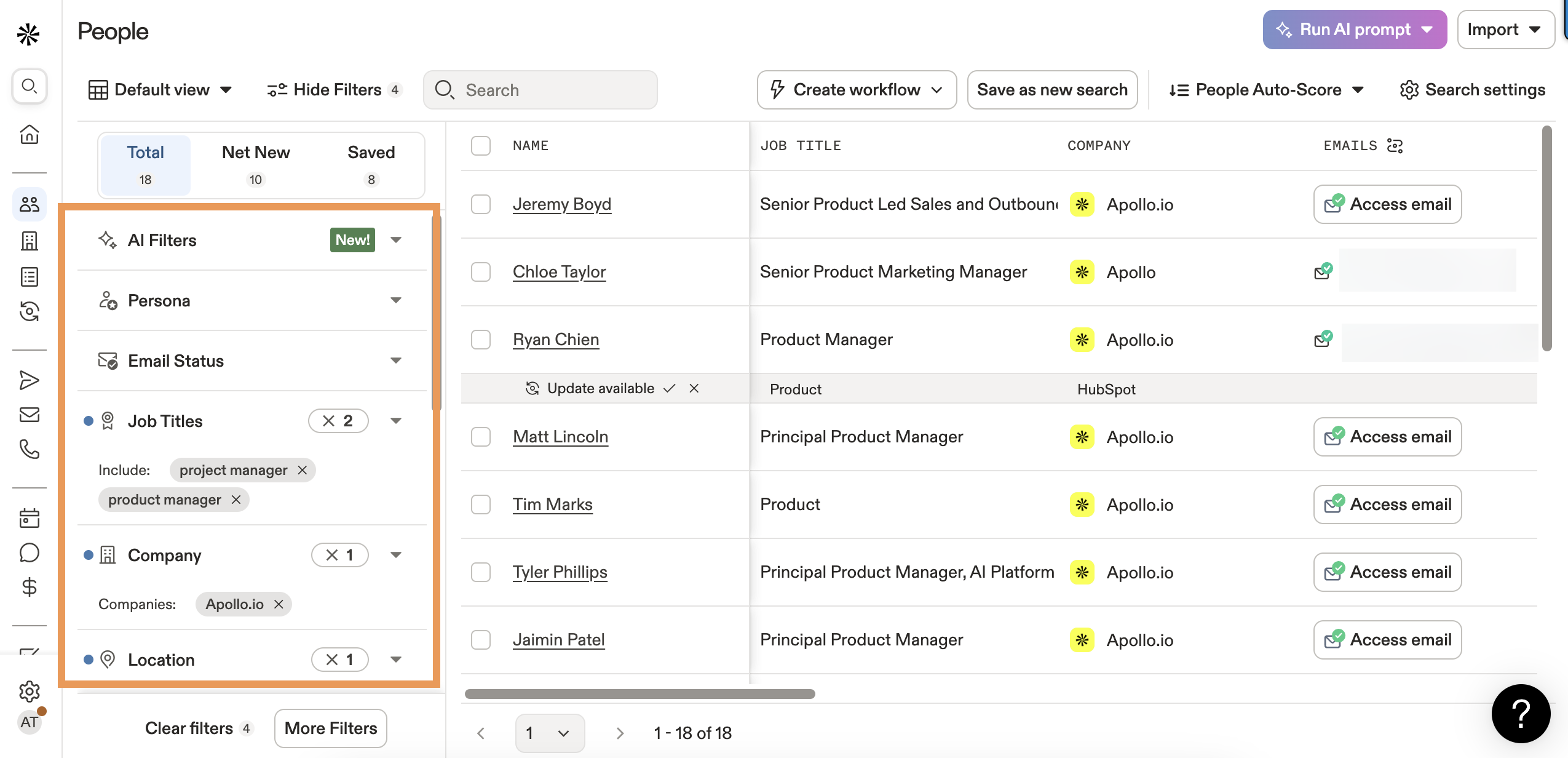
Apollo.io is the obvious starting point for SMB teams that want prospecting, sequencing, and a database in one platform. The 275M+ contact database is widely used for North American prospecting, and the free tier is genuinely useful for testing. Where it falls short is data accuracy on emails and phones compared to dedicated verification tools - pairing it with a verification layer keeps your bounce rates clean. (If you're comparing categories, see sales prospecting platforms.)
Clay is for teams that want to build custom enrichment workflows - waterfall enrichment across multiple providers, AI-powered research, and automated list building. It's powerful but has a learning curve. Think of it as the "developer tool" of the outbound stack.
Smartlead and Instantly handle multi-inbox cold email infrastructure. Both manage warm-up, rotation, and deliverability across multiple sending accounts. Smartlead has a slight edge on advanced rotation features; Instantly wins on simplicity and price. They're functionally similar enough that UI preference should drive your decision.
Outreach and Salesloft are enterprise sales engagement platforms. If you have fewer than 5 SDRs, skip these and use Smartlead or Instantly instead. They're overkill for small teams but essential for organizations running complex multi-step sequences across large SDR teams.
Lavender coaches reps on email quality in real time - tone, length, readability. Worth it if your team writes a lot of custom emails. Skip it if you're running mostly templated sequences.
Before buying anything, run through this evaluation checklist: does it fit your process? Does it fit your budget? Does it integrate with what you already use? Can your team actually adopt it in under two weeks?
Outbound Benchmarks and KPIs
Here's what "good" looks like in 2026, based on industry ranges and platform data:
| Metric | Benchmark Range |
|---|---|
| Cold email reply rate | 3-10% |
| Positive reply rate | 1-3% |
| Meeting rate (per prospect list) | 0.5-2% |
| Cold call connect rate | 3-5% |
| Reply rate (positive signal) | >10% |
Speed matters more than most teams realize. Deals closed within 50 days show a 47% win rate versus 20% for deals that drag beyond that threshold. Teams using conversation intelligence close deals 11 days faster on average, with a 10-percentage-point win-rate improvement on deals over $50K. And 34% of sales teams operate on 1-2 quarter sales cycles, which means every week of pipeline delay compounds quickly.
If your reply rate is below 1%, don't tweak subject lines. Look at your data, your targeting, and your domain reputation first. Those are the three levers that actually move the needle.
FAQ
Is outbounding still effective in 2026?
Yes - 45% of high-performing teams now run hybrid human-AI SDR models, and outbound remains the fastest path to targeted pipeline. The tactics have evolved, but seller-initiated contact is stronger than ever for complex B2B sales with deal sizes above $15K.
How many cold emails can I send per day?
The safe limit is 100-150 per domain per day. Scale by adding domains (5 domains x 100/day = 500/day), not by pushing volume on a single domain. Warm up new domains for 2-4 weeks minimum before reaching full sending volume.
What's a good cold email reply rate?
Expect 3-10% depending on ICP quality and offer relevance. Above 10% signals strong targeting and deliverability. Below 1% means your data, messaging, or domain reputation needs work - fix data first, then revisit copy.
How do I stop outbound emails landing in spam?
Authenticate your domain (SPF/DKIM/DMARC), verify every email before sending, keep bounce rates under 3%, and never exceed 150 emails per day per domain. Multi-domain infrastructure and proper warm-up are the two most overlooked fixes.
Outbound vs. inbound - which should I prioritize?
Neither replaces the other. Outbound gives you control and speed to targeted accounts; inbound scales at lower marginal cost but is slower and less predictable. The best revenue teams run both - outbound for precision pipeline, inbound for compounding organic demand.