

What Is an SQO (Sales Qualified Opportunity)? The Complete Guide
Your VP of Sales just pulled up last quarter's pipeline review. Sixty percent of "qualified" opportunities stalled before a single proposal went out. The forecast was off by a mile, and nobody could explain why. The real problem isn't that deals died - it's that they were never truly qualified as an SQO in the first place.
The Short Version
A sales qualified opportunity is a deal that an Account Executive has formally accepted into pipeline after validating fit, need, and a clear next step. It sits one stage beyond an SQL. Most teams skip the definition entirely, then wonder why forecasts are fiction.
What follows covers the exact criteria, frameworks, benchmarks, and CRM setup to make this stage a real, revenue-driving gate - not just another acronym on a whiteboard.
What Does SQO Mean in Sales?
A Sales Qualified Opportunity is a deal that an Account Executive has formally accepted from an SDR after confirming a validated problem, an identified stakeholder, and a defined next step.
Every word matters here. "Formally accepted" means the AE reviewed the opportunity and agreed it belongs in pipeline - not that a meeting was booked and auto-promoted. "Validated problem" means the prospect articulated a pain point, not that they downloaded a whitepaper. "Defined next step" means there's a concrete action on the calendar, not a vague "let's circle back."
The distinction between a generic "opportunity" and a properly qualified one is structured validation. Plenty of CRMs are full of opportunities that are really just meetings that went okay. An SQO requires the AE to put their name on it and say: this is real, this person has a problem we solve, and we have a path forward.
This is the moment a deal stops being a lead and starts being a forecast input. If your AEs aren't gatekeeping this stage, your pipeline numbers are aspirational at best.
Where SQO Fits in the Funnel
The alphabet soup of pipeline stages confuses everyone. Here's the full lifecycle, laid out cleanly.
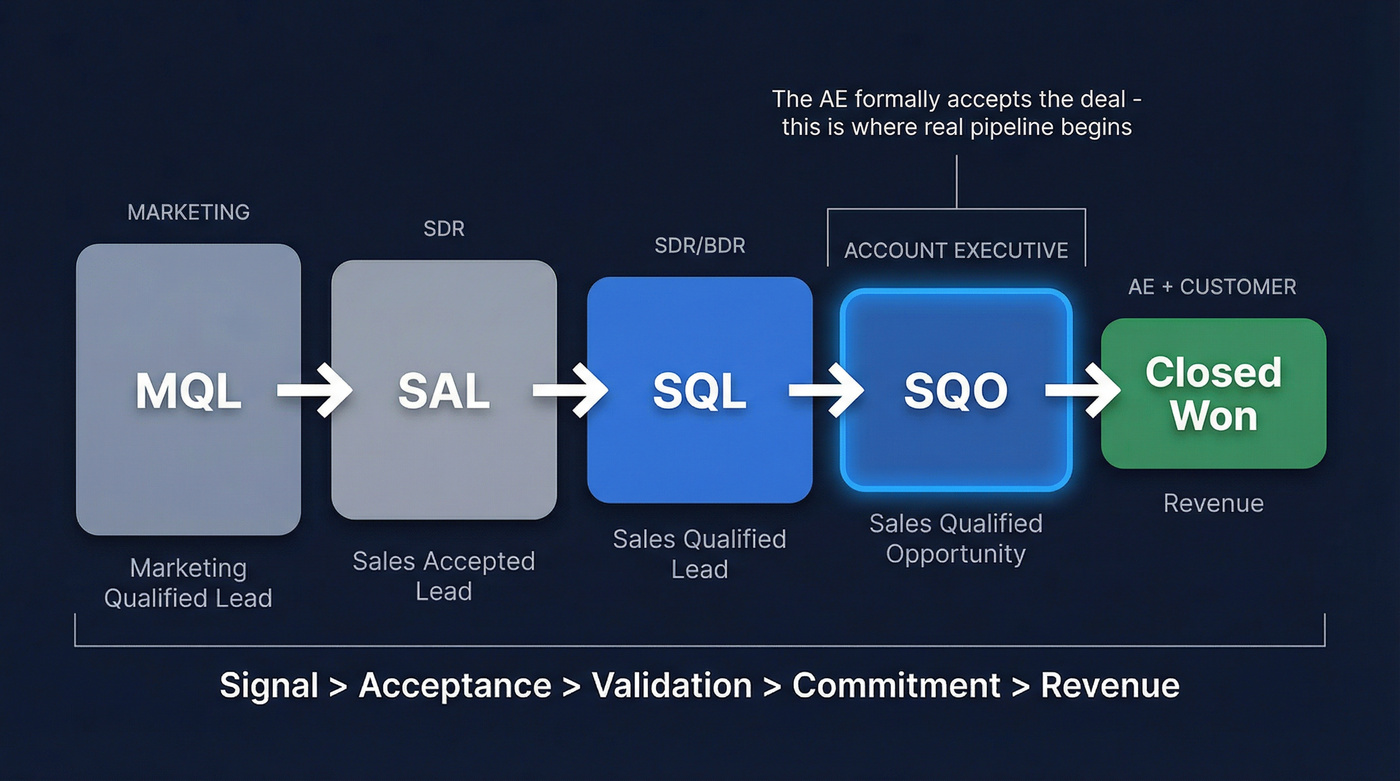
| Stage | Owner | Definition | Example Signal |
|---|---|---|---|
| MQL | Marketing | Above-average engagement | Downloaded whitepaper, webinar |
| SAL | Sales | Lead accepted by sales, not yet qualified | Matches ICP, assigned to SDR |
| SQL | Sales (typically SDR/BDR) | Buying intent confirmed through interaction | Discovery call, pain validated |
| SQO | AE (accepted) | Validated opp with criteria + next step | Pricing discussed, demo set |
| PQL | Product/Sales | Qualified via product usage | Trial user hit activation |
SAL trips people up. It's the handoff point where sales accepts a marketing lead but hasn't qualified it yet. An SAL might match your ICP on paper - right industry, right headcount, right title - but nobody's talked to them. The SDR still needs to run discovery before it becomes an SQL.
PQL matters if you're running a product-led growth motion. These prospects qualify themselves through usage patterns - hitting activation thresholds, inviting teammates, exploring paid features. They skip the traditional MQL path entirely.
Each stage narrows the funnel and increases confidence. MQL is a signal. SAL is acceptance. SQL is validation. SQO is commitment. Every stage without clear criteria is a stage where deals leak.
SQO vs SQL vs MQL
An MQL showed interest. They engaged with marketing content - attended a webinar, downloaded a guide, visited your pricing page multiple times. Marketing says they're worth talking to. That's it.
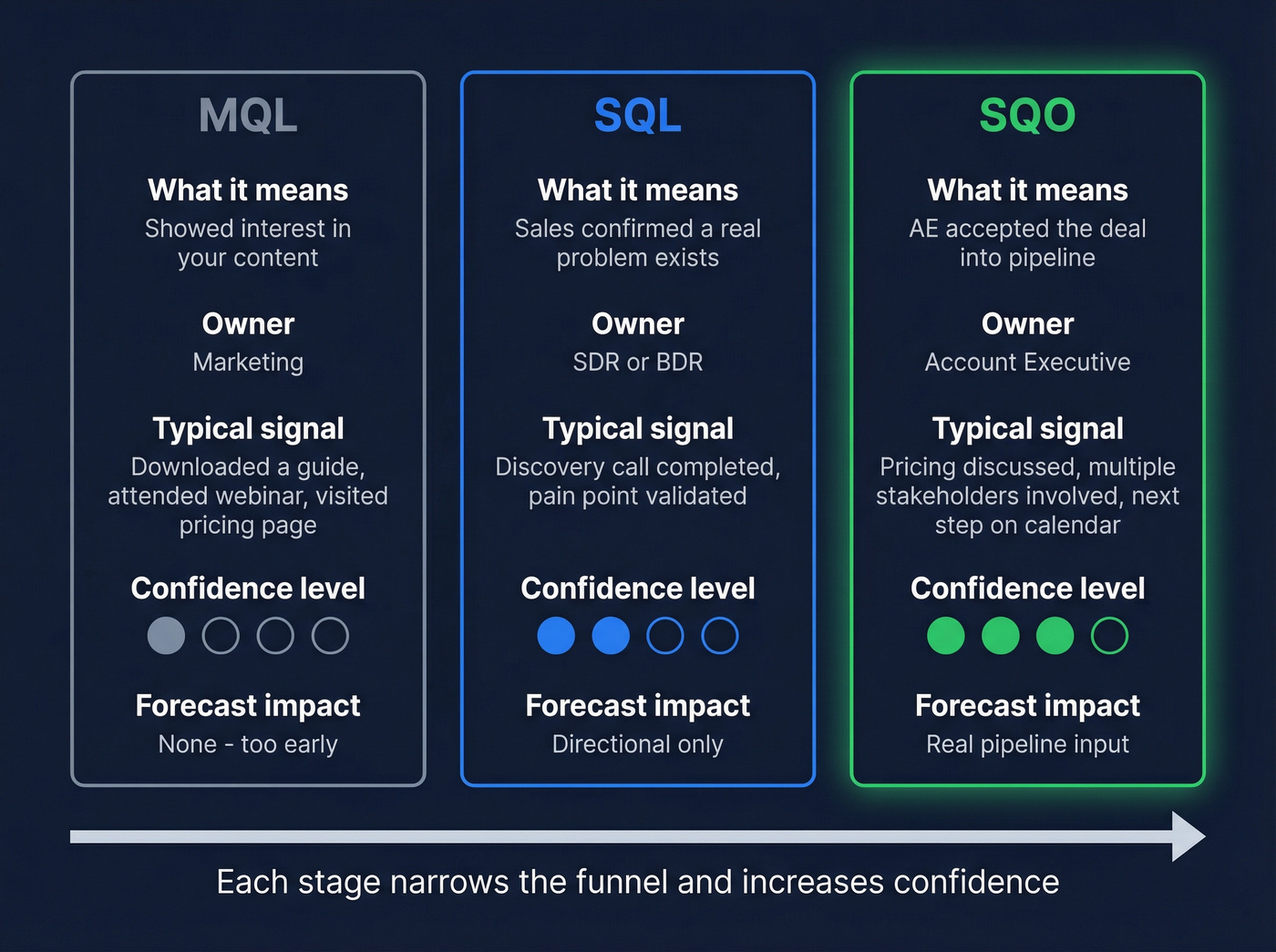
An SQL went further. Sales had a real conversation, confirmed the prospect has a problem worth solving, and determined they're worth an AE's time.
A sales qualified opportunity is where real pipeline begins. The AE has accepted the deal after confirming pricing discussions are happening, multiple stakeholders are involved, technical evaluation is underway, and clear buying criteria or next steps are established. When a prospect starts asking about implementation timelines and security reviews, that's opportunity territory - not SQL.
With 72% of CMOs planning to increase marketing budgets relative to sales in 2026, the volume of MQLs hitting sales teams is only going up. That makes the qualification gate more critical than ever - without it, AEs drown in leads that look qualified on paper but collapse under scrutiny.

Bad data kills SQOs before they start. If your AEs can't reach the right stakeholders, no qualification framework will save the deal. Prospeo gives you 98% verified emails and 125M+ direct dials so every opportunity has real contacts behind it.
Stop qualifying ghosts. Start building pipeline with verified buyer data.
Core Qualification Criteria
Before an AE accepts an opportunity, these five criteria need clear answers. Not perfect answers - clear ones.
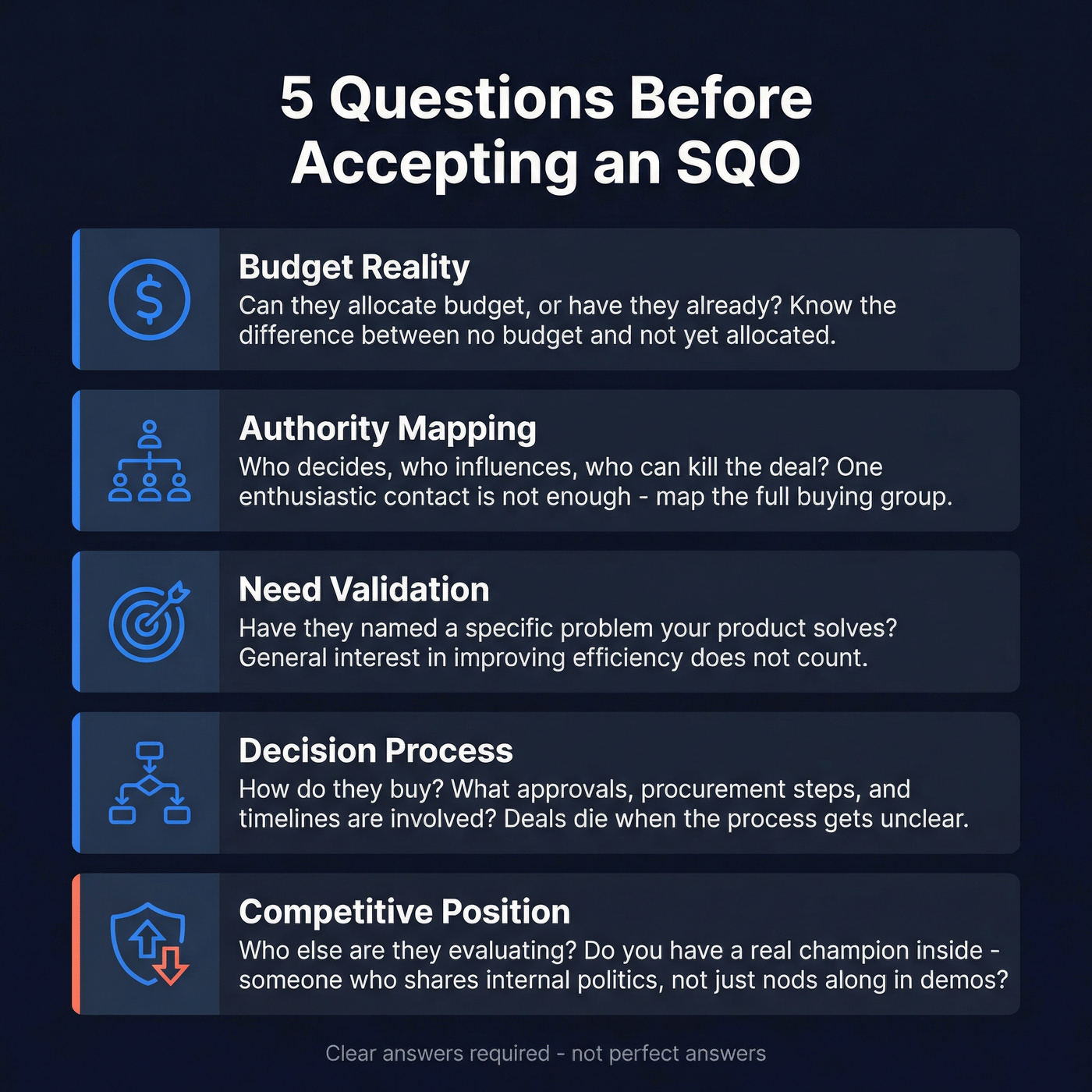
Budget Reality
Does the prospect have budget allocated, or can they create it? "We don't have budget" and "we haven't allocated budget yet" are very different statements. Dig into which one you're hearing.
Authority Mapping
You need to know who makes the final call, who influences it, and who can kill the deal. A single enthusiastic contact isn't enough. Modern B2B buying groups often include 6-10+ stakeholders, and if you've only talked to one, you haven't mapped authority.
Need Validation
The prospect has articulated a specific problem your product solves. Not a general interest in "improving efficiency" - a concrete pain with measurable impact on their business.
Decision Process
You understand how they buy. What approvals are needed? What's the timeline? Is there a procurement team involved? Deals die when the buying process gets unclear, not just when discovery goes poorly.
Competitive Position
You know who else they're evaluating and you have a differentiation strategy. You also need a real champion inside the account - someone who shares internal politics and brings detractors to the table. If they're just nodding along in demos, they're a fan, not a champion.
SQO Qualification Frameworks
There are a lot of frameworks for qualifying opportunities. None is universally correct. All of them are better than winging it.
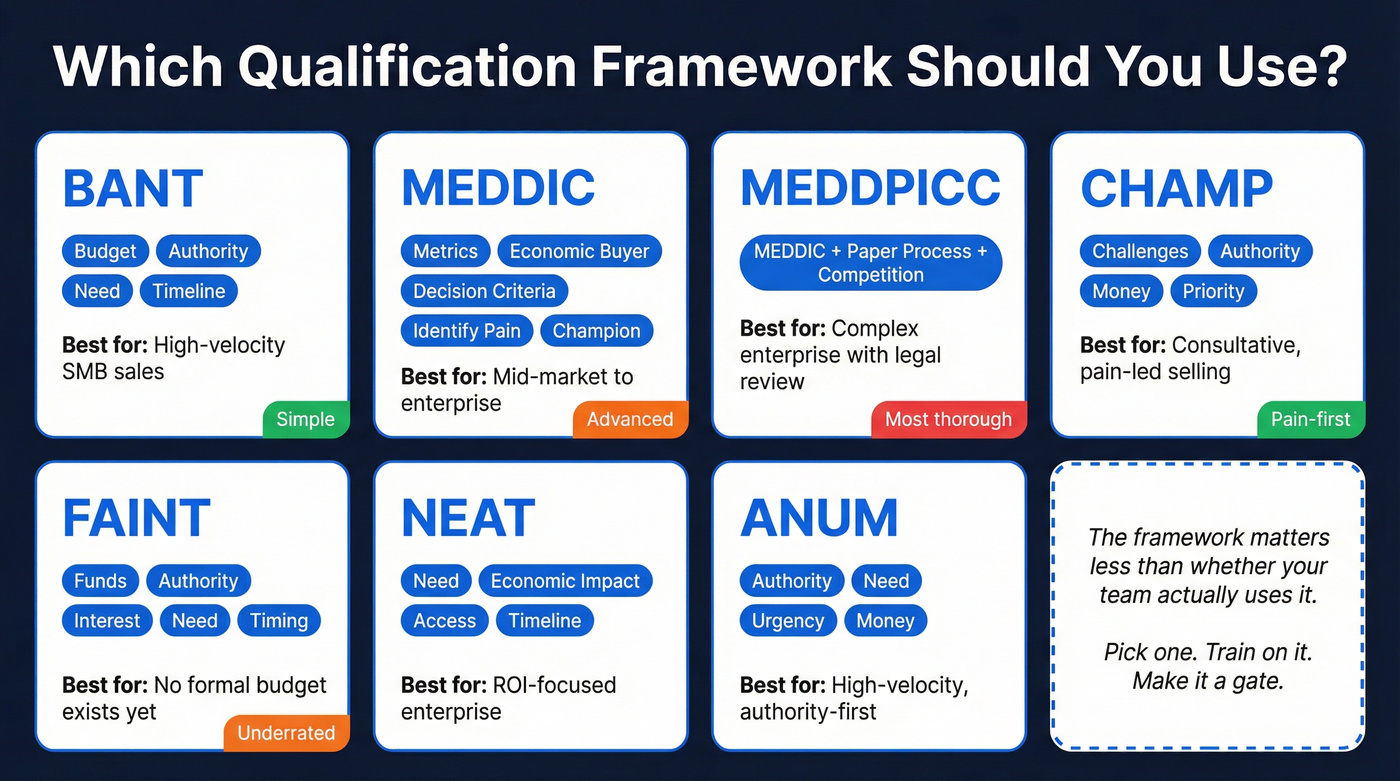
| Framework | Core Focus | Best For |
|---|---|---|
| BANT | Budget, Authority, Need, Timeline | High-velocity SMB |
| MEDDIC | Metrics, Buyer, Criteria, Process, Pain, Champion | Mid-market to enterprise |
| MEDDPICC | MEDDIC + Paper Process, Competition | Complex enterprise |
| CHAMP | Challenges, Authority, Money, Priority | Consultative, pain-led |
| GPCTBA/C&I | Goals, Plans, Challenges + Budget, Authority | Inbound-heavy teams |
| FAINT | Funds, Authority, Interest, Need, Timing | No formal budget exists |
| NEAT | Need, Economic Impact, Access, Timeline | ROI-focused enterprise |
| ANUM | Authority, Need, Urgency, Money | High-velocity, authority-first |
BANT is fine for SMB. Stop using it for enterprise deals. It was designed for transactional sales where budget and timeline are knowable in a single call. When you're selling a six-figure platform to a company with a 6-10+ person buying group and a long sales cycle, asking "do you have budget?" in the first meeting is naive at best.
MEDDIC and MEDDPICC are the workhorses for mid-market and enterprise. MEDDPICC adds paper process - how contracts actually get signed - and competition tracking, both critical when deals involve legal review and multi-vendor evaluations.
CHAMP flips the script by leading with challenges instead of budget. It's strong for consultative sales where the prospect doesn't know they have a budget problem yet - they know they have a business problem. FAINT deserves more attention than it gets. It acknowledges that many prospects don't have formal budgets allocated. "Funds" replaces "budget," meaning the organization has money and could allocate it if the case is compelling enough. That's reality for most mid-market deals.
Here's the thing: the framework you pick matters far less than whether your team actually uses it. We've seen teams adopt MEDDPICC, fill it out for two weeks, then abandon it because nobody enforced the fields. Pick one. Train on it. Make it a gate. That's what turns a framework from a slide deck into a pipeline tool.
Benchmarks and Conversion Rates
Hard SQO-specific benchmarks are scarce because most published data lumps SQL and opportunity stages together. Here's what we know, plus reasonable estimates based on what we've seen across different sales motions.
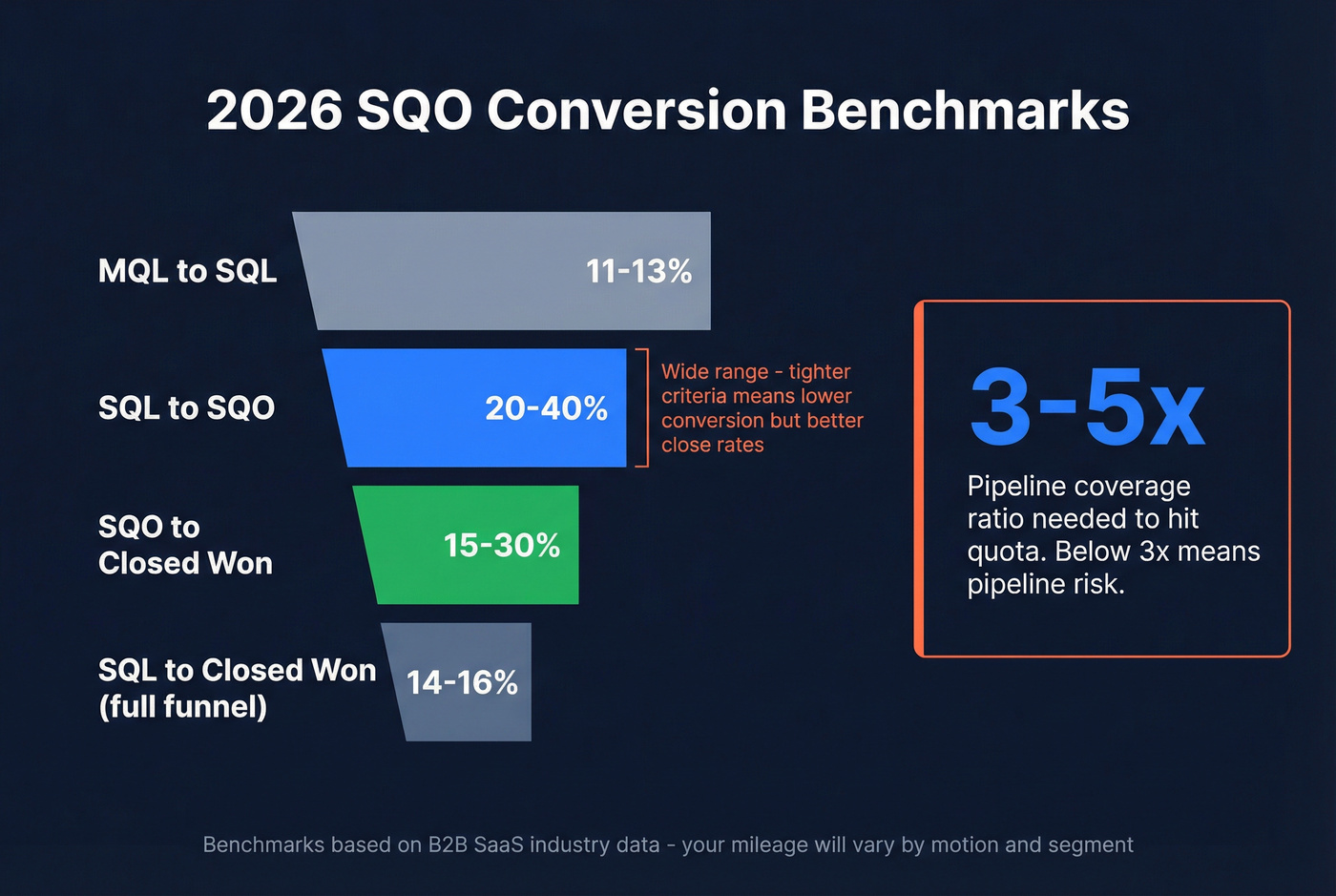
| Conversion | Benchmark Range | Notes |
|---|---|---|
| MQL → SQL | 11-13% | Financial services/fintech |
| SQL → SQO | 20-40% (est.) | Higher inbound, lower outbound |
| SQO → Closed Won | 15-30% (est.) | Higher PLG, lower enterprise |
| SQL → Closed Won | 14-16% | Full-funnel baseline |
| Pipeline Coverage | 3-5x quota | Below 3x = pipeline risk |
That SQL → Closed Won row is revealing. If only 14-16% of SQLs close overall, but qualified opportunities close at 15-30%, the SQO stage is doing real work - it filters out the deals that would've dragged your win rate down.
The SQL → SQO range is wide because it depends on how strict your criteria are. Teams with loose definitions see 40%+ conversion and then wonder why their close rate is terrible. Teams with tight criteria see 20-25% conversion but close at higher rates downstream. There's no free lunch here.
The most important operational point: AE-gated opportunities produce cleaner pipeline. If a deal can be created by automation or by an SDR alone, you don't have a real qualification stage - you have a renamed meeting stage.
How to Track SQOs in Your CRM
The operational trigger is straightforward: an AE formally accepts an opportunity from an SDR. That acceptance - not the meeting booking, not the discovery call - is what creates the stage in your CRM.
Create a dedicated pipeline stage. Require AE acceptance as the gate, meaning the stage can't be reached by automation or by the SDR alone. The AE reviews the qualification criteria and manually advances the deal. This friction is intentional. It forces the AE to evaluate before the deal inflates your pipeline.
Track these formulas at the team and individual level:
- Pipeline Generated = sum of all SDR-sourced opportunity values
- Average Deal Size = total pipeline generated / number of qualified opportunities
- Lead-to-Opportunity Conversion = (SQOs / total leads worked) x 100
- Pipeline Coverage Ratio = total pipeline value / sales quota
The conversion rate between stages is where you spot bottlenecks. If your SQL → SQO rate drops suddenly, either qualification criteria changed or SDRs are passing weaker leads. If your close rate drops, AEs are accepting deals too loosely.
One step most teams skip: verifying contact data before AE acceptance. If the emails and phone numbers attached to an opportunity are stale, the deal is technically qualified but practically unreachable. We've found that running contacts through an enrichment step - returning 50+ data points per contact on a weekly refresh cycle - means AEs accept opportunities with verified, current information instead of data that's six months old.
Common Mistakes to Avoid
Stage inflation. This is the most common pipeline sin. SDRs book a meeting, it auto-advances in the CRM, and suddenly your pipeline looks 3x bigger than reality. The fix: require manual AE acceptance. No exceptions.
SDR-AE misalignment on acceptance criteria. If your SDRs think a completed discovery call qualifies a deal, but your AEs expect budget confirmation and multi-stakeholder access, you'll have a constant friction loop. Document the criteria. Make them visible. Review them quarterly. The specific framework matters less than both teams agreeing on what "qualified" means.
Bad contact data corrupting pipeline metrics. This one's a silent killer. A team books 40 meetings in a month. Twelve become real opportunities. The other 28? Emails bounced, phone numbers were disconnected, contacts had left the company months ago. Your pipeline count says 40. Reality says 12. Before switching to Prospeo, Snyk's sales team was running bounce rates of 35-40%. After implementing 98% accuracy emails on a 7-day refresh cycle, bounce rates dropped under 5%, AE-sourced pipeline grew 180%, and the team generated 200+ new opportunities per month.
Ignoring pipeline velocity by source. Not all opportunities are equal. An inbound deal from a demo request closes faster than an outbound one from a cold sequence. If you're blending them in your forecast model, your predictions will consistently miss. Tag the source. Measure velocity separately. Skip this step and you'll keep wondering why your quarterly forecast is off by 30%.
Authority mapping requires reaching 6-10 stakeholders per deal. Prospeo's 300M+ profiles with 30+ filters - including department headcount, job changes, and buyer intent - let you map the entire buying group before your first discovery call.
Map every decision-maker in the account for $0.01 per contact.
FAQ
What is an SQO in sales?
A Sales Qualified Opportunity is a deal that an AE has formally accepted into pipeline after validating budget, authority, need, competitive position, and a defined next step. It sits one stage beyond an SQL and represents the point where a lead becomes a real forecast input.
Is an SQO the same as an SQL?
No. An SQL is a lead qualified for a sales conversation - sales confirmed interest and fit. An SQO is one stage further: an opportunity formally accepted by an AE after validating budget reality, stakeholder access, and a concrete next step on the calendar.
How many SQOs should an SDR generate per month?
High-velocity SMB teams typically target 15-25 per SDR monthly. Enterprise SDRs working complex, multi-stakeholder deals target 5-10. One well-qualified opportunity outperforms five that stall at proposal.
What's a good SQO-to-close rate?
Most B2B teams see 15-30% convert to Closed Won. Inbound and PLG motions trend higher at 25-30%. Outbound enterprise sits closer to 15%. Below 15% means your qualification criteria need tightening.
How does contact data quality affect SQO accuracy?
Directly. If emails bounce and phone numbers are dead, your "qualified opportunities" aren't reachable and your pipeline count is inflated. Verifying contacts before they enter the pipeline - using a tool like Prospeo with 98% email accuracy and a 7-day refresh cycle - ensures counts reflect real, contactable prospects.