

Best Email Deliverability Tools in 2026 (We Tested 12)
Every deliverability guide starts with warmup tools. That's backwards. Warmup is step 3. Step 1 is making sure you're emailing real people at real addresses - and most teams skip it entirely, then wonder why their domains end up flagged.
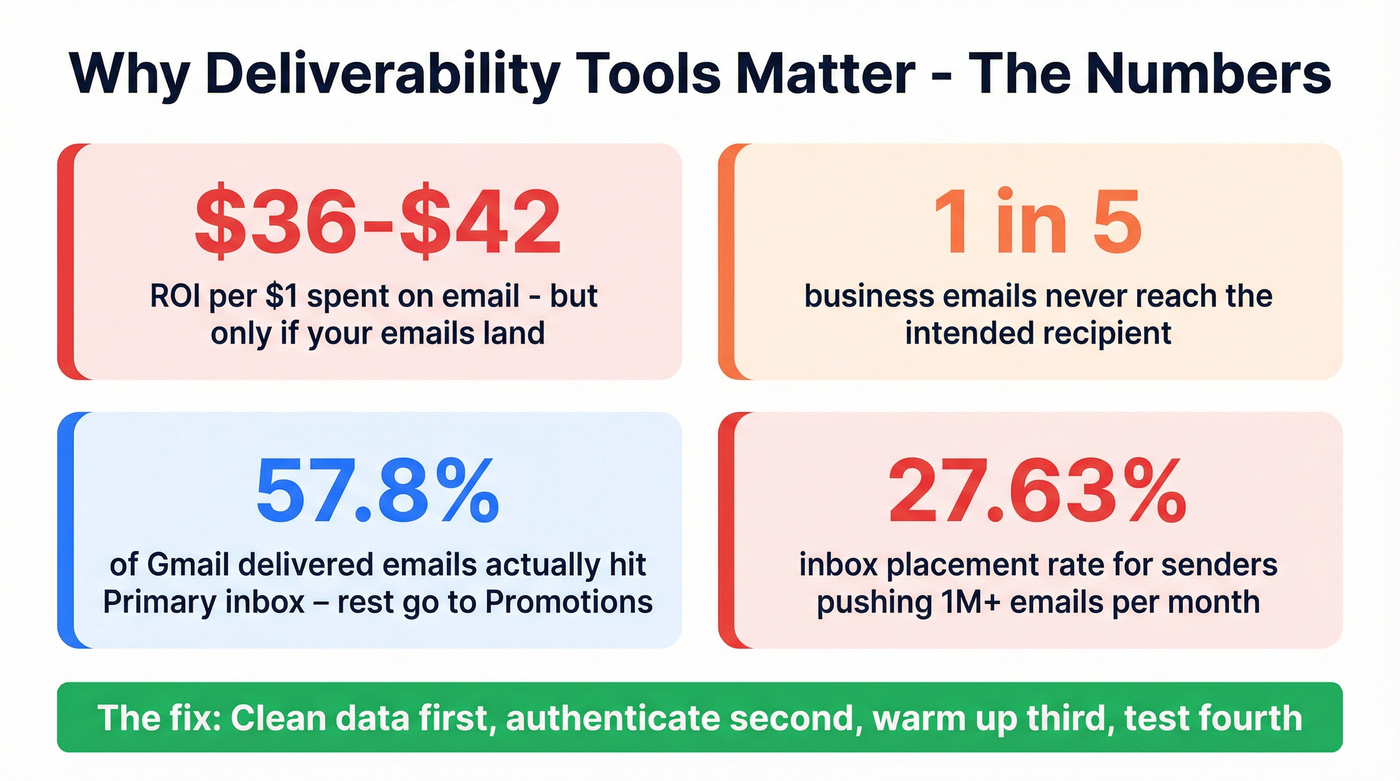
Email marketing delivers $36-$42 ROI per $1 spent. But that number assumes your emails actually land. One in five business emails never reaches the intended recipient. Gmail's deliverability rate looks great at 95.54% - until you realize only 57.8% of delivered emails hit the Primary inbox, with 37.74% buried in Promotions. For e-commerce senders, it's worse: just 2.7-4.4% reach Primary while 91.22% land in Promotions. For high-volume senders pushing 1M+ emails per month, inbox placement drops to a brutal 27.63%.
The tools that fix this span five categories: email verification, inbox placement testing, warmup, monitoring, and all-in-one platforms. Most teams need two or three working together - not one magic solution. Here are twelve we tested, plus the free tools worth knowing, organized by what they actually solve.
The order matters. Clean data first, authentication second, warmup third, testing fourth. Get the sequence wrong and you're warming up domains that send to dead addresses. No amount of engagement simulation fixes a 22% bounce rate.
Our Top Picks
| Pick | Best For | Price |
|---|---|---|
| Prospeo | Preventing deliverability problems at the source | Free; ~$0.01/email |
| GlockApps | Inbox placement testing | Free-$129/mo |
| Warmup Inbox | Affordable domain warmup | $12/mo per inbox |
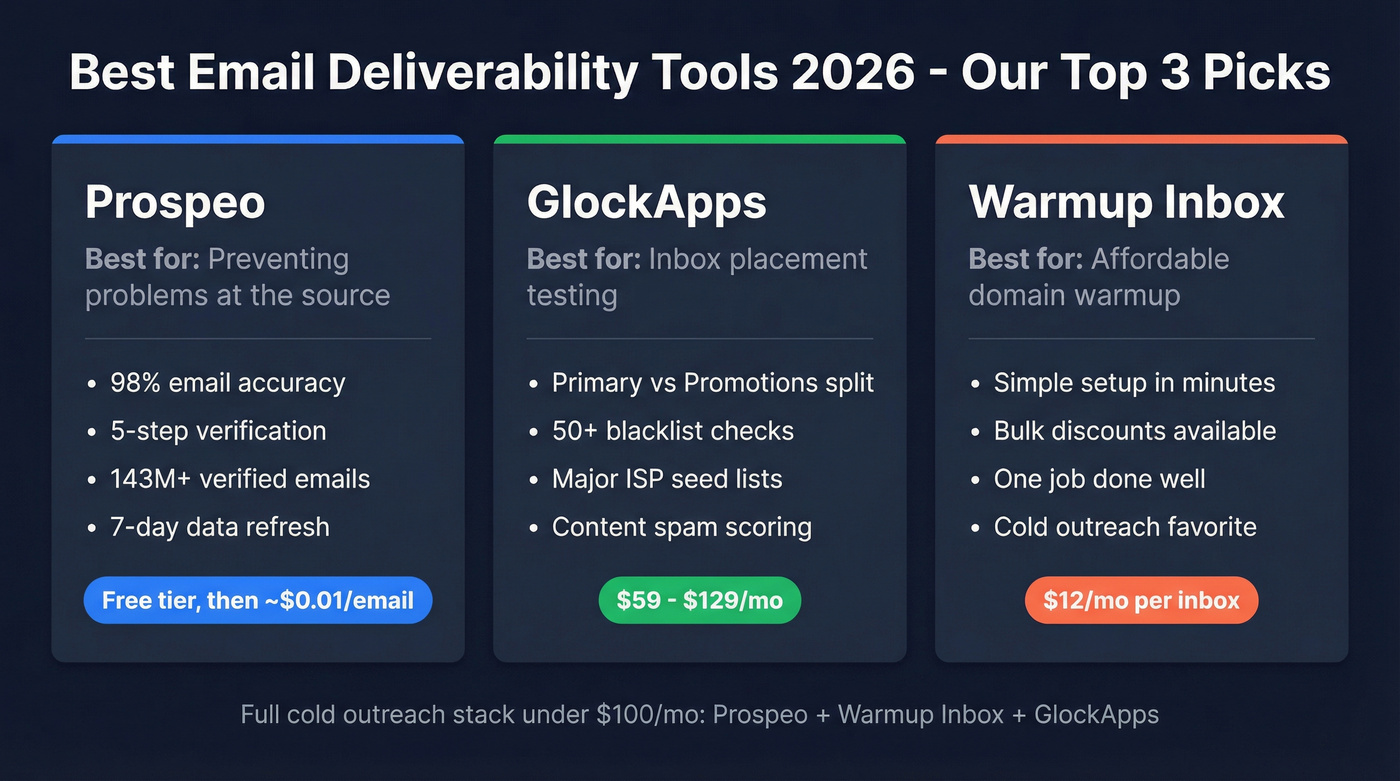
Best enterprise: Validity Everest. Best all-in-one: ZeroBounce. Best free: Google Postmaster Tools + MxToolbox.
If you're running cold outreach, start with verified data, add Warmup Inbox for new domains, and use GlockApps to confirm you're hitting Primary. That stack runs under $100/mo total and covers the full pipeline.
How to Choose a Deliverability Tool
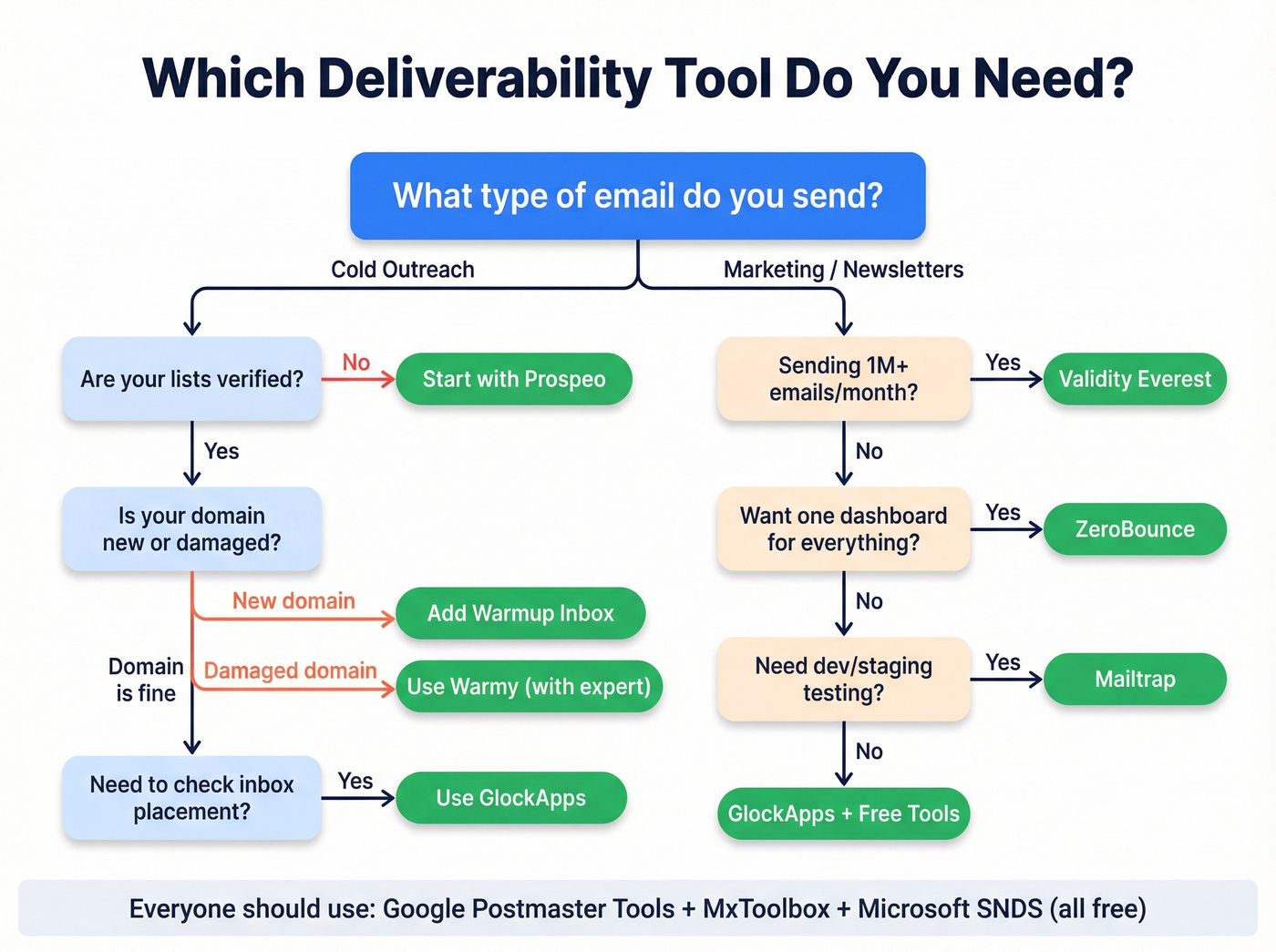
Not every team needs the same tool. A cold outreach team burning through new domains has completely different problems than a marketing team sending newsletters to 200K subscribers.
Six features matter when picking:
- Inbox placement testing - shows where your email lands (Primary, Promotions, Spam) across providers
- Spam checker - scores your content against filters like SpamAssassin and Barracuda before you send
- Authentication checker - validates SPF, DKIM, DMARC, and newer standards like BIMI and MTA-STS
- Reputation monitoring - tracks your domain and IP reputation over time
- Email validation - verifies addresses exist before you send, removing bounces and spam traps
- Engagement simulation - warmup tools that generate opens and replies to build sender reputation
One caveat about seedlist testing: the emails sent to seedlists are essentially cold emails. They never generate real engagement - no opens, no replies, no clicks. Seedlist results tend to understate your actual performance with a real, engaged audience. Keep that in mind when GlockApps or Mailtrap shows you a 78% inbox rate. Your real numbers with warm contacts will be better.
Cold email teams should prioritize validation and warmup. Marketing teams should prioritize authentication checking and reputation monitoring. Both need inbox placement testing to verify their setup works.
12 Top Email Deliverability Tools Tested
Prospeo
Most deliverability problems start upstream - with bad data. We've seen this play out dozens of times: a team invests in warmup, builds a careful sending cadence, then torches the whole thing with a single campaign to an unverified list. Prospeo's 5-step verification process delivers 98% email accuracy by catching the issues that kill sender reputation before you ever hit send. That means spam-trap removal, honeypot filtering, catch-all domain handling, and real-time validity checks across 143M+ verified emails. The 7-day data refresh cycle means you're not sending to addresses that went stale six weeks ago, which is the industry average refresh window.
Stack Optimize built to $1M ARR using Prospeo's data with 94%+ client deliverability and zero domain flags. Meritt cut their bounce rate from 35% to under 4%. If you're running cold outreach and need to guarantee sub-3% bounce rates, this is where you start. Skip it if you only send marketing emails to double opt-in lists - you've already solved the data quality problem through consent.
Pricing: Free tier (75 emails/month), ~$0.01/email after that. No contracts, no sales calls.
ZeroBounce
ZeroBounce is the Swiss Army knife of deliverability - good at everything, best-in-class at nothing. It bundles email validation with deliverability tooling like inbox placement testing and blacklist monitoring, which makes it the right pick for teams that want one dashboard instead of three browser tabs.
Pricing: Pay-as-you-go validation starts at $20 for 2,000 credits, and the Deliverability Toolkit plans start at $49/month.
The tradeoff is depth. Dedicated tools like GlockApps go deeper on inbox placement testing, and dedicated verification tools offer higher accuracy. But if you're a marketing team that wants a single vendor and "good enough" across the board, ZeroBounce earns its spot.
Bouncer
Bouncer's pitch is simple: verification-first, everything else bolted on. The 95.5% accuracy rate is solid, and the pay-as-you-go model ($8/1,000 credits) keeps costs predictable for teams with variable sending volumes. Their Deliverability Kit at $25/mo adds inbox testing for 250 emails plus monitoring for 10 IP addresses and domains.
Where Bouncer falls short is database size. Teams running large-scale outreach across diverse industries will hit more "unknown" results compared to platforms with larger verification databases.
GlockApps
GlockApps is the inbox placement tester most teams should start with. No hedging - it's the best value in this category for mid-market teams.
The seed list covers major ISPs plus country-specific providers, and it shows you the Primary vs. Promotions split that matters so much for Gmail. It checks against 50+ blacklists and gives you a clear picture of where your emails actually land. The Growth plan at $99/mo covers 10 sending accounts with 1,080 spam test credits - enough for most mid-size teams.
The limitation is statistical significance. The seed list runs around 100 mailboxes, so individual test results shouldn't be overgeneralized. Run multiple tests over time for reliable trends. In our experience, three tests over two weeks gives you a much more accurate baseline than a single snapshot.
Pricing: Free (2 credits), Essential $59/mo, Growth $99/mo, Enterprise $129/mo. G2 rating: 4.3/5. Capterra: 4.8/5.
Mailtrap
Your dev team needs to test emails in staging before production - that's Mailtrap's sweet spot. It started as a developer testing tool and evolved into a legitimate deliverability platform. What sets it apart is published benchmark data: in their own testing, Mailtrap hit 78.8% inbox placement, with 14.4% going to spam and 4.8% to tabs. The provider breakdown is revealing - Gmail at 67.50%, Outlook at 77.78%, Hotmail at 100%, Yahoo at 55.56%.
If you're a sales team doing cold outreach, Mailtrap's developer-first workflow will feel like wearing someone else's shoes. But for engineering and QA teams, nothing else integrates as cleanly into CI/CD pipelines.
Pricing: Free tier available, Basic $15/mo, Business $85/mo, Enterprise $750/mo. G2: 4.8/5.
Warmup Inbox
At $12/mo per inbox with bulk discounts, Warmup Inbox is the most cost-effective warmup tool for teams scaling cold outreach across multiple domains. Setup takes minutes, not hours. It does one thing - warmup - and does it well.
The consensus in cold outreach communities on Reddit is to start with the cheapest warmup tool that works, then upgrade only if you hit specific problems. Warmup Inbox fits that philosophy perfectly. Don't expect deliverability consulting or AI-driven strategies. This is a clean, simple warmup tool, and that's exactly what most teams need.
Warmy
Warmy takes a different approach: AI-driven warmup with a dedicated deliverability expert included in every plan. Google Postmaster integration gives you real reputation data alongside the warmup metrics, and the 7-day free trial (no credit card) makes it easy to test. Warmy has improved over 650,000 domains - that scale means their algorithms have seen nearly every warmup scenario.
This is the tool for damaged domains that need expert-guided recovery, not just automated warmup. The dedicated expert justifies the higher price. Plans start around $49/mailbox/month and scale up from there.
Validity Everest
Everest is the enterprise gold standard for deliverability monitoring. Elements starts at $20/mo for up to 5,000 emails, but the real product is Elements Plus at $525/mo or the Enterprise tier. We've seen enterprise contracts with list prices around $106K that negotiate down to $35K-$65K/yr through procurement platforms like Vendr.
This is overkill for 90% of teams. If you're sending millions of emails monthly and a 1% improvement in inbox placement translates to six figures in revenue, Everest pays for itself. Everyone else should look elsewhere.
MxToolbox
The free baseline every team should run before spending a dollar on paid tools. MxToolbox's free blacklist monitoring catches the obvious problems - blacklisted IPs, DNS misconfigurations, authentication gaps. Their paid Delivery Center ($129/mo) and Delivery Center Plus ($399/mo) add deeper monitoring.
MxToolbox diagnoses problems; it doesn't fix them. Pair it with action-oriented tools for the actual remediation.
Mailgun Optimize
Mailgun Optimize is for teams that use multiple ESPs and need deliverability testing that works across all of them. Pilot starts at $49/mo, Starter at $99/mo, with a 1-month free trial. It doesn't care what you send from - it tests the result.
If you're already locked into an ESP with built-in deliverability tools, adding Mailgun Optimize creates redundancy you don't need.
Folderly
Folderly combines spam checking and warmup at ~$96/mailbox/month. Inbox Insights starts at $64/mo, and there's a free plan with 2 tests/month. The per-mailbox pricing gets expensive fast - five mailboxes puts you near $500/mo, which buys a lot of specialized tools.
Smartlead
Smartlead is an outreach platform with built-in warmup and inbox rotation - not a standalone deliverability tool. Basic $39/mo, Pro $94/mo, Custom $174/mo, with a 14-day free trial. Good for teams that want deliverability baked into their sending workflow rather than bolted on.
Free Tools You Should Already Be Using
Three free tools belong in every deliverability stack. Google Postmaster Tools gives you domain reputation and spam rate tracking - the ground truth on how Gmail sees you. Microsoft SNDS provides IP reputation monitoring for Outlook. Yahoo Sender Hub delivers feedback loops and complaint data. These cost nothing and provide the baseline reputation data that paid tools build on.
Let's be honest: if you haven't set up Google Postmaster Tools yet, do that before you spend a cent on anything else.

Every deliverability tool on this list fixes problems after they happen. Prospeo prevents them. With 98% email accuracy, spam-trap removal, and a 7-day data refresh cycle, you eliminate the bad data that triggers blacklists and tanks sender reputation.
Stop warming up domains just to send to dead addresses.
Side-by-Side Comparison
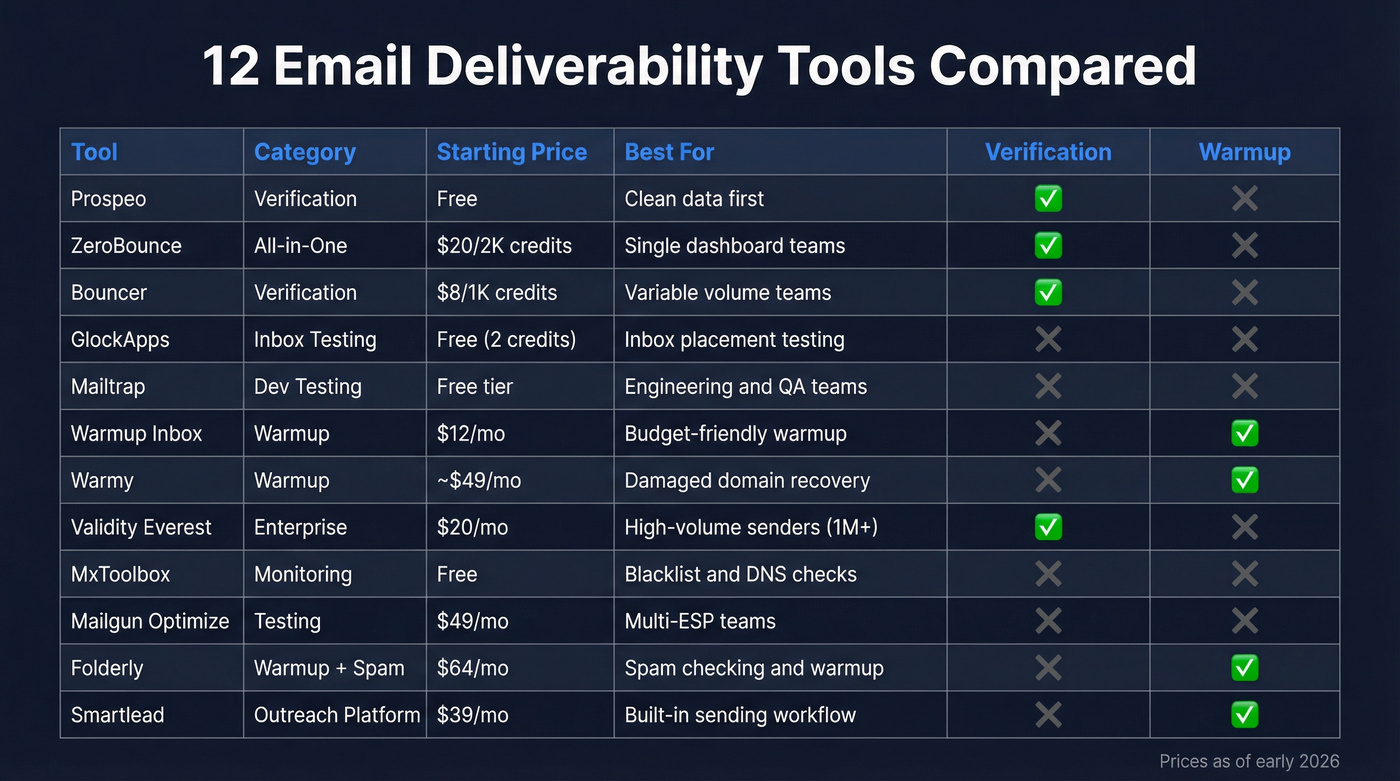
| Tool | Best For | Starting Price | Key Feature |
|---|---|---|---|
| Prospeo | Data quality / verification | Free; ~$0.01/email | 5-step verification |
| GlockApps | Inbox placement testing | Free-$129/mo | Primary vs. Promotions split |
| Mailtrap | Dev-friendly testing | Free-$750/mo | Published benchmark data |
| Warmup Inbox | Affordable warmup | $12/mo per inbox | Bulk discounts available |
| Warmy | AI warmup + expert | From ~$49/mailbox/mo | Dedicated deliverability expert |
| ZeroBounce | All-in-one validation | $20/2K credits | Validation + deliverability toolkit |
| Validity Everest | Enterprise monitoring | $20-$525+/mo | ISP-level reputation tracking |
| MxToolbox | Free diagnostics | Free-$399/mo | Blacklist monitoring |
| Mailgun Optimize | ESP-agnostic testing | $49/mo | Cross-platform compatibility |
| Bouncer | Verification-first | $8/1K credits | Pay-as-you-go flexibility |
| Folderly | Spam checking + warmup | ~$64-$96/mo | Per-mailbox warmup |
| Smartlead | Outreach + warmup | $39-$174/mo | Built-in rotation + warmup |
| Google Postmaster | Domain reputation | Free | Spam rate tracking |
| Microsoft SNDS | IP reputation | Free | Outlook reputation data |
| Yahoo Sender Hub | Feedback loops | Free | Complaint data |
Why Deliverability Fails
Your SDR team just sent 5,000 cold emails. Bounce rate: 22%. Three sending domains are now flagged. The warmup tool you've been running for six weeks just got undone in a single afternoon.
Here's the causal chain: bad data leads to bounces. Bounces trigger spam trap hits. Spam trap hits destroy sender reputation. Damaged reputation triggers blacklisting. Once you're blacklisted, every email from that domain - even to valid, engaged contacts - goes to spam.
No amount of warmup fixes sending to addresses that don't exist. Warmup builds reputation; bad data destroys it. A single campaign with a 20%+ bounce rate can undo months of careful domain warming. That's why data verification isn't optional - it's the foundation everything else sits on. Tools that remove spam traps and honeypots before you send aren't just "nice to have." They're the upstream fix that makes every downstream tool actually work.
Here's the thing: if your deals average under $15K, you probably don't need an enterprise deliverability suite. A $95/mo stack of verification + warmup + placement testing gets you 90% of the way there. The last 10% costs 10x more and matters only at massive scale.
Deliverability Best Practices for 2026
The authentication stack has expanded. SPF, DKIM, and DMARC are table stakes - if you haven't set these up, stop reading and go do it now. In 2026, add BIMI (brand indicators in the inbox) and MTA-STS (encrypted mail transport) to your setup. Gmail and Microsoft increasingly use these as positive reputation signals.
For cold outreach, volume discipline is non-negotiable. Start at 20 emails per inbox per day for new domains. Scale gradually - never jump straight to high volume. Cap at 100 emails per day per inbox, and use multiple inboxes with rotation to mimic human sending patterns. With 65% of email opens happening on mobile, test your emails on phone screens before worrying about desktop rendering.
Domain hygiene matters more than most teams realize. Avoid hyphens and numbers in your sending domains. Stick with .com or your country's official TLD. Exotic extensions like .xyz or .io carry lower baseline trust with spam filters. Set up a custom tracking domain for every sending tool you use - default shared tracking domains are reputation poison, because one bad sender on the shared domain drags everyone down.
Monitor continuously with Google Postmaster Tools and Microsoft SNDS. These are free and give you the ground truth on how Gmail and Outlook see your domain. Check weekly at minimum. Clean your lists on a regular cadence - a quarterly re-verification pass prevents the slow reputation decay that comes from people changing jobs, emails getting deactivated, and domains expiring. If you need a step-by-step, follow an email deliverability checklist.
Recommended Tool Stacks
Cold outreach stack (under $100/mo): Prospeo for verified data (~$0.01/email) + Warmup Inbox ($12/mo per inbox) + GlockApps Essential ($59/mo). This covers the full pipeline: clean data going in, warmed domains sending it, and placement testing confirming it lands. For a team running 3 sending accounts, you're looking at roughly $95/mo total.
Marketing email stack (~$60-$140/mo): ZeroBounce for validation (Deliverability Toolkit from $49/mo) + GlockApps for inbox placement testing ($59/mo) + Google Postmaster Tools for free ongoing monitoring. Marketing teams with established domains and opt-in lists don't need warmup - they need validation and visibility.
Enterprise stack ($600-$1,500+/mo): Validity Everest for continuous monitoring ($525+/mo) + Bouncer for validation ($25/mo Deliverability Kit) + Warmy for AI-driven warmup (from ~$49/mailbox/mo). This is the stack for teams sending millions of emails monthly where a 1% improvement in inbox placement translates to real revenue.
The best email deliverability tools aren't the most expensive ones - they're the ones that match your sending profile and work together in the right sequence. Clean data first, reputation building second, testing third. Get that order right and the tools do their job. If you're building a broader outbound stack, start with these cold email marketing tools and layer deliverability on top.
Stack Optimize hit $1M ARR with 94%+ deliverability and zero domain flags. Meritt cut bounce rates from 35% to under 4%. Both started with Prospeo's 5-step verified emails at $0.01 each - no contracts, no sales calls.
Fix deliverability at the source for a penny per email.
FAQ
What's the difference between deliverability and inbox placement?
Deliverability means the server accepted your email. Inbox placement means it landed in Primary, not Promotions or Spam. Gmail's deliverability rate is 95.54%, but only 57.8% of delivered emails reach Primary. You need both metrics - a high delivery rate with low inbox placement still means lost revenue.
Do I need a warmup tool for marketing emails?
Usually not. Established domains with engaged subscriber lists rarely need warmup. Warmup matters most for cold outreach on new or reputation-damaged domains. Focus on authentication setup and list hygiene first - those solve 80% of marketing deliverability issues.
How many cold emails can I safely send per day?
Start at 20 per inbox per day for new domains, then scale gradually to 100/day per inbox. Use multiple inboxes with rotation to distribute volume. Jumping straight to high volume on a fresh domain is the fastest way to get flagged by ISPs.
Can email verification actually improve inbox placement?
Yes - bad data is the #1 root cause of deliverability failures. Verifying emails before sending eliminates bounces, avoids spam traps, and protects sender reputation. Prospeo's 5-step verification with spam-trap and honeypot removal prevents the reputation damage that cascades into spam folder placement. Bouncer and ZeroBounce also offer solid verification, though with smaller databases.
What's the cheapest effective deliverability stack?
Three layers for under $100/month: Prospeo for verified data (~$0.01/email), Warmup Inbox for new domains ($12/mo per inbox), and GlockApps Essential for inbox placement testing ($59/mo). Add Google Postmaster Tools and Microsoft SNDS for free monitoring. That covers verification, warmup, testing, and reputation tracking.