

Sales Enablement vs Sales Engagement: What's Actually Different?
Every vendor in the space muddies this distinction to suit their positioning. Highspot says engagement is a subset of enablement. Kixie says enablement is narrower. SPOTIO throws in a third category called "sales execution." No wonder teams end up buying the wrong thing.
Here's the actual distinction - and how to figure out what you need.
The 30-Second Answer
Sales enablement prepares reps to sell: training, content, coaching. Sales engagement optimizes how reps interact with buyers: cadences, multi-channel outreach, automation. Enablement is the strategy. Engagement is the execution.
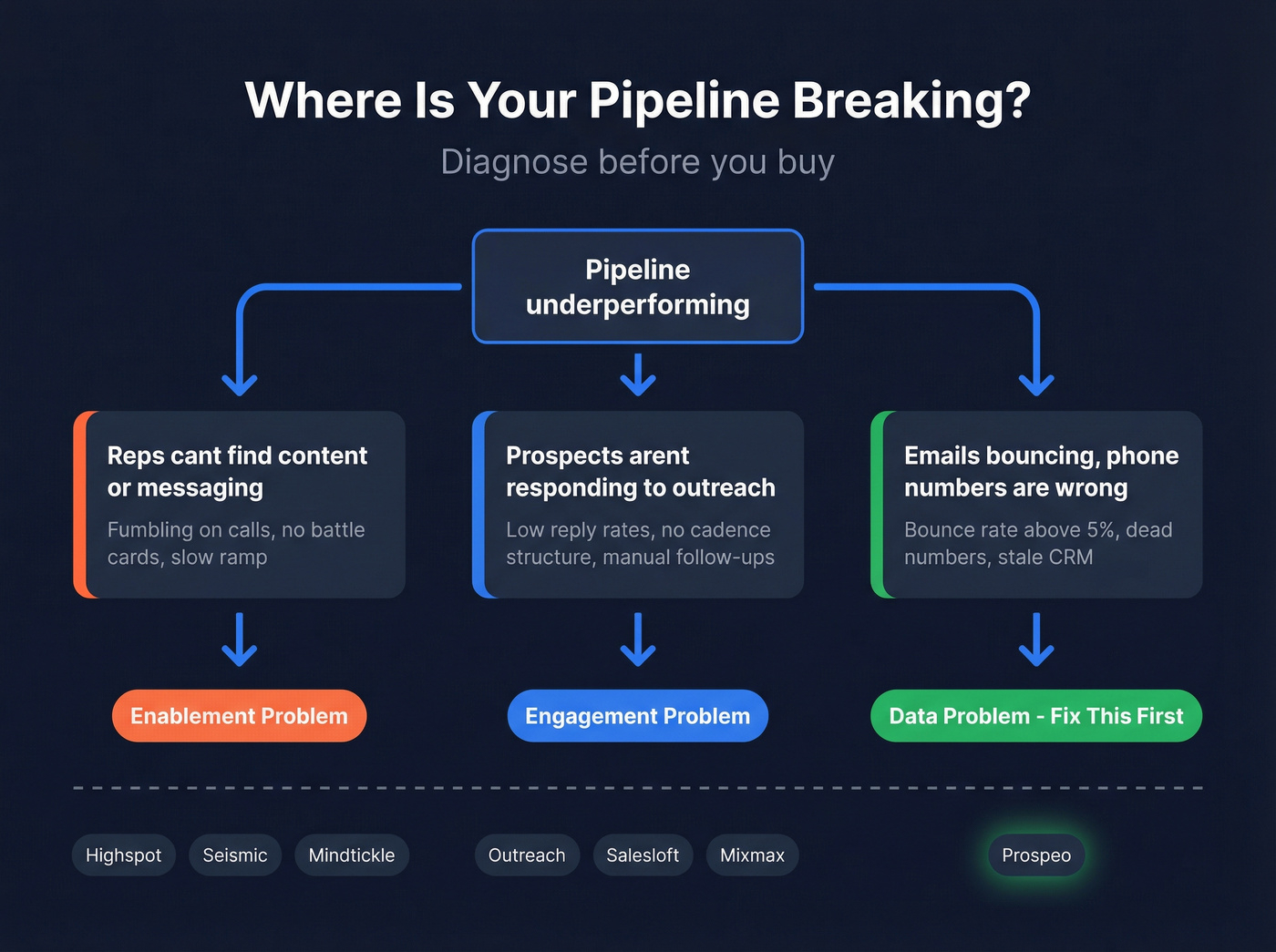
Diagnose where your pipeline is breaking:
- Reps can't find the right content or messaging - enablement problem.
- Reps have content but prospects aren't responding - engagement problem.
- Emails are bouncing and phone numbers are wrong - data problem. Fix this first.
Sales Enablement Explained
Sales enablement is everything that happens before a rep talks to a buyer. Training, content, coaching, onboarding programs, battle cards, content libraries reps can actually find. The KPIs that matter: time to productivity, content usage rates, win/loss ratios, deal velocity.
Companies with formal enablement programs achieve 49% win rates on forecasted deals versus 42.5% without. Enablement also cuts onboarding time by 40-50%, which is a massive deal when the average SDR tenure hovers around 14 months and you're essentially always onboarding someone.
Here's the dirty secret, though: half of all prospect engagement comes from just 10% of enablement content. The rest sits unused, costing enterprises roughly $2.3M annually in wasted marketing spend. If your enablement program is a content graveyard where battle cards go to die, it's not enablement. It's shelfware.
Sales Engagement Explained
Sales engagement is the action layer - sales cadences, multi-channel sequences, automated follow-ups, call logging. Your CRM is the system of record. Marketing automation handles scaled outbound and inbound. A sales engagement platform bridges the gap by enabling structured one-to-one rep workflows that neither CRM nor marketing automation was designed for.
87% of sales dev teams already use a dedicated engagement platform. Teams using one book 15% more meetings, see 27% higher reply rates, and process roughly 50 leads per hour versus 5 manually. That throughput gap is why engagement platforms aren't optional for outbound-heavy teams.
How They Work Together
The cleanest model comes from a before/during framework. Enablement is what happens before the rep engages a buyer. Engagement is what happens during buyer interactions.
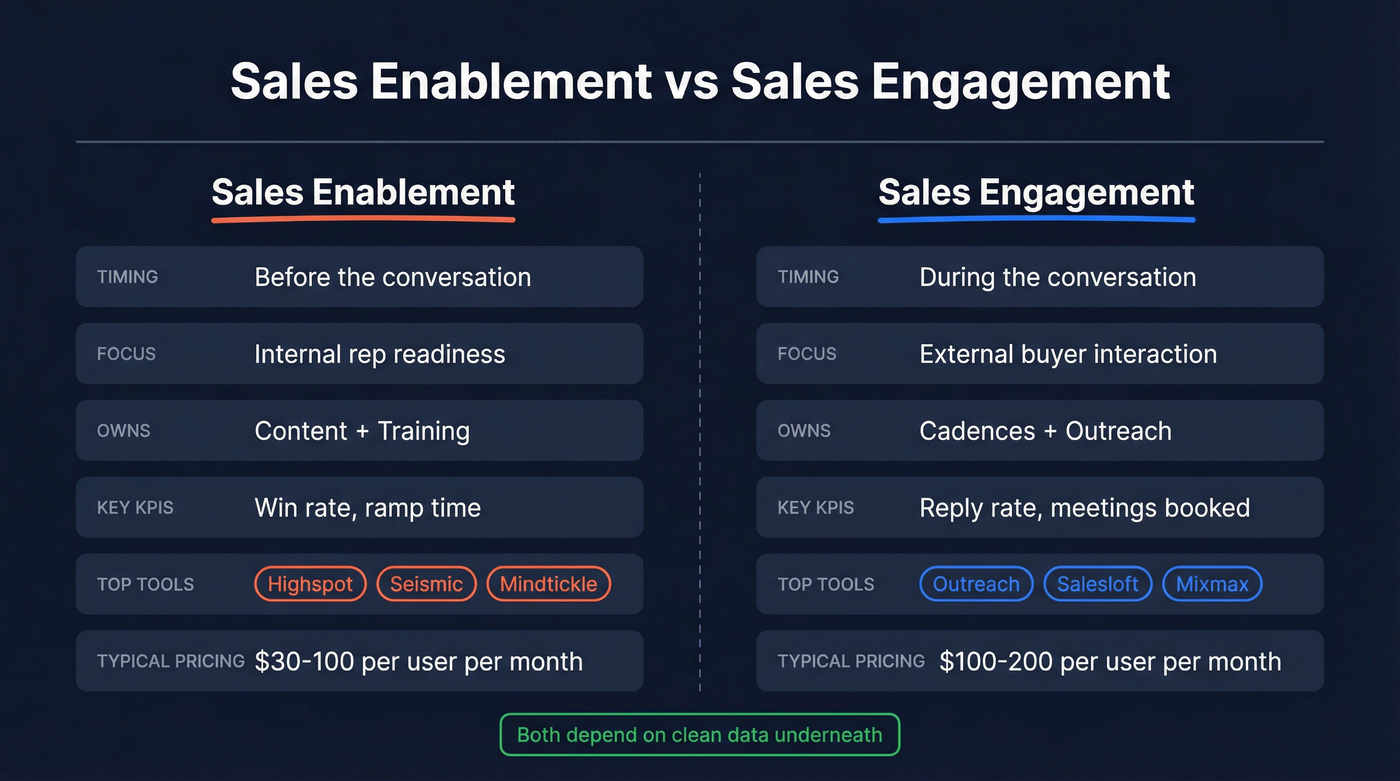
| Dimension | Sales Enablement | Sales Engagement |
|---|---|---|
| Timing | Before the conversation | During the conversation |
| Focus | Internal rep readiness | External buyer interaction |
| Owns | Content + training | Cadences + outreach |
| KPIs | Win rate, ramp time | Reply rate, meetings booked |
| Key tools | Highspot, Seismic, Mindtickle | Outreach, Salesloft, Mixmax |
| Typical pricing | ~$30-100/user/mo | ~$100-200/user/mo |
One quick distinction worth making: "sales operations" is a separate function from both. Ops buys and implements the tools. Enablement trains reps to use them. Confusing the two is how you end up with a $60k tech stack and 26% CRM adoption.

You just read that neither enablement content nor engagement cadences fix a 15% bounce rate. Prospeo's 5-step email verification delivers 98% accuracy on 143M+ verified emails - refreshed every 7 days, not every 6 weeks. At $0.01 per email, fixing your data layer costs less than one bounced sequence.
Stop sending engagement sequences to dead inboxes.
Why Both Markets Are Exploding
The sales engagement platform market sits at roughly $9.2B in 2026 and is projected to hit $26.6B by 2033 - a 16.4% CAGR. The sales enablement platform market is on track for $8.79B by 2029. On the enablement side, effective training delivers a 353% ROI - $4.53 back for every $1 spent.
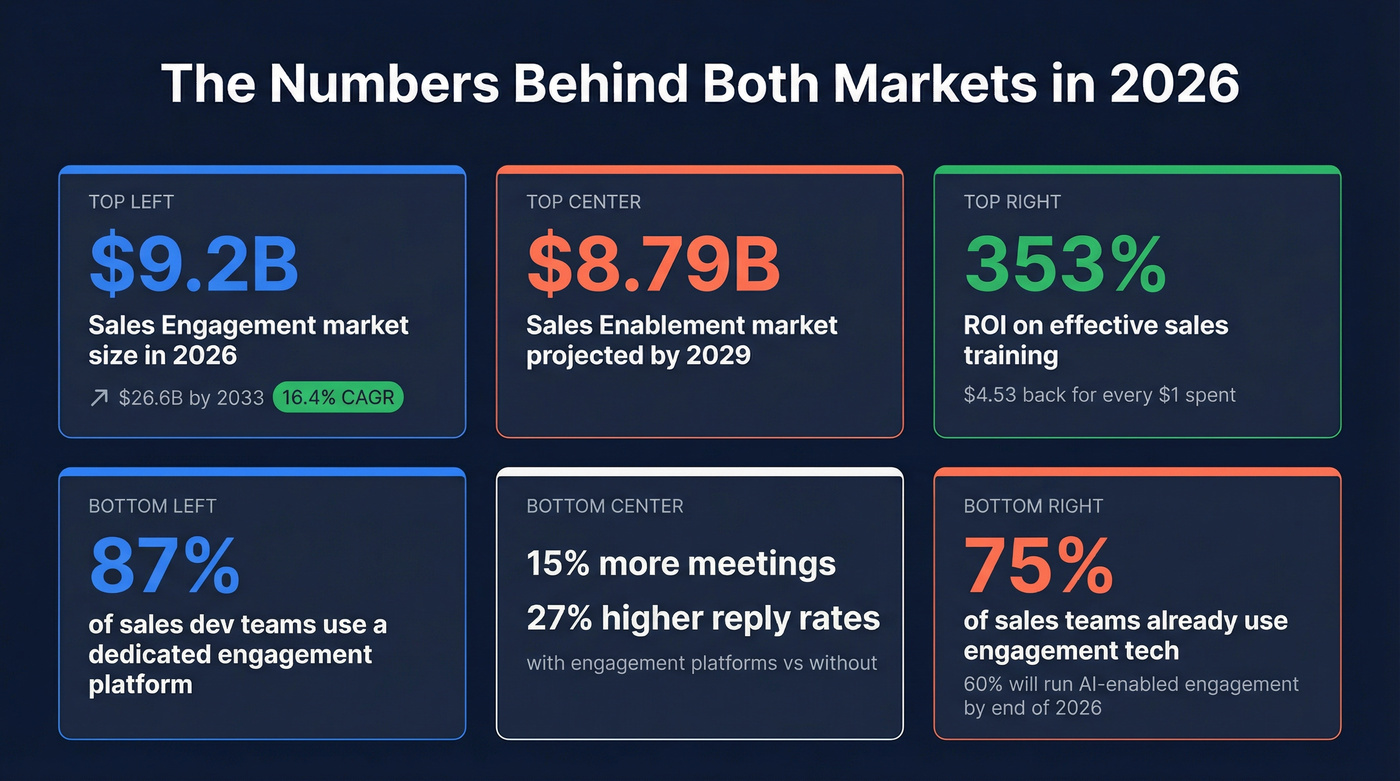
75% of sales teams already use engagement technology, and 60% are expected to run AI-enabled engagement by end of 2026. These aren't nice-to-have categories anymore. They're baseline infrastructure for any team running outbound at scale.
Where the Category Is Heading
Let's be honest: the "vs." framing is already outdated. Forrester's Q3 2024 Wave covered Revenue Enablement Platforms, and a separate Q3 2024 Wave covered Revenue Orchestration Platforms for B2B - and the walls between them are collapsing fast. Salesloft now positions as "revenue orchestration," not just engagement. Allego got named a leader in Forrester's Revenue Enablement wave, which bundles readiness, coaching, content management, conversation intelligence, and digital sales rooms into one evaluation.
As Forrester put it: "Traditional content providers now provide mature L&D solutions, and traditional L&D providers provide viable content management." Your buying decision should be based on where your pipeline is breaking, not on which analyst quadrant a vendor lands in.
What to Prioritize First
Every article on this topic says "you need both." That's lazy advice.
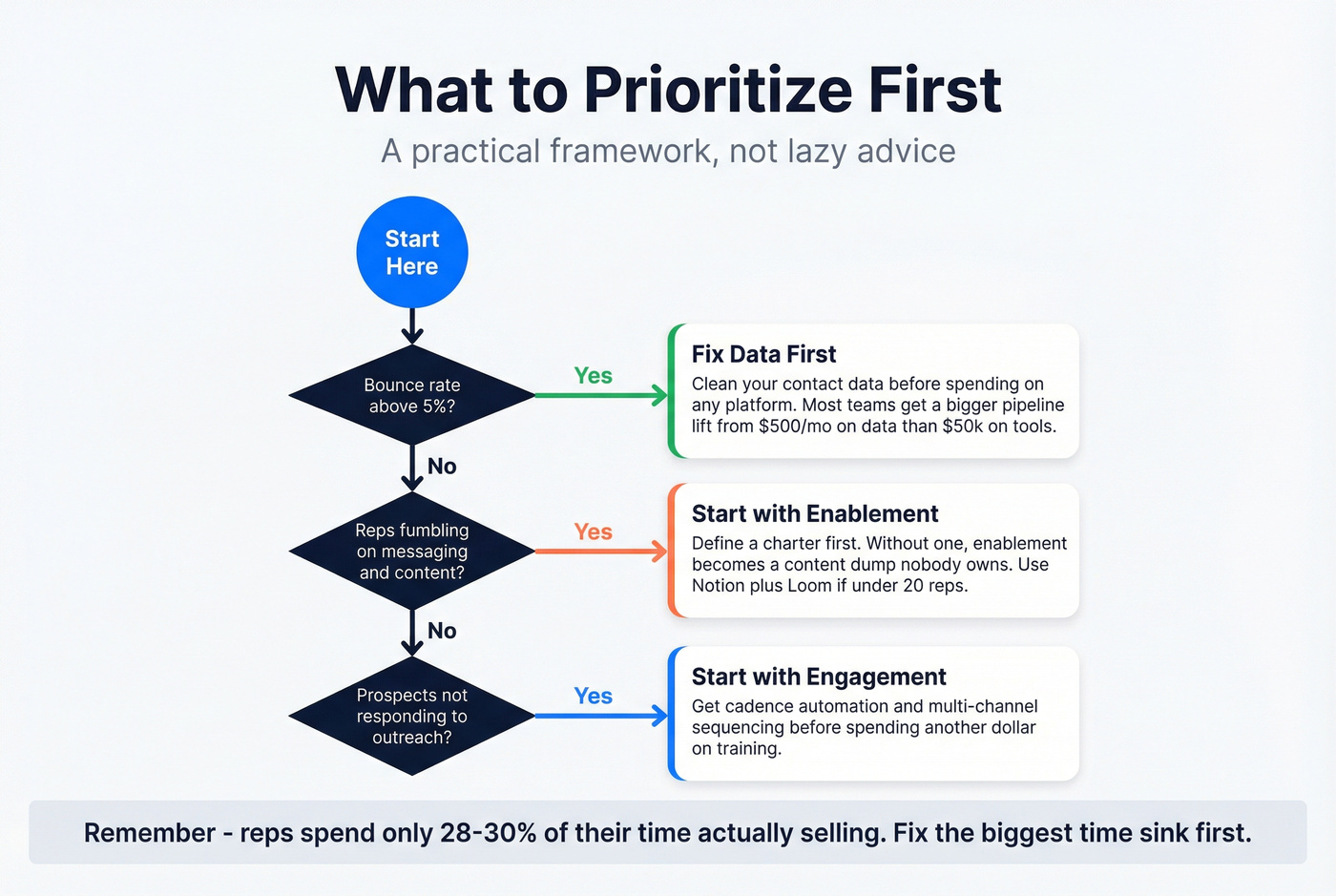
Diagnose first. If reps can't find or use the right content, start with enablement. And the #1 enablement mistake we see is never defining what enablement actually means at your company - without a charter, every stakeholder projects their own definition onto the function, and the whole thing drifts into a content-dumping exercise nobody owns.
If reps have content but prospects aren't responding, start with engagement. Get cadence automation and multi-channel sequencing in place before you spend another dollar on training.
If emails are bouncing and phone numbers are wrong, neither platform will help. You've got a data problem, and no amount of Salesloft sequencing or Highspot battle cards fixes a 15% bounce rate.
For teams under 20 reps, we've found you get more ROI from engagement plus lightweight enablement - Notion for battle cards, Loom for training videos, your CRM for basics. Scale to a dedicated enablement platform when onboarding velocity demands it.
Reps spend only 28-30% of their time actually selling. The rest is admin, searching for content, and fixing bad data. If your diagnosis points to data, that's where to start.
The Data Layer Both Depend On
The best engagement sequences in the world are organized spam if your contact data is wrong. We've watched teams run 200 sequences a week where half the emails bounce and the phone numbers ring out to dead lines. That's not an engagement problem. It's a data problem wearing an engagement mask.

One team we worked with tripled their reply rates just by fixing contact data before touching their cadence strategy. Prospeo sits underneath both enablement and engagement as the data quality layer - 98% email accuracy, a 7-day refresh cycle versus the 6-week industry average, and 125M+ verified mobile numbers with a 30% pickup rate. The free tier gives you 75 verified emails per month plus 100 Chrome extension credits, enough to test whether your engagement problem is actually a data problem. It integrates natively with Outreach, Salesloft, HubSpot, and Salesforce.
Here's the thing: most teams debating which $50k platform to buy would get a bigger pipeline lift from spending $500/month on clean data. Fix the foundation before you renovate the house.
Reps spend 70% of their time not selling - searching for content, fixing CRM data, chasing wrong numbers. Prospeo gives your team 125M+ verified mobile numbers with a 30% pickup rate and 300M+ profiles with 30+ filters. That's the data foundation your enablement and engagement stack actually needs to perform.
Build your engagement sequences on data that actually connects.
FAQ
What's the difference between sales enablement and sales engagement?
Sales enablement prepares reps through training, content, and coaching - everything before the buyer conversation. Sales engagement optimizes actual buyer interactions through cadences, multi-channel outreach, and automation. Enablement builds readiness; engagement drives execution.
Should I invest in enablement or engagement first?
Diagnose where your pipeline breaks. If reps can't find content or fumble messaging, invest in enablement. If prospects aren't responding to outreach, prioritize engagement. If emails bounce above 5%, fix your data layer first - that's a problem neither platform can solve on its own.
What is revenue enablement?
Revenue enablement is the convergence of sales enablement and engagement into a unified discipline. Forrester's 2024 Wave evaluated it as a single category covering content management, coaching, conversation intelligence, and digital sales rooms - reflecting that leading platforms now bundle both capabilities under one roof.