

Appointment Setting vs Lead Generation in 2026
A RevOps lead we know ran a webinar last quarter that pulled 5,000 registrations. Marketing celebrated. Then the SDR team got to work: 12 meetings booked, 4 no-shows, 2 deals in pipeline. The CPL looked great. The cost per held meeting was catastrophic.
The appointment setting vs lead generation debate isn't really an either/or question - it's a funnel diagnosis. Here's where the money actually goes and where your pipeline is leaking.
The Short Version
Lead generation fills the top of your funnel. Appointment setting converts that funnel into meetings. Most teams don't need more of one or the other - they need better data connecting the two.
What Is Lead Generation?
Lead generation is everything you do to capture contact information from people who might eventually buy: content marketing, paid ads, SEO, webinars, events. The output is a name, an email, maybe a phone number, and a signal of interest.
What most teams underestimate is how wildly cost-per-lead varies by industry and channel.
| Channel / Industry | Avg CPL |
|---|---|
| Google Ads (B2B avg) | $70.11 |
| LinkedIn Ads | $110 |
| B2B SaaS | $237 |
| Cybersecurity | $406 |
| Manufacturing | $553 |
| Financial Services | $653 |
The average B2B CPL across all channels sits around $84, but that number hides enormous variance. What matters more than CPL is what happens next - and that's where MQL-to-SQL conversion rates expose the actual gap.
| Channel | MQL to SQL Rate |
|---|---|
| SEO | 51% |
| 46% | |
| Webinars | 30% |
| PPC | 26% |
| Events | 24% |
SEO leads convert to sales-qualified at almost 2x the rate of PPC leads. That $237 SaaS lead from organic search converting at 51% is cheaper downstream than a $70.11 Google Ads lead converting at 26%. Cheaper inputs don't always mean cheaper outcomes.
What Is Appointment Setting?
Appointment setting lives in the middle of the funnel. It's the work of taking a lead - inbound or outbound - and converting it into a scheduled, qualified meeting with a decision-maker. The skills are different from lead gen: objection handling, qualification, scheduling logistics, no-show prevention.
Pricing models for outsourced appointment setting vary more than most buyers expect.
| Model | Typical Range |
|---|---|
| Hourly | $16.12/hr |
| Subscription | $2K-$4.5K/mo |
| Per appointment | $75-$500 |
| Per qualified lead | $50-$250 |
| Retainer | $2K-$5K/mo |
Here's the thing: the booked meeting isn't the real unit of measurement. The held meeting is. A 60% show rate means your effective cost per held meeting is 67% higher than the sticker price. If you're paying $400 per booked appointment and only 60% show up, you're really paying $667 per conversation.
Pay-per-appointment models can push costs 30-50% above retainer models at scale, because vendors optimize for calendar volume over lead quality. On the compliance side, CAN-SPAM penalties run up to $53,088 per violating email - a real risk when volume-incentivized vendors get sloppy with targeting.
Side-by-Side Comparison
| Dimension | Lead Generation | Appointment Setting |
|---|---|---|
| Goal | Capture interest | Book qualified meetings |
| Funnel stage | Top | Middle |
| Primary KPIs | CPL, MQL volume, conversion rate | Meetings booked, show rate, cost/meeting |
| Core activities | Content, ads, SEO, events | Outreach, qualification, scheduling |
| Key skills | Marketing, targeting | Sales, objection handling |
| Output metric | MQLs / SQLs | Held meetings |
| Cost range | $70-$650+ per lead | $300-$1,150 per meeting |
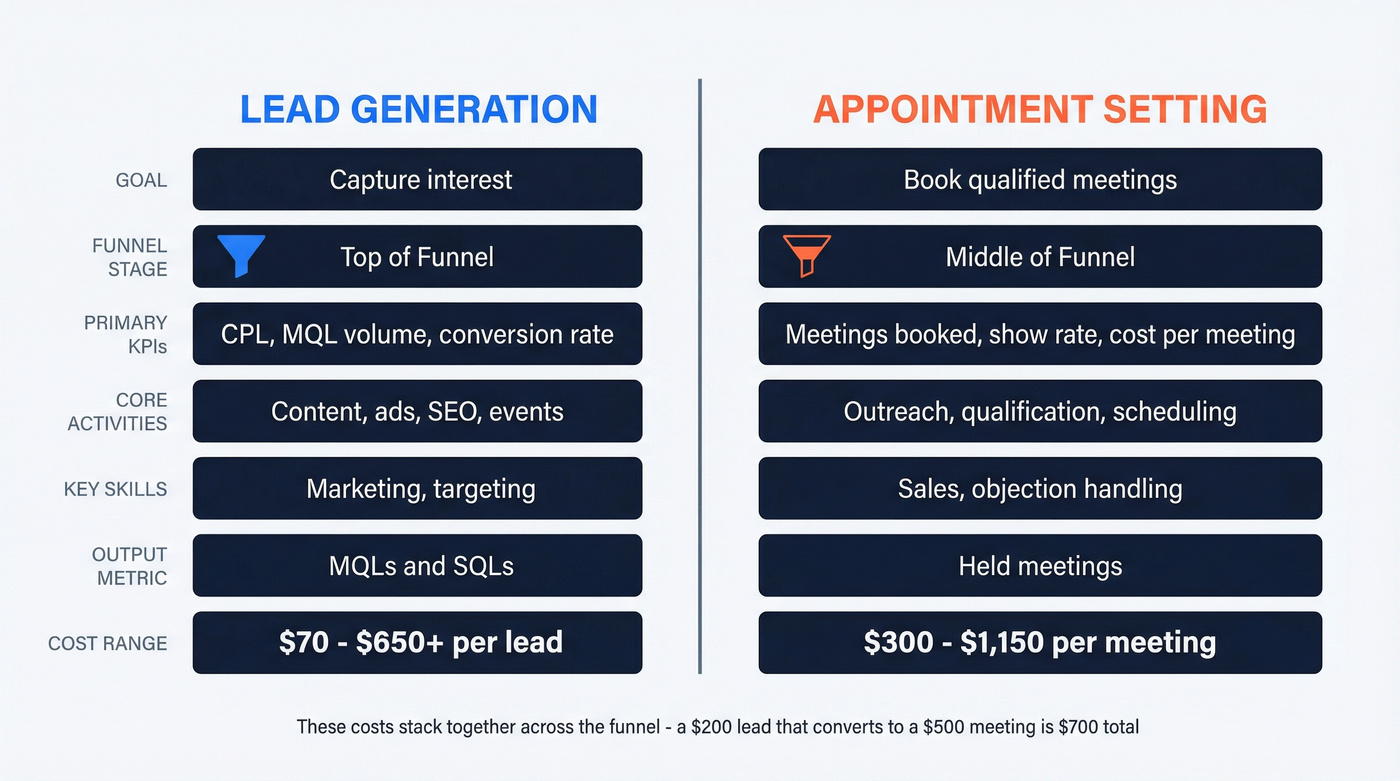
CPL and cost-per-meeting aren't directly comparable - a $200 lead that converts to a $500 meeting represents the full funnel cost stacked together.
Two benchmarks worth anchoring to: appointment setters should target a 15-20% call-to-appointment rate, and lead response time under 24 hours meaningfully improves conversion at every stage.
If you want a tighter operational definition of where each motion starts and ends, see prospecting and lead generation side-by-side.

Bad data is the #1 reason meetings don't get booked. When 35% of your emails bounce, your SDRs burn hours chasing ghosts - inflating your real cost per held meeting. Prospeo's 98% email accuracy and 125M+ verified mobile numbers mean your appointment setters connect with real decision-makers, not dead ends.
Cut your cost per held meeting by starting with data that actually connects.
Conversion Math That Matters
Raw lead volume is a vanity metric unless you track what happens downstream. Agency data from Belkins illustrates this - the gap between channels is staggering.
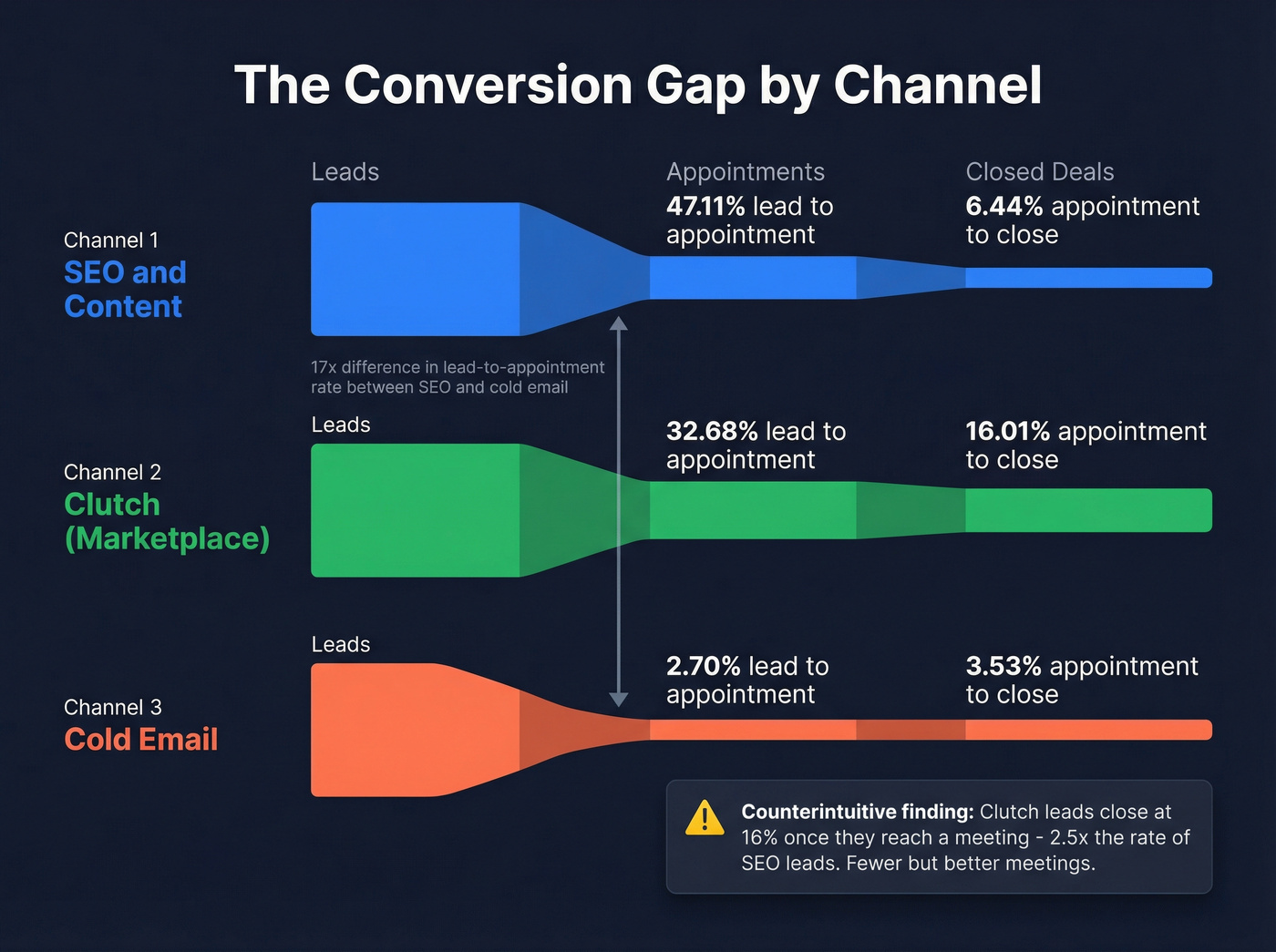
| Channel | Lead to Appointment | Appointment to Close |
|---|---|---|
| SEO / Content | 47.11% | 6.44% |
| Clutch (marketplace) | 32.68% | 16.01% |
| Cold email | 2.70% | 3.53% |
That's a 17x difference in lead-to-appointment conversion between SEO content and cold email. But here's the counterintuitive finding most people miss: Clutch leads close at 16% once they reach a meeting - 2.5x the rate of SEO leads. Higher-intent channels produce fewer but better meetings.
Cold email isn't broken. It just operates at different unit economics. Average cold email reply rates run 5-8%, with top performers hitting 15-20%. Even at the high end, you're working with single-digit meeting conversion rates. For marketplace leads, Clutch data shows roughly $140 per lead and $450 per opportunity. If you're running outbound, it helps to benchmark against modern cold email tactics and the right outbound email campaign structure.
How Setters Qualify Leads
Not all meetings are equal. The qualification framework your team uses determines whether appointment setting produces pipeline or wastes AE time.
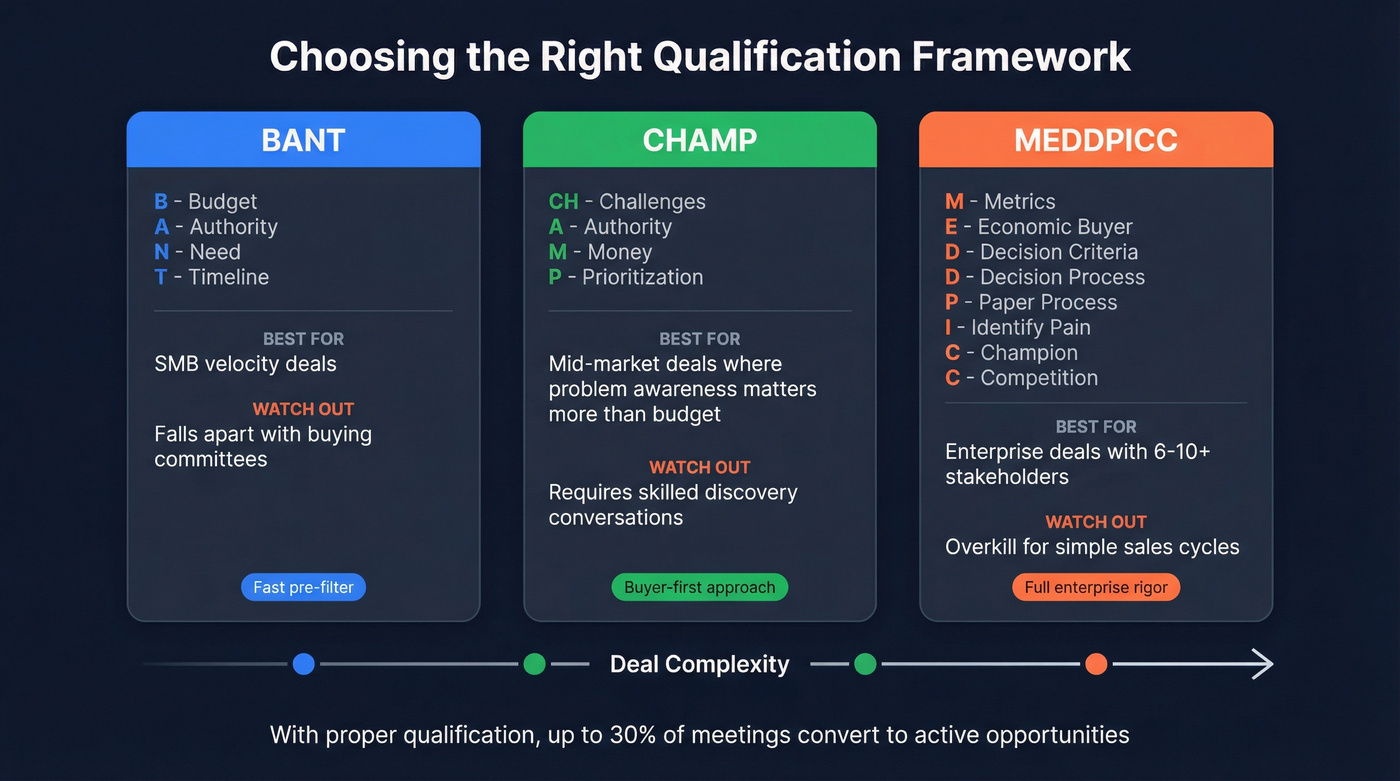
For enterprise deals with 6-10+ stakeholders, MEDDPICC is the go-to framework - it adds Paper Process and Competition to the original MEDDIC criteria. Before investing serious AE time, require at minimum Metrics + Economic Buyer + Pain + Champion. (If you're choosing between frameworks, compare MEDDIC vs MEDDPICC directly.)
BANT works as a fast top-of-funnel pre-filter, but it falls apart in complex deals where budget authority is distributed across a buying committee. Use it for SMB velocity deals, not enterprise. CHAMP flips the script by leading with the buyer's challenges instead of their budget, which makes it the right fit for mid-market deals where problem awareness matters more than budget confirmation - a "no budget" answer just means "hasn't built the business case yet."
In B2B SaaS and IT, up to 30% of qualified meetings convert into active opportunities when proper qualification frameworks are in place. That number drops fast when "qualified" just means "they agreed to a call." If you want to systematize this, build an account qualification checklist and enforce it in routing.
Build vs Buy: SDRs vs Outsourcing
The math here is more straightforward than most vendors want you to believe.
A fully loaded SDR costs $110K-$150K/year - salary, benefits, tools, management overhead. Two SDRs plus a manager runs $300K-$350K annually. If those SDRs produce 10-14 meetings per month each, you're looking at $821-$1,150 per qualified meeting.
An outsourced program delivering comparable output typically runs $120K-$150K/year, with per-meeting costs in the $300-$600 range. The tradeoff: less control, less institutional knowledge, but faster time-to-value. Outsourced services deliver first meetings in 2-4 weeks versus 8-12+ weeks for self-managed tools. SDR ramp time averages 3.2 months to full productivity - three months of salary before you see real output.
About 59% of companies outsource at least some lead generation. Hybrid models are the norm, not the exception. Pay-per-meeting makes the most sense when your ACV exceeds $25K, because the meeting cost becomes a rounding error on deal value. If you're evaluating vendors, start with a shortlist of B2B appointment setting services and map them to your funnel stage.
Let's be honest: if your average deal size is under $10K, you probably don't need outsourced appointment setting at all. A $500 meeting cost on an $8K deal eats your margin alive. Invest in inbound lead gen and let product-led growth do the qualifying. (For ideas, use these inbound lead generation examples as a baseline.)
The Data Quality Problem
Look - for most SDR teams, the problem isn't getting leads. It's that a huge share of contact data is dead on arrival. The #1 killer of appointment setting ROI isn't bad scripts. It's stale contact lists.
Bad emails destroy sender reputation, which tanks future deliverability across every campaign. Gmail alone blocks 15 billion unwanted emails daily - bad data puts your domain on the wrong side of that filter. Wrong phone numbers waste SDR call blocks. Your $150K/year rep spends half their dial time reaching voicemail boxes for people who left the company six months ago. We've seen this pattern over and over: teams blame their scripts, their cadences, their SDRs - when the real culprit is data that was outdated before the first email went out. If you want the underlying benchmarks and fixes, start with B2B contact data decay and a practical CRM hygiene process.

Prospeo addresses this at the infrastructure level with 300M+ professional profiles and 98% verified-deliverable email accuracy, plus 125M+ verified mobile numbers with a 30% pickup rate so SDRs actually reach humans instead of dead lines. The 7-day data refresh cycle compounds fast compared to the 6-week industry average. Snyk's 50 AEs saw bounce rates drop from 35-40% to under 5%, with AE-sourced pipeline up 180%. If you're auditing list health, use a dedicated email checker tool and align on data quality KPIs.
Whether you build an in-house SDR team at $150K/year or outsource at $300-$600 per meeting, the ROI hinges on contact data quality. Prospeo delivers verified emails at $0.01 each with a 7-day refresh cycle - so your reps spend time booking meetings, not cleaning lists.
Stop paying $1,150 per meeting because your data is six weeks stale.
Where to Invest First
Your next move depends on where the funnel is broken. Before you throw money at either side, diagnose the actual bottleneck.
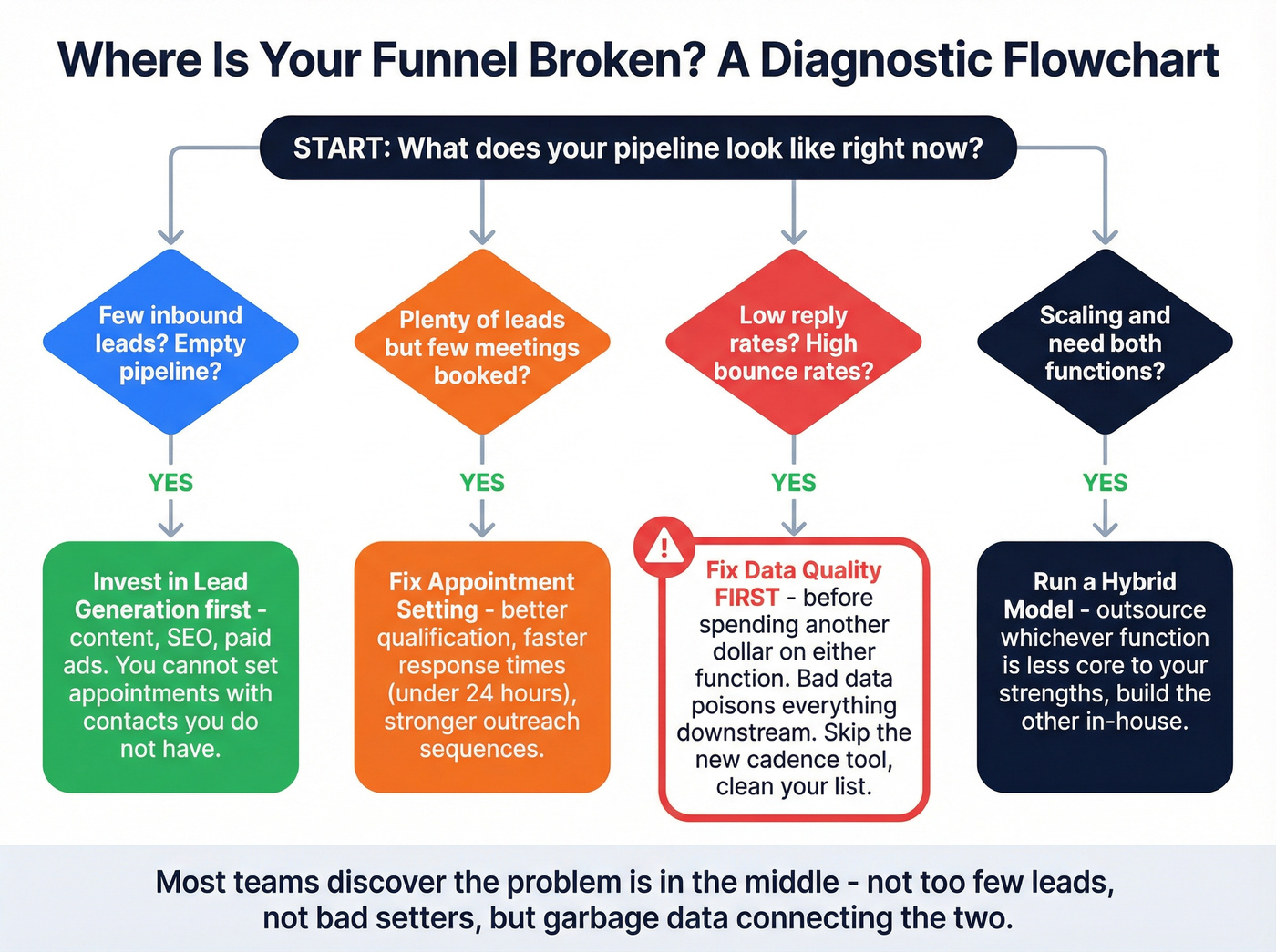
Empty pipeline, few inbound leads: Invest in lead generation first. You can't set appointments with contacts you don't have.
Plenty of leads, few meetings: Your appointment setting process needs work - better qualification, faster response times, stronger outreach sequences. If you need a repeatable system, build an appointment setting campaign with clear SLAs and handoffs.
Low reply rates, high bounce rates: Fix data quality before spending another dollar on either function. Bad data poisons everything downstream. Skip the new cadence tool, skip the AI dialer - clean your list first.
Scaling and need both: Run a hybrid model. Outsource whichever function is less core to your team's strengths and build the other in-house.
Most teams we've worked with discover the problem is in the middle - not too few leads, not bad appointment setters, but garbage data connecting the two. When you're weighing appointment setting vs lead generation investment, start by auditing the data layer that feeds both.
FAQ
Can one team handle both?
Yes, but lead gen is marketing-heavy while appointment setting is sales-heavy. Most scaling teams split the functions or outsource one. Below 5 reps, a single SDR pod can manage both with the right tooling.
What's a good cost per qualified meeting?
Outsourced: $300-$600 per qualified, held meeting. In-house SDRs: $800-$1,150 fully loaded. A 60% show rate inflates booked-meeting pricing by 67%, so always negotiate contracts around held meetings, not booked ones.
How does data quality affect results?
Bounced emails tank sender reputation, reducing deliverability across all future campaigns. Wrong numbers waste SDR call blocks. Snyk cut bounce rates from 35-40% to under 5% and grew AE-sourced pipeline 180% after fixing data accuracy - it's the highest-ROI move before optimizing scripts or cadences.
Should I outsource or build in-house?
Outsource when you need meetings within 2-4 weeks and lack SDR management infrastructure. Build in-house when your ACV exceeds $50K and deal cycles require deep product knowledge. Most B2B teams run hybrid - outsourced top-of-funnel prospecting with in-house AEs handling qualified conversations.