

Pay-for-Performance B2B Lead Gen: The 2026 Buyer's Playbook
Your AE just sat through a 30-minute "qualified meeting" with someone who has no budget, no authority, and no idea why they're on the call. You paid $400 for that calendar invite. This is what B2B lead generation pay for performance collides with reality - and it happens far more often than anyone in this space wants to admit.
Pay-for-performance isn't the future of B2B lead gen. It's one tool, and the one most likely to blow up without the right contract.
The Short Answer
The hybrid model - $2K-$4K base plus $150-$400 per meeting - is the smartest structure for most B2B companies. Pure pay-per-appointment ($300-$600/meeting) works once you've established benchmarks with a trusted provider. Commission-only is a red flag. Walk away.
What Pay-for-Performance Actually Means
Pay-for-performance in B2B lead generation means you're paying an agency based on outcomes, not effort. Three sub-models matter:
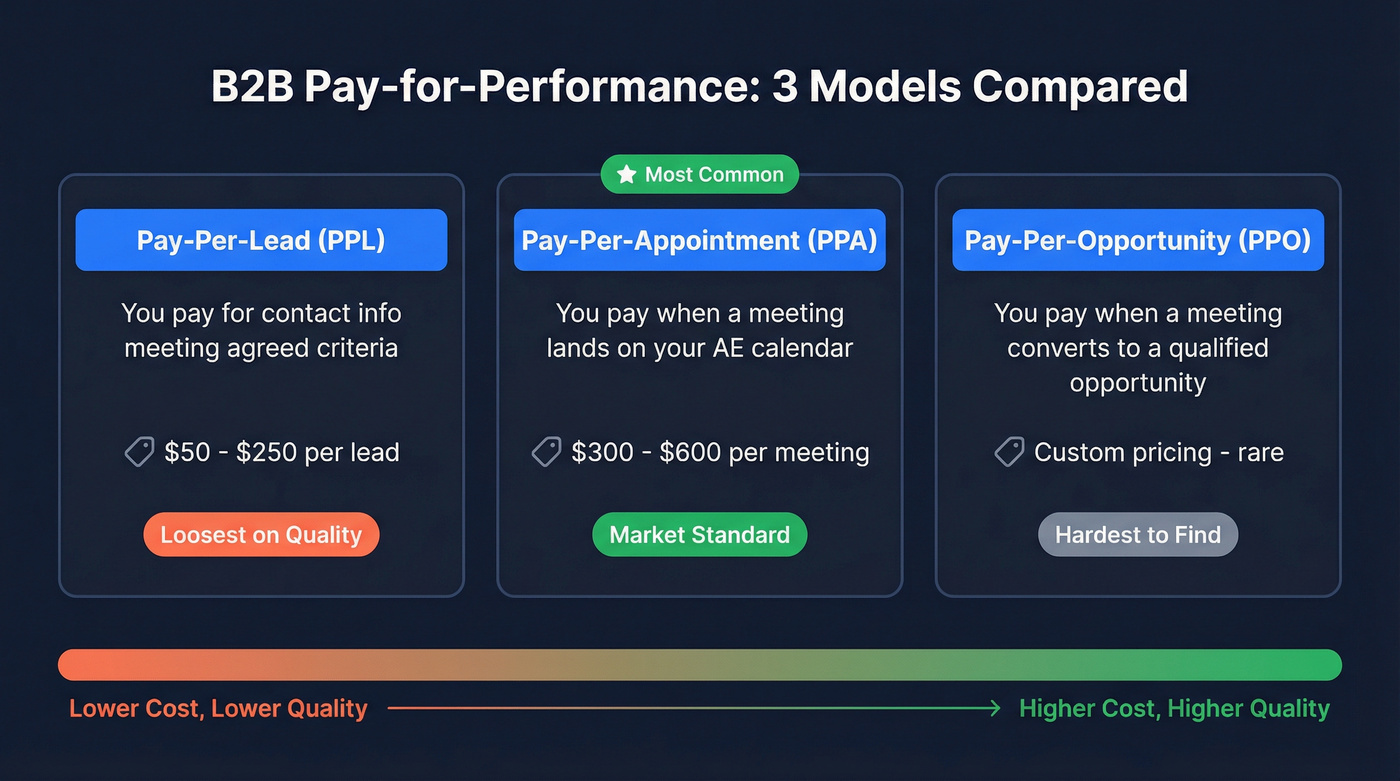
Pay-per-lead (PPL): You pay for contact information meeting agreed criteria. Cheapest per unit, loosest on quality.
Pay-per-appointment (PPA): You pay when a meeting lands on your AE's calendar. This is the most common structure in the market right now (and often overlaps with appointment setting more than true lead gen).
Pay-per-opportunity (PPO): You pay when a meeting converts to a qualified sales opportunity. Rarest model, and the hardest to find a provider willing to offer.
B2B lead generation services are projected to grow from $2.4B to $6.5B by 2032 at 11.8% CAGR. That growth is pulling in a flood of new providers, many of whom are simply selling leads without much regard for quality or fit.
2026 Pricing Benchmarks
Every other article on this topic makes you "book a call" for pricing. Here's what the market actually charges:
| Model | Typical Range | Notes |
|---|---|---|
| PPA (standard) | $300-$600/mtg | Mid-market B2B |
| PPA (low-end) | $50-$300/mtg | Offshore, simpler ICP |
| PPA (enterprise) | $600-$1,500+/mtg | Enterprise / hard-to-reach segments |
| Retainer | $2K-$10K+/mo | Dedicated resources |
| Hybrid | $2K-$4K base + $150-$400/mtg | Best risk balance |
| Commission-only | 10-25% of deal | Red flag territory |
| Pay-per-qualified-lead | $50-$250/lead | Contact info only |
| Hourly (offshore) | $16-$25/hr | Common with BPO-style shops |
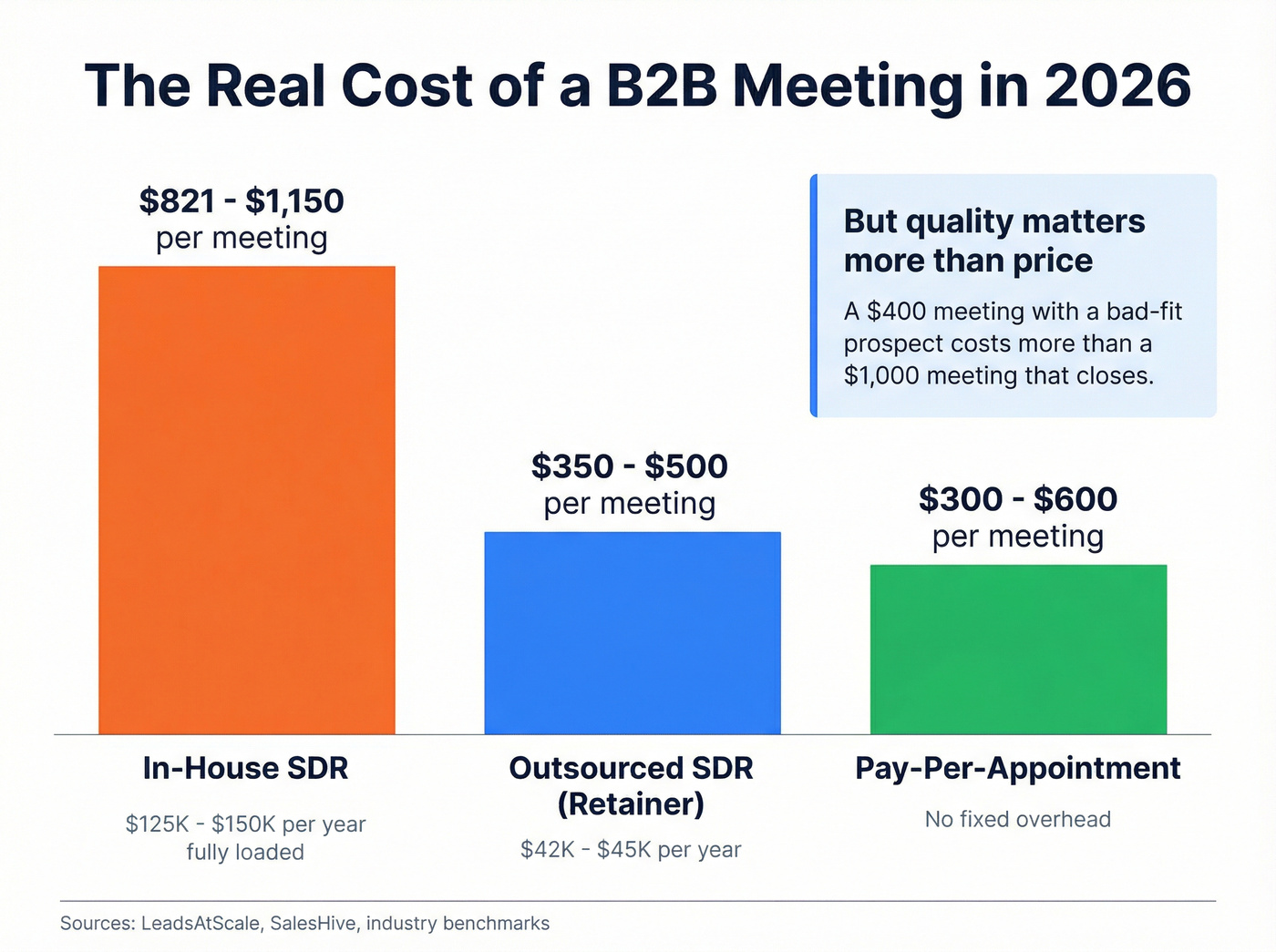
A fully loaded in-house SDR costs $125K-$150K/year and produces meetings at roughly $821-$1,150 each. An outsourced SDR runs $42K-$45K/year, less than a third of the cost. So a $400 PPA meeting looks like a bargain against in-house. But only if the quality holds up.
For sanity-checking, here are industry CPL benchmarks:
The average B2B CPL across all channels is $84. If your PPA provider charges $400/meeting in a space where the average CPL is $237, the qualification better be airtight.
When Performance-Based Models Work (and When They Don't)
Use pay-for-performance when:
- You've got a clearly defined ICP and can articulate "qualified" in writing (use a real lead qualification framework instead of vibes)
- Your average deal size justifies $300-$600 per meeting - think $25K+ ACV
- You need to scale pipeline faster than you can hire, since in-house SDR turnover runs ~40% and ramp takes 3-6 months while outsourced launches in 4-6 weeks
- You're testing a new market or vertical before committing headcount
Skip it when:
- Your deal size is in the low four figures - the unit economics collapse
- You can't define "qualified meeting" with precision
- You expect results in 90 days, because Belkins puts the real timeline at nine months, not the 90 days most providers promise in their pitch decks
- You're unwilling to commit to a 3-month minimum
Here's the thing: if your average contract value sits below $10K, you probably don't need an outsourced appointment-setting model at all. A $400 meeting needs to convert at unrealistic rates to justify itself against a $5K deal. Put that budget into content and inbound instead (or borrow from these inbound lead generation examples if you need a starting point).
We've seen the hybrid model outperform pure PPA consistently because it aligns incentives on both sides. The base retainer keeps the agency invested in your account; the per-meeting bonus rewards output. Start with a hybrid and move to pure PPA only after you've benchmarked quality over 3+ months.

Pay-per-appointment agencies charge $300-$600 per meeting with no quality guarantee. Prospeo gives you 300M+ verified contacts with 98% email accuracy - so your team books its own meetings at $0.01 per email. No middlemen. No recycled leads. No contract traps.
Own your pipeline instead of renting someone else's.
The Quality Problem Nobody Warns You About
When you pay per meeting, the agency's incentive is to book meetings. Not good meetings. Meetings.
One agency promised Billboard ad space to prospects just to get them on calls. That's an extreme example, but the incentive structure makes it predictable. Businesses lose roughly 30% of lead gen expenses to fraud - duplicate leads, bot traffic, cookie stuffing affecting 5-10% of affiliate transactions, and leads built from stolen data that create GDPR and TCPA exposure. Some providers sell contacts to lead brokers who resell the same names to multiple buyers, further diluting quality. Gartner found that 73% of buyers actively avoid irrelevant outreach, which means poorly targeted PPA meetings don't just waste money - they poison your brand with the exact accounts you're trying to win.
Red flags to watch for:
- Provider won't define "qualified meeting" in writing
- No-show rates above 30%
- Meetings consistently outside your stated ICP
- Provider resists CRM integration or transparent reporting (this is basic CRM lead source tracking hygiene)
- Commission-only pricing - no successful agency builds a durable business on commission-only
How to Structure the Contract
Let's say finance approved a $5,000/month PPA pilot. Three months in, 30 meetings, zero deals. Was the provider bad, or was the contract bad? In our experience, it's usually the contract.
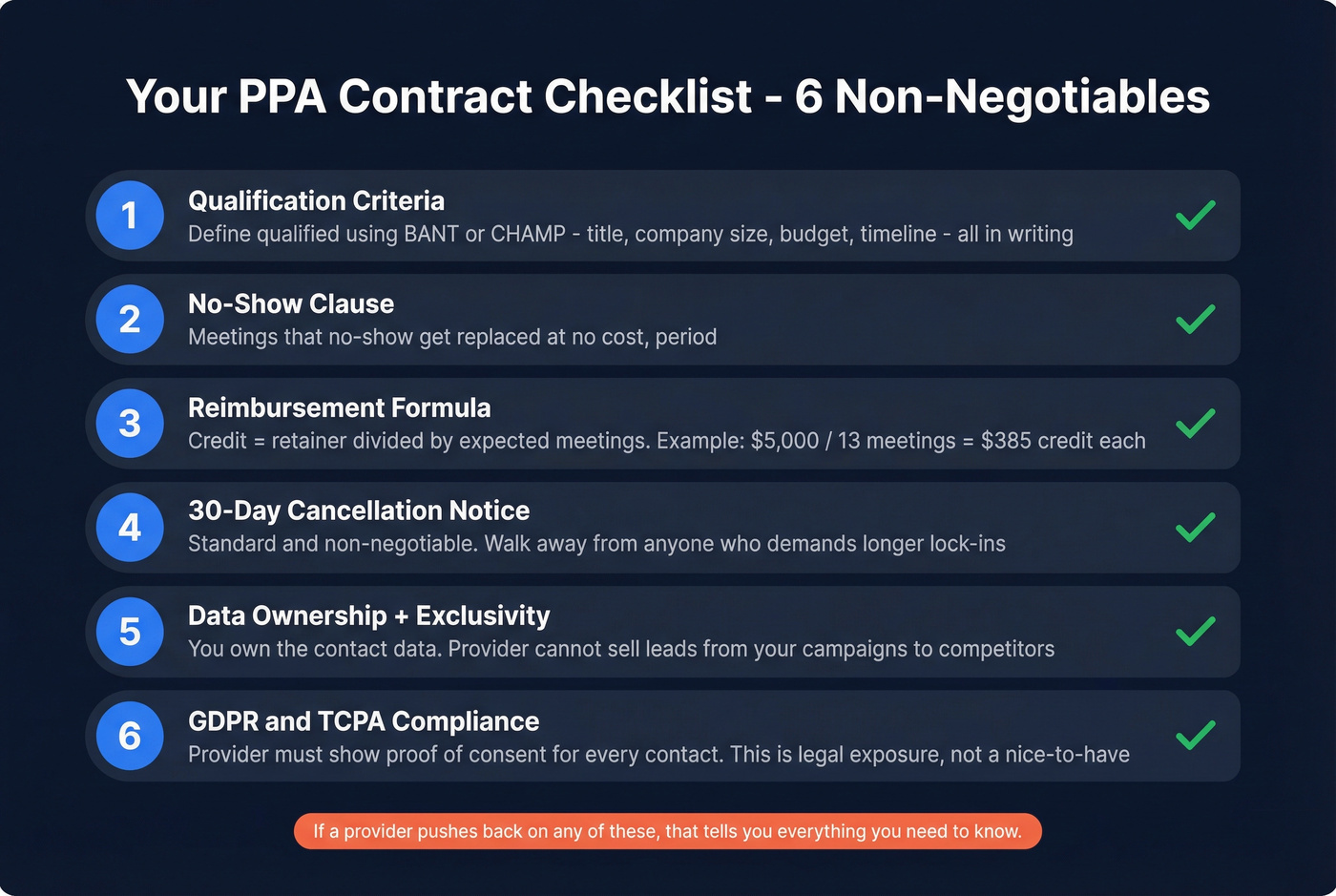
Qualification criteria: Define "qualified" using BANT or CHAMP - title, company size, budget range, timeline, all in writing (if you want to go deeper, map it to account qualification so sales and marketing stop arguing).
No-show clause: Meetings that no-show get replaced at no cost. Period.
Reimbursement formula: If minimum meetings aren't met, calculate credit as retainer / expected meetings. Example: $5,000 / 13 expected meetings = $385 per-meeting credit.
30-day cancellation notice: Standard and non-negotiable.
Data ownership + exclusivity: You own the contact data. The provider can't sell leads from your campaigns to competitors.
GDPR/TCPA compliance: Provider must demonstrate proof of consent for every contact. This isn't optional - it's legal exposure.
If a provider pushes back on any of these, that tells you everything you need to know.
KPIs Beyond Raw Meeting Count
Raw meeting count is a vanity metric. The teams who consistently get ROI from performance-based models track a tighter set of numbers.
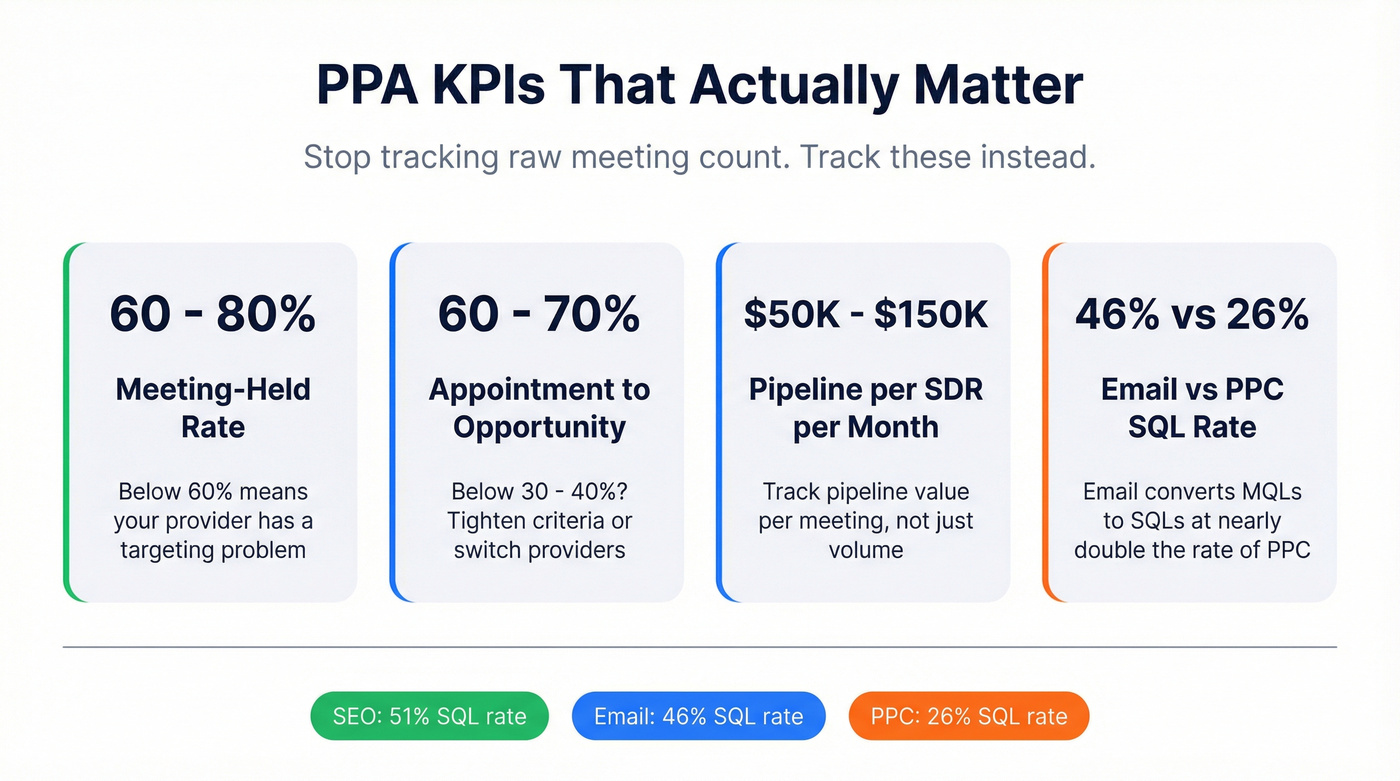
Meeting-held rate should land between 60-80%. Below 60%, your provider has a targeting problem. Appointment-to-opportunity conversion should hit 60-70% for strong qualification; below 30-40%, tighten the criteria or switch providers. And track pipeline-per-meeting, not just volume - healthy SDR output generates $50K-$150K in pipeline per month per SDR (use SDR conversion rate benchmarks to sanity-check). Email converts MQLs to SQLs at 46%, SEO at 51%, PPC at just 26%, so know your channel mix to benchmark PPA against alternatives.
Why Bad Data Kills the Model
Every pricing model above assumes the contact data is accurate. When it isn't, you're paying $400 for a meeting with a wrong number, a bounced email, or someone who left the company six months ago. Bad email data also tanks your domain reputation, which kills deliverability for every future campaign (and is usually a symptom of B2B contact data decay).
This is where we've seen teams save the most money with the least effort. Prospeo's 98% email accuracy and 7-day data refresh cycle mean you're verifying contacts before they enter the pipeline, not discovering they're dead after you've already paid for a meeting. Meritt cut their bounce rate from 35% to under 4% after switching, and their pipeline tripled. At $0.01 per lead for verification, the math is straightforward: verify before you pay $400 for a meeting that might not exist (start with an email checker tool if you're auditing your current list).

The quality problem with PPA isn't just bad agencies - it's bad data underneath. Prospeo refreshes every record on a 7-day cycle, removes spam traps and honeypots, and delivers 98% verified emails. That's how teams like Snyk cut bounce rates from 35% to under 5% and added 200+ opportunities per month.
Skip the agency markup. Get the data that actually converts.
Major Providers and What They Charge
| Provider | Monthly Range | Best For |
|---|---|---|
| SalesBread | $3,000 + setup | Small teams wanting white-glove quality |
| CIENCE | $3,000-$7,000 | Mid-market SaaS, multi-channel |
| Martal Group | $3,600-$8,000 | Tech/SaaS verticals |
| SalesHive | $4,000-$9,000 | Teams that value pricing transparency |
| SalesRoads | $5,400-$9,500+ | US-only SDR requirements |
| Belkins | $5,000-$14,800+ | Predictable volume + reporting |
| EBQ | $5,000-$10,000 | Full-funnel from lead to close |
| Callbox | $50K-$200K/yr | Enterprise with APAC coverage |
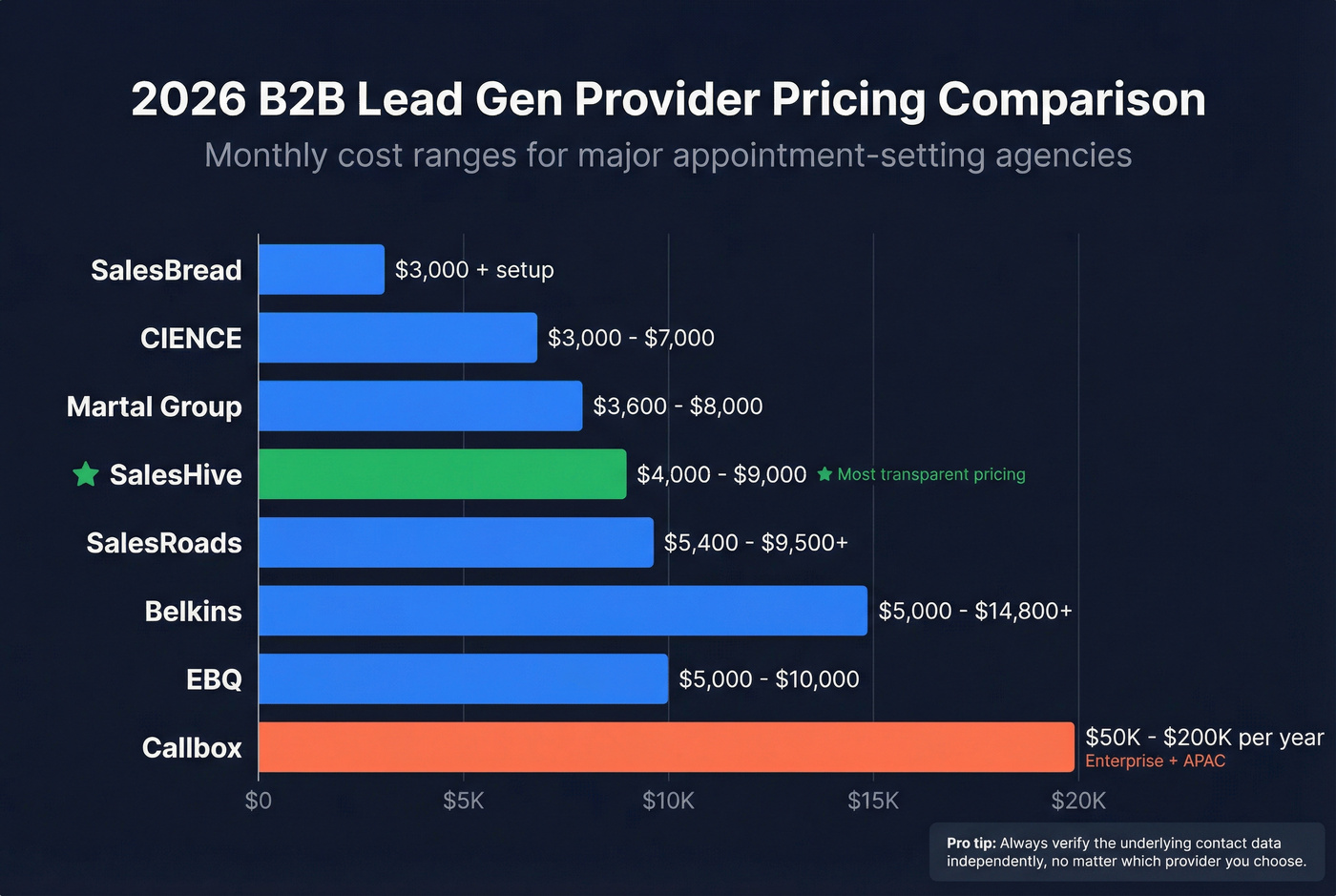
SalesHive is one of the more transparent providers on pricing. Most others require a sales conversation. Regardless of which provider you choose, verify the underlying contact data independently - don't trust the agency's list quality on faith (this is a core data quality control). The consensus on r/sales is pretty clear: agencies that resist independent data verification usually have something to hide.
FAQ
What's a fair price per qualified B2B meeting?
$300-$600 for standard mid-market B2B; $600-$1,500+ for enterprise or hard-to-reach targeting. Compare against your in-house SDR cost ($821-$1,150/meeting fully loaded). Your deal size determines whether the spend makes sense - at $25K+ ACV, most PPA economics work.
Is commission-only lead generation worth it?
Almost never. Commission-only attracts providers who cut corners on targeting and qualification. Hybrid models with a $2K-$4K base retainer plus $150-$400 per-meeting bonuses align incentives far better. Both sides share financial risk, which produces higher-quality outcomes.
How do I avoid low-quality meetings from PPA providers?
Define "qualified" in writing using BANT or CHAMP criteria before signing. Require no-show replacements, CRM integration for transparent reporting, and a 30-day cancellation clause. Track appointment-to-opportunity conversion - below 30%, tighten your ICP definition or switch providers.
What's the difference between pay-per-lead and pay-per-appointment?
Pay-per-lead means you're buying contact information - names, emails, phone numbers - that meet your criteria ($50-$250/lead). Pay-per-appointment means you pay only when a meeting is booked on your AE's calendar ($300-$600). PPA costs more per unit but delivers further down the funnel, which is why most B2B teams prefer it. Either way, verify contact data independently before it enters your pipeline.