

How to Build an Appointment Setting Campaign That Actually Books Meetings
Your SDR made 800 dials this week. Two meetings booked. Both no-shows.
That's not a people problem - it's a campaign architecture problem. 43% of sales teams say too few qualified meetings is their top bottleneck, and the fix isn't more activity. It's a better system: tighter targeting, smarter cadences, and data that doesn't waste your reps' time on dead contacts.
What You Need (Quick Version)
- Clean, verified contact data. Everything downstream - cadence, messaging, show rates - fails without it. (If you need tooling, start with an email checker or email ID validator.)
- A 14-day multi-channel cadence with 8-12 touches. 80% of conversions require 6+ follow-ups.
- Track show rate and SQL rate, not just meetings booked. A calendar full of no-shows wastes AE time and distorts your pipeline.
The Foundation: Data Quality
Ask any SDR manager what kills campaigns and the answer is always the same: bad data. A high bounce rate doesn't just mean missed contacts - it damages your sender reputation and deliverability for every email you send afterward. You're poisoning future campaigns with today's bad list.
We've seen this play out dozens of times. One customer, Meritt, was running a 35% bounce rate before switching to Prospeo's database of 300M+ professional profiles with 143M+ verified emails at 98% accuracy, all refreshed on a 7-day cycle. Their bounce rate dropped under 4%, and their pipeline tripled. That kind of swing doesn't come from better copy or more dials - it comes from reaching real people at real addresses.

Build Your Campaign in 6 Steps
1. Define Your ICP and Build a Verified List
Use 30+ filters - industry, headcount, funding stage, tech stack, department size - to narrow your market to decision-makers who match your buyer profile. Layer intent data on top of firmographics so you're reaching people actively researching your category. Here's the thing: a tight list of 500 verified contacts will outperform a sloppy list of 5,000 every time, because your reps spend their energy on conversations instead of chasing bounces and wrong numbers.
2. Set Qualification Criteria
Decide what counts as a "qualified meeting" before your first touch goes out. Here's the KPI chain that matters:
Connect rate → Conversation rate → Meeting set rate → Show rate → SQL rate
Volume metrics feel good in standups but mean nothing if show rates are 40% and SQL conversion is single digits. Define every stage before you launch. (If you want a tighter definition of pipeline stages, align on SQO vs SQL internally.)
3. Design a Multi-Channel Cadence
Plan 8-12 touches across email, phone, and social over 14-21 days. Space emails 2-4 business days apart. A proven email structure: Intro → Value add → Direct ask → Permission to close. Layer in 2-3 call attempts and 1-2 social touches between emails. If you need examples, start with a sales cadence example or these best sales sequences.
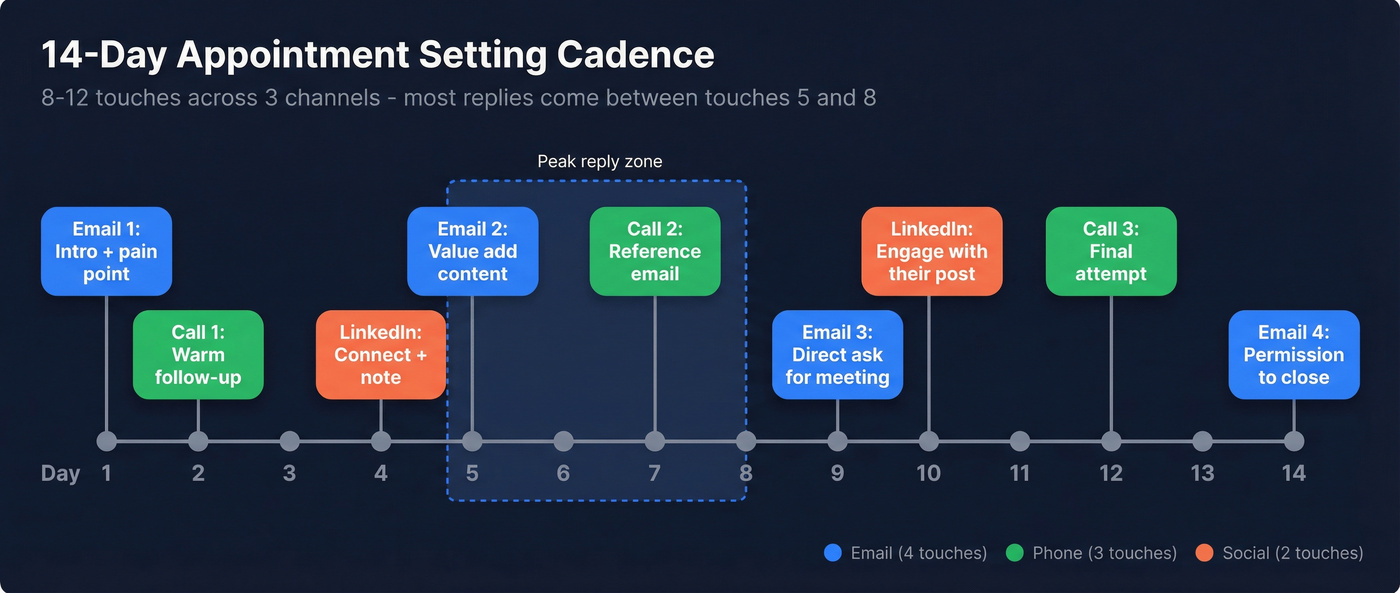
If your cadence stops at 3 touches, you're quitting before results start. Most teams we've worked with see the majority of replies between touches 5 and 8 - right where most competitors have already given up.
4. Write Messaging That Earns the Meeting
Here's what a bad first email looks like: "Hi {{first_name}}, I'd love to learn about your challenges." Delete. Gone. Nobody responds to that.
Instead, lead with evidence you've done your homework. Reference their tech stack, a recent funding round, or a job posting that signals the pain you solve. Make the prospect think "this person understands my problem," not "this person wants my money." And respect the "no" - stop sequences after a clear rejection. Burning bridges with aggressive follow-ups after someone declines costs you referrals and reputation in tight-knit industries. (For copy frameworks, use an outreach email template and avoid the classic “polite opener” traps like I hope this email finds you well.)
5. Execute With Speed
Leads contacted within 5 minutes are 21x more likely to convert than those contacted after 30 minutes. That stat alone should reshape your workflow.
Omnichannel cadences drive response rates up to 3x compared to single-channel outreach, so when a prospect engages on any channel, the clock starts immediately. Automate the first touch where possible, then layer in human follow-up for anyone who shows interest. (If you're building this end-to-end, map it as a prospecting workflow.)
6. Optimize Show Rates
Booking meetings isn't the goal - booking meetings that show up and convert is. Send a confirmation immediately after booking, a reminder 24 hours before, and a value-reinforcement message the morning of. Include a specific agenda point that makes the meeting feel worth attending.
For no-shows, trigger a recovery sequence the same day. We've seen teams recover 10-15% of missed meetings with a simple two-email rebook cadence. Skip this step and you're leaving pipeline on the table every single week.

Bad data kills appointment setting campaigns before your first email sends. Prospeo's 300M+ profiles with 98% email accuracy and 7-day refresh cycles keep your bounce rate under 4% - so every cadence touch reaches a real person.
Stop poisoning your sender reputation with dead contacts.
Benchmarks That Actually Matter
| Metric | Benchmark |
|---|---|
| Outbound contact → meeting | 2-5% |
| Cold call → meeting | 2-3% (~1 per 40 dials) |
| Top-performing teams | 5-8% |
| Inbound qualified → booked | Median 62%, top 10% 78%+ |
| Follow-ups to convert | 80% need 6+ |
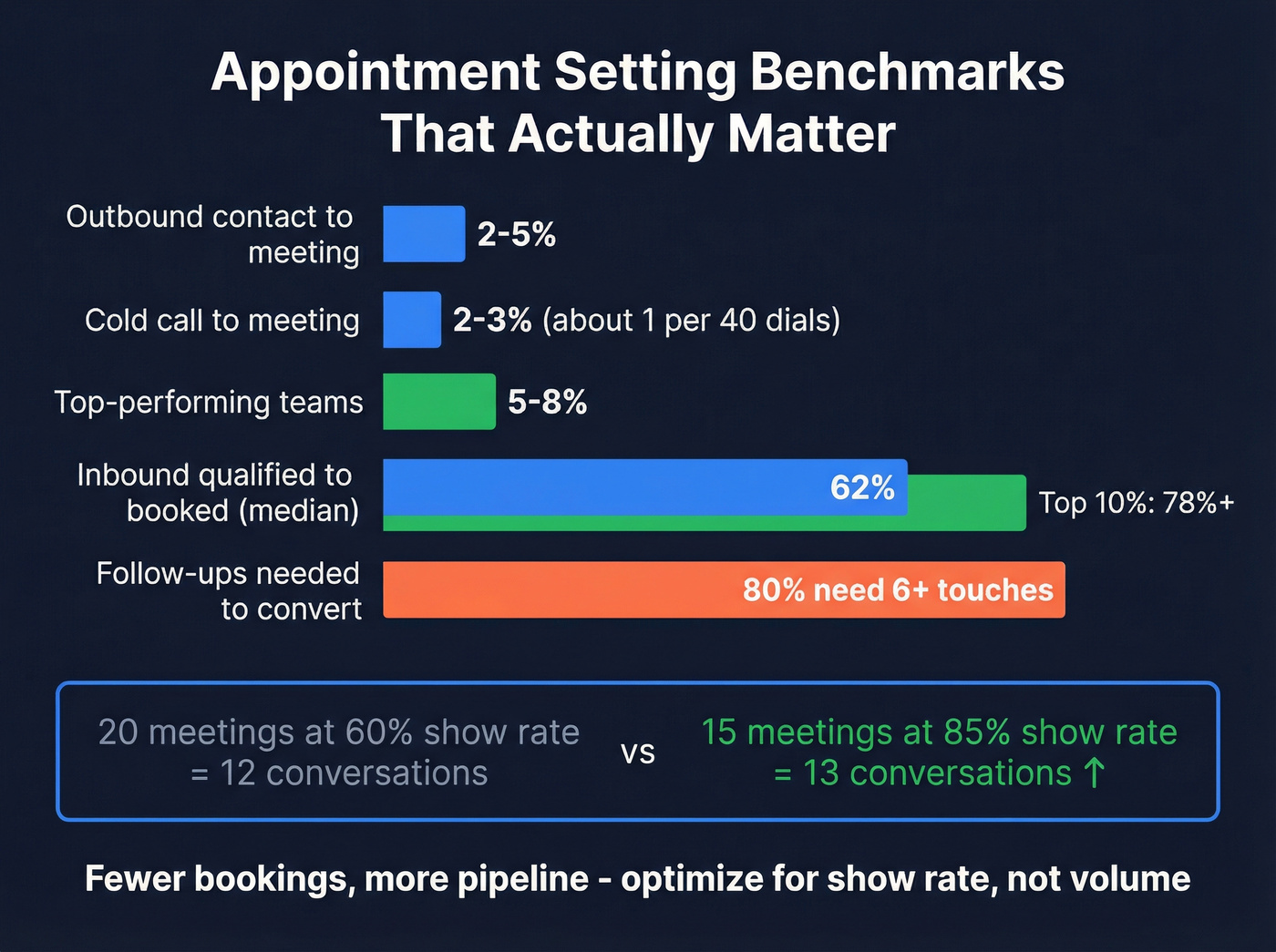
Most teams obsess over connect rate and ignore show rate entirely. Let's do the math: a 60% show rate on 20 meetings is 12 actual conversations. An 85% show rate on 15 meetings is almost 13. Fewer bookings, more pipeline. In our experience, teams that start tracking show rate alongside meeting volume see pipeline improvements within 30 days because they stop optimizing for vanity metrics and start optimizing for revenue.
The Real Cost Math
| Model | Annual Cost | Notes |
|---|---|---|
| In-house SDR (loaded) | ~$125K/yr | Base + benefits, tools, ramp, turnover |
| Outsourced equivalent | ~$65K/yr | ~48% less than in-house |
| Retainer service | $24K-$120K/yr | $2K-$10K/month |
| Pay-per-appointment | Varies | $50-$500 per meeting |
The fully-loaded in-house SDR math catches people off guard. It's not just the $65K base - it's $20K in benefits and commission, $5K in tools, $15K in management overhead, $12K in ramp-up productivity loss, and $8K in turnover costs at ~40% annual attrition.
If your average deal size sits below $15K, you probably can't justify a dedicated in-house SDR. Outsource the volume work, keep strategic accounts internal, and spend the savings on better data and tooling. The hybrid model is increasingly the right answer for mid-market teams, and the consensus on r/sales backs this up - most founders who've tried both say the hybrid approach outperforms either extreme.
Sales Engagement Tech Stack
| Layer | Tool | Starting Price |
|---|---|---|
| Data / Prospecting | Prospeo | Free tier, ~$0.01/email |
| Data / Prospecting | Apollo | Free tier, from $49/user/mo |
| Data / Prospecting | ZoomInfo | $15K-$40K/yr |
| Sequencing | Instantly | From ~$30/mo |
| Sequencing | Lemlist | From ~$39/mo |
| Engagement | Outreach | ~$100-150/user/mo |
| Engagement | Salesloft | ~$100-150/user/mo |
| Scheduling | Calendly | Free, paid from $12/user/mo |
| Scheduling | Cal.com | Free, paid from $15/user/mo |
| CRM | HubSpot | Free tier |
| CRM | Salesforce | From $25/user/mo |
Knowing how to wire these layers together matters just as much as choosing the right tools. Start by mapping each layer - data, sequencing, engagement, scheduling, and CRM - to a specific stage in your cadence, then connect them so prospect activity in one tool triggers the next step automatically. Without that workflow glue, you end up with a collection of point solutions instead of a functioning pipeline machine. (If you're pressure-testing your stack, use this sales tools checklist.)
For teams spending less than $500/month on tooling, skip the enterprise engagement platforms entirely. A combination of Prospeo for data, Instantly or Lemlist for sequencing, and a free CRM tier covers 90% of what you need.
Five Campaign Killers to Avoid
Wrong ICP targeting. Reaching the wrong people with the right message still produces zero pipeline. This is the most expensive mistake because it wastes every dollar spent downstream.
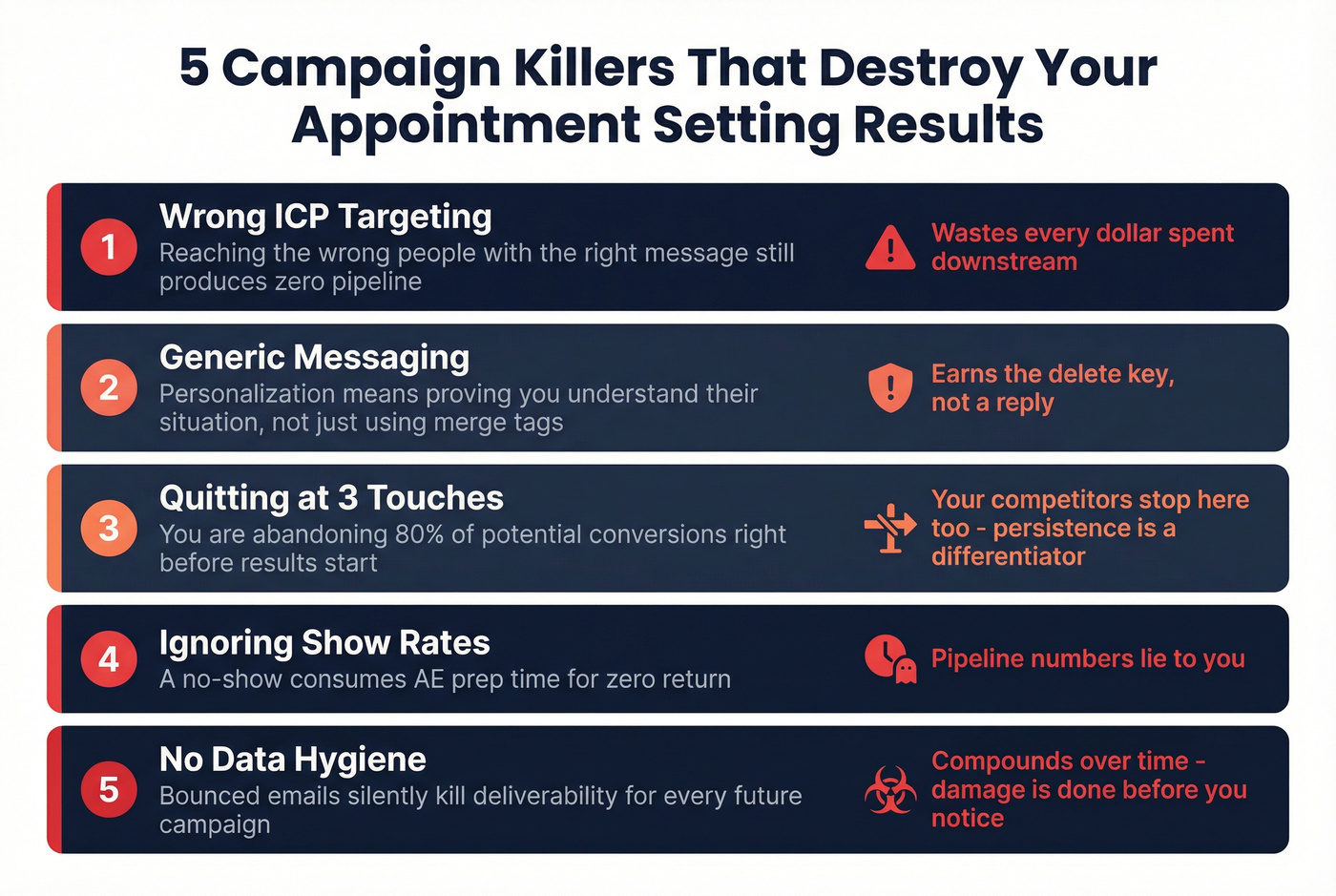
Generic messaging. "I'd love to learn about your challenges" earns the delete key, not a reply. Personalization doesn't mean {{first_name}} merge tags - it means proving you understand their specific situation.
Quitting at 3 touches. You're abandoning 80% of potential conversions. Most of your competitors stop here, which means persistence alone is a differentiator.
Ignoring show rates. A booked meeting that no-shows is negative ROI - it consumed AE prep time for nothing. Track it, fix it, or watch your pipeline numbers lie to you.
No data hygiene. Bounced emails damage your sender reputation and silently kill deliverability for every future campaign. This one compounds. By the time you notice, the damage is already done. (If you want a system for keeping records clean, follow a CRM hygiene process.)
Your SDRs don't need more dials - they need better lists. With 30+ filters, intent data across 15,000 topics, and verified mobiles with a 30% pickup rate, Prospeo turns your appointment setting campaign into a pipeline machine at $0.01 per email.
Book more meetings with fewer touches - start with data that connects.
FAQ
What is an appointment setting campaign?
It's a structured outbound program where SDRs use phone, email, and social to qualify prospects and book meetings for account executives. It typically runs over a 14-21 day multi-channel cadence with 8-12 touches, tracked from connect rate through to SQL conversion.
How many touches does it take to book a meeting?
Plan for 8-12 touches across multiple channels over 14-21 days. 80% of conversions require 6+ follow-ups. If your cadence stops at 3, you're quitting right before results start - most teams see the majority of replies between touches 5 and 8.
How much does an appointment setting campaign cost?
A fully-loaded in-house SDR costs ~$125K/year. Outsourced services run $2K-$10K/month on retainer or $50-$500 per booked meeting. Your tool stack typically adds $100-$300/month per user before headcount - less if you use self-serve platforms with transparent pricing instead of enterprise-priced alternatives.