

How to Reach Out to Individual Contributors (and Why Most Teams Get It Wrong)
A $200K-$300K deal dies in committee - not because the VP said no, but because three engineers your SDR never contacted told procurement the product was wrong for their stack. Nobody on the sales team even knew those engineers were in the buying group. This happens constantly, and it's almost always preventable.
Reaching out to individual contributors is the single most overlooked motion in modern B2B sales. B2B buying committees now run 8-13 stakeholders deep. The 6sense Buyer Experience Report found that 95% of the time, the winning vendor is already on the Day One shortlist - and the pre-contact favorite wins roughly 80% of deals. If you're not engaging the ICs who shape that shortlist, you're playing a game you've already lost.
Ask any SDR team lead and they'll say the same thing: finding verified contact data for ICs is the biggest bottleneck in bottom-up selling. Executives have public profiles. A staff engineer at a Series B startup often doesn't.
What You Need (Quick Version)
Three priorities, in order:
- Verified contact data. ICs have lower public profiles than directors and VPs. If your emails bounce, nothing else matters. (If you’re troubleshooting bounces, start with email deliverability and a proper email validity check.)
- Role-specific messaging. An IC cares about workflow impact, not ROI narratives. Write to their reality. Use a personalization framework that’s specific to the role.
- Multi-channel sequencing. But shorter than you think. Deeply personalized first touches can convert in 1-3 contacts. Blasting 12-step sequences at ICs is how you get blocked. (If you need structure, borrow from proven sales sequences.)
Why Individual Contributors Matter in Every Deal
The old playbook was simple: find the VP, pitch the VP, close the VP. That assumed executives controlled the shortlist. They don't anymore.
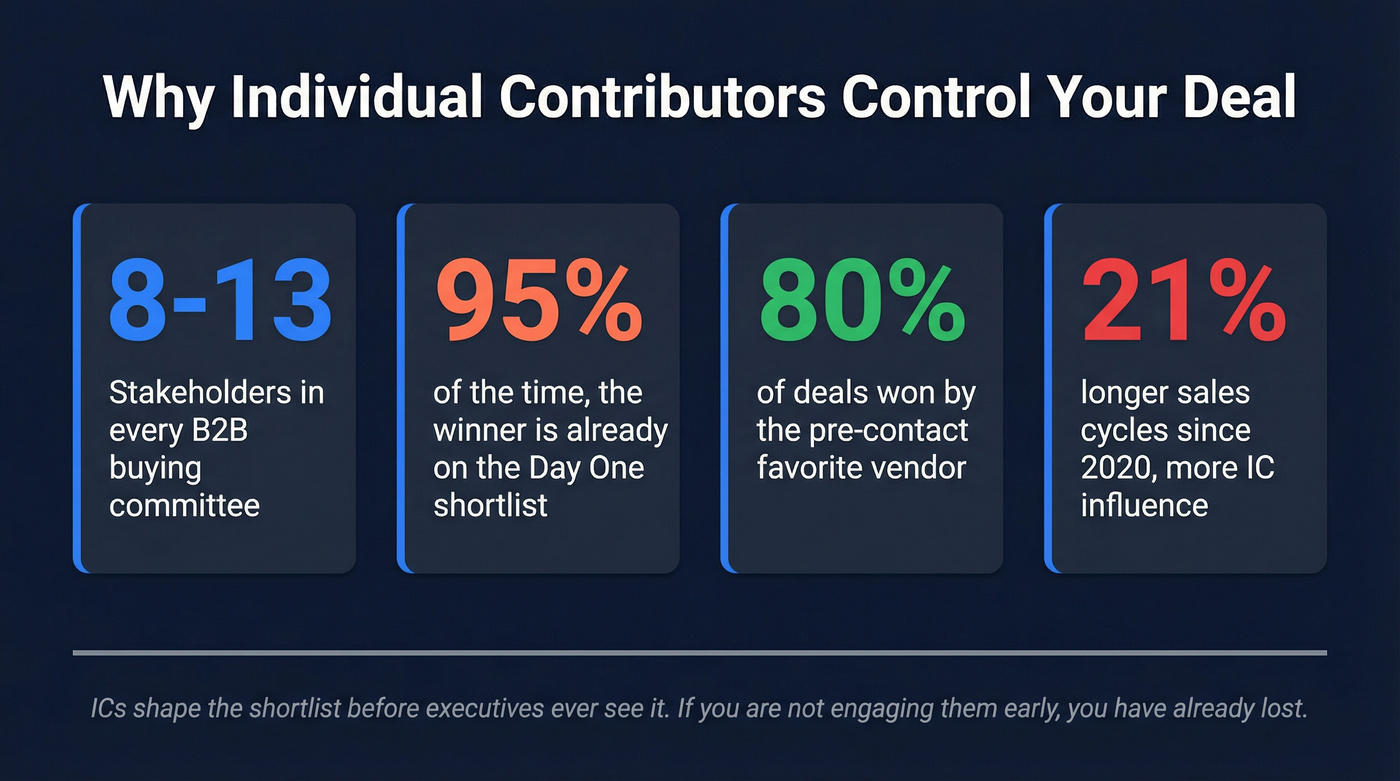
6sense's data - based on nearly 4,000 B2B buyers - shows buying cycles compressed from 11.3 months to 10.1 months, with first vendor contact happening at 61% of the journey instead of 69%. That's 6-7 weeks earlier than the prior year. Buyers form opinions faster, and those opinions are shaped by the people who'll actually use the product. Meanwhile, sales cycles are 21% longer and win rates 2% lower than in 2020, meaning more internal stakeholders weigh in on every purchase and each one has more leverage to slow things down or kill a deal outright.
Individual contributors are the ones testing free trials, reading documentation, and telling their manager "this won't work with our current setup" or "we need this yesterday." They're the hidden influencers in every buying committee. When you skip them, you're hoping the executive sponsor can sell internally on your behalf. That's a terrible bet.
In mid-market and enterprise deals, end users make up a meaningful share of the buying group. They don't sign contracts, but they absolutely kill them. (This is the core of multithreading done right.)
Here's a take we'll stand behind: if your deal size sits below $30K, you probably don't need to multi-thread into the C-suite at all. Win the ICs, win their manager, close the deal. The executive layer adds friction without adding value at that price point.
Sales Outreach - The Bottom-Up Playbook
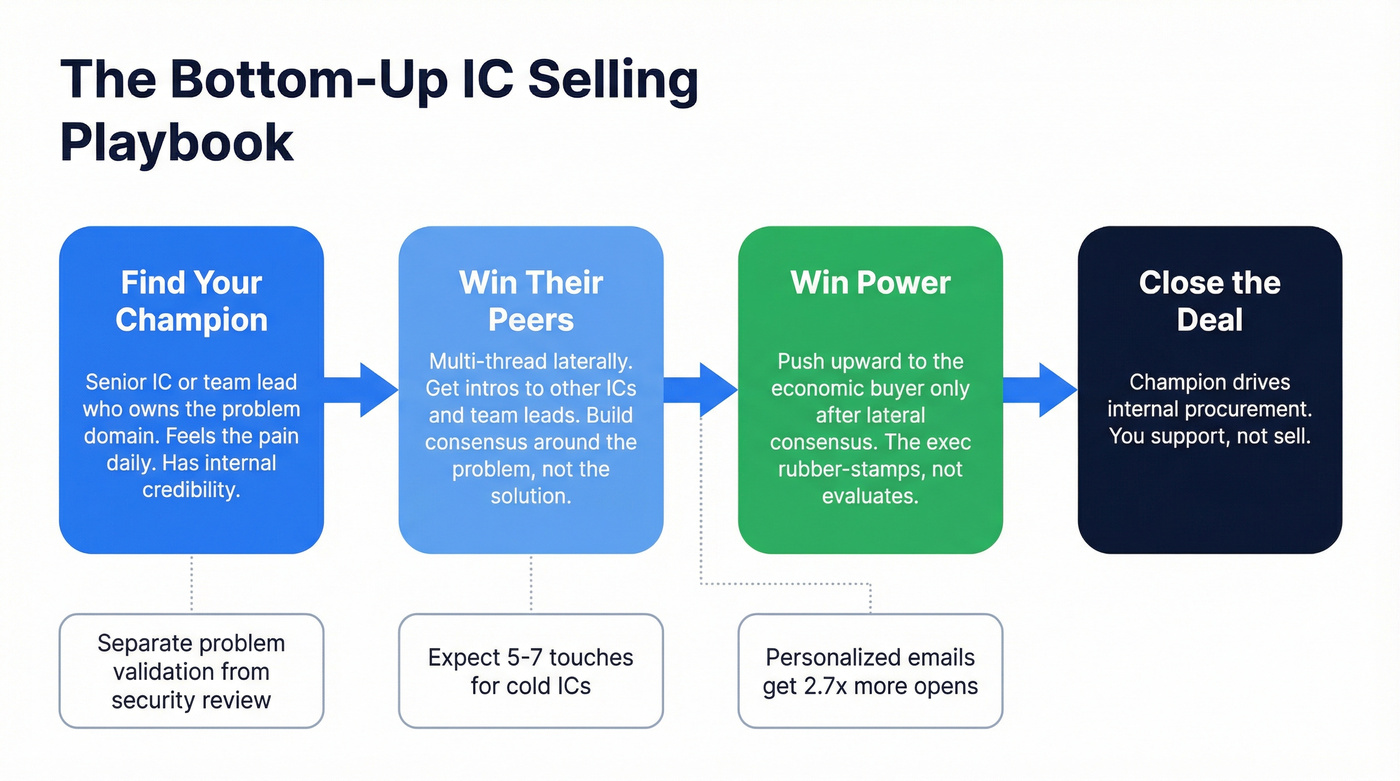
The most reliable framework for IC-first selling comes from champion selling methodology: find a champion, win their peers, win power, then make it work.
Find Your Champion
Your champion isn't the CEO. It's the senior IC or team lead who owns the problem domain - the person who feels the pain daily and has enough internal credibility to advocate for a solution. Start with stakeholder mapping: who must approve? Who has veto power? Who influences the shortlist? Your champion should be someone who can answer these questions and wants to.
Win Their Peers, Then Win Power
Once your champion is engaged, multi-thread laterally. Get introduced to their peers - other ICs and team leads who'll be affected by the purchase. This is where deals build momentum or stall.
Separate the "does this solve our problem?" conversation from the "does this pass our security review?" conversation. The first one happens with ICs and champions. The second comes later, after business priority is established. Only after you've built lateral consensus do you push upward to the economic buyer. By then, the executive isn't evaluating your product - they're rubber-stamping a decision their team already made.
How Many Touches It Takes
Outreach's internal data shows touches required for first interactions hit 4.81 in 2024, up 17% since 2021. For cold outbound to non-qualified leads, expect closer to 7 touches on average. Interestingly, senior IT individual contributors actually saw a decrease in required touches year-over-year, suggesting that ICs in technical roles are more receptive to relevant outreach than their executive counterparts. (If you’re building a cadence, use a repeatable outreach campaign structure.)
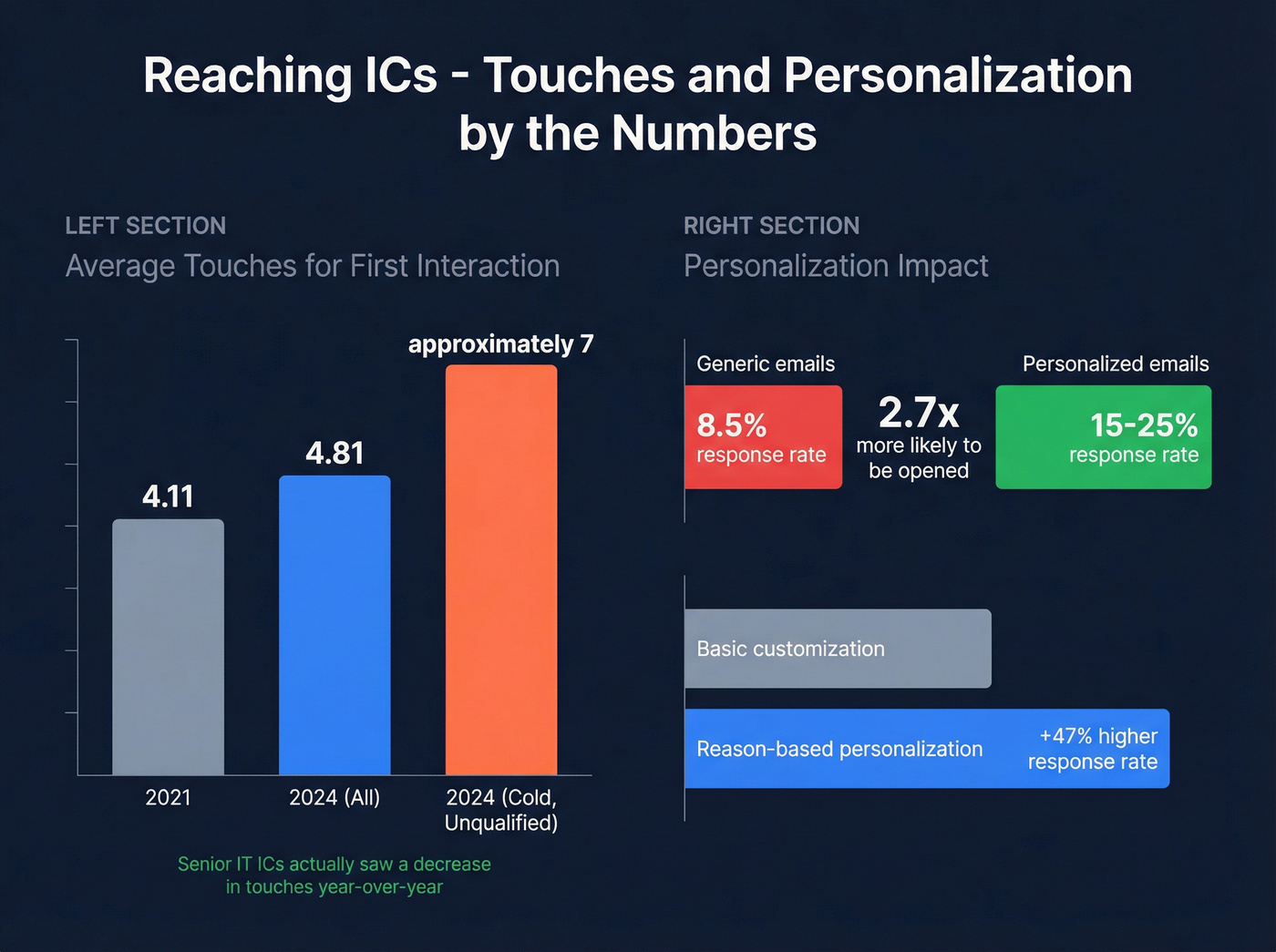
Volume isn't the answer, though. Personalized cold emails are roughly 2.7x more likely to be opened, and top performers hit 15-25% response rates versus the 8.5% average. The difference isn't more emails - it's better emails sent to verified addresses with role-specific messaging. (If you want more patterns, pull from these Outreach email templates.)
A Template for IC Cold Outreach
Here's a cold email framework we've seen consistently earn replies from ICs. Adapt the specifics, but keep the structure:
Subject: Quick question about [specific tool/process they use]
Hey [First Name],
I noticed [their team / company] is using [specific technology or process - pull from job postings or technographic data]. We work with [similar role] teams at [2-3 comparable companies] who were running into [specific pain point ICs at that level actually feel].
[One sentence on what changed for those teams - concrete outcome, not marketing speak.]
Worth a 15-min call this week, or should I send over a quick walkthrough instead?
[Your name]
The key: reference something specific to them, name a pain they recognize, and give them a low-commitment next step. No ROI stats. No "I'd love to pick your brain." ICs see through that instantly.
Recruiting ICs - Outreach That Gets Replies
Every recruiter has sent the generic InMail: "Hi [Name], I came across your profile and thought you'd be a great fit for..." ICs delete these reflexively. They get dozens a week.
The gap between basic customization and deep personalization is enormous. Gem's data shows that messages using reason-based personalization achieve 47% higher response rates than those without. Personalized subject lines alone boost open rates by 26%. We've seen this play out firsthand - the recruiters on our team who reference a specific project or open-source contribution get replies at 3-4x the rate of those who just swap in a name and title.
Use this if you're recruiting senior ICs in competitive markets: lead with why them specifically, reference something they've built or written, and connect it to a real problem your team is solving. Skip the job description dump.
Skip this if you're doing high-volume campus recruiting - the ROI on deep personalization doesn't scale at that level.
For 2026, this matters even more: 87% of Gen Z professionals would consider leaving for a company with better values alignment. For younger ICs, your outreach needs to signal mission and culture, not just comp and title.

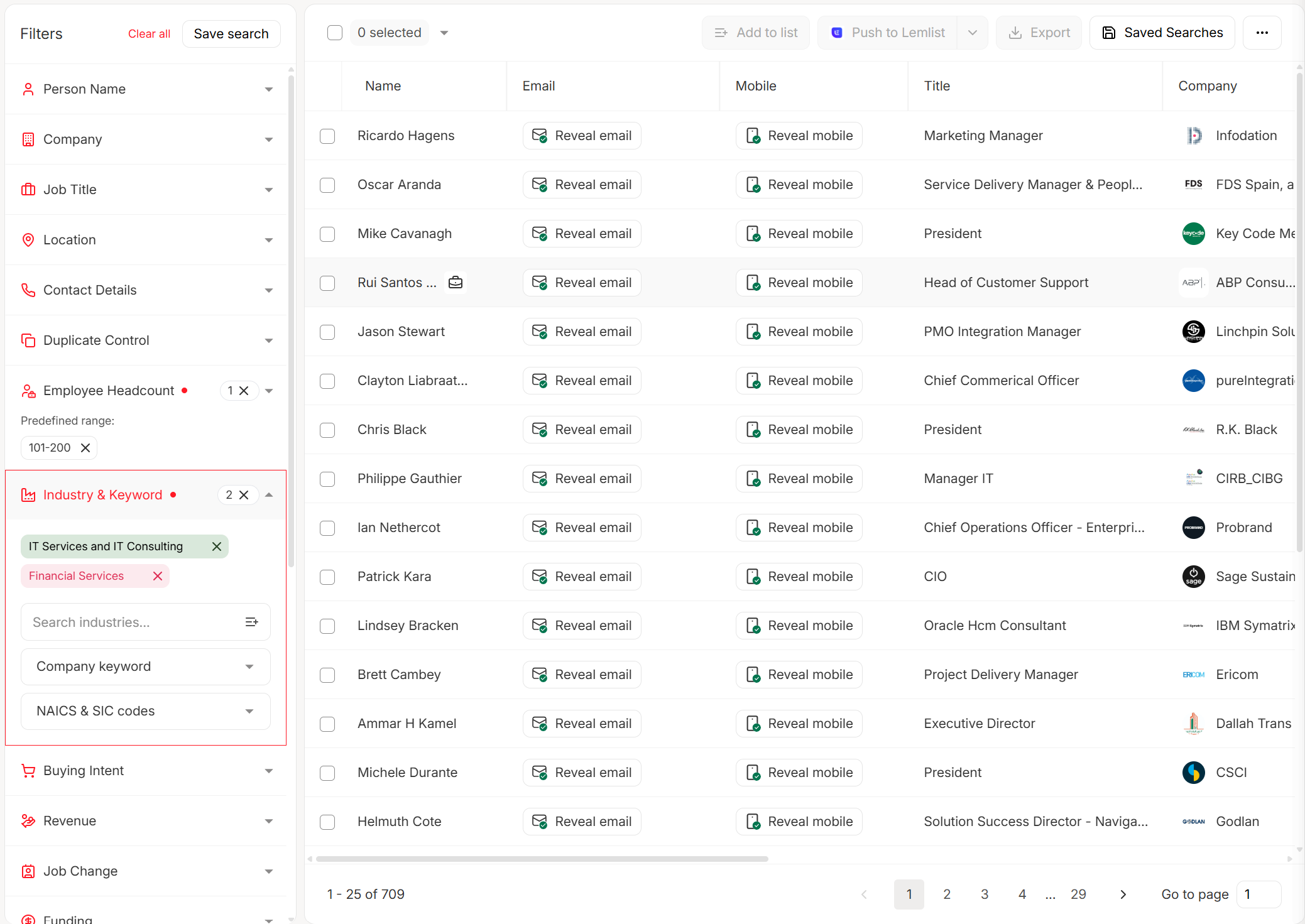
Finding verified emails for individual contributors is the #1 bottleneck in bottom-up selling. Prospeo's 300M+ database with 98% email accuracy means your first touch actually lands - even for staff engineers at Series B startups with zero public presence.
Stop bouncing emails. Start building champion consensus.
Internal Outreach - Getting ICs on Board
Contacting ICs isn't just an external motion. When you're rolling out a new tool, process, or reorg internally, the ICs who'll live with the change daily determine whether it sticks.
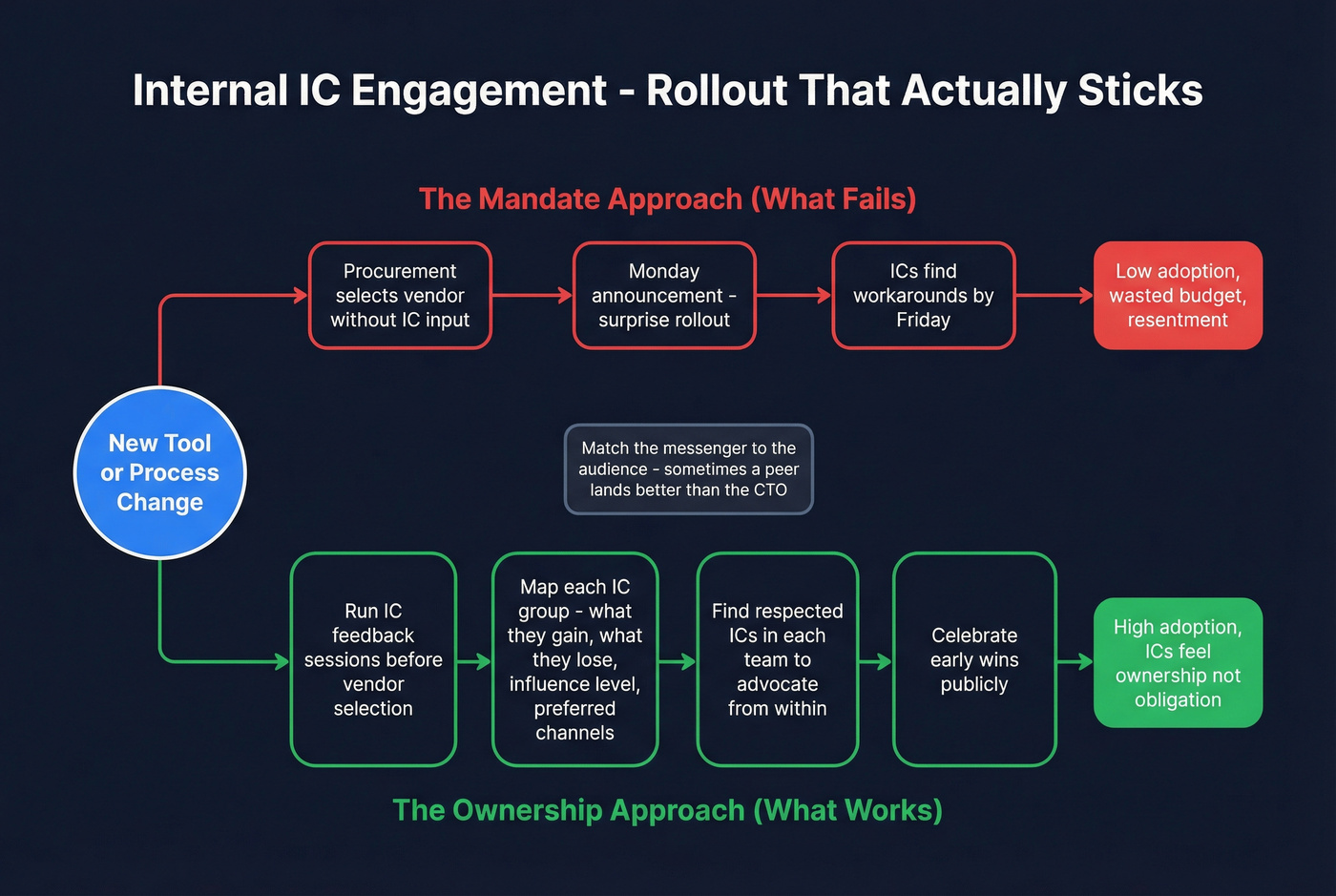
Consider what happens when internal rollouts skip IC input: a mid-size SaaS company pushes a new security tool through procurement, announces it on a Monday, and by Friday half the engineering team has found workarounds because nobody asked them about their existing workflow. Contrast that with teams that run IC feedback sessions before the vendor is selected - adoption rates jump because people feel ownership, not obligation.
The playbook is straightforward. Engage end users before the decision is finalized. Gather their insights, surface concerns, and build ownership. ICs who feel consulted adopt faster than ICs who feel mandated. For each IC group, run a stakeholder analysis mapping what they gain, what they lose, their influence level, and preferred communication channels. Match the messenger to the audience - sometimes the message lands better from a peer than from the CTO. Find the respected individual contributors in each team who can advocate for the change from within, and celebrate early wins publicly.
The Data Quality Problem
Here's where most IC outreach falls apart before it starts.
You've built the perfect sequence, nailed the messaging, mapped the buying committee - and 35-40% of your emails bounce. Your domain reputation tanks. Deliverability craters across all campaigns, not just the bad list. It's infuriating, and we hear about it constantly from teams switching to us after burning their sender reputation on bad data. (If you’re seeing this, start with hard bounces and a deliverability-first email deliverability checklist.)
The consensus across B2B communities like r/sales is that IC-level contacts are the hardest to source accurate data for. ICs don't speak at conferences, they're not on podcast circuits, and their contact info changes frequently as they move between roles. One customer, Meritt, went from a 35% bounce rate to under 4% after switching their data source - that's the difference between a functioning outbound program and a dead one.
Channel Strategy
| Channel | Best For | When to Use |
|---|---|---|
| Scale IC outreach | First touch, nurture sequences | |
| Phone | High-value IC targets | After email engagement, or with verified direct dials |
| Social | Warm intros, recruiting | Supplement to email, not replacement |
| Multi-channel | Enterprise deals | Always - 200%+ engagement lift vs single-channel |
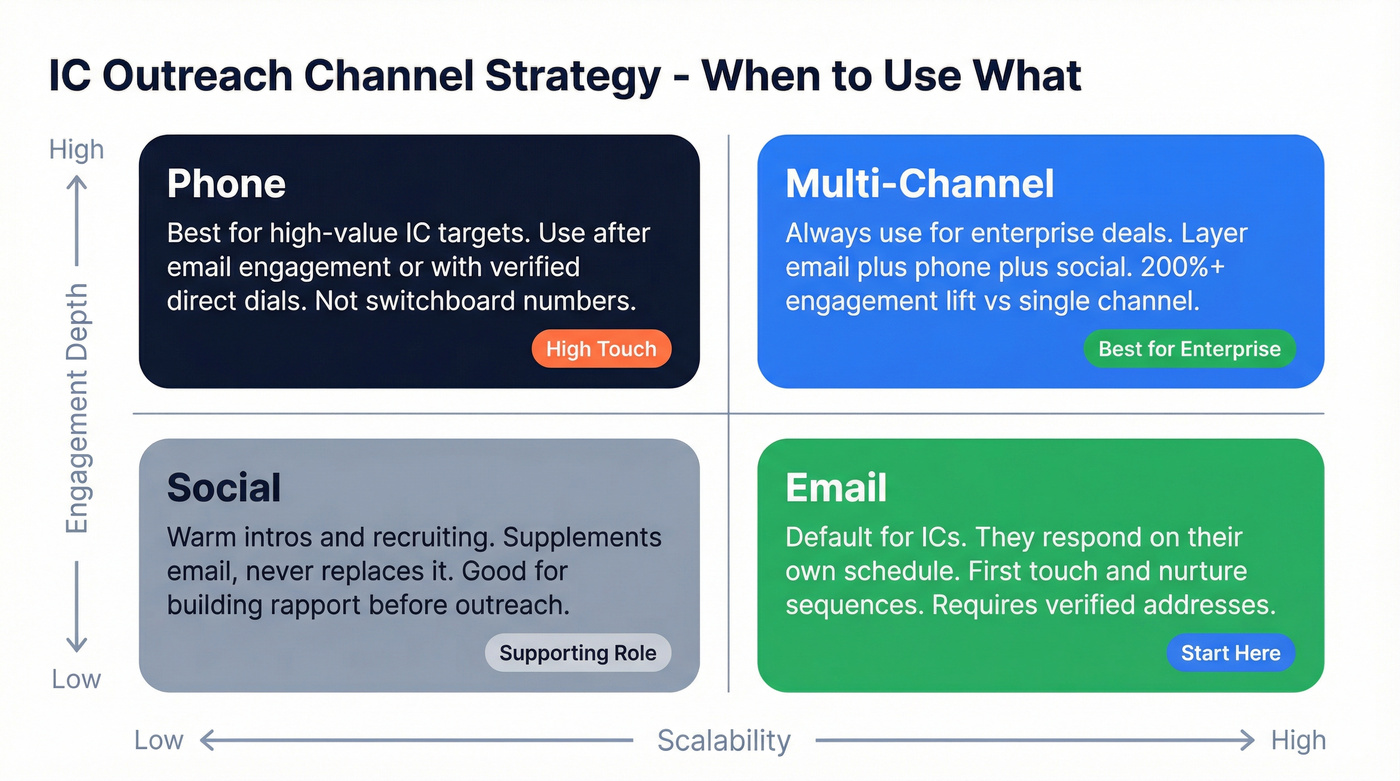
Email is the default for ICs. It's the channel they can respond to on their own schedule without feeling ambushed. Phone works for high-value targets when you've got verified direct dials, not switchboard numbers. Social touches add warmth but rarely close on their own. (If you’re adding phone, make sure you understand what a direct dial actually is.)
For enterprise deals, always layer channels - the engagement lift is too significant to ignore.
The Strategic Layer - PLG Starts with ICs
Everything above is tactical. The strategic question is bigger: why are the fastest-growing B2B companies building entire go-to-market motions around individual contributors?
McKinsey's analysis of 107 publicly listed B2B SaaS providers found that product-led sales outperformers see ~10 percentage points more ARR growth and ~50% higher valuation ratios. The mechanism is IC adoption: get end users hooked on the product, then convert that bottom-up usage into enterprise contracts. Direct IC outreach and PLG aren't competing strategies - they're complementary. One creates the initial relationship; the other scales it.
Let's be honest: if your outbound team is still only targeting VPs and directors in 2026, you're leaving deals on the table. The companies winning right now are the ones treating ICs as first-class targets in their prospecting workflows, not afterthoughts. (If you’re rebuilding the motion, start with a modern prospecting workflow.)
Multi-threading into ICs requires role-specific contact data that most providers can't deliver. Prospeo's 30+ filters - including technographics, department headcount, and job changes - let you map entire buying committees at $0.01 per verified email.
Find every stakeholder in the buying group before your competitor does.
FAQ
What's the difference between an IC and a manager?
An individual contributor executes hands-on work without direct reports - engineers, designers, analysts, account executives. Managers oversee people and processes. ICs typically hold deeper technical knowledge and more direct influence over product adoption decisions within buying committees, even though they rarely hold budget authority.
How many touchpoints to reach an IC?
The average across all outbound is 4.81 touches, up 17% since 2021. Cold outbound to unqualified leads runs closer to 7 touches. Deeply personalized first messages can convert in 1-3 contacts - a relevant, specific email outperforms a 12-step generic sequence every time.
What's the best channel for contacting ICs?
Email-first. It's the highest-scale, most natural channel for ICs who don't want unsolicited phone calls. Supplement with phone for high-value targets where you've got verified direct dials, and layer in social touches for warmth. Multi-channel sequences boost engagement 200%+ versus single-channel approaches.
How do I find verified contact data for ICs?
IC-level contacts are notoriously hard to source because they lack public profiles. Tools like Prospeo cover 300M+ professionals with 98% email accuracy and a 7-day refresh cycle, with filters for job title, technographics, and department headcount that let you isolate ICs precisely. The free tier (75 emails/month) lets you validate the data before scaling.