

Software Sales Prospecting: The SaaS Playbook for 2026
A RevOps lead at a Series B security company ran a pipeline audit last quarter. The SDR team had been cut sharply. AEs were expected to self-source a meaningful share of pipeline. And the "verified" contact list they'd been handed still produced a painful number of bounces on the first sequence. That's software sales prospecting in 2026 - fewer dedicated prospectors, bigger buying committees, and data quality that makes or breaks your quarter.
The average B2B buying group now includes 22 people. You can't brute-force your way through that with volume. You need precision.
The Short Version
The fundamentals haven't changed, but the execution has.
Match your prospecting motion to your ACV tier. PLG for deals under $5K, hybrid for $5K-$50K, full sales-led for $50K+. The wrong motion wastes months.
Prospect on buying signals, not cold lists. Only 25% of B2B companies use intent or signal data. The ones that do see materially better reply rates.
Your data provider matters more than your sequencer. Start with verified contacts, plug in a sequencer and your CRM. That's the stack.
What Makes SaaS Prospecting Different
SaaS prospecting isn't just B2B outbound with a different product. The economics change everything.
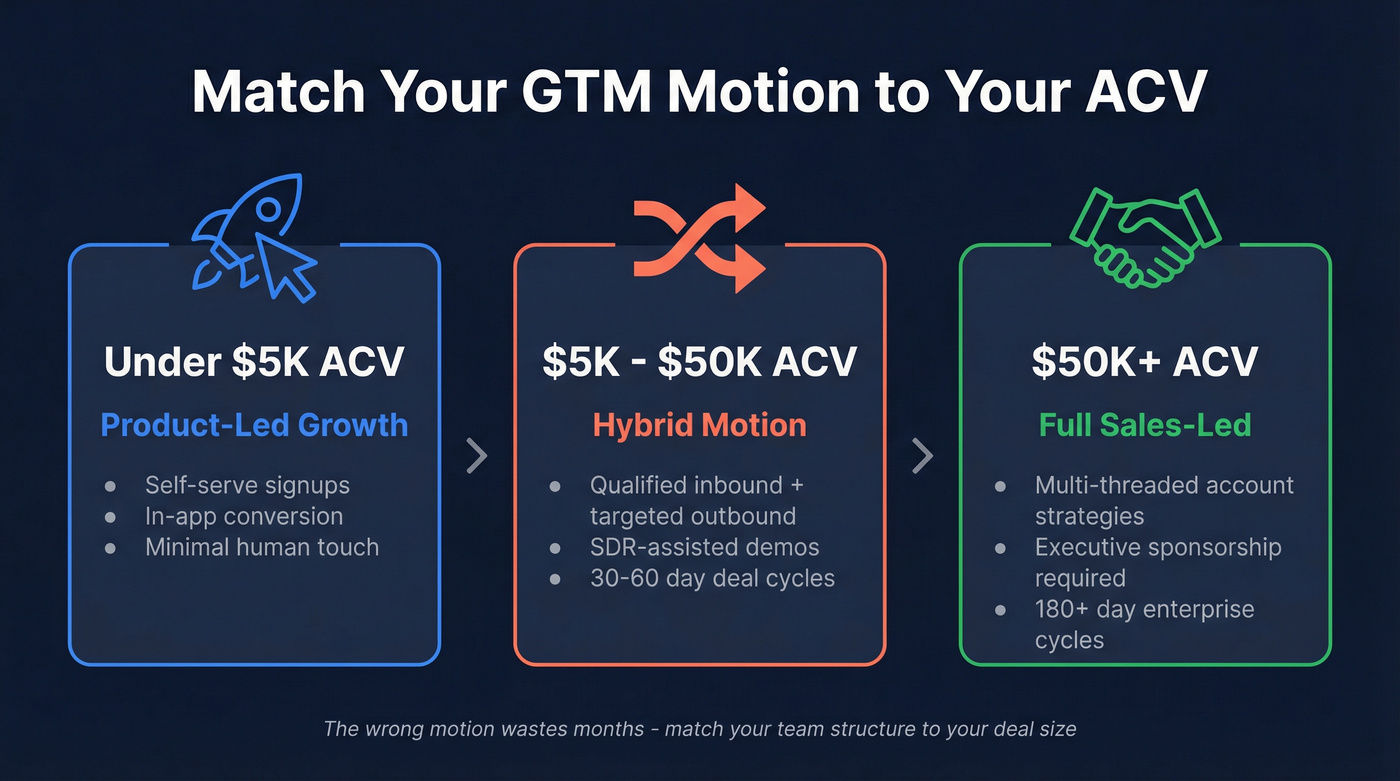
Your GTM motion should match your ACV. Teams selling sub-$5K deals need product-led growth - humans can't profitably touch every deal. In the $5K-$50K range, you're running a hybrid motion where reps engage qualified inbound and run targeted outbound. Above $50K, it's full sales-led with multi-threaded account strategies.
The timeline pressure is real. The average B2B SaaS deal cycle runs about 84 days. Enterprise stretches to 180+. Mid-market can close in 30-60 days if your timing is right.
And timing is the operative word: 6Sense research found that 92% of B2B SaaS buyers start with at least one vendor already in mind, and 95% of the time the winner is on the day-one shortlist. That stat should change how you think about prospecting entirely. You're not convincing people to buy software - you're fighting to be on the shortlist before they even start evaluating.
Look, if your deal size sits below $10K, you probably don't need ZoomInfo-level data or a 12-tool stack. A verified contact database, a sequencer, and disciplined signal-based targeting will outperform the bloated enterprise setup every time.
Build a SaaS ICP That Actually Converts
A sharp ICP converts 2-3x better than a broad one. That's not a marginal improvement - it's the difference between a team that hits quota and one that churns through reps.
Your ICP needs four dimensions:
- Firmographics - industry, headcount, revenue, geography, tech stack
- Pain points - the specific problems your software solves, stated in the buyer's language
- Buying triggers - funding rounds, leadership changes, headcount growth, compliance deadlines
- Decision process - who's involved, what approvals are needed, typical timeline
Here's the validation heuristic that actually works: talk to 30 potential customers. If 20 of them describe the same pain and would pay to solve it, your ICP is validated. If you're getting scattered responses, you're too broad. You can accelerate this without scheduling 30 new calls - mine your existing customer interviews, Gong call recordings, and G2 reviews of competitors for patterns.
Guard your unit economics. Target accounts where you can hit LTV:CAC of 3:1 or better with CAC payback under 12 months. Teams that target based on retention patterns - not just ICP fit - cut their sales cycle in half. If the math doesn't work at the ICP level, no amount of prospecting skill will save you.
Signal-Based Prospecting
Here's the thing: generic outbound gets 3-5% reply rates. Signal-personalized outreach hits 15-25%. That's the difference between booking two meetings a week and booking ten.
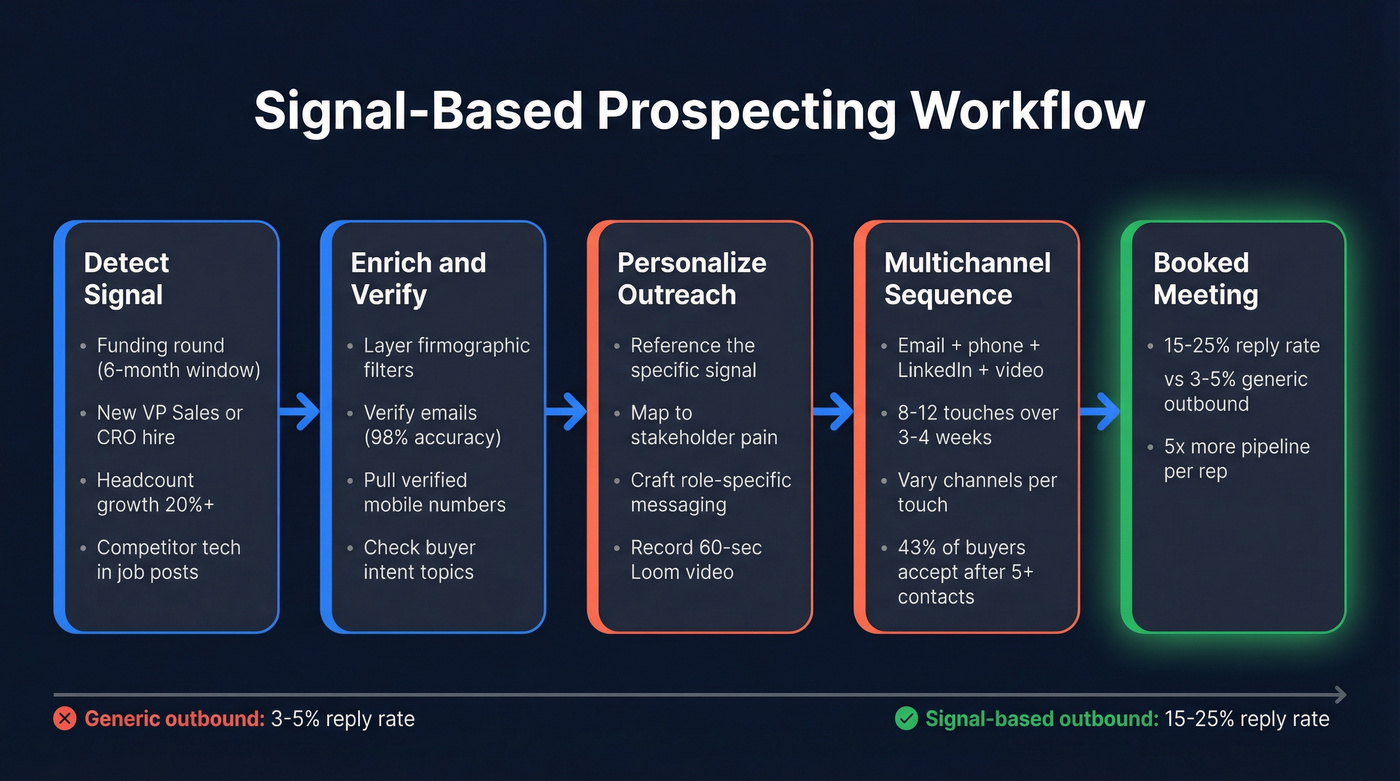
Only 25% of B2B companies use intent or signal data. If you build signal-based workflows, you're competing against teams that are still spraying and praying.
The highest-intent window is 6 months post-funding round, when new budget meets new priorities and stack decisions are wide open. Leadership hires - especially a new VP of Sales or CRO - often trigger stack reviews within about 90 days. Teams scaling fast need tools that scale with them, making headcount growth one of the most reliable signals.
Two signals that get overlooked: tech stack mentions in job posts and earnings call language. If a company is hiring for a competitor's platform, they're locked in. If they're hiring generalists, they're still deciding. And when a public company's CEO says "investing in go-to-market efficiency" on an earnings call, that's a buying signal for half the SaaS market.
Operationalizing these signals is where most teams stall. You need a data provider that lets you layer buyer signals - job changes, headcount growth, funding events, technographics - directly into your prospecting workflow. That turns "we should prospect signal-based" into an actual list you can sequence today.
The Outbound Playbook
Multichannel, persistent, personal. Those three words summarize what works.
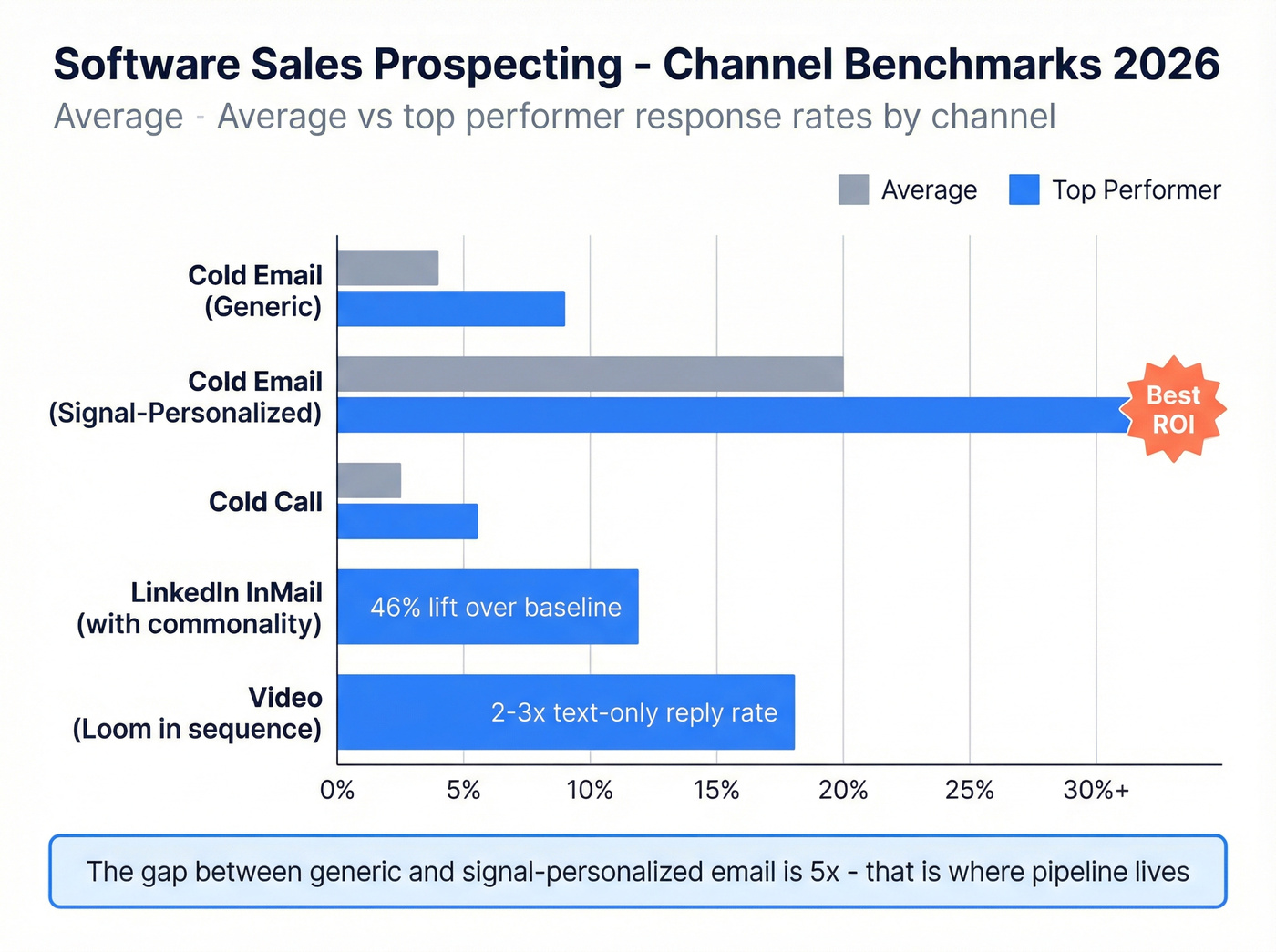
Multichannel means email, phone, social, and video touches in a coordinated sequence. A LinkedIn Sales Navigator analysis found that mentioning at least one commonality yields a 46% lift in InMail acceptance rates - shared connections and shared alma mater were the top performers. Video prospecting is gaining traction too: personalized 60-second Loom videos in cold sequences pull 2-3x the reply rate of text-only emails in many segments. Conversational tools like Drift and Qualified can also capture buying intent from website visitors before a rep ever reaches out.
Persistent means more touches than you think. RAIN Group found that 43% of buyers who accept meetings say it's fine for sellers to contact them five or more times. Most reps give up after two. That gap is where pipeline lives.
Channel Benchmarks
| Channel | Avg Response Rate | Top Performer Rate |
|---|---|---|
| Cold email (generic) | 3-5% | 8-10% |
| Cold email (signal-personalized) | 15-25% | 30%+ |
| Cold call | 2-3% meeting rate | 5%+ |
| LinkedIn InMail (with commonality) | ~46% lift over baseline | - |
| Video (Loom in sequence) | 2-3x text-only | - |
Personal means stakeholder-specific messaging. In a 22-person buying group, you can't send the same email to everyone. Map your angles:
- CRO / VP Sales - revenue impact, competitive displacement, time-to-value
- RevOps - integrations, data model, implementation timeline
- CFO - ROI model, contract flexibility, total cost of ownership
- Security / IT - SOC2, SSO, data handling, compliance certifications
Buyers say 58% of sales meetings aren't valuable. That's because reps show up with generic decks instead of stakeholder-specific value props. Do the homework.

You just read that signal-personalized outreach hits 15-25% reply rates vs 3-5% for generic blasts. Prospeo lets you layer buyer intent, job changes, headcount growth, funding, and technographics into a single search - then export verified emails (98% accuracy) directly into your sequencer.
Turn buying signals into booked meetings, not bounced emails.
Five Mistakes That Kill Deals
1. Bad data destroys your domain before you send a single sequence. Apollo bounce rates often land in the 15-35% range depending on the segment. That's not a data quality issue - it's a deliverability crisis. Every bounced email chips away at your sender reputation. Verify every email before it enters your sequence. At roughly $0.01/email with tools like Prospeo, verification costs less than a single bounced sequence.
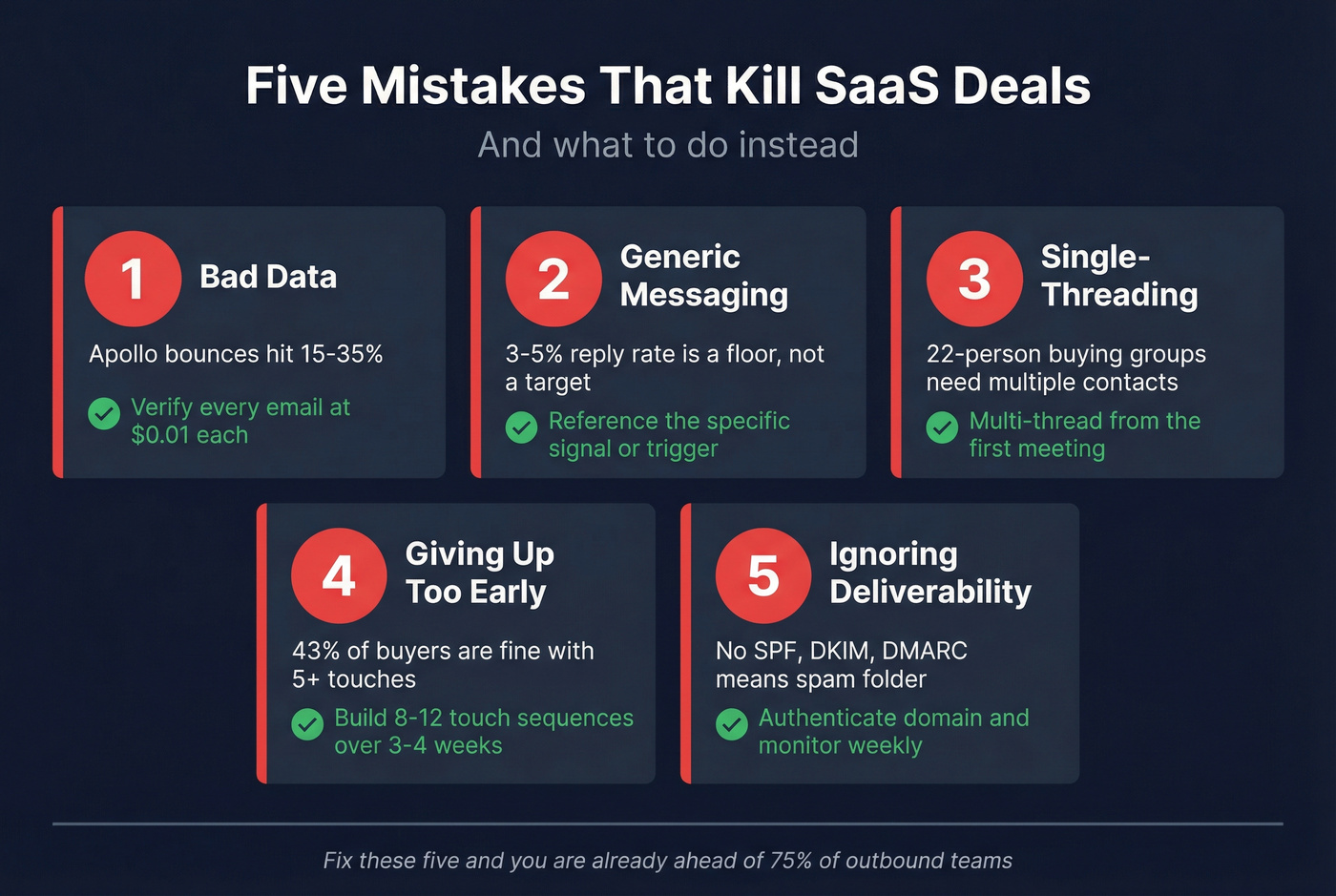
2. Generic messaging signals you didn't do your homework. "I noticed your company is growing" isn't personalization. Reference the specific signal - the funding round, the leadership hire, the job post that mentions your competitor's tool. The 3-5% reply rate on generic outbound isn't a benchmark to accept. It's a floor to escape.
3. Single-threading in a 22-person buying group is a losing bet. If your champion leaves, gets reassigned, or loses internal influence, your deal dies. Multi-thread from the first meeting. Map the buying committee early and build relationships across it.
4. Giving up after two touches. 43% of buyers are fine with five or more contacts. Most reps stop at two. Build sequences that run 8-12 touches across 3-4 weeks.
5. Ignoring deliverability fundamentals. SPF, DKIM, and DMARC aren't optional anymore. If your domain authentication isn't configured properly, your emails land in spam regardless of how good your copy is. Verify your list, warm your domain, and monitor deliverability metrics weekly.
The SaaS Prospecting Tool Stack
What You Actually Need
You need four tools: a data provider, a sequencer, a CRM, and a dialer. Everything else is optional.
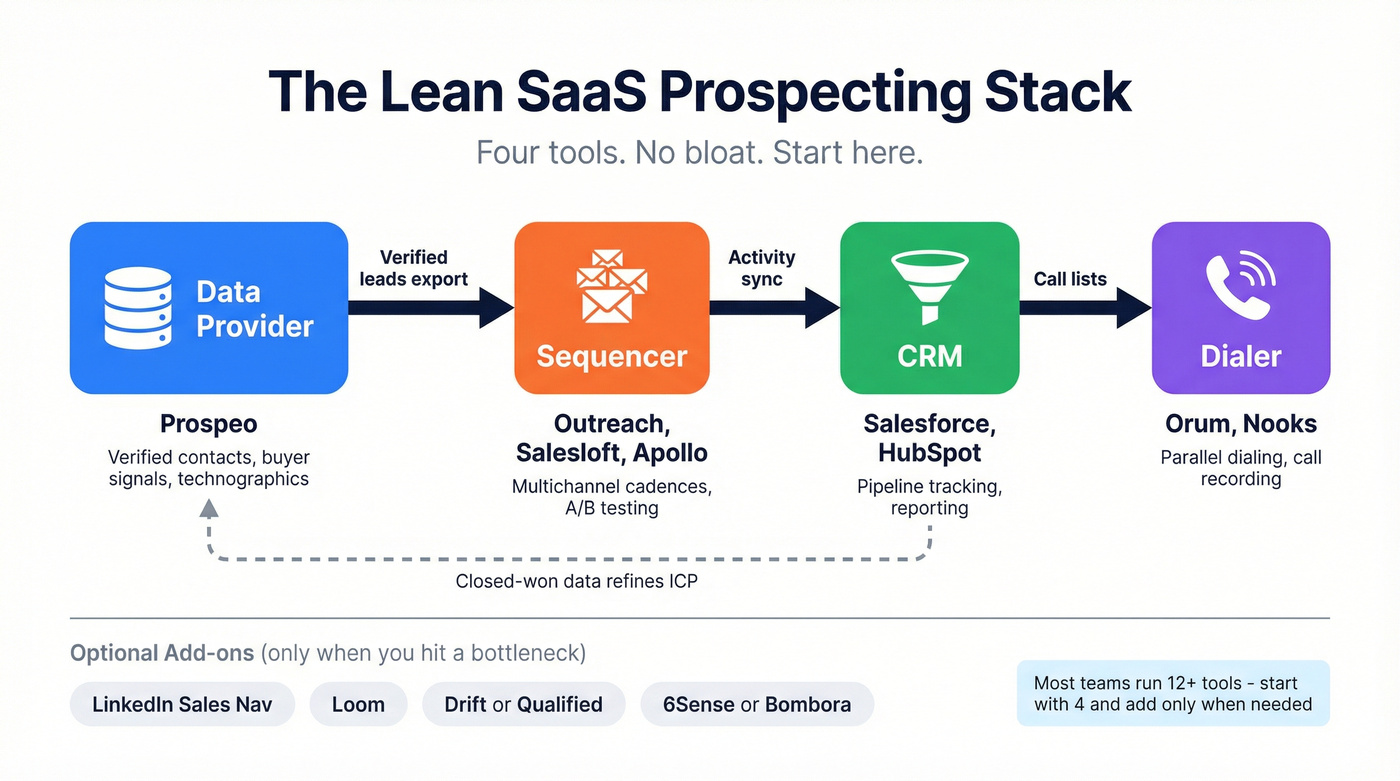
We've seen teams running 12+ tools in their stack and spending more time managing integrations than actually prospecting. Start lean. Add tools when you hit a specific bottleneck, not because a vendor's demo looked impressive.
Talk to any operator running outbound and you'll hear the same frustrations: Apollo's database is huge but bounce rates can be brutal, ZoomInfo's data is solid but the contract locks you in for a year minimum, and everyone's looking for something that just works without the enterprise pricing. The consensus on r/sales mirrors this - data accuracy before sequencing volume is what separates teams consistently hitting quota from those blaming "the channel."
Prospeo
Prospeo covers 300M+ professional profiles with 98% email accuracy, 143M+ verified emails, and 125M+ verified mobile numbers that deliver a 30% pickup rate. Data refreshes every 7 days - compared to the roughly 6-week industry average, that's a meaningful edge when you're prospecting into fast-moving SaaS companies where people change roles constantly.

The 30+ search filters include buyer intent powered by 15,000 Bombora topics, technographics, job changes, headcount growth, funding events, and department-level headcount. You can build a signal-based list and export verified contacts in minutes rather than stitching together three different tools.
Pricing starts free with 75 emails/month and 100 Chrome extension credits/month. Paid plans run from ~$39/mo with no contracts. At roughly $0.01 per lead, that's 90% cheaper than ZoomInfo's ~$1/lead. For context, a mid-size ZoomInfo contract runs $25K-$40K/year.
The Snyk case study tells the story: 50 AEs prospecting 4-6 hours per week, bounce rates cut from 35-40% to under 5%, AE-sourced pipeline up 180%, and 200+ new opportunities per month.
Apollo.io
Apollo is the default choice for teams that want data and sequencing in one platform. The database is massive at 275M+ contacts, and the built-in sequencer saves you a separate tool. But bounce rates are the elephant in the room - 15-35% in real-world usage means you're burning sender reputation unless you verify externally. Paid plans start at $49/user/month billed annually. Best for early-stage teams who need an all-in-one and will verify contacts before sequencing.
ZoomInfo
ZoomInfo offers one of the deepest US-focused databases with strong intent signals and org chart data. If you're running enterprise ABM with $100K+ ACVs, the depth can justify the price. Real contracts land at $25K-$40K/year, and you're locked in annually. Skip this if your ACV is under $50K - the ROI math won't work.
Clay
Clay is the darling of the RevOps community for good reason. Its waterfall enrichment pulls from many sources and fills gaps no single provider covers. The learning curve is steep - expect a week of setup before you're productive - but for teams that need to enrich messy CRM data or build complex workflows, nothing else comes close. Plans start at $149/mo.
Sequencing and Outreach Tools
| Tool | Starting Price | Best For | Watch Out For |
|---|---|---|---|
| Salesloft | ~$100/user/mo | Enterprise cadences with coaching | No data included, annual contract |
| Outreach | ~$100/user/mo | Complex multi-step workflows | Steep setup, overkill for small teams |
| Instantly | ~$30/mo | High-volume cold email, deliverability | Email only - no phone or social |
| Lemlist | ~$59/mo | Creative personalization at mid-scale | Struggles at high volume |
| La Growth Machine | EUR50/mo | Multichannel automation | Smaller user community |
Full Comparison
| Tool | Category | Starting Price | Best For |
|---|---|---|---|
| Prospeo | Data + Verification | Free / ~$39/mo | Verified emails and mobiles at scale |
| Apollo.io | Data + Sequencing | $49/user/mo | All-in-one for early-stage teams |
| ZoomInfo | Data + Intent | ~$15K/yr min | Enterprise ABM, US-focused depth |
| Lusha | Data | $36/mo | Quick lookups, small teams |
| Hunter.io | Email Finding | $34/mo | Simple email finding on a budget |
| Seamless.AI | Data | $147/mo | Real-time search, aggressive prospecting |
| Clay | Enrichment | $149/mo | Waterfall enrichment, RevOps workflows |
| Salesloft | Sequencing | ~$100/user/mo | Enterprise sales cadences |
| Outreach | Sequencing | ~$100/user/mo | Complex multi-step workflows |
| Instantly | Cold Email | ~$30/mo | High-volume cold email deliverability |
| Lemlist | Cold Email | ~$59/mo | Creative personalization |
| La Growth Machine | Multichannel | EUR50/mo | Automated email + social sequences |
Benchmarks That Actually Matter
Forget vanity metrics. These numbers tell you whether your prospecting engine is working or leaking.
| Metric | Median | Top 10% | Source |
|---|---|---|---|
| Qualified-to-booked rate | 62% | 78%+ | RevenueHero |
| Industry average (no scheduling) | ~30% | - | Chili Piper |
| Form-to-meeting (with scheduling) | 66.7% | - | Chili Piper |
| Cold call-to-meeting | 2-3% | 5%+ | Everstage |
| Outbound email-to-meeting | 2-5% | 5%+ | RevenueHero |
Speed-to-lead is the highest-leverage fix most teams ignore. Prospects contacted within 5 minutes are 21x more likely to convert than those contacted after 30 minutes. Yet most teams still route leads through a round-robin that takes hours.
The Chili Piper stat deserves its own paragraph: form scheduling doubles inbound conversion from 30% to 66.7%. Only 8% of top B2B SaaS companies have implemented it. If you haven't, stop reading and go set it up. We've seen this single change move the needle more than any outbound optimization.
For outbound, expect 2-5% meeting conversion from initial contact. If your numbers are below that, look at data quality and messaging before blaming the channel.
AI-Powered Prospecting in 2026
AI usage among sales reps nearly doubled from 24% to 43% in a single year, and 81% of sales teams are now experimenting with or have implemented AI in their workflows. Daily AI users are 2x as likely to exceed their targets. Already, 22% of teams have fully replaced human SDRs with AI agents.
But most teams are using AI wrong. They're generating mass-produced "personalized" emails that all sound the same - and buyers can tell. We've tested AI-generated first drafts extensively. They save real time but still need a human pass for tone and genuine insight.
The AI workflows that actually move the needle are more targeted:
Signal monitoring is where AI shines brightest. Scanning funding announcements, leadership changes, and job posts to surface accounts entering a buying window can cut prospect research from 12 hours per week to 4 by auto-generating account briefs your reps can act on immediately.
First-draft personalization is where most teams start: AI writes the initial draft referencing specific signals, the rep edits for tone and adds genuine insight. The output beats static template libraries because it adapts to each prospect's context rather than slotting names into brackets.
Sequence optimization is the quiet winner. AI testing send times, subject lines, and channel order across thousands of sequences simultaneously produces compounding gains that no human could manage manually.
The AI SDR market is projected to hit $15B by 2030 at a 29.5% CAGR. That's not hype - it reflects real productivity gains. But the teams winning aren't replacing reps with AI. They're giving reps AI-powered signal data and letting humans handle the relationship-building that actually closes deals.
Your AEs are self-sourcing pipeline with bad data - and every bounce erodes domain reputation. Prospeo delivers 143M+ verified emails on a 7-day refresh cycle at $0.01 per lead. That's 90% cheaper than ZoomInfo with higher accuracy. Teams using Prospeo book 26% more meetings.
Protect your domain and triple your pipeline output.
Prospecting During a Downturn
When budgets tighten, prospecting doesn't stop - it shifts. Deals take longer, buying committees add more stakeholders, and every vendor faces a higher bar for ROI justification.
The teams that thrive during downturns double down on signal-based targeting rather than increasing volume, because spray-and-pray burns cash you can't afford to waste. Focus on accounts showing expansion signals even in a contracting market: companies still hiring, still raising rounds, or publicly committing to infrastructure investments on earnings calls. Cloud migration projects tend to hold up better in downturns because initiatives already in motion rarely get killed - they just get scrutinized harder.
Let's be honest about the messaging shift too. Lead with cost savings and efficiency gains rather than growth narratives, and build ROI models that speak directly to the CFO's recession-era priorities. The teams that reframe their pitch around "protect what you have" instead of "grow faster" are the ones still booking meetings when everyone else is getting ghosted.
FAQ
What's the difference between leads and prospects?
Leads are unqualified contacts who fit a basic demographic filter. Prospects match your ICP and have demonstrated buying signals - funding, leadership changes, or active evaluation. In SaaS, this distinction matters because the average buying group is 22 people; you need to qualify at the account level before investing rep time.
How many touches to book a meeting?
Expect five or more touches across multiple channels. RAIN Group found 43% of buyers who accept meetings are fine with that level of persistence. Signal-personalized email gets 15-25% reply rates - far above the 3-5% generic baseline. Multichannel sequences combining email, phone, and social consistently outperform single-channel approaches.
What's the best free tool to start?
Prospeo's free tier gives you 75 verified emails per month at 98% accuracy - enough to test outbound without risking your domain on bad data. Pair it with your existing CRM and a free-tier sequencer like Instantly. That three-tool stack costs nothing to start and scales as your pipeline grows.
How does SaaS prospecting differ from general B2B outbound?
Software sales prospecting requires matching your entire go-to-market motion to your ACV tier - something general B2B outbound rarely accounts for. The subscription model means you're targeting accounts with strong retention potential and LTV:CAC ratios that justify acquisition cost. Buying committees are larger, prospects are more technically literate, and generic pitches fall flat faster.