

How to Source Candidates: The 2026 Playbook With Templates and Benchmarks
Recruiters are handling 93% more applications than in 2021 while juggling an average of 13.4 open roles each - and recruiting headcount is down 14% from its peak. The math only works if you source smarter. Sourced candidates are 8x more likely to be hired than inbound applicants, and direct sourcing produces 11% of all hires from just 2.6% of applications - a 4x yield advantage over job boards. This playbook covers the exact steps, Boolean strings, outreach templates, and benchmarks to build a sourcing engine that actually fills roles.
The Short Version
- Stop relying on job boards alone. They generate ~90% of applications but only about half of hires.
- Mine your ATS first. 46% of sourced hires are rediscovered candidates already in your system - up from 26% in 2021.
- Learn 3 Boolean strings. Copy-paste strings with proper operators will outperform most recruiters who rely on basic keyword searches.
- Verify contact data before outreach. Bounced emails destroy sender reputation and kill reply rates. Run every list through a verification tool before you hit send.
What Is Candidate Sourcing?
Candidate sourcing is the proactive identification and outreach to potential hires before they apply. It's the top-of-funnel work that feeds the recruiting process. Recruiting encompasses screening, interviewing, and closing. Sourcing fills the pipeline in the first place.
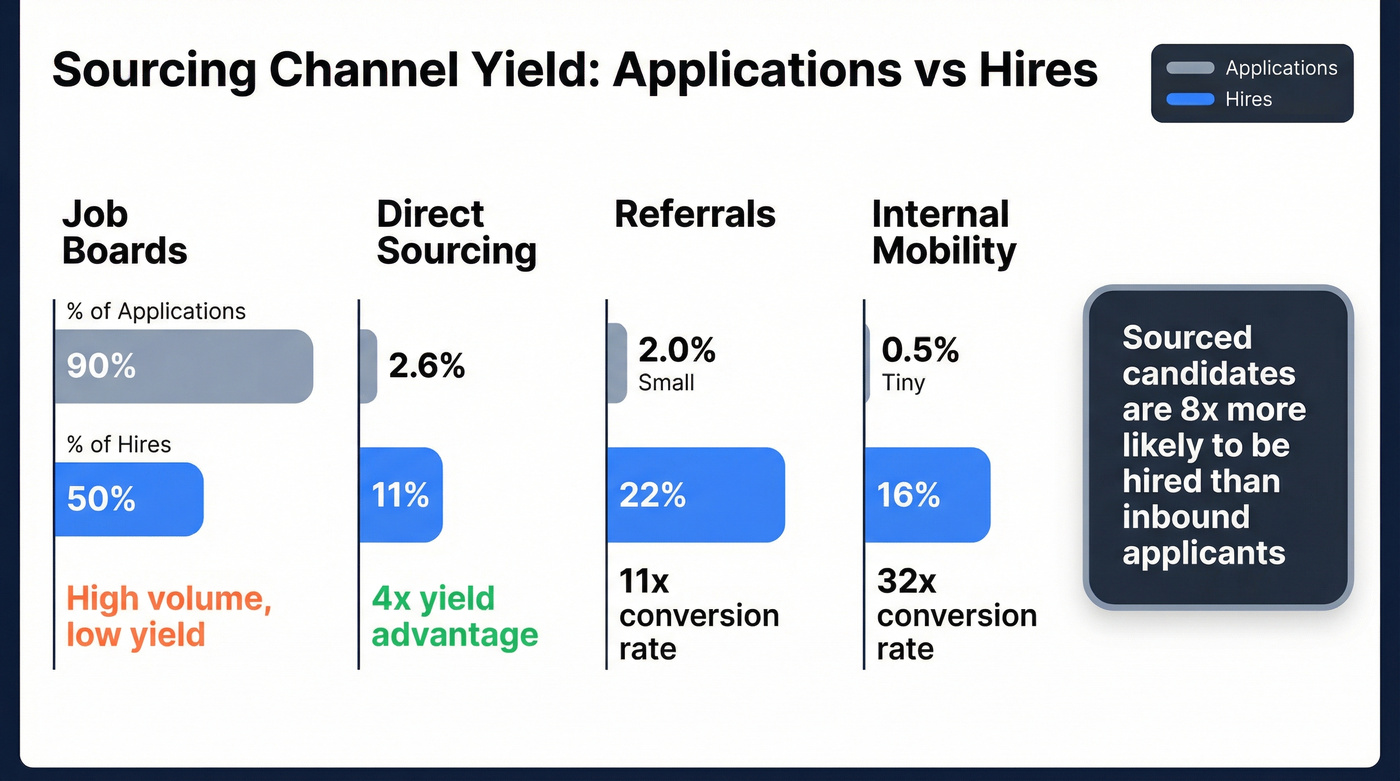
The distinction matters because channels perform wildly differently. Job boards drive ~90% of applications but account for roughly half of actual hires. Direct sourcing delivers 11% of hires from just 2.6% of applications - a 4x yield. Referrals convert at 11x inbound, and internal mobility converts at 32x. The highest-performing recruiting teams don't wait for applications. They go find people.

Bad contact data kills sourcing campaigns before your message even gets read. Prospeo covers 300M+ professional profiles with 98% email accuracy and a 7-day data refresh - so the candidates you sourced last week still have valid contact info today.
Stop losing great candidates to bounced emails.
Step-by-Step Candidate Sourcing Process
Align With Your Hiring Manager First
Every sourcing project that fails can usually be traced back to a misaligned intake meeting. Before you search a single profile, sit down with your hiring manager and get calibrated. Think of this step as account planning for talent - you need the same strategic alignment that sales teams build before pursuing a target account.
Chris Adams, a sourcer at Uber, recommends a tactic we've seen work consistently: build a quick calibration list of 20 candidates, then review each profile together. You're not debating job descriptions in the abstract - you're looking at real people and asking "yes or no, and why?" That single exercise saves more time than any tool purchase.
Your intake checklist should cover:
- Must-have skills vs. nice-to-haves (force the hiring manager to rank them)
- Target companies and industries to source from
- Compensation range and level expectations
- Timeline and interview capacity
- What "no" looks like - the disqualifiers that save you hours
Mine Your ATS First
46% of sourced hires are rediscovered candidates - people already in your system from a previous req. That number was 26% in 2021. Your ATS is the single highest-ROI sourcing channel you have, and most teams barely touch it.
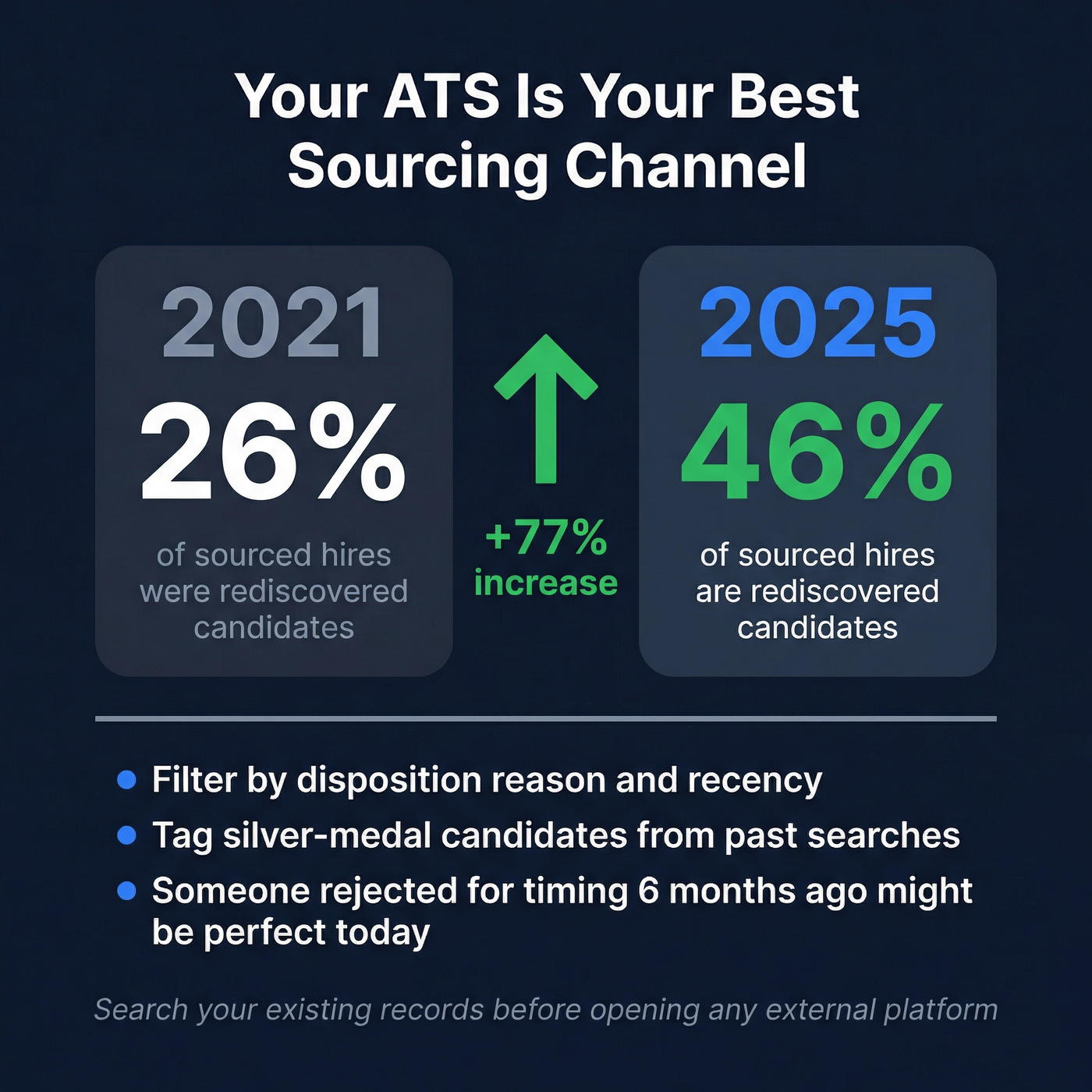
It's not flashy, but it's usually the fastest way to cut time-to-fill. Before you open any external platform, search your existing records. Filter by disposition reason, previous role applied for, and recency. Tag silver-medal candidates from past searches so they're easy to surface next time. Someone rejected for timing six months ago might be perfect today. If your ATS doesn't support robust tagging and search, that's a process problem worth fixing before you spend money on new sourcing tools.
Prioritize Passive Candidates
Roughly 70% of the talent market is passive - not actively job hunting but open to the right opportunity. These people won't see your job posting. You have to go find them, and engaging them is fundamentally different from screening inbound applicants.
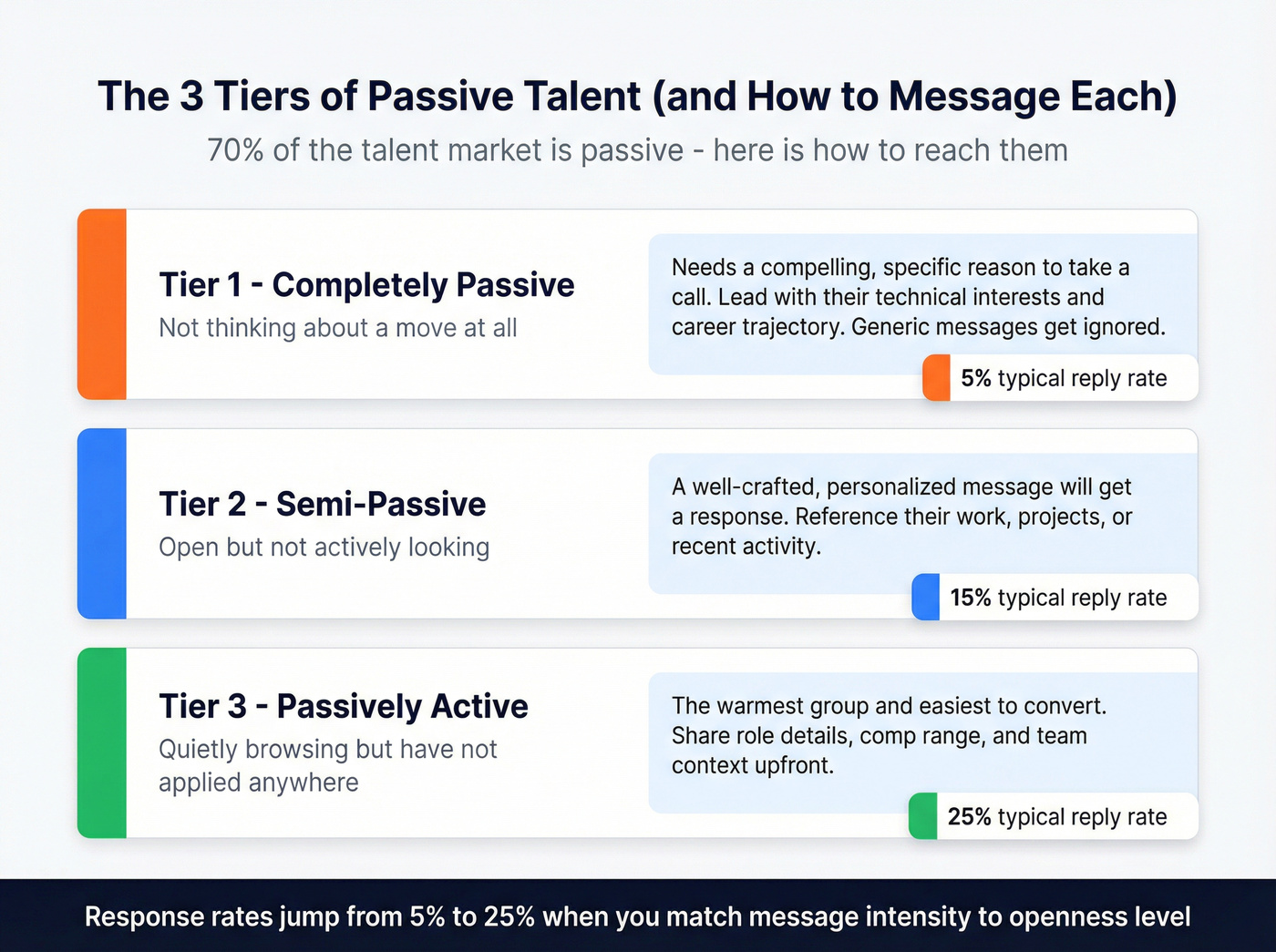
A useful framework breaks passive talent into three tiers:
- Completely passive - not thinking about a move at all. They need a compelling, specific reason to even take a call.
- Semi-passive - open but not looking. A well-crafted, personalized message will get a response.
- Passively active - quietly browsing but haven't applied anywhere. The warmest group and easiest to convert.
Your messaging should differ for each tier. A generic "I have an exciting opportunity" message won't move a completely passive VP of Engineering. A specific, research-backed message about their technical interests and career trajectory might. We've seen response rates jump from 5% to 25% just by matching the message intensity to the candidate's openness level.
Master Boolean Search
Boolean search is the single most underrated sourcing skill. Three operators - AND, OR, NOT - combined with quotation marks and parentheses let you build precise candidate searches across any platform.
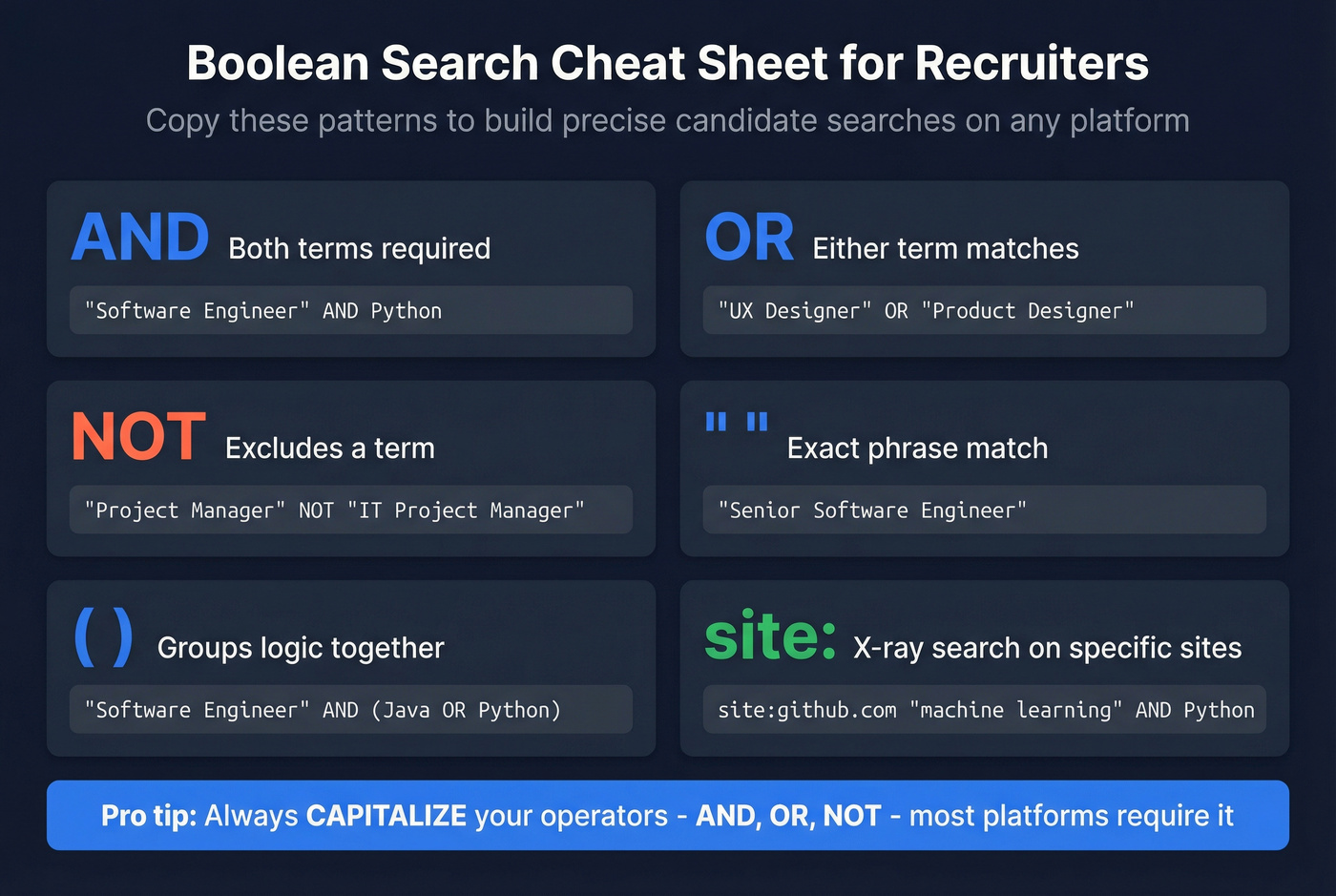
| Operator | What It Does | Example |
|---|---|---|
| AND | Both terms required | "Software Engineer" AND Python |
| OR | Either term matches | "UX Designer" OR "Product Designer" |
| NOT | Excludes a term | "Project Manager" NOT "IT Project Manager" |
| " " | Exact phrase match | "Senior Software Engineer" |
| ( ) | Groups logic | "Software Engineer" AND (Java OR Python) |
| * | Wildcard variations | develop* - developer, development |
Capitalize your operators (AND/OR/NOT). Most platforms require it.
Here are copy-paste strings for common roles:
Software Engineer (Python/Java, Bay Area):
"Software Engineer" AND (Python OR Java) AND "San Francisco"
Sales Rep (SaaS, mid-market):
("Account Executive" OR "Sales Rep") AND SaaS AND ("mid-market" OR "SMB")
Marketing Manager (B2B, content focus):
"Marketing Manager" AND B2B AND ("content marketing" OR "demand generation")
For X-ray searches on public profiles, use Google's site: operator to search within specific platforms. Example: site:github.com "machine learning" AND Python AND "San Francisco" surfaces GitHub profiles matching those criteria. Google's advanced search operators documentation is worth bookmarking if you're new to this.
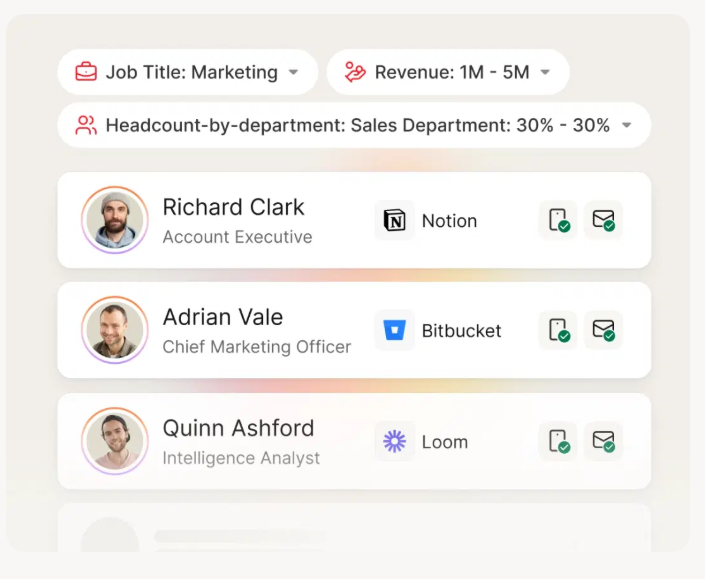
Find Verified Contact Information
You've built your candidate list. Now you need emails and phone numbers that actually work.
This is where most outreach campaigns quietly die. Bad data torpedoes even the best messaging. The difference between a 98% accuracy tool and one hovering around 80% isn't academic - it's the difference between a healthy sender domain and one flagged as spam. A single campaign with a 15% bounce rate can tank your deliverability for months.
Many recruiting teams now use a "waterfall enrichment" approach: running candidate lists through multiple data providers in sequence, starting with the highest-accuracy source and filling gaps with secondary tools. Smart workflow if your primary tool doesn't cover a specific region or industry.
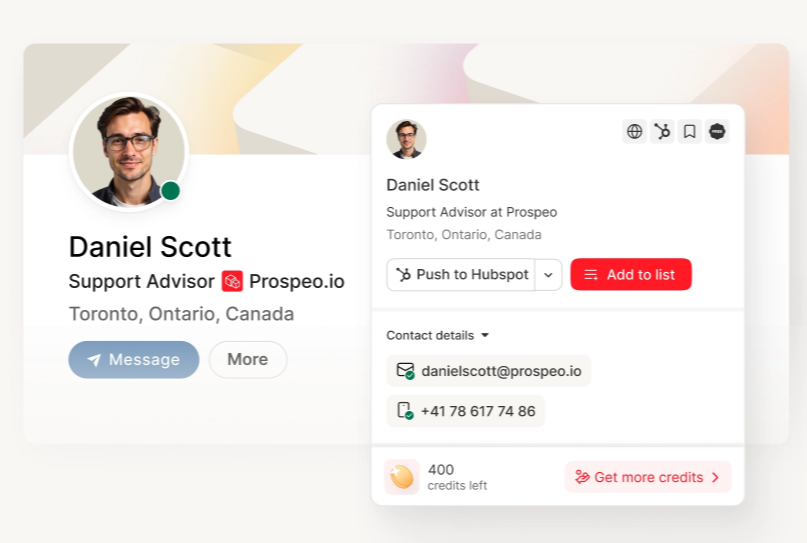
Prospeo works well as the primary layer here. It covers 300M+ professional profiles with 98% email accuracy and 125M+ verified mobile numbers, refreshing data every 7 days compared to the 6-week industry average. The Chrome extension lets you pull verified contact info from any website or professional profile in one click, and there's a free tier (75 emails/month) so you can test without a sales call.
| Tool | Starting Price | Key Strength | Best For |
|---|---|---|---|
| Prospeo | Free (75 emails/mo) | 98% email accuracy, 7-day refresh | Verified emails + mobiles |
| Apollo | ~$49/mo | Large database + built-in CRM | Volume + sequencing |
| Hunter.io | ~$49/mo | Simple domain search | Quick email lookups |
| Snov.io | ~$39/mo | Budget-friendly | Small teams, tight budgets |
| RocketReach | ~$40/mo | 250M+ profiles | Database breadth |
| ZoomInfo | ~$1,000+/mo | Enterprise features | Large orgs, deep pockets |
Skip ZoomInfo if your average cost-per-hire is under $5,000. A verified contact finder plus a sequencing tool will get you 90% of the way there at a fraction of the cost. Save the enterprise budget for roles where a single bad hire costs six figures.
Craft Outreach That Gets Replies
Verification comes first. If your emails bounce, your messaging doesn't matter.
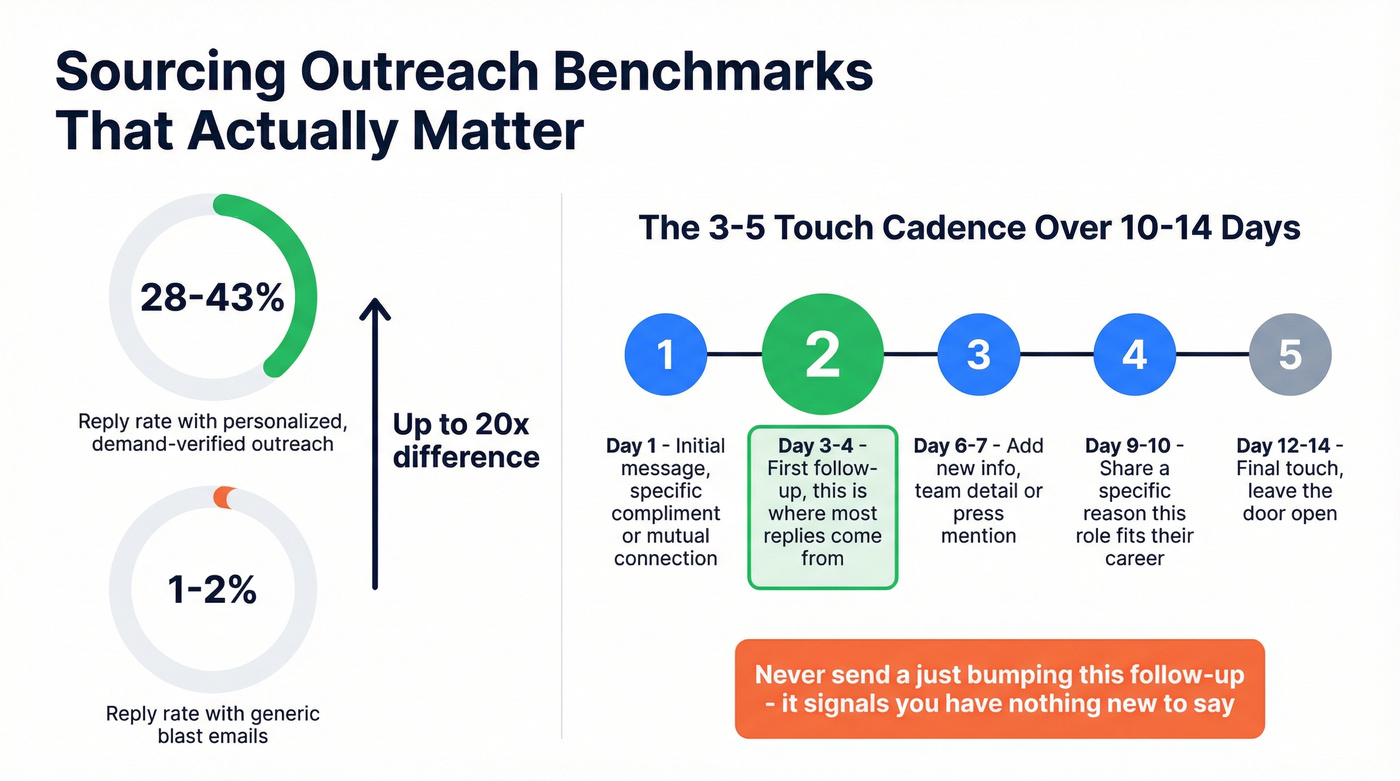
With that covered, targeted outreach with demand-verified positioning delivers 28-43% reply rates in agency campaigns - compared to 1-2% when recruiters blast generic emails. The gap is personalization and cadence.
Framework 1: The Specific Compliment
Subject: [Their recent project/talk/post] + [your company]
Hi {first_name}, I saw {specific_thing_they_did} - {one sentence on why it's impressive}. We're building {team/product context} at {company}, and your background in {relevant_skill} is exactly what we need. Worth a 15-minute call this week?
Framework 2: The Mutual Connection
Subject: {mutual_connection} suggested I reach out
Hi {first_name}, {connection_name} mentioned you'd be a great fit for what we're building at {company}. We're hiring a {role} to {one-sentence impact description}. I'd love to share more - are you open to a quick chat?
Plan 3-5 touches over 10-14 days. Each follow-up should add new information - a team detail, a press mention, a specific reason this role fits their career trajectory. Never send a "just bumping this" follow-up. It signals you have nothing new to say.
The consensus on r/recruiting is that the first follow-up is where most replies actually come from, not the initial message. Don't give up after one send.
You just built a killer Boolean search and found 200 perfect candidates. Now you need emails and direct dials that actually connect. Prospeo's Chrome extension pulls verified contact data from any profile in one click - 125M+ mobile numbers, 98% email accuracy, no batch uploads required.
Turn your sourced list into real conversations at $0.01 per email.
Diversify Your Channels
Don't put all your sourcing eggs in one basket. Referrals convert at 11x inbound, and internal mobility converts at 32x. Those are your highest-yield channels by far.
Beyond referrals, build presence where your target candidates actually spend time. GitHub and Stack Overflow contribution histories reveal more about engineering candidates than any resume. Industry Slack groups and Discord servers are goldmines for niche roles in infosec, data engineering, and product. Conference speaker lists and podcast guest rosters surface senior hires who'd never respond to a cold message.
AI-assisted sourcing tools are emerging as a 2026 channel worth watching - platforms that use LLMs to match candidate profiles against role requirements and draft personalized outreach. They're not replacing human sourcers yet, but the best ones are cutting initial list-building time by 30-50%. Phenom's 2026 talent acquisition report covers several of these tools in detail.
Let's be honest: the best sourcers we've worked with spend 30% of their time on channels that aren't their primary platform. That diversification is what separates a pipeline that's one algorithm change from collapse and one that's resilient.
Sourcing Mistakes to Avoid
These are process failures, not people problems. Recruiting sourcers and SDRs share more DNA than most people realize - both are doing outbound into cold or lukewarm audiences. The most common mistakes map directly across both disciplines.
Over-reliance on job boards. Cap job board sourcing at 50% of your pipeline. Allocate real time to direct outreach and referrals.
Ignoring passive candidates. Dedicate at least one sourcing block per week to outbound-only, non-applicant outreach. Block the calendar. Protect the time.
Skipping verification. Verify every email before it enters a sequence. One tool, two minutes, zero bounces. I've watched teams burn through three sender domains in a quarter because they skipped this step.
No metrics tracking. Track source-of-hire, response rate by channel, and time-to-fill by source. Without this data, you're guessing where to double down and where to cut. Gem's sourcing benchmarks are a solid external reference point.
Generic outreach. Personalize the first line of every message. Reference something specific - a project, a talk, a company milestone. Templates are starting points, not final drafts. If you need a starting library, use an outreach template set that’s built for replies.
2026 Sourcing Benchmarks
Let's ground your expectations in data. Based on 165M applications, 15M candidates, and 1.2M hires, hiring is up 8.3% year-over-year but still ~30% below pre-downturn peaks. Offer acceptance sits at 82% - the highest since 2021.
| Metric | Small Biz | Mid-Market | Enterprise | Tech |
|---|---|---|---|---|
| Apps/job | 312 | - | 208.1 | 369.1 |
| Time to screen | - | - | 5.7 days | 9 days |
| Interview-to-offer | 7.0% | 16.6% | 72.2% | 14.8% |
| Offer acceptance | 83.9% | 89.8% | 81.5% | 80.8% |
The interview-to-offer gap between enterprise (72.2%) and small business (7.0%) is striking - it reflects how much more selective smaller companies are at the top of the funnel. Tech's 369 applications per job means you're competing for attention in the noisiest market.
When candidates decline offers, the reasons are consistent: ~40% cite limited growth opportunities or wrong location, roughly a third point to rigid remote-work policies, and ~20% flag a poor interview experience. These aren't sourcing problems - they're closing problems. But they affect your sourcing ROI directly, because every declined offer sends you back to the pipeline. Understanding why offers fail is just as important as understanding how to fill the funnel in the first place.
FAQ
What's the difference between sourcing and recruiting?
Sourcing is the proactive identification and engagement of potential candidates - the top-of-funnel work that builds pipeline. Recruiting encompasses screening, interviewing, negotiating, and closing. Sourcing feeds the pipeline; recruiting converts it into hires.
How many candidates should I source per role?
Sourced candidates convert at ~8x the rate of inbound applicants, so a targeted list of 25-50 sourced profiles per role is a strong starting point. For senior or niche positions, aim for 40-75 to account for lower response rates.
What tools do I need to source candidates?
Three tools cover most needs: an ATS for pipeline management, a contact finder with built-in verification for emails and direct dials, and a sequencing tool like Outreach or Instantly for multi-touch cadences. That stack handles 90% of sourcing workflows without enterprise pricing.
How do I source candidates who aren't on job boards?
Focus on passive talent channels: mine your existing ATS for silver-medal candidates, run Boolean X-ray searches on GitHub and industry forums, tap employee referral networks (11x inbound conversion), and engage in niche Slack and Discord communities where specialists gather.