

Retaining Sales Talent: 7 Data-Backed Strategies That Work
Your top AE just gave two weeks' notice for a 15% bump and a better territory. You saw it coming - the quota complaints, the Slack silence, the spike in profile activity. Now you're staring at a nine-month ramp for their replacement and a pipeline hole that won't close itself.
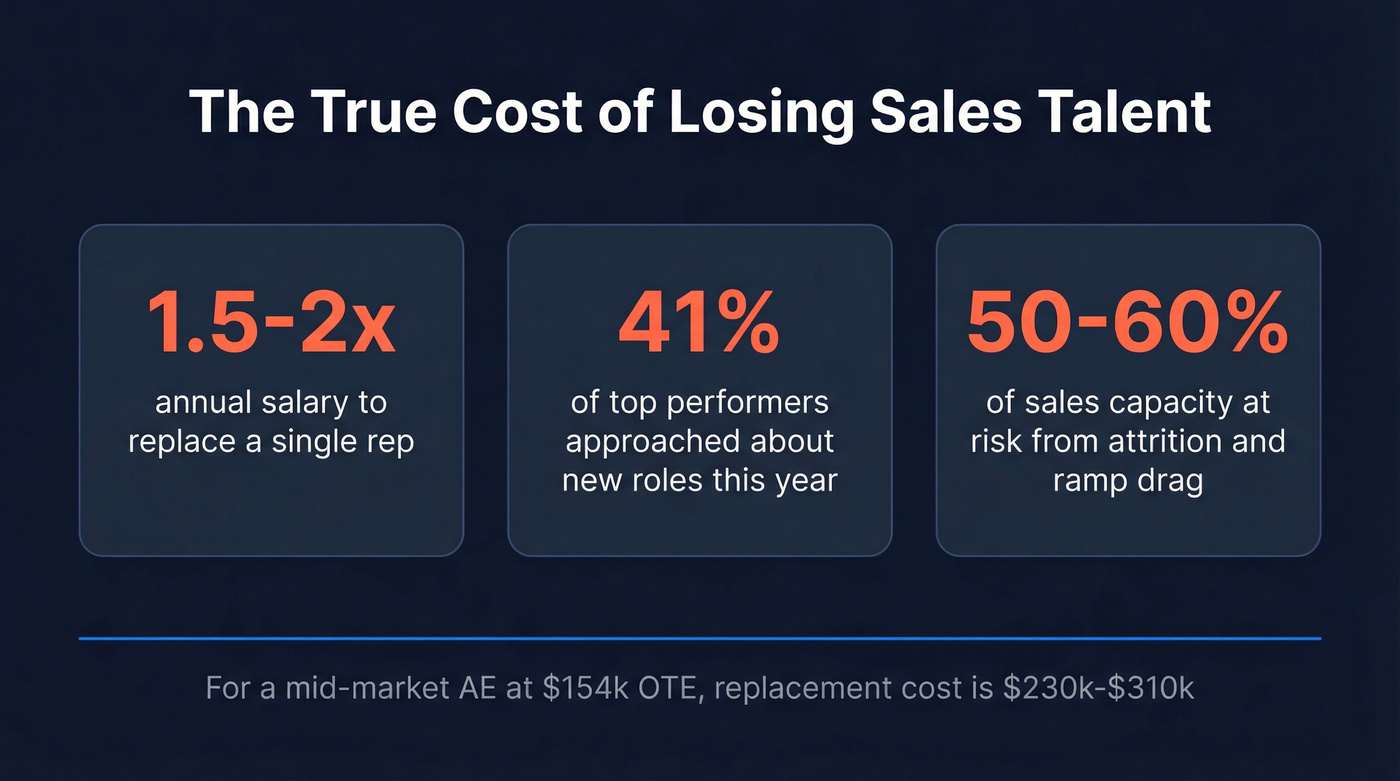
The math is brutal. Replacing a single rep costs 1.5-2x their annual salary. 41% of top-performing reps have been approached about a new role multiple times this year, and HBR puts true sales capacity at risk at 50-60% when you combine open headcount, attrition, and new-hire productivity drag. Retaining sales talent isn't a culture initiative. It's a revenue problem. Experienced reps have more leverage than ever, and they know it.
If You Can Only Do Three Things This Quarter
- Audit territory fairness. Equal opportunity to hit quota, not equal account counts.
- Run stay interviews with every rep. Twenty minutes each. Zero cost.
- Publish a career pathing document with timelines and comp ranges for every role.
Pay What Top Performers Are Worth
Most comp plans are designed around 100% attainment. The problem? Average quota attainment sits at 74%. Most reps don't hit the OTE you pitched during the interview, and if your plan assumes full attainment to reach competitive OTE, you're underpaying the majority of your team.
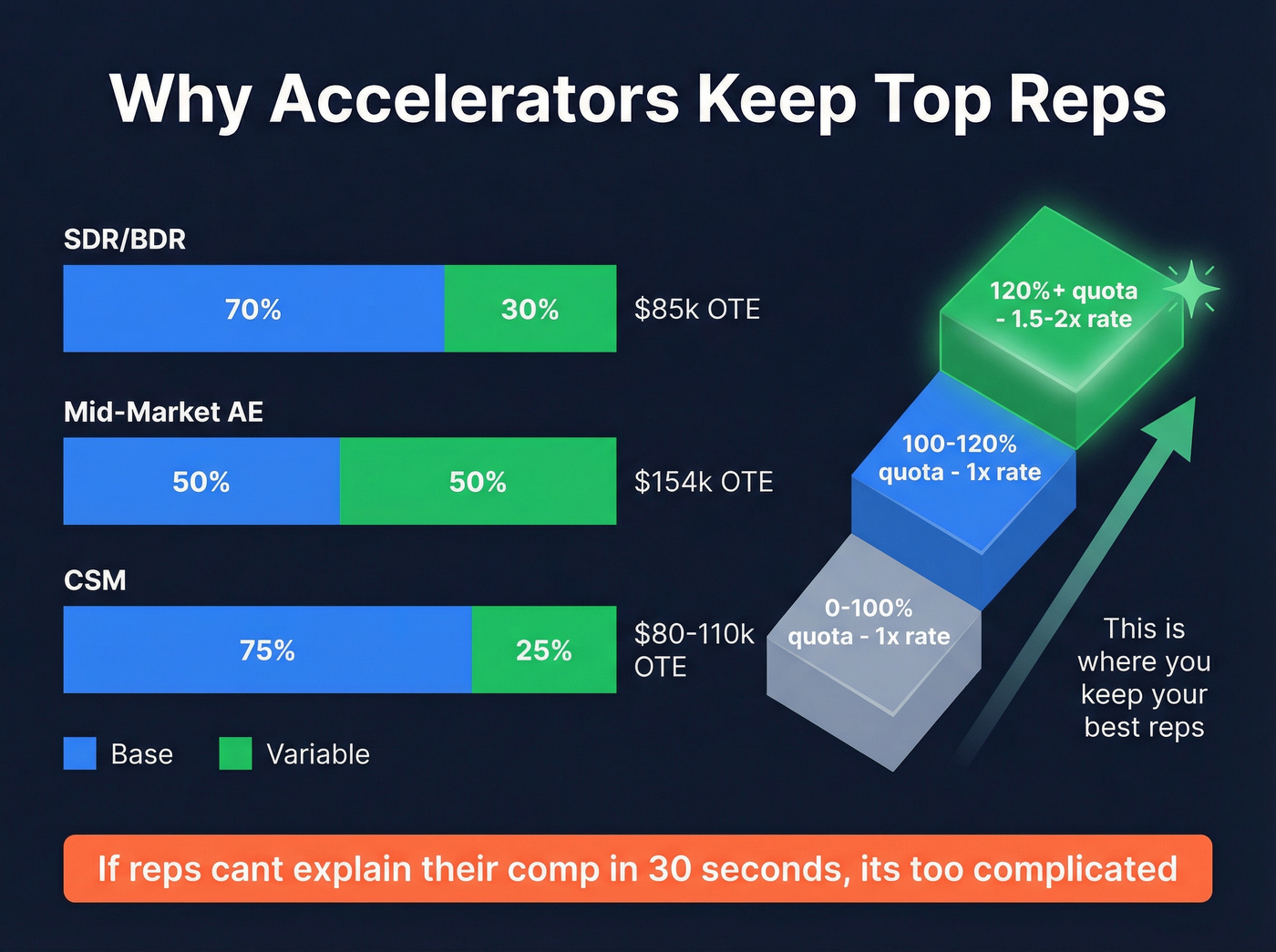
Here's where the market sits right now:
| Role | Base Range | OTE | Pay Mix | Accelerator Trigger |
|---|---|---|---|---|
| SDR/BDR | $50-60k | ~$85k | 70/30 | 1.5x above 120% |
| Mid-Market AE | $75-80k | ~$154k | 50/50 | 1.5-2x above 120% |
| CSM | $55-75k | $80-110k | 75/25 | 1.2-1.5x above 110% NRR |
Two things matter more than the base number. First, accelerators: top performers should earn 1.5-2x their standard commission rate above 120% attainment. That's the carrot that keeps your best reps from entertaining recruiter calls. Second, simplicity: the best-performing plans use roughly three core metrics. If your reps can't explain their comp plan in 30 seconds, it's too complicated, and distrust follows fast.
A 15% OTE bump at a competitor is enough to pull many reps. Make sure your plan doesn't give them a reason to take the meeting.
Fix Territories Before Comp Plans
Territory design is the most underrated retention lever in sales. You can have the best comp plan in the industry, but if territories are unequal, your top reps will leave anyway.
Fair doesn't mean equal account counts. It means equal opportunity to hit quota - factoring in market density, account quality, deal velocity, and workload. SAP's own research is blunt: quotas disconnected from territory reality lead to distrust, disengagement, burnout, and attrition. Only 39% of reps consistently hit quota. Before you blame enablement or hiring, ask whether your territory model is setting reps up to fail. We've seen teams fix territories and watch attrition drop within two quarters, without changing comp at all.
Onboard Like Ramp Time Matters
The average sales rep takes roughly nine months to fully ramp. That's nine months of below-quota performance, frustration, and vulnerability to recruiter outreach. New hires who go through structured onboarding are 50% more likely to stay - yet 87% of sales training is forgotten within a month without reinforcement.
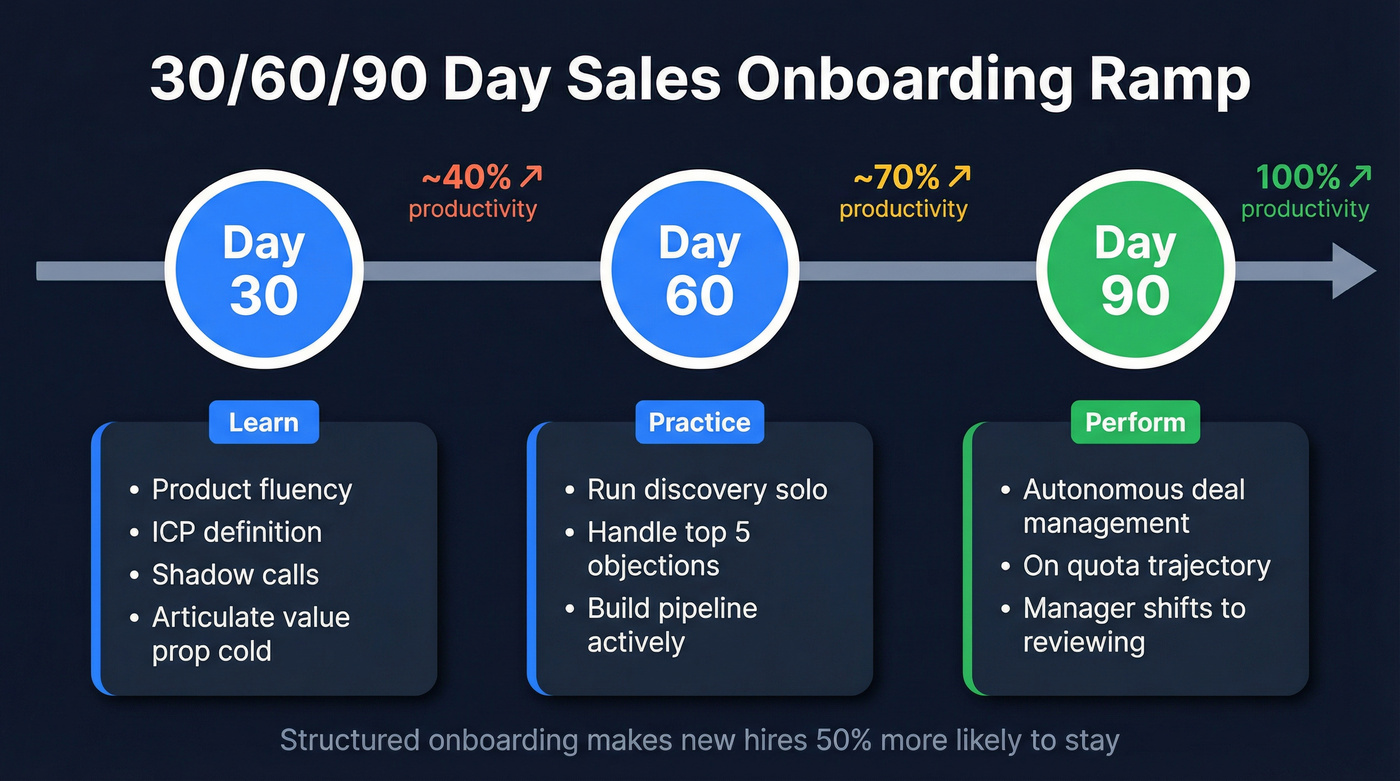
Onboarding isn't a two-week orientation. It's a 90-day operating system.
30/60/90 ramp milestones:
- Day 30: Product fluency, ICP definition, shadowing calls. The rep should articulate the value prop cold.
- Day 60: Running discovery independently, handling top 5 objections, building pipeline.
- Day 90: Autonomous deal management, on quota trajectory. Manager shifts from coaching to reviewing.
Every week a rep spends confused and unproductive is a week they're thinking about leaving. And only 4 in 10 reps clearly understand how AI tools help their performance, so don't just hand new hires a tech stack - teach them how each tool connects to quota. Hiring reliable salespeople is only half the battle; the other half is making sure they succeed once they arrive.

Bad data doesn't just kill deals - it kills retention. Reps forced to manually verify contacts and chase bounced emails burn out faster. Prospeo delivers 98% email accuracy and 125M+ verified mobiles, so your reps spend time selling, not researching.
Stop losing reps to tool-stack frustration. Give them data that works.
Run Stay Interviews, Not Exit Interviews
Let's be honest: by the time you're conducting an exit interview, you've already lost. Nearly half of employees are actively looking or monitoring job openings at any given time. And 52% of millennials have left a job because of their manager - not their comp plan, not their territory, their manager.
A stay interview is the exit interview in reverse: a brief 1:1 aimed at understanding what keeps a rep engaged and what might push them out. They cost nothing and take 20 minutes. The fact that almost no sales org runs them is baffling.
- Set the stage. Tell the rep this isn't a performance review.
- Open up. "What do you look forward to when you come to work?"
- Explore motivators. "What's one thing that would make your job meaningfully better?"
- Invite candor. "If you were going to leave, what would the reason be?"
- Act on themes. Don't promise what you can't deliver. Follow up within two weeks.
Run these quarterly. The patterns will tell you more than any engagement survey ever will.
Build Career Paths With Timelines
Your SDRs have been in role for 18 months with no promotion timeline. Three of them are interviewing. This is entirely preventable.
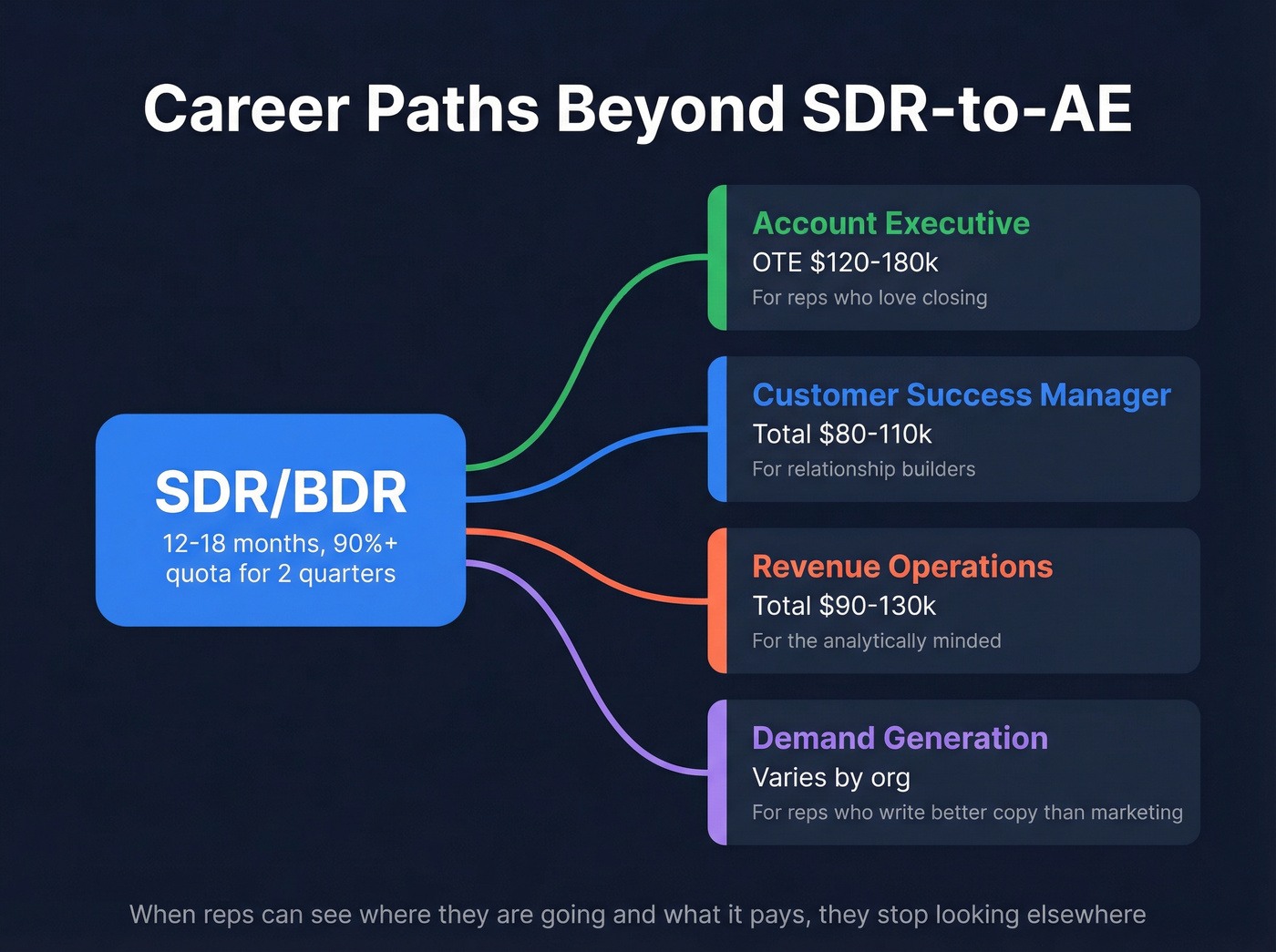
The benchmark for SDR promotion readiness is 12-18 months in role with 90%+ quota attainment for two consecutive quarters. But most orgs only show one path, and SDR-to-AE isn't the only trajectory. Pretending it is loses you people who'd thrive in other roles.
Publish a career pathing document with multiple tracks and comp ranges:
- AE track: OTE $120-180k. The classic path for reps who love closing.
- CSM track: Total $80-110k. For reps who build relationships better than they hunt.
- RevOps track: Total $90-130k. For the analytically-minded rep who keeps rebuilding your dashboards.
- Demand gen track: For the rep who writes better outbound copy than your marketing team.
When reps can see where they're going and what it pays, they stop looking elsewhere to find out. Clear career paths also help you retain female sales talent, who disproportionately cite lack of advancement visibility as a reason for leaving.
Reduce Tool-Stack Friction
Here's the thing: most sales leaders obsess over comp and culture when the real daily frustration is the tool stack. Reps toggling between a clunky CRM, a half-configured sequencer, and three browser tabs of manual research aren't just inefficient - they're demoralized. 70% of sales reps struggle with work-life balance, and a huge chunk of that comes from tools that create work instead of eliminating it.
The fix isn't buying more software. It's auditing what you have. Ask your reps which tools they actually use versus which ones they work around. Kill the ones nobody opens. Consolidate where you can. One customer, GreyScout, cut new-rep ramp time from 8-10 weeks to 4 weeks after replacing fragmented prospecting workflows with Prospeo's verified contact data - reps stopped re-researching the same accounts and started selling. That's not a culture initiative; it's an operational fix that directly reduces early attrition.
When reps trust their tools, they hit quota more often. When they hit quota, they stay.
Give Reps Their Data Back
The retention chain most leaders miss: bad data leads to wasted prospecting hours, which leads to missed quota, which leads to frustration, which leads to attrition. The most common complaint on r/sales isn't about base pay or PTO - it's about spending half the day on manual research and bounced emails instead of actual selling.
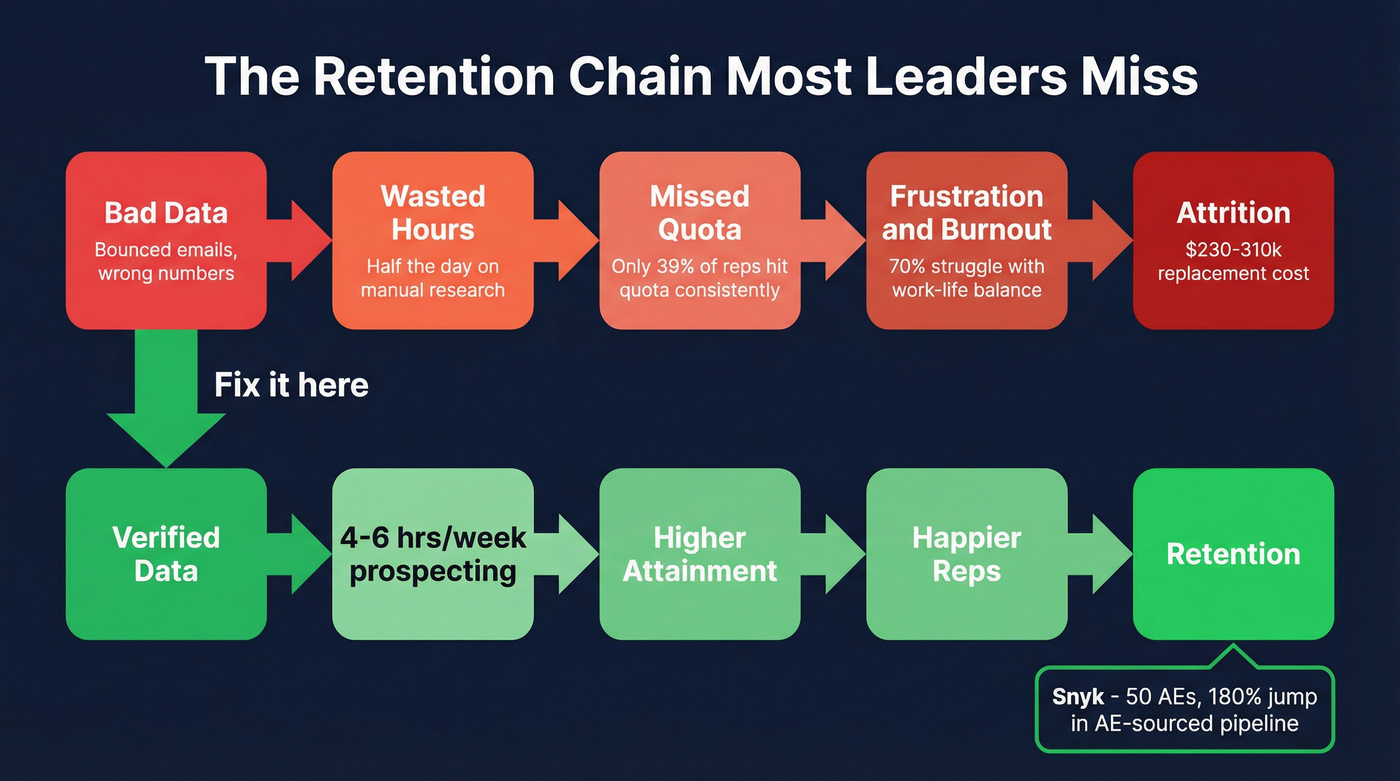
At Snyk, 50 AEs spend just 4-6 hours per week prospecting because they work with verified emails and direct dials. AE-sourced pipeline jumped 180%. That kind of efficiency gain doesn't just improve revenue - it improves quality of life. Reps who spend time selling instead of data-cleaning are happier, hit quota more often, and stay longer.
If you're seeing bounces and wasted cycles, start with data quality and a simple email verification layer before you scale outbound. If your team is also struggling to keep records usable, tighten CRM hygiene so reps aren't cleaning up fields instead of selling.
GreyScout cut new-rep ramp from 8-10 weeks to 4 by replacing fragmented prospecting tools with Prospeo's verified data. Faster ramp means reps hit quota sooner - and reps hitting quota don't leave. At $0.01 per email, it costs less than one hour of a recruiter's time.
Cut ramp time in half and keep your best reps longer.
FAQ
How much does losing a sales rep actually cost?
Expect 1.5-2x annual salary when you factor in recruiting, onboarding, ramp time, and lost pipeline. For a mid-market AE at $154k OTE, that's $230-310k in total replacement cost. Sourcing experienced closers in a competitive market adds weeks to the timeline, compounding the revenue gap.
What's the top reason sales reps leave?
Leadership credibility. A survey of 830 B2B sellers found 52% of millennials left because of their manager, not comp. Territory fairness ranks close behind - reps who feel set up to fail won't stick around regardless of base salary.
How does better data help retain sales reps?
Reps who waste hours on bad contact info miss quota and burn out faster. Verified data means more selling time, higher attainment, and less temptation from recruiter outreach. GreyScout saw pipeline jump 140% and ramp time halve after switching to verified contacts.
Does hiring quality affect retention?
Absolutely. Reps who are a strong fit for your sales motion, culture, and territory model ramp faster and stay longer. But even the best hire will leave if the environment doesn't support them. Retention and hiring are two sides of the same revenue coin.