

Sales Intelligence vs Business Intelligence: What's the Difference and Which Do You Need?
Your VP of Sales wants to know why the team is hitting 60% of quota despite a $30K BI dashboard that took three months to implement. The dashboard shows pipeline is down. Everyone already knew that. What nobody has is a system that tells reps who to call next, which accounts are showing buying signals, and whether the contact data feeding their sequences is even accurate.
That's the real tension behind sales intelligence vs business intelligence - not which is "better," but whether you've got a data quality problem or a data analysis problem.
Quick version:
- BI tells you what happened across the business. SI tells your sales team who to call next and when.
- Most sales-led companies under 50 people should invest in SI first. You can't analyze pipeline you never built.
- If data quality is your bottleneck - bouncing emails, stale contacts - fix that before buying another dashboard.
Both markets are booming. BI software sits at roughly $47B and continues climbing. The SI market reached $4.99B in 2026 and is growing at a 12.89% CAGR. The money's flowing because the problems are real.
What Is Business Intelligence?
Business intelligence is retrospective analysis of company-wide data. It answers "what happened?" and "where are we trending?" across every department - finance, operations, marketing, supply chain, HR. The outputs are dashboards, reports, and drill-down analyses that help executives make strategic decisions.
Concrete use cases include KPI tracking, operational process optimization like redesigning distribution routes to cut fuel costs, customer data analysis for marketing programs, and executive strategic planning. When applied to revenue teams, BI helps leaders spot conversion bottlenecks and forecast more accurately.
The results are tangible. European Wax Center consolidated data from 900+ franchise locations into real-time dashboards and cut corporate reporting time by over 90%. Traeger Grills connected Salesforce, NetSuite, and inventory data to reduce their financial close cycle by 50%. DHL used IoT sensor dashboards for cold-chain shipments and slashed anomaly investigation time by 80%. The BI market is projected to reach $168B by 2035, reflecting a shift from static spreadsheets to cloud-native, AI-assisted analytics that non-technical users can actually operate.
What Is Sales Intelligence?
Sales intelligence is a real-time system of buyer signals built specifically for revenue teams. Where BI looks backward, SI looks forward - surfacing who to contact, who's showing intent signals, and what buyers care about before they ever talk to a rep. 81% of buyers research products online before engaging sales, which means the old playbook of cold-calling a static list is dead.
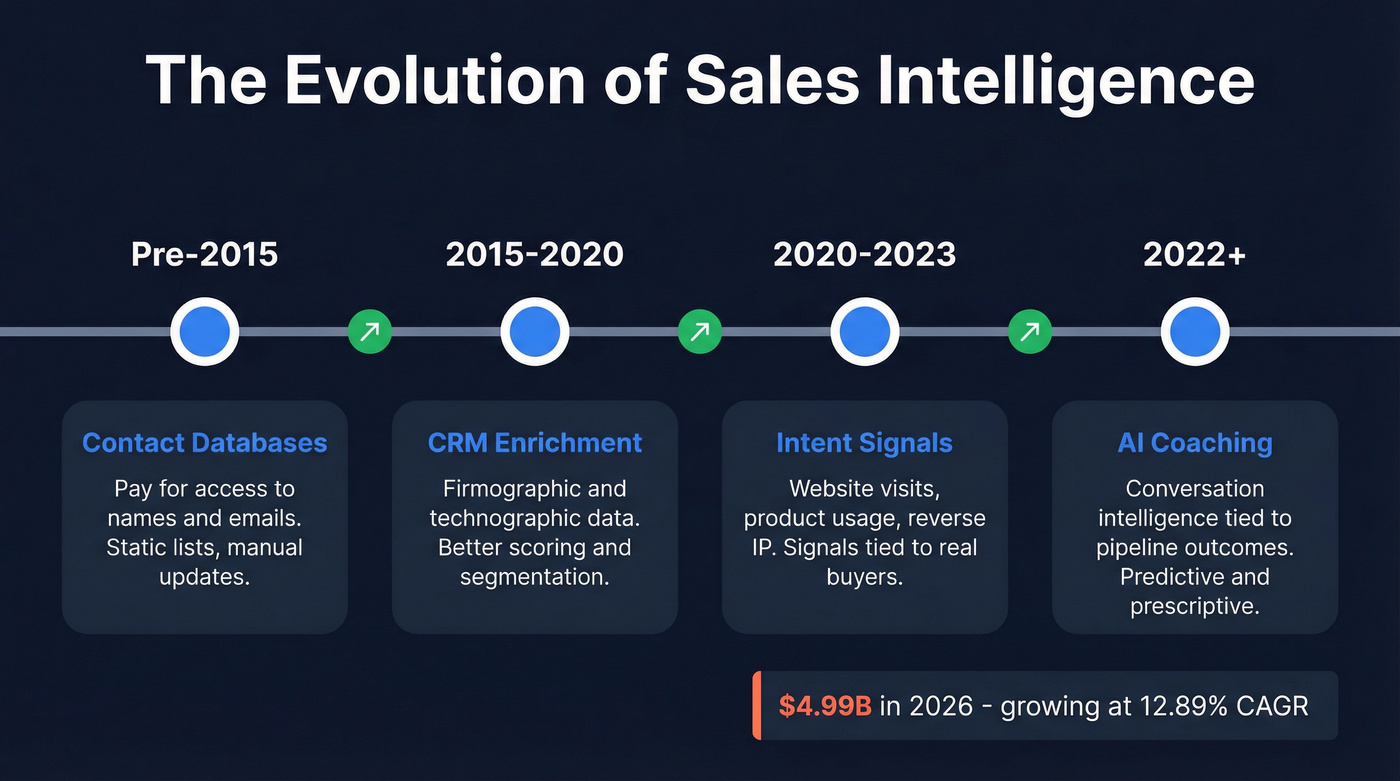
SI has evolved in distinct phases:
- Pre-2015: Contact databases. You paid for access to names and emails.
- 2015-2020: CRM auto-enrichment, firmographic and technographic data enabled better scoring and segmentation.
- 2020-2023: Intent signals and behavioral tracking got sharper - website visits, product usage, reverse IP - and started tying signals closer to real buyers.
- Since 2022: Conversation intelligence shifted from "call recording for review" to AI coaching tied to pipeline outcomes.
The market reflects this evolution: $4.99B in 2026, projected to hit $9.15B by 2031 at a 12.89% CAGR. Cloud-based SI now accounts for 82% of deployments. The fastest-growing segments are inside sales at 18.6% CAGR and SME adoption at 16.9% CAGR.
Here's the thing most vendors won't tell you: B2B contact data decays at roughly 30% per year. People change jobs, companies restructure, emails go stale. If your SI tool doesn't refresh aggressively, you're prospecting into a void.
Key Differences at a Glance
| Dimension | Business Intelligence | Sales Intelligence |
|---|---|---|
| Purpose | Analyze what happened | Decide who to engage next |
| Time focus | Retrospective | Real-time / predictive |
| Primary users | Executives, analysts, ops | Sales reps, SDRs, RevOps |
| Data types | Internal: ERP, CRM, finance | External: contacts, intent signals |
| Typical KPIs | Gross margin, inventory turns | Connect rate, pipeline velocity |
| Market size | ~$47B | ~$5B |
| Tool cost range | Free-$75/user/mo | Free-$40K+/year |
| Output format | Dashboards, reports | Lead lists, alerts, signals |
| Decision type | Strategic, operational | Tactical, deal-level |
| ROI benchmarks | 112% average ROI | 47% win rate on sub-50-day deals |
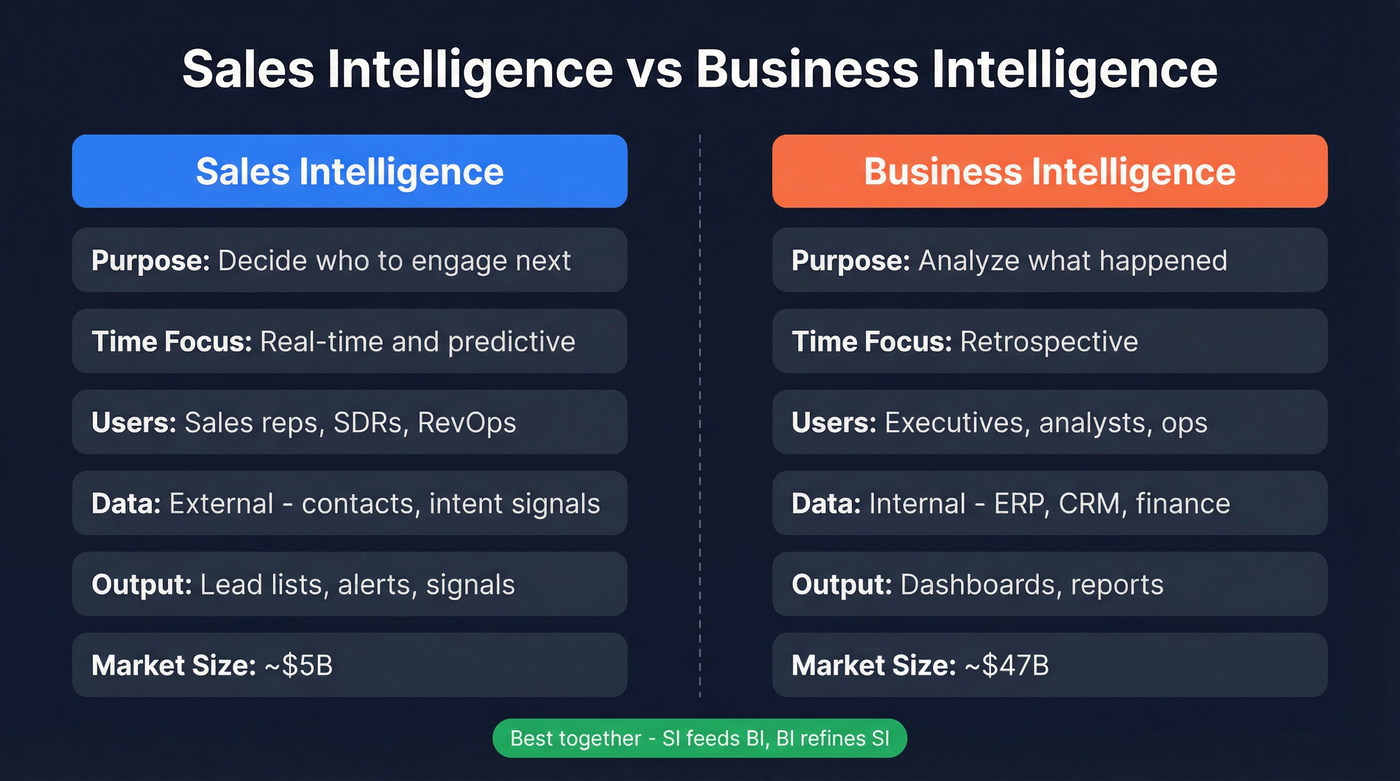
One benchmark ties these worlds together: deals closed within 50 days have a 47% win rate, versus 20% or lower beyond that threshold. BI can show you that pattern in your historical data. SI gives reps the tools to actually compress those cycles - verified contacts, intent signals, and timely alerts that prevent deals from stalling.
People sometimes confuse sales intelligence with sales enablement. They solve different problems. Enablement equips reps with training, content, and playbooks. Intelligence equips them with data - who to target, when to reach out, and what those buyers care about. Enablement makes reps better; intelligence makes their targeting smarter.

This article makes it clear: BI shows you pipeline is down, but SI fixes it. Prospeo gives your reps 300M+ profiles with 98% verified emails, intent data across 15,000 topics, and a 7-day refresh cycle that kills the 30% annual data decay problem before it starts. At $0.01 per email, you build pipeline before you need a dashboard to analyze it.
Stop analyzing a pipeline you never built. Start building one.
How SI and BI Work Together
The "vs" framing is a false dichotomy. These are complementary layers in the same data stack, not rivals competing for the same budget line.
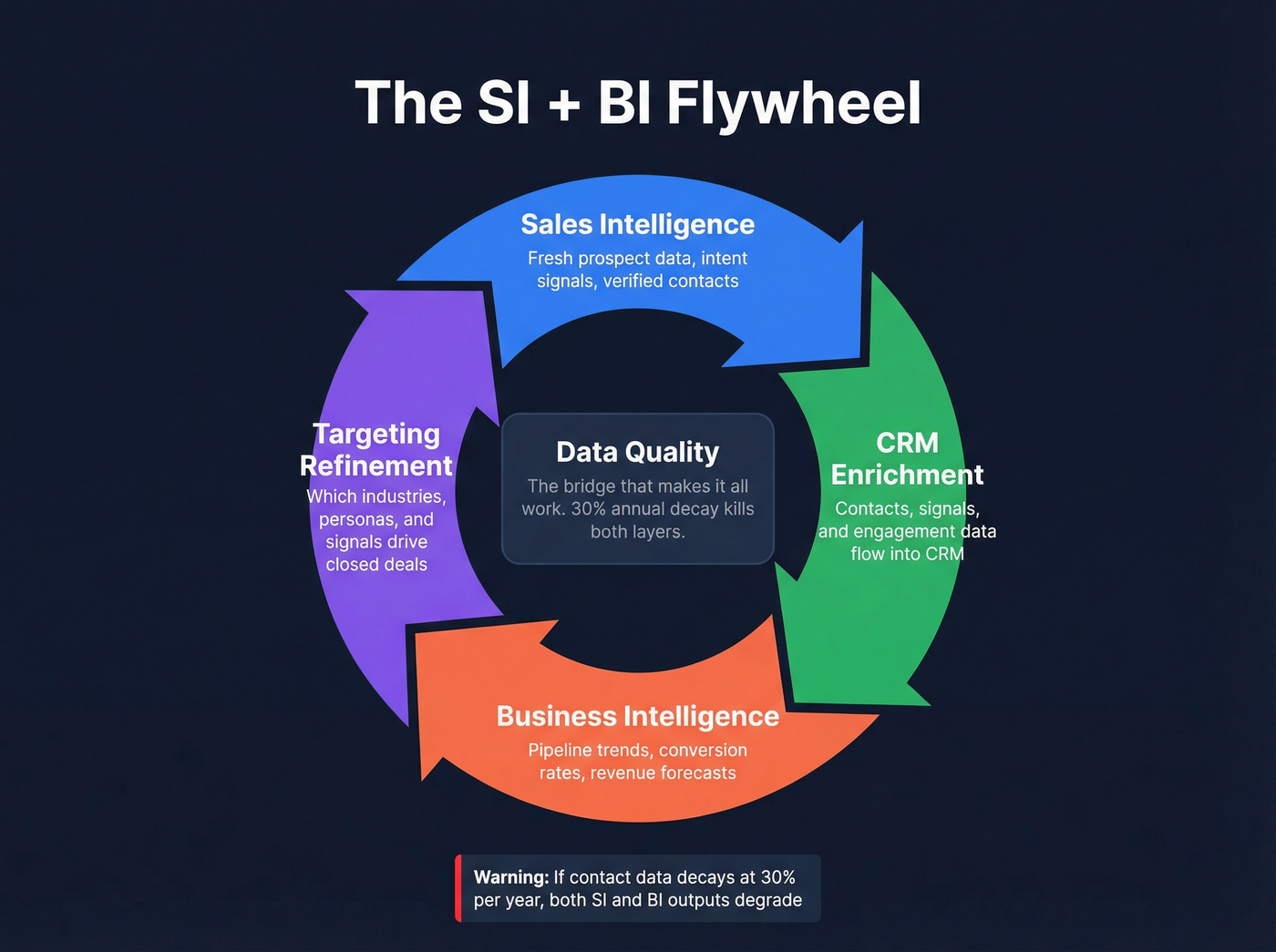
SI feeds fresh prospect data into your CRM. BI analyzes the pipeline trends, conversion rates, and revenue forecasts that result. Those insights loop back to refine SI targeting - which industries convert fastest, which personas respond to outreach, which intent signals actually correlate with closed deals. We've seen the best revenue operations teams combine both layers so that historical analysis directly informs real-time prospecting decisions, creating a flywheel that gets smarter every quarter.
The bridge between them is data quality. If your contact data is decaying at 30% per year and your provider refreshes on a roughly 6-week industry-average cycle, your BI dashboards are showing garbage trends and your SI workflows are producing bounced emails. Fix the inputs and everything downstream improves.
Which Should You Invest In First?
Let's be honest: if your average deal size is under $10K and your team is under 50 people, you probably don't need a $30K BI platform. You need pipeline.
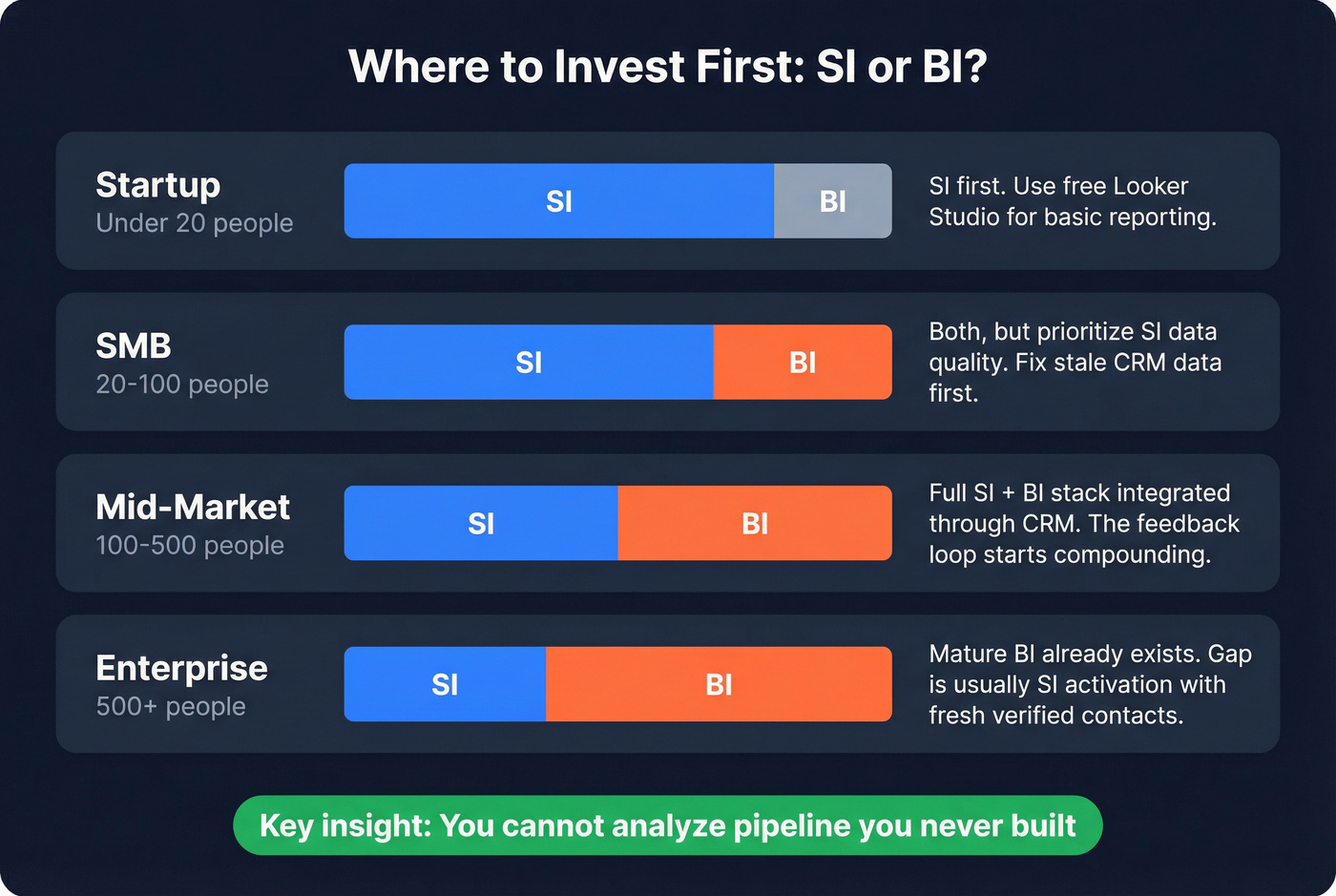
Startup (under 20 people): SI first, lean BI stack. Use BigQuery + Looker Studio for basic reporting and invest your real budget in verified contact data and intent signals.
SMB (20-100 people): Both, but prioritize SI data quality. Your CRM is the system of record. If the data going in is stale, every downstream report is wrong.
Mid-market (100-500): Full SI + BI stack, integrated through your CRM. This is where the feedback loop between SI targeting and BI analysis starts generating compounding returns - your dashboards should connect directly to enrichment workflows so they reflect real-time pipeline health, not a snapshot from six weeks ago.
Enterprise (500+): You already have mature BI. The gap is usually SI activation - turning those insights into actual outbound motion with fresh, verified contacts.
Organizations with high BI adoption are 5x more likely to make faster decisions, and average BI ROI runs around 112%. But you can't analyze pipeline you never built.
Tools to Know
Sales Intelligence
Prospeo covers 300M+ professional profiles with 98% email accuracy and a 7-day refresh cycle - compared to a roughly 6-week industry average. The platform includes 30+ search filters and intent data across 15,000 topics, plus technographics, job changes, and funding signals. Unlike ZoomInfo's annual commitments, Prospeo is self-serve with month-to-month billing. Pricing starts free with 75 emails/month, scaling to roughly $0.01 per email on paid plans. In our experience, the weekly refresh cycle is what separates it from competitors - when one of our test campaigns dropped bounce rates from 35% to under 4%, the difference was entirely data freshness.

ZoomInfo is the industry default for US database depth, covering intent, chat, and workflow automation under one roof. Mid-market contracts run $15K-40K/year depending on seats and modules, with annual commitments, and refresh cycles sit around 4-6 weeks. We've watched teams burn through $40K ZoomInfo contracts using 10% of the features. Skip it if you're under 50 people or if you don't need the full platform - you'll pay for modules you never touch.
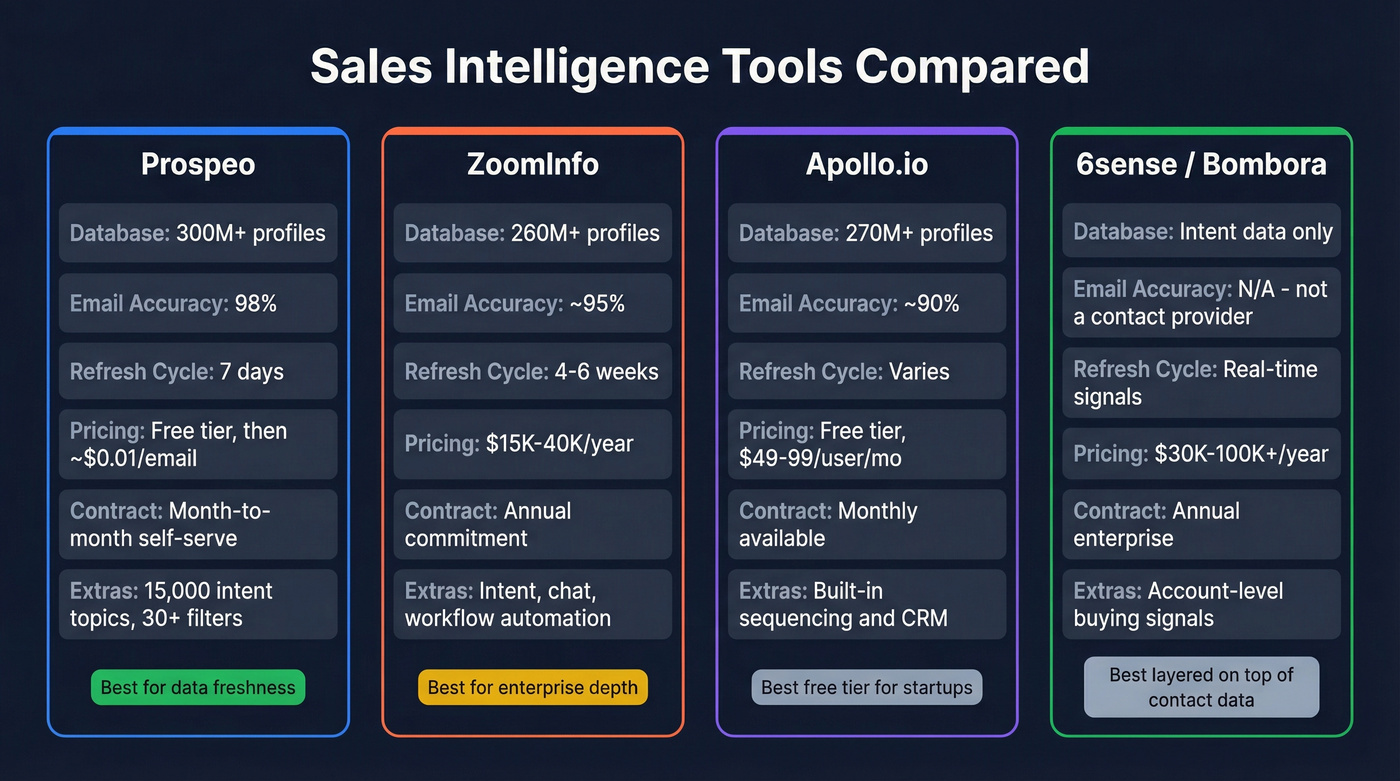
Apollo.io wins on the free tier - basic search and limited exports at no cost. Paid plans run $49-99/user/month with solid CRM integration and sequencing. Email accuracy runs lower than dedicated verification platforms, but the all-in-one workflow appeals to teams wanting prospecting and outreach in a single tool. The consensus on r/sales is that Apollo's great for getting started, but teams tend to outgrow it once email deliverability becomes a priority.
6sense / Bombora are intent data specialists, not contact providers. They tell you which accounts are researching topics relevant to your product. Enterprise pricing runs $30K-100K+/year. Best layered on top of a contact data provider rather than used standalone.
Business Intelligence
| Tool | Price | Best For |
|---|---|---|
| Power BI | Free-$20/user/mo | Microsoft 365 shops, deep Excel integration |
| Tableau | $15-75/user/mo | Visual storytelling, analyst-heavy teams |
| Looker Studio | Free | Startups on Google Cloud |
| Metabase | Free self-hosted, $85/mo cloud | Technical teams wanting full control |
For teams that just need basic pipeline reporting, Looker Studio connected to your CRM does 80% of what Tableau does at zero cost. Don't over-buy BI tooling early.
Deals closed in under 50 days win at 47%. That only happens when reps reach real buyers with verified data. Prospeo combines buyer intent signals, 125M+ verified mobile numbers with a 30% pickup rate, and 30+ search filters - so your sales intelligence actually connects reps to decision-makers, not dead leads.
Compress deal cycles with contacts that actually pick up the phone.
FAQ
Can sales intelligence replace business intelligence?
No. SI helps sales teams find and engage buyers with real-time signals and verified contacts. BI helps the entire organization analyze historical performance across finance, ops, and marketing. Different audiences, different decisions - most scaling companies need both.
What's the ROI of sales intelligence?
Deals closed within 50 days convert at a 47% win rate, dropping to 20% beyond that window. SI shortens cycles by surfacing intent signals and verified contacts at the right moment, directly compressing time-to-close.
Is business intelligence only for large companies?
Not anymore. Free tools like Looker Studio and Metabase make BI accessible to any startup. Start with one North Star metric and a few supporting KPIs rather than a $50K platform - you can scale tooling as your data complexity grows.
What's the biggest sales intelligence data mistake?
Using stale contacts. B2B data decays at 30% per year. If your provider refreshes on a 6-week cycle, you're prospecting with outdated information by default. Weekly refresh cycles cut bounce rates dramatically - one Prospeo customer dropped from 35% bounces to under 4% after switching.
Do I need both SI and BI tools?
Most revenue teams benefit from both. SI feeds fresh prospect data into your CRM; BI analyzes the pipeline trends that result. Start with whichever solves your most urgent bottleneck - usually SI if you're pipeline-constrained, BI if you're insight-constrained.