Best Sales Lead Generation Services in 2026
Your CEO just asked why the $8K/mo lead gen retainer produced three no-show appointments last quarter. You don't have a good answer - because you never got a clear breakdown of what happened. Sales teams spend roughly 40% of their time prospecting, and the entire sales lead generation services industry exists to fix that. The trouble is, most agencies won't publish pricing, most platforms oversell their data quality, and the gap between "qualified lead" and "warm body who downloaded a PDF" is wide enough to lose a quarter's pipeline in.
The right service depends on your team size, budget, and how much control you want. Below: agencies, platforms, and hybrids - with real pricing, CPL benchmarks, and a framework so you don't pick the wrong one.
Our Picks
| Pick | Category | Starting Price | Best For |
|---|---|---|---|
| Prospeo | Best data accuracy | ~$0.01/lead | Verified emails + mobiles, no enterprise contract |
| Belkins | Best agency | ~$5K/mo | Mid-market teams wanting 100+ appointments/year |
| SalesBread | Best budget agency | ~$3K/mo | Startups needing quality over volume |
| ZoomInfo | Best enterprise platform | ~$15K/yr | Large orgs running multi-channel GTM |
| Prospeo + Instantly | Best DIY stack | ~$200-500/mo | Teams under 20 reps who want full control |
Three Models of Lead Generation
Before you evaluate any specific vendor, decide which model fits your team. There are three, and they're often confused.
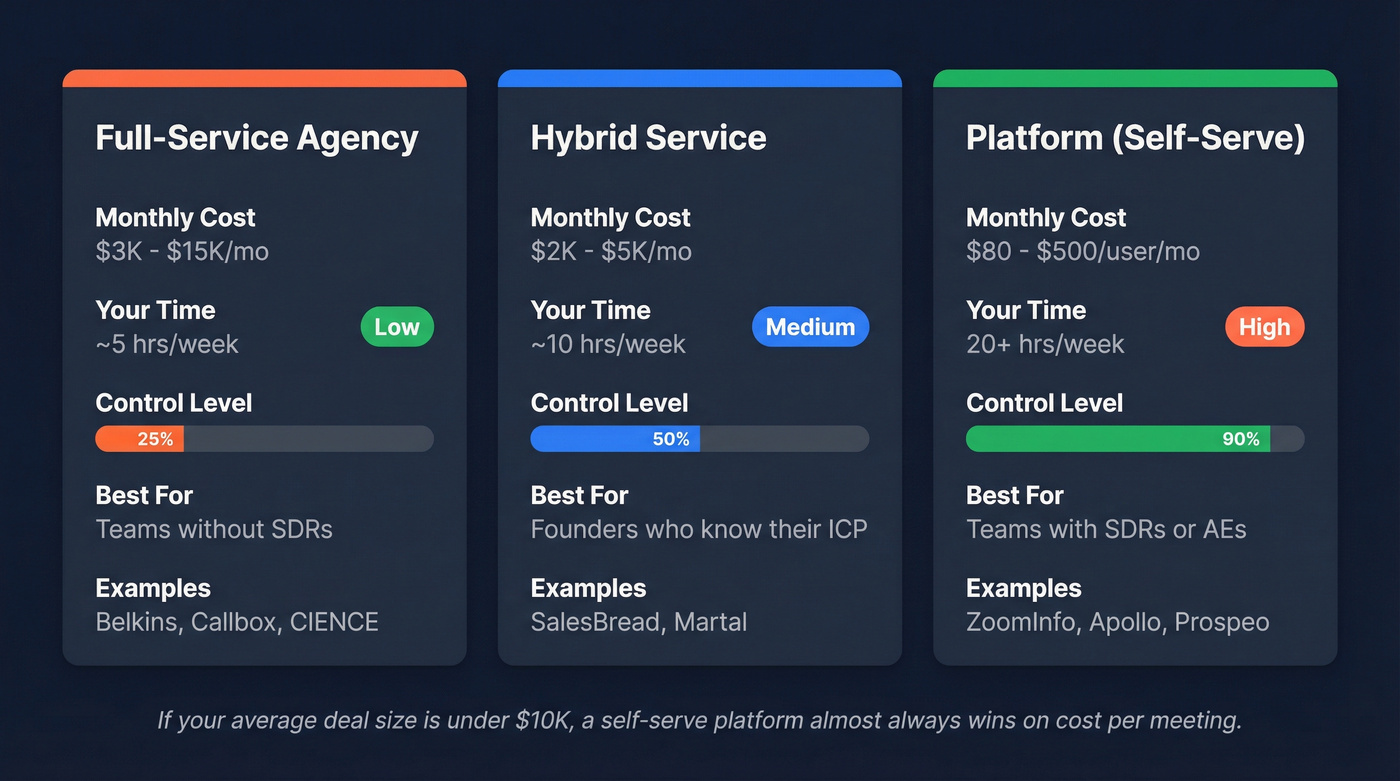
| Model | Monthly Cost | Your Time | Best For | Examples |
|---|---|---|---|---|
| Full-service agency | $3K-$15K/mo | Low (5 hrs/wk) | Teams without SDRs | Belkins, Callbox, CIENCE |
| Hybrid service | $2K-$5K/mo | Medium (10 hrs/wk) | Teams with 1-2 reps | SalesBread, Martal |
| Platform (self-serve) | $80-$500/user/mo | High (20+ hrs/wk) | Teams with SDRs/AEs | ZoomInfo, Apollo |
Full-service agencies act as your outsourced SDR team. You pay a retainer, they book meetings. The upside is speed - you're buying a functioning outbound motion without hiring. The downside is cost and control. If the agency's messaging doesn't land, you're burning $5K-$15K/mo while they "optimize." Most lead generation companies operate this way, bundling research, copywriting, and outreach into a single retainer.
Hybrid services give you a mix of tech and human oversight. In our experience, the hybrid model works best for founders who know their ICP but don't have time to execute daily outbound. These run $2K-$5K/mo and bridge the gap between full delegation and full DIY.
Platforms are the self-serve route. You get the data, the tools, and the integrations - but your team runs the campaigns. For teams under 20 reps, a solid sales prospecting platforms paired with a sending tool like Instantly or Smartlead at $200-500/mo replaces a $5K+ agency retainer. The economics are hard to argue with if you have even one person who can write a decent outbound email campaign.
The performance gap matters too. Multi-channel outreach combining email, phone, and social generates 5-8% response rates versus roughly 2% for email-only. Agencies typically run multi-channel by default. If you're going the platform route, make sure you aren't just blasting emails.
Here's the thing: if your average deal size sits below $10K, you almost certainly don't need a $5K/mo agency. A self-serve data platform plus a $100/mo sending tool will outperform most outsourced providers on a per-dollar basis - because you know your buyers better than any outsourced SDR ever will.
Best Agencies for Lead Generation
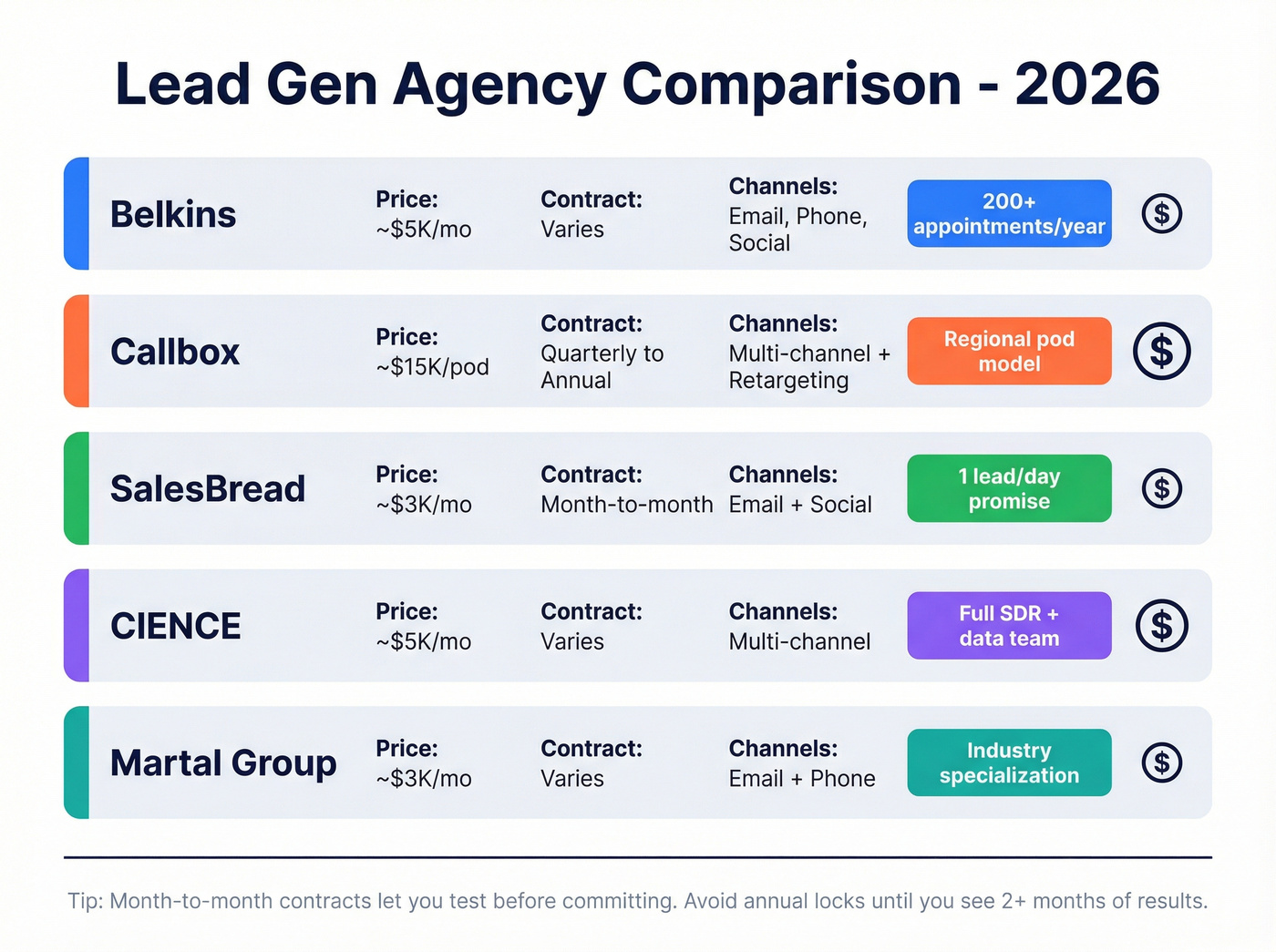
| Agency | Starting Price | Contract | Channels | Standout |
|---|---|---|---|---|
| Belkins | ~$5K/mo | Varies | Email, phone, social | 200+ yearly appointments package |
| Callbox | ~$15K/pod | Quarterly-annual | Multi-channel + retargeting | Regional pod model |
| SalesBread | ~$3K/mo | Month-to-month | Email + social | 1 lead/day promise |
| CIENCE | ~$5K/mo | Varies | Multi-channel | Full SDR + data team |
| Martal Group | ~$3K/mo | Varies | Email + phone | Industry specialization |
Belkins
Use this if you need a proven agency that can scale appointment volume and you've got $5K+/mo to spend. Belkins structures packages around outcomes: their Growth package targets 100+ yearly appointments, Growth Plus pushes to 200+, and a small-business package delivers 30+ through partner agencies. Every package includes a sales audit, TAM calculation, manual lead research, copywriting, appointment scheduling, and no-show recovery.
Skip this if you're a bootstrapped startup or need fewer than 30 meetings a year - you'll overpay for capacity you don't use. Belkins doesn't publish dollar pricing on their site, which is frustrating but standard for agencies at this level. Based on their positioning and appointment volumes, expect $5K-$15K/mo depending on scope and channel mix. Their enterprise plan includes support for SOC 2, ISO, and data privacy requirements, which matters if you're selling into regulated industries.
The included tooling is a real perk - they save clients up to $10K/year on premium tools bundled into the retainer. This model works well for mid-market teams who need meetings but don't want to build an SDR function from scratch.
Callbox
Use this if you're an enterprise team that needs multi-region, multi-language outbound with dedicated pods. Callbox runs a "Campaign Pod" model - each pod covers one region and language, staffed with managers, SDRs, researchers, and digital marketers. Pricing runs $15,000-$30,000 per pod, and multi-region campaigns require multiple pods. Three pods? You're looking at $45K-$90K.
Skip this if you need strategic agility. Common complaints on G2 and Clutch include limited proactive insights, struggles with regional nuances outside the US, and SDRs who stick too closely to scripts without pivoting when campaigns underperform. For that price tag, you should expect more strategic depth.
SalesBread
SalesBread is the anti-Belkins. Instead of scaling appointment volume, they focus obsessively on quality: one qualified lead per day, delivered through personalized outreach, on a month-to-month contract. Their retainer starts around $3K/mo plus a one-time setup fee.
The numbers back up the positioning - they report a 19.98% average reply rate since 2019, with roughly 48% of replies being meeting requests or qualified inquiries. We appreciate the transparency. Most agencies won't publish reply rates because the numbers aren't flattering.
The trade-off? Onboarding takes time. Reviews flag a long ramp-up period and extensive onboarding process. If you need meetings next week, this isn't your play. But if you're a startup founder who'd rather have 20 genuinely qualified conversations per month than 50 lukewarm ones, SalesBread earns its spot.
CIENCE
Full-service agency running dedicated SDR teams with integrated data research. Expect around $5K-$15K/mo depending on scope. CIENCE is a solid mid-market option if you want a single vendor handling both data sourcing and outreach execution. Their strength is the combined data + SDR model - fewer handoffs, fewer data quality excuses.
Martal Group
Industry-specific agency focused on tech and SaaS verticals, starting around $3K/mo. Worth a conversation if your ICP is narrow and you need reps who understand your space. We haven't tested them deeply enough to recommend over Belkins or SalesBread, but the industry specialization angle is legitimate for niche markets.

The article above shows DIY stacks at $200-500/mo outperform $5K agency retainers - but only if the data is accurate. Prospeo delivers 98% verified emails and 125M+ direct dials at ~$0.01/lead, refreshed every 7 days. Pair it with Instantly or Smartlead and you have an outbound machine that costs less than one agency invoice.
Replace your lead gen retainer with data that actually connects.
Best B2B Lead Generation Platforms
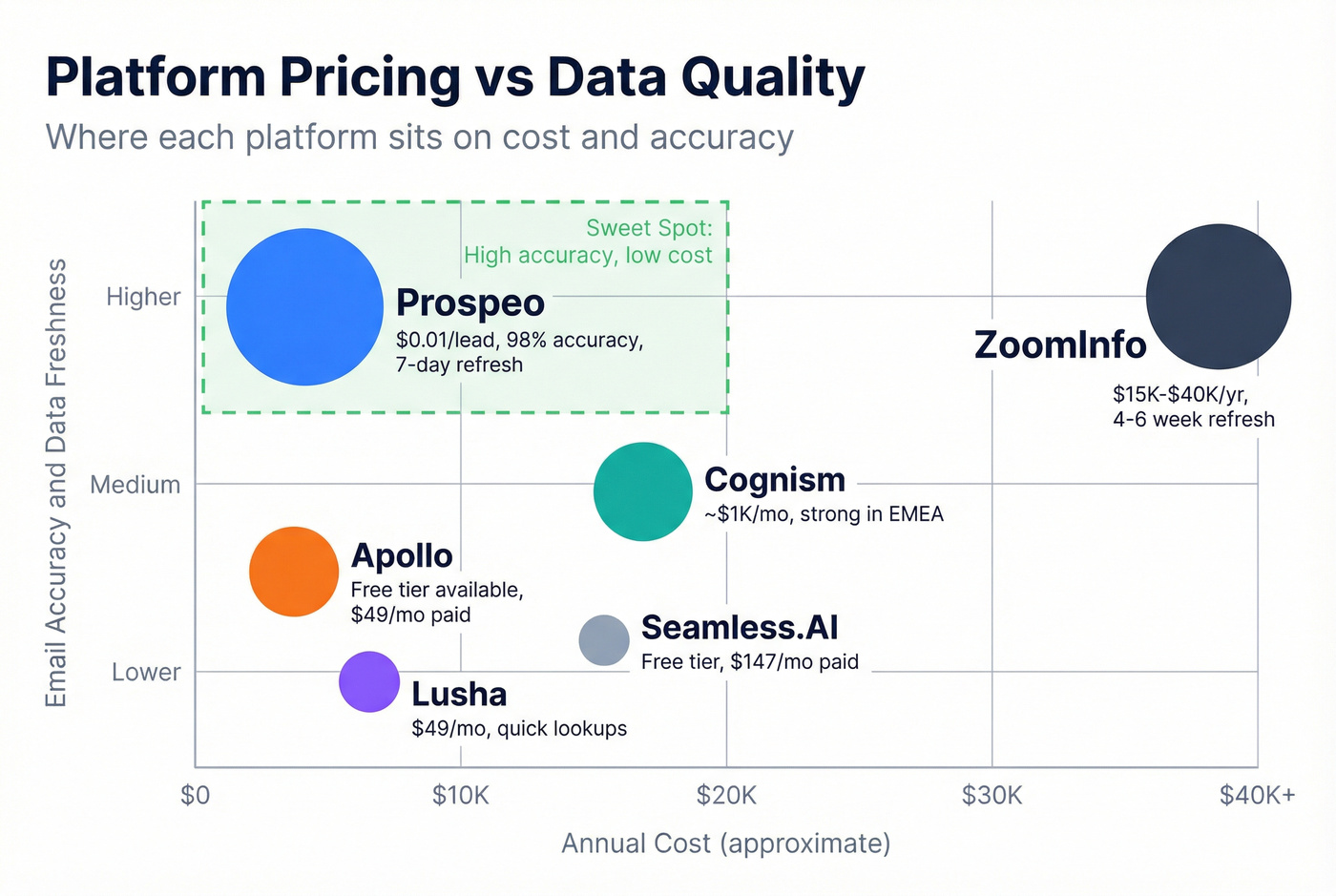
Bounce rates vary wildly by platform, and the differences matter more than database size.
| Platform | Starting Price | Standout | Best For |
|---|---|---|---|
| Prospeo | Free / ~$0.01/lead | 98% email accuracy + 7-day refresh | Accuracy-first teams |
| ZoomInfo | ~$15K/yr | Massive scale + enterprise workflows | Enterprise GTM |
| Apollo | Free / ~$49/mo | Useful free tier + built-in sequencer | SMB prospecting |
| Cognism | ~$1K/mo | Strong EMEA coverage + verified mobiles | Europe-focused teams |
| Seamless.AI | Free / ~$147/mo | Fast list building | Budget prospecting |
| Lusha | ~$49/mo | Simple Chrome extension | Quick lookups |

Prospeo
Prospeo's database covers 300M+ professional profiles, 143M+ verified emails, and 125M+ verified mobile numbers - all refreshed on a 7-day cycle while the industry average sits around 6 weeks. The 98% email accuracy comes from a proprietary 5-step verification process with catch-all handling, spam-trap removal, and honeypot filtering. Meritt tripled their pipeline from $100K to $300K/week after switching, dropping bounce rates from 35% to under 4%. Snyk saw similar results across 50 AEs: bounce rates fell from 35-40% to under 5%, and AE-sourced pipeline jumped 180%.
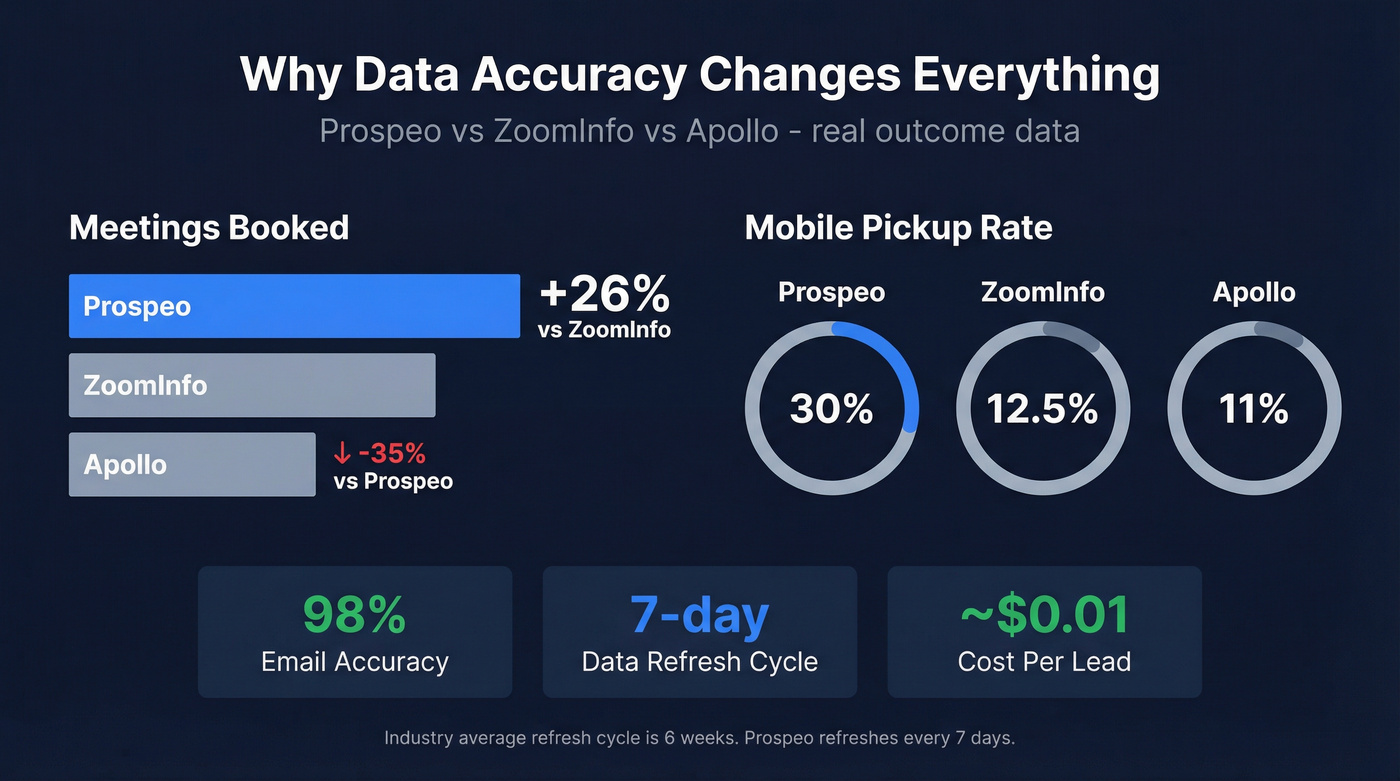
The outcome data tells the real story. Teams book 26% more meetings compared to ZoomInfo and 35% more compared to Apollo. Mobile numbers hit a 30% pickup rate versus 12.5% for ZoomInfo and 11% for Apollo. The Chrome extension has 40,000+ users pulling verified contacts from any website or CRM in one click.
The platform runs 30+ search filters including buyer intent across 15,000 Bombora topics, technographics, job changes, headcount growth, and funding signals. Native integrations push directly into Salesforce, HubSpot, Instantly, Lemlist, Smartlead, and Clay. At roughly $0.01 per email, the unit economics are 90% cheaper than ZoomInfo. The free tier gives you 75 verified emails and 100 Chrome extension credits per month - no credit card, no sales call, no annual contract.
ZoomInfo
ZoomInfo's biggest drawback isn't the data - it's the pricing. A 10-seat contract with intent data and mobile numbers runs $15K-$40K/year, and that's before you add modules you'll probably never fully activate.
That said, ZoomInfo is the 800-pound gorilla for a reason: 500M+ verified contact profiles, 100M company profiles, and 1B buying signals monthly. If you're a 200+ person sales org running outbound, ABM, and intent from one platform, the breadth is hard to match. It's GDPR, CCPA, and SOC 2 compliant, with 35,000+ customers.
Where ZoomInfo still wins: US database depth, workflow breadth, and the sheer number of integrations available out of the box. Where it falls short: many teams run into stale records because much of the data refreshes on a 4-6 week cycle. If you're already paying for ZoomInfo and using less than half the platform, it's worth auditing whether a leaner stack would deliver better results for less.
Apollo
Apollo is the default recommendation for SMB teams, and for good reason - the free tier is genuinely useful, and paid plans start around $49/mo per user. The built-in sequencer means you can prospect and send from one tool, which eliminates integration headaches.
The trade-off is data quality. If you're doing targeted campaigns where every bounce hurts your domain reputation, you'll want a verification-first platform in the stack once you've proven outbound works.
Cognism
If you're selling into the UK, DACH, or Nordics, look at Cognism early. Their EMEA coverage with verified mobile numbers is the top reason teams pick them for Europe-focused outbound. Pricing typically runs $1,000-$3,000/mo for small teams. Less competitive in the US market, but for European GTM, it's a strong option. Their Diamond Data verified mobiles are especially useful for cold calling campaigns where direct dials matter.
Seamless.AI
The real-time verification approach is interesting but inconsistent in practice. Free tier available with basic search, and paid plans start around $147/mo. Worth testing if budget is your primary constraint, but don't expect enterprise-grade accuracy.
Lusha
Starts at $49/mo with a straightforward Chrome extension for quick contact lookups. Good for individual reps who need a few dozen contacts per week. Limited at scale - enrichment depth doesn't match larger platforms, and the credit system gets expensive fast if you're building large lists.
Agencies charge $3K-$15K/mo partly because bad data forces manual research and rework. Prospeo's 5-step verification keeps bounce rates under 4% - the same benchmark top agencies brag about. With 30+ filters for intent, technographics, and headcount growth, your team targets the right buyers without outsourcing the thinking.
Get agency-grade targeting at 90% less cost. No retainer, no contract.
What Should a Lead Actually Cost?
Most teams have no idea whether their providers are delivering good economics. These benchmarks fix that.
| Industry | Paid CPL | Organic CPL | Blended CPL |
|---|---|---|---|
| B2B SaaS | $310 | $164 | $237 |
| Cybersecurity | $411 | $404 | $406 |
| IT & Managed Services | $617 | $385 | $503 |
| Financial Services | $761 | $555 | $653 |
| Manufacturing | $691 | $415 | $553 |
| Higher Education | $1,261 | $705 | $982 |
Source: First Page Sage CPL Report, data collected Jan 2022-Jun 2025.
The formula for evaluating any provider is simple: monthly retainer / leads delivered = your CPL. If you're paying Belkins $8K/mo and getting 15 qualified meetings, your CPL is ~$533. For B2B SaaS, that's above the $237 blended benchmark - but if those meetings convert at 30%+, the math still works.
Lead costs can balloon from $40 to $300+ when you're chasing low-intent audiences. That's where the platform model shines. Data costs on self-serve platforms run a fraction of agency rates - even factoring in your team's time and a sending tool, your effective CPL stays dramatically lower. The trade-off is labor: someone on your team has to build lists, write copy, and manage sequences. For teams with even basic outbound skills, the economics are compelling.
Five Mistakes That Kill Lead Gen ROI
1. Giving up after one touch. 44% of reps abandon prospects after a single follow-up, yet 80% of deals require five or more touches. If your agency or your reps aren't running multi-touch sequences, you're leaving pipeline on the table. Build at least 7-10 steps into every sequence.
2. Tracking vanity metrics. Lead count means nothing if those leads don't convert. Track sales-accepted leads, opportunity conversion rate, and pipeline by intent tier. The recurring theme across G2 and Clutch reviews: providers oversell appointment volume and underdeliver on lead quality. Hold them to conversion metrics, not activity metrics.
3. Tolerating bad data. This is the root cause of most outbound failures. Manual research hits 85-90% accuracy. Automated scraping? 60-70% valid contacts. The difference between those numbers is the difference between a healthy domain reputation and getting flagged as spam. Look for providers with multi-step verification - catch-all handling, spam-trap removal, honeypot filtering. If your provider can't explain their verification process in detail, your data is probably worse than you think. (If you want a deeper benchmark view, see prospect data accuracy and B2B contact data decay.)
4. Signing long contracts without performance guarantees. Annual contracts with no exit clause and no minimum deliverables are how agencies lock in revenue regardless of results. Insist on quarterly reviews with defined performance thresholds, or go month-to-month.
5. No agreed definition of "qualified lead." Let's be honest: if you and your agency haven't aligned on what counts as a qualified lead before the engagement starts, you'll argue about it every month. Define it in writing - title level, company size, budget authority, and engagement criteria. (A simple lead qualification framework prevents most of these fights.)
How to Evaluate Any Service
Before you sign anything, run through this checklist. It'll save you months of frustration.
Data sourcing. Where do they get their contact data? Proprietary database, third-party providers, or manual research? Each has different accuracy and compliance implications. Ask specifically whether they use proprietary verification infrastructure or rely on third-party data resellers. (If you're building a DIY stack, start with data enrichment for cold email.)
Contract terms. What's the minimum commitment? What are the exit terms? Month-to-month is ideal. Anything longer than quarterly should come with performance guarantees.
Lead definition. Get this in writing before you start. What title levels, company sizes, and engagement signals qualify a lead as "delivered"?
Compliance. Are they GDPR and CCPA compliant? Do they have SOC 2 certification? If you're selling into Europe, this isn't optional. The GDPR enforcement tracker shows fines climbing every year - don't assume your vendor has this covered. (For outbound specifics, use this GDPR for Sales and Marketing playbook.)
Reporting cadence. Weekly reports minimum. Monthly is too slow to course-correct. Ask what metrics they track and whether you get access to raw data.
Ramp-up timeline. Set realistic expectations. First meetings typically arrive in 30-60 days. Pipeline impact shows at 60-120 days. Real ROI takes 3-6 months depending on your sales cycle. Any agency promising results in week one is overselling.
Performance guarantees. What happens if they miss targets? Credits, extended terms, or nothing? Get this in writing.
Tech stack transparency. What tools are they using? Do you get access? If the engagement ends, do you keep the data and sequences they built? Reputable providers give you full ownership of campaign assets and contact lists. We've seen teams lose months of work because they didn't clarify this upfront. (Use a simple prospecting workflow to document ownership and handoffs.)
FAQ
How long before a lead gen service produces results?
Expect first qualified meetings within 30-60 days of launch. Meaningful pipeline impact typically shows at 60-120 days, and clear ROI takes 3-6 months. Agencies need time to test messaging, refine targeting, and build sender reputation. Anyone promising immediate results is either overselling or running low-quality spray-and-pray campaigns.
What's the minimum budget for outsourced lead generation?
Budget agencies like SalesBread start around $3K/mo. Full-service shops like Belkins run $5K-$15K/mo. If that's too steep, a self-serve platform paired with a sending tool gets you running for $200-500/mo - but you'll need someone on your team to execute campaigns.
Should I hire an agency or use a platform?
If you have zero outbound experience and no SDRs, start with an agency. If you have even one person who can write cold emails and manage sequences, a platform gives you better unit economics and more control. SalesBread splits the difference for teams that want guidance without full delegation.
How do I know if my lead data is accurate?
Send a test batch of 200-500 emails and measure your bounce rate. Anything above 5% signals a data quality problem. Reliable platforms verify emails through multi-step processes - MX checks, SMTP validation, catch-all detection, and spam-trap filtering. If your provider can't describe their verification steps, be skeptical.
Is there a free tool worth trying before committing?
Prospeo's free tier includes 75 verified emails and 100 Chrome extension credits per month - no credit card required. Apollo also offers a useful free plan with a built-in sequencer. Run a small campaign on either, measure bounce and reply rates, and use that data to decide whether you need a platform upgrade, an agency, or both.