How to Generate Leads Without Social Media: 6 Channels That Actually Work
You're posting three times a week, tweaking hashtags, chasing algorithm changes - and your content reaches fewer than 5% of the people who already follow you. Even on the "professional" networks, your outreach competes with birthday congratulations and humble-brag posts, not buying decisions.
Here's what we've learned running outbound for years: you can generate leads without social media, and the channels that actually fill pipelines don't depend on any platform's algorithm. Cold email, SEO, referrals, and a few others consistently outperform organic social - and the data backs it up.
The Short Version
If you're skimming, here's where to start:
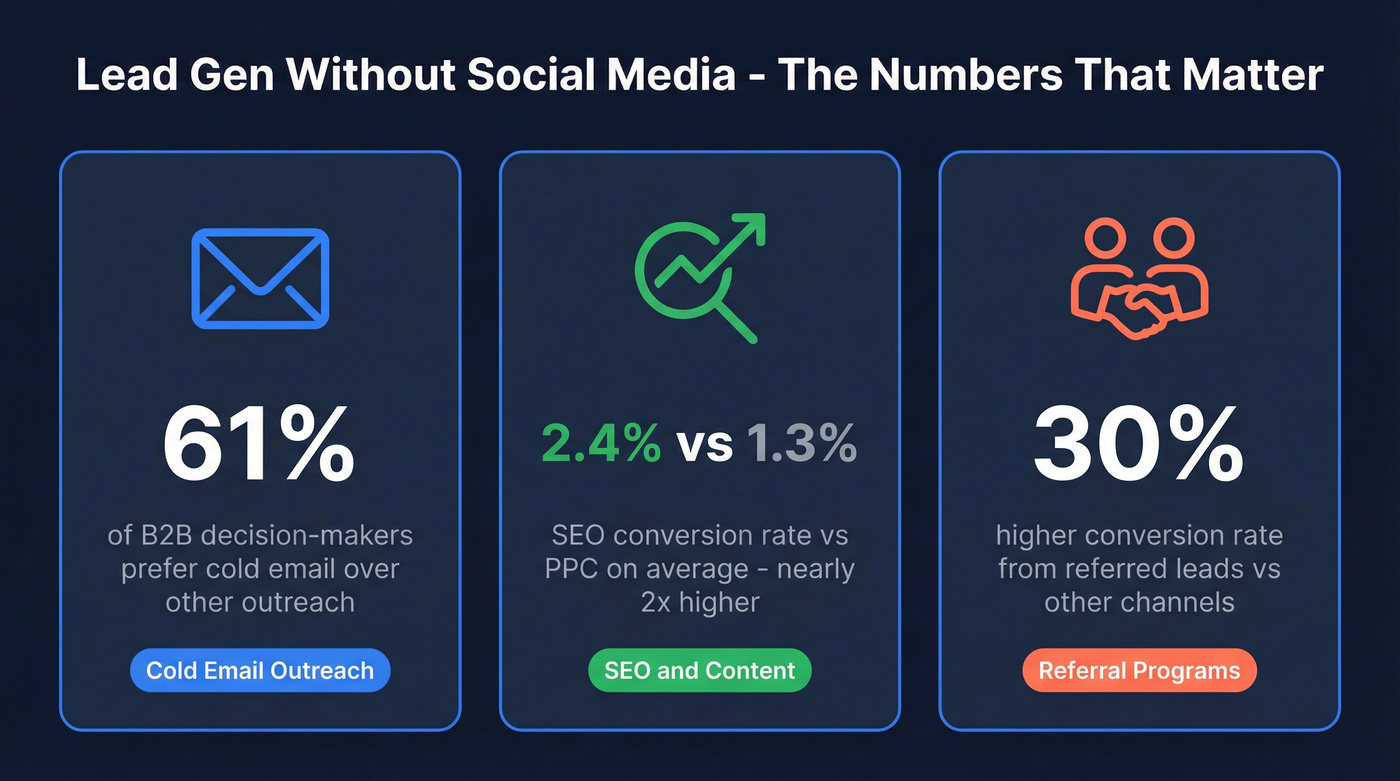
- Cold email outreach - 61% of B2B decision-makers prefer it over other outreach methods.
- SEO and content marketing - converts at roughly 1.8x the rate of PPC on average (2.4% vs 1.3%), and the traffic compounds.
- Referral programs - referred leads convert 30% better. The cheapest pipeline you'll ever build.
Now let's go deeper on each.

Cold email only works when your data does. Prospeo's 300M+ profiles with 98% email accuracy and 7-day refresh cycle mean you're reaching real buyers - not bouncing off stale contacts. Filter by intent, technographics, job changes, and 30+ other criteria to build hyper-targeted lists that actually convert.
Stop chasing algorithms. Start reaching decision-makers directly for $0.01 per email.
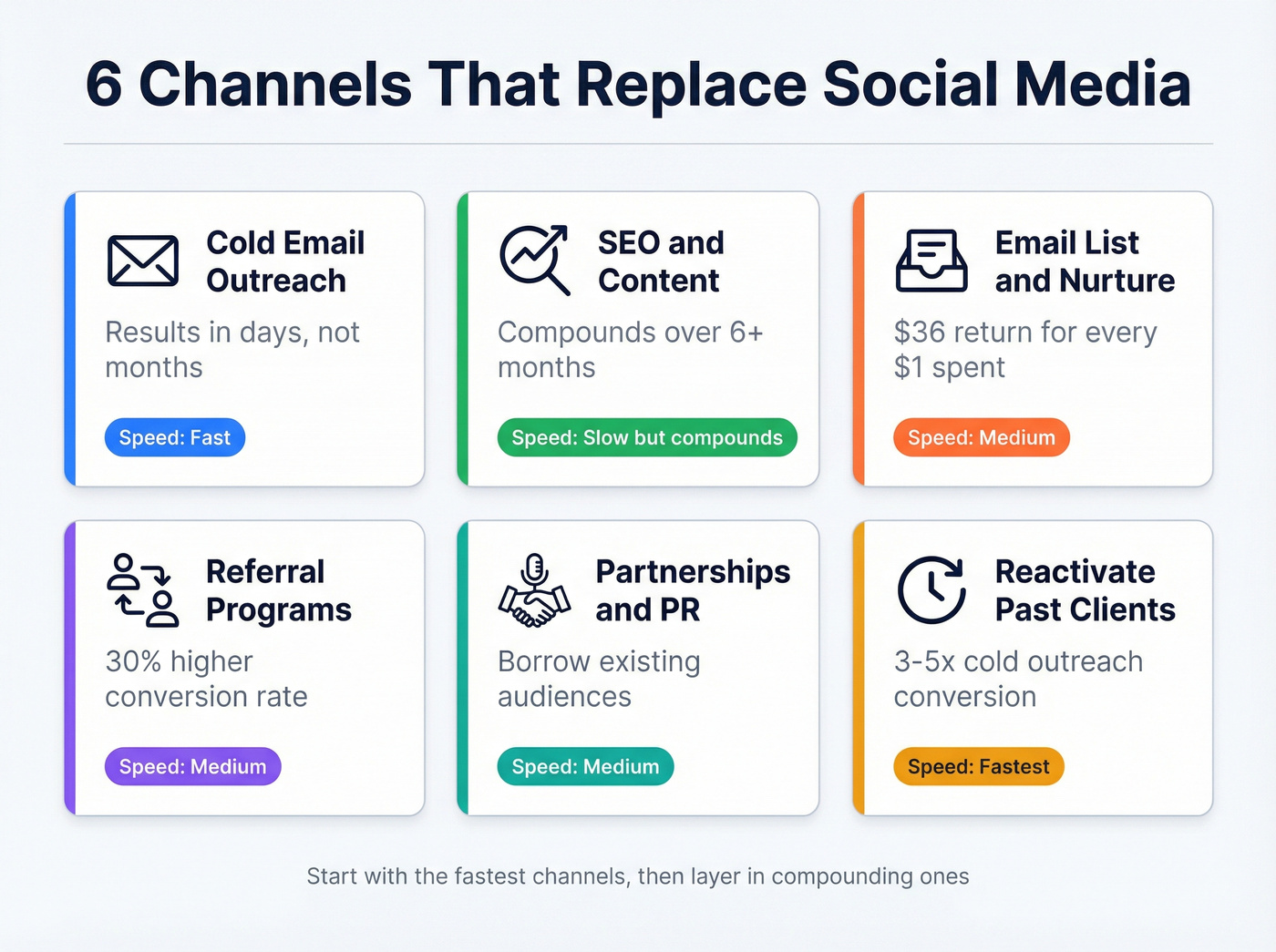
6 Channels That Replace Social Media
Cold Email Outreach
Cold email is the fastest path to pipeline when you don't have a social audience - and even when you do. In the US, 71% of decision-makers prefer cold email over other outreach methods. Globally, that number is 61%. Cold calls? Just 10%.
If you're still weighing channels, it helps to understand inbound vs outbound sales so you can set expectations on speed and compounding.
But 71% of recipients ignore cold emails because they're irrelevant. You've got 5-7 seconds before someone deletes your message. That means targeting and data quality matter more than your subject line - because only 2-3% of buyers are in-market at any given time, which is exactly why consistent, well-targeted outbound matters more than a single viral post.
A few rules that hold up across every campaign we've tested: emails from custom domains get almost 2x the reply rate versus generic Gmail addresses, segmented lists under 100 contacts perform significantly better than larger blasts, and two-email sequences are a solid baseline since longer drips often just annoy people. (If you want a deeper playbook, start with these cold email tactics.)
The question everyone asks: where do you get the contacts? Prospeo's database covers 300M+ professional profiles with 98% email accuracy and 125M+ verified mobile numbers. You can filter by 30+ criteria - buyer intent, technographics, job change, headcount growth, funding, revenue, and more - then export a verified list in minutes. Data refreshes every 7 days (the industry average is 6 weeks), so you're not emailing people who changed jobs last quarter. There's a free tier (75 emails/month + 100 Chrome extension credits/month) so you can test before committing a dollar.
If you're struggling with bounces, start by tightening your prospect data accuracy and running a proper email validity check before you send.

SEO and Content Marketing
SEO converts at 2.4% on average versus 1.3% for PPC - and the gap widens in specific verticals. B2B SaaS sees 2.1% versus 1.0%. Financial services is the most dramatic: SEO converts at 7.3x the rate of paid search.
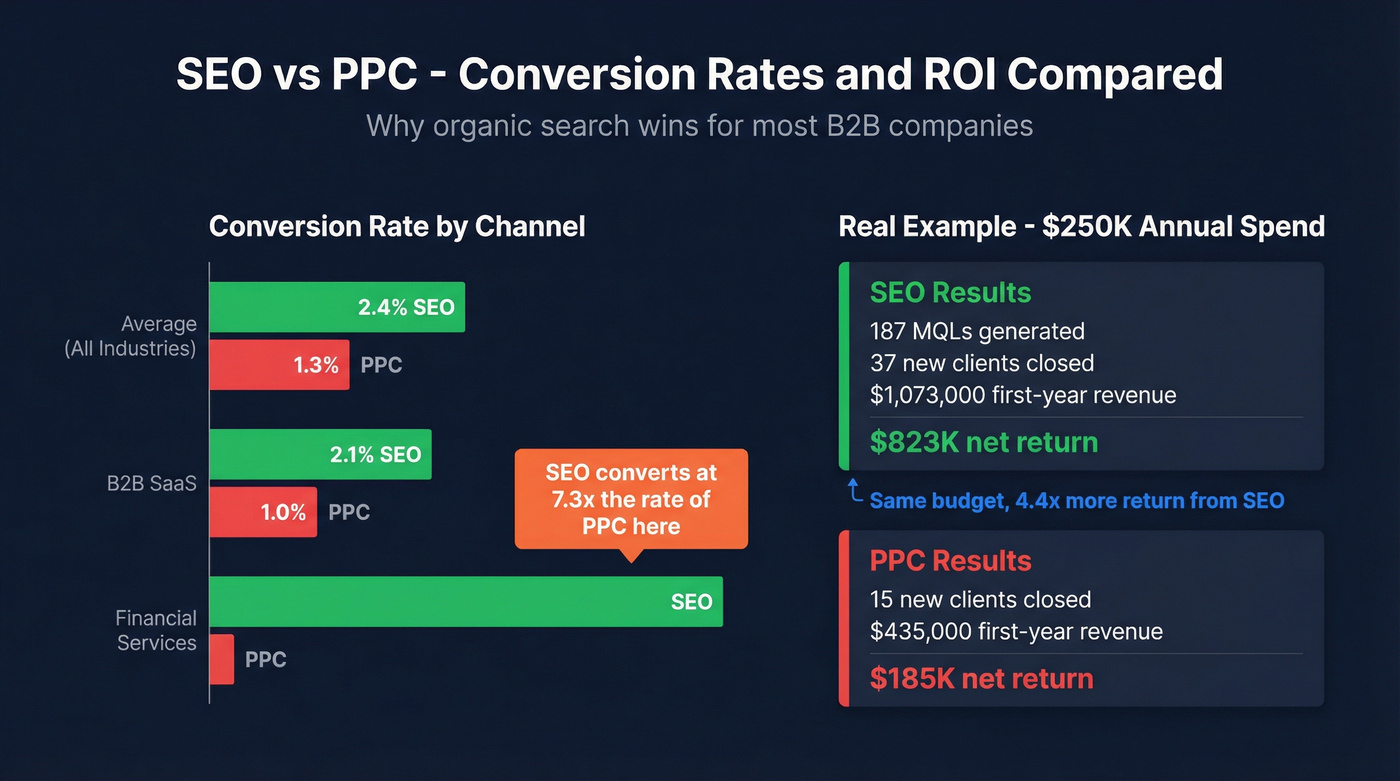
Let's put real numbers on this. A commercial insurance company spending $250K/year on SEO generated roughly 187 MQLs, closed 37 new clients, and produced $1,073,000 in first-year revenue - an $823K return on spend. The same budget on PPC? 15 clients, $435,000 in revenue, and a $185,000 return after ad spend. In our experience, bottom-of-funnel content targeting buyers already searching for what you sell produces the fastest SEO returns.
The tradeoff is time. SEO takes months to compound. But once it does, you own that traffic - no algorithm can take it away. A reasonable budget split for most B2B companies: 75% SEO, 25% PPC. Start with pages that target buyers, not browsers. (For more examples of compounding channels, see these inbound lead generation examples.)
Email List Building and Nurture
Email marketing returns $36 for every $1 spent. Unlike social followers, your email list is an asset you control completely.
The playbook is straightforward. Create a lead magnet worth exchanging an email for - a calculator, template, or benchmark report. Gate it behind an opt-in form on your highest-traffic pages. Then build an automated welcome sequence using a platform like Mailchimp or ConvertKit that delivers value before asking for anything. Three to five nurture emails over two weeks is enough to qualify interest without burning goodwill.
If you want to systematize this, build a simple lead nurturing strategy and track the handoff with inbound lead qualification.
Referral Programs
86% of consumers say recommendations influence their purchase decisions. Four in five discover new brands through conversations, not ads. Referred leads convert 30% better than leads from other channels.
The structure matters. 78% of referral programs are double-sided - rewarding both the referrer and the new customer - and 65% of referrers prefer shared rewards over keeping the incentive themselves. So design your program accordingly: give both parties something meaningful. Discounts, extended trials, or account credits all work.
Here's the thing: referral programs are the most underbuilt channel in B2B. Most companies ask for referrals informally and wonder why they don't get them. Build a system - even a simple one with a shared Google Form and a tracking spreadsheet - and you'll see results within weeks. One agency we know added a "refer a friend, both get a free month" offer to their invoice emails and generated 14 qualified leads in the first 30 days. Zero ad spend.
When you do ask, having a tight referral introduction email makes it far easier for customers to forward.
Partnerships and PR
This channel is about showing up where audiences already gather without building your own from scratch. Podcast guesting puts you in front of a host's audience. Co-marketing webinars split the lead list. Media pitching earns backlinks and credibility simultaneously.
A single guest appearance on a niche podcast can generate more qualified leads than a month of social posting. The key is picking partners whose audience overlaps with yours - not just whoever says yes. If you're reaching out cold to partners, a solid business partnership email helps you get to "yes" faster.
Reactivating Past Clients
This is the fastest channel on the list. Days, not months.
Every company has former clients, expired proposals, and prospects who went dark. A well-timed email or phone call to these warm contacts converts at rates that make net-new outreach look inefficient - we've seen reactivation campaigns convert at 3-5x the rate of cold outreach because the existing relationship does the heavy lifting. It's especially effective in industries like manufacturing, healthcare, and professional services where relationships run deep and buying cycles are long. Before you spend a dollar on new lead gen, mine your CRM for opportunities you've already earned.
If you need copy ideas, start with these re-engagement email subject lines.
How to Pick Your First Channel
The right starting point depends on two things: how fast you need leads and whether you're selling B2B or B2C.
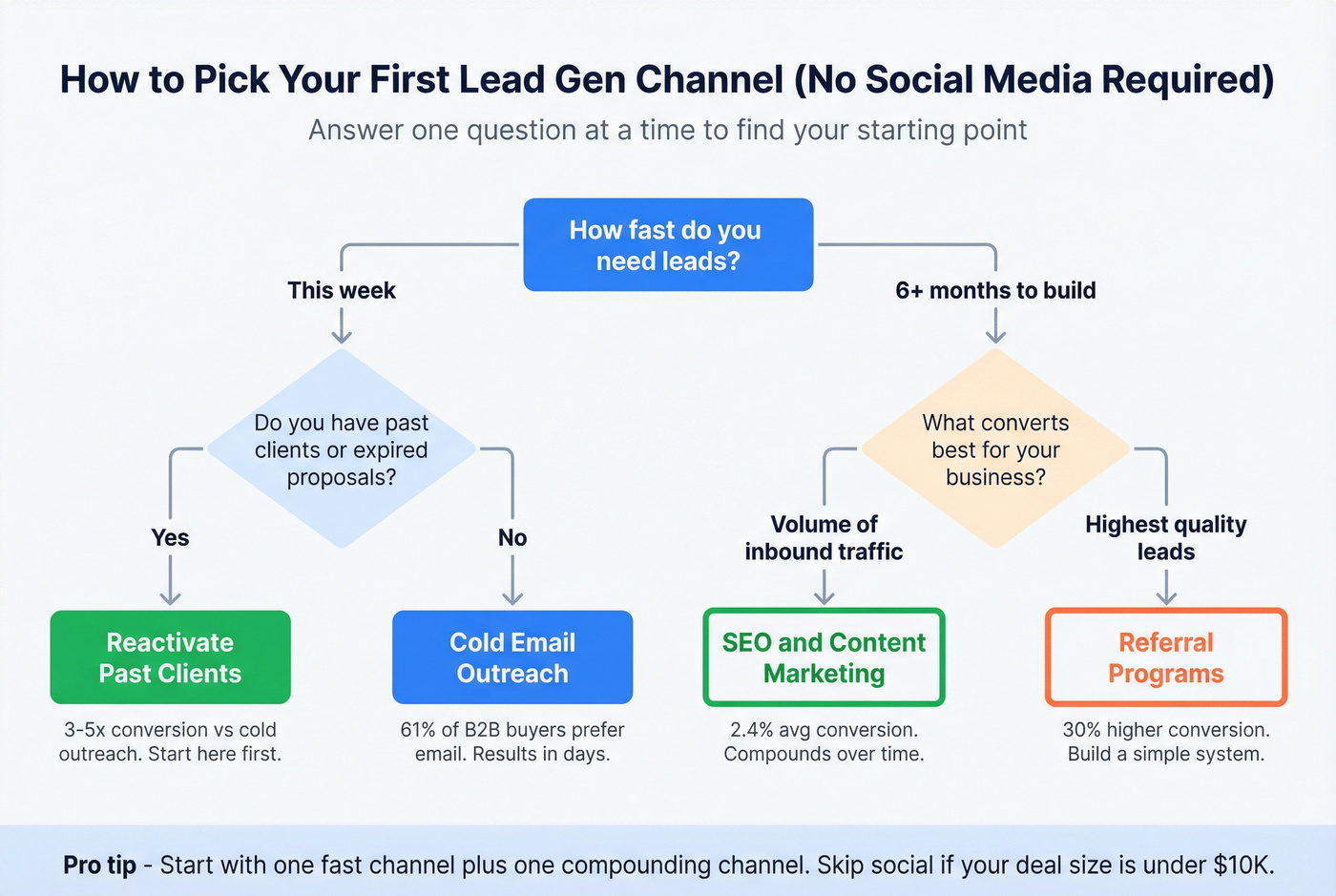
Need meetings this week? Cold email outreach or client reactivation - both produce results in days. Building a pipeline that compounds over six-plus months? SEO and email list building. Want the highest-converting leads possible? A structured referral program. For teams with budget who want another non-social option, paid search returns roughly $8 per $1 spent, but it stops the moment you stop paying.
Skip social entirely if your average deal size is under $10K. Cold email plus one compounding channel (SEO or referrals) will outperform a social strategy at that price point every time.
Most "quit social media" guides just replace Instagram with another slow content channel. That's a mistake. Outbound gets results in days, and you can layer in SEO and referrals as longer-term plays. If social is currently producing leads for you, don't kill it overnight - build your replacement channel first, then phase social out. Start with speed, then build for compounding.
The consensus in B2B communities like r/sales is simple: if you're ditching social, start with cold email. It's the only channel where you control the timing, the targeting, and the message. The practitioners who've made the switch rarely look back.
You don't need a social audience to fill a pipeline. You need verified contact data and the right filters. Prospeo gives you 30+ search criteria - buyer intent, funding, headcount growth, revenue - so every cold email lands with someone who fits your ICP. Free tier included, no contracts, no sales calls.
Build your first targeted prospect list in under 5 minutes.
FAQ
How do you generate B2B leads without social media?
Start with cold email - 61% of B2B decision-makers prefer it over other outreach. Pair outbound with SEO for inbound traffic and referrals for high-conversion leads, and you've got a complete pipeline without touching a social platform. Most teams see booked meetings within the first week of outbound.
What's the fastest non-social lead gen channel?
Cold email outreach and reactivating past clients both produce booked meetings within days, not months. Reactivation campaigns convert at 3-5x the rate of cold outreach. SEO and referral programs take longer but compound over time - layer them in once your outbound engine is running.
What tools do you need for lead generation without social media?
At minimum: a data provider with verified contacts, a sending tool, and a CRM. For sending, tools like Smartlead, Instantly, or Lemlist work well. For SEO, Google Search Console and a keyword research tool are enough to start. For referrals, even a simple spreadsheet works until you scale.