

3CX vs RingCentral: Which Phone System Actually Fits Your Team?
Your RingCentral bill just went up again. Twenty seats, a handful of add-ons nobody asked for, and a renewal quote that makes the CFO twitch. Meanwhile, someone on your IT team keeps floating 3CX as the cheaper alternative. The 3CX vs RingCentral debate comes down to one question: do you want to pay someone else to run your phones, or do you want to own the stack yourself?
30-Second Verdict
Choose RingCentral if you want a fully managed cloud service with zero IT overhead, 24/7 support, and 330+ integrations ready to go.
Choose 3CX if you've got dedicated IT staff, want to own your telephony stack, and have fewer than 40 users where the cost math actually works.
Here's the thing, though: most teams agonizing over this decision are solving the wrong problem. A shiny new PBX won't fix disconnected numbers and bounced emails. If your reps are dialing dead numbers, the phone system isn't the bottleneck - the data feeding it is (see B2B contact data decay).
If neither platform fits, 8x8, Nextiva, and Dialpad occupy solid middle ground worth evaluating (start with 8x8 vs Nextiva).
Quick Feature Comparison
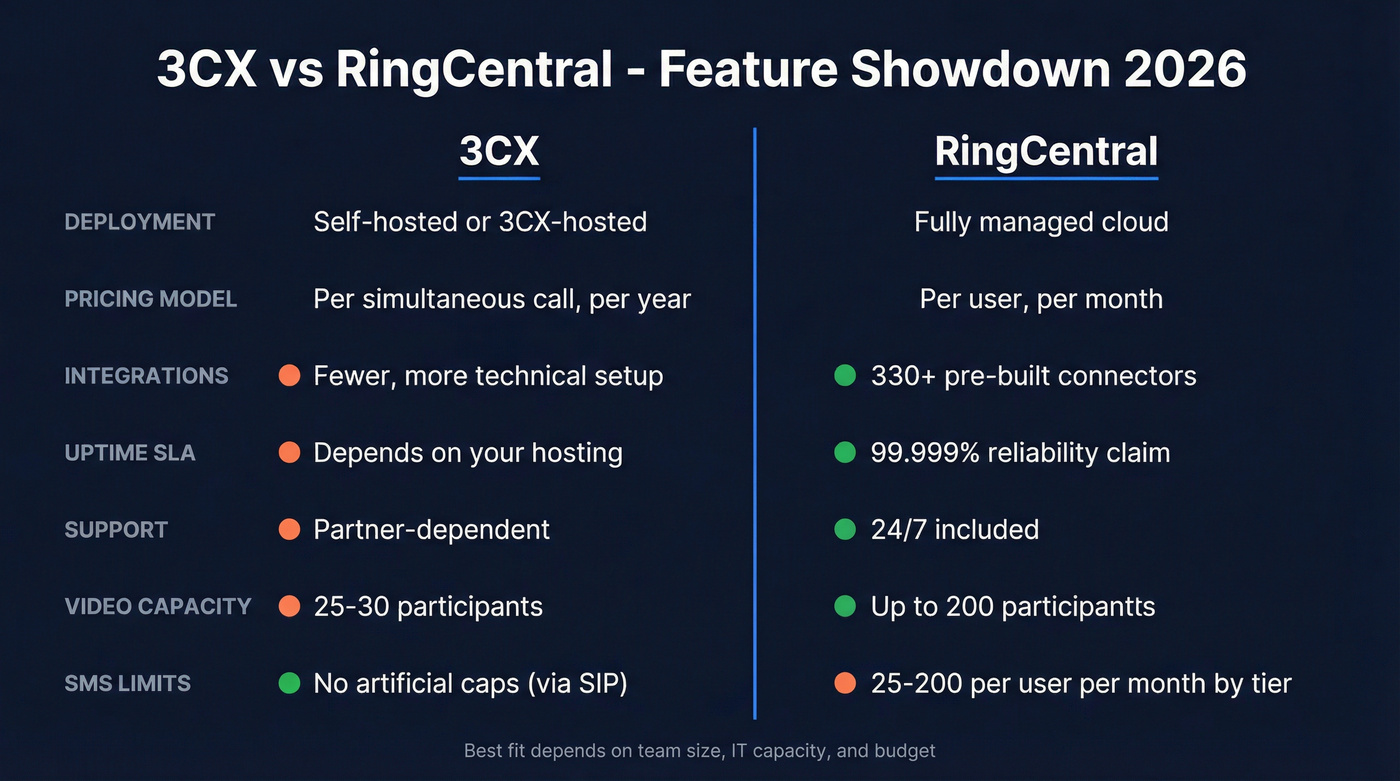
| Category | RingCentral | 3CX | Edge |
|---|---|---|---|
| Deployment | Cloud (managed) | Self-hosted or 3CX-hosted | Tie - depends on IT capacity |
| Pricing model | Per user/month | Per simultaneous call/year | 3CX (lower sticker price) |
| Integrations | 330+ (including Microsoft Teams) | Fewer, more technical | RingCentral |
| Uptime | 99.999% reliability claim | Depends on your hosting | RingCentral |
| Support | 24/7 included | Partner-dependent | RingCentral |
| Video capacity | Up to 200 participants | ~25-30 participants | RingCentral |
| SMS caps | 25-200/user/mo by tier | Via SIP provider | 3CX (no artificial caps) |
| Total cost of ownership | Higher, predictable | Lower, variable | 3CX (if you have IT staff) |
What Each Actually Costs
Pricing is where this comparison gets interesting - and where most articles get lazy.
RingCentral Pricing
RingCentral's RingEX tiers on annual billing:
| Tier | Annual billing | Monthly billing |
|---|---|---|
| Core | $20/user/mo | $30/user/mo |
| Advanced | $25/user/mo | $35/user/mo |
| Ultra | $35/user/mo | $45/user/mo |
Monthly billing runs about 33% more - a penalty for not committing upfront. RingCentral also offers a 14-day free trial supporting up to 20 phone lines, which is worth using before you sign anything.
The base tier looks clean until you realize the features most teams actually need are extras. AI Receptionist starts at $39/mo. Business SMS Booster is $25/mo. Call Queues Booster runs $35/mo. And the AI Conversation Expert? $60/mo. A 20-person team on Advanced with three of those boosters hits roughly $600-650/mo before anyone notices. That's the kind of creep that makes finance teams lose trust in "per-seat" pricing models (more on stack math in cost of sales tech stack).
3CX Pricing
3CX licenses by simultaneous calls (SC), not per user. Here are widely used 2026 benchmarks for self-hosted licensing:
| SC (max users) | Basic | Pro | ENT/AI | ENT+ |
|---|---|---|---|---|
| 8 SC (~40 users) | $320/yr | $350/yr | $575/yr | $775/yr |
| 16 SC (~80 users) | $640/yr | $750/yr | $1,095/yr | $1,445/yr |
Want 3CX to host it for you? Prices jump. 8 SC Pro runs $645/year, 16 SC Pro hits $1,150/year.
The license is cheap. Running 3CX is not. You'll need hosting ($50-150/mo), SIP trunking ($15-200/mo depending on volume), and implementation ($500-2,500 one-time). 3CX price increases going into effect in 2026 are narrowing the gap with managed alternatives even further.
Side-by-Side: 20-Person Team
- RingCentral Advanced: 20 x $25 = $500/mo ($6,000/yr)
- 3CX self-hosted Pro (8 SC): $350/yr license + ~$100/mo hosting + ~$50/mo SIP = ~$179/mo ($2,150/yr)
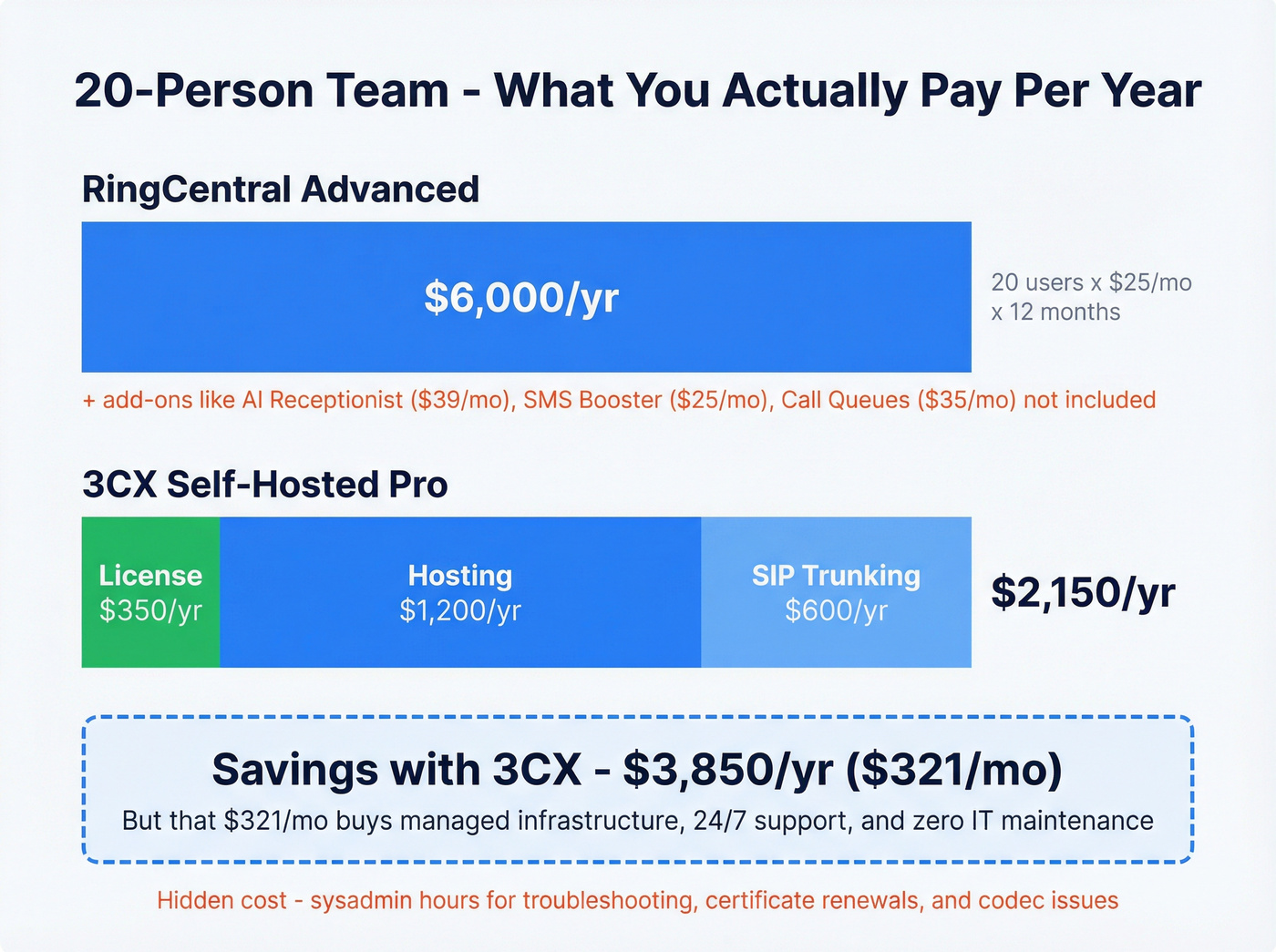
The gap is real - about $321/mo. But that $321 buys you managed infrastructure, 24/7 support, and zero IT maintenance. We've talked to teams who saved on the license and then spent double in sysadmin hours troubleshooting codec issues and certificate renewals. For teams without a VoIP-fluent admin, that's a fair trade.

You're comparing phone systems, but your reps are still dialing disconnected numbers. Prospeo's 125M+ verified mobile numbers deliver a 30% pickup rate - nearly 3x the industry average. At $0.01 per lead, fixing your data costs less than one month of RingCentral add-ons.
Stop optimizing the PBX. Start fixing the data that feeds it.
Feature Deep Dive
Both platforms handle the basics - calling, messaging, video, AI transcription. The differences show up in scale and polish.
RingCentral's video conferencing supports up to 200 participants on standard plans. 3CX's WebMeeting tops out around 25-30 participants comfortably. If you're running company all-hands or large client demos, that's a dealbreaker for 3CX.
On integrations, RingCentral's 330+ pre-built connectors cover virtually every CRM, helpdesk, and productivity tool you'd want - and it offers a Microsoft Teams integration so users can make and receive calls without switching apps. 3CX also supports Teams, but RingCentral's connector is easier to roll out at scale. For Microsoft-heavy shops, this alone can settle the debate. SelectHub's analysis flags integration challenges as a common complaint for both platforms, though 3CX users report it more frequently. RingCentral also carries about 2.36x the review volume of 3CX on SelectHub (1,450 vs 613), reflecting its larger install base.
SMS caps on RingCentral are worth watching: 25 texts per user on Core, 100 on Advanced, 200 on Ultra. If your team texts prospects heavily, you'll hit those limits or pay for the SMS Booster (compare outreach channels in cold emailing vs cold calling). 3CX routes SMS through your SIP provider, which is cheaper but requires more setup.
Both now offer AI features. RingCentral bundles AI transcription and offers the AI Receptionist as an add-on. 3CX includes AI transcription and an AI Receptionist in its ENT/AI tier. For contact center needs, RingCentral offers RingCX starting at $65/agent/month, with higher tiers at $95 and $145/agent/month, while 3CX includes call-center-style features in paid editions depending on configuration.
Admins on both sides report recurring frustrations. RingCentral catches flak for dropped calls and audio delays on lower bandwidth connections - the r/sysadmin consensus is that QoS configuration solves most of it, but it shouldn't be necessary on a managed platform. On the 3CX side, the pain points are SIP trunk complexity and porting timelines. Budget more time than you think for the cutover.
The Security Question
This is the section most comparison articles skip. They shouldn't.
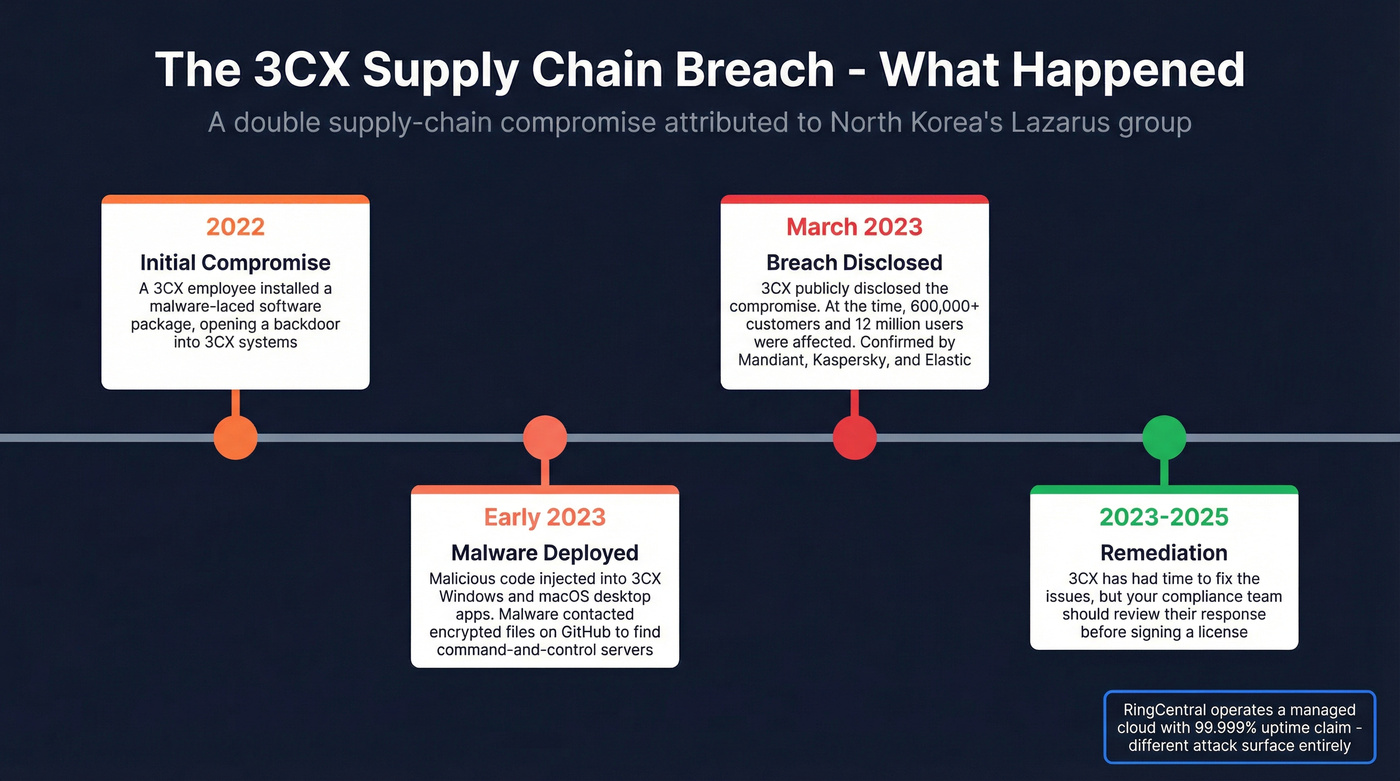
In March 2023, 3CX disclosed that its Windows and macOS desktop apps had been compromised with malicious code. Mandiant's investigation traced the breach back to 2022, when a 3CX employee installed a malware-laced software package that opened the door. The attack was attributed to North Korea's Lazarus group - confirmed independently by Kaspersky and Elastic.
This was a double supply-chain compromise. The malware contacted encrypted files hosted on GitHub to locate command-and-control servers, then fetched further payloads. At the time, 3CX reported 600,000+ customers and 12 million users.
RingCentral operates a managed cloud with a 99.999% reliability claim and standard enterprise compliance certifications. That doesn't make it immune to breaches, but the attack surface is fundamentally different when you aren't self-hosting.
3CX has had time to remediate. But if your compliance team hasn't reviewed the 2023 incident and 3CX's response, that's a gap you need to close before signing a license.
Who Should Pick What
Use RingCentral if you have 50+ users, no dedicated VoIP admin, and need deep CRM integrations out of the box. The managed service model means your IT team isn't troubleshooting SIP trunks at 2 AM.
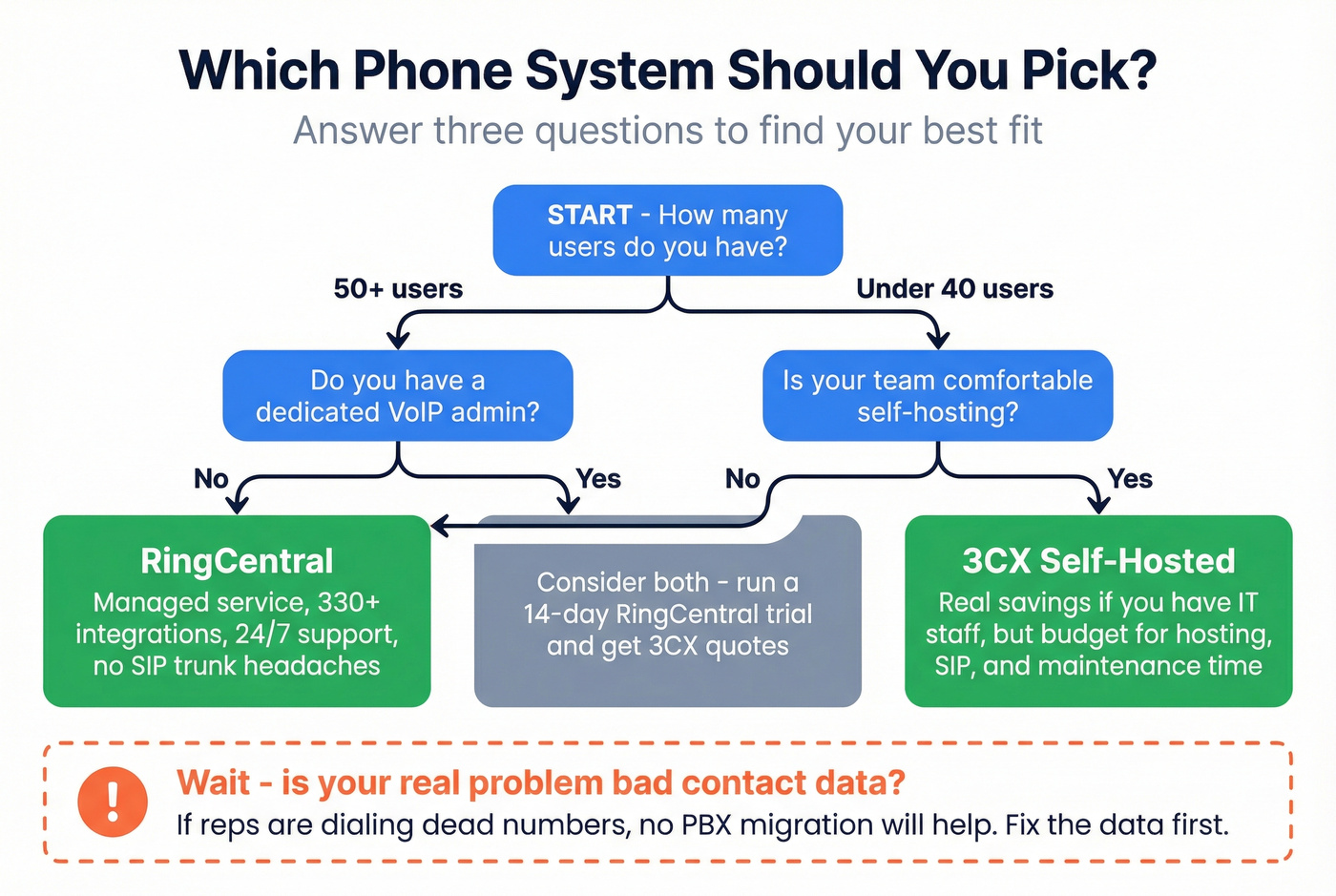
Use 3CX if you have fewer than 40 users, an IT team that's comfortable with self-hosted infrastructure, and you're genuinely cost-sensitive. The savings are real - but only if you don't factor in the labor.
Skip both if you're primarily an outbound sales team and your real bottleneck is contact data, not the phone system. We've seen teams spend months migrating PBX platforms only to discover their reps are still dialing the same dead numbers on the new system. 8x8, Nextiva, and Dialpad are also worth a look if neither RingCentral nor 3CX feels right - each splits the difference between managed simplicity and cost control in different ways.
Clean Your Data Before You Switch
Here's a pattern we see constantly: a team migrates from RingCentral to 3CX (or vice versa), spends weeks on porting and configuration, goes live - and reps immediately start burning call blocks on disconnected numbers. The new system works perfectly. The data doesn't.
Before you invest in any phone system migration, run your contact list through Prospeo's mobile finder. With 143M+ verified emails, 125M+ verified mobile numbers, and a 7-day refresh cycle, you'll know which numbers are actually worth dialing on day one. At a 30% mobile pickup rate, reps start conversations instead of leaving voicemails into the void (see phone validator and prospect data accuracy).
Whether you pick 3CX or RingCentral, neither system can connect your reps to prospects with dead numbers. Prospeo refreshes 300M+ profiles every 7 days - not every 6 weeks - so your sales team dials real people, not voicemail graveyards. 98% email accuracy and verified direct dials included.
The best phone system in the world can't fix bad contact data.
FAQ
Can I port numbers from RingCentral to 3CX?
Yes, number porting is standard across carriers and typically takes 2-4 weeks. You'll need a SIP trunk provider configured and tested on the 3CX side before initiating the port - don't start the process until that's confirmed working.
Does 3CX still offer a free plan?
No. 3CX discontinued its free tier. The cheapest option is the 8 SC Basic self-hosted license at $320/year, which works out to about $27/month for up to 40 users. Budget for hosting and SIP trunking on top of that - expect $150+/month all-in.
Is RingCentral's Teams integration worth the price premium?
If your company already runs on Microsoft 365, yes. RingCentral integrates directly into Teams so users can make and receive calls without switching apps. 3CX also supports Teams, but RingCentral's connector is easier to roll out at scale. For Teams-heavy organizations, this single feature can justify the cost difference.
What if my real problem is bad contact data?
If reps burn call blocks on disconnected numbers, switching PBX platforms won't help. Clean your list first with a tool like Prospeo, then worry about which phone system to run it through. That's where the ROI actually lives.