How to Use Lead Magnets in Cold Email Without Destroying Your Deliverability
You built a 15-page industry report, linked it in your cold email, and watched your open rates drop from 45% to 12% within two weeks. The spam filters ate your lead magnet. Your domain reputation tanked. And that report nobody asked for is sitting in a Google Drive folder collecting dust.
Here's the reframe most senders miss: in cold email, you already have the prospect's address. You don't need to capture a lead - you need to earn a reply. That makes lead magnets in cold outreach less about downloads and more about what we call reply magnets. The goal isn't gated content. It's conversations.
The Short Version
- Short-form assets win. One-page checklists, templates, and short video audits outperform 30-page ebooks every time.
- Keep email #1 plain text with no links. Hunter's analysis found HTML cold emails bounce 674% more than plain text, and adding links, images, formatting, or tracking pixels turns a message into HTML. (If you’re still tracking opens, see open tracking.)
- Use a reply-first flow. Tease value, earn a reply, deliver the magnet. This protects your sender reputation and qualifies interest at the same time. (More tactics here: cold email tactics.)
- Verify your list before sending. One bounced campaign can undo weeks of domain warming. Clean data isn't optional. (Start with email verification for outreach.)
What Makes Cold Email Lead Magnets Different
Inbound lead magnets live behind landing pages and opt-in forms. Someone finds your content, trades their email for it, and enters your funnel. Cold email flips that entirely - you're pushing value to strangers who never asked for it, with no landing page and no opt-in. (If you’re comparing motions, see Inbound vs Outbound Sales.)
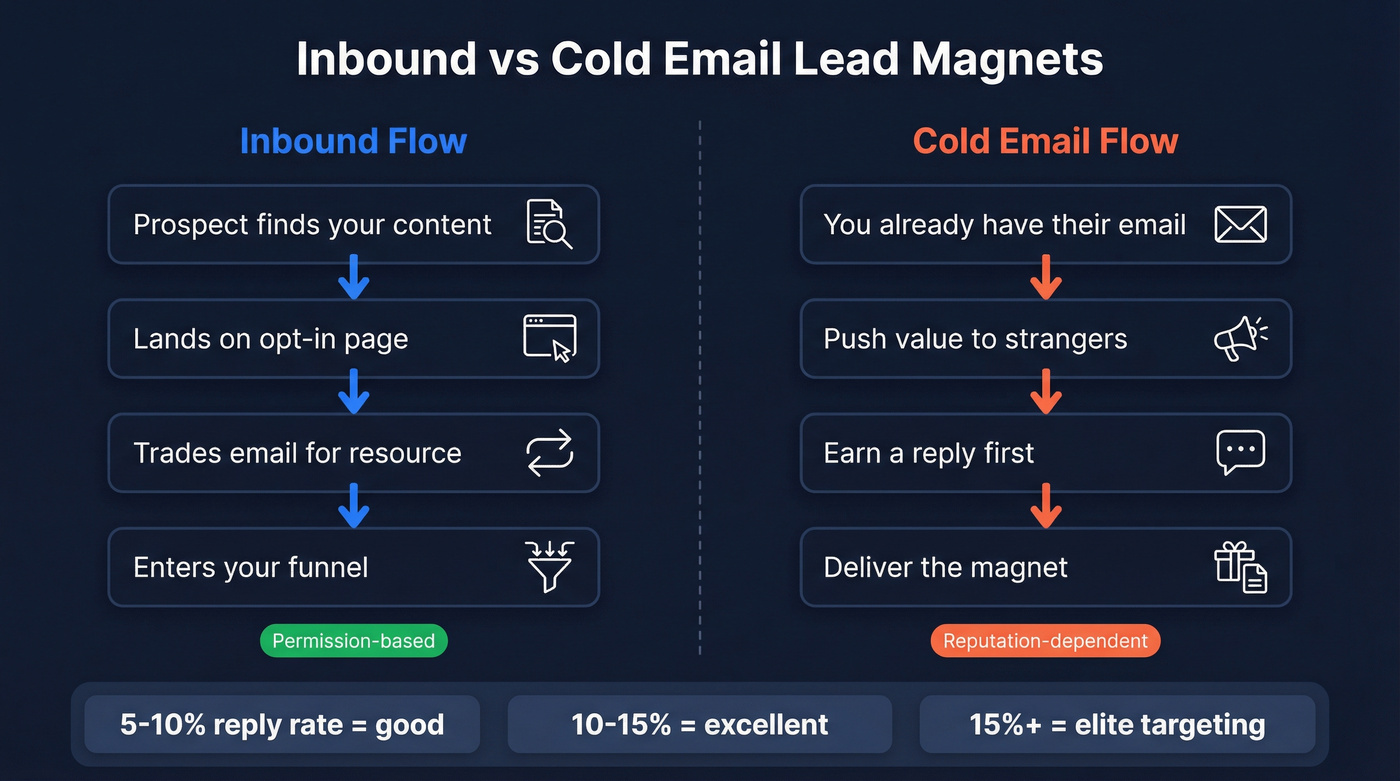
The benchmarks reflect this gap. A 5-10% reply rate is good for cold outbound, which aligns with Backlinko's outreach study finding an average ~8.5% response rate across millions of emails. Hit 10-15% and you're in excellent territory. Above 15% means your targeting and messaging are dialed in tight. (To benchmark outcomes, use positive response rate.)
Your first follow-up alone adds 40-50% more replies. That means most of the value from a lead magnet comes not from the first email but from how you sequence it across touches. (For timing, see When Should You Follow Up on an Email?.)
Three Types That Actually Work
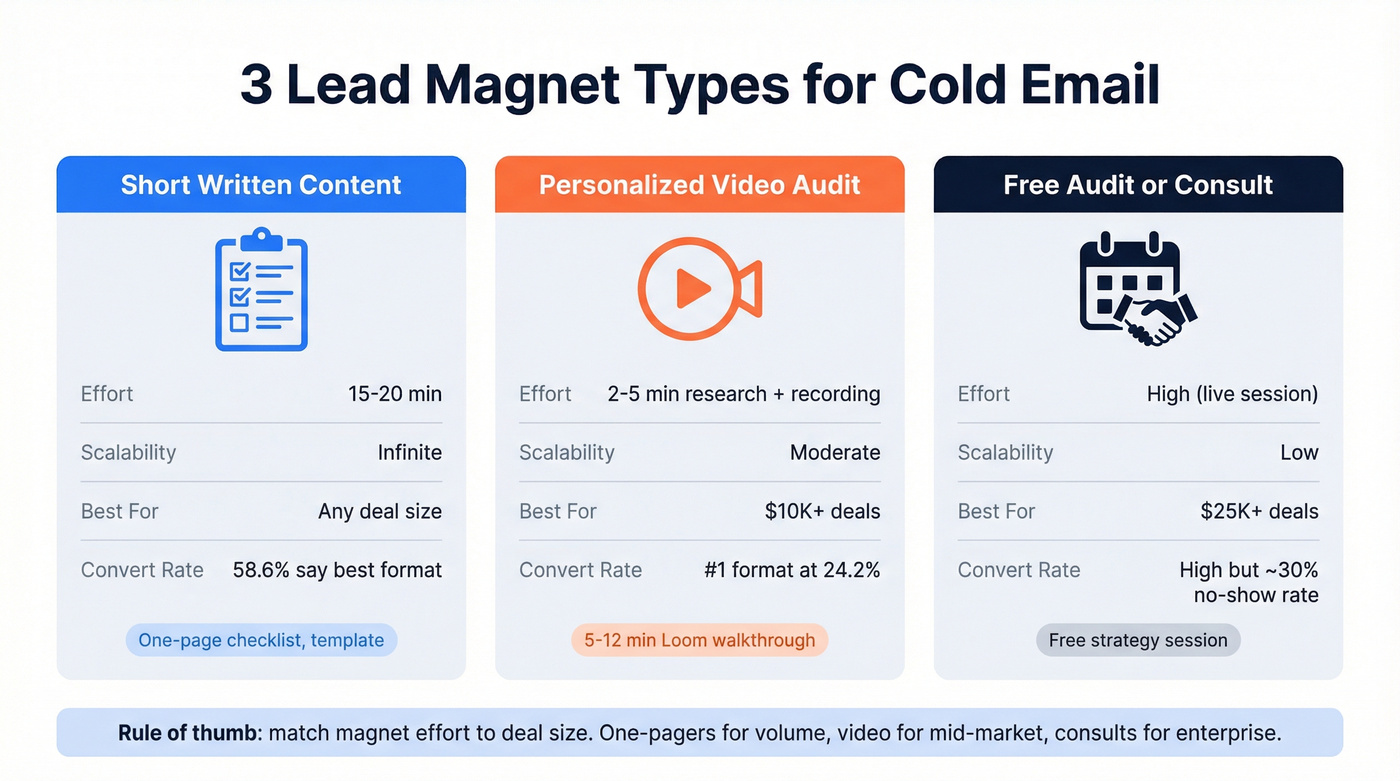
Cold email lead magnets fall into three categories, each with different constraints when you're emailing strangers.
Checklists, Templates, Short Reports
This is your starting point. A one-page checklist or template can be created in 15-20 minutes, scales infinitely, and works for any deal size. A GetResponse survey of 790 marketers - the most thorough format study we've found - showed 58.6% said short written content converts best. That tracks with what we've seen in our own outreach: nobody wants your 30-page ebook, but everyone wants a one-page "10 questions to ask your vendor before signing" checklist. (Need copy? Use these outreach email templates.)
The constraint: it has to be genuinely useful in under 60 seconds.
Personalized Loom Audits
Higher effort, higher perceived value. Spend 2-5 minutes researching the prospect's business, record a 5-12 minute video starting on their website, give three actionable recommendations, and end with a specific-time CTA. (If you’re building a video motion, see video prospecting scripts.)
One practitioner documented 607 positive replies over 13 months using this approach. Not scalable for a 50-person SDR team, but for deals above $10K, the math works easily. Video ranked as the #1 converting format in that same GetResponse study (24.2%), and 73% of those respondents specified short-form over long-form. If you're selling high-ticket services, this is the play.
Free Audits and Consults
High-touch, not scalable. The ~30% no-show rate for booked appointments makes this expensive fast. Reserve service-based magnets for high-ticket deals where one closed opportunity justifies 10 no-shows. (For meeting asks, see How to Ask for an Appointment.)
| Type | Effort | Scalability | Best Deal Size | Example |
|---|---|---|---|---|
| Media-based | Low (~15-20 min) | Infinite | Any | One-page checklist |
| Technology-based | Medium-High | Moderate | $10K+ | Personalized Loom audit |
| Service-based | High | Low | $25K+ | Free strategy consult |
Why Links Kill Your First Touch
Let's be honest about this one - it's the single biggest mistake we see teams make. (If you’re scaling volume, read How to Scale Outbound Campaigns.)
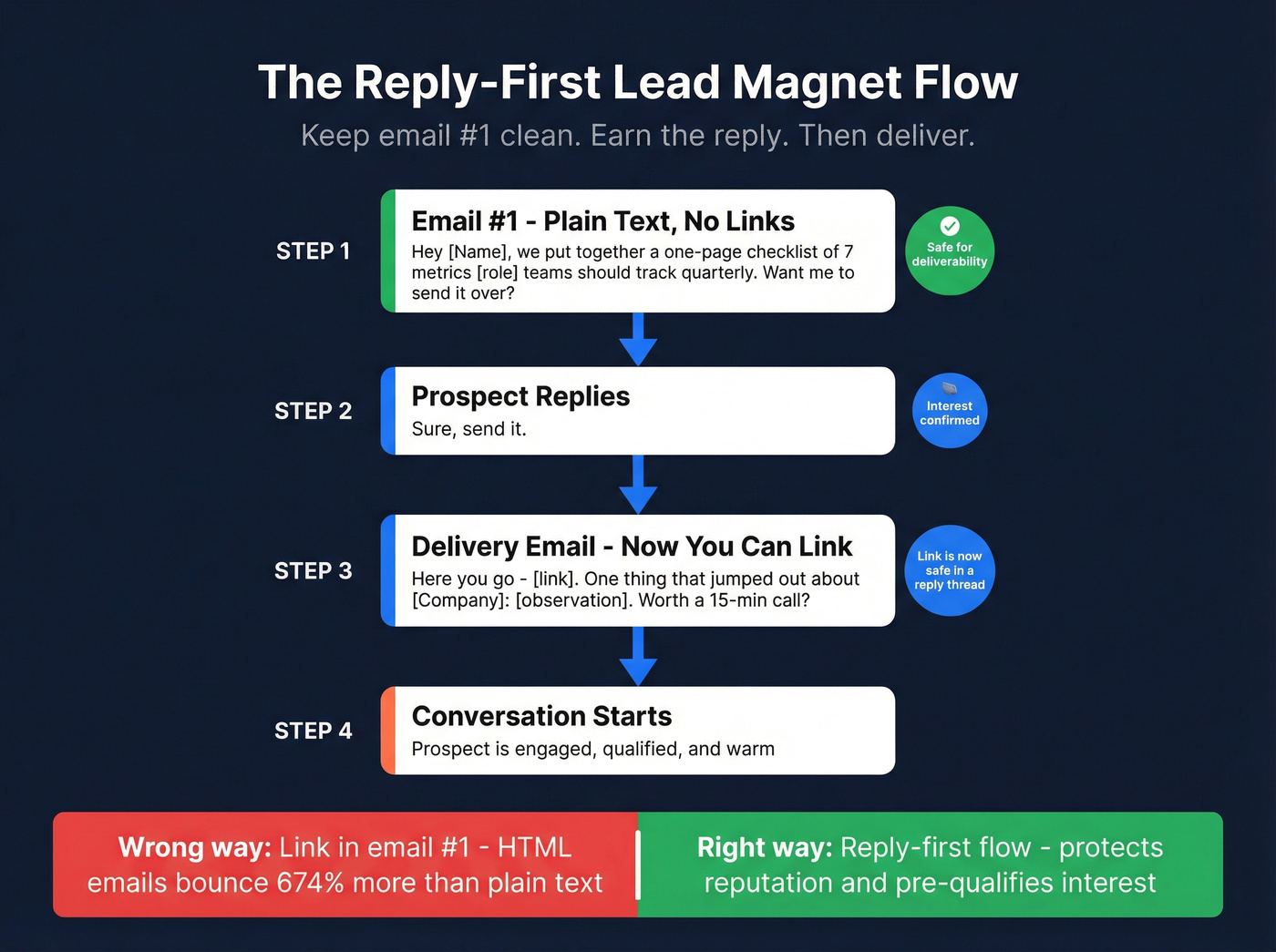
Hunter's analysis of 2.2 million emails found that HTML cold emails bounce 674% more than plain text. In cold outreach, adding links, images, formatting, or tracking pixels turns a message into HTML, which makes it look less like a personal 1:1 note and more like bulk marketing.
This is why most lead magnet cold emails fail before the prospect ever sees them. The fix is dead simple: keep the first touch clean, earn the reply, then deliver the resource.
Email #1 (plain text, no links):
"Hey [Name], we put together a one-page checklist of the 7 metrics [role] teams at [company type] should track quarterly. Want me to send it over?"
Prospect replies: "Sure, send it."
Delivery email:
"Here you go - [link]. One thing that jumped out when I was looking at [Company]: [specific observation]. Worth a 15-minute call this week?"
This protects your deliverability by keeping email #1 clean and pre-qualifies interest - anyone who replies is already engaged. It's especially important when you're sending to 50-100 people per campaign. (For structure, see sales email structure.)

Your reply-first flow only works if the email lands. Prospeo's 5-step verification delivers 98% email accuracy on a 7-day refresh cycle - so your lead magnet sequences hit real inboxes, not spam traps. Stack Optimize built a $1M agency on sub-3% bounce rates using this exact foundation.
Clean your list before you tease the checklist.
Where to Place the Magnet in Your Sequence
The lead magnet isn't your opening line - it's your follow-up ammunition. Structure a 3-touch sequence over 7-14 days, keeping each email between 50-125 words with one clear CTA. (Need a full cadence? Start with a cold email drip campaign.)
Email #1 (Day 1) - The Tease:
"Hi [Name], we compiled a short template that [specific outcome] for [role] teams at companies like [Company]. Happy to share if useful - just say the word."
Email #2 (Day 4) - The Re-Offer:
"Following up - the template I mentioned has been getting solid feedback from [similar company type] teams. Want it?"
Email #3 (Day 8) - The Specificity Play:
"Last note - [Name at similar company] used the template to [specific result]. If that's relevant at [Company], I'll send it over."
The Data Quality Foundation Most Senders Skip
Here's a scenario we've watched play out dozens of times. Your SDR sends 2,000 cold emails offering a free audit. 180 bounce. 14 reply. 4 say "wrong person." Your domain reputation is in the gutter, and the lead magnet strategy everyone told you would work just made things worse.
Most lead magnet campaigns don't fail because of the magnet. They fail because of the data. A 10% bounce rate doesn't just waste 10% of your sends - it poisons your domain reputation for the other 90%. (If you’re diagnosing bounces, see hard bounce.)
Prospeo's 5-step verification catches dead addresses, spam traps, and catch-all domains before you hit send, delivering 98% email accuracy with data refreshed every 7 days. Stack Optimize built from $0 to $1M ARR on this foundation, maintaining 94%+ deliverability and under 3% bounce rates across all their clients. That's what makes lead magnet campaigns viable - whether you're running them in-house or through an agency managing outbound on your behalf.
Deliverability Checklist
Before you launch a single lead magnet campaign:
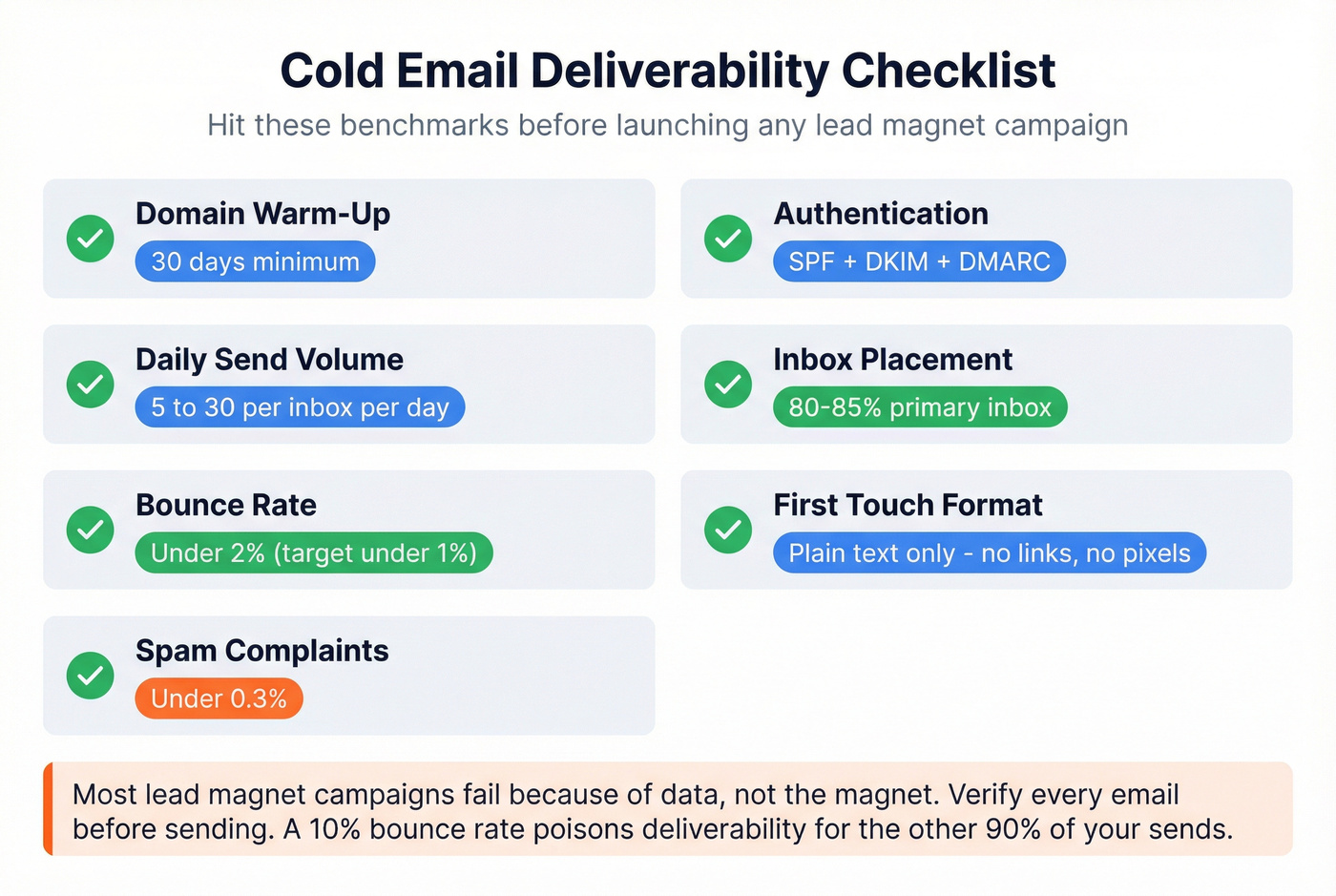
- Warm your domains for 30 days minimum. No shortcuts. Cold domains sending volume get flagged immediately. (Deep dive: automated email warmup.)
- Ramp from 5 to 30 emails per inbox per day. Jumping straight to high volume is a deliverability death sentence.
- Keep bounces under 2%. Stricter teams target under 1%. Verify your list before every send - not once, every time.
- Hold spam complaints under 0.3%. Above that threshold, major providers start throttling you.
- Authenticate with SPF, DKIM, and DMARC. Non-negotiable. If you haven't set these up, stop reading and go do it now.
- Target 80-85% primary inbox placement. Pause campaigns if health drops below 80%.
- Plain text for first touch. No links, no tracking pixels, no images.
Five Mistakes That Tank Reply Rates
1. Linking to a PDF in email #1. Links, formatting, and tracking turn your message into HTML, and HTML cold emails bounce far more than plain text. Tease the resource. Wait for the reply.
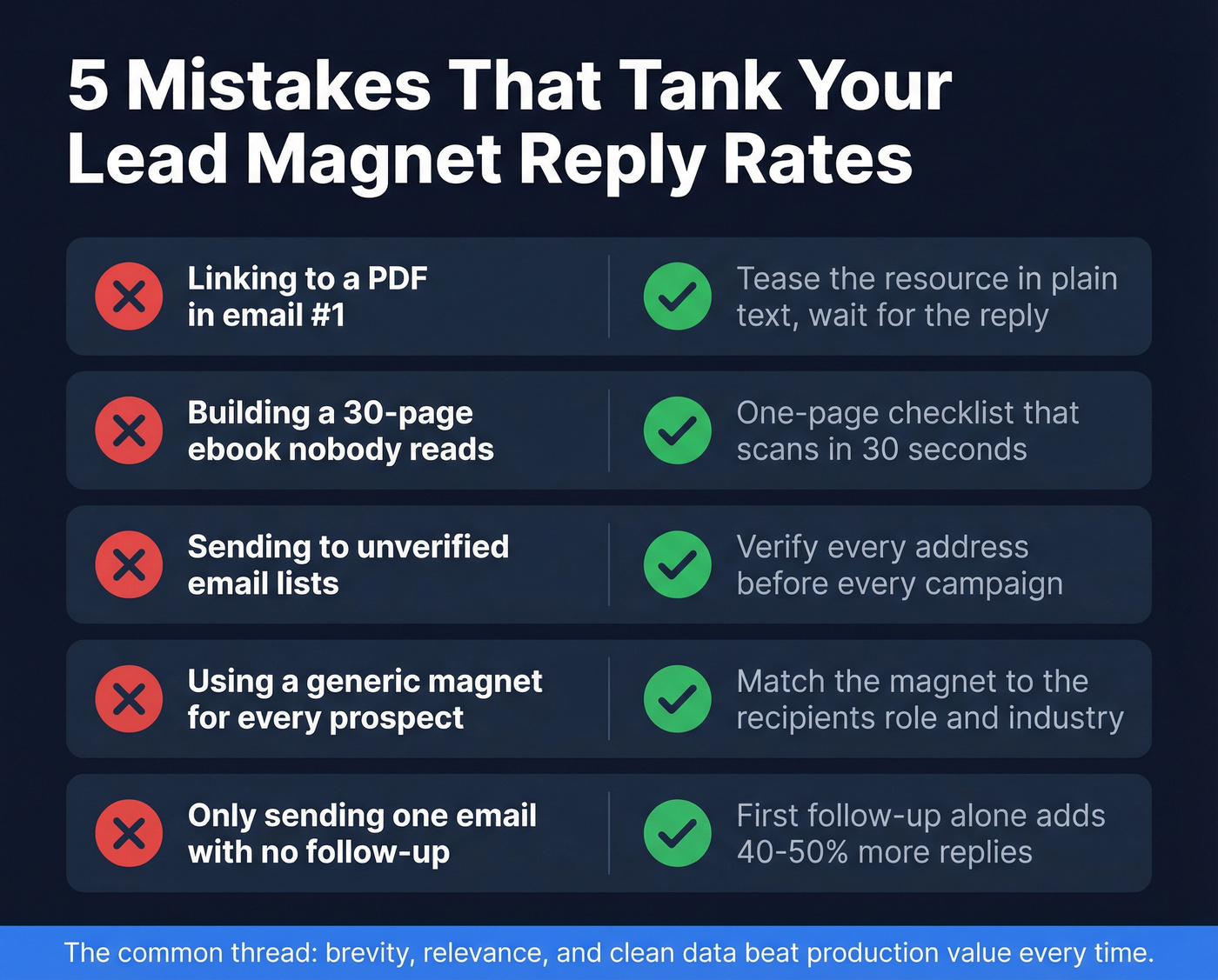
2. Building a 30-page ebook nobody reads. A one-page checklist that takes 30 seconds to scan beats a sprawling guide that takes 30 minutes to read. The consensus on r/coldemail is pretty clear on this - brevity wins, always.
3. Sending to unverified lists. A 10% bounce rate poisons your domain reputation for the other 90% of your sends. We've seen teams recover from bounce spirals in 2-3 weeks once they switch to verified lists, but the damage during those weeks is real and measurable.
4. Using a generic magnet that doesn't match the prospect's pain. "10 Tips for Better Marketing" sent to a VP of Engineering is noise. Skip the generic stuff entirely - if your magnet doesn't feel made for the recipient's role or industry, it reads like spam with extra steps.
5. Skipping follow-ups. Your first follow-up adds 40-50% more replies. If you're only sending one email, you're leaving half your replies on the table.
Bad targeting kills lead magnet campaigns faster than bad magnets. Prospeo's 30+ filters - buyer intent, job changes, headcount growth, technographics - let you build lists of prospects who actually care about your one-page checklist. At $0.01 per verified email, a 100-person campaign costs a dollar.
Send your best asset to the right people, not random strangers.
FAQ
Do lead magnets actually improve cold email reply rates?
Yes - when the magnet is tightly aligned to the prospect's pain and offered after initial interest. Expect a 10-30% relative lift in reply rates compared to a straight ask. A generic ebook linked in email #1 will hurt more than it helps. Timing and relevance matter more than production value.
Should I attach a PDF to my cold email?
No. Attachments trigger spam filters just like links do. Use the reply-first flow: mention the resource in plain text, wait for a reply confirming interest, then send the file. This protects deliverability and confirms the prospect actually wants it.
How do I make sure my lead magnet emails actually get delivered?
Start with clean data - verify every email address before sending. Then follow the basics: warm your domain for 30 days, ramp volume slowly, authenticate with SPF/DKIM/DMARC, and keep bounces under 2%. If you're doing all of that and still landing in spam, your content is probably the issue - too many links, too much formatting, or a domain that's already been flagged.
Are lead magnets still effective for cold outreach in 2026?
They are, but format has shifted hard. Short-form assets - one-page checklists, 5-minute Loom audits, ROI calculators - outperform long-form content by a wide margin. The 58.6% of marketers who say short written content converts best confirms what cold senders already know: brevity wins.