How to Compete Against Bigger Companies in Sales
Here's a pattern we see constantly: a small team wins a deal against an enterprise incumbent - not because they had a better product, but because the buyer was exhausted by six-week procurement cycles and rotating account managers. That story isn't unusual. It's the norm.
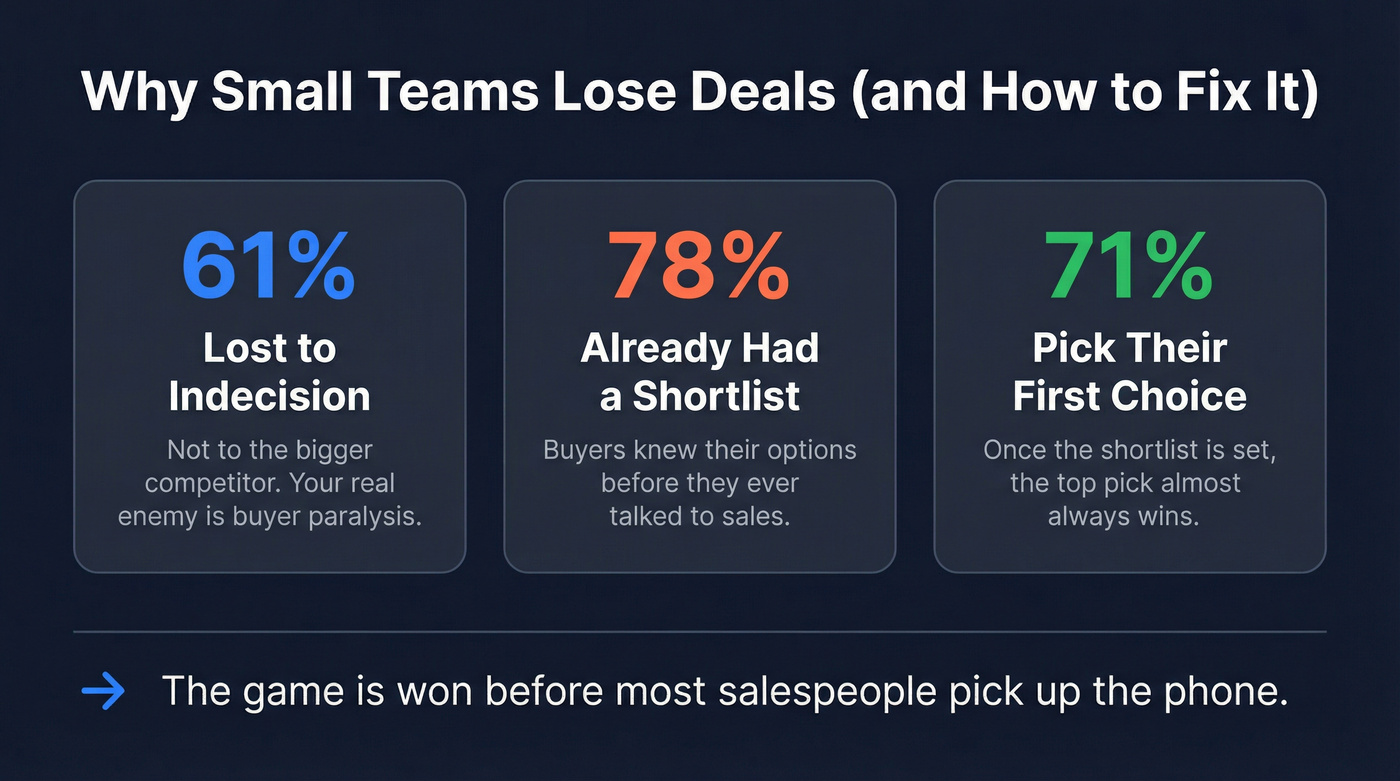
Most "David vs. Goliath" sales advice gets the framing wrong. Your biggest competitor usually isn't the enterprise vendor. 61% of lost deals, and 78% of buyers shortlist brands they already knew before researching. The game is won before most salespeople pick up the phone.
If your average deal size is under $50K, you probably don't need to "beat" the enterprise vendor at all. You need to beat inertia.
Three Things That Move the Needle
- Get on the shortlist early. 71% of buyers choose their first choice once the shortlist is set. If you're not on it, nothing else matters.
- Lead with insight, not your pitch. Buyers want someone who understands their problem better than they do.
- Stop burning selling time on bad data. Reps spend 70% of their time on non-selling tasks. Clean data and sharp targeting are force multipliers for small teams.
Get on the Shortlist Early
Shortlists have shrunk to two or three products - 96% of buyers consider five or fewer options. Once that shortlist is locked, 71% choose their first choice. If you're not already known, you're already losing.
So how do you get known? Start with peer review sites. Half of sales leaders check review platforms before they'll accept a meeting. Your G2 profile and case studies aren't marketing vanity - they're pipeline infrastructure. Demos matter too: 54% of buyers say demos are their most-used resource during evaluation, which means a frictionless booking experience can be the difference between making the cut and getting ignored entirely.
The practical move: publish comparison pages, get customers to leave reviews, make your demo easy to book. Enterprise vendors are slow at this because they rely on brand gravity. You don't have that luxury, but you also don't have their bureaucracy.
Lead with Insight, Not Pitches
63% of buyers avoid salespeople during the Discovery phase entirely. By the time they talk to you, they don't want basic discovery questions - they want someone who can tell them something they didn't already know.
Anthony Iannarino calls this the shift from the "Era of the Solution" to the "Era of Decision-Making." Buyers aren't struggling to find options. They're struggling to decide. The salesperson who wins helps them navigate that uncertainty, and that requires showing up with a genuine point of view rather than a slide deck full of logos.
Treat your first meeting as an executive briefing. Bring industry trends, benchmarks, and a perspective on what's changing in their market. This is where smaller companies have a real edge: your reps are closer to the product and can speak with specificity that a large vendor's SDR team simply can't match.
Outservice the Enterprise
The FORD method - Family, Occupation, Recreation, Dreams - sounds soft, but it works. Record personal details alongside contact info. Big vendors don't do this; their CRMs are full of BANT fields, not human context.
Here's the thing: fewer management layers mean faster proposals and follow-up. Only 21% of large-company employees feel they have the management they need to perform well. That dysfunction is your opening. Channel the Hertz playbook: "We're #2, we try harder." Say it explicitly. Buyers respect the honesty, and it reframes the conversation from "why should we trust you?" to "what can you do that they can't?"
Skip this if you're tempted: don't match the enterprise vendor feature-for-feature. You'll lose. And don't discount aggressively. You're competing on attention and care, not cost. Racing to the bottom signals desperation.

When you have five reps instead of fifty, bad data isn't an annoyance - it's a death sentence. Prospeo's 98% email accuracy and 7-day data refresh mean your small team stops wasting cycles on bounced emails and outdated contacts. That's how you outpunch the enterprise vendor with a fraction of the headcount.
Stop burning reps' time on dead leads. Start closing competitive deals.
The Three-Cycle Pattern
"Nobody got fired for hiring IBM." Here's how that dynamic actually plays out.
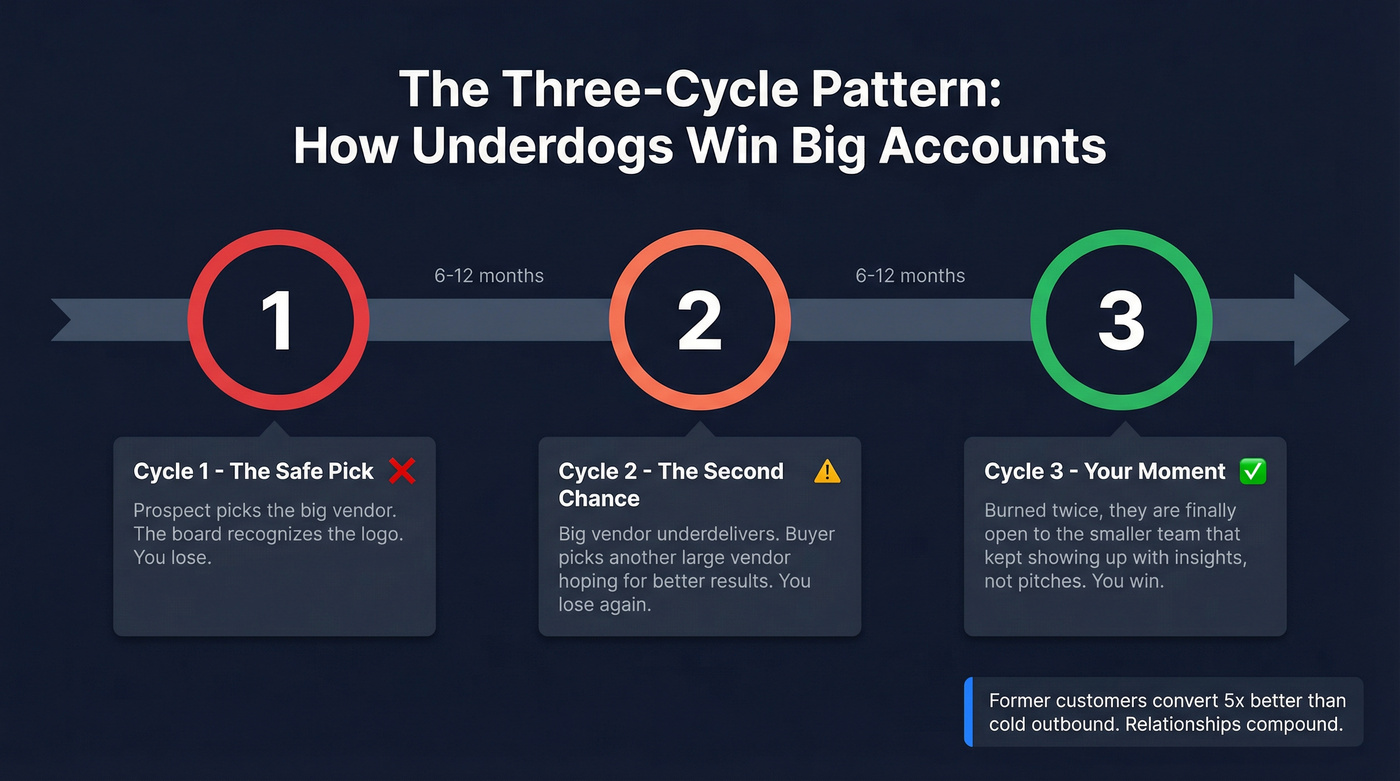
First cycle: The prospect picks the big, safe vendor. The board recognizes the logo.
Second cycle: The big vendor underdelivers. But the buyer picks another large vendor, hoping for a different result.
Third cycle: Now they're fed up. They've been burned twice. They're finally open to the smaller company that's been showing up consistently - not with pitches, but with insights and genuine helpfulness. This is the cycle where you win, not by outspending them, but by outlasting them.
In our experience, this pattern holds remarkably well. We've watched teams build a list of 60 dream accounts, touch three per day with relevant content, and start closing deals in the third cycle that seemed impossible in the first. Former customers convert roughly 5x better than cold outbound, and opportunities with prior buying committee members win at around 49% versus the 19% average. Relationships compound.
What to Say in Competitive Deals
When you're head-to-head against a bigger vendor, your talk track matters more than your feature set.
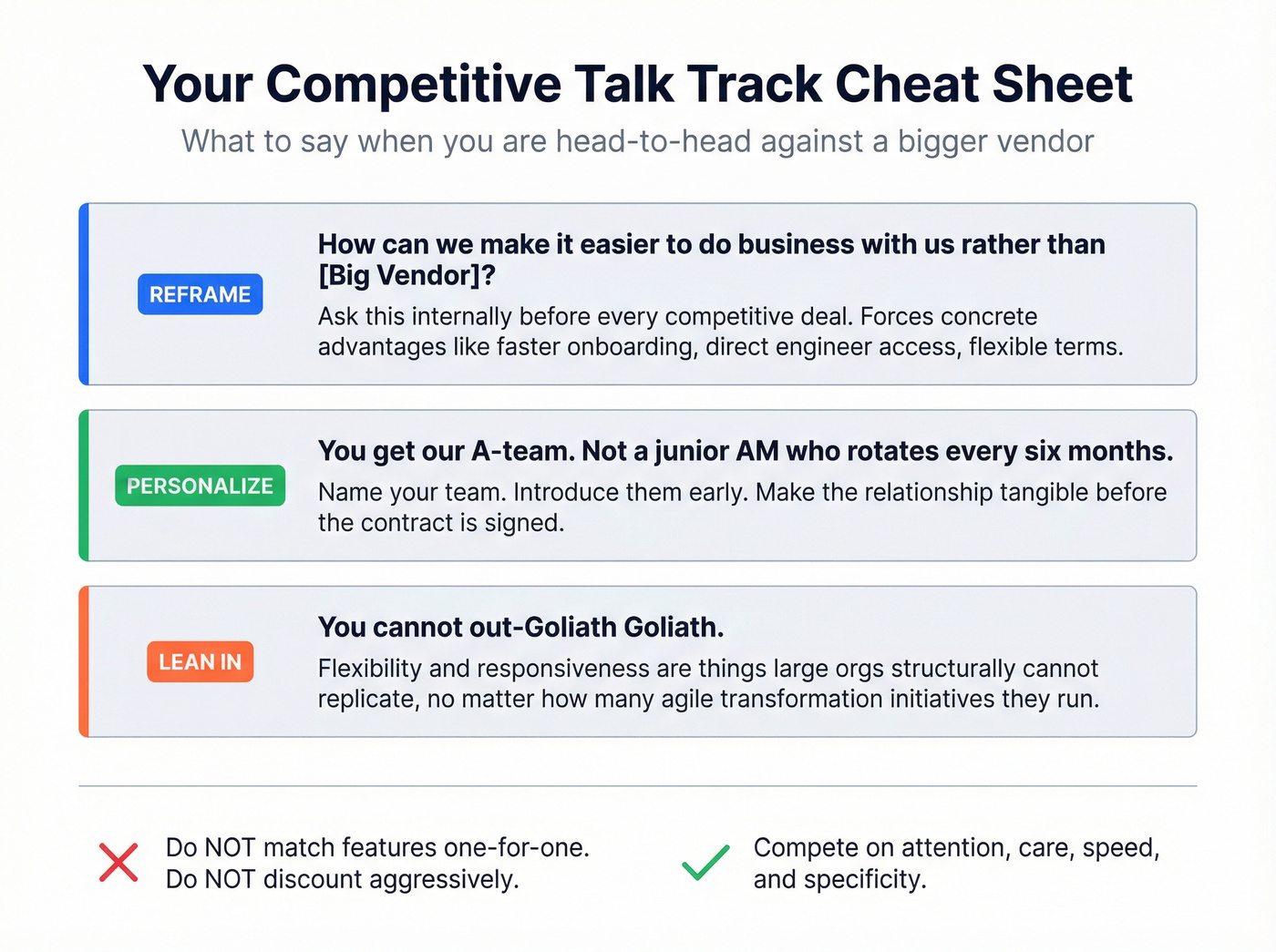
"How can we make it easier to do business with us rather than [Big Vendor]?" Ask this internally before every competitive deal. It forces concrete advantages - faster onboarding, direct access to engineers, flexible terms.
"You get our A-team. Not a junior AM who rotates every six months." Name your team. Introduce them early. Make the relationship tangible before the contract is signed.
"You can't out-Goliath Goliath." Lean into being small. Flexibility and responsiveness are things large organizations structurally can't replicate, no matter how many "agile transformation" initiatives they run.
Build a Competitive Intelligence System
You don't need a six-figure CI platform. You need a rhythm.
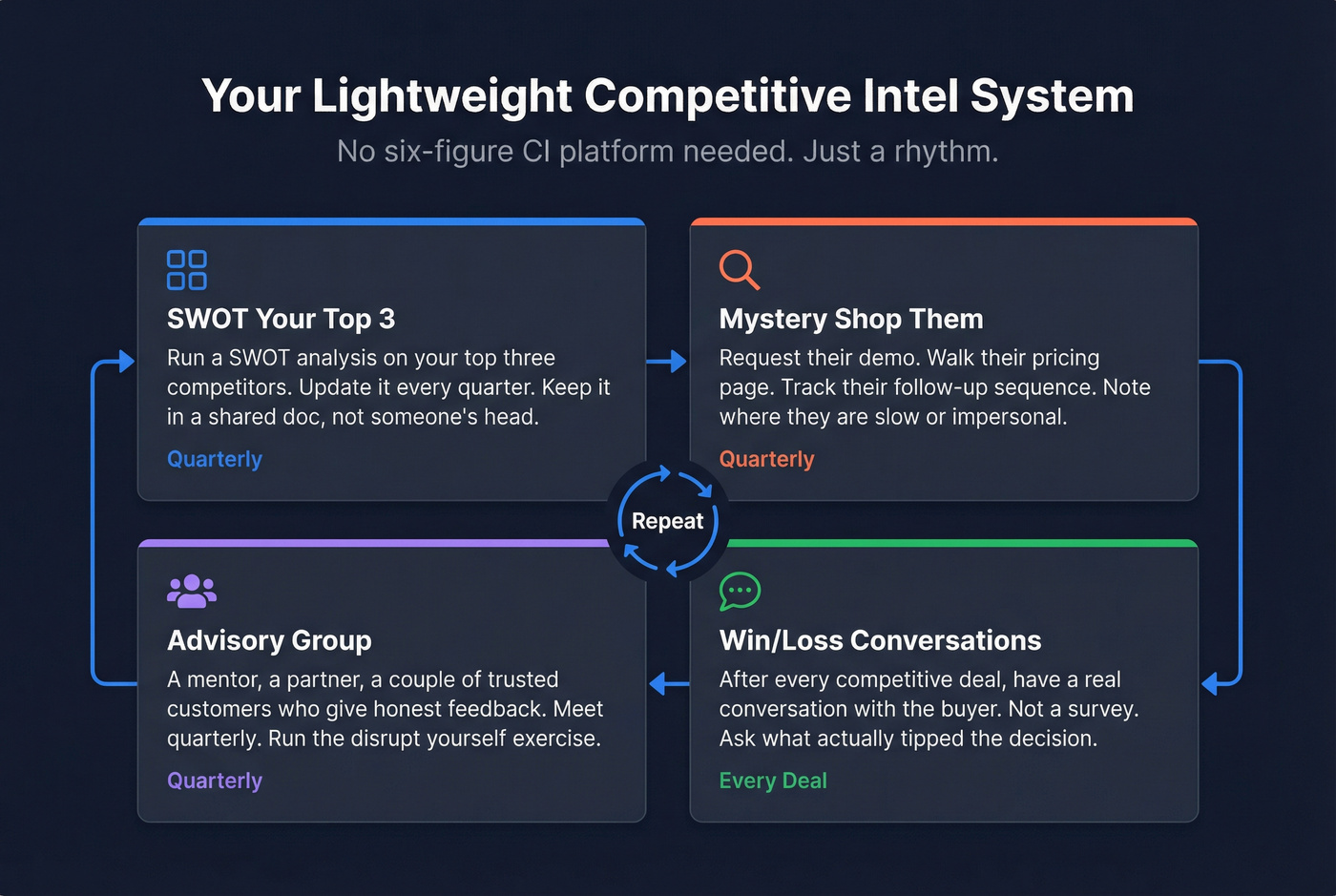
Run a SWOT on your top three competitors and update it quarterly. Mystery-shop their buying experience - demo request, pricing page, follow-up sequence - and note where they're slow or impersonal. Do win/loss analysis after every competitive deal, not a survey but a real conversation with the buyer about what tipped the decision.
Set up a quarterly advisory group: a mentor, a partner, a couple of trusted customers who'll give you honest feedback. And run the "disrupt yourself" exercise. Grasshopper did this - asking "if we were starting from scratch, how would we kill our own company?" - and eventually sold for $170M. The consensus on r/sales is that most small teams skip competitive intel entirely, which means even a basic system puts you ahead of 80% of your peers.
Better Data Means a Bigger Punch
When you have five reps instead of fifty, you can't afford to send 2,000 emails, watch 340 bounce, and book 12 meetings. That math is fatal.
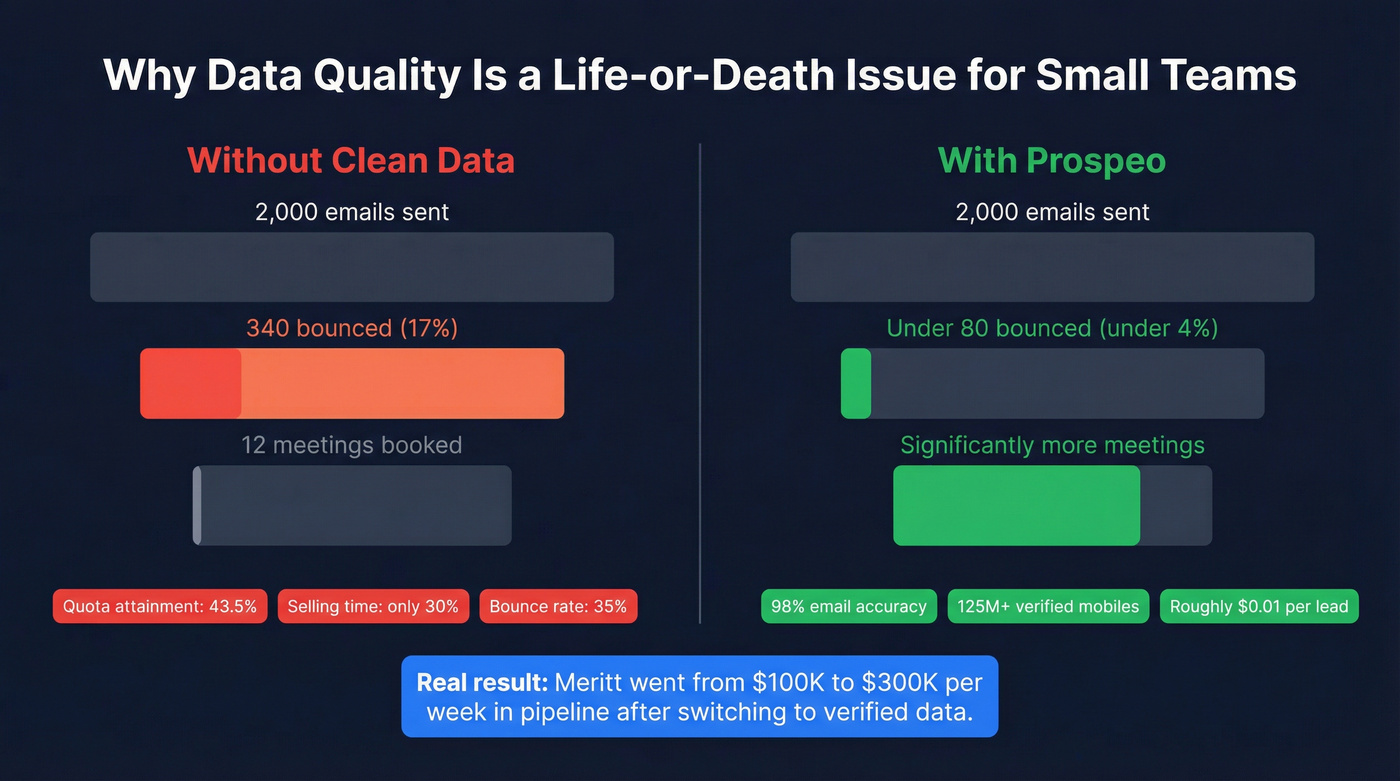
Industry-wide, quota attainment sits at 43.5%, and reps spend only 30% of their time actually selling. AI-using teams are seeing 83% revenue growth versus 66% without. The tools you choose aren't a nice-to-have - they're the difference between competing and drowning.
We've seen small teams triple their pipeline just by fixing data quality. Prospeo delivers 98% email accuracy and 125M+ verified mobile numbers on a 7-day refresh cycle, with 30+ search filters including buyer intent powered by Bombora. One customer, Meritt, went from $100K to $300K per week in pipeline and dropped their bounce rate from 35% to under 4%. At roughly $0.01 per lead with no contracts, it's built for teams that need enterprise-grade data without enterprise pricing.

The three-cycle pattern only works if you can consistently reach the right buyers with accurate contact data. Prospeo's 300M+ profiles, 30+ filters including buyer intent and job change signals, and 125M+ verified mobiles let you show up at exactly the right moment - when they're finally done with the big vendor.
Outlast the enterprise. Reach decision-makers directly for $0.01 per email.
FAQ
Can a small team realistically beat an enterprise vendor?
Yes. 61% of deals are lost to buyer indecision, not to the bigger competitor. Invest in being known before deals start and outservice the incumbent during the process. Small teams that win consistently do it through speed, personalization, and showing up across multiple buying cycles.
What's the single most important first step?
Get on the shortlist. 71% of buyers choose their first choice once it's set. Prioritize G2 reviews, published case studies, and brand awareness campaigns before deals start - not during them.
What tools help small sales teams compete?
A lightweight CRM like HubSpot's free tier, a verified data platform like Prospeo for accurate contacts and intent signals, and an AI writing assistant to scale personalized outreach. Prospeo's 75 free monthly credits let you test without commitment.
How long does it take to start winning competitive deals?
Expect 2-3 buying cycles, roughly 12-18 months, before dream accounts convert. Former customers convert 5x better than cold outbound, so consistent relationship-building across cycles is the highest-ROI activity for underdog teams.