How to Use Battle Cards in Sales - A Practitioner's Playbook
It's 2 minutes before a demo. Your rep pulls up the battlecard - last updated eight months ago. The competitor has shipped three major features since then. The rep closes the card and wings it.
That scenario plays out every single day, and it's not a battlecard problem. It's a usage problem. Klue analyzed 150+ battlecard audits and found that only 43% include talk tracks, just 19% provide supporting evidence, and only 35% include customer-facing proof points. The cards aren't built for live calls - they're built for completeness. This article covers how to use battle cards in sales, not how to build them.
Stop building comprehensive battlecards. Comprehensive is the enemy of adoption.
The teams winning competitive deals in 2026 aren't the ones with the best battlecards. They're the ones whose reps can find the right piece of the right card in under 10 seconds - and who are reaching verified contacts in the first place.
What a Sales Battle Card Actually Is
A battlecard isn't a feature matrix, and it isn't a sales playbook. A playbook covers your entire methodology. A battlecard is a single-page, in-call reference designed to help a rep win against a specific competitor in a specific deal moment.
The design principle that separates useful cards from shelfware: if a rep can't find what they need in under 10 seconds, the card won't get used. Fifteen-page PDFs are documentation, not enablement.
Three Frameworks That Make Battle Cards Usable
FIA - Fact, Impact, Act
FIA turns competitive intel into something a rep can actually say on a call.
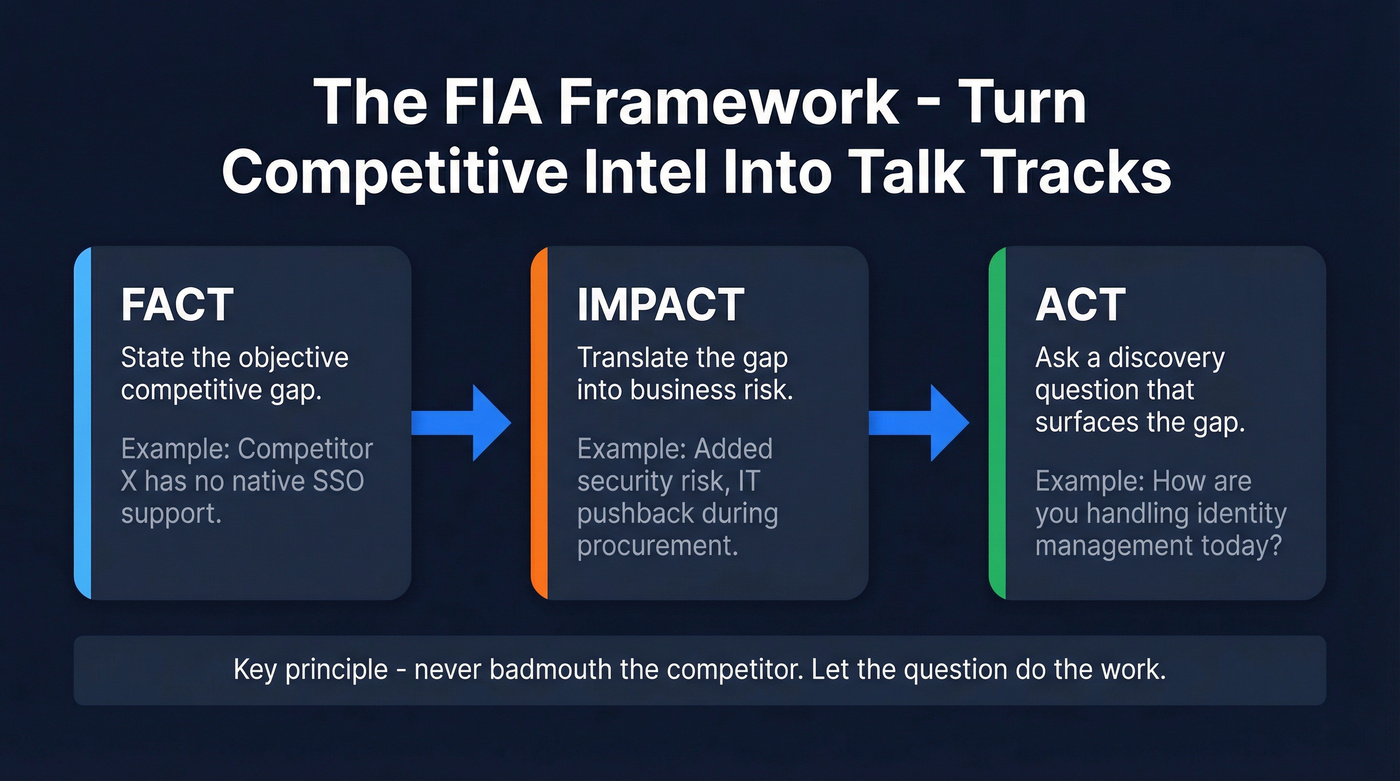
Fact: "Competitor X doesn't support SSO natively." Impact: No native SSO means added security risk and IT pushback during procurement. Act: Ask in discovery: "How are you handling identity management across your security stack today?"
That question surfaces the gap without badmouthing anyone. Klue uses a similar adoption pattern in high-retention cards - Know, Say, Show - but we've found FIA sticks better mid-call because it maps directly to what the rep needs to do next.
The Kill Sheet - Setup, Wedge, Landmine, Proof
Skip FIA when you know the competitor going in. Go straight to the Kill Sheet. Four sections:
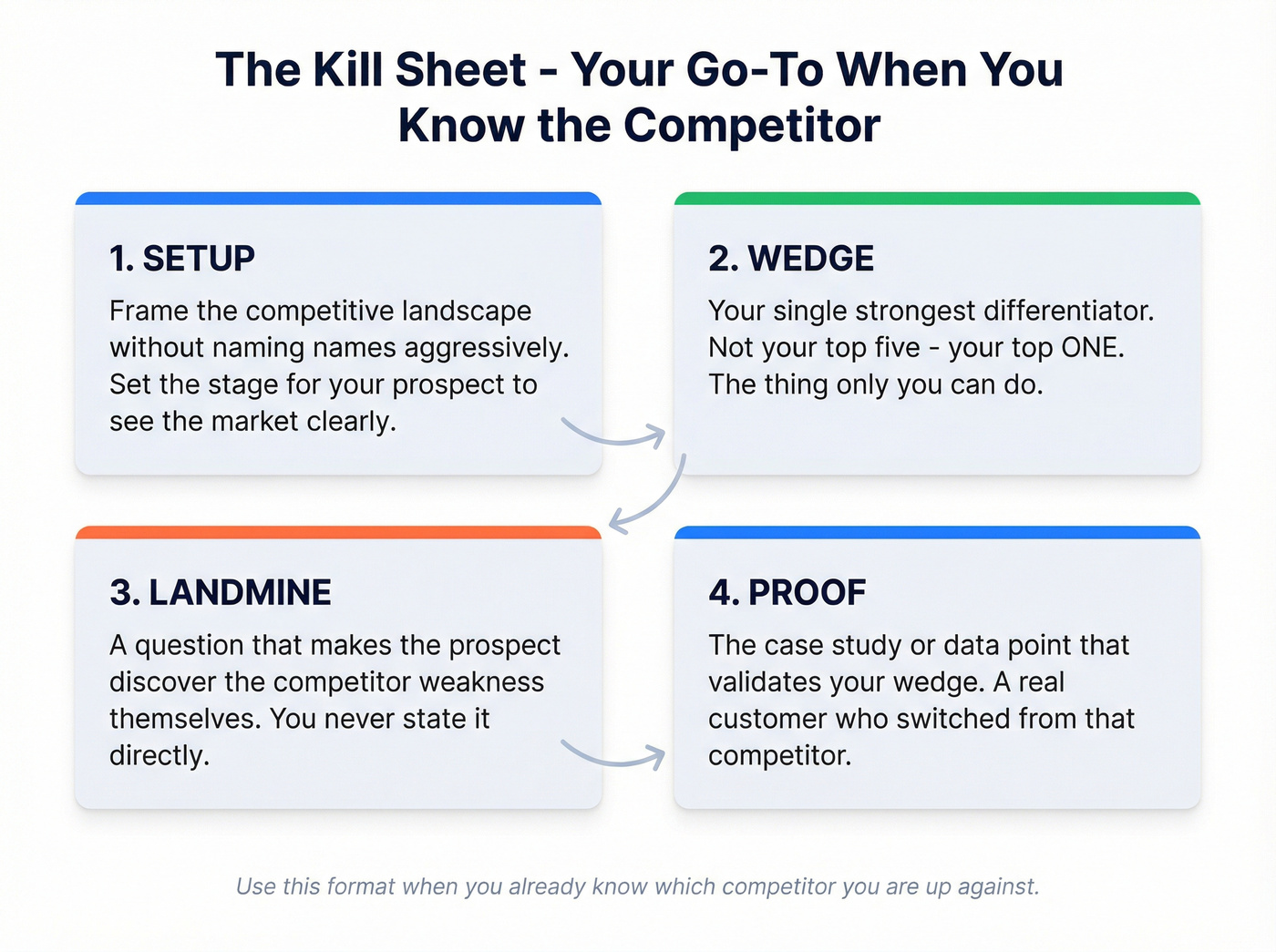
Setup frames the competitive landscape without naming names aggressively. Wedge is your single strongest differentiator - not your top five, your top one. Landmine is a question that makes the prospect discover the competitor's weakness themselves. Proof is the case study or data point that validates your wedge.
The 10-Second Rule
Every battlecard needs exactly three scannable sections:
- Quick Dismiss - a 10-second soundbite that pivots the conversation when a competitor comes up unexpectedly.
- Landmine Question - forces the prospect to surface the competitor's weakness without you stating it.
- Value Wedge - one thing you do that the competitor can't. Not five things. One.
I've watched reps fumble competitive calls because they tried to remember five differentiators instead of one. Everything else on the card is supporting material. These three sections are the operating system.
Deploying Battle Cards Across the Deal Cycle
Knowing what's on the card isn't the skill. Knowing when to deploy which piece is. The most common complaint in competitive enablement is consistent: battlecards get written for completeness, not execution. Let's fix that, stage by stage.
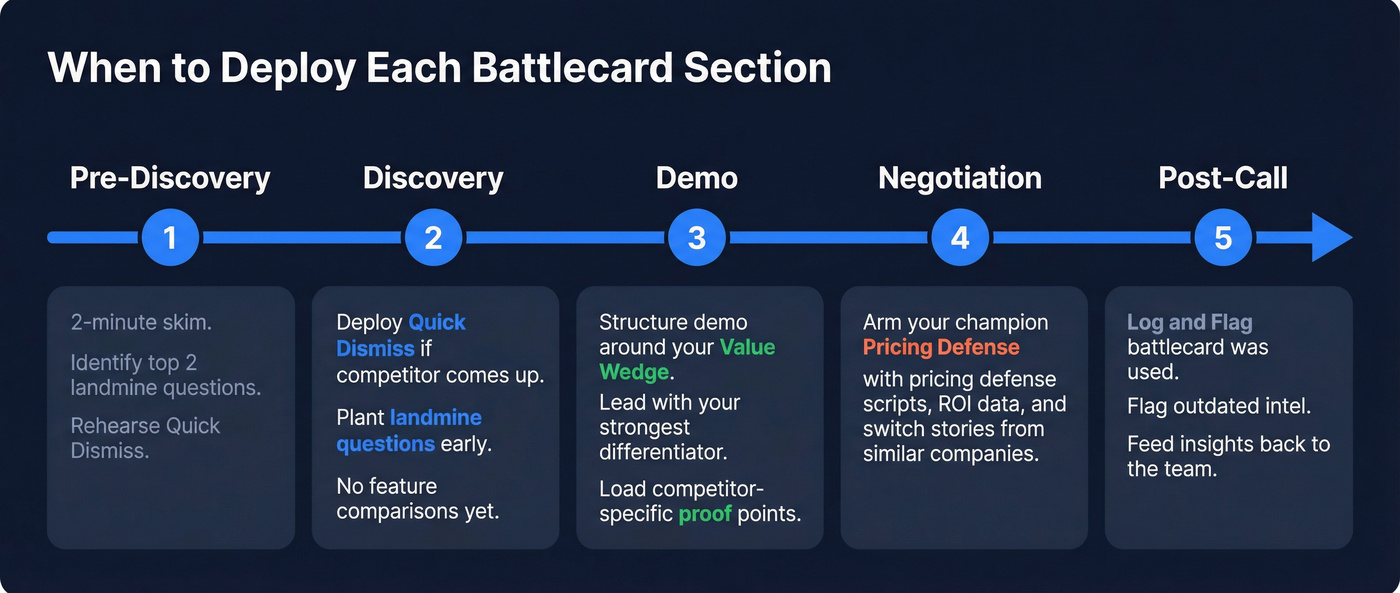
Pre-Discovery - The 2-Minute Skim
Before any discovery call, spend two minutes on the battlecard for whichever competitor the prospect is evaluating. Do two things: identify your top two landmine questions and rehearse your Quick Dismiss. Don't re-read the whole card.
Discovery - Quick Dismiss + Landmine
If the competitor comes up, deploy the Quick Dismiss to acknowledge and pivot. Don't trash-talk. Don't launch into a feature comparison.
Then plant your landmine questions early. The goal is to get the prospect thinking about gaps before the demo, not after. A well-placed "How are you handling X today?" does more competitive damage than any slide deck.
Demo - Value Wedge + Proof Points
Structure your demo around your Value Wedge, not your feature list. If the wedge is security, demo security first and deepest. Have proof points loaded for the exact competitor being evaluated - a customer quote from a company that switched from Competitor X carries ten times the weight of a feature checkbox.
Negotiation - Pricing Defense
Late-stage deals are where battlecards earn their keep. Your prospect's champion is selling internally, and the competitor's rep is throwing last-minute objections at the buying committee. Your battlecard should arm your champion with pricing defense scripts, ROI data, and case studies from similar companies that chose you over the named competitor.
If your battlecard doesn't have a "pricing defense" section, it's incomplete.
Post-Call - Log and Flag
After every competitive deal, log which battlecard was used and flag outdated intel. The best sales managers enforce this in pipeline reviews by asking "which battlecard decision did you use?" In our experience, the number one reason battlecards die is that no manager ever asks about them. Without that enforcement loop, even great cards decay into shelfware within a quarter.

Your battlecard's proof points hit harder when reps actually reach the prospect. Prospeo delivers 98% email accuracy and 125M+ verified mobile numbers with a 30% pickup rate - so your competitive plays land on live conversations, not voicemails.
Stop perfecting cards for calls that never connect.
Real Battle Card Examples Worth Stealing
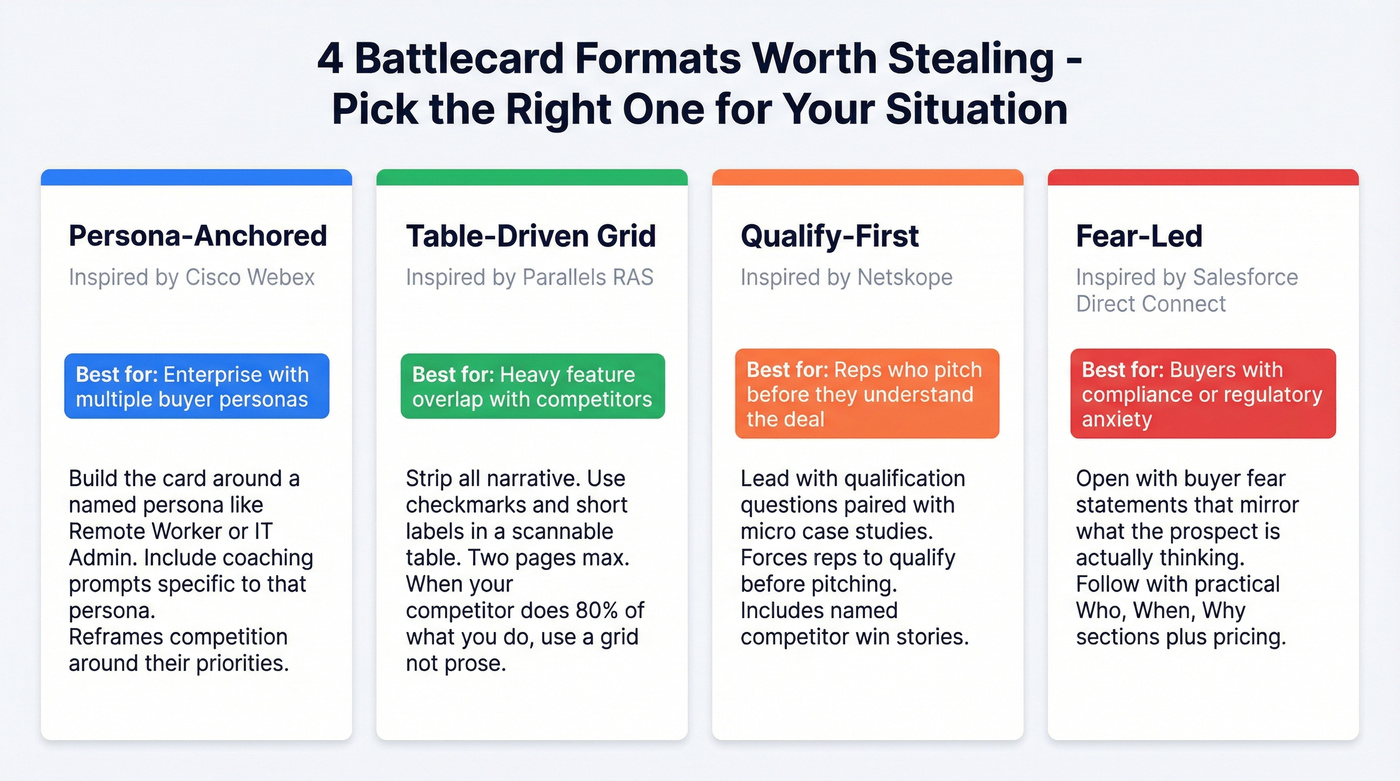
Let's look at real battlecard patterns from recognizable companies](https://www.dock.us/library/sales-battlecard-examples).
Cisco Webex - Enterprise Gold Standard
The Cisco Webex approach is the gold standard for enterprise sales teams with persona-anchored cards. Their card against Zoom and Teams anchors everything around "Thema, Remote Worker," reframing the competition around end-to-end security. It includes coaching prompts like "Ask about MFA for Apple Macs and IoT devices."
Steal this: build your card around a named persona, not a feature list.
Parallels RAS - Heavy Feature Overlap
Unlike the Cisco approach, Parallels strips all narrative. Their two-page, table-driven battlecard against Citrix uses checkmarks and short labels designed to be scanned mid-call. No paragraphs. For products with heavy feature overlap, this format wins. If your competitor does 80% of what you do, use a grid - not prose.
Netskope - Qualify Before You Pitch
Netskope's partner battlecard leads with qualification questions like "Can your SWG inspect SSL traffic?", paired with micro case studies explaining why Netskope won against named competitors. The structure forces reps to qualify before pitching - exactly the right order of operations. If your reps tend to pitch before they understand the deal, steal this format.
Salesforce Direct Connect - Lead with Fear
Salesforce's Direct Connect card opens with buyer fear statements: "I don't know when I can text a prospect." Then it moves into practical "Who/When/Why" sections with pricing and setup. Opening with fear is bold, but it works because it mirrors what the prospect is actually thinking. For buyers with compliance anxiety, this format hits hard.
Fixing the Shelfware Problem
The failure modes are predictable. Cards are too long. Cards lack talk tracks. Cards never get updated.
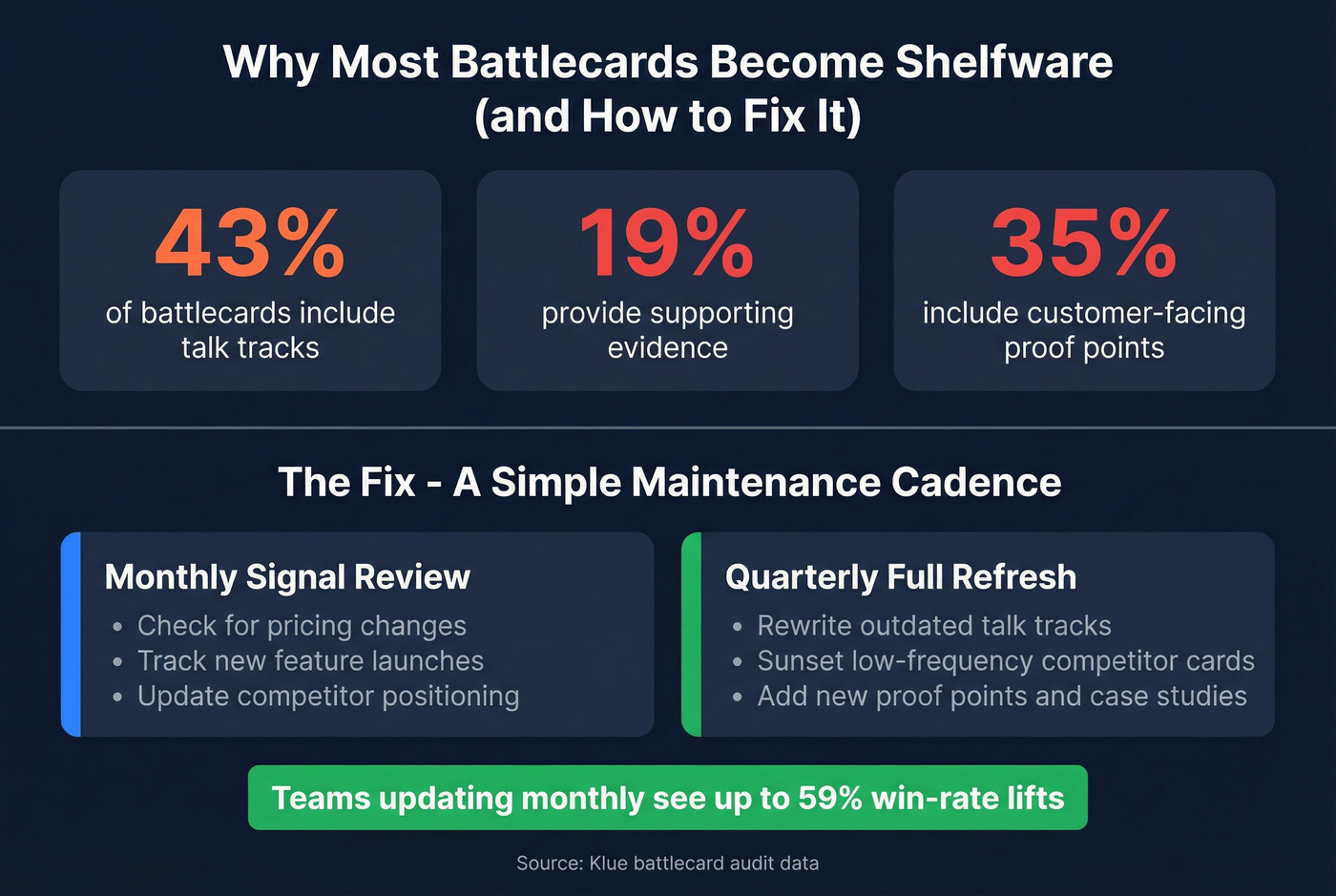
The fix is a maintenance cadence: monthly signal reviews covering pricing changes, feature launches, and new positioning, plus a quarterly full refresh. Sunset cards for competitors that rarely come up - reducing noise increases adoption. Teams updating monthly see up to 59% win-rate lifts.
Here's the thing: if your team has fewer than 5 active competitors, don't bother with dedicated battlecard software. You're paying $30K for a problem a spreadsheet solves. The biggest lever is manager enforcement - if battlecard usage isn't part of pipeline reviews, it's optional. Optional tools don't get used.
The Foundation Most Teams Skip - Data Quality
There's a problem that runs deeper than card design: your reps are reaching the wrong people. If 35% of your emails bounce, all that competitive prep goes to waste. The rep rehearsed the landmine question, loaded the proof point, and the email never arrived.
We've seen this firsthand working with teams that had great enablement content and terrible deliverability. One customer, Snyk, had 50 AEs prospecting 4-6 hours per week with bounce rates between 35-40%. After switching to Prospeo's verified data, bounces dropped under 5% and AE-sourced pipeline jumped 180%. The battlecards didn't change - the data did.
Prospeo's bulk verification handles contact cleanup in minutes and pushes clean contacts straight to Salesforce or HubSpot, so your reps spend time deploying the Kill Sheet instead of chasing dead email addresses.

Battlecards decay when your contact data does. Prospeo refreshes every 7 days - not every 6 weeks - so your reps walk into competitive deals with accurate emails, direct dials, and buyer intent signals across 15,000 topics. All at $0.01 per email.
Arm your reps with data as fresh as your battlecards should be.
Tools for Building and Distributing Battle Cards
For enterprise teams with 10+ competitors and 50+ reps, dedicated platforms make sense. Crayon runs around $30K/year for a typical contract and automates competitive monitoring. Klue starts around $16K/year and scores a 4.8/5 across 428+ reviews on G2.
For everyone else, a well-maintained Notion page or Google Doc gets you 80% of the way there at 5% of the cost. Distribute via Slack bookmarks or embed directly in CRM opportunity records. For most teams under 50 reps, a Notion page plus verified contact data is the stack. Spend the $30K you saved on hiring another SDR.
FAQ
How often should you update sales battle cards?
Monthly signal reviews plus a quarterly full refresh. Teams that update monthly see up to 59% win-rate lifts. Sunset cards for competitors that rarely appear - reducing noise is just as important as adding intel.
What's the difference between a battle card and a sales playbook?
A playbook covers your entire sales process - methodology, stages, messaging. A battlecard is a single-page competitive reference for in-call use against a specific competitor. Playbooks train reps on how to sell; battlecards arm them to win a live deal.
Do you need dedicated software for battle cards?
Not unless you have 50+ reps and 10+ active competitors. Crayon and Klue add automation and version control at $16K-$30K/year. For smaller teams, a Notion page distributed via Slack handles the job.
How do you measure whether battle cards are working?
Track competitive win rate before and after rollout, battlecard open/view rates if your platform supports it, and rep feedback in pipeline reviews. If win rates against a named competitor don't improve within 90 days, the card needs a structural overhaul - not more content.