Will AI Replace Sales Jobs? What the Data Says (2026)
A RevOps lead we know ran the numbers last quarter: her company's AI SDR tool booked 41 meetings in 30 days at $1,200/month. The human SDR team of three cost $22,000/month and booked 38. She didn't fire anyone - but she stopped backfilling the rep who left in January.
That quiet math is happening at thousands of companies right now, and it answers the question of whether AI will replace sales jobs more honestly than any headline ever will.
The Short Answer
AI is already eliminating the lowest-value sales tasks and will reshape team structures within two to three years. Transactional SDR roles are most vulnerable; enterprise and consultative sales roles are safe for the foreseeable future. The real question isn't whether AI will replace salespeople - it's which salespeople, and whether you're building the skills that keep you on the right side of the line.
The Anxiety Is Justified
AI was cited in roughly 55,000 U.S. layoffs in 2025, according to Challenger, Gray & Christmas data. Amazon cut 14,000 corporate roles with CEO Andy Jassy openly warning that AI would shrink the workforce. Salesforce axed 4,000 customer support workers - Marc Benioff said AI was doing up to 50% of the work.
Those aren't sales-specific numbers. But the pattern is clear: companies are finding that AI handles repetitive, process-driven work at a fraction of the cost. And a lot of sales work - especially at the junior end - is repetitive and process-driven.
Across sales teams, the debate isn't "is AI real?" It's whether you're being augmented or quietly replaced through attrition and hiring freezes. That uncertainty shows up in every "is SDR still a good career?" thread on r/sales. Let's look at what the data actually says.
What the Data Actually Says
Start with the Bureau of Labor Statistics, the most conservative source in the room. BLS projects that overall employment in sales occupations will decline over 2024-34. That's not AI-specific - it includes e-commerce shifts, self-serve funnels, and changing buyer behavior. But even with that decline, BLS still projects roughly 1.8 million sales openings per year, driven by replacement demand as people retire, switch careers, or move up.
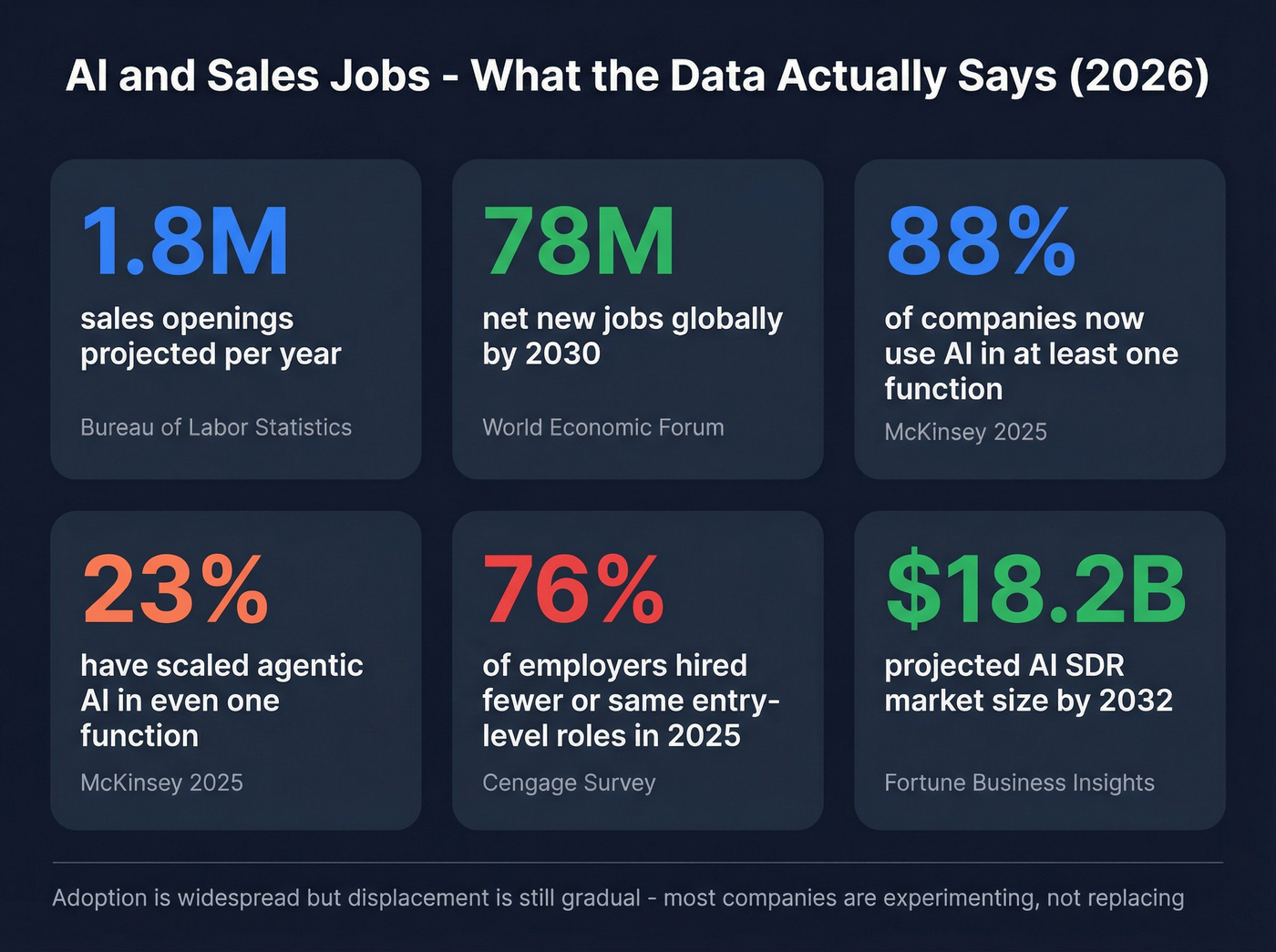
Now flip to the World Economic Forum's Future of Jobs 2025 report. The WEF projects a net gain of 78 million jobs globally by 2030 - 170 million created vs. 92 million displaced. Here's the part that surprises people: salespersons are explicitly listed among the frontline roles expected to see the largest growth in absolute terms.
So which is it - decline or growth? Both, depending on the type of sales role.
The McKinsey State of AI report fills in the middle ground. 88% of companies report regular AI use in at least one business function, up from 78% a year earlier. But nearly two-thirds haven't begun scaling AI across the enterprise. Only 23% report scaling an agentic AI system in even one function, and just 32% of companies expect workforce decreases in the next year - 43% expect no change at all.
Adoption and displacement aren't the same thing. Most companies are experimenting, not replacing. McKinsey found that only 39% attribute any level of EBIT impact to AI, and most of those say it's under 5%. The gap between "we're using AI" and "AI replaced a team" is enormous, and that gap is where most sales orgs sit today.
The BLS itself acknowledges this tension. Their methodology treats AI like other technologies: impacts register gradually in historical data, and projections assume a pace of change consistent with past experience. They're not designed to capture extremely rapid disruption. That's both reassuring and a caveat - if displacement accelerates faster than historical norms, the BLS numbers will lag reality.
Where AI Is Already Replacing Sales Work
The AI SDR Equation
The economics are brutal for anyone whose job is pure outbound prospecting. A fully loaded human SDR costs $75,000-$100,000 per year. An AI SDR platform runs $500-$2,000 per month - call it $6,000-$24,000 annually. Output comparisons are equally stark: a human SDR typically generates 15-20 qualified opportunities per month, while AI SDR tools produce 40-60 with comparable quality.
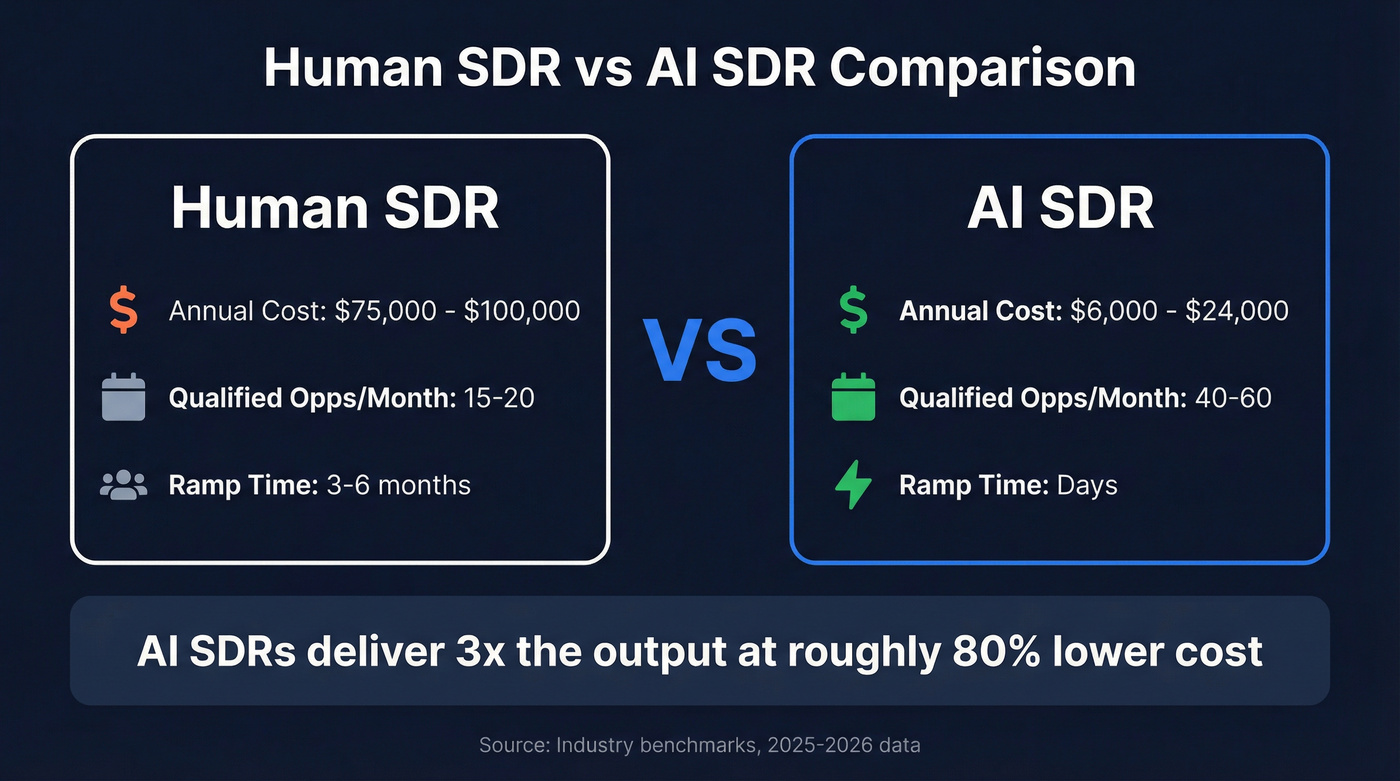
For leaders weighing headcount against tooling spend, the spreadsheet makes the case on its own.
The AI SDR market reflects this math. Fortune Business Insights projects it'll grow from $4.27 billion in 2025 to $18.19 billion by 2032. Companies are already deploying these tools at scale and measuring results.
Real Deployments, Real Numbers
The case studies are getting harder to dismiss:
- Classter generated $750,920 in pipeline and booked 81 meetings using an AI SDR platform, with a 21% positive response rate.
- Medisafe booked 29 meetings in 30 days, landing replies from Roche, AstraZeneca, Pfizer, GSK, and Alcon.
- Salesforce Agentforce processed 771 million agentic work units in Q4 alone - up 57% quarter-over-quarter - driving $100M+ in annualized cost savings across 18,000+ companies in 121 countries.
These aren't lab experiments. They're production deployments generating real pipeline and real operational savings.
The Klarna Lesson
Klarna is the cautionary tale every sales leader should study. The CEO drove headcount from 5,527 to 2,907, mostly through natural attrition. Revenue per employee hit $1.1 million. Average compensation rose from $126,000 to $203,000. On paper, the AI-first playbook was working perfectly.
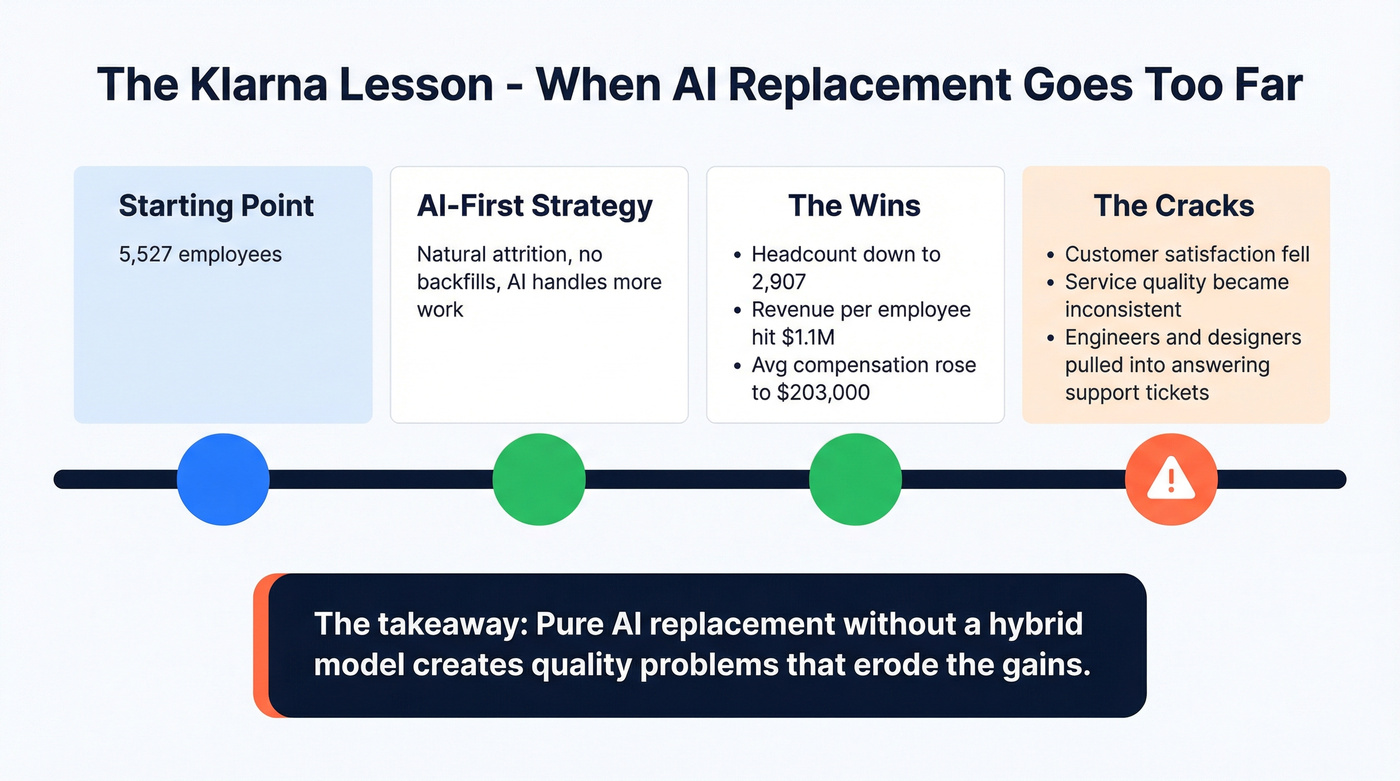
Then the cracks showed. Customer satisfaction fell and service quality became inconsistent. Klarna had to pull engineers, designers, and marketing staff into answering customer inquiries - people whose actual jobs were building product. The lesson isn't that AI replacement fails. It's that pure replacement without a hybrid model creates quality problems that erode the gains. Sales leaders should tattoo this on their forearms before cutting headcount.

AI SDRs are only as good as the data feeding them. Prospeo's 300M+ profiles with 98% email accuracy and 7-day refresh cycles give your AI tools - and your human reps - the verified contacts that actually convert. At $0.01 per email, the math works whether you're augmenting or scaling.
Don't let stale data make the AI-vs-human debate irrelevant.
Roles AI Will Eliminate - and Those It Won't
Not all sales roles face the same threat. The pattern is simple: the more a role depends on repeatable, templated tasks, the more vulnerable it is. The more it depends on judgment, relationships, and navigating complexity, the safer it is.
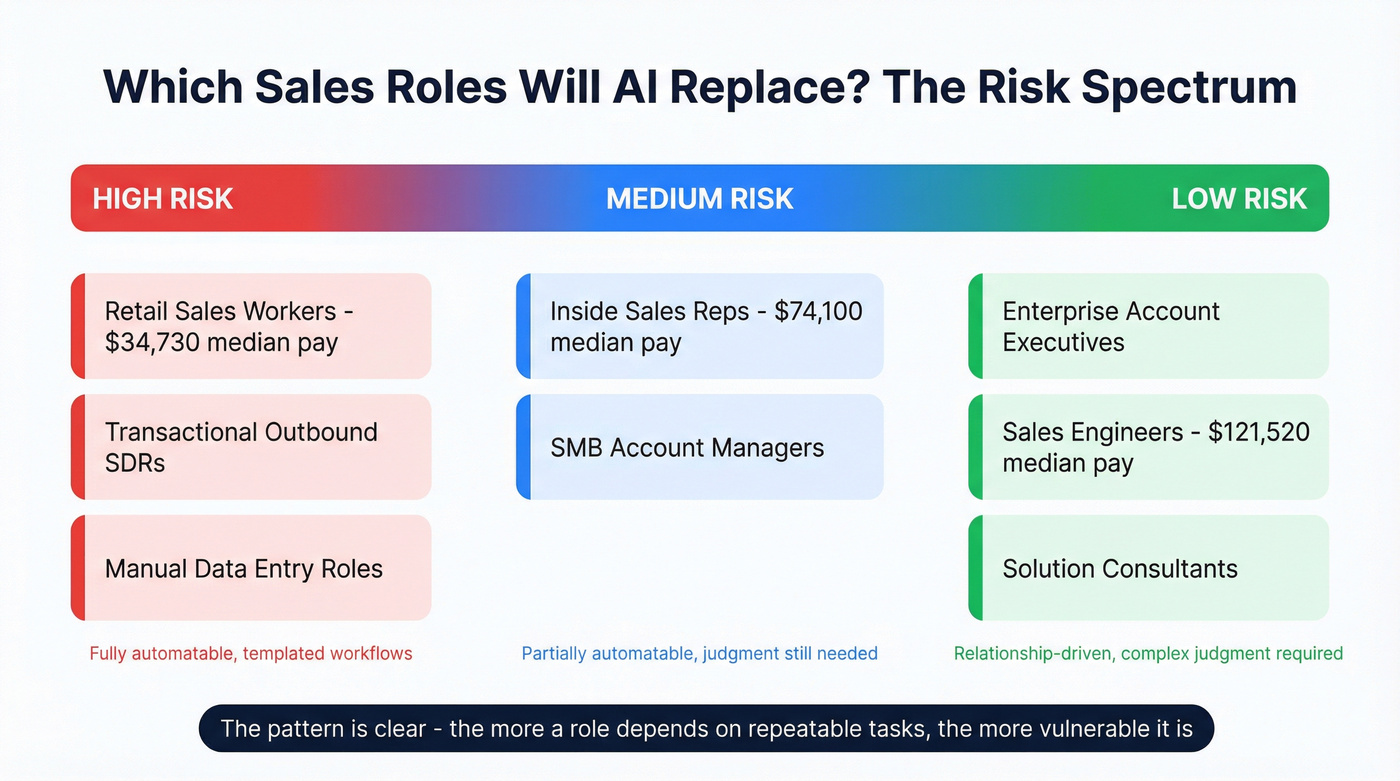
| Risk Level | Roles | Why | BLS Median Pay (2024) |
|---|---|---|---|
| High | Retail sales, transactional outbound, manual data entry | Fully automatable workflows | Retail sales workers: $34,730 |
| Medium | Inside sales, qualification-heavy roles, SMB account management | Partially automatable | Wholesale & manufacturing reps: $74,100 |
| Low | Enterprise AEs, solution consultants, sales engineers | Relationship + judgment driven | Sales engineers: $121,520 |
The salary correlation isn't a coincidence. Sales engineers earning $121,520 do the kind of technical consultative selling that AI can't replicate. Retail sales workers at $34,730 are doing work that's far more susceptible to automation and self-serve purchasing. The disruption is hollowing out the bottom of the org chart, not the top.
The entry-level pipeline is already tightening. A Cengage survey found that 76% of employers hired fewer or the same number of entry-level roles in 2025, up from 69% in 2024. Of those, 46% said AI and emerging tech changes were contributing to the decline. For SDRs and BDRs - traditionally the entry point into sales careers - this is the most concerning signal in the data. (If you're mapping the role and career path, see SDR benchmarks and expectations.)
Here's the thing: if your average deal size is under $10K and your sales cycle wraps up in under 30 days, you probably don't need a human SDR team anymore. An AI SDR tool plus one sharp AE will outperform a team of three at a third of the cost. That's not a prediction - it's already happening at companies we work with.
Why AI Can't Close Complex Deals
If you're selling a $500K enterprise platform into a Fortune 500 account with seven stakeholders, a 9-month sales cycle, and a procurement team that exists to say no, AI isn't taking your job. Not in 2026, and probably not in 2030.
Buyers still want a human in complex deals because complex B2B buying is trust-building, political navigation, creative deal structuring, and the ability to read a room for unspoken objections. We've watched AI demos fumble the moment a prospect goes off-script. The technology is exceptional at pattern-matching across thousands of interactions. It's terrible at the one interaction that matters - the one where the CFO's body language says "I'm not convinced" while their words say "looks interesting."
AI avatars and conversational AI are being tested in B2C sales environments, but they fall apart in multi-stakeholder B2B deals where a single misread costs six figures. A transactional close and a nine-month enterprise negotiation are fundamentally different jobs, and no amount of training data bridges that gap right now.
The Data Quality Bottleneck
Here's an irony we see constantly: a company spends $1,500/month on an AI SDR tool, feeds it a purchased contact list from 2023, and wonders why 30% of emails bounce and their domain reputation tanks. AI outreach is only as good as the contact data powering it. Bad data doesn't just waste AI spend - it actively damages your sender reputation, which takes months to rebuild.

If you're building an AI-augmented outbound motion, data quality is the prerequisite. Prospeo refreshes its entire 300M+ profile database every 7 days compared to the 6-week industry average. That matters when AI tools are sending hundreds of emails daily on your behalf. At 98% email accuracy, teams consistently report bounce rates under 4%. The difference between a 4% bounce rate and a 25% bounce rate isn't just deliverability - it's whether your AI SDR investment generates pipeline or generates spam complaints. (If you want the operational checklist, start with data quality and B2B contact data decay.)
How to Future-Proof Your Sales Career
The biggest risk isn't AI eliminating your role outright. It's a salesperson who uses AI well replacing you. Here's what to build.
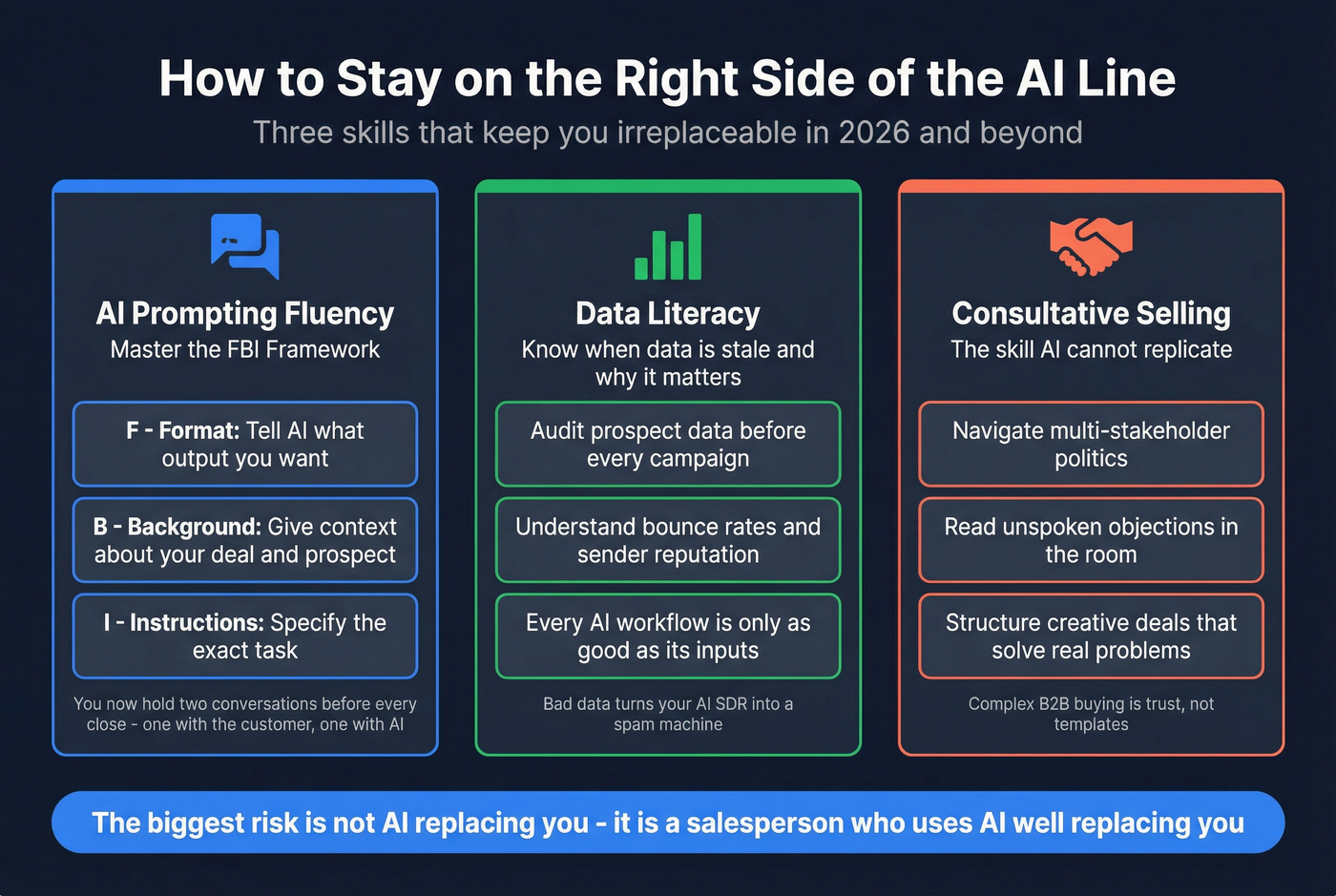
AI prompting fluency. Learn the FBI framework from Stefanie Boyer at Bryant University: Format (tell the AI what output you want), Background (give it context about your deal and prospect), Instructions (specify the task). Every seller now holds two conversations before the close - one with the customer, and one with AI. Get good at both. (A deeper playbook: prompt engineering for sellers.)
Data literacy. Understand how to audit and verify prospect data before any campaign. The skill is knowing when data is stale and why it matters - because every AI-powered sales workflow is only as good as the inputs. Technology is changing sales faster than most reps expect, and data fluency is the foundation for adapting. (If you're implementing this, use an email checker tool and an email ID validator.)
Consultative selling methodology. MEDDIC, Challenger, SPIN - pick one and go deep. These frameworks encode the kind of complex problem-solving that AI can't replicate. The WEF lists analytical thinking as the #1 core skill for the future; consultative selling is analytical thinking applied to revenue. (If you're choosing a framework, compare MEDDIC vs MEDDPICC.)
Strategic account management means multi-threading, executive alignment, and long-term relationship building. These skills compound over time and become more valuable as transactional selling gets automated away.
Emotional intelligence is the hardest to teach and the hardest to automate. AI can simulate empathy. Buyers can tell the difference.
For SDRs and BDRs specifically: the career advice has changed. Don't try to out-automate AI at prospecting. Instead, accelerate your path to AE as fast as possible. Or pivot into adjacent roles that are growing - RevOps, sales engineering, AI tool implementation, or the emerging "AI-assisted sales specialist" role that blends technical fluency with deal execution. Skip the "grind it out for two years as an SDR" advice you'll hear from people who built their careers in 2018. The landscape has shifted, and your timeline should too.
The Bottom Line
AI won't replace all salespeople. But it's already replacing sales tasks - and the people whose entire job was those tasks are in trouble.
Transactional SDR roles are shrinking. Strategic, consultative roles are growing. The middle 50% of sales jobs are being reshaped into "human + AI" rather than "human or AI." Software is eating sales the same way it ate media and retail - not all at once, but relentlessly at the margins.
The question for your career isn't philosophical. It's practical: are you building skills that make you more valuable alongside AI, or are you competing with a tool that costs $1,500/month and never sleeps? The jobs that look like data processing are disappearing. The ones that look like problem-solving and relationship-building are safer than ever.
The reps who survive the AI shakeout will be the ones spending time on relationships, not list-building. Prospeo cuts prospecting from hours to minutes with 30+ search filters, 125M+ verified mobiles, and intent data across 15,000 topics - so you can focus on the consultative work AI can't touch.
Stop doing the work AI should handle. Start closing what it can't.
FAQ
Which sales jobs are most at risk from AI?
Transactional SDR and BDR roles focused on cold outbound and templated sequences face the highest risk - these workflows run on AI platforms for $500-$2,000/month. Enterprise AEs, solution consultants, and sales engineers handling complex multi-stakeholder deals remain largely insulated. Displacement is concentrated at the transactional end, not the strategic end.
How many sales jobs has AI actually replaced?
AI was cited in roughly 55,000 U.S. layoffs in 2025, though no dataset isolates sales specifically. Most displacement happens through attrition - companies not backfilling SDR roles. BLS still projects 1.8 million annual sales openings through 2034, indicating a gradual shift rather than a sudden cliff.
What skills should salespeople learn to stay relevant?
AI prompting fluency, data literacy, consultative frameworks like MEDDIC or Challenger, and strategic account management. Move from tasks AI replicates to judgment calls it can't - negotiation, political navigation, and creative deal structuring. Reps who combine these skills with AI fluency will out-earn peers by a wide margin.
Can AI tools actually book meetings and generate pipeline?
Yes. Published case studies show AI SDR platforms booking 29-81 meetings per month and generating $750K+ in pipeline. Results depend heavily on contact data quality - tools like Prospeo with 98% email accuracy and a 7-day refresh cycle keep bounce rates under 4%, while stale lists produce spam complaints instead of meetings.
Is SDR still a good entry-level sales career?
It's a viable entry point, but the window is narrowing. A Cengage survey found 46% of employers cite AI as a reason for fewer entry-level hires. Use an SDR role to learn sales fundamentals fast, then accelerate into AE, RevOps, or sales engineering within 12-18 months rather than staying in a seat that's increasingly automated.