PIP Sales Meaning: What It Really Is, What the Data Says, and How to Survive One
You just got called into a conference room with your manager and someone from HR. There's a document on the table. Your stomach drops before anyone says a word.
If you're reading this, you either just lived that moment or you're terrified it's coming. Understanding the PIP sales meaning is the first step toward knowing your options, so here's what you need to know right now:
- The hard truth: 59% of employees placed on a PIP don't survive it. But with proper support, the success rate climbs to 46%. Your odds depend entirely on what you do next.
- Three things to do today: Read the legal rights section below, start a parallel job search, and audit your pipeline data for fixable problems dragging your numbers down.
- If you're a manager about to write a PIP: Try coaching first. If you've already tried, use the 6-step legal framework later in this guide to protect both the company and the rep.
What Does PIP Mean in Sales?
A Performance Improvement Plan (PIP) is a formal, documented plan that outlines specific performance deficiencies, sets measurable improvement targets, and gives the employee a defined window - usually 30 to 90 days - to meet those targets or face termination. That's the textbook definition. Some companies rebrand PIPs as Performance Development Plans (PDPs) or Performance Growth Plans (PGPs) to soften the punitive connotation, but the structure and stakes are identical.
Here's the cultural definition: in sales, PIP stands for "Paid Interviewing Period."
That nickname didn't come from HR consultants. It came from reps on Reddit and in Slack channels who've watched colleagues get PIP'd and disappear within 60 days. The cynicism isn't unfounded - most sales reps view a PIP as formal documentation before a firing, not a genuine improvement effort. Statistically, they're more right than wrong.
But context matters. A PIP from a manager who's been coaching you for months and genuinely wants you to succeed looks very different from one that lands on your desk with no prior warning. The first is a structured last chance. The second is a paper trail.
The rest of this guide helps you figure out which one you're dealing with - and what to do either way.
PIP by the Numbers - What the Data Actually Says
Let's kill the ambiguity:

- 59% of employees placed on a PIP don't make it through. They're either terminated or resign before the window closes.
- 41% pass and remain in their roles.
- 46% succeed when the company provides proper support structures - coaching, resources, regular check-ins, and genuinely achievable goals.
That gap between 41% and 46% is the difference between a PIP designed to help and a PIP designed to document. When companies actually invest in the process, nearly half of underperformers turn it around.
A Wall Street Journal column called PIPs "the most hated way of firing someone." The data backs that framing - most employees who receive a performance improvement plan are ultimately terminated. But "most" isn't "all." The 41% who survive aren't lucky. They're strategic.
The survival rate varies wildly by company culture. At organizations where PIPs are genuinely used as improvement tools, the odds are close to a coin flip. At companies where they're a legal formality before a termination, your odds are closer to zero. Knowing which environment you're in is step one.
Why Sales PIPs Are Surging in 2026
Sales PIPs aren't happening in a vacuum.

Win rates have dropped sharply. The largest group of sales teams now falls in the 21-25% win rate bracket, down from 31-40% in recent years. Reps are working harder and closing less. Quotas, predictably, haven't adjusted to match.
The SDR role is shrinking, too. Fewer dedicated SDRs means pipeline ownership is falling to AEs - reps who were hired to close deals are now spending significant time prospecting. That's a fundamentally different job with different skill requirements, and many AEs weren't trained for it. As of 2026, nearly half of teams are running hybrid AI-SDR models, and that number keeps growing. The human reps left are expected to handle more complex, higher-touch pipeline work.
The math is brutal: lower win rates + higher pipeline expectations + fewer support resources = more reps missing quota. When reps miss quota for two or more quarters, the performance improvement plan conversation starts.
Lead qualification is now the #1 seller challenge, up from opportunity management in prior years. Reps aren't just struggling to close - they're struggling to find the right people to talk to in the first place. When your pipeline is full of bad-fit prospects and bounced emails, your activity metrics look terrible even if your effort is high.
Reps didn't suddenly get worse. The job got harder and the tools didn't keep up.

Most sales PIPs trace back to pipeline problems - bad emails, wrong contacts, wasted activity. Prospeo gives you 300M+ verified profiles with 98% email accuracy, so every call and email counts toward quota instead of bouncing into the void.
Stop getting PIP'd for problems your data created.
What Actually Triggers a Sales PIP?
Legitimate Performance Triggers
Most sales PIPs are triggered by a combination of these factors:
- Missing quota for 2+ consecutive quarters - the most common trigger by far
- Declining pipeline value - not just closed-won, but leading indicators: fewer qualified opportunities, shrinking deal sizes, lower stage-progression rates
- Activity drops - fewer calls, fewer emails sent, fewer meetings booked
- Conversion rate declines - a rep whose demo-to-close rate drops 30% over two quarters is flagging something, whether it's skill, effort, or market fit
- Product knowledge gaps - reps who can't articulate value props or handle objections in competitive deals
- Process non-compliance - not updating CRM, skipping discovery calls, going rogue on pricing
When It's NOT About Performance
Not every PIP is legitimate. Reddit's r/sales community is full of stories that prove it.

One rep who exceeded quota for three consecutive years received a PIP. His read? "The higher ups want to replace me with a cheaper rep." Another rep got PIP'd after returning from leave - no one had covered their territory, deals pushed to the next quarter, and suddenly they were "underperforming."
These are political PIPs. They exist to create a paper trail for a decision that's already been made. The tells are obvious: no prior verbal warning, vague performance criteria, unrealistic timelines, or a PIP that arrives suspiciously close to a reorg or budget cut.
Circumstantial factors that can trigger unfair PIPs:
- Territory changes mid-year
- Product launches that shift your ICP
- Leave gaps with no coverage
- Management turnover where the new boss wants "their people"
If any of these apply to you, document everything. You'll need it.
What a Sales Performance Improvement Plan Looks Like
Standard PIP Template Structure
Every sales PIP should follow this framework:
- Employee Details - Name, role, manager, department, date issued
- Reason for PIP - Clear statement of why the PIP is being initiated
- Performance Issues - Specific expectations vs. actual performance, with numbers
- Performance Goals - SMART format (Specific, Measurable, Achievable, Relevant, Time-bound) with milestones
- Timeline - Start date, check-in dates, end date (30/60/90 days)
- Support & Resources - What the company will provide (coaching, training, tools, territory adjustments)
- Sign-off - Employee signature, manager signature, HR signature
Filled-Out Example
Employee: Jordan Chen, Account Executive - Mid-Market Manager: Sarah Williams, VP of Sales Date Issued: March 15, 2026 PIP Duration: 60 days (March 15 - May 15, 2026)
Reason: Quota attainment has fallen below acceptable thresholds for two consecutive quarters.
Performance Issues:
| Metric | Expected | Actual (Q4 2025) | Actual (Q1 2026) |
|---|---|---|---|
| Quota attainment | ≥80% | 52% | 47% |
| Pipeline value | ≥$450K | $280K | $210K |
| Meetings/week | ≥12 | 7 | 5 |
| Demo-to-close rate | ≥18% | 11% | 9% |
Performance Goals:
- Achieve ≥75% quota attainment for the PIP period
- Maintain pipeline value ≥$400K by Day 45
- Book ≥10 qualified meetings per week by Day 30
- Improve demo-to-close rate to ≥15% by Day 60
Support Provided: Weekly 1:1 coaching with VP Sales, access to deal review sessions, product training refresher (Week 2), refreshed territory prospect lists
Check-ins: Weekly (every Friday, 2:00 PM)
Consequences: Failure to meet goals by May 15, 2026 may result in termination.
Notice the specificity. A good PIP doesn't say "improve your numbers." It says "book 10 qualified meetings per week by Day 30." If your PIP lacks this level of detail, that's a red flag - and potentially your leverage.
How to Survive a Sales PIP: The DPFS Framework
Document. Prove. Fix. Search. That's the playbook.
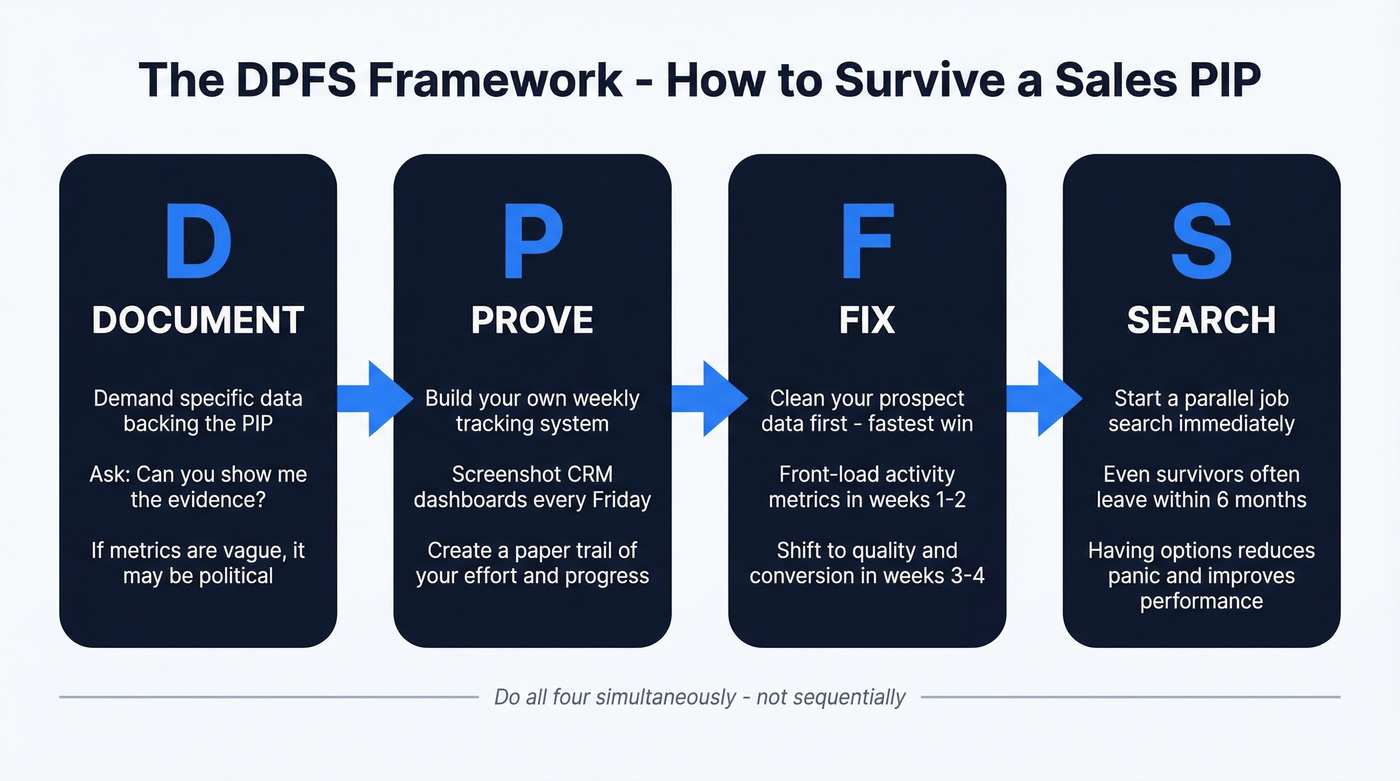
1. Demand Documented Proof
Before you accept anything, ask one question: "Can you show me the specific data supporting this?"
One Reddit user shared a survival story worth memorizing: a rep who received an unwarranted PIP demanded concrete evidence of underperformance. The manager couldn't provide it. Within a couple of months, the manager was let go for not doing their job. The rep survived.
This isn't about being combative. It's about establishing that the PIP is based on facts, not feelings. If the metrics are real, you'll know exactly what to fix. If they're vague, you've just identified a political PIP - and your strategy shifts accordingly.
2. Build Your Own Tracking System
Don't rely on your manager's interpretation of your progress. Build a simple weekly tracker that maps directly to your PIP metrics. Every Friday, before your check-in, update it yourself.
Track the exact numbers from your PIP goals: meetings booked, pipeline generated, conversion rates, activity counts. Screenshot your CRM dashboards. Save email confirmations of meetings. Create a paper trail that proves your effort and progress - even if the final numbers fall short, documented improvement matters.
3. Fix What's Fixable Fast
When you're on a 60-day clock, you don't have time for strategic overhauls. You need quick wins.
The fastest lever most reps can pull is data quality. If your prospect list is full of bounced emails and disconnected phone numbers, your activity metrics will never recover - no matter how many hours you put in. Run your list through a verification tool like Prospeo. If half your emails are bouncing, that's not an effort problem. It's a data problem. Cleaning your list so you're only reaching real, verified contacts is the single fastest way to improve activity-to-conversation ratios during a PIP window.

Beyond data, focus on the two or three metrics in your PIP that are most within your control. Activity numbers (calls, emails, meetings booked) move faster than conversion rates. Front-load your effort on volume metrics in the first two weeks, then shift to quality as your pipeline fills.
4. Start a Parallel Job Search
I've seen this pattern repeatedly: even reps who survive a PIP often leave within six months. One Reddit user put it perfectly - "I somehow hit my quota, but I still need to get out by August."
Surviving a PIP doesn't erase the experience. The relationship with your manager is damaged. The stigma lingers. And a company that PIP'd you once will PIP you again.
Give the PIP your genuine best effort - the skills you build and the metrics you hit will make you a stronger candidate elsewhere. But update your resume, activate your network, and start interviewing. The best outcome is having options when the PIP window closes, regardless of the result.
Hot take: If your deals average under $15K and you're at a company that treats PIPs as a termination formality, stop trying to save the job. Pour that energy into landing somewhere that actually invests in reps. The 60-day PIP window is a gift - it's two months of guaranteed income while you job search.
Managing the Emotional Toll
A PIP hits different than other professional setbacks.
One 27-year-old SaaS rep described it this way: "I can't help but feel like a failure and a let down to my wife." That's not an overreaction. That's a normal human response to being told you're not good enough at the thing you do every day.
Acknowledge the anxiety. Then redirect it. Talk to someone outside work. Exercise. The PIP is a 60-day sprint - you can endure almost anything for 60 days if you know there's an end date.
Your Legal Rights During a PIP
This is the section most PIP articles skip, and it's the one you actually need.
Signing a PIP doesn't mean you agree with it. Your signature acknowledges receipt, not agreement. You can - and should - submit a formal written rebuttal documenting any inaccuracies, missing context, or mitigating circumstances.
Refusing to sign doesn't void the PIP. If you refuse, the employer notes "employee refused to sign" and has two managers sign instead. The PIP still stands. Refusing to sign doesn't protect you; a well-written rebuttal does.
Courts generally don't view a PIP itself as an adverse employment action. Getting PIP'd alone isn't grounds for a lawsuit. If the PIP results in lost benefits, missed promotions, or wage reductions, the legal calculus changes significantly. Document everything.
When a PIP may not be legally sound:
- It includes discriminatory components (targeting protected characteristics)
- It contradicts prior positive performance reviews
- It appears retaliatory (filed after you reported a workplace issue, requested leave, or filed a complaint)
- The timeline is unreasonably short (under 30 days raises red flags)
At-will employment still applies. In most US states, your employer can terminate you at any point - PIP or not. But a PIP creates an implied process, and firing someone mid-PIP without following the stated plan weakens the employer's legal position if challenged.
Don't quit impulsively. Resigning during a PIP may forfeit unemployment benefits and any potential severance. Consult an employment attorney before making that decision, especially if you suspect discrimination or retaliation. Many offer free initial consultations.
When to get a lawyer involved: If your PIP arrived after you filed a workers' comp claim, requested medical leave, reported harassment, or complained about labor violations. These are potential retaliation scenarios, and an attorney should review the timeline.
How to Create a Sales PIP That Actually Works (Manager's Guide)
If a PIP is the first time a rep hears their performance needs improvement, the manager failed - not the rep.
A PIP should be the final step in a documented coaching process, not the opening move. And PIPs can work. One manager shared this on Reddit: "We put him on a PIP. He recognized that his job was in jeopardy and changed his behavior. He's now been with my company for around 5 years." Companies that implement PIPs effectively see a 30% increase in engagement and a 20% uplift in productivity. The difference between a PIP that transforms a rep and one that destroys trust is entirely in the execution.
The 6-Step Legal Framework
This framework is adapted from Fisher Phillips with sales-specific examples:
Step 1: Identify specific incidents, not vague patterns. Don't write "poor sales performance." Write "missed quota by 48% in Q1 2026, with pipeline value declining from $450K to $210K over two quarters." If it's not in writing with numbers, it didn't happen.
Step 2: Provide specific, measurable improvement instructions. "Book 10 qualified meetings per week" is actionable. "Be more proactive" is not. Every goal should have a number and a deadline.
Step 3: Give adequate time. 30-60 days minimum. Less than 30 days isn't enough time for meaningful improvement and signals bad faith. More than 90 days drags out the process and loses urgency. For sales, 60 days is the sweet spot - it covers a meaningful portion of a sales cycle and gives the rep enough runway to show real change.
Step 4: State consequences clearly. "Failure to meet the goals outlined above by [date] may result in termination of employment." No ambiguity.
Step 5: Get the employee's signature. If they refuse, note it and have two managers sign. The PIP should also state that it doesn't affect the at-will nature of employment.
Step 6: Schedule regular check-ins with written follow-ups. Weekly is standard. Document every conversation. Send a follow-up email after each check-in summarizing what was discussed and any progress noted.
Mistakes That Guarantee a PIP Fails
Vague goals. "Improve your pipeline" means nothing. "Increase pipeline value to $400K by Day 45" means everything.
Personality-based targets. "Be more outgoing with prospects" or "show more enthusiasm" aren't performance metrics. They're personality critiques disguised as improvement goals, and they're legally indefensible.
No prior verbal warning. If the PIP is the first conversation about performance, you've skipped steps. A documented verbal warning should always precede a formal plan.
Too many goals. Aim for 2-3 specific, measurable targets. Five or six goals overwhelm the rep and dilute focus. One sales director found a rep's conversion rates had dropped 30% over two quarters - the root cause wasn't effort, it was market dynamics requiring product training. After targeted training on the specific gap, the rep's win rate improved 45% in three months. One focused intervention beat a laundry list of demands.
No resources provided. A sales rep improvement plan that says "hit these numbers" without offering coaching, training, tools, or territory support isn't an improvement plan. It's a countdown to termination.
Alternatives to PIPs That Actually Work
The best managers we've worked with treat PIPs as a last resort, not a first response.
Continuous Feedback (The Adobe Model)
Adobe scrapped annual performance reviews in 2012 and replaced them with a "Check-In" system - ongoing, informal conversations between managers and reps about performance, expectations, and development. The results: a 30% drop in voluntary turnover and a 26% improvement in performance.
The principle is simple: if you're giving feedback weekly, performance issues never compound to the point where a formal improvement plan is necessary. The problem isn't that reps can't improve. It's that they don't know they need to until it's too late.
Coaching Conversations (GROW Model)
The GROW coaching framework - Goal, Reality, Options, Way Forward - turns performance conversations from confrontational to collaborative. Employees with coaching-oriented managers are 40% more engaged and deliver 38% more discretionary effort.
In sales, instead of "you missed quota by 40%," it's "your goal is $500K this quarter. The reality is you're at $210K pipeline with 6 weeks left. What options do you see? What's the path forward?" Same data, completely different dynamic.
94% of employees say they'd stay longer at a company that invests in their development - and coaching is the cheapest investment a manager can make.
Consider Role Redesign Before a PIP
Sometimes people fail because they're in the wrong role, not because they're bad employees. A lateral move - from closing to account management, from enterprise to mid-market - can unlock performance that no PIP ever would. Teams receiving feedback on strengths are 12.5% more productive than those receiving reviews focused on weaknesses.
Fix the Data Before You Fix the Rep
Before putting a rep on a PIP for low pipeline, audit their data. If their email bounce rate is above 5%, the problem isn't effort - it's data quality. I've seen teams where a rep's "low activity" was actually a data problem: they were making the calls and sending the emails, but 30% of contacts were bouncing or disconnected. Fix the data source, and the activity metrics fix themselves. That's a one-day solution versus a 60-day PIP.
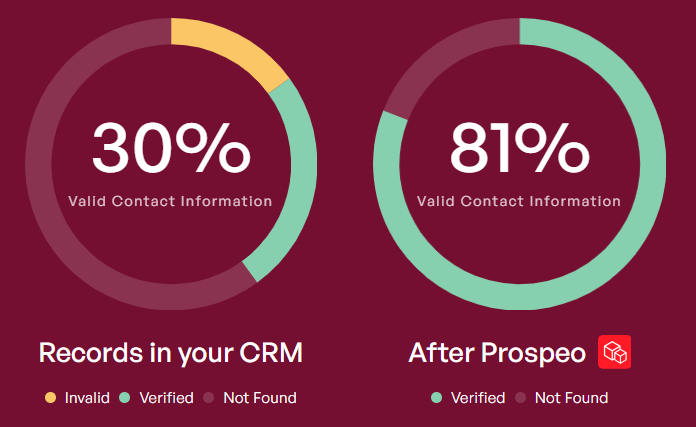
Bad data is a pipeline problem, not a people problem.
Lead qualification is the #1 seller challenge in 2026. Prospeo's 30+ search filters - buyer intent, technographics, headcount growth - let you fill your pipeline with prospects who actually convert, at $0.01 per verified email.
Crush your PIP targets with data that connects you to real buyers.
FAQ
What does PIP mean in sales?
A PIP in sales is a formal, documented plan issued when a rep's performance falls below expectations - typically after missing quota for two or more consecutive quarters. It specifies exact metrics that need to improve, sets measurable targets, and gives the rep 30 to 90 days to hit those targets or face termination.
Can you actually survive a PIP in sales?
Yes - 41% of employees placed on a PIP pass and keep their roles, climbing to 46% when the company provides genuine support. Your odds improve significantly if you demand documented evidence, track your own metrics independently, and fix pipeline issues like bad contact data immediately.
How long does a sales PIP last?
Most sales PIPs run 60 days, which is the standard for quota-carrying roles. Complex enterprise sales cycles may warrant 90 days. Anything under 30 days is legally risky for the employer and signals the plan isn't a genuine improvement effort - it's documentation for a termination that's already been decided.
Should I quit or complete my PIP?
Don't resign impulsively - quitting during a PIP may forfeit unemployment benefits and any potential severance package. Consult an employment attorney first, especially if you suspect retaliation. The smartest approach is completing the PIP while job searching in parallel, preserving your legal options and buying time to land something better.
What's the fastest way to improve sales numbers during a PIP?
Audit your prospect data first - eliminating bounced emails and bad phone numbers immediately improves activity-to-conversation ratios. Then focus on the 2-3 specific metrics in your PIP, front-loading volume metrics like meetings booked in weeks one and two before shifting to conversion quality as pipeline fills.