Email Templates for Startups (2026): The 90-Day Playbook + Sequences
Most startup emails fail for boring reasons: they're too long, they go to the wrong person, or they land in spam. These email templates for startups work because they're built around timing, targeting, and follow-up discipline, not "clever copy."
Here's the thing: good templates don't save bad ops.
We've tested this across founder-led outbound, early sales teams, and lifecycle email at product-led startups. The pattern's consistent: the teams that win treat deliverability and list quality like a product feature, then keep the copy short enough that a busy human can say "yes" without thinking.
What you need (quick version)
You don't need 50 templates. You need three motions running every week:

Outbound 4-touch sequence + breakup Most replies show up after touch #3/#4, not email #1.
Day 0-12 onboarding sequence Split users into activated vs not activated and talk to them differently.
Founder-led churn save + winback A personal founder email beats "automated lifecycle copy" almost every time.
Three non-negotiables (print these):
- Single CTA + short copy. One screen, <200 words. For cold email, aim <100.
- Follow-ups are mandatory. 60-70% of replies come after email #3/#4.
- Deliverability thresholds. Bounce <2%, spam complaints <0.1% (ops target). If you're a bulk sender, keep spam complaint rate <0.3%.
One screen. One ask. One next step.
The Startup Email Map (the only templates you need in the next 90 days)
Templates aren't a library problem. They're a lifecycle mapping problem.
In the next 90 days, your startup will do ~12 email "jobs" repeatedly: create pipeline, convert trials, recruit, raise, save churn, and re-activate. Nail those, and you'll stop rewriting the same email 30 different ways.
Use this map to pick the right template fast.
| Goal | Who | Length | CTA (example) | Follow-up schedule |
|---|---|---|---|---|
| Book intro call | ICP prospect | 50-120 words | "Worth a quick look?" | D1/D3/D6/D10 + breakup |
| Trigger outreach | ICP prospect | <50 words | "Should I send the checklist?" | Same day + D2 |
| Ask for intro | Connector | 60-120 words | "Can you intro me?" + forwardable blurb | D3 + D7 |
| Seed VC cold | Investor | 75-200 words | "Open to Tue/Wed/Thu?" | D4 + D10 |
| Post-meeting VC | Investor | 80-160 words | "What's the biggest open question?" | D2 |
| Candidate outreach | Passive candidate | 80-140 words | "Open to a 12-min chat?" | 3-4 emails total |
| Partnership pitch | Partner lead | 90-160 words | "Worth a 15-min explore?" | D4 + D10 |
| Welcome | New user | 60-120 words | "Do this first: {1 step}" | D1 |
| Quick win | New user | 80-140 words | "Reply 'review' and I'll check." | D3 |
| Activation rescue | Inactive user | 60-120 words | "Reply with the blocker (1 sentence)." | D5 |
| Cancel save | Churn risk | 80-160 words | "Reply with the reason." | Same day + D3 |
| Winback | Churned/inactive | 60-140 words | "Resume / snooze / unsubscribe?" | D7 + D30 |
Cold outbound templates (rules that increase replies)
Before you touch copy, get the rules right.
The "one screen" rule
If it doesn't fit on one screen, it dies. I've watched founders write beautiful 400-word emails that got exactly zero replies because nobody reads them.
Do:
- 2-5 short sentences
- One idea per email
- One CTA (a question)
Don't:
- Multi-paragraph "story time"
- 3 CTAs ("book a call / watch a demo / reply with thoughts")
- Attachments on cold outbound
Context personalization beats fake familiarity
Personalization that works is context: role + company + a real trigger. Personalization that fails is "I loved your post" energy. It reads weird, and it's usually automated.
Good context lines:
- "Noticed you're hiring 3 SDRs - usually means pipeline coverage is a priority."
- "Saw you rolled out an integration page for {category}. That's often a sign you're scaling partners."
Bad fake familiarity:
- "Loved your recent post..."
- "Hope you're having a great week..."
Soft CTAs win (especially early)
Your first email shouldn't demand a meeting. It should earn a reply.
Steal these soft CTAs:
- "Worth a quick look?"
- "Should I send the 2-line summary?"
- "Open to a 10-min sanity check?"
- "Is this even on your roadmap this quarter?"
Follow-ups are where replies happen
Real talk: email #1 is just permission to follow up.
60-70% of replies come after email #3 or #4. That's why teams that "don't want to be annoying" lose to teams that are politely persistent.
Ops that actually moves the needle (not copy tweaks)
If your outbound's flat, these are the levers that change outcomes:
- Rotate domains/inboxes on purpose. Run Batch 1 for ~2 weeks, then bring up Batch 2 while Batch 1 cools. Don't keep "backup domains" idle.
- Consider turning off open tracking for cold outbound. Belkins saw ~3% higher response rates after stopping open tracking mid-year (tracking pixels can hurt deliverability).
- Cap volume per inbox. If you're pushing volume, you're trading short-term sends for long-term inbox placement.
Hot take: if your average deal's under five figures and you're sending fewer than 1,000 cold emails/week, your "copy problem" is usually a list + deliverability problem. Fix the plumbing first.

These templates only work if they reach real inboxes. 60-70% of replies come after email #3 - but that only matters if your bounce rate is under 2%. Prospeo's 98% email accuracy and 7-day data refresh keep your sequences landing, not bouncing.
Fix the list before you fix the copy. Start with 100 free credits.
Copy-paste cold sales sequence (5 emails + timing + breakup)
Cadence that works for most B2B startups:

- Day 1: Email 1
- Day 3: Email 2
- Day 6: Email 3
- Day 10: Email 4
- Day 14: Breakup
Belkins analyzed 16.5M cold emails across 93 domains and saw 5.8% average reply rate in 2024. Their data also shows follow-ups matter: the first follow-up can lift replies up to 49%, but by follow-up #4 responses drop ~55% and complaints/unsubs climb. Use follow-ups, but keep them tight and respectful. Benchmark details: Belkins cold email response rate benchmarks.
Email 1 - "Context + credibility + soft ask" (2 variants)
Variant A: founder-led (simple, human) Subject: {Company} -> quick question
Hi {FirstName} - noticed {context about role/company}.
We help {peer group} get {outcome} without {common pain}.
Worth a quick look if I send a 2-line summary?
- {YourName}
Variant B: SDR-led (still human, slightly more structured) Subject: {Outcome} for {Company}
Hey {FirstName} - quick one.
Teams like {peer} use us to {outcome} by {mechanism}. Most switch because {pain they already feel}.
Open to a 10-min chat next week, or should I send details first?
- {YourName}
Notes that matter:
- "Peer group" can be industry ("B2B SaaS"), stage ("Series A"), or role ("RevOps teams").
- Keep credibility light: 1 proof point max. No logo soup.
Email 2 - "Quick version" follow-up (3 days later)
Subject: Re: {Outcome} for {Company}
{FirstName} - quick version:
- Problem: {pain in their world}
- Fix: {your approach}
- Result: {metric or qualitative win}
Should I send the 30-second overview, or is this a "not now"?
- {YourName}
Email 3 - "Proof / micro-case" follow-up
Subject: Example for {industry}
{FirstName} - one example:
{CustomerType} was dealing with {pain}. They did {one change} and got {result}.
If you want, I can share the exact workflow we used. Worth it?
- {YourName}
If you don't have a case study yet: use a "micro-proof" instead.
- "We're seeing this pattern across 12 teams..."
- "We built this after running into the same issue at {previous company type}..."
Early-stage teams stall because they refuse to mention proof until they have a polished PDF. Don't wait.
Email 4 - "Objection flip" follow-up
Subject: Usually it's one of these
{FirstName} - when teams don't engage, it's usually because:
- timing's off
- you already have a solution
- this isn't a priority
Which one is it on your side? I'll close the loop accordingly.
- {YourName}
Breakup - "Bad timing?" (permission-based close)
Subject: Close the loop?
All good if now's not the time, {FirstName}.
Want me to circle back in {30/60/90} days, or should I stop reaching out?
- {YourName}
Optional add-on (only if relevant): "If someone else owns {topic}, who's the right person?"
Trigger-based outreach templates (send within 48 hours)
Trigger outreach is the cheat code because it answers the silent question: "Why are you emailing me now?"
Two rules:
- Send within 48 hours of the trigger.
- Keep it under 50 words. Over 100 words tanks response.
Trigger -> angle -> CTA (use this instead of overthinking it)
| Trigger | Angle that lands | CTA that gets replies |
|---|---|---|
| Funding announcement | "Congrats - here's the 30-60 day problem that shows up after hiring ramps." | "Want the checklist?" |
| New leader hired | "First 30 days = inherited mess + quick wins." | "Open to a 10-min sanity check?" |
| Hiring spike / job post | "Hiring for X usually means initiative Y." | "Should I send what's worked for peers?" |
| Tech stack change / integration page | "You just standardized tooling - here's how teams squeeze ROI from it." | "Worth a 2-line summary?" |

Funding announcement
Subject: Congrats on the round
Congrats on the raise, {FirstName}.
When teams hire fast after funding, {pain} usually shows up within 30-60 days.
Want a quick checklist we use to avoid it?
- {YourName}
New hire / new leader
Subject: New role at {Company}
Congrats on the new role.
When {role} joins, the first 30 days usually include {pain}. We help with {outcome}.
Worth a 10-min sanity check next week?
- {YourName}
Job post / hiring spike
Subject: Hiring {team}?
Saw you're hiring for {role/team}.
That usually means {initiative}. If you want, I can share what's worked for {peer group}.
Should I send it?
- {YourName}
Tech stack change / new integration page (technographic trigger)
Subject: Noticed {tool} on your site
Noticed {Company} is using {tool}/added an integration page.
We plug into that to {outcome}.
Worth exploring, or should I send a 2-line summary?
- {YourName}
Fundraising / investor outreach templates (seed -> Series A)
Investor emails are a different sport. You're not "selling." You're compressing signal.
Hard rules (follow these and you'll look serious):
- Skip attachments on the first cold VC email. Link the deck. Attachments scream "spray and pray."
- If you can't state traction in 3 bullets, you're not ready to cold email investors. Get your metrics straight first.
- Subject lines under 5 words when you can. Investors triage fast.
Signal density checklist (include / cut)
Include:
- One-line category + ICP
- 3 traction bullets with numbers
- Why now (market shift, regulation, behavior change)
- Clear raise ask + 2-3 time slots

Cut:
- Adjectives ("excited," "incredible," "game-changing")
- Long origin stories
- Feature lists
- "We'd love to pick your brain"
Cold VC outreach (seed)
Subject: {Category} seed
Hi {InvestorName} - reaching out because you've backed {relevant company} and have a clear thesis on {thesis}.
We're building {one-line what you do} for {ICP}. We're winning because {unfair advantage}.
Traction:
- {metric 1}
- {metric 2}
- {metric 3}
We're raising a {round size} on a SAFE. Open to a quick intro? I can do {Tue 10:00} / {Wed 14:00} / {Thu 09:30}.
- {Name}, {Title} {1-line credibility} {Deck link}
Two realistic traction bullet examples (steal the structure)
Example A (waitlist + conversion):
- 2,400-company waitlist; 310 activated; 38 paying in 60 days
- $18k MRR, 22% MoM growth last 3 months
- 41% of new revenue from referrals/partners
Example B (pipeline + LOIs):
- 14 LOIs signed; 6 in paid pilots; $420k pipeline with 90-day cycles
- 3 design partners in regulated vertical; 2 integrations live
- Gross retention 96% in cohort 1
Warm intro follow-up (sendable to connector)
Subject: Intro to {InvestorFirm}?
Hey {ConnectorName} - quick ask.
Could you intro me to {InvestorName} at {Firm}? They're a fit because {1 reason}.
Forwardable blurb: "{Name} is building {what} for {who}. Traction: {1-2 bullets}. Raising {round} now. Would love your take."
If you're up for it, I'll send a short deck + 3 bullets you can paste.
Post-meeting follow-up + "materials" email
Subject: Materials + next steps
Thanks again for the time today.
Here are the materials:
- Deck: {link}
- Product: {link}
- Data room (if relevant): {link}
Two questions so I can keep momentum:
- What's the biggest open question on your side?
- Who else should we meet at the firm?
If helpful, I can also share customer references.
VC partner template (soft ask)
Subject: Worth a chat?
Hi {InvestorName} - {why you picked them in 1 line}.
We're {what you do} for {ICP}. The wedge is {insight}.
Traction: {3 bullets}.
Team: {1 credibility line}.
Raising: {amount} this quarter.
Pls let me know if it's worth a chat. I'm free {slot 1}, {slot 2}, {slot 3}.
- {Name}
Hiring + partnership templates (the overlooked growth lever)
A recruiting benchmark often cited in sourcing playbooks: people get ~122 emails/day and give each message under 5 seconds on the first skim. That's why recruiting and partnership emails must be scannable and persistent.
Founder-to-candidate outreach + 2 follow-ups
Recruiting persistence norm is 3-4 emails. If you send one note and stop, you're basically filtering for "people who check inbox constantly," not "best candidate."
Use this if: you're hiring for a role that changes the company (first AE, first PM, founding engineer). Skip this if: you can't articulate the role's mission and upside in 2 sentences.
Email 1 Subject: {Role} at {Startup}
Hi {FirstName} - I'm the founder at {Company}.
We're building {what} for {who}. I think you'd be a great fit for {Role} because {specific reason}.
Open to a 12-min chat this week?
- {Name}
Follow-up 1 (3-4 days later) Subject: Re: {Role} at {Company}
Quick bump - is this worth a conversation, or should I stop reaching out?
Follow-up 2 (1 week later) Subject: Closing the loop
Last note from me. If you're not looking, totally fair - want me to reach back out in a few months?
Interview invite + confirmation + follow-up
Use this if: you're moving fast and don't want candidates to ghost. Skip this if: your process is still fuzzy (you'll create confusion).
Invite
Subject: Interview for {Role}
Hi {FirstName} - excited to chat. Here are two options:
- {Day/time}
- {Day/time}
It'll be {length} and we'll cover {topics}. Does one work?
Confirmation (after they pick)
Subject: Confirmed: {Day/time}
Confirmed for {Day/time} {timezone}. Here's the link: {link}. If anything changes, reply here and we'll adjust.
Follow-up (if no response in 24h)
Subject: Quick confirm?
Want to make sure this didn't get buried - still good for {Day/time}?
Partnership/co-marketing pitch + follow-up (win-win bullets)
Partnership emails fail when they're vague. "Let's partner" means nothing.
Use win-win bullets so the other side can evaluate quickly. If you have an affiliate motion, a clean offer like 15% recurring commission is easy to understand.
Use this if: your audiences overlap and your products don't compete. Skip this if: you can't name a specific joint asset (webinar, guide, integration, referral swap).
Email 1 Subject: Co-marketing idea for {Company}
Hi {FirstName} - I run partnerships at {Company}.
I think there's a clean win-win with {Company}:
- Audience overlap: {who}
- Complementary offers: {how you fit}
- Joint asset: {webinar/guide}
- Promo plan: {list size / community / paid}
- Optional: affiliate at 15% recurring for referred customers
Worth a 15-min chat to see if it's real?
- {Name}
Follow-up (4-5 days later)
Subject: Re: co-marketing
If co-marketing isn't a focus, no worries - who's the right owner on your side?
Onboarding + retention email templates (Day 0-30)
Your first 24-48 hours after signup are the whole game. 61% of users go inactive within 48 hours if they don't hit a quick win. Your job is to interrupt that drift with simple, behavior-based nudges.
A solid onboarding sequence runs 7-10 days, max 1 email/day. Keep it plain text unless visuals are essential.
I've seen teams obsess over "welcome email design" while their product takes 21 days to value and activation sits at 31%. In that situation, the email's job is simple: remove the next setup blocker.
Day 0-12 onboarding (6 emails) + subject line patterns
Steal the numbered subject line pattern: "(1/6) ... (6/6)". It sets expectations and boosts opens.
Email 1 - Day 0 (Welcome + 1 step)
Subject: (1/6) Welcome - do this first
Welcome to {Product}, {FirstName}.
Fastest path to value: {single setup step}. It takes ~{2-5} minutes.
Reply if you get stuck - I read these.
Email 2 - Day 1 (Quick win)
Subject: (2/6) Your first win
If you do one thing today, do this: {quick win action}.
Here's a 60-second walkthrough: {link}.
Want me to check your setup? Reply "review" and I'll take a look.
Email 3 - Day 3 (Social proof)
Subject: (3/6) How teams use {Product}
One example: {customer type} uses {Product} to {job}.
If you tell me your goal ({A}/{B}/{C}), I'll point you to the best workflow.
Email 4 - Day 5 (Usage review / unblock)
Subject: (4/6) Quick check-in
Quick check: have you {key activation event} yet?
- If yes: reply "yes" and I'll send the advanced play.
- If no: what's blocking you? (1 sentence is fine)
Email 5 - Day 8 (Sales touch, but helpful)
Subject: (5/6) Want a setup assist?
If you want, I can help you set up {core workflow} in 15 minutes.
Pick a time: {calendar link}. If you'd rather not meet, reply with your goal and I'll send a tailored checklist.
Email 6 - Day 12 (Offer / urgency)
Subject: (6/6) Last nudge
If you're still evaluating, here's the simplest plan: {what to do next}.
If you're not moving forward, reply "pass" and I'll stop nudging.
Activated vs not activated branches (Day 1 + Day 5)
Branch A: Activated (Day 1)
Subject: Nice - want the advanced play?
You're already set up. The next lever is {advanced feature/workflow}.
Want the 3-step version?
Branch B: Not activated (Day 1)
Subject: What got in the way?
Most people get stuck on one of these: {blocker 1}, {blocker 2}, {blocker 3}.
Which one hit you? Reply with 1/2/3 and I'll send the fix.
Branch A: Activated (Day 5)
Subject: One way to get value faster
Try this to get value faster: {power tip}.
Reply with your use case and I'll tailor it.
Branch B: Not activated (Day 5)
Subject: Want me to set it up with you?
If setup's the issue, we can do it together in 10 minutes.
Want {two time options}, or prefer a checklist?
Behavior-triggered rescue (the stuff that actually saves activation)
Behavior beats calendar timing. These two messages consistently pull users back.
45-minute inactivity nudge (send if they start setup but stall)
Subject: Your workspace is 80% done
Hey {FirstName} - you're close. Your workspace is about 80% done.
Finish {one remaining step} and you'll get {quick win}.
Want me to do it with you? Reply "help" and I'll send 2 time options.
14-day inactive winback (resume / snooze / unsubscribe)
Subject: Should I close your account?
Hey {FirstName} - looks like you haven't used {Product} in a bit.
Want to resume, snooze for 30 days, or unsubscribe? Reply with one word and I'll do it.
This pattern recovered 23% of inactive users for us because it forces a clean choice instead of endless nudges.
Cancellation save (founder personal) + winback (Day 7 / Day 30)
Founder emails work because they feel real. A personal churn email can hit 70% response rate when it's short and genuinely curious.
Cancellation save (send immediately, from founder)
Subject: Quick question
Hey {FirstName} - saw you canceled. Quick question: what was the main reason?
If you reply with one sentence, I'll either fix it or tell you honestly if we're not a fit.
- {FounderName}
Winback - Day 7
Subject: Still a no?
Totally fine if you moved on. If you want to give {Product} another shot, I can set up {key workflow} for you.
Resume, snooze for 30 days, or unsubscribe?
Winback - Day 30 (what changed)
Subject: We fixed {pain}
Quick update: we fixed {specific issue} and added {improvement}.
Want me to re-open your account for a week so you can test it?
Referral ask + review request + NPS follow-ups (promoter/passive/detractor)
Referrals work because trust is borrowed: 84% trust recommendations, referred buyers are 4x more likely to purchase, and referred customers drive +16% LTV.
Referral ask (to happy users)
Subject: Quick favor?
If {Product}'s been useful, do you know 1 person who'd benefit from {outcome}?
If you reply with a name, I'll write a short intro blurb you can forward.
Review request (reduce friction)
Subject: Could you share a quick review?
Could you spare 3 minutes to leave a review? 69% of customers leave one when asked, and it helps a lot.
Here's the link: {link}. Thank you.
NPS "close the loop" follow-ups Companies that close the loop see 3x promoters next time. The trick is to reply fast and be specific.
- Promoter (9-10): ask for referral/review
- Passive (7-8): ask what'd make it a 9
- Detractor (0-6): apologize + ask for the one fix that matters
Promoter follow-up
Subject: Thank you - one more?
Appreciate the score. Want to refer 1 team? I'll make it easy.
Passive follow-up
Subject: Quick question
What's the one thing that'd make this a 9?
Detractor follow-up
Subject: I hear you
Thanks for the honesty. If we fixed one thing in the next 2 weeks, what should it be?
Deliverability, compliance, and troubleshooting (2026 rules + thresholds)
If your deliverability's shaky, templates don't matter. You're writing into spam.
Targets that keep you safe:
- Bounce rate: <2%
- Spam complaints: <0.1% (ops target)
- Bulk sender spam complaint threshold: <0.3%
- Volume cap: don't exceed 50/day per inbox
- Warmup schedule: 5-10/day -> 15-20/day -> 30-40/day -> 50/day

Also: Gmail clips emails over 102 KB. If you're sending heavy HTML, you're asking for rendering issues and broken tracking.
Before you send: list quality (this is where most startups mess up)
Bad lists are a tax on founders. They burn domain reputation, waste follow-ups, and make you think your offer's bad when your data's bad.
One scenario we see all the time: a founder spins up a new domain, loads 5,000 "target" contacts from a scraped spreadsheet, and hits send. Week one looks fine. Week two bounces climb, replies drop, and suddenly every email tool "stops working." Nothing broke. The list did, and the domain paid the price.
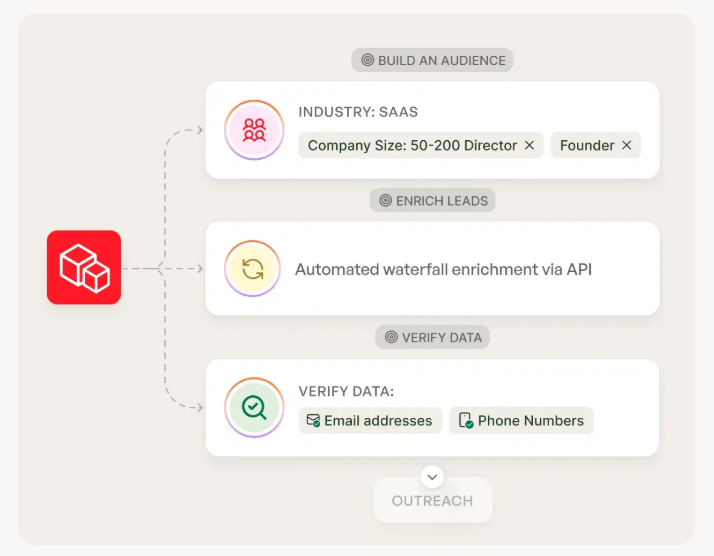
If you want the cleanest default layer before outbound, Prospeo is a solid pick. It's "The B2B data platform built for accuracy," and it's built for teams that care about verified emails, fresh records, and self-serve workflows.
What matters in practice:
- 98% verified email accuracy with real-time verification
- 7-day data refresh cycle (the industry average is ~6 weeks)
- 5-step verification with catch-all handling plus spam-trap and honeypot filtering
- 300M+ professional profiles, 143M+ verified emails, and 125M+ verified mobile numbers
- 30+ search filters, plus CRM/CSV enrichment that returns 50+ data points per contact with an 83% enrichment match rate and 92% API match rate
Compliance checklist (don't get cute)
CAN-SPAM basics (US):
- Include a valid physical address
- Clear opt-out link
- Honor opt-outs within 10 business days
- Keep the opt-out mechanism working for 30 business days after sending
- Penalties can hit $53,088 per message
Bulk sender rules (Gmail/Yahoo):
- Bulk sender = ~5,000+ emails/day to Gmail/Yahoo (rules apply)
- Authenticate with SPF/DKIM + DMARC
- One-click unsubscribe headers
- Process unsubscribes within 2 days
- Keep spam complaints under 0.3%
DMARC enforcement's table stakes across major providers, including Microsoft's bulk sender enforcement starting May 5, 2026. If your DNS/auth is sloppy, fix it before you scale.
Mini decision tree: what's actually broken?
If reply rate <1%: it's usually infrastructure/data.
- Check SPF/DKIM/DMARC alignment
- Reduce volume, rotate inboxes, warm up properly
- Verify your list (bounce <2%)
- Consider turning off open tracking if you're struggling
If reply rate >1% but positive replies are low: it's offer/targeting/copy.
- Tighten ICP (job + pain + trigger)
- Make CTA softer
- Replace "features" with outcomes
- Add one proof point
Minimal stack + cost ranges (keep it boring)
You don't need a monster stack. You need a reliable one.
- Sending/sequencing: Smartlead / Instantly / Lemlist typically $30-$150/seat/mo
- Enrichment/personalization workflows: Clay often lands in that same $30-$150/seat/mo tooling band
- Data providers: Clearbit-style budgets usually $5k-$30k/year depending on volume
- Verification: credit-based; expect roughly $10-$100/mo for early-stage volumes
- Lifecycle sending: Resend is a common lightweight, usage-based option
If you're trying to protect deliverability while scaling outbound, pairing your sequencer with a verification + data layer (like Prospeo) keeps bounces down and saves you from the "why'd our domain tank?" spiral. If you’re evaluating tools, start with a shortlist of cold email outreach tools and a dedicated email verifier website.
Running a 5-touch cold sequence to the wrong email burns your domain and kills future campaigns. Prospeo verifies every email through a 5-step process - spam traps, honeypots, and catch-alls filtered out - so your founder-led outbound actually connects.
Protect your domain. Send every template to a verified inbox.
Templates are useful. Ops is everything.
Map emails to lifecycle, keep them to one screen, and treat deliverability like a product feature. That's how email templates for startups turn into replies, pipeline, and retained revenue. For more structure, steal a proven B2B cold email sequence and tighten your email cadence rules.
FAQ: Startup email templates
What's the best length for a startup cold email in 2026?
The best-performing startup cold emails are typically 50-120 words (one screen), with 2-5 short sentences and a single soft CTA. If your message needs a second scroll to understand the ask, expect lower replies.
How many follow-ups should startups send before stopping?
Send 3-4 follow-ups plus a breakup, because most replies arrive after email #3/#4. Keep each follow-up shorter than the last, and stop immediately on opt-out or a clear "no."
What metrics tell me my templates are failing vs deliverability is failing?
If reply rate's under 1%, deliverability or list quality's usually the issue (spam placement, domain reputation, or bounces above 2%). If reply rate's above 1% but positive replies are under ~5%, your offer/targeting is off.
What's a good free tool to keep bounce rate under 2%?
Use a verifier with real-time checks and a meaningful free tier. Prospeo's free plan includes 75 email credits/month plus 100 Chrome extension credits/month, with 98% verified email accuracy.