

How to Check Email Account Validity (and Why Most Free Tools Get It Wrong)
SDRs waste 27% of their time on bad email data - that's $1,640-$2,730 per rep, per month, down the drain. If you don't check email account validity before hitting send, you're gambling with your domain reputation. B2B email data decays at over 22% annually, which means roughly a quarter of your list goes stale every year. Send to those addresses and complaint rates spike above 0.1%, ISPs start throttling you, and even your good emails stop landing.
The fix is straightforward: verify before you send. We've watched teams torch their sender reputation by skipping this step, and the recovery takes months.
Quick Picks
- One email to check? Use Mailmeteor or Email Hippo - no signup needed.
- Cleaning a list of 500+? EmailListVerify at $24/10K or Bouncer at $45/10K for bulk verification.
- Want emails that are already verified? Prospeo finds and verifies in one step - 98% accuracy, 75 free emails/month.
How Email Verification Works
Every verification tool runs some version of the same pipeline. The good ones execute all five steps; the cheap ones skip the hard parts.
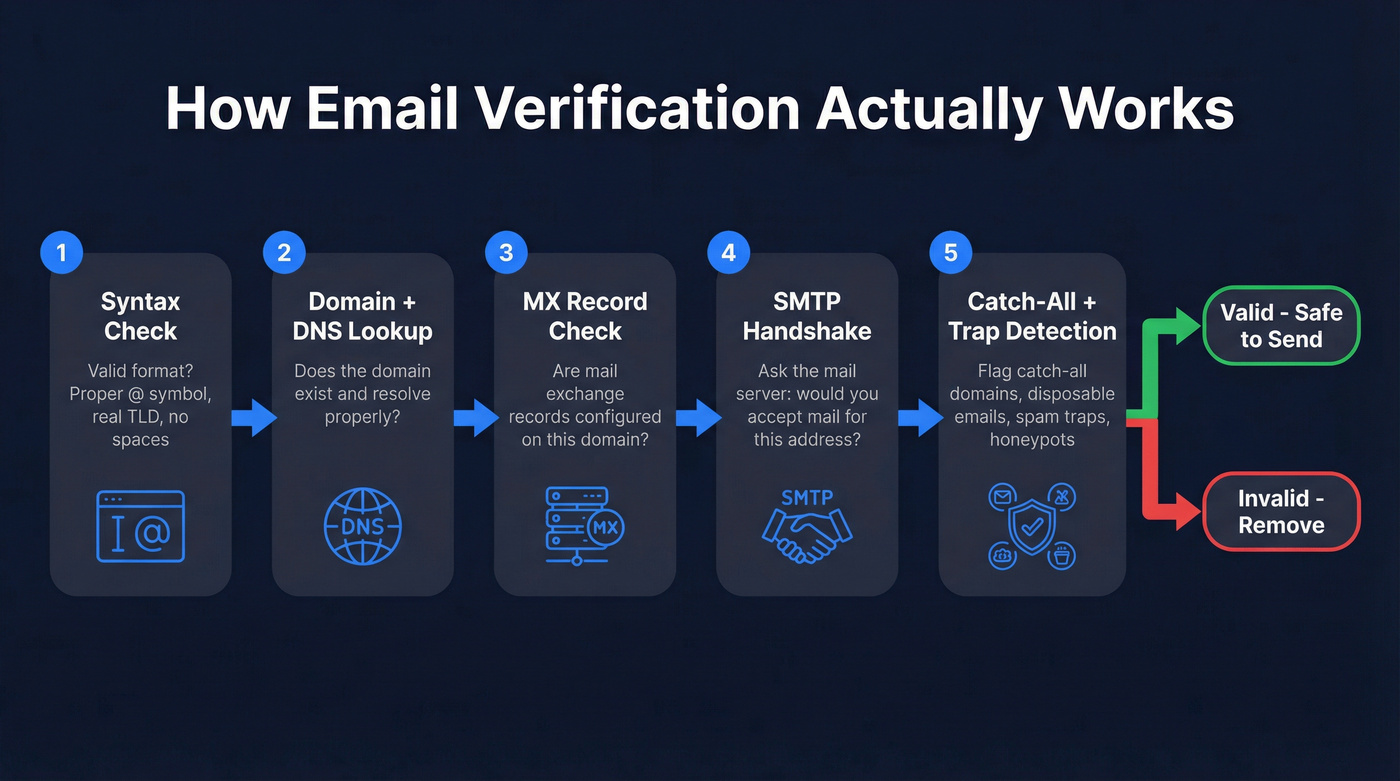
- Syntax check - Does the address follow valid format? No spaces, proper @ symbol, real TLD.
- Domain and DNS lookup - Does the domain exist and resolve?
- MX record check - Are mail exchange records configured? No MX records means no mail server.
- SMTP handshake - The tool connects to the mail server and asks "would you accept a message for this address?" without actually sending one. A 5xx response means the mailbox doesn't exist. A 4xx means "try later," and simplistic checkers often misclassify these as valid.
- Catch-all and disposable detection - Some domains accept mail for any address, making individual verification impossible. Good tools flag these separately and filter out disposable services, spam traps, and honeypots. (If you need a reference list, see our disposable services guide.)
Manual Methods That Work
For one-off checks, you've got a few options that don't scale but work in a pinch.
Send a test email. If it hard-bounces, you have your answer. Google the address - if it shows up on a company page or professional profile, it's probably active. You can also try a password recovery flow on Gmail, Outlook, or Yahoo to see if the account exists, but do this sparingly or you'll get IP-blocked.
These work for one or two addresses. For anything over 50, use a dedicated tool.

Most teams find emails first, then pay again to verify them. Prospeo's 5-step verification runs automatically - syntax, DNS, SMTP, catch-all, and spam-trap removal - so every email you pull is already validated. 98% accuracy at $0.01/email.
Get 75 verified emails free this month - no credit card, no contract.
Best Tools to Verify Email Addresses
| Tool | Free Tier | Price/10K | Verdict |
|---|---|---|---|
| Prospeo | 75/mo (+100 extension credits) | ~$0.01/email | Best all-in-one: finds AND verifies |
| EmailListVerify | 100 | $24 | Best budget bulk pick |
| Bouncer | 100 | $45 | Best accuracy per dollar |
| Emailable | 250 | $50 | Credits never expire - rare perk |
| NeverBounce | 10 | $50 | Solid, but credits expire after one year |
| ZeroBounce | 100 | $64 | Overpriced for its 60.70% benchmark score |
| Clearout | 100 | $58 | 68.37% benchmark accuracy, fair price |
| Kickbox | 100 | $80 | Hard to justify when Bouncer costs half |
| Hunter | 50 | $149 | 3x pricier; admits home-field advantage in its own test |
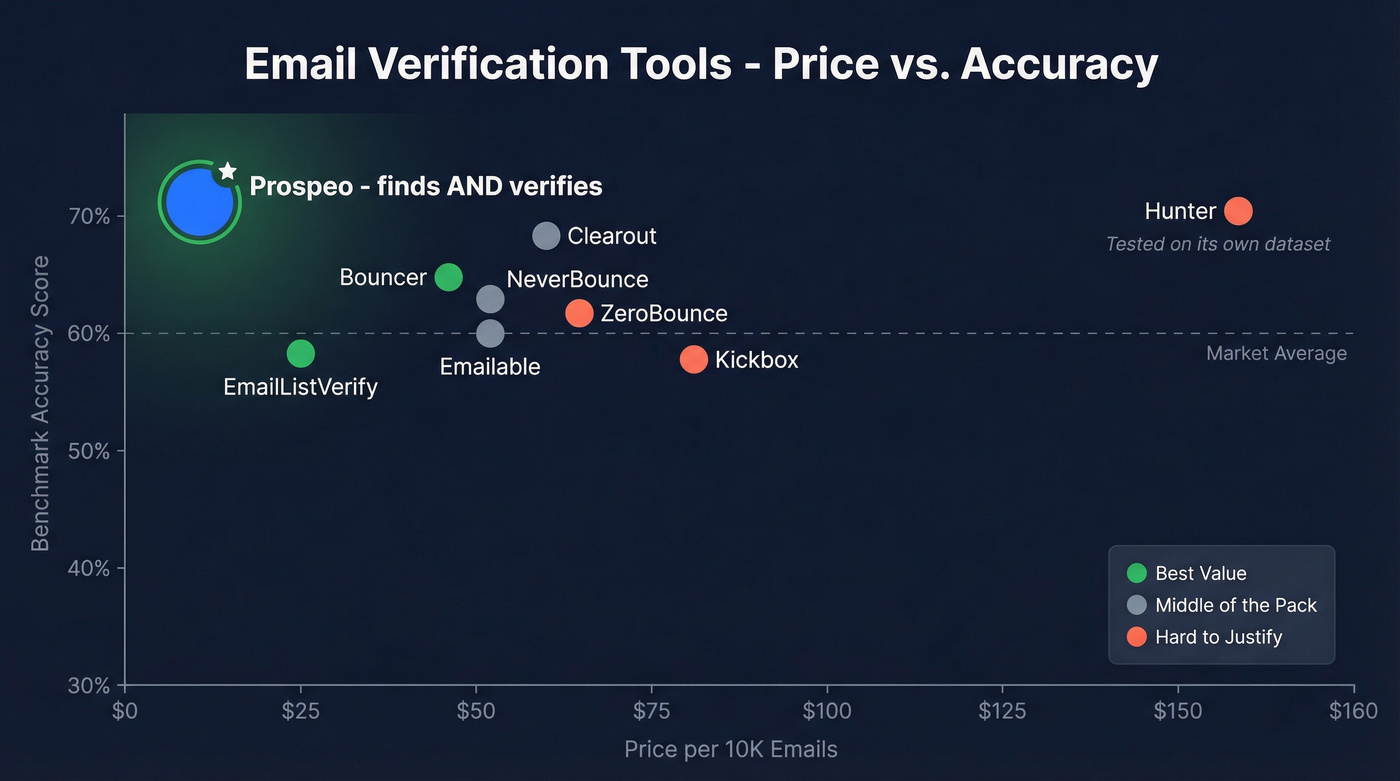
Here's the thing: if your average deal size is under $10K, you don't need to spend $64-$149 per 10K verifications. EmailListVerify or Bouncer will get you 90% of the way there at a fraction of the cost. If you want a broader shortlist, see our roundup of email checker tools.
EmailListVerify vs. Bouncer
EmailListVerify is the budget pick at $24 per 10K - roughly half the price of most competitors. Bouncer costs more at $45 per 10K but scored 65.43% in a 15-tool benchmark by EmailTooltester, placing it above NeverBounce (63.17%) and ZeroBounce (60.70%). If accuracy matters more than cost-per-check, Bouncer wins. If you're cleaning a massive list on a tight budget, EmailListVerify is the smarter play.
Skip These (or Think Twice)
ZeroBounce scored 60.70% in that same benchmark - hard to justify at $64/10K when cheaper tools outperform it. NeverBounce is fine at $50/10K, but credits expire one year from purchase, which punishes teams that verify in bursts rather than on a steady cadence. Hunter scored highest at 70%, but at $149/10K it's 3x pricier than EmailListVerify, and the test used Hunter's own dataset. Take that number with a grain of salt.
Understanding Your Results
| Status | Meaning | Action |
|---|---|---|
| Valid | Mailbox exists, accepts mail | Send |
| Invalid | Mailbox doesn't exist | Remove immediately |
| Catch-all | Domain accepts everything | Send cautiously, recheck in 60-90 days |
| Unknown | Server didn't respond clearly | Recheck in 60-90 days |
| Risky | Disposable, role-based, or spam trap | Remove or isolate |
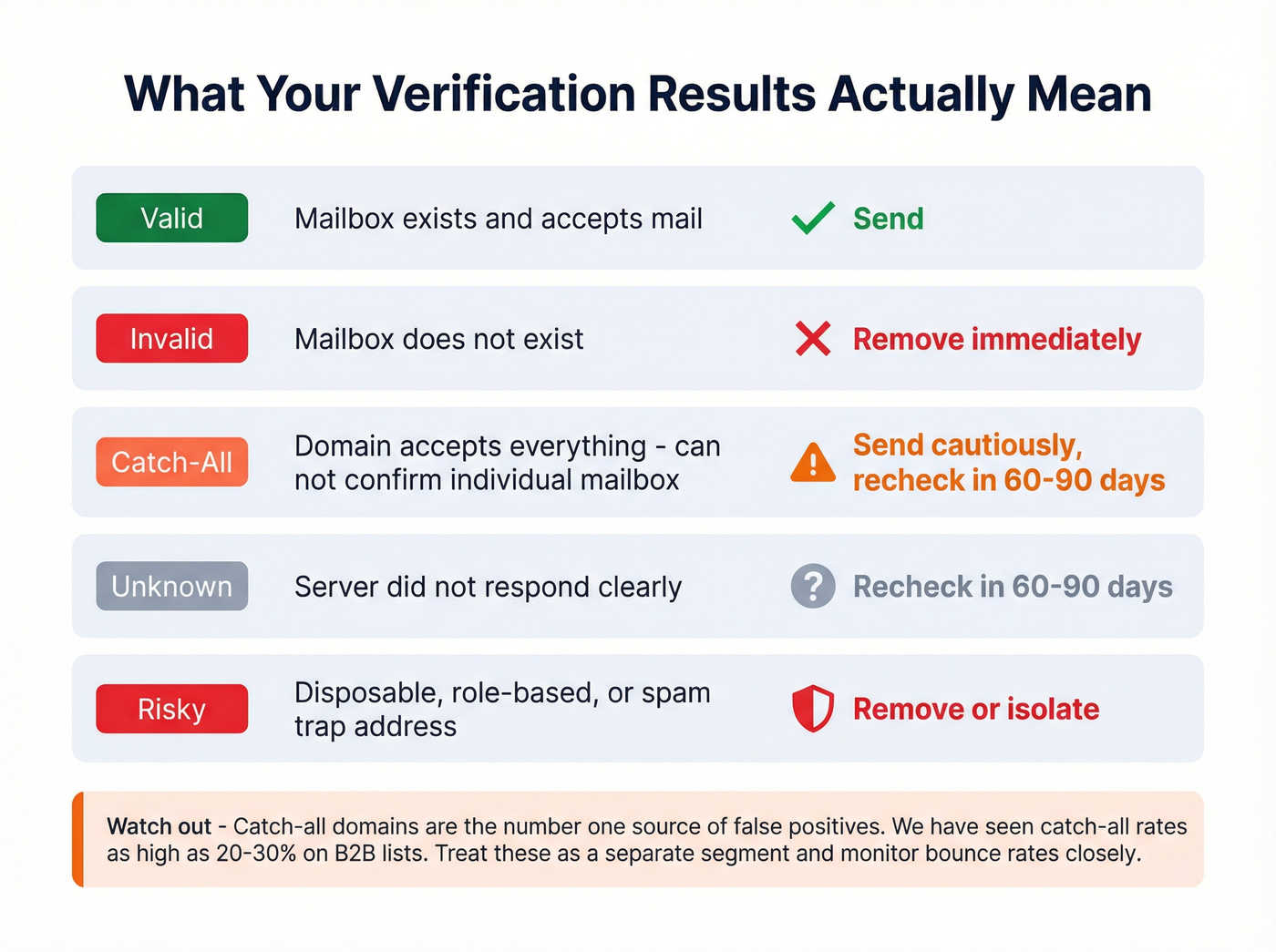
Catch-all domains are the #1 source of ambiguous results. The server accepts mail for any address, so the tool can't confirm whether a specific mailbox exists. We've seen catch-all rates as high as 20-30% on B2B lists, which makes your "verified" count less reliable than it looks.
A common failure mode: tools mark catch-all addresses as "valid," then you eat the bounces. If your list has a high catch-all percentage, treat those addresses as a separate segment and monitor bounce rates closely. (If you're also seeing deliverability issues, run a quick email deliverability checklist.)
Your list decays 22% per year. Prospeo refreshes its 300M+ profiles every 7 days - not every 6 weeks like competitors. That means fewer catch-all surprises, fewer bounces, and a sender reputation that stays intact.
Skip the cleanup step. Pull emails that are already verified.
How Accurate Are Free Checkers?
Worse than you'd expect. The most eye-opening result from that 15-tool benchmark across ~3,000 real business emails: Snov.io scored just 31.20%. The best tool hit 70%. A separate Icypeas benchmark reported an 85% market average - better, but nowhere near the 99% accuracy vendors plaster on their marketing pages. If you're comparing options, our email verification free breakdown covers the real limits.
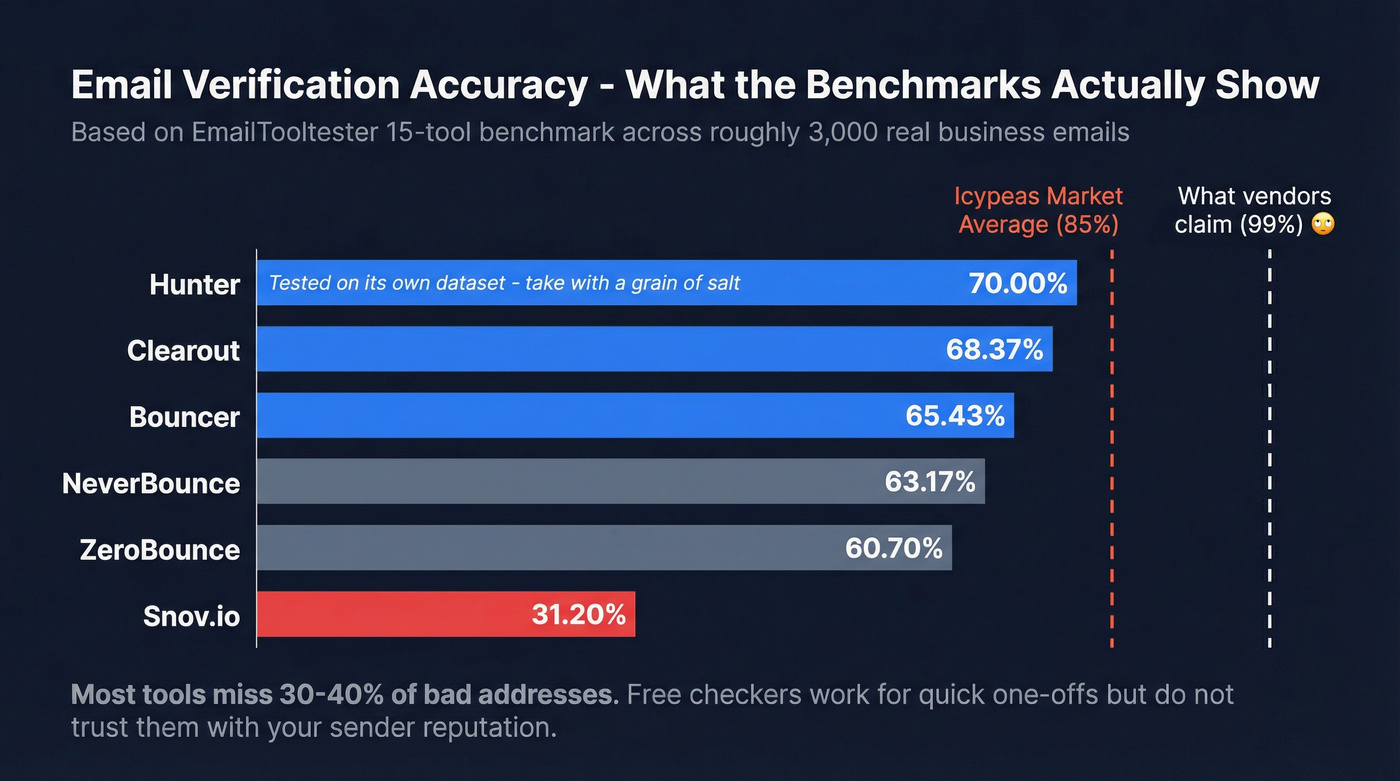
In our testing, both benchmarks confirm the same pattern: most tools miss 30-40% of bad addresses. Free checkers are fine for quick one-offs. Don't trust them with your sender reputation.
Keep Your List Clean in 2026
Verification isn't one-and-done. B2B lists need rechecking every 60-90 days, especially catch-all and unknown results. Real-time verification at the point of capture - through a form, API, or prospecting tool - prevents bad data from entering your CRM in the first place. (If you're building this into your workflow, start with our guide to email verification for outreach.)
For reference, excellent bounce rates sit under 1%, good is 1-2%, and anything above 5% signals serious list quality problems. B2B/SaaS teams typically run 0.5-1.5%. For teams that want to check email account validity at scale without a separate cleanup step, tools that verify during the enrichment process save the most time. Prospeo's 5-step verification pipeline, which includes catch-all handling and spam-trap removal, runs automatically when you pull contacts - so you're never working with unverified data. If you're cleaning data inside your CRM, follow a CRM hygiene process so bad records don't creep back in.
FAQ
What's the difference between email validation and verification?
Validation checks format and syntax - proper @ symbol, real TLD, no spaces. Verification checks deliverability by pinging the mail server to confirm the mailbox exists. Most modern tools run both automatically, so the distinction rarely matters in practice.
Why did a "valid" email still bounce?
Almost always a catch-all domain. The server accepts all mail during the SMTP handshake, so verification tools can't confirm individual mailboxes. The address looked valid, but the actual mailbox was dead. Recheck catch-all results every 60-90 days.
Can I verify emails without a tool?
For one-off checks, yes - send a test email, search Google, or try a password recovery flow. For lists over 50 emails, a dedicated tool saves hours and protects your domain reputation. Let's be honest: manually checking a list of 500 addresses isn't realistic.
What's a good free option for checking email validity?
Prospeo offers 75 free verified emails per month plus 100 Chrome extension credits - enough for small teams running real campaigns. Mailmeteor and Email Hippo handle quick single-address lookups with no signup. For bulk lists, EmailListVerify's 100 free credits are a solid starting point.