

How to Turn Product Usage Signals Into Outreach That Actually Converts
Last quarter, 47 trial accounts at a mid-market SaaS company hit activation milestones - three or more core workflows completed, colleagues invited, pricing page viewed twice. The sales team didn't notice for 11 days. By then, 30 of those accounts had gone cold. Those were textbook product usage signals, and ignoring them cost the team real pipeline.
That's the signal gap. Reps spend roughly 30% of their time actually selling - the rest gets eaten by admin, prioritization guesswork, and chasing accounts that aren't ready. Signal-based selling flips this. Teams running it see 15-25% reply rates versus the 3-5% cold email baseline. The difference isn't volume. It's timing and context.
The Short Version
If you're pressed for time, here's the framework in four moves:
- Signal taxonomy: Define which in-product behaviors indicate buying intent (the thresholds section below covers specifics).
- PQL scoring: Stack multiple signals - single-signal outreach is barely better than cold.
- Playbooks: Four repeatable motions: Assist, Convert, Expand, Consolidate.
- Data quality foundation: None of this works if 9% of your emails bounce. Real-time verification before sequences fire is the cheapest insurance in the stack.
Why In-Product Signals Beat Every Other Signal Type
Less than 5% of your ICP is actively looking to buy at any given moment. Buyers complete 70% of their journey before ever talking to sales. The traditional outbound model - build a list, blast it, hope for replies - is structurally broken because you're reaching 95% of people who aren't ready and missing the 5% who are.
In-product behavior is the highest-fidelity signal available. No third-party inference required. Nobody's guessing whether someone "intends" to buy based on a whitepaper download - they're literally using your product, and that behavioral data belongs to you.
Look, most teams don't have a lead generation problem. They have a signal detection problem. The buyers are already inside your product.
| Traditional Outbound | Signal-Based Outreach | |
|---|---|---|
| Targeting | Static ICP lists | Real-time behavioral triggers |
| Timing | Calendar-based cadences | Buyer-action timing |
| Personalization | Company/role merge fields | Usage context + pain points |
| Reply rates | 3-5% | 15-25% |
| Volume needed | 1,000+ emails/week | 200-300 targeted sends |
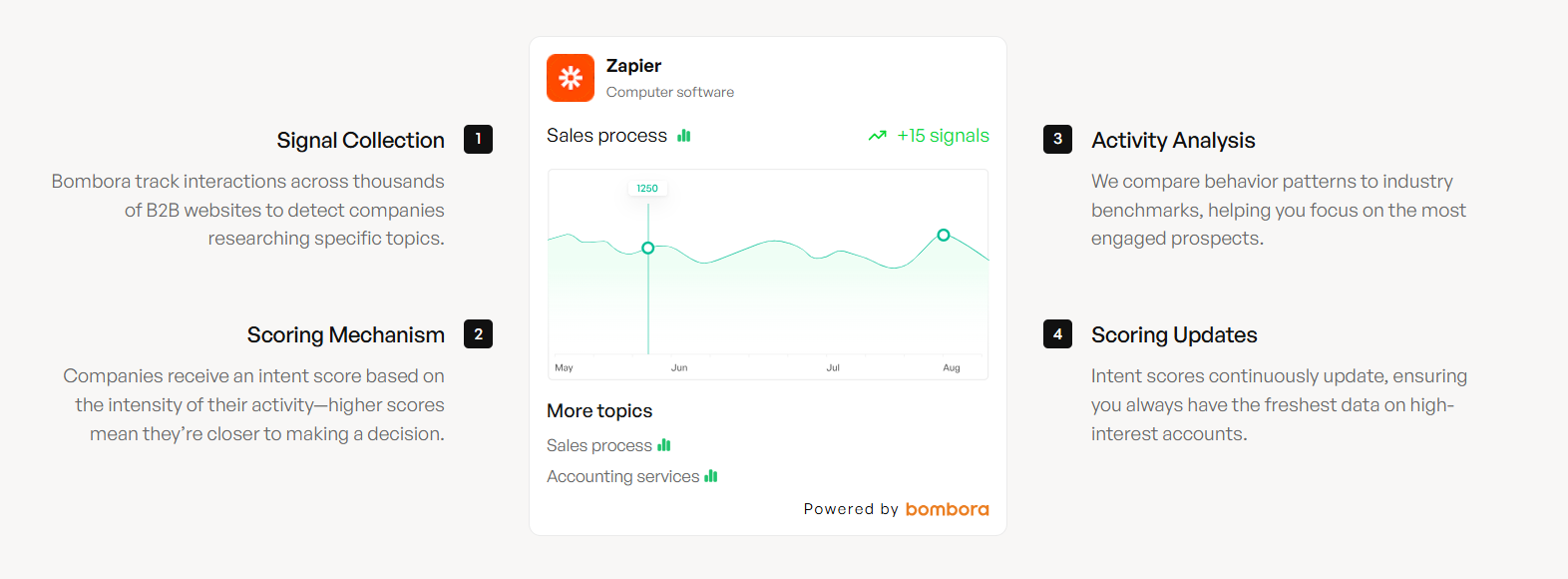
Signals That Actually Indicate Buying Intent
Over 80-90% of leads are content leads converting at less than 2%. Product usage signals cut through that noise. Here are the ones worth tracking, with thresholds that separate casual browsers from real purchase intent:
| Signal | What It Means | Threshold | Urgency |
|---|---|---|---|
| Login frequency | Active engagement | 5-10x/week | Medium |
| Feature adoption | Deep product fit | 3+ core workflows | High |
| Colleague invites | Organic expansion | Any invite sent | High |
| Pricing page views | Budget evaluation | 2+ views in 7 days | Very High |
| Usage spikes | New use case or urgency | 2x baseline activity | High |
| Usage drops | Churn risk or blocker | 50%+ decline over 2 weeks | High |
| Plan limit proximity | Upgrade readiness | 80%+ of quota used | Very High |
| API/integration setup | Technical commitment | Any API call made | High |
| Export activity | Data extraction = value | 3+ exports in a week | Medium |
| Admin actions | Buying authority engaged | User management changes | High |
These thresholds aren't universal - calibrate them to your product's activation curve. A project management tool defines "core workflows" as creating a board, inviting a teammate, and setting a due date. A data platform defines it as running a query, building a dashboard, and scheduling a report. The point is specificity: vague signals produce vague outreach.
A user who logs in 8 times this week, hits 3 core workflows, and views pricing twice is a textbook PQL - that's three high-urgency signals stacking. A user who just logged in a lot? Noise. In our experience, the teams that struggle most with signal programs are the ones who trigger outreach on single behaviors instead of combinations.
Prioritize signals closest to revenue first. Plan limit proximity and pricing page views tell you someone's evaluating budget. Feature adoption and colleague invites tell you they've found value. Start with the money signals, then layer in engagement signals for scoring depth.
PQL Scoring and Signal Stacking
Here's the thing about single-signal outreach: it's almost as bad as cold outreach. The personalization spectrum runs from 1-3% reply rates with no personalization, to 5-9% with basic personalization, to 15-25% with signal-based personalization. Accounts with three or more active signals convert at 2.4x the rate of single-signal accounts.
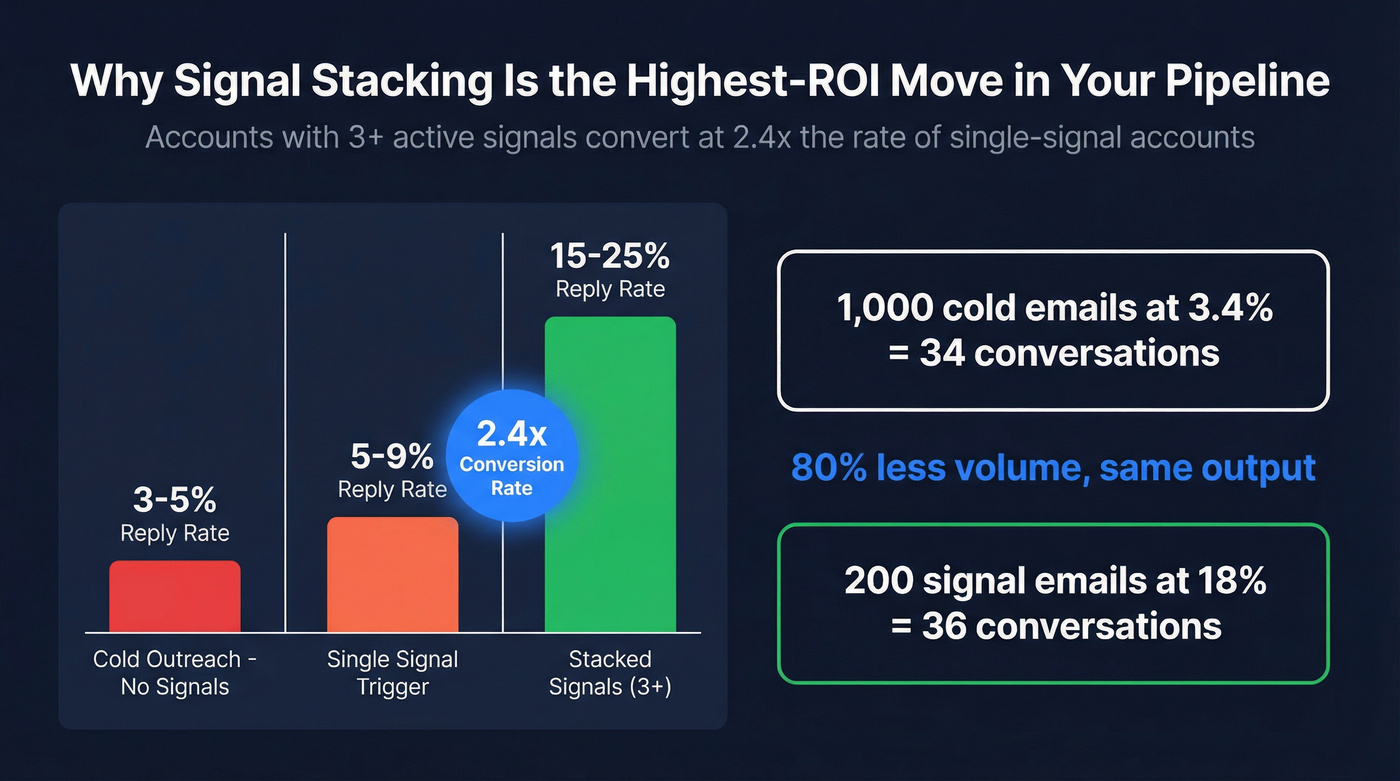
That 2.4x multiplier is the most important number in this entire article.
It's the difference between a signal program that justifies its existence and one that gets killed at the next budget review. Let's do the math: send 200 signal-triggered emails at an 18% reply rate and you get roughly 36 conversations. Send 1,000 generic cold emails at 3.4% and you get 34 conversations. Same output, 80% less volume, dramatically better brand perception, and far less domain risk.
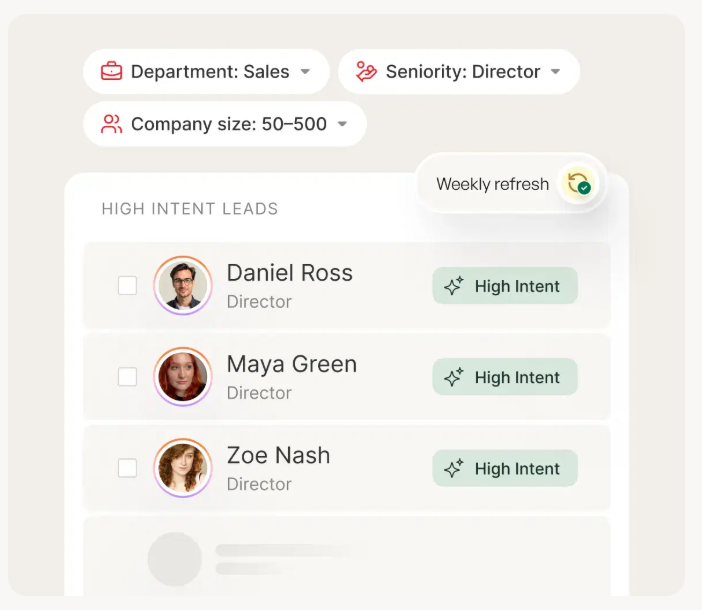
Score your PQLs by stacking signals. A user who's hit three core workflows, invited a colleague, and viewed pricing twice in a week isn't a "lead." They're a deal waiting for a conversation.
If you're still building your scoring model, start with a simple lead scoring system and iterate from there.

Signal stacking only works if your emails actually land. One bounced email on a high-intent PQL is a deal lost to your competitor. Prospeo's 98% email accuracy and 7-day data refresh mean your signal-triggered sequences hit real inboxes - not dead addresses.
Stop wasting perfect timing on bad data. Verify before you send.
Four Playbooks for Signal-Triggered Outreach
These four motions, adapted from HockeyStack's PLG framework, cover the full lifecycle.
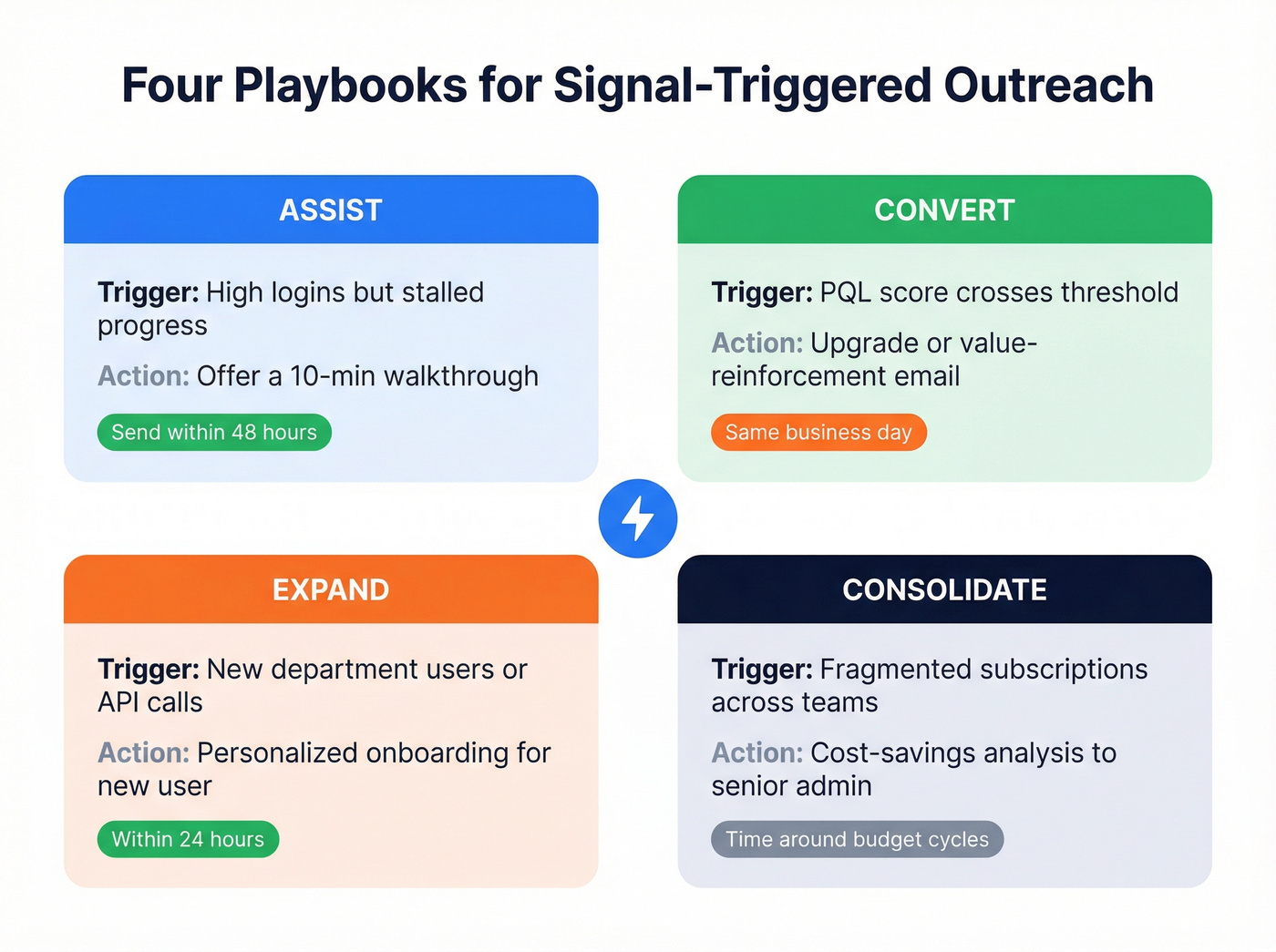
Assist - Unstick the Stalled User
"Hey [Name], I noticed you set up [feature] but haven't connected [integration] yet. Most teams that connect it see [specific outcome] within a week. Want a 10-minute walkthrough? I'm free Thursday at 2."
No pitch, no demo request, just help. Trigger this when a user shows high engagement but stalled progress - lots of logins, partial feature adoption, no colleague invites. They're trying but hitting a wall. Send it within 48 hours of the stall signal. Two weeks later is too late; they've already found a workaround or given up.
Convert - Close the PQL
This one's a decision tree:
- PQL score crosses threshold + plan limit at 80%+ - Direct upgrade conversation. Reference what they've built and frame the paid plan around protecting that investment.
- PQL score crosses threshold + no plan limit pressure - Value-reinforcement email. Show them what they'd unlock, tied to the features they already use most.
- Pricing page viewed 3+ times but no other signals - Soft touch. They're comparison shopping. Send a competitive positioning asset, not a sales pitch.
Email first, then phone if no response within 48 hours. PQLs at plan limits are time-sensitive - someone else will close them if you don't. Fire the sequence the same business day the threshold is crossed.
If you need copy you can deploy fast, pull from these outreach email templates and adapt them to your signals.
Expand - Grow the Account
Enterprise deals involve 5-11 stakeholders. Expansion signals tell you who those stakeholders are before they ever fill out a form. Watch for colleague invites from different departments, API calls from new environments, or usage spikes in features the original buyer didn't touch.
Email the new user with a personalized onboarding offer within 24 hours of the expansion signal, and loop in the account owner internally. The new user is in exploration mode - catch them while they're curious, not after they've formed opinions.
This is also where multithreading in sales stops being a buzzword and becomes a requirement.
Consolidate - Land the Enterprise Deal
With an average of 23 tools in the GTM stack, consolidation is a real budget conversation. Trigger this when you spot fragmented subscriptions across an organization - multiple teams on separate plans, inconsistent usage patterns, shadow IT signals.
Email the most senior admin user with a cost-savings analysis attached. Time it around end of quarter or budget planning cycles. Frame it around governance and cost reduction, not upselling. Nobody wants to hear "upgrade" - they want to hear "save $40k and reduce vendor sprawl."
Build Your Signal Stack
Start with your data infrastructure, not a $30k+/year orchestration platform. We've seen teams spend most of their early budget on Common Room or a similar tool before they even have clean product analytics flowing into a warehouse. That's backwards.
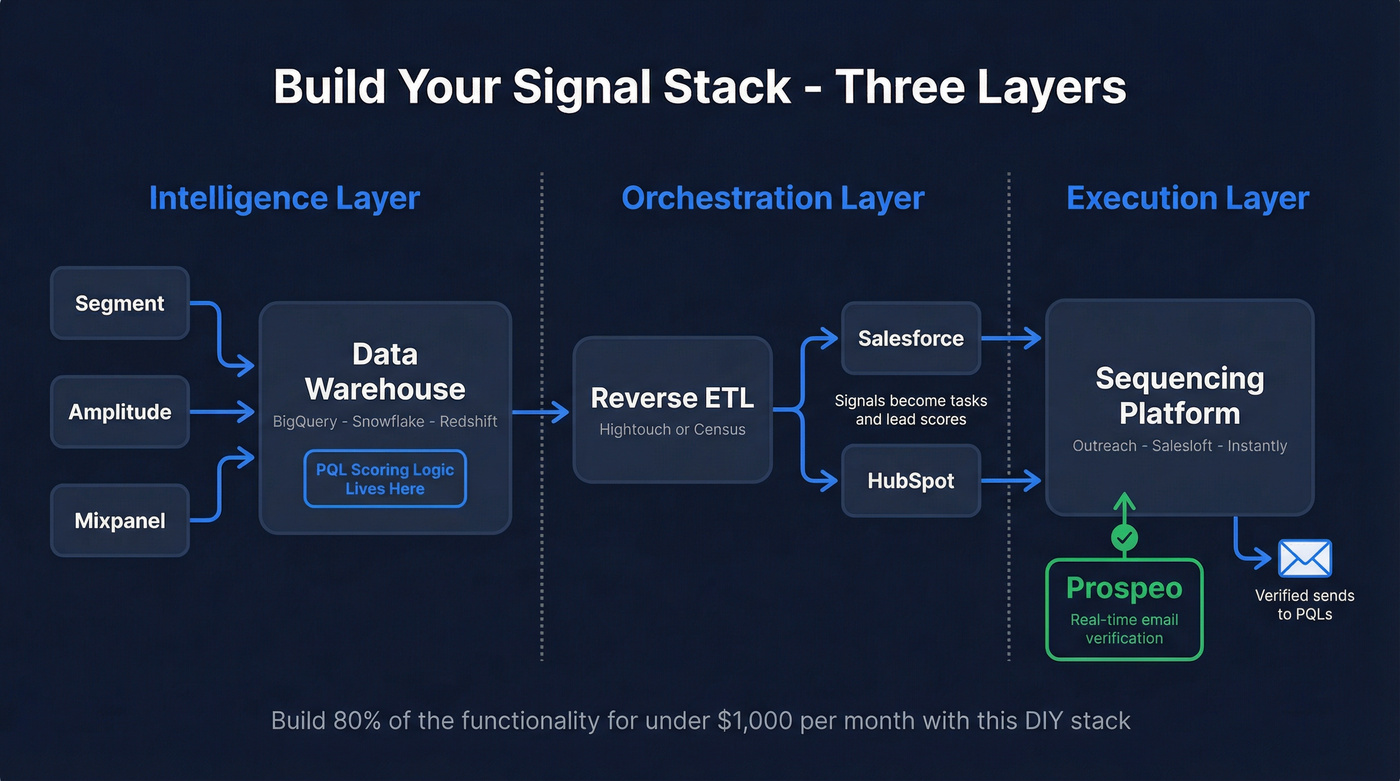
Intelligence layer. Product analytics tools like Segment, Amplitude, or Mixpanel feed events into a data warehouse - BigQuery, Snowflake, Redshift, or S3. This is where PQL scoring logic lives. Get this right first; everything downstream depends on it.
Orchestration layer. Reverse ETL tools like Hightouch or Census push scored accounts and signal data back into your CRM. This is where signals become actionable - triggering tasks, updating lead scores, routing to reps in Salesforce or HubSpot.
Execution layer. Your sequencing platform - Outreach, Salesloft, or a tool like Instantly - runs the playbooks. Pair it with Prospeo for real-time email verification before sends, because a signal-triggered sequence that bounces 8% of the time defeats the entire purpose.
If you're mapping the full stack, use this B2B sales stack blueprint to sanity-check coverage and overlap.
Common Room packages much of this into one platform (Starter at ~$1,000/mo, Team at ~$2,500/mo, Enterprise $50-80k+/year), but you can build 80% of the functionality for under $1,000/month with the stack above. We've watched teams get better results with the DIY approach because they understand every piece of the pipeline - no black-box scoring they can't debug.
Skip the all-in-one platform if your team has even basic data engineering chops. You'll move faster and spend less.
The Data Quality Layer Everyone Skips
You built the PQL model. You wired the signals. You triggered the sequence. And 9% of the emails bounced.
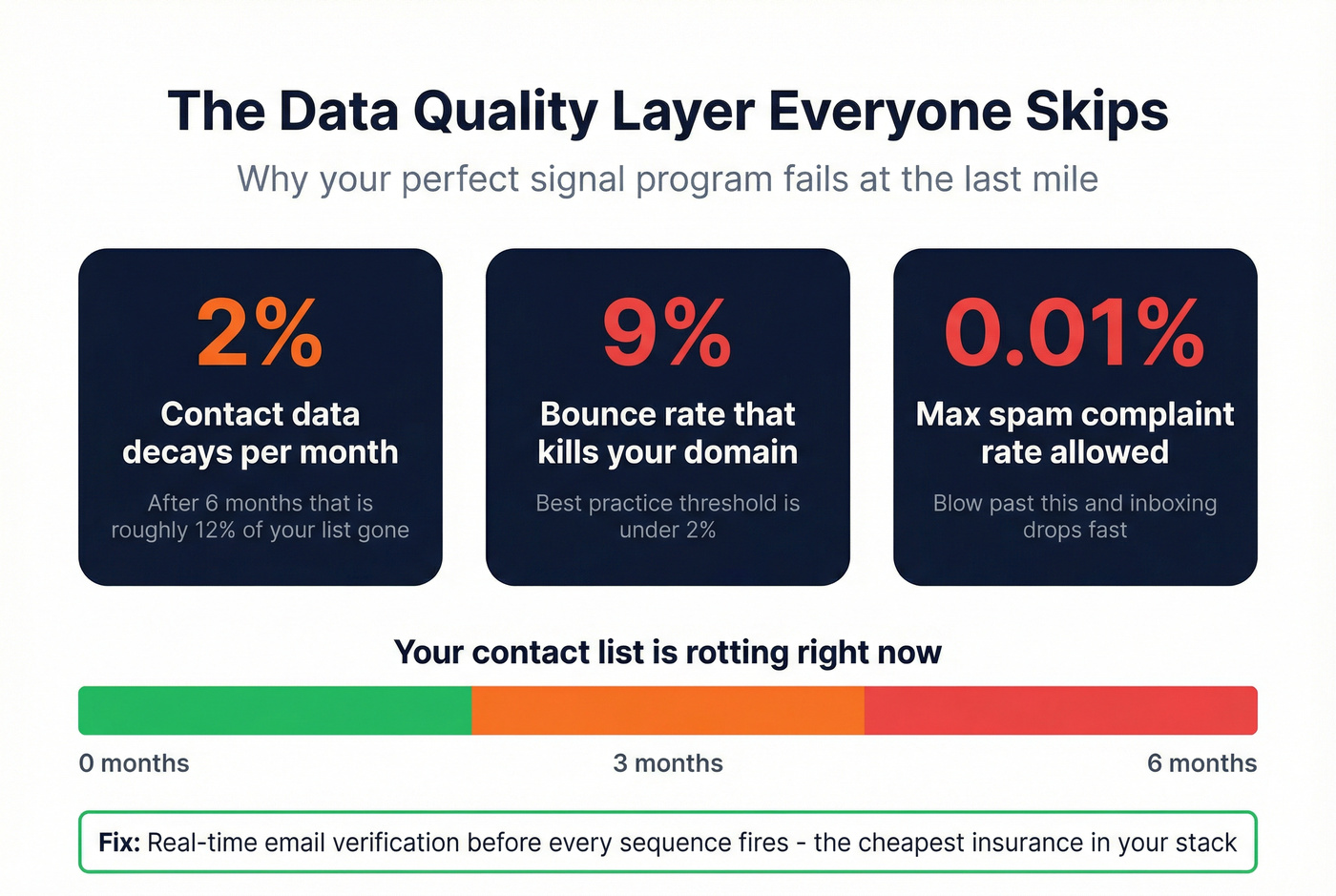
Contact data decays at roughly 2% per month. After six months, that's ~12% decay baked into your contact list. Deliverability best practices demand a bounce rate under 2% and spam complaint rate under 0.01%. Blow past those thresholds and your domain reputation tanks, which means even your best signal-triggered sequences stop landing in inboxes. If you're operating in the EU, GDPR fines run up to EUR 20M or 4% of global annual revenue.
Run your triggered lists through real-time verification before any sequence fires. At $0.01 per email with a 7-day refresh cycle - versus the six-week industry average - it catches the decay that accumulates between when you captured a contact and when your signal fires.
If you want the operational checklist behind this, start with email deliverability and then lock in CRM hygiene so bad data doesn’t keep re-entering your system.
The most sophisticated signal program in the world is worthless if 1 in 10 emails never arrives.
You've scored the PQL. Three signals stacked. They hit pricing twice. Now you need a verified direct dial to close the deal before they go cold. Prospeo gives you 125M+ verified mobiles with a 30% pickup rate - at $0.01 per email credit.
Turn product signals into conversations within hours, not days.
Mistakes That Kill Signal Programs
Over-automation. Triggering outreach on every micro-signal floods reps with low-quality tasks and trains them to ignore alerts. Set minimum PQL thresholds before anything fires. Alert fatigue is the most common reason signal programs get abandoned - reps stop trusting the system and revert to gut-feel prospecting.
Creepy personalization. "I noticed you logged in 7 times yesterday and spent 4 minutes on the billing page" is surveillance, not sales. Reference the value they've gotten, not the tracking data. Good rule: if you'd feel weird receiving the message, rewrite it.
Acting on single signals. One pricing page view isn't intent. It's curiosity, a competitor doing research, or an accidental click. Stack signals before you act - the 2.4x conversion multiplier only kicks in at three or more.
Ignoring data quality. Bounce rates above 2% compound fast and damage every future send. This is the most common and most preventable failure mode we see. If you need a deeper fix, follow an email verification for outreach workflow and monitor hard bounces like a leading indicator.
No control group. If you aren't A/B testing signal-triggered sequences against a holdout group, you can't prove the signals are working. We've watched signal programs die because nobody set up a control, and leadership couldn't distinguish signal-driven pipeline from coincidence. Run the test. The numbers will justify the investment.
FAQ
What's the difference between a PQL and an MQL?
An MQL is qualified by marketing engagement - downloads, webinars, ad clicks. A PQL is qualified by actual product usage: logins, feature adoption, collaboration signals. PQLs convert at higher rates because the prospect has experienced your product firsthand, making them far more reliable than any form fill.
How many signals should trigger outreach?
At minimum two, ideally three or more. Accounts with 3+ active signals convert at 2.4x the rate of single-signal accounts. Single-signal outreach risks false positives and feels premature to the prospect.
Do I need an expensive platform to start?
No. A product analytics tool, a data warehouse like Snowflake or BigQuery, and a reverse ETL connector like Hightouch or Census get you 80% of the way. Add real-time email verification at ~$0.01/email before sequences fire, and you've got a working signal stack for under $1,000/month.
What's the best free tool for verifying signal-triggered contact lists?
Prospeo offers a free tier with 75 email credits per month - enough to validate your highest-priority PQLs before sequences fire. For teams running product usage signals outreach at scale, 98% accuracy and a 7-day refresh cycle prevent the bounce-rate damage that kills deliverability over time.