slug: best-time-to-send-prospecting-emails
Best Time to Send Prospecting Emails in 2026
You've read five "best time to send prospecting emails" guides and gotten five different answers. That's because most pull from marketing email datasets - newsletters, drip campaigns, promotional blasts - and apply those findings to cold outreach. Prospecting emails and marketing emails are different animals. Here's what the data actually says when you isolate prospecting-style sends.
The Short Answer: Tuesday or Wednesday Morning
Tuesday or Wednesday, 8-10 AM in the prospect's local time zone. That's the consensus across three primary datasets from Siege Media, Amplemarket, and Instantly, plus one aggregated benchmark roundup from Martal. In Siege Media's dataset, the gap between the "best" and "second best" day is only about 0.2% in reply rate. Not exactly a canyon.
If your bounce rate is in the high single digits, no send time will save you. Fix your data first.
Opens and Replies Peak at Different Times
This is the insight most guides miss entirely. Amplemarket analyzed 200,000+ leads and found that peak open times and peak reply times diverge sharply.
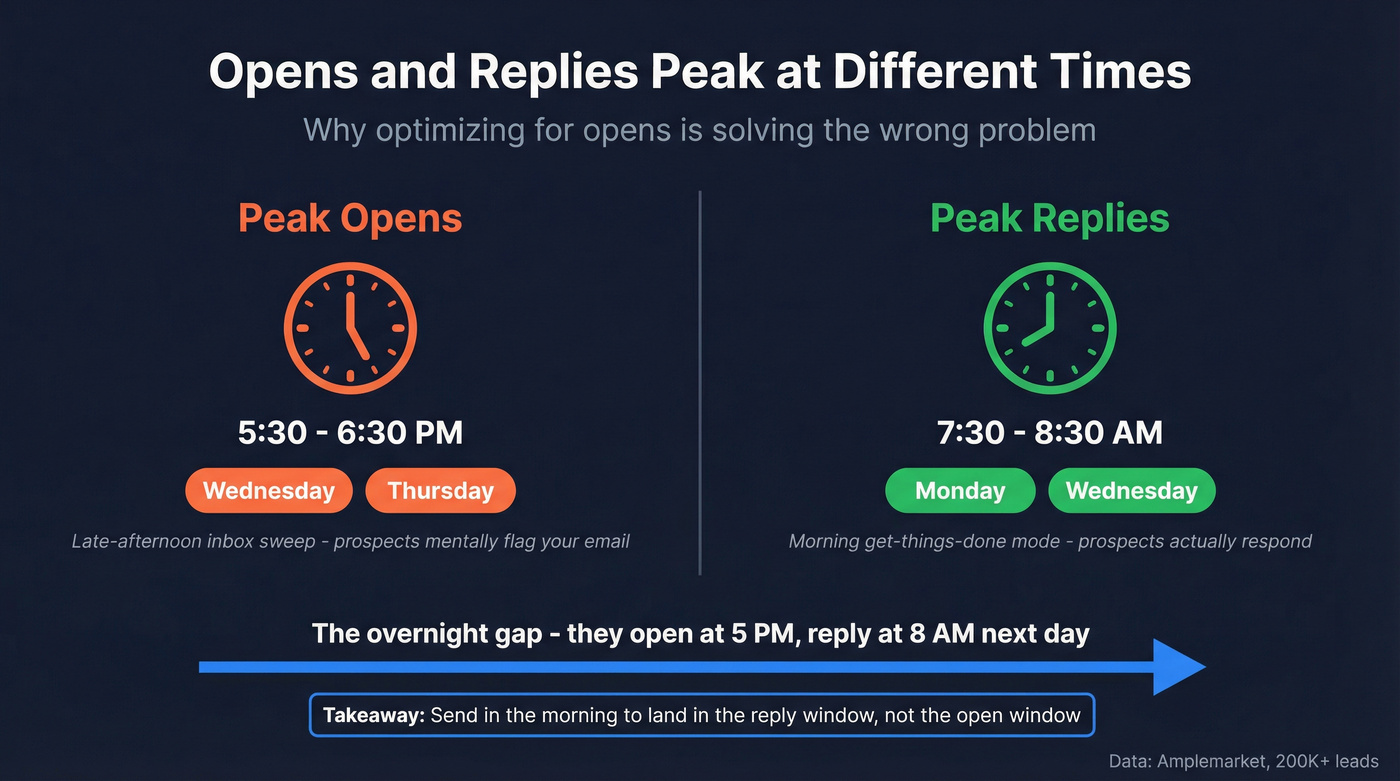
Opens cluster on Wednesdays and Thursdays between 5:30-6:30 PM in the prospect's local time zone. Replies peak at 7:30-8:30 AM on Mondays and Wednesdays.
The pattern makes sense when you think about how people actually work. Prospects open your email during a late-afternoon inbox sweep, mentally flag it, then respond the next morning in "get things done" mode. If you're optimizing for opens - like most marketing guides suggest - you're solving the wrong problem. Prospecting emails don't need opens. They need replies.
Sending at 5 PM might goose your open rate but won't move the metric that matters. Morning sends give your email the best shot at landing in the reply window.
What 4 Studies Found
| Study | Dataset | Best Day(s) | Best Time | Key Takeaway |
|---|---|---|---|---|
| Siege Media | 85K emails | Monday | 6-9 AM PST | Monday mornings perform best in their outreach dataset |
| Amplemarket | 200K+ leads | Mon/Wed | 7:30-8:30 AM | Optimize for replies, not opens |
| Instantly | Billions | Tue/Wed | N/A (day-of-week analysis) | Mid-week consistency wins |
| Martal | Compilation | Mon/Tue | 1 PM | Afternoon sends can work |
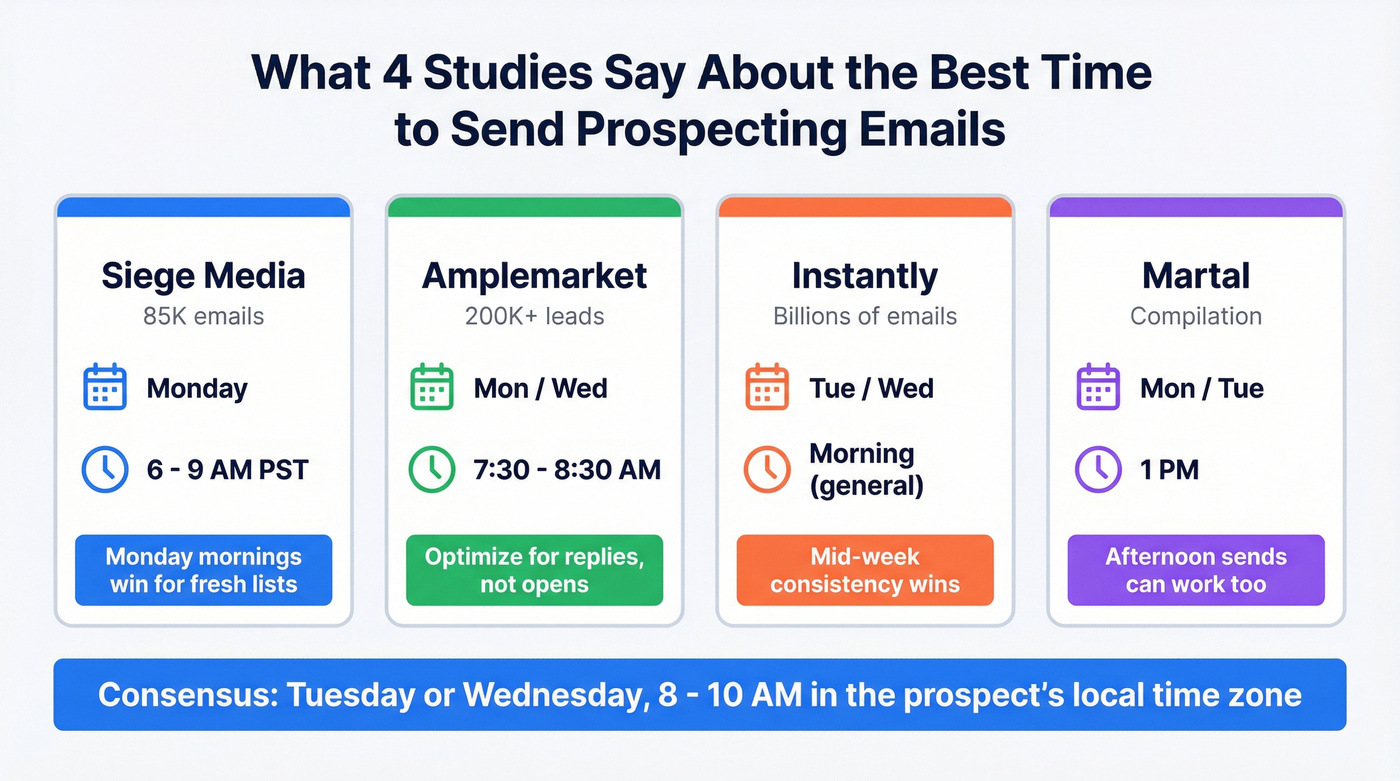
Tuesday and Wednesday mornings are the safest bet across datasets. Monday works well with fresh lists - Siege Media's data showed Monday with the highest open rate at 20%+. The broader outbound playbook is consistent: Tuesday through Thursday mornings are a reliable sweet spot, with late-afternoon sends sometimes working well for hard-to-catch inboxes.

The best send time in the world won't help if 16.9% of your emails never reach the inbox. Prospeo's 5-step verification catches spam traps, honeypots, and invalid addresses before they tank your sender score - at 98% accuracy and $0.01 per email.
Clean your list before you schedule your next Tuesday morning send.
Send in Their Time Zone
Most teams know this in theory and ignore it in practice. 23% of email opens happen in the first hour after delivery. Miss that window and your email gets buried under everything else that arrived overnight.
Segment your prospect list by time zone before scheduling. You're targeting 8-10 AM in their local time, not yours. Adjust for Daylight Saving Time transitions - failing to do so drops open rates by roughly 15%. Use timezone-aware sending in your sequencer, and avoid sending in obvious "batch blast" patterns. Staggering sends at odd minutes like 8:07 AM or 8:21 AM helps your traffic look more natural.
Timezone segmentation alone lifts open rates by up to 14%, with some teams seeing gains as high as 40%. That's a bigger improvement than picking Tuesday over Thursday.
What Good Looks Like
Before you obsess over timing, know your benchmarks. Here's where cold email performance sits in 2026:
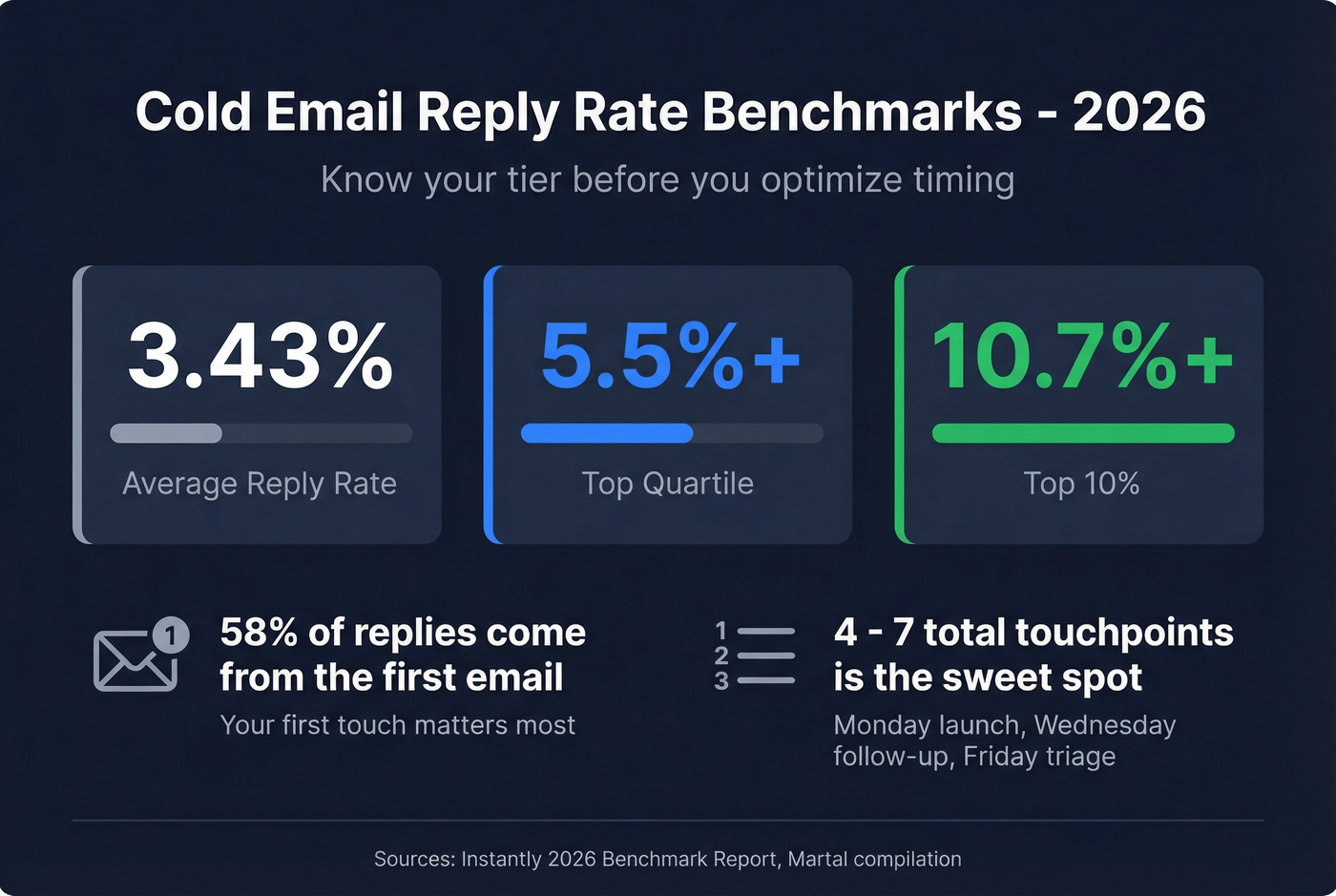
| Tier | Reply Rate |
|---|---|
| Average | 3.43% |
| Top quartile | 5.5%+ |
| Top 10% | 10.7%+ |
58% of all replies come from the first email in a sequence, and the sweet spot for total touchpoints is 4-7. A practical weekly cadence: Monday launch, Wednesday follow-up, Friday triage.
Why Timing Won't Fix Your Reply Rate
Here's the thing. Your SDR sent 200 cold emails last Tuesday at 10 AM. Open rate: 22%. Reply rate: 0.5%. The problem wasn't the time - 40 of those emails bounced and now your domain is flagged.
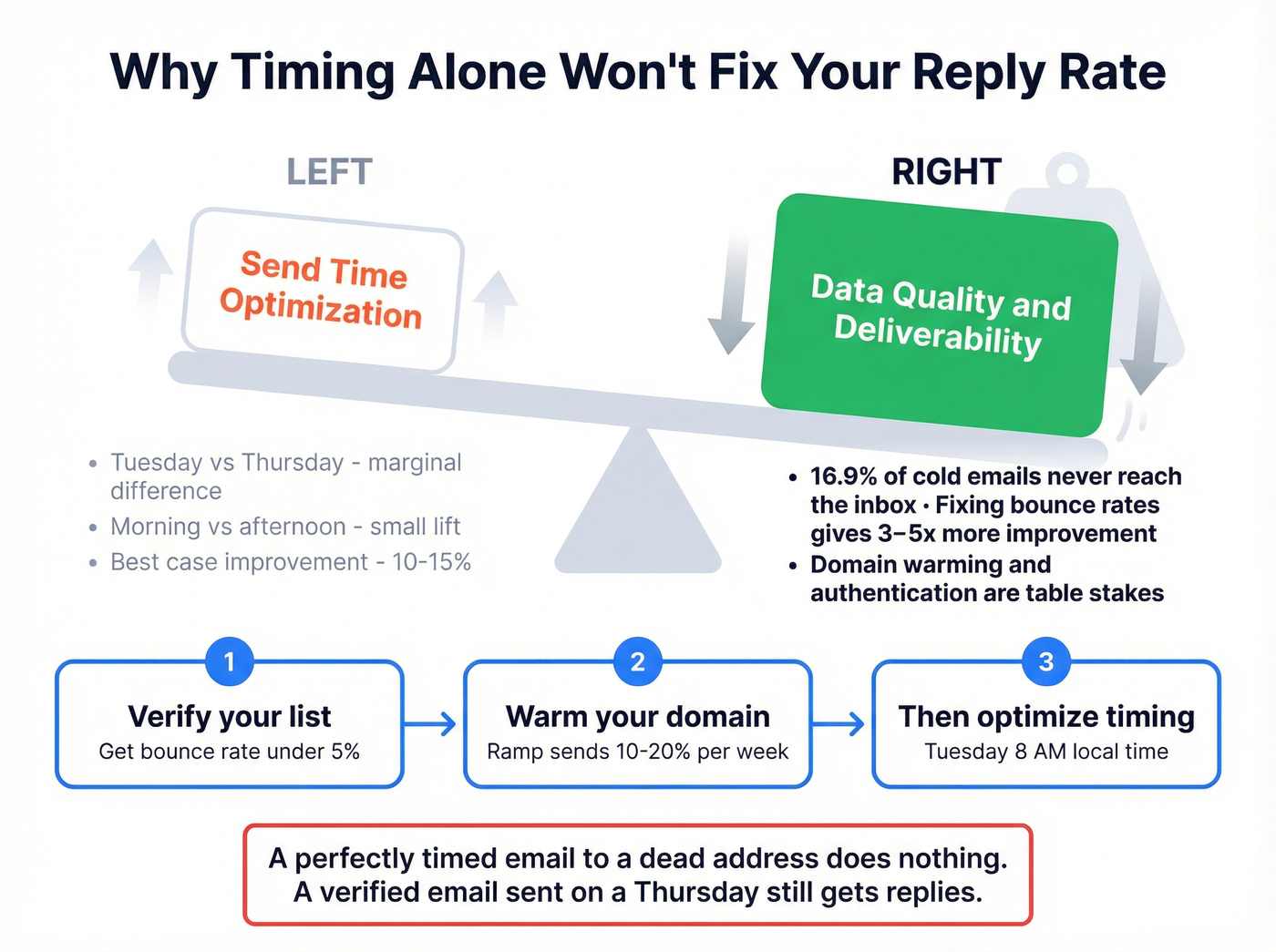
16.9% of cold emails never reach the inbox. That's not a timing problem. That's a data quality and deliverability problem. We've seen teams agonize over send schedules while running a 30% bounce rate, and it's the single most common mistake in cold outreach. Ramp sends by 10-20% per week, not 0-to-200 overnight. SPF, DKIM, and DMARC authentication aren't optional - they're table stakes.
Before you optimize send times, verify your list. Prospeo's 5-step verification catches invalid emails, spam traps, and honeypots before they damage your sender score. Snyk's team saw their bounce rate drop from 35-40% to under 5% after switching, and AE-sourced pipeline jumped 180%.
Our honest take: The best time to send prospecting emails is whenever your data is clean and your domain is warm. A perfectly timed email to a dead address does nothing. A verified email sent on a Thursday still gets replies.
Snyk's 50 AEs dropped their bounce rate from 35-40% to under 5% and grew AE-sourced pipeline 180%. No send-time hack did that - verified data did. Prospeo refreshes every 7 days so your Tuesday 8 AM sends actually land.
Stop optimizing send times on dirty data. Fix the list first.
How to Test Your Own Timing
Skip this section if you're still getting bounce rates above 5%. Timing tests are meaningless when your data is noisy.
Start with clean data. If your list has bad emails, your timing tests measure data quality noise, not timing. Verify your list first so you're testing one variable at a time.
Run a controlled split. Send your optimized cohort (Tuesday 8 AM local) against a test cohort - say, Thursday 2 PM. Stagger batches to avoid rate limiting. Track reply rate, not just opens.
Wait 90 days. Seventh Sense's research shows send-time optimization compounds over time. Your audience's behavior matters more than any universal benchmark, and it takes a few cycles for the signal to separate from the noise.
FAQ
Does cold email timing differ by industry?
No large-scale study breaks timing down by industry with statistical rigor. Knowledge workers respond to 8-10 AM emails, executives check early AM and late PM, and shift-based roles are best reached around shift changes. Test within your ICP rather than relying on cross-industry averages.
Should I send prospecting emails on weekends?
Generally no - weekday reply rates consistently outperform weekends across every dataset we reviewed. The narrow exception: founders or solo operators who check email Saturday mornings. Tuesday-Wednesday remains the safer default for most B2B outreach.
How much does data quality affect reply rates compared to timing?
Far more than timing does. If 16.9% of your emails never reach the inbox, optimizing send windows is irrelevant. Teams that fix data quality first typically see 3-5x the improvement versus timing changes alone. Let's be real - you can't A/B test your way out of a bad list.