Social Selling Personalization: The 2026 Playbook
You spent 45 minutes crafting the perfect message. You referenced the prospect's recent podcast appearance, tied it to a pain point you know their team faces, and closed with a sharp question. Then it bounced. Wrong email. Stale data. Forty-five minutes, gone.
That's the social selling personalization problem nobody talks about. Everyone obsesses over what to write - and they should, because personalization is the only approach that consistently works. But most reps fail in two ways at once: their personalization is shallow (name + company name isn't personal), and their contact data is bad. Fix both or fix neither.
What You Actually Need
Three things separate reps who get replies from reps who get ignored:
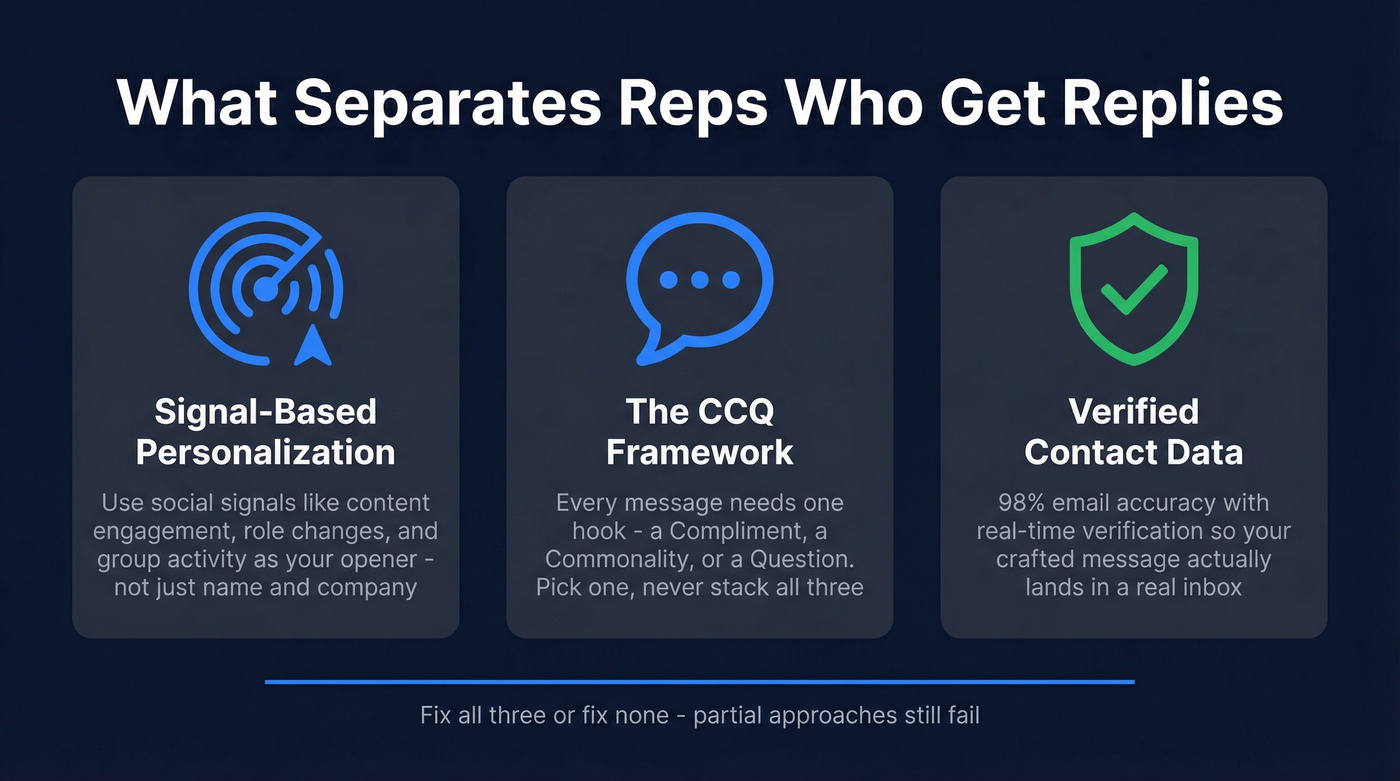
- Signal-based personalization. Stop leading with name and company. Use social signals - content engagement, role changes, group activity - as your opener.
- The CCQ framework. Every personalized message needs one of three hooks: a Compliment, a Commonality, or a Question. More below.
- Verified contact data. Personalization is wasted on bounced emails. Verify before you send. Prospeo handles this with 98% email accuracy and real-time verification, so your crafted message actually lands.
Why Personalized Outreach Is Non-Negotiable
Generic cold outreach gets 0.5-2% reply rates. Signal-based personalized outreach reaches 6-20%+. Highly personalized sequences on professional networks can exceed 25%. That's not a marginal improvement - it's a different sport entirely.
McKinsey's research found 71% of consumers expect personalized interactions from the companies they engage with. B2B buyers aren't any different - they're the same people, just at work. Gartner predicted 80% of B2B sales interactions would occur in digital channels by 2025, and that threshold has arrived.
We've tested both approaches across hundreds of campaigns. Mail-merge tokens - first name, company name, maybe an industry - don't clear the bar anymore. You've probably received a dozen of those "personalized" messages this week. You ignored all of them.

The Four-Layer Personalization Stack
Most personalization guides skip straight to "what to write." That's like teaching someone to cook by handing them a recipe but no ingredients. The full stack has four layers, and you need all of them.
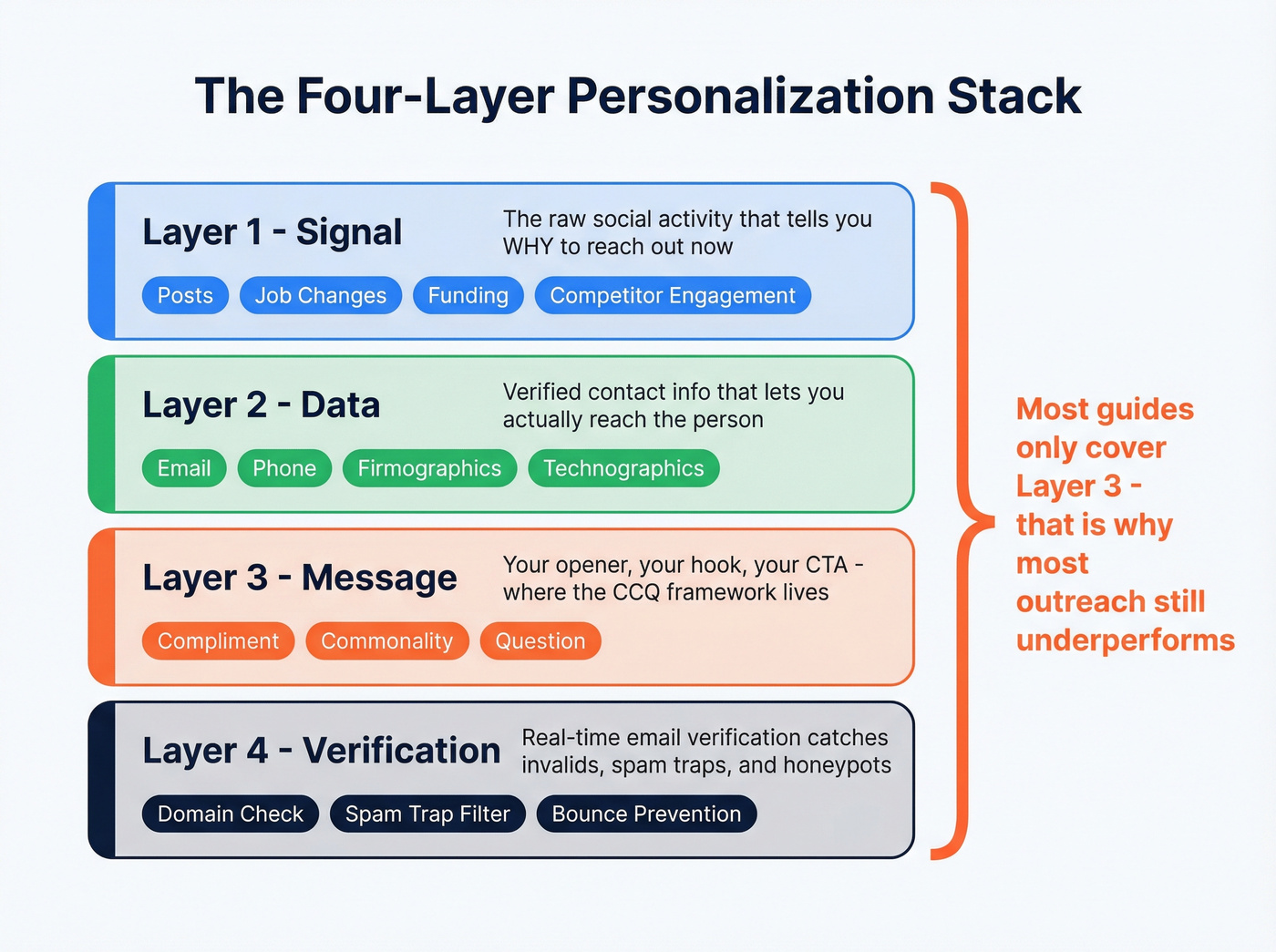
Layer 1: Signal. The raw social activity that tells you why to reach out now - a prospect's post, a job change, a funding round, competitor engagement.
Layer 2: Data. The verified contact information that lets you actually reach the person. Your personalization is only as good as your data. Industry-average data refresh cycles run about six weeks, which means you're working with stale records more often than you'd think.
Layer 3: Message. The actual words - your opener, your hook, your CTA. This is where the CCQ framework lives. (If you want more structures like this, see our guide to sales email structure.)
Layer 4: Verification. The final check before you hit send. Real-time email verification catches invalid addresses, spam traps, and honeypots. Skip this step and you're gambling your domain reputation on every batch. (More on tooling in our roundup of email checker tools and email ID validators.)
Most guides cover Layer 3 and nothing else. That's why most personalized outreach still underperforms.
Social Signals Worth Tracking
Not all signals are created equal. Here's what to watch for, ranked by how actionable they are.
Content they've published - blog posts, articles, podcast appearances, webinar decks. This is the gold standard because it tells you exactly what they care about right now, in their own words.
Role changes or promotions. New VPs have new budgets and new mandates. In our experience, the first 90 days in a role is the highest-converting outreach window you'll find. (If job changes are a core trigger for you, use this job change sales outreach playbook.)
Company news or funding. A Series B announcement means they're hiring, scaling, and buying tools. Timing matters more than cleverness here.
Group participation and competitor mentions. Active in industry communities? That's a shared-context signal you can reference naturally. Engaging with a competitor's content? They're in-market. Period. (For a broader system, see signal-based outbound.)
Pre-outreach warming. Before you DM, engage with their posts and comments for a few days. Like their content, leave a thoughtful reply. When your message arrives, you're a familiar name instead of a stranger. Platform algorithms also surface DMs from people you've interacted with, so warming improves deliverability too. (Related: social selling thought leadership works best when you’re comment-first.)
One shift that changes the playbook: comments per post fell 16-24% year-over-year across major platforms, per Socialinsider's analysis of 70M posts. Engagement is going passive - more views, more saves, fewer public comments. You can't rely solely on comment activity as your signal source. Look at shares, content creation, and profile activity patterns too.

You just spent 20 minutes researching a prospect's signals and crafting a CCQ opener. Don't let stale data kill it. Prospeo refreshes every 7 days - not 6 weeks - so the email you're sending to actually belongs to the person you researched.
98% email accuracy means your personalization actually reaches real inboxes.
The CCQ Framework + Templates
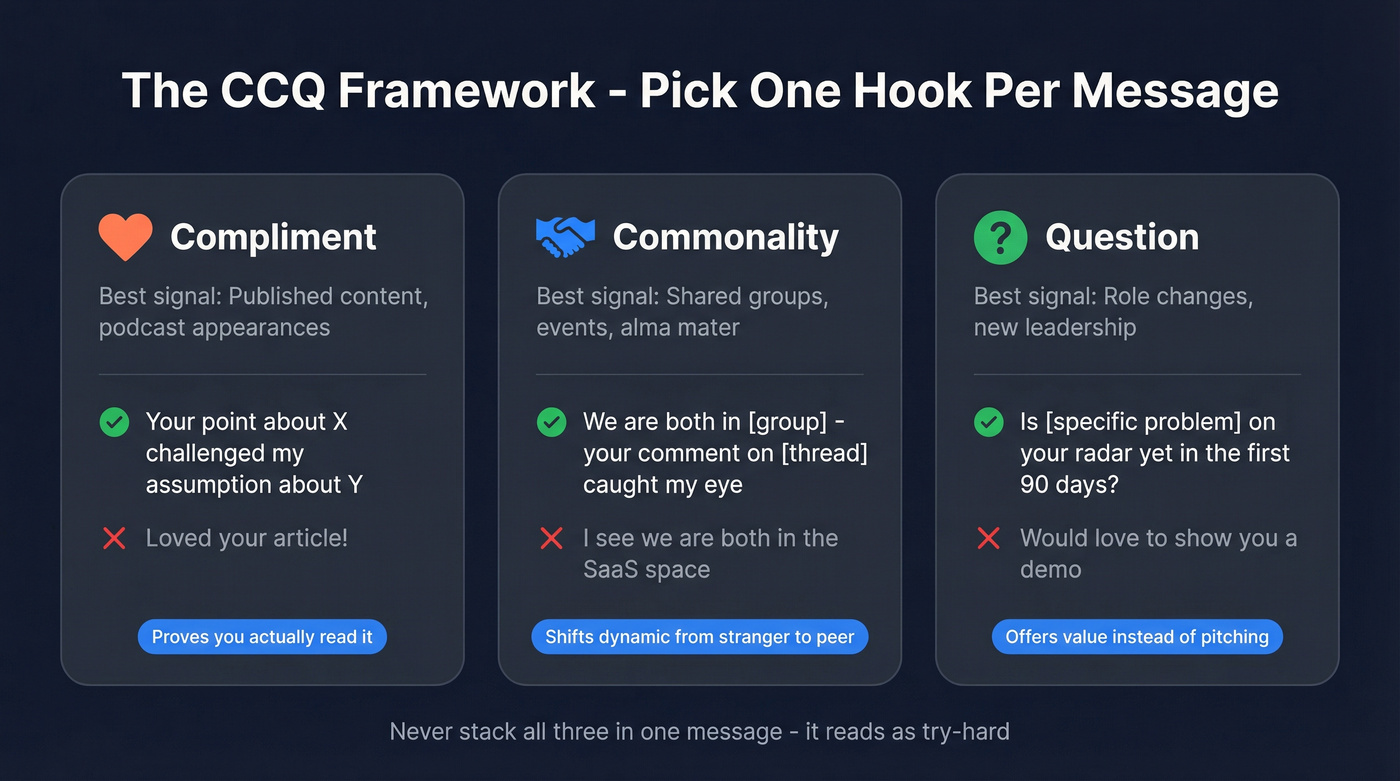
Every strong personalized opener uses one of three hooks: a Compliment, a Commonality, or a Question. Pick one per message. Don't stack all three - it reads as try-hard.
Prospect Published Content (Compliment)
Signal: They published an article or appeared on a podcast.
Your piece on [specific topic] changed how I think about [related challenge]. Particularly the point about [specific detail] - we're seeing the same pattern with [your relevant observation].
Would it make sense to compare notes? I work with [type of company] navigating [related problem], and your framework maps closely to what's working.
Reference a specific detail, not just the title. "Loved your article" is flattery. "Your point about X challenged my assumption about Y" is a compliment that proves you read it.
Shared Group or Background (Commonality)
Signal: You're in the same professional group, attended the same event, or share an alma mater.
Noticed we're both in [group name] - your comment on [specific thread] caught my attention. We've been wrestling with the same question at [your company].
Curious how your team is approaching [specific challenge]? Happy to share what's worked on our end too.
Commonality shifts the dynamic from stranger-to-stranger to peer-to-peer. The shared context does the heavy lifting.
Role Change (Question)
Signal: They just moved into a new role.
Congrats on the move to [new title] at [company]. The first 90 days usually mean [specific challenge for that role] hits hardest.
Quick question: is [specific problem] on your radar yet? We've helped [similar companies] tackle this during transitions - happy to share what we've seen.
New leaders are actively seeking information. You're offering value, not pitching.
Company Funding
Most reps send something like: "Congrats on the Series B! Would love to show you how we can help you scale." That's a pitch wearing a congratulations mask.
Here's what works instead: "Saw the Series B news - impressive trajectory. Scaling [specific function] after a round like that usually means [specific operational challenge]. How's your team thinking about [related problem]? The pattern is pretty consistent at this stage - curious if your experience matches."
The difference is simple: the first version centers you, the second centers their challenge and invites a conversation.
The best templates aren't templates at all - they're structures. The signal does the personalizing; the framework keeps you from rambling.
How to Personalize at Scale
A rep can manually write 10-15 deeply personalized messages per day. Research eats 3-10 minutes per prospect for light personalization, 10-20 for deep research. The math doesn't work at pipeline scale.
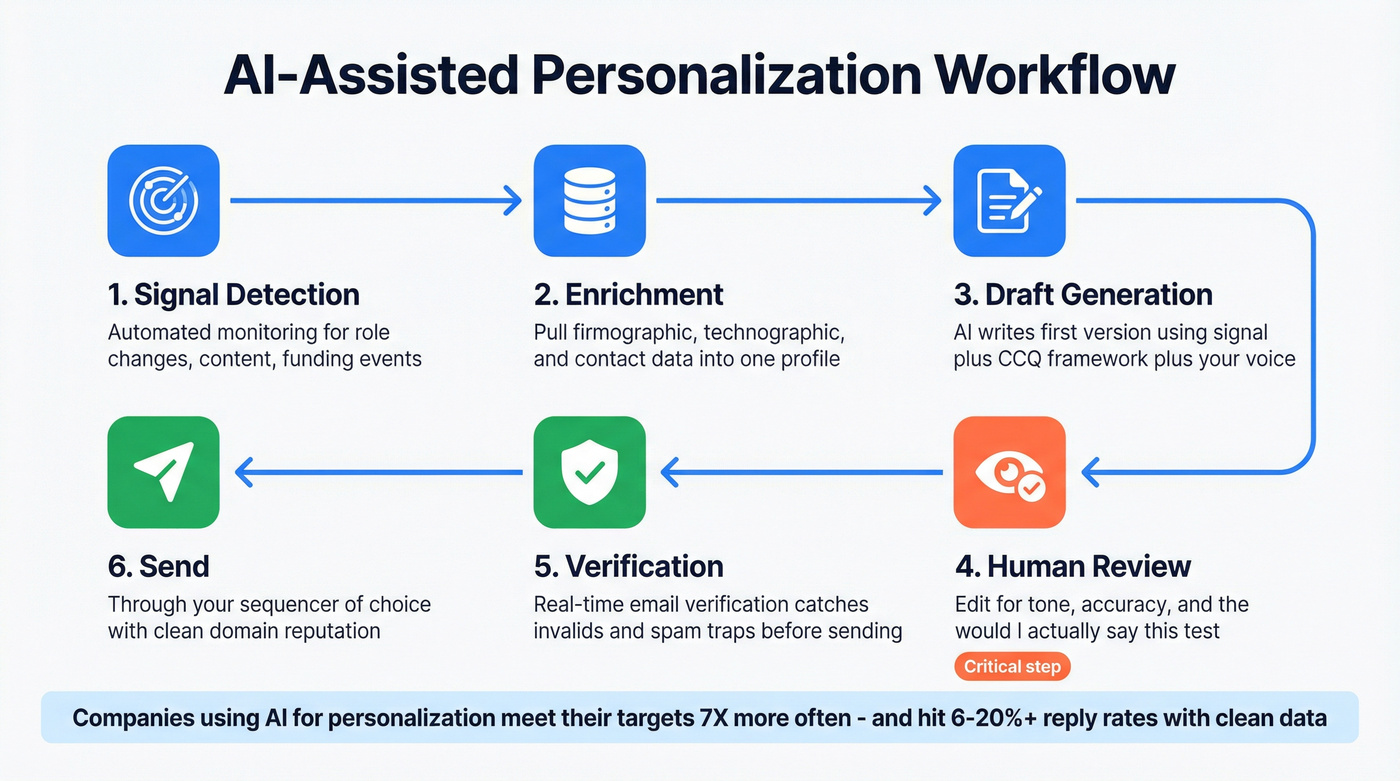
AI changes the math, but only if you use it right:
- Signal detection - automated monitoring for role changes, content publishing, funding events.
- Enrichment - pull firmographic, technographic, and contact data into a unified profile. (If you’re building this layer, start with firmographic and technographic data.)
- Draft generation - AI writes the first version using signal + CCQ framework + your brand voice guidelines. (More workflows in AI for B2B outreach.)
- Human review - edit for tone, accuracy, and the "would I actually say this?" test.
- Verification - before any AI-drafted sequence goes live, verify your list. Real-time verification catches invalid addresses, spam traps, and honeypots so 500 personalized messages don't torch your domain reputation. (See email verification for outreach.)
- Send - through your sequencer of choice.
One MarketingProfs analysis found B2B companies using AI meet their targets 7X more often. Pair that with the outreach benchmarks: AI-personalized outreach reaches 6-20%+ reply rates when the data layer is clean.
Brand voice guardrails are non-negotiable when you're using AI for drafts. Without them - tone guidelines, approved phrases, banned language - AI output drifts toward generic corporate speak. Build a brief for your AI the same way you'd brief a new SDR. (If you’re operationalizing this, AI in sales cadences is a good next read.)
Let's be honest about tiering, because trying to personalize every message the same way is a trap. Tier 1 prospects (high deal value, strong fit) get deep manual personalization. Tier 2 gets AI-assisted signal-based personalization. Tier 3 gets smart segmentation with one personalized element. For deals under $15k, you probably don't need 20 minutes of research per prospect - you need better signals and faster verification. Most AI personalization tools run $50-300/user/month.
Mistakes That Kill Your Personalization
Five anti-patterns that tank reply rates, no matter how good your research is.
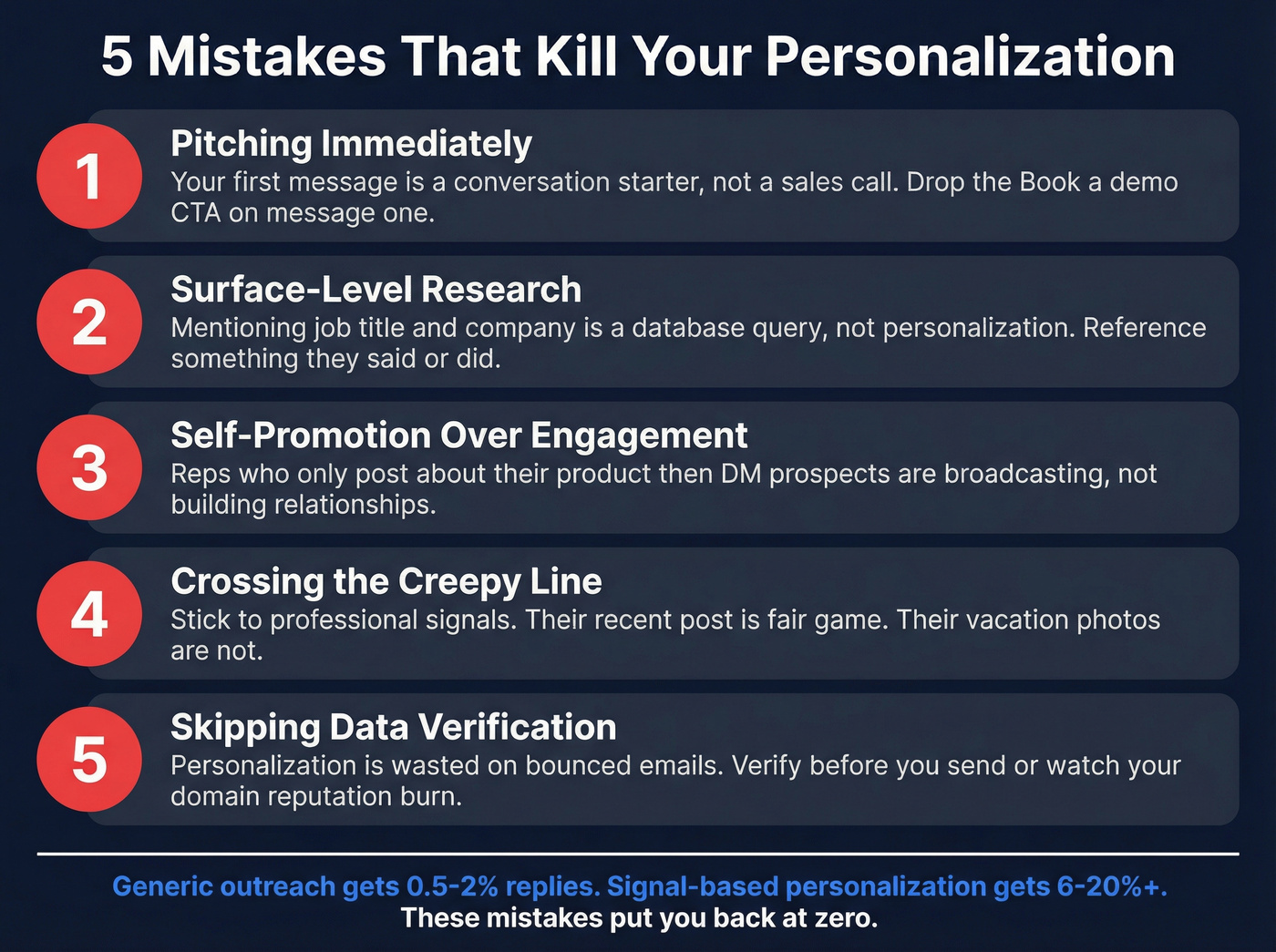
Pitching immediately. Your first message isn't a sales call. It's a conversation starter. If your CTA is "book a demo" on message one, you've already lost. Lead with curiosity, not a calendar link. (If you need copy patterns, pull from these outreach email templates.)
Surface-level research. Mentioning someone's job title and company isn't personalization - it's a database query. If you can't reference something specific they've done or said, you haven't done enough research. Skip this prospect and move to one where you have a real signal.
Self-promotion over engagement. Social selling means being social first. Reps who only post about their product and then DM prospects are broadcasting, not building relationships. I've watched reps with half the tech stack outperform teams with every tool in the market, purely because they engaged genuinely before asking for anything.
Crossing the creepy line. Stick to professional signals. Referencing someone's recent post? Helpful. Referencing their vacation photos? Creepy. If the information isn't something they'd expect a professional contact to know, don't use it. GDPR and CCPA exist for a reason - stay within professional context.
Giving up after one touch. Follow up 3-6 times, every 3 days or so, adding new personalization each time. A single unanswered message isn't rejection - it's noise. Most deals start after the third touch. The consensus on r/sales is that reps who quit after one message are leaving the majority of their pipeline on the table.
Measuring Personalization ROI
Only 31% of leaders believe personalization is improving their bottom line. That's not because personalization doesn't work - it's because most teams don't measure it properly. Separately, 44% of top executives cite complicated or fragmented data as the biggest barrier. The measurement problem and the data problem are the same problem. (If you’re fixing the data layer, start with B2B contact data decay.)
The formula: Personalization ROI = (Revenue lift + Cost savings) / Total investment. The hard part is isolating the variable.
Run control groups. Send 200 prospects your standard outreach and 200 your signal-based personalized outreach. Measure positive reply rate - not opens, because opens are vanity. Track meeting velocity, meaning how fast signals convert to calls, and pipeline influenced. Do this for one quarter and you'll have the data to justify the investment. The KPIs that matter: positive reply rate, meetings booked per 100 sends, and average days from first touch to meeting. Everything else is noise.
Signal-based personalization only works when Layer 2 holds up. Prospeo gives you 300M+ profiles with 30+ filters - buyer intent, job changes, technographics - so you find the right signal AND the right contact data in one workflow.
Stop personalizing messages to addresses that bounce. Start at $0.01 per email.
FAQ
How does social selling personalization differ from segmentation?
Segmentation groups prospects by shared attributes like industry, company size, or role. Personalization tailors the actual message to the individual using specific signals - their recent content, role changes, or company news. Segmentation gets you in the right neighborhood; personalization gets you in the door.
Which social platform works best for B2B social selling?
Professional networks dominate for B2B outreach, but signals exist everywhere - TikTok engagement is up 49% YoY. The platform matters less than the signal quality you extract. Pair any platform's signals with verified contact data to actually reach the prospect off-platform.
How many personalized messages can one rep send daily?
Manually, 10-15 is the realistic ceiling once you factor in research time. With AI-assisted workflows and clean, verified data, reps can send 50-100+ per day without sacrificing quality. The bottleneck shifts from writing to signal detection and verification.
Does personalized social selling actually improve reply rates?
Yes - consistently. Generic cold outreach gets 0.5-2% replies, while signal-based personalized outreach reaches 6-20%+. Highly personalized sequences on professional networks can exceed 25%. The lift holds across industries and deal sizes.